Lightroom Repaired

One of several reasons why I haven’t posted much here in the last couple of weeks is the problems I’ve had with Lightroom 2.0.  Having been preaching for some time that Lightroom was the best thing for photographers since Linda’s unsliced wholemeal bread (I taught her breadmaking shortly after we were married, and who would ever want to eat sliced white again)  I was keen to install Lightroom 2.0 when it came out (even though unlike the original it did cost me real money. But along with a considerable proportion of other adopters, I found that 2.0 turned importing a day’s pictures from being soemthing that happened while you had a quick meal into an overnight job.

I searched the web for answers – and none of the advice I found helped at all, though it probably was a good idea to update my video drivers. Even posted on the Lightroom forum, though only got sympathy rather than answers.

It was frustrating as well as time-consuming. Installing 2.1 seemed to have broken my previous 1.4 installation (despite assuarances it wouldn’t) so reverting to  the older version wasn’t a straightforward option. And once the images had been imported, there were some exciting new tools, especially a great way to dodge and burn selective areas, removing one of the main reasons for needing to export images to Photoshop.

Today I found, downloaded and installed the release candidate for Lightroom 2.1  and I’m pleased to say it seems to have sorted that problem at least. From the release notes it looks as if what was happening was that 2.0 was trying to write to my second monitor, and this computer only has one connected. RC 2.1 does seem to offer a blisteringly fast import of files, although the writing of standard previews that occurs following this is still perhaps a little slower than with 1.4.

So if you’ve also had problems with LR2.0, it’s worthgiving RC 2.1 a try. If 2.0 is working fine already for you it would probably make sense to wait until there is an official 2.1

And if there are any photographers still wondering if Lightroom is worth using, I’d suggest you take a look (Aperture is another possibility for Mac users.)  If you shoot RAW it’s a great piece of software, doing all you need for most pictures from camera to client (there is still the occasional image – now well under 1% – where I need to use Photoshop as well.) If you only shoot jpeg, you should know by now you are missing out on what digital can offer you, although on those few occasions when I have shot jpegs – mainly by accident – – Lightroom has also proved its worth.

It isn’t cheap software, but much more reasonably priced than Photoshop itself – and this in itself may be doing Adobe some good. I’ve yet to meet a photographer with a pirated version of Lightroom, though dodgy versions of Photoshop seem widespread. You can download a trial version of Lightroom, identical to the full version except that it will stop working after 30 days, as well as get more information, from Adobe.

Using ABW on PFBG

Epson’s Advanced Black and White (ABW) printing system on Permajet  Fibre Base Gloss (PFBG)

With any printing system using a computer the aim is to make good prints that correspond to the image that you see on screen. I made my prints using Photoshop, which displays images making use of a print space. Since I was printing black and white images I chose to use a grayscale print space, and for simplicity I chose my default grayscale working space, Gamma 2.2  – although other working spaces should give identical results if applied both to screen and in printing.

I started by reading  the very useful work on simple black and white printing by Clayton Jones and then decided to try an even more straightforward approach! Here, in a more or less logical order are my notes on how I did it.
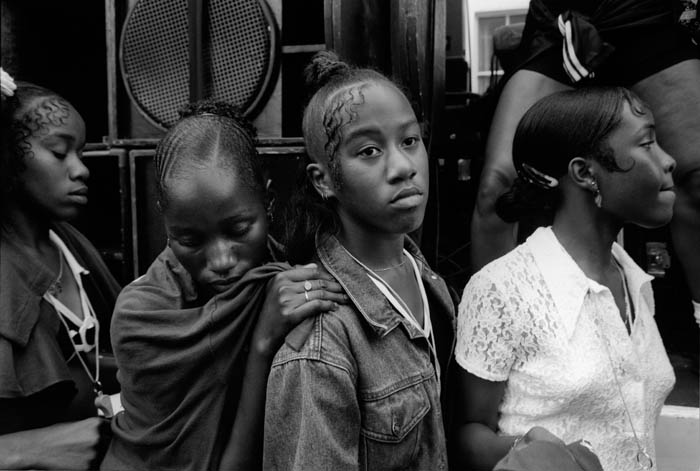
N Hill 1996
Notting Hill Carnival, 1996

 Monitor set up
The monitor was calibrated to the usual D65 (6500K) and Gamma 2.2 that I use to get accurate colour.

 Files
I scanned the negatives at the highest optical resolution my films scanner will give (4800 dpi for 35mm negs.) I use Vuescan as the scanner driver, preferring the results from this to those from either the Minolta software or Silverfast, particularly for negatives on chromogenic films (scanned as colour negative) but it also does a good job on black and white. I use a light amount of Infrared cleaning on chromogenic negatives and no grain reduction. Most automatic cleaning processes increase scan time and destroy detail. The scan at 4800 dpi allows for excellent prints up to around 24×16″ and so long as the negatives (and scans) are sharp you can go larger, with cost being the main limit!

Of course the quality of your prints will depend critically on good scans, and if you have any doubt about this, it may pay you to have scans made commercially on a drum scanner.  Using a Minolta Dimage Scan MultiPro with a Scanhancer diffuser and setting Vuescan to sample the image four times gives similar quality to drum scans – just a pity that scanner is no longer available.

Files are saved as 16 bit grayscale tiffs and with gamma 2.2 – my Adobe Photoshop grayscale working space. You can print from 16 bit tiffs and it is bet8-818-6er to keep this format in case you want to work further on the images.

Photoshop
The first task is to spot the image, working at 100% view. get the image looking exactly how I want it on the monitor, spotting, adjusting contrast and levels, dodging and burning (I find it easier to work most of the time using rough selections with considerable feathering and then to apply either levels or curves rather than either the dodge/burn tools or working with layers and masking etc – it just seems more like I used to do it in the darkroom.) I then save the file, and apply a small amount of mainly edge sharpening with the Focal Blade plugin ready for printing.

Print Settings

It turned out easier than I expected to get the print to be a more or less exact match to the on-screen image, using the following printer settings:

In the print preview window, selecting colour management, select the Document: Gray Gamma 2.2 as the source space, and the print space to “Same as Source“. See below for some comments on the maximum size and margins required. Click on the print button and then make the printer settings.

To print on glossy papers such as PFBG, you need to use the glossy photo black (PB) ink cartridge instead of the matt black used for matt papers.  With this loaded you should  be able to select Epson Premium Glossy as the paper type. Then chose ‘Best Photo‘ for print quality. Check the paper feed (Sheet), paper size settings and orientation are correct. Empty all five boxes under ‘Print Options’ and select ABW.

In the ABW settings, choose ‘Fine Adjustment‘ and ‘Normal‘ and adjust the Horizontal and Vertical settings to give the ink colour you prefer – I found 3v and 3h gave a very slightly warm neutral which I liked. Leave all other settings at 0 or empty  and ‘OK’ the dialogue.

In the paper configuration dialogue I found a Color Density of around +2 gave a slightly better match between screen and print. Finally, on the maintenance tab of the printer properties, checking the ‘thick paper’ box will cut down the paper handling problems (see below) slightly, though you will have to confirm this when you print.

Paper Handling

The main problems I had in making prints on PFBG were in loading the paper and in avoiding catastrophic collisions between paper edge and print head. PFBG – at least after some months of storage  in my dampish house – is never flat, but curls up considerably along the long edges. Possibly this could be corrected by leaving it under heavy objects for a day or two, but a quicker method is to place a pile of several sheets face down on a clean sheet of cheaper paper, then roll the whole pile up from each short end in turn. It’s also worth doing a little rolling against the curl along each long side of the heap.

At first I had great problems in getting the paper to load at all, even after this flattening, although some other papers were loading without problems. The solution was to clean the roller that pulls it into the printer. I borrowed a glass drying cloth from the kitchen, folded it a few times and dampened it, then held the moist (but not dripping!) pad reasonably firmly against the rubber roller while pressing the paper feed button to make it attempt 3 or 4 print load cycles.

After this, I fed a sheet of cheap paper through the printer a few times to remove any moisture or dirt – always a good idea before feeding in your paper that costs a couple of pounds for an A3 sheet.

I soon also found that it was not possible to reliably use the whole print area of the A3 sheet.  Even with the paper flattened as described above, there was still the occasional slight clip of the paper edge by the print head, which wasn’t a great problem while the sheet was held by the rollers, but knocked it askew once the end had emerged from these.  So although A3 paper is 420 mm long, the longest print you can make is around 380mm, with a left margin (assuming a landscape format print) of around 2mm and a right margin approaching 40mm. It annoys me to print off-centre like this, but it’s even more annoying when the print-head catches the paper edge and messes up the print.

While the print is emerging from the printer (its appearance on the paper, gradually building up through multiple passes of the print-head has much of the same magic as the image appearing in the developer tray) it also can help avoid clipping to hold the edges of the paper down slightly as it leaves the front of the printer. But even so, most of the prints I made have slightly messy edges.

You can see the results of my printing session on show in English Carnival at the Shoreditch Gallery at The Juggler, 5 Hoxton Market, London, N1 6HG from 29 Sept- 31 Oct 2008 (Mon-Fri 8am-6pm, Sat 10-4pm, closed Sundays. ) You are welcome to the opening on Thursday  2 Oct, 6.30-8.30pm.  This is one of over a hundred exhibitions and events in London as a part of photomonth 08 (this year’s web site with full details should be on line shortly)  making this the largest photography festival in the UK.

For a more general look at my attempts at getting fine prints from a desktop inkjet printer, see Making Fine Inkjet Prints

1968 Remembered

Actually I don’t remember too much of the sixties – I was a student for most of them and pretty involved in the events in Manchester which had some interest, although not at quite the same level as Paris, though we did have our demonstrations and of course occupied the university like everyone else.

Had I been taking photographs then I would at least have some aids to jog my memory, but I didn’t have the cash. I have just a few pictures, slides of girlfriends sitting in cherry trees or posing in front of stately homes, a few assorted black and whites, and a set of terrible grey and white wedding photos from what was my personal major event of 1968 (our honeymoon was in Manchester with a day trip by coach to the Lake District.)

But this year, 40 years on, has seen a great deal of time devoted to remembering the other events of 1968, and one of the most dramatic was of course the Soviet Army invasion of Czechoslovakia which brought an end to the ‘Prague Spring’. This was the first news event that a 30 year old Czech photographer covered, and he risked his life using his Exacta camera to produce an amazing set of black and white pictures. A year later these images, smuggled out of the country were published anonymously as it was thought they could endanger his life, and the 1969 Robert Capa gold medal for photographs requiring exceptional courage was awarded to that anonymous Czech photographer.

The following year, Joseph Koudelka, with a little help from Magnum and the British authorities was allowed to leave the country for England on a 3-month visa and not return when it expired.  The Magnum Blog has a set of 10 images from that 1968 invasion, as well as links to a set of 100 images from it as well as some of his later work.

A new book from Aperture features his pictures: Invasion 68: Prague, and his work will also be on show shortly in New York at the Aperture Gallery (Sept. 5 – Oct. 30, 2008) and Pace/MacGill Gallery (Sept. 4 – Oct. 11, 2008.)

Bronx Boy John Benton-Harris examines the validity of Frank Gohlke’s “Where We Live”

‘Where We Live – Queens, New York 2003-4’,
Howard Greenberg Gallery, New York, 27 June-22 Aug 2008

As someone as long in the tooth as Mr Gohlke, and involved just as long as he in communication through seeing, I feel I have both the right and the obligation to speak of this show, and what I feel are its merits and failings. And as I sense its overall merits are few, and its failings great, I’ll deal with the former first.

The 40 plus prints exhibited (mostly horizontal) are large and very large by the standards of a documentary photographer of his age and type, and far too big for the smallness of their content. So why he would want to draw our attention to this view of Queens is beyond my comprehension, especially after the gallery handout stated: “Queens is both a destination and a way station, where ethnic diversity first undergoes the turbulent process of Americanization.”.

Well, looking at this show, I would have to challenge that remark, for there is no sign of habitation, let alone a piling up of people awaiting assimilation, neither is there anything chaotic, untidy, or frenzied about these images that would suggest this process, singularly or en masse. Indeed for Mr Gohlke to gain a chance to capture anything of it, he would have had to take the risk of working in a less affluent, more borderline neighbourhood. That way, he could easily show us these same nice tidy homes adjacent to or juxtaposed against failing light-industry, foreign greengrocers, new Irish pubs, Indian news agents, graffiti, abandoned cars, and possibly even sneakers dangling from tied shoelaces hanging from a spaghetti of overhead cables. And all manner of other signs of change and cultural clash, that are easily and abundantly available, if one chooses the right locality, and focuses an appropriate mindset to illustrate transition.

These images are more like advertisements than anything to do with social commentary or the art of thoughtful seeing, and that having been said, I believe they would be better placed in an Estate Agent’s window than on a gallery wall.

So I’m thinking whoever wrote the PR for this show was doing it without access to the images, while Mr Gohlke was out doing some simple stock-taking with his camera in a part of Queens that looks more like the place where we would find “Stepford Wives” residing than any area in the process of great social and ethnic turmoil. The only kind of reading these observations project is the neutrality and economy of a quantity surveyors list. A list of different types and kinds of required bricks, railings, fences, doors, sidings, windows, awnings, bushes, trees, shrubs, and flower beds. All that seems to be missing here is the costings of all these different home and garden accessories, so if they celebrate anything at all, it seems to be “Home Depot“, or some such other like place.

As someone who is a veteran walker of this city, I know where to look for what “Where We Live” promised but didn’t deliver, because I’ve explored a number of such confused and contrasting areas of this borough and the other four. So I know from experience all that just mentioned is indicative of this kind of turbulence, and is very gettable, as long as one commits the necessary thought, time and effort.

But I suspect he’s a contented one-way approach person, and will carry on snapping stylistically as he always has, leaving any sign of personal reading in or across his imagery to others, as well as any accompanying text. And that will always get him into deep shit with people who can read image/text and text/image, for his promises remain undelivered.

However, on the plus side, as this kind of graphic wall furniture goes, they are beautifully finished and presented, as is the standard of Howard’s gallery. But Mr Gohlke’s commitment here is merely to shape-up on this dull neighbourhood, that at best reveals an abundance of poor taste, made taut through simple juxtaposition. And to think it took him two years to bring into being this small graphic exercise. Even more astonishing to me is that it should get an outing off campus, let alone at a major New York Gallery.

But to be kind, and to also to encourage the photographer to go back and give the subject suggested in the text another try, I did happen to notice here and there a few barred windows and the occasional front door that resembled a small town bank vault. So maybe his mind was beginning to kick in with a little, but too late. From his CV, he seems like a guy who knows how to get access to funding, so if he doesn’t feel “he’s already done it and there is a next time, this could be a start point. He might consider trying to let us know something about those who live there, as I listed earlier. Such as what the inhabitants drive, where they eat and shop, anything that would help to warm up Mr Gohlke’s precision and economy, so we are motivated to look again.

At this juncture he simply gives us access to what we can easily see for ourselves if we venture past those houses, and down those streets. So I must pose the question – “Does this view of Queens really deserves great praise?  Yes indeed it does, but only if we were tragically all born blind, and these observations were printed in Braille, then we could all feel our way around the gallery walls, and be amazed.

© John Benton-Harris14 August 2008

Web Links

Howard Greenberg Gallery
Frank Gohlke

Harry Benson – Let Glasgow Flourish!

Harry Benson – A photographer’s journey

Friday 30 May 2008 – Sunday 14 September 2008
Kelvingrove Art Gallery and Museum, Glasgow

People who know me won’t be one jot surprised to learn that Glasgow is my favourite Scottish city – though Edinburgh’s nice enough, and as Irvine Welsh reminds us, in particular Leith has its moments.

And although Harry Benson’s glittering career working for the major news magazines took him to London and New York which is now his home, it is clear from his photographs that his native city is where his heart still lives.

His large and interesting show at the Kelvingrove until September is worth a visit, not least for another chance to view the TV program on show there where Benson talks about his work, and is shown taking pictures in the city and around. You can see at least most of the pictures from the show (and some others) on his web site – with around 30 pictures from Glasgow which includes a portrait made with the giraffe and Spitfire in the art gallery itself.

Benson is the kind of press photographer who makes a career of setting up his subjects – often the rich and famous (including every US president since Eisenhower) – to perform for his camera. Were I ever to try to cover an event at the same time as him I can imagine he would leave me fuming , one of those guys who feels he has to organise things. At one point on the film he says something like if you just take pictures of people as they are they would look boring, so he gets them to jump in the air or something. But equally I’m sure he would be a fascinating guy to talk to in the pub afterwards.

In the end its his own pictures that provide the best argument against what he says. For me the strongest work in the show – or on his web site – isn’t the organised images of celebrities (though you can surely see why they have been so popular with editors and readers alike) but the pictures from the streets of Glasgow where he has taken things as they were. Beside his pictures of the boys at the Stewart Memorial fountain (a short walk from the gallery) or the couple of girls in front of graffiti playing with the city motto his pillow fighting Beatles are empty, meaningless decoration, however nicely done.

Like I say, Glasgow rather than Edinburgh.

John Benton-Harris – “a son of the beach” – looks at Joseph Szabo’s “Jones Beach”

Michael Hoppen Gallery, London (1 August – to -19 September)

It takes courage to be a leader, instead of simply playing it safe by being yet another follower, just as it’s refreshing for us, not to gaze upon works by people who’ve been over-celebrated and over-marketed. But sadly Mr Hoppen’s courage isn’t quite enough; it also takes the ability to differentiate between imagery that is adequate, or even good in editorial terms, and seeing that goes way beyond familiar observations of everyday existence.

However, imagery that take us to this new plain of awareness is always the by-product of those who take the trouble to know this history, and also something about their subjects and those earlier eyes that contributed to both. Sadly Joseph Szabo’s love affair with Long Island’s Jones Beach has more the look of a voyeur then someone engaged in a fine romance.  He, as this imagery states (excuse the clumsy metaphor) has been operating in the dark while he’s been out there basking in the sunshine of this subject. So as adequate as these first images looked on paper, as illustration, they do not pass muster as notable examples of fine art, on a gallery or museum wall.

And when I first caught sight of his Jones beach snaps while flipping through a copy of a recent Sunday supplement, the thought that came to me was something Walker Evans wrote (for a show of his work at MoMA in 1956 – quoted in full in “Walker Evans and Robert Frank: An Essay on Influence”, Tod Papageorge, Yale University Art Gallery, 1981) in regard to where he believed “Valid photography” could not to be found; after listing several unlikely spots, he concluded – “under no circumstances is it anything ever anywhere near a beach.”

Looking at these images without the benefit of my knowing of my medium and its achievements, I might well agree with Walker’s prejudice. But since I have this knowledge and openness, I can also see what Mr Szabo’s simple approach denies him: a message or opinion to deliver; a desire to entertain; a determination to seek and capture what has not been previously seen; and a talent for invisibility.  Understandably all this allows, even demands, that I be under-whelmed by Mr Szabo’s shoot, and Mr Hoppen’s choices, as well as Mr Evans’s words, when it comes to understanding what the beach has to offer.

At this point, I must confess I haven’t yet seen the complete show, only the synopsis of it. But having experienced Mr Hoppen’s disregard for fact, his poor visual sensitivity tells me he’s simply looking here to sell lower priced works, to gain some advantage from the recent down-turn in the photographic market.

Well, now that I’ve seen the “whole tamale”, I’m left feeling that the additional 30 images only devalued his smaller view, for it became clear that the diversity that was hinted at in the first eight images that illustrated his “DAYS OF SUNSHINE AND POSES”  revealed more about him then his subject. Snap, after snap, after snap, this beach was used as his premier place for watching “dolls strutting their stuff”, mixed in amongst a few muscle flexing Adonises. If Joseph truly wants us to be taken seriously (by me at any rate) he needs to stop letting little Joe point the way, and also attempt to look beyond the reach of his lens, for a contact that strives to go beyond the best – and nothing of that is to be gleaned in this display of beach trekking

The variety hinted at in the small editorial advertisement for this show was never delivered, but a diversity of sorts was to be found; it was in the prices asked, which ran from £790 for an 11 x 14 inch print to as much as £8289 for something near 2 by 4 feet. So I must admit, I got Mr Hoppen’s motivation wrong, it was not after all about a show at a lesser cost to everyone, it was about giving us an “AMERICAN FANTASIST” to follow in the wake of his first “AMERICAN FICTION” – “The New York School” – his last American offering.

So thinking there might also be a fictional aspect to this show as well, I took one last look around these 36 exhibited prints, to make sure there weren’t any from Brighton, Ramsgate, Margate or Scarborough, by another true “son of the beach” like myself, that could more justifiably be connected to either of these poorly represented and distorted offerings.

© John Benton-Harris – 6 August 2008

City of Ambition – Ferit Kuyas and other shows

Yesterday I had a day of looking at pictures rather than taking them, though I couldn’t resist a few snaps later on – after too many glasses of red wine – as you can see here. Between a couple of meetings I fitted in visits to the Michael Hoppen Gallery in Chelsea and the Photographers’ Gallery near Leicester Square in an afternoon involving far too much sitting in hot buses in slow moving traffic and sweltering in the underground.

There were three shows at Michael Hoppen, but the only one I found of much interest was of work by Miroslav Tichy who I had written briefly about in 2005, around the time he won the ‘New Discovery Award’ at Arles (he first allowed his work to be shown in public in a show in Spain in 2004.) Tichy was obsessed by women, how they looked, stood, their gestures, and carried that obsession beyond normal limits, photographing through windows, the fences of swimming pools and on the streets, taking sometimes a hundred pictures a day with his handmade cameras.  Part of the charm that these pictures do possess is that they are so crudely made, but I think they are really objects that are talking points rather than photographs.  I certainly find the idea of paying 8 or 10,000 euros for one extremely curious. Yesterday was the last day of the show, but if you missed it I don’t think you missed a great deal. You can read the story on the web site (and elsewhere) and that’s what this is all about.

The Photographers’ Gallery has a show that clearly demonstrates how much better fashion photography used to be. I never thought I would walk around a show and decide that the most interesting picture was by Helmut Newton (there is a nice Irvin Penn and a quite a few others of interest.)  But frankly I don’t think any of the more current big names in the show stand up to the earlier competition and printing them big just makes them seem more vacuous.  Fashion in the Mirror continues until 14 Sept 2008.

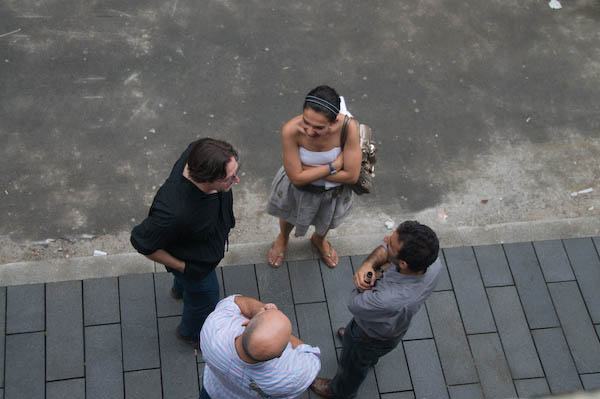
Outside the gallery
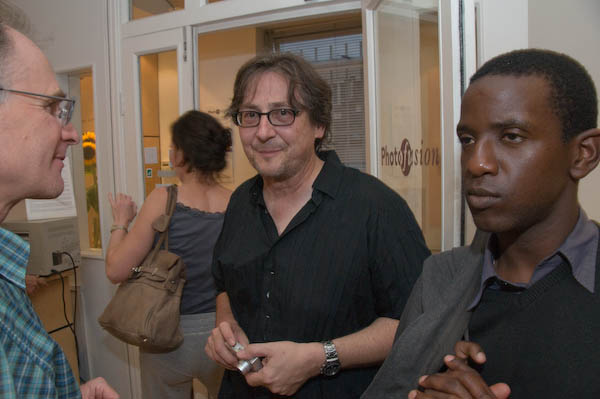
It was cooler on the street outside Photofusion

In several ways my most rewarding gallery visit was to Photofusion in Brixton, where Turkish-born Ferit Kuyas’s City of Ambition was having its private view.  The city in question is Chongqingin, China, whose 32 million inhabitants include the family of the photographer’s wife. The large colour prints made from his 4×5 images are mainly from the outskirts of the city, showing areas of rapid growth through the haze of pollution that appears to cover most of the country (and will possibly lead to the cancellation of the Olympic marathon in Beijing.)

Ferit Kuyas
Ferit Kuyas (centre) at the opening

You can see some excellent images of his work from the project on his web site, along with some other projects worth looking at. ‘Agglosuisse‘ is a collection of colour images of “mediocre suburban spaces” that I really like, while the black and white images in ‘Archetypes‘ show more of his sense of design. You can also read more about him in a feature in the Hasselblad Masters Archive.

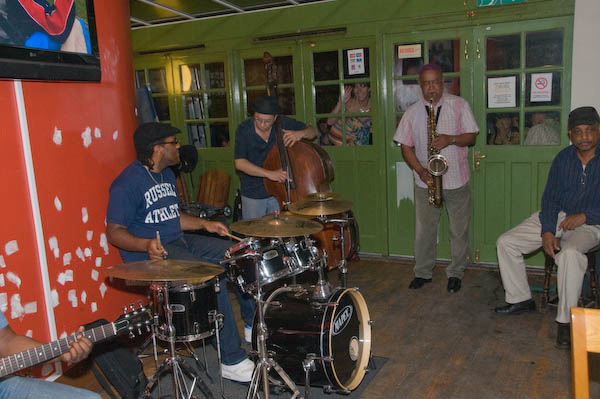
Down the pub
Brixton – band in pub

My evening finished at a pub a short walk away, before a rather long wait for the bus to take me to Clapham Junction for the train home.  It’s a pain that the Victoria line closes at 10.00pm – these works seem to be dragging on for ever.

Kings of the Street

John Benton-Harris looks at:

Henri Cartier-Bresson & Helen Levitt, ‘Side By Side
Laurence Miller Gallery,  20 West 57th Street, New York
(5 June to 14 August, 2008)

All things being equal (which they never are,) we who use photography to communicate should be encouraged to be courageous, minded and to speak from the heart, even while working to fill our pockets – as it once was in America. But the commercial world has become smaller, narrower, dumber, as well as much greedier, particularly in recent years.And as an American, who has resided here in England as long as I have, I pine the loss of more mature and optimistic times in a place where anything was possible as long as  we made the effort to work towards it.

And that’s the most honest declaration I can provide others with as to why I still return to New York once or twice yearly, but continuing  to speak frankly, it’s to protect and fan that flame that still is in me to stay alight and grow. And also because here in “Never Never Land”, the UK, there is no home-grown history of serious individual expression or mature leadership, that could spark such a light.   Here we merely continue to produce a glut of ambitious photographers, but not a surplus of talented ones. This will continue to be the case as long as  photography is controlled by a disconnected leadership at the very conservative centre of English life.

That is why New York – and  more particularly Paris today – are regarded jointly and deservedly as the ‘Home Offices’ of this medium. In fact the French have overtaken us Yanks in their celebration of visual expression, through and with photography. Through doing so much more to expand interest, understanding, opportunity and access, with its introduction of major city and regional festivals that are given over to this discipline.

Now you might be wondering what has all this to do with Henri Cartier-Bresson and Helen Levitt. Well they are the two significant talents that immediately come to mind signifying that personal commitment in these twin visual cultures on a personal level. And although very different people with very different outlooks, overviews, approach modes and subjects, none the less they were both committed to their personal understanding of excellence.

One travelled the world to catch views of people and life that concentrated more on defining his sense of timing, sensitivity, and eloquence. The other’s eye being a motherly one mostly watched over neighbourhood life, with a particular fondness for children at play and the elderly with time on their hands. And speaking of Time, they were both equally obsessed with shaping it, catching it, saving it, and presenting it, all together in ways that capture our attention, our appreciation, and our wonderment.

Helen and Hank (excuse the familiarity) are not just good friends, they are in their very different ways, life long influences; for one’s emotional warmth and sensitivity is as important as the other’s structuring and timing. Helen in her later years moved a little further out from her immediate neighbourhood and added additional information of another colour to her New York visual symphony that gained her an even larger and more appreciative audience. While Hank, hankering to be what he had already achieved, “An Artist” in his own right and place, took himself out from behind his camera. But quite apart from these late-life alterations, both still remain; put simply “Kings of the Street”.

In closing I feel no need to attempt to describe in words what is meant for eyes to digest, all I will say to those who know nothing of them, is that they are in for a very special treat. And for them that do, this presentation is chock full of premium works.

© John Benton-Harris – July 30th 2008

Selected Web Links

Lawrence Miller Gallery: Side By Side
Helen LevittNew York Streets  1938 to 1990s
Henri Cartier-Bresson: Magnum
Fondation Henri Cartier-Bresson

A Host of Pictures

There certainly were a host of pictures at the FOTO8 Summer Show 2008 in the Host Gallery in London’s Honduras St,  EC1Y 0TH (23 July- 31 August 2008), with 164 images on the walls of the gallery and the adjoining stairs. Although it is perhaps admirable to be so inclusive, (and I was told there was a much larger than expected entry from around the world), I think it would have been a much better show, and certainly rather easier to view with perhaps half that number of prints.


Honduras St gets quite full

A simple listing  with photographers names, sizes, media and prices was available at the gallery, but to fully appreciate the show you need a copy of the catalogue which contains the captions for the prints and can be downloaded as an illustrated pdf (4Mb) from the site. A rather smaller number of prints would have had the bonus of allowing captions to be included on the price list.

Most of the work was by photographers whose names were unfamiliar to me, although the three prints I personally singled out as possible choices for best of show were by photographers I know, including one I see regularly and another I’ve written about in the past. I won’t attempt to influence your efforts to find your own choice by naming them. Go along, look at the work and vote for your choice of best of show. Though I do think they have missed out in not calling it the Golden Daffodil Award.


The open bar was kept busy

Meeting another photographer from my generation (most of those present at the opening were considerably younger), I asked if she had anything in the show, and she told me that she didn’t have a great interest in  competitions and hadn’t entered. I feel much the same, although in my case a general lack of organisation had also contributed to my not sending anything in. I have after all been a subscriber to FOTO8 magazine since it began, and did feel that perhaps I should support this initiative. But then I had other things to do.  (If any of you reading this don’t get the magazine, do take a look at a recent issue – now better than ever.)

Competitions, particularly those based around single images (though a few photographers had two or three) do encourage and reward a particular type of photography, and much of what we were presented could be seen as a celebration of the exotic – unusual places, people and events – in a kind of colour supplement view of life.  When my students used (rather often) to complain about having “nothing to photograph” and if only they could go to China or New York or Bosnia or wherever the last set of pictures they had seen in a magazine had been taken I used to remind them of something I think said by Alfred Steiglitz, to the effect that he had found his best photographs within 50 yards of his front gate. Though of course his family back yard at Lake George was also extremely extensive.

Or perhaps I might show them the work of Helen Levitt or Ruth Orkin (New York yes, but working on their not very unusual doorsteps) or many other photographers whose subject has been everyday life, not treated as the exotica so often on display in this show, but working with the warp and weft of everyday life and creating something with a little magic, some small epiphany. Of course you also see it in the best photojournalism, often working with much more dramatic events (and it is important that these should be photographed too.)


Pizza appeared and quickly disappeared

It’s work like this that, for me at least, is at the heart of photography, and perhaps the only game worth playing is trying to bring out the significance of the ordinary. There is work in this show that moved me in this way, perhaps even 20 or 30 pictures that I might want to live with and hang on my wall, but much of the rest, after I had stood looking at the image for perhaps thirty seconds on the gallery wall I didn’t really feel I wanted to look at it much longer or need to see it again. Plenty of novelty perhaps, but it isn’t easy to produce photographs you can live with. But 20 good prints is a good show, and one well worth a detour. Buses 55 and 243 stop handily and Old Street tube is a short walk away.

The show also prompted me to think about photographic printing, print sizes and pricing.

Pricing
Also on the show page at the Foto8 web site is a useful guide intended for the selected photographers about the pricing of their pictures, which others might also like to download for some sensible general advice on the subject. However I think there were perhaps rather too many who might have been given further advice on the subject.

Setting prices is always a problem. But I think many of these works are unlikely to find buyers at the kind of prices involved, unless the photographers have particularly rich and generous friends and relatives to support them as sometimes happens (mine are all poor and expect prints for nothing.) It would be nice to be proved wrong and to find that there are people willing to pay perhaps £500 or £750 or more for a work by a relatively unknown photographer.

Print sizes
As a very minor quibble, while I’m not in favour of uniformity in general, I think the gallery might have converted all sizes to centimetres rather than have some in metric and others imperial.

What I do find interesting is looking at the small images in the downloaded catalogue and comparing them with the works on show, which range from original small Polaroid prints to five-footers. One of the conclusions I drew from looking at the show was that printing large can be and usually is a mistake!

That all the pictures I found of most interest were a moderate size (mainly 16×20″ or 20×24″) in part reflects my interests stated above, but I did actually feel some of these were a little too large and might have been better at say 10×15″ or even smaller. But then I think photography is at its best as an intimate medium, perhaps in a book (although having spent more on my Eizo screen than the computer that serves it, I’m coming very much to appreciate the advantages of a high resolution rock-steady display screen for viewing my own work and other pictures available at suitable resolution – and certainly looking forward to a new generation of very much higher resolution screens in the future.)

Some works do need scale, but I’m not sure these were the ones actually printed big for this show – and there were a few small images that might have looked rather better at floor to ceiling size. What we are I think seeing in photography at the moment is size largely as a marketing device rather than an artistic one, relating more to the display space than the image. It’s an approach that has a great deal of sense. While large prints may – and I think did – look rather out of place on the crowded wall at HOST, the more normal photographic sizes would be lost on the vast white spaces of the corporate atrium.

Print Quality
Some of the best prints on the wall were inkjet prints, both black and white and colour. With prints for which no information on the print process (or an ambiguous term) it was seldom possible to decide whether they were inkjet or chemically processed.

Inkjet as a medium has certainly come of age (it did so a few years ago for colour, but black and white has now more or less caught up too), although this show also demonstrates that some of its users have still some way to go. Looking through the small digital thumbs in the catalogue there are clearly a dozen or two images on the wall where the print fails to do the work justice.

It isn’t too hard to set up a properly calibrated digital workflow that will produce excellent print quality on desktop printers such as the Epson R2400 – and, using appropriate paper and inks the results are likely to be more long-lasting than C-types or other chemical colour processes. But if you don’t have proper colour management or use unsuitable materials – such as Epson’s misleadingly named ‘Archival Matte’ then problems will arise.

Of course, back in the days when more of us went into the dark to print our own colour there were often some sorry examples of C-types on some exhibition walls – and of course many expensive lab prints from the 1970s and 80s boom in ‘New Color’ are now distinctly past their best.

Giclée

One thing I did find amusing is the number of different ways photographers choose to tell us (or, more often to disguise the fact) that their work is an inkjet print. Among the variations in this show (apparently produced on a device lacking an e acute)  are:  Giclee, archival Giclee, HP Professional, archival pigment, Giclee printed on Art photo paper, Giclee print on archival matt paper, Giclee art paper print, digital Giclee print (I wonder briefly about analogue Giclees, and how they might be made, but given its slang usage it’s best not pursue this train of thought far) while others give us the make of the printer,  the paper, the day of the week and the name of their cat who sat next to their printer (well, almost.) I was pleased to see a few that simply said ‘inkjet print’ or ‘archival inkjet print.’ Giclee (or even giclée) is a term than should have long since been dead and buried.


Someone still working in an office round the corner as I went home

Up and Down: Seesaw Summer 2008

It’s in the nature of Seesaws that they go up and down, and I have to say there is work in the summer 2008 edition of this on-line magazine that excites and work that depresses me.What depresses me is perhaps not so much a reflection on the photographers concerned, but more on the photographic education some of these photographers have recently suffered. That they occasionally manage to rise above it is a tribute to their talent.

Last year in Birmingham a number of us looking at portfolios were driven almost to breaking point over so many portfolios of work in which students had gone back to their childhood homes and explored their memories (or some such similar idea) producing images that may have had interest for them but frankly were worse than boring for the viewer. But although Betsie Genou‘s Les Moguichets is an example of this genre, I actually found the variation in the subject matter and her feeling for lighting and colour made this a series of pictures I clicked through several times and ended wanting to see more. And there are more at her own web site.

Rian Dundon’s black and white work on the Chinese born since the planned birth policy limited families to a single child is also well worth a look. After getting his BFA in 2003, he worked in China from 2005-8, and on his web site you can see more of his photography from China, the US and Europe as well as his writing about China.

The third set of pictures I found of interest was Latvia:Terminus Riga, a very personal and visual investigation of the city with some intriguing images. You can also see more of Iveta Vaivode‘s work on the Latvijas fotogrāfijas Gada balvas galerija 2007 site, including both fashion and five very wintry images in “Dārziņi” (at the bottom of the page.)

Teaching photographers is never easy, at least once you get beyond the basics (though many photography courses in this country have never quite managed to teach these – where I taught it used to be a constant refrain from students who came back to visit us after a year on a higher level course: “Thank God you taught us how to… , because nobody does here.”) What is difficult is encouraging people to see things in their own way and not to be afraid of actually looking both at the motif and their own photographs and seeing where the visual might lead them, rather than working from neatly expressed and constricting ideas or reworking themes that are currently fashionable.

Perhaps there are some hopeful signs in some of the work here that I’ve not mentioned, some glimpses of individual talents that may escape the academic straight-jacket that photography tied itself into from the late 70s. There are certainly some pictures I like among the portfolios, although I think there is rather more interesting work in the Seesaw archives.

Also in this issue Seesaw is a reprint of an interview with Ryan McGinley which more or less tells us exactly the same as every other interview or feature on him (including one I wrote a few years back) and its main claim to fame is that it was made on his 30th birthday. I wrote not long ago about OjodePez, the Madrid-based on-line magazine for which Seesaw editor Aaron Schumann guest-edited issue 13 on ‘This Land Was Made for You and Me‘, including work by McGinley. Schumann contributes three found images of a bare-breasted Tahitian dancer to this issue, found in Winchester (UK) in 2008. I can see no particular reason for finding these images and even less to publish them.

Dundon is one of the contributors to the fascinating collection – kind of a photographic version of fishing stories, where it is always the biggest fishes that got away – made by Will Steacy, ‘The Photographs Not Taken‘ with an essay on social conventions in China, ‘Drunk in Fujian‘. Here’s a completely gratuitous fish that didn’t get away, a 27lb pike caught in Hornsea Mere in 1907.


The Cafe at Hornsea Mere. (C) Peter Marshall, 2008