30

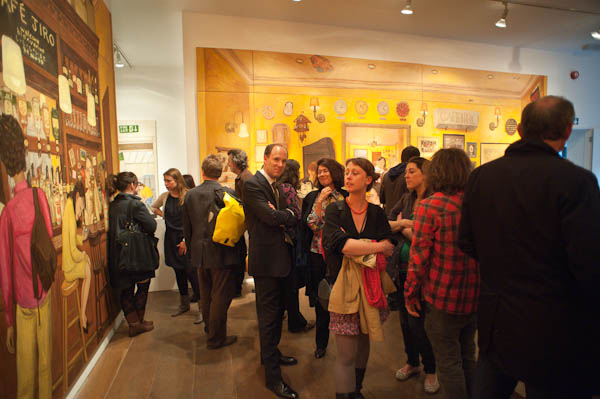
30 – photographic show at the Shoreditch Town Hall, London, open 10-6 until 2 May 2009, is a show by 30 photography students from the University of Westminster, where ‘producing a photographic show’ was a module on their course.

You can see some of their names with an example  of their work on the 30 blog,  and if you are anywhere within distance I think it’s a show worth seeing, both for the impressive range of work on display, but also for the location itself.

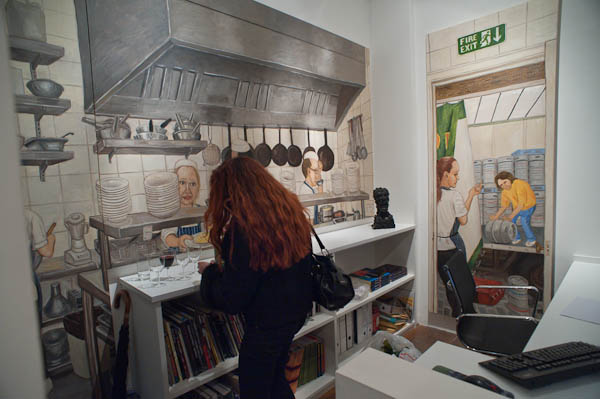
Where else can you see a film of a bride and groom projected above a urinal, images made to fit in a room with the floor half dug up and a large brown earthenware pipe and much much more, and some of the pictures simply pinned up on decaying walls are well worth a look.  This was an exhibition I really enjoyed visiting, which is more than you can say for many at more prestigious venues. It has a liveliness that makes the current offering at the Photographers’ Gallery I visited the previous day seem extremely sad.

It’s good also to see a student show with such a wide range of work, rather than some that seem to be largely a series of clones of a particular tutor or small group of tutors.  There is certainly a lot of talent here, though perhaps a little depressing to reflect that with the current state of the market for photography nearly all of them will end up doing other things for a living. Of course that isn’t necessarily a bad thing and I’m sure that photography will continue to enrich the lives of many of them – and of others who will continue to enjoy their work.

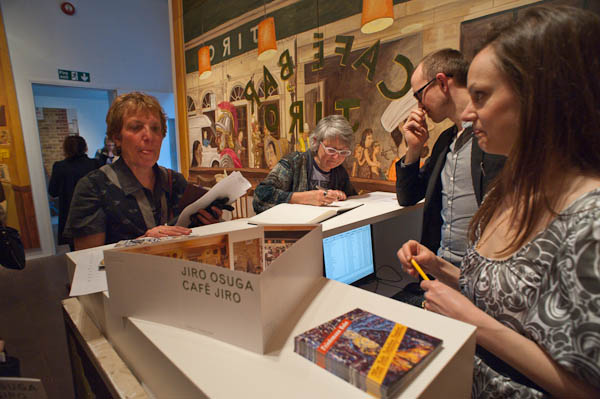
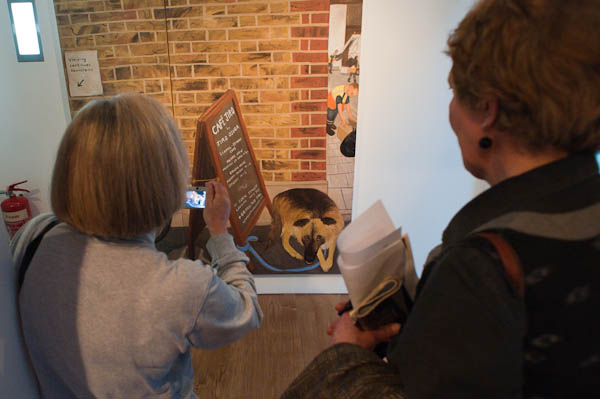
Don’t put off going to see this – it ends this Saturday. Here are a few of the pictures I took of the location and the work on display.

© 2009 Peter Marshall.

© 2009 Peter Marshall.

© 2009 Peter Marshall.

© 2009 Peter Marshall.

© 2009 Peter Marshall.

© 2009 Peter Marshall.

© 2009 Peter Marshall.

© 2009 Peter Marshall.

© 2009 Peter Marshall.

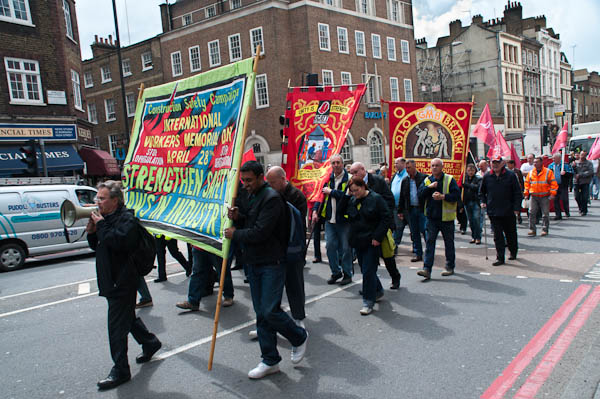
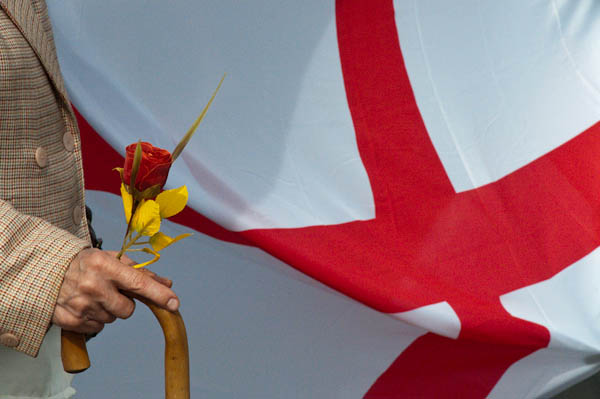
Where was St George?

I spent much of the day on April 23 looking for St George around the centre of London, and was largely disappointed. Celebration of our patron saint’s day still seems to be pretty low key, and I found a handful of members of the English Democratic Party in Trafalgar Square trying to drum up support for a national holiday every April 23. At least this year – unlike last – they were allowed to visit our National Gallery in the square, which was also putting on some related events. Apparently last year they were refused entry for wearing the national flag.

© 2009 Peter Marshall.
Looking for St George’s Day in Trafalgar Square – more pictures

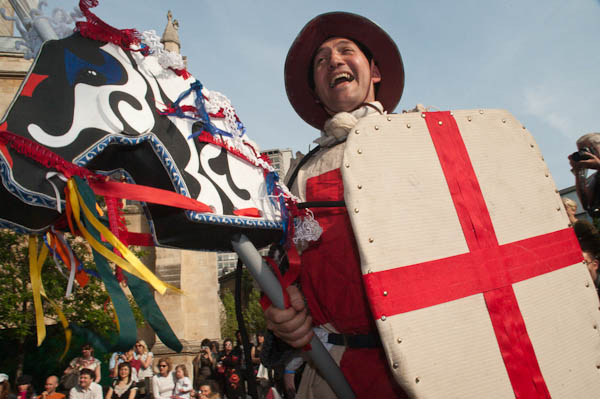
Others were in the square expecting something to happen, but without success, though when I returned later things were a little livelier. Meanwhile I knew that the theatre group, The Lions part, were giving some performances during the afternoon in Southwark and I went to take some pictures of St George and the others there.

© 2009 Peter Marshall.
The Lions part: St George (& the Dragon – more pictures)

There were other things going on that I missed, some on purpose. Boris took a trip to the City for some cheap publicity, and Southwark Cathedral and St Georges Church were also marking the day with events.

© 2009 Peter Marshall.
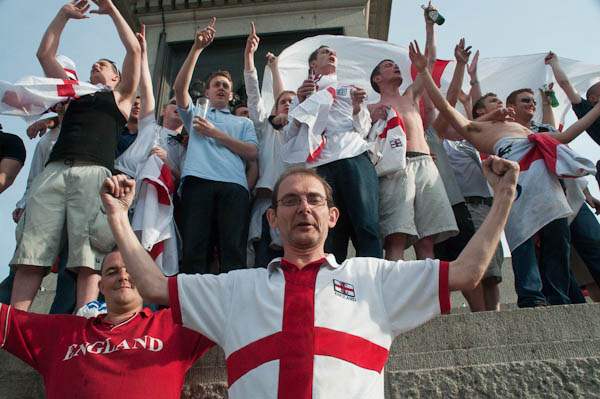
England Supporters – More pictures

I went back to Trafalgar Square on my way to the Photographers’ Gallery, and found around 25 young people having a noisy time on the plinth below Nelson, and then another theatre group who had come out from their show in the National Gallery decided to put one on in the square also – with a little more audience participation than they are used to.

© 2009 Peter Marshall.
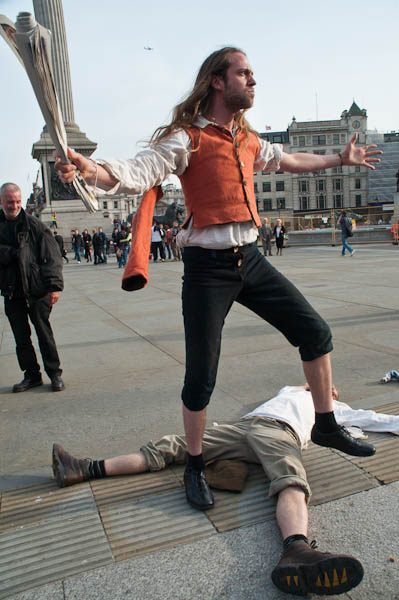
St George is defeated by the Turkish Knight, while ‘Lucozade Man’ looks on. More pictures

The latest show at the Photographers’ Gallery didn’t detain me long, though as always I read the texts and looked at the pictures and other objects. As before the most interesting work was on around the edges, in the print room (including a couple of nice prints by Thurston Hopkins – which reminded me very much of my own games on the streets in the 1950s) as well as work by Guy Tillim I’ve mentioned before.  Although I appreciate a wide range of work across all the genres, the PG doesn’t seem to be showing much of quality outside the odd bit of photojournalism these days.

In the main show, the work of Gerhard Richter stood out rather more than head and shoulders above the rest (perhaps from the ankles up?) , though I don’t think the small photographs which he has over-painted actually have a great deal to do with photography or being a photographer – and there are some rather more interesting examples on the web site.

One of those admiring Hopkins work with me was  Shimelis Desta, formerly the court photographer to the Ethiopian Emperor Haile Selassie, some of whose work was shown in the Photographers Gallery in 2007. You can see a CNN film about how he managed to get this work out of the country on YouTube. He tells me that he has more interesting images than those that were chosen by the curators for that show, so I hope that one day we will see more of his work.

Slough Vaisakhi

The Gurdwara Sri Guru Singh Sabha in the north of Slough is around ten miles – an easy bike ride – from my home, though I always do an extra half mile or so. Slough isn’t a place a visit too frequently, and something about it means I always get lost, despite knowing exactly where I want to go.  Somehow, as usual, I end up in the middle of town on the wrong side of a wide road with a fence down the middle, and have to divert and cycle through a subway.

Fortunately I’d left home early, and arrived in plenty of time, well before much had started to happen. Photography often involves rather a lot of hanging around and waiting, because it isn’t much good arriving with your camera after things have happened – and the only time I’d come to Slough to photograph the Vaisakhi celebrations before I had been just a little late.

Being there early did give me the opportunity to go inside the Gurdwara and take a look around, and as well as taking a few pictures get to know my way around and talk to people.

© 2009 Peter Marshall.
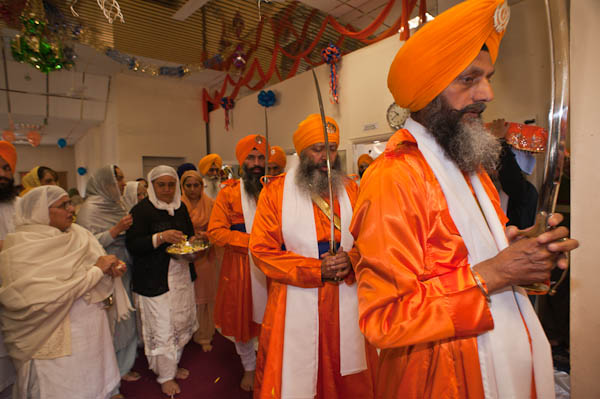
The Panj Piyare process from the prayer hall, swords raised

© 2009 Peter Marshall
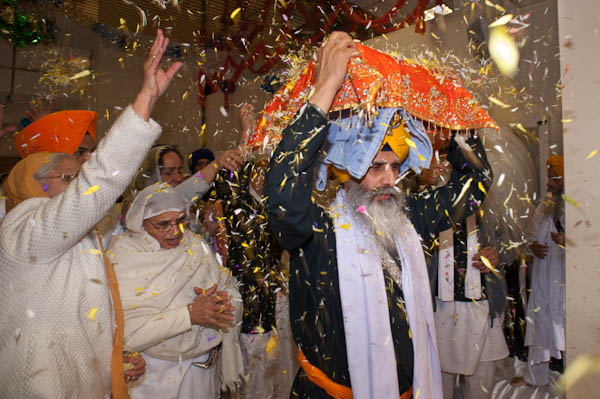
Women throw flower petals at the Guru Granth Sahib

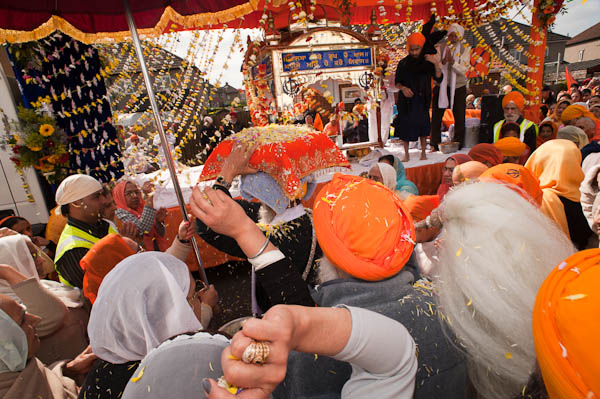
I was at the top of the stairs when the procession came out of the prayer hall and made its way down and out to the crowds waiting below; all the time women were throwing flower petals over the Guru Granth Sahib and I joined them to take pictures from their viewpoint as the scriputres were carried to the waiting float.

© 2009 Peter Marshall.

Most of the pictures inside were taken with a 20mm lens on the Nikon D700, and this enabled me to work in rather crowded conditions. The 20mm is a nice compact lens too, and although in some ways I’d prefer a wide zoom, I’m getting to like working with a fixed lens again.

This was the first real set of pictures I’ve taken with the Nissin Di622 flash, and I was impressed. It just worked, and seemed to keep up rather better with my fairly rapid shooting than the SB800 generally does.  I simply put it on the hot shoe, flipped out the diffuser to cover the wide angle and shot in ‘P’ mode, moving from indoor exposures of 1/60 at f5.6 to outdoors at 1/250 at f18 (at ISO 400.)

I’d tried shooting inside with available light earlier, and at ISO 2000 could work at around f4 and 1/100, but the colour was poor with the fluorescent lighting. On the stairs light levels were higher with a large window adding daylight, but the mixed lighting seemed an added problem. So flash seemed the obvious choice, although I felt a little obtrusive using it. But my previous experience photographing at other Vaisakhi celebrations and a Sikh wedding was that this was unlikely to present a problem to those I was photographing. And I did really want it for those petals.

More pictures from the event – many of those outdoors taken with a Sigma 18-125mm on the D300 – on My London Diary. The Sigma – which I’ve had for a few years – seems more robust than the Nikon 18-200mm, and has similar image quality – very usable rather than really superb. It lacks the VR of the Nikon lens, but I seldom seem to see much benefit from this in practice – and certainly not on sunny days. I have less focus problems with the Sigma, and its one fault is that the zoom ring works in the wrong direction.

Working with two bodies again does make life easier in most ways – though I wish they were lighter and came with straps that could never get entangled!

London 2012 & Rose-Red Empire

 London 2012


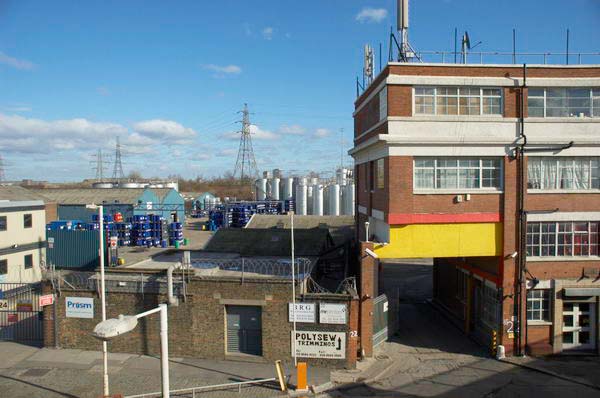
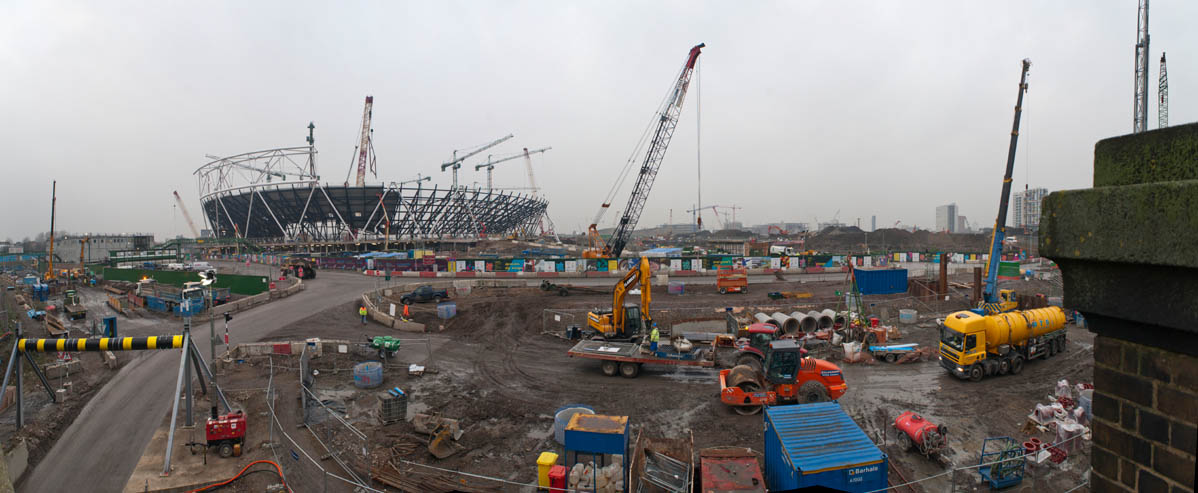
In 2005, this was the view from the Greenway where it crossed over Marshgate Lane; now it looks like this:

with the Olympic stadium taking shape amid a complete re-creation of the landscape. You can see many more of my pictures of the area covered and surrounding the Olympic site from the 1980s to 2005 on my Lea Valley site,  and more current work in My London Diary, for which I try to add a roughly monthly progress report.

I’ve photographed various panoramas around the area over the years, working with several swing lens cameras (and the relatively cheap Ukrainian Horizon 202 is probably my favourite – when the first one wore out after around 10 years I immediately ordered another) and later also with the considerably more expensive Hassleblad XPan equipped with a 30mm lens. This gave close to the maximum angle of view that makes sense as a rectilinear perspective – any wider and the edge-stretching becomes silly.  Swing lens cameras get over this problem, but their cylindrical projection adds another of its own that makes them tricky to work with, giving curvature in all non-vertical lines except for that along the exact centre of the image(where usually you try to place the horizon.)

Now I most often use a normal DSLR, taking several exposures and joining them with PTGui, which allows a choice of projections, including rectilinear and cylindrical but also others. The latest version (8.1.2)  has added more possiblities, including ‘Vedutismo‘ which I used for the above panorama (see a larger version)  which keeps all lines that pass through the centre of the image straight.  There is also a modified version of the cylindrical projection, ‘Mercator’, (added in version 7.0) which is also of interest.

You can see February’s London 2012 site pictures here.

Rose-Red Empire

On Saturday I went to see the show ‘Rose-Red Empire‘ at Danielle Arnaud contemporary art in Kennington, which accompanied the launch of Iain Sinclair’s latest book on Hackney (it continues until 15 March – see website.) Show and book include material on the impact of the Olympics on Hackney,  and a film by Emily Richardson brought back memories of the Manor Gardens Allotments as well as the Bow Back Rivers.  The show does include some photographic work, as well as paintings and other media, but the photography in general disappointed. Perhaps the best was in ‘The Book of the Brook’  by Iain Sinclair, produced as a unique single copy with his own photos tipped in, along with other material, simple honest and un-pretentious records of his observations on walks around the largely hidden parth of Hackney Brook.

Here’s a picture that I think Sinclair might appreciate:

© 2007 Peter Marshall
Northern Outfall Sewer and Lea Navigation
.

and I made it without a kayak.

D700 at ISO 3200

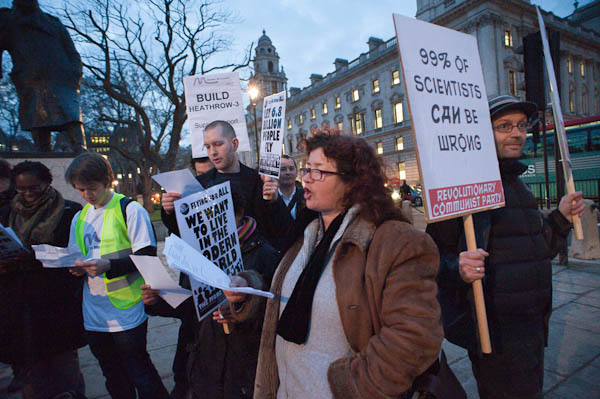
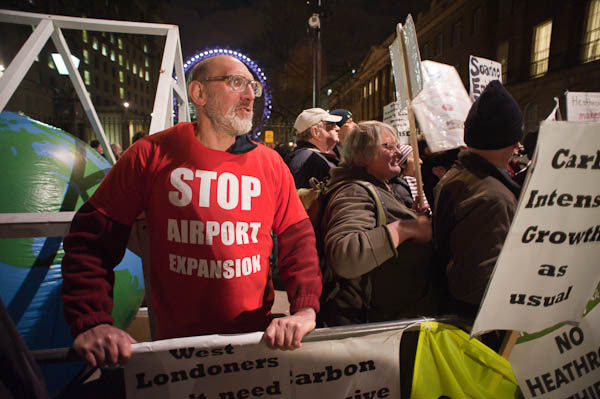
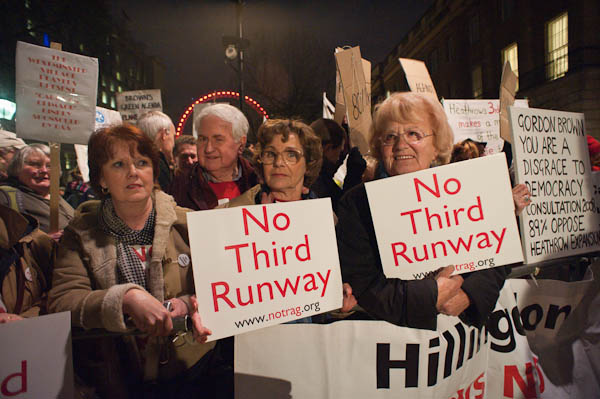
There were two demonstrations starting at 5.30 in Westminster, so it seemed a good occasion to try out the Nikon D700 at high ISO working with available light, though I also took some flash pictures with the D300.

© 2009 Peter Marshall.

As the light fell, I started working at ISO 2000, and this shot at 1/60, f4 with the Nikon 20mm f 2.8 is  very usable, although my normal Lightroom settings for noise reduction left a little colour noise on 1:1 viewing – easily removed by a small increase in the ‘Color’ setting from 11 to 15.  There was also visible luminance noise, improved slightly by increasing the setting for this, although it wasn’t possible to remove it completely.

Most frames taken at 3200 were actually a little cleaner, suggesting that despite shooting on RAW, in-camera noise reduction is kicking in more strongly. Although there is a little noise, the overall quality is remarkable, and these images are fully usable. I wouldn’t anticipate having any problems even with the occasionally rather pernickety quality control on sites such as Alamy.  The noise is actually quite attractive – rather like film grain – so long as you remove the colour component.

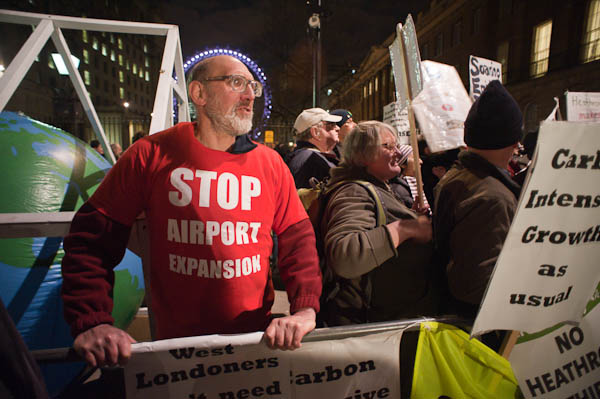
Here is a picture of two NOTRAG  supporters in Whitehall, taken at 18:15, 1/80 f4.5 ISO 3200, again with the 20mm.  In fact I suppose it is really at ISO 6400, as to keepthe highlights (except for actual light sources) I had to use a -1 EV exposure bias.

© 2009 Peter Marshall.

The main technical problem in this picture is not the camera but the colour and quality of the available light. Here’s a 1:1 section from the image

1:1 detail, ISO 3200
1:1 crop from ISO 3200 image on the D700

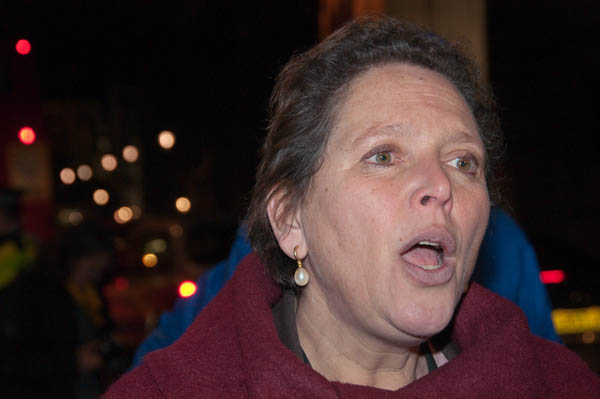
There is some noise visible, and a slight lack of detail compared with a low ISO picture, but overall the quality seems very usable. And in the city centre, ISO 3200 lets you shoot hand-held in available light, certainly with wide-angle lenses. Here are a few pictures I took later in the evening.

© 2009 Peter Marshall.

© 2009 Peter Marshall.

© 2009 Peter Marshall.

© 2009 Peter Marshall.

This last image shows what is now sadly the former Eurostar terminal at Waterloo (St Pancras may be fine for some, but the switch there and the huge sums spent on the high speed line from Kent to there have increased my journey times to Paris by on average 15 minutes.) And it’s a little of a cheat as a hand-held image because I was resting my hand holding the camera on a nice solid wall for the 1/6 second exposure.  But the roof detail is great at the left of the picture. Surprisingly for a 20mm image it seems not to have sufficient depth of field to retain sharpness to the end of the structure.  So a tripod would have been a good idea, allowing me to stop down and give a longer exposure, and doubtless the lens would also perform a little better stopped down. And it might even have been improved slightly by using a lower ISO.

Flash still has a big advantage in taking portraits in the street at night because of the poor colour spectrum of most street lighting, which makes it impossible to get normal skin tones.  But I can see that on the D700 I shall be shooting flash at higher ISO to, to retain more of the surroundings.

2009 Deutsche Börse Show

There were I’m afraid no surprises at tonight’s opening of the show of the four shortlisted for the Deutsche Börse photography prize at the London Photographers’ Gallery, except that the wine ran out before I had got a second glass.

Tod Papageorge‘s work from Central Park afflicted me with the same ennui it had generated on its previous viewing at the Michael Hoppen Gallery, where the main interest had been that one print was shown upside down (this time they all seemed the right way up.)

His pictures of the park taken over twenty-two years, although very highly praised by some, have to me the air of an amateur, little slices of life, observations of little consequence. Immaculately presented, they are printed with a curious tonality that  renders flesh more as cold porcelain than living flesh or anything with warmth or humanity. It looks somewhat better on the web than on the wall partly because the tones are more normal there, but also because the large prints seem to to emphasize the vacuity of some of the images.

Papageorge has produced some interesting books, notably that showing the similarities in the major works of Walker Evans and Robert Frank, American Photographs and The Americans, arguably the two most important American photography books of the twentieth century.

The selection of images on show here did nothing to improve my view of his photography. Papageorge is highly regarded as a teacher, and definitely is a great promoter of his students and former students, but as a photographer he has always seemed an also-ran.

Paul Graham‘s work from the book a shimmer of possibility, described somewhere on the wall as ‘haikus’, lacked any photographic coherence so far as I was concerned. A haiku is perhaps a form that creates an instant flash of recognition, a seventeen mora that create an image, a single moment. Here we had stilted, repetitive and poorly exposed frames that to me resembled more the stuttering of a partially sighted person with severe learning difficulties. The programme notes describe them as photographic short stories, but I don’t feel they had a story. Frankly I could see no value at all in these works, although some of Graham’s earlier work – such as his Beyond Caring (1984-85) still appeal.

The work of Emily Jacir is interesting but seemed to me to have no place in a photographic gallery – as the gallery notes clearly state, hers is the work of an archivist, activist and poet. Not a photographer. On display were the notes and the artifacts collected by her in a study of the assassinaion of Wael Zualter, a Palestinian intellectual assassinated by Israeli secret service agents in ROme in 1972. These include a letter written by Alberto Moravia recommending him to to Jean-Paul Sartre, and another handwritten list of the Mossad agents involved in his assassination. Is it’s inclusion here a suggestion that we should all abandon photography entirely? Like those Camera Clubs that turned over to bicycling when the photographic craze abated?

For me the outstanding work of the four finalists came from Taryn Simon, whose ‘An American Index of the Hidden and Unfamiliar‘ gained the 2008 Infinity Award for publishing from the ICP, and was one of the few decent shows to grace the Photographers Gallery in recent times.

In the unlikely event that I was a member of the panel deciding on the winner of the DB prize, a short walk around the gallery would have convinced me to sidestep the four shortlisted choices and award it instead to Guy Tillim, not actually for the few of his large prints on the wall but for the book of them,  Avenue Patrice Lumumba. This work is currently also on show at the Fondation Henri Cartier-Bresson in Paris and will also be shown at Foam Photography Museum in Amsterdam and the Serralves Museum in Porto, Portugal, and looks a very likely candidate for next year’s Deutsche Börse prize – assuming the bank stays solvent.

But I hesitate to make predictions as to who will win, given the fate of those I’ve tipped in previous years. If the prize was to be awarded on the basis of the photography on show, for me Simon would be the only choice. But Jacir has politics, and the Palestinian situation very much on her side – despite the fact she isn’t a photographer. Papageorge is undoubtedly the biggest name in the world of photography among the four, even if not largely known for his pictures. Graham seems too dark a horse to even consider. But I won’t be making any bets.

Sweet Nothings – Vanessa Winship

I don’t know why so few of my friends go to openings at HOST gallery in Honduras Street, (perhaps the guys from Hackney dropped by later or it didn’t seem political enough) but on reflection many of the rest are south Londoners, and Photofusion closer to their natural habitat, with anything north of the Photographers’ Gallery perhaps seeming like another country. But it would be really worth their while jumping as I did on a number 243 and making the trip in the next few weeks, because Vanessa Winship‘s ‘Sweet Nothings‘, continuing until 5 March 2009, is really London’s outstanding show at the moment and one not to miss.

Posed portraits in large format may not seem state of the art, and Winship has deliberately pared her approach to a minimum, and it is perhaps this and her remarkable young Anatolian schoolgirls that give her work its strength and a resonance from almost the entire history of photography.

©: V Winship; used with permission

There is definitely something there of the daguerreotype portrait, perhaps in the way her subjects stand facing the camera and the photographer. For these young Anatolian girls from the rural east of Turkey – as for those early subjects – the act of being photographed, delightful though Ms Winship is, is still a considerable ordeal, not to be taken lightly and one for which at times, again as in the early days, they cannot stand still long for their images to render sharply.

Particularly when photographing in school interiors (some pictures are in school yards and other outdoor locations)  with a 4×5 camera and using only available light, exposures may sometimes run into appreciable fractions of a second rather than the instantaneity we take for granted with high ISO cameras, fast apertures, and small formats. Of course the times concerned do not approach the minutes needed for the early processes.

Turkey is a country with significant ethnic minorities, the largest of which is the Kurds who live in the east of the country and across the border in neighbouring states. Since its inception the modern Turkish state has attempted to minimise ethnic differences – at first by force, when  in the early years of the twentieth century literally millions of Greeks, Armenians and Assyrians were killed to create “a Turkey for the Turks”, but more recently largely by repressive laws and policing.

The Kurds make up perhaps a fifth of the population of Turkey, mainly speaking Kurdish rather than Turkish. For many years until 1991 speaking Kurdish was an offence in Turkey, and it is still discriminated against. Government over the years have referred to them as ‘Mountain Turks’ or ‘Eastern Turks’ rather than recognise their existence as a separate ethnic group, and there are no reliable figures for their numbers. Resistance to forced assimilation has led to a violent armed rebellion with Kurds calling for a separate state of Kurdistan and government repression.

©: V Winship; used with permission

Education is utilised by the government as an important means for the assimilation of ethnic groups and great efforts have been made to increase attendance at schools, particularly by girls, who had traditionally often remained in the home and without formal education. One important aspect of the education system is the use of Turkish as the first (and possibly only) language and the language of instruction.

Going to school is a part of a process of socialisation and of indoctrination into Turkishness. The adoption of a common blue uniform is part of this and its basic form appears to be a kind of smock;  to English eyes it resembles something that might have been designed as a coverall at the time of the Arts and Crafts movement for girls engaged in cookery or domestic science.

But what is important for these images is the way that it is individualised with various embroidery and trimmings. Often these seem to included traditional motifs such as flowers although the photographs also show some evidence of a more twentieth century globalised culture.

Although looking at a single image from this series one might see parallels with the portraits of August Sander, this really brings out the virtually orthogonal nature of their intentions. While Sander was interested in establishing a typology, this work is almost entirely about individuality and how it springs out at us from the sameness of the situation, the uniform and the technical approach.

Several other photographers are mentioned in a foreword to the book ‘Sweet Nothings’ containing 45 of these images , published in the UK by Foto8  and available from HOST.  Although there are some visual similarities, for example between Winship’s pictures and a few of the images of Diane Arbus, I think the resemblance ends there – Arbus had quite a different agenda (and the same could be said for the others mentioned.) The images in the book are finely printed and I think the more intimate scale perhaps suits the work better than the exhibition wall, although it was good to see the work large.

The  exhibition prints, fine inkjet prints on Canson paper made from the large format negatives are superb, but also have a vintage feel, perhaps reminding me in some ways of the best photo-mechanical reproduction of the mid-twentieth century, although with a sharpness not then achievable. But there is something about both the sharpness and tonality which is a little different to modern silver prints whether from film or digital.

But in the end what makes these images memorable for me is the faces and body language of the girls as they face the camera, usually posing with a friend or sister, occasionally alone or in a threesome. Although few of them are in any conventional sense beautiful (and some decidedly not) they have a powerful and highly individual presence in these fine photographs.

Irish Ghosts

I’ve been intending to write something about the current show at Photofusion, David Creedon‘s Ghosts of the Faithful Departed, since I went to the opening a couple of weeks ago.

© 2009 Peter Marshall
David Creedon speaking at Photofusion

You can see roughly 20 of the images from this on Creedon’s web site – along with some of his other work, although I think ‘Ghosts’ rather stands head and shoulders above the rest. Some of the images on the web have an odd sparkle – perhaps over-sharpening – but otherwise it gives a good idea of the show.

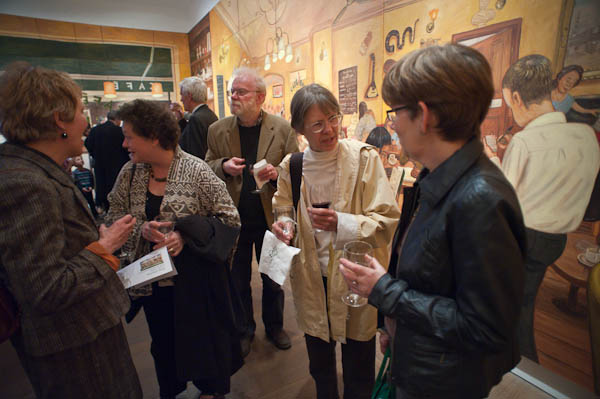
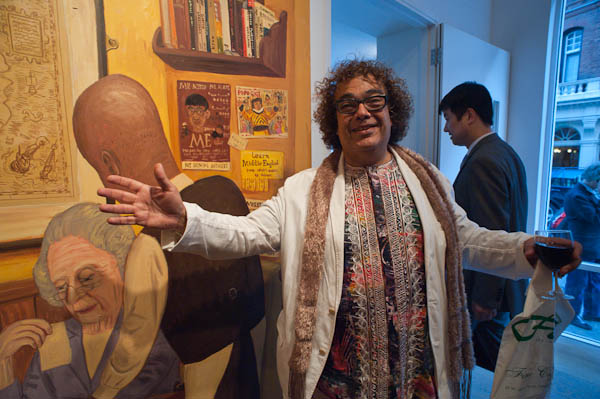
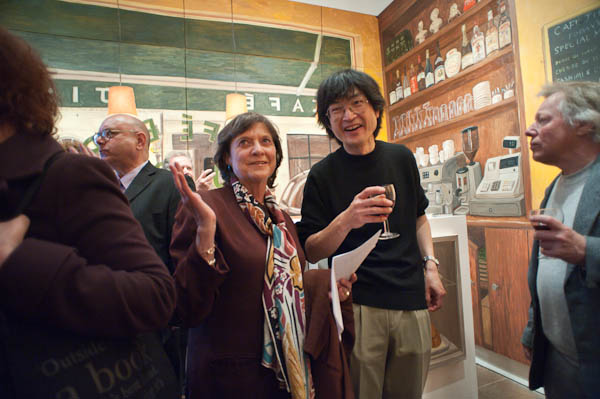
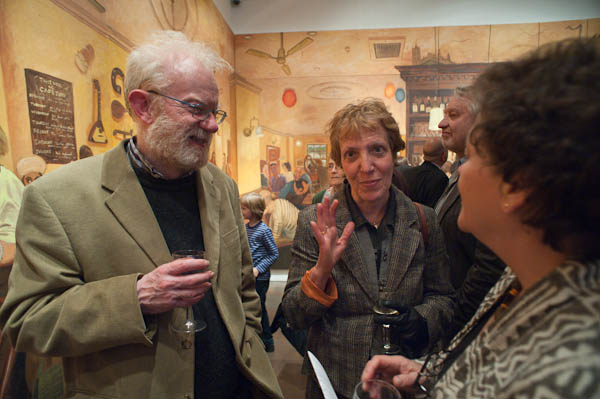
I usually go to Photofusion openings more to meet people that to see the photographs, but this time they were certainly worth a look. Creedon captures well the sense of frozen time in many of these interiors with an eye for detail and a feeling for colour.

It is subject matter that is a gift for photography, at its heart a medium concerned with the freezing of time, and at the opening Creedon spoke clearly about his feelings and the work. These isolated derelict rural homes were where the remnants of families, single people who stayed behind to look after elderly parents when famine drove their brothers and sisters to seek work in England or America. The parents died, the carers, now elderly lived and died and they were simply abandoned, left to decay and rot.

The pictures provide evidence of religious obsession and other aspects of eccentricity common among the old who live alone and of course have a particular resonance for the Irish as a part of their national history. Those of us who can claim no Hibernian connection perhaps view them more objectively, and although I enjoyed the show I did sometimes feel the photography was a little over the top. Perhaps the printing could have been less dramatic (it reminded me at times of Cibachrome’s gross hyper-realism) and more senstive and nuanced. And sometimes I felt that images were too arranged, lacking that certain accidental character that for me characterises great photography. This was perhaps a Guiness of a show (and I enjoy a pint, particular from Dublin) rather than fine wine.

© 2009 Peter Marshall

© 2009 Peter Marshall

The opening was also perhaps over the top, with three speeches. The photographer acquitted himself well – and I would have liked to hear him talk more about the work. The diplomat was diplomatic, short and sweet, but the academic appeared out to prove he had no great love or knowledge of photography, which was rather a shame.

Lightroom Recovers Again

For those of us who shoot largish numbers of pictures with digital SLRs there are really two outstanding choices of software to handle your files, Adobe Lightroom and Apple Aperture. And if, like me, you prefer to use PC rather than Mac, that leaves Lightroom.

Using it, I can take pictures, download them to my PC, rename them, add that essential metadata including keywords, select the best images, add them to my searchable catalogue, adjust the tonal curve, exposure, contrast etc, get rid of chromatic aberration, cut down noise, apply sharpening and do all the really basic things that every image needs before outputting jpeg (or TIFF) files for all my specific uses (web, my clients, image libraries.)  Almost every step is speeded by appropriate presets which I’ve set up and most of the processing takes place in the background as I get on with working on further images.

With Lightroom 2.1 we got  some great tools for dodging and burning images, and as I wrote at the time,  Photoshop was hardly necessary for working with digital images except for a few essential third-party plugins, some of which can also work standalone or as plugins to cheaper  – or even free – image manipulation software.

I do have other software which can do a great job of converting RAW files to images. Phase One’s  Capture One 4 is an improvement on earlier versions, and Nikon’s own Capture NX (I only have Version 1.3.5) has the advantage of knowing more about Nikon files and a few nice touches. But frankly both are a pain to use and lack the superb workflow of Lightroom, as well as many of its features.

So Lightroom has become central to my current work. When LR 2.0 came out I loved the new tools, but was crippled by its slowness at importing files, making jobs that should take minutes into hours.  in the post Lightroom Repaired I rejoiced that the release candidate for 2.1 had solved the problem.

But a similar problem developed with LR 2.2; if, like me you began to make extensive use of the local adjustment tools you soon found that the program seized up, or crashed. There was a very obvious memory leak.

I’ve got used to having Windows Task Manager open and every ten or 20 images having to kill the Lightroom process. Each time it took perhaps a minute or so to get it up and running again and find the image I was working on, so it wasn’t the end of the world, but it was a major pain, especially as writing batches of jpegs to disk would also have the same effect. I could no longer leave the machine writing out a hundred or two files while I relaxed and had a meal.

So I’m very pleased to report that this particular bug has now been squashed in the release candidate for Lightroom 2.3, which I downloaded (133Mb) on Sunday; it has since behaved itself perfectly on my system.

Lightroom is I think a great program, one that is fast becoming a classic for photographers in the same way that Photoshop itself is for graphic designers (and we photographers used around 5% of it because that 5% was as good or better than anything else on the market.)  But I’m very worried about depending for a living on software that is clearly released without proper testing. Two recent major versions with such obvious bugs is more than unfortunate.

Inez Baturo – Polish Landscapes

The current exhibition at the Paris-based on-line Dmochowski Gallery features the work of a good friend of mine from Bielsko-Biala, Poland, Inez Baturo.

© 2005 Peter Marshall
Inez Baturo

A week or so ago I wrote something about the ugliness of snow on trees and now have to eat my words seeing the magic which this gives to some of Inez’s pictures. As gallery owner Piotr Dmochowski writes, these are “misty, wistful and pensive visions” and have a powerful poetry, full of “nostalgia, memories and sad reflection.”  I think there is something deeply Polish in them – as Polish as the music of Chopin.

But go and look at them on the web site – and there are some good large versions of the images on show. The pictures date from 1991 – 2008, with 2007 seeming to be a particularly productive year.

Dmochowski was born in Poland and works as a barrister and professor of law in Paris, but has devoted much of his time to promoting the work of Polish artist Zdzisław Beksiński (1929-2005) with a gallery at rue Quincampoix in the centre of Paris from 1989-95. Work from the Dmochowski collection is now on show as the Beksinski Museum in Częstochowa, Poland, and the gallery is now an on-line one, showing mainly paintings.

Earlier shows of photography on the Dmochowski gallery have included the surreal recreations of dreams by Misha Gordin, who I was pleased to spend some time with on my last visit to Bialsko-Biala where we were both guests of the FotoArt Festival organised by Inez Baturo.

© 2007 Peter Marshall
Inez and Misha on stage at the FotoArt Festival in Bielsko-Biala, 2007

Other photographic shows at Dmochowski have included the controversial ‘To die so as to leave the hell’ with work by James Nachtwey, Don McCullin, Sebastião Salgado, Raymond Depardon, Joël-Peter Witkin, Dieter Appelt and Elizabeth Prouvost as well as of Beksiński’s own photographs, which include some powerful closely cropped heads using his family and friends as models.

© 2005 Peter Marshall
Inez and Andrzej Baturo at opening of FotoArtFestival in 2005

Inez and her husband Andrzej Baturo are both photographers and run a gallery in Bielsko-Biala and publish photographic books. They are the co-founders of the Foundation Centre of Photography and the Programme and General Directors of the FotoArtFestival of international photography held in Bielsko-Biala. I met them both when I was invited to show work at the first festival in 2005, and again when I returned to speak at the second in 2007.

© 2007 Peter Marshall
Inez introduces a speaker at the FotoArtFestival, 2007

© 2007 Peter Marshall
Inez listens to one of the talks

Sarah Moon and Inez at FotoArtFestival 2007

So, my congratulations and warm hugs to Inez!