Deutsche Börse Shame

I can’t say I was surprised to hear that this year’s prize was awarded to Sophie Ristelhueber, who as I mentioned when I wrote rather briefly about this year’s four finalists said of herself “Nowadays I am not even a photographer because I am a conceptual artist.” And she is right, she isn’t a photographer and was in the wrong competition in the wrong gallery.

Frankly it wasn’t a good year for the gallery, with none of the four finalists standing out, and even by Photographers’ Gallery standards it was an extremely boring show.  As usual the best work was on display in the print room, though even there it didn’t seem quite up to the usual standard.

It isn’t a situation I take any satisfaction in, rather one of considerable frustration because I know there is a lot of great photography out there. At least half a dozen photographers in the current show of Indian photography at the Whitechapel and another dozen whose work I’ve seen at other shows in London in the past year whose work I’ve found in some way exciting, and far more whose work I’ve come across on the web who have had shows in other cities across Europe.

What did interest me today was to read a Guardian feature, Has the Deutsche Börse turned into a conceptual art prize? by Sean O’Hagan which makes much the same kind of criticisms against the prize that I’ve made over the years, that the prize simply fails to reflect the “vitality, range or depth of contemporary photography from around the globe” and calling for “less theory and process and more exciting pictures.”

I wrote that the prize should have gone to the man who produced the scrapbooks that formed a part of Donovan Wylie‘s exhibition. Joanna Pitman in the Times suggested it should go to ‘Pete’ for his anti-cuisine meals photographed in loving close-up by Anna Fox.

This prize has simply become a piece of mutual curatorial back-scratching, with very little relevance to what is actually happening in photography – and rather a backwater so far as art more generally is concerned.

I’ve been a member of the Photographers’ Gallery for over 30 years, but now it has become something I’m almost ashamed to admit to other photographers and it isn’t just this prize that makes me feel that, but the whole programme there over recent years. As I’ve written before, it seems always to be apologising for photography rather than celebrating it. It really is time for the gallery either to start supporting photography or consider a change of name – and for the Art Council to rethink how it can support photography in Britain. There isn’t much point in funding a flagship if it is flying the wrong flag.

Crown Court Demo

Last Friday morning was a little disconcerting as I found myself walking up a road that I’ve not visited for many years, but first walked up in the mid 1950s, in short trousers and with a new blazer that was a little too big to give room for growth and satchel. I didn’t quite get as far as my old school at the top of the hill, though I saw it a little ahead as I turned off at the building before it, Isleworth Crown Court, a new building since my young days.

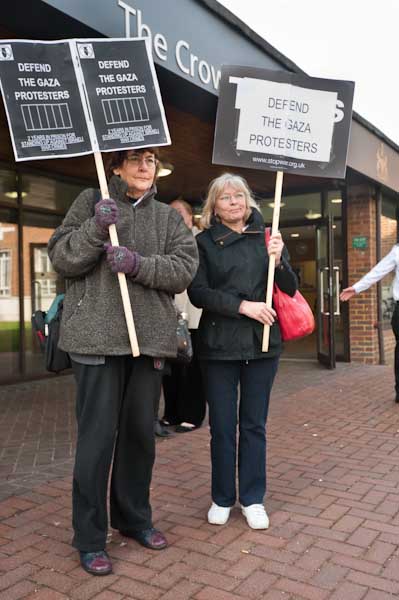
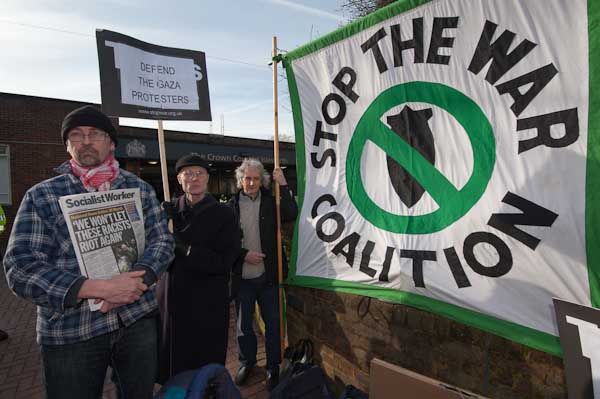
I wasn’t going to court but to photograph a demonstration outside it, where young Muslim boys and men who had been picked out from CCTV coverage of the demonstrations in January 2009 during the Israeli attacks on Gaza were being sentenced.

Before their trials the judge had told them he’d already viewed the evidence and advised them to plead guilty. I didn’t think this was how we usually did justice in our courts, and certainly at least one defendant who went against this advice later left the court an innocent man. But most decided to plead guilty, doubtless being advised that this would result in a lesser sentence.

But the opposite appears to be true. The judge made clear in at least some of his judgements that he was very much intending to make an example of these people aimed at their community. Actions that at other times might have been expected to lead to a smallish fine or suspended sentence led to jail sentences of a year or even two.

Protesters see the trials and sentencing as both racist and an attempt to suppress legitimate expression of  protest as well as unjust. The effects on the young men unfortunate enough to have been identified from the camera footage (mainly because, unlike many more seasoned demonstrators, they had not thought to keep their faces masked) are clearly disproportionate to their actions. Collectively they seem certain to fuel terrorism in this country, their severity and unfairness acting as effective recruitment for dissident groups. I can only hope – though it doesn’t seem likely – that their will be some review and serious reduction in these sentences after the judge has done his worst.

Stop the War had called an emergency picket of the court at relatively short notice, and probably few people know where Isleworth is or find it easy to get there early on a Friday morning (though its only 35 minutes on the Piccadilly line from the centre of London – and a ten minute walk.) So I was really quite surprised to find around 15 people there when I arrived – and about the same number again arrived while I was there.

© 2010, Peter Marshall
17-35mm f4 at 35mm

Photographing around courts can be a problem, and we were told we had to move away when we tried to take pictures of a couple of women with placards just in front of the court entrance. The protesters too had to move just a few yards away on the pathway leading from the small car park at the front of the building. But otherwise the police were helpful, even moving their car out of the park to give the protest more space.

This was my first outing with the new Nikon 16-35mm f4 lens. I’ve been using the Sigma 12-24 as my main wide-angle on the D700, and although it works well on the DX format D300, with the full frame it is just a bit extreme.  Very few pictures really work at 12mm, and although I seldom notice the stretching at the edges that results from its rectilinear design  in the viewfinder, they are only too obvious when I see the image on my computer screen or in print.

Using the physics and geometry I learnt many years ago just a hundred yards or so up the road from the court, while the distance from the the centre of a simple 12mm lens to the  sensor is – for a subject at infinity – 12mm, the distance from that same lens centre to the corner of the frame is 24.6mm, giving roughly twice the magnification. Hardly surprising it is noticeable, as the maths also applies to the much more complex arrangement of glass in a photographic lens.  The horizontal angle of view of the lens at 12mm is around 112 degrees, and anything over 90 degrees really calls for a different perspective except in very special cases.  On full-frame anything below around 17mm is seldom much use.

Nikon used to make a 17-35mmf2.8, and it was a good lens for film and for DX Cameras, but they discontinued it a while back, though it is still listed on the Nikon UK site. It was also rather large and heavy, and still sells second-hand for around a grand. With their FX camera they brought out a larger, heavier and more expensive 14-24mm  f2.8, which seems a very good lens but has a bulbous front element that you can’t put a filter on for protection. It is faster and doubtless sharper than the 12-24mm Sigma I’ve used for around six years, but considerably larger and heavier, and given a choice I’d buy the Sigma again. It does the job and the D700 (or D3s) takes away much of the need for fast lenses.

But when Nikon announced their new AF-S NIKKOR 16-35mm f/4G ED VR it seemed to me to be an ideal lens for FX, although the various boards across the Internet were full of photographers who strongly and vituperatively felt otherwise. My only disappointment was that it was quite so large and heavy – around the same size and almost as heavy as the 17-35 f2.8 – in part perhaps because of digital favouring a design that gives rays more perpendicular to the sensor, and in part because it includes VR – Nikon’s Vibration Reduction II system.

I’m not sure that I need VR. In practice I haven’t found it seems to make much difference to my picutres even on the 18-200 zoom where I’d expect it to be most valuable at the long end.  But it doesn’t seem to do any harm – most of my pictures were sharp before and they are still sharp now. But I think it does more for test exposures than in anger, though perhaps it will help in those situations where people are pushing me while I’m taking pictures.

© 2010, Peter Marshall
17-35mm at 18mm

VR also puts up the price of lenses, though I think I got a pretty decent deal considering I got the lens the day after it was launched for a price that was in three figures ( just.)  Focus is really fast and everything seems pretty sharp – usable wide open though just a little better at f5.6, but the difference isn’t big in practice. The corners seem pretty sharp, there is a little chromatic aberration which is readily corrected in Lightroom, and distortion seems reasonably low, though I’d want to correct it for architectural work – not quite as good as my old 12-24 Sigma in this respect. And it does feel like a lens built for pro use, unlike many cheaper Nikon lenses which clearly are not, although in true Nikon fashion, the lens hood can rather easily get knocked off. It’s one area where Sigma are clearly superior.

So once I get the Sigma 24-70 back from repair (soon please – its been almost a month away now – and get it right this time), I’ll be putting this on the D300 body, where it works like a 36-105.  Or for for those days when I feel I might need something longer I’ll use the Nikon 18-200 (27-300) on the D300.

2010 Deutsche Börse Photography Prize

This evening I went to the opening of the showing fo the four photographers short-listed for this year’s Deutsche Börse Prize at the Photographer’s Gallery in London and was disappointed. Although in previous years I’ve usually disagreed with the decision of the judges in making the award, I think this year is the first in which I’ve found little or nothing among the work displayed really worth looking at.

I’m particularly disappointed because one of those short-listed was a photographer who I knew years ago in the 1980s and whose work I then admired. Back then I was involved with a small group of photographers who called themselves Framework and met monthly to look at each other’s current work, and occasionally organised group shows. The core of the group apart from myself was Terry King, who did most of the organising, and others involved included Carol Hudson, Derek Ridgers and Jim Barron. (You can read more about this group in an old and outdated but never finished web site.) We had our first exhibition as Framework in 1986 and the last in 1992, and the full list of those who showed with us included some well-known names in UK photography, including Jo Spence.

© 1988 Peter Marshall

One of the photographers who brought her work to several of our meetings in Kew was Anna Fox, and I was greatly impressed by her pictures of office workers in London, later published as ‘Workstations‘ (1988). When she came to Framework she had I think just finished her degree studies at Farnham, where she is now Professor of Photography at University for the Creative Arts. I think she was also the only photographer we invited to show with Framework who declined to do so!

So I went to the gallery tonight rather rooting for Anna (though we’ve not kept in touch) but found myself rather disappointed by what I saw on the wall. You can see quite a lot of it on her web site. The series I found most interesting was her 1999 miniature bookwork ‘My Mother’s Cupboards‘, but it was simply too small and in a way too limited. The selection from ‘Back to the Village‘ was also rather disappointing, and in general I felt that what we were seeing in the gallery was too many little bits and nothing really substantial. And looking through her web site, I still find the work from her early projects – particularly ‘Workstations’ – rather more exciting than anything she has since produced. You can read about her work ( and the other three) in The Telegraph.

I can’t even bring myself to write anything about the actual work by Sophie Ristelhueber which is on the ground floor of the gallery. Other than that the prints are quite large. But on my last visit to Paris I saw shows by twenty or more French photographers who I find of more interest, and I find it hard to see why her work made it here. There is a gallery of her work from her Jeu de Paume show on The Guardian web site which I find rather better than looking at the gallery wall, but still fails to convince me the hype is really more than hype. And I’m not sure why the Photographers Gallery should be showing the work of someone who saysNowadays I am not even a photographer because I am a conceptual artist.’

Zoe Leonard is a photographer whose work I’ve known for a long time and probably first saw in the American photography magazines, perhaps Modern Photo. I’ve always thought of her as a pretty good photographer, but nothing really special, and the work on show confirms this.  Analogue 1998-2007, on show at the gallery, isn’t a bad piece of work, but I think there is very little to distinguish it above the work of the many other photographers who have also photographed “tacky shop windows, quaint signage and mundane commercial products“. I can’t really say anything against it. There are quite a few images I’d have been happy to take myself when I worked extensively with similar subject matter in London twenty years ago. But I didn’t take them on square format and print the film borders.

Duncan Wylie’s work on the Maze prison after closure I’ve always found rather boring, and this show did nothing to change my mind. The article in The Telegraph is considerably more interesting – and the smaller selection of images helps greatly in this.

But the prize winner in this show must surely be the original producer of the scrapbook which fills one wall, I think Wylie’s uncle, although it was published by Wylie and Timothy Prus. The selection of spreads on the Steidl page is misleading, because the major interest lies not in the photographs but in drawings and the text of the articles, from magazines and newspapers – and also a typed ‘recipe’ for the troubles.

It’s these articles and  (and that the wine ran out almost before the opening started) that stick in my memory and created the greatest impact –  not the photographs, and that seems to be a fairly damning indictment of what was meant to be a photography show.

Where Three Dreams Cross

Where Three Dreams Cross, continuing at the Whitechapel Art Gallery in London (Aldgate East or Aldgate tube) until 11 April 2010 is an important show although it perhaps does not live up to its subtitle, 150 Years of Photography from India, Pakistan and Bangladesh. It is worth going to see mainly because of the broad cross-section of contemporary work it displays from the sub-continent, but perhaps fails to deal adequately with the earlier history of photography there.

I say perhaps, because I don’t know in detail what history exists, though I feel sure there must be considerably more than this exhibition reveals. One indication that this is so is the very poor showing given to the work of India’s first great indigenous photographer, Lala Deen Dayal (1844-1905), whose work I wrote about at some length a few years ago. There are eight pictures by him on display in the ‘Street‘ section of the show, four of them interiors. None really fits this section of the show, and only one is a good example of his work.

Although my piece on Lala Deen Dayal is no longer on line, you can find more about this remarkable photographer on the Lala Deen Dayal web site. He gained international recognition with his work being exhibited in the photographic shows in London and Chicago as well as India, gaining over 25 gold medals between 1875 and 1905. The problem perhaps for the organisers of this show is that Deen Dayal was very much a photographer of the Raj, and honoured by the Nizam of Hyderabad who appointed him Court Photographer and gave him the title of ‘Raja’. In November 2006, one of his images appeared in an edition of 0.4 million on an Indian 500 Rupee stamp.

Deen Dayal was certainly the leading Indian portrait photographer of the nineteenth century, but unless I missed them (and it is large show in a gallery where the layout is always misleading to simple guys like me) this work was missing from that section of the show.

The work in the first gallery of the show deals with the two themes of ‘The Portrait‘ and ‘The Performance‘ with the historical material in the second containing considerably too much routine cinema publicity work.

Raghu Rai is I think still the only Indian photographer (born in what is now Pakistan in 1942) to have made it to Magnum, and his work certainly stood out in this show. You can also read about him on Global Adjustments.

Most of the nineteenth century work on display in the portrait section appeared to be studio portraits by unknown photographers, and much of it was pretty ordinary stuff. It’s hard too to believe that the first half of the twentieth century has so little to offer from India, and although there was some exciting material from the second half, most of it came from names that will already be well-known to many, though it was still welcome to see it being given greater exposure here.

Perhaps the  most intriguing work in this gallery was that of Umrao Singh Sher-Gil (1870-1954.) I actually find his work rather more interesting in itself than in the more widely known works based on them by his daughter Amrita Sher-Gil. Umrao Singh began taking photos in 1889 and continued for over 60 years, during which time he married a Hungarian opera singer in 1912 and was a political exile in Hungary for the next 9 years. The family returned to Europe for five years in 1929 so Amrita and her sister could study at the the Ecole des Beaux Arts in Paris. His best-known work is probably an extensive series of self-portraits.  Another member of this artistic dynasty also has work in the show, Vivan Sundaram, the nephew of Amrita Sher-Gil, whose work in ‘The Family‘ section consisted of montages of Umrao Singh’s pictures. I’d  rather have seen the original photographs on which these works were based.

The Family gallery also contained perhaps the most traditionally Indian of the works on show, large hand coloured rather symmetric tableaux that could almost have been embroidery. Here photography was being forced into a very non-photographic mould and retaining little of its inherent magic, although the results do have a certain charm.

The final gallery of the show contains work on the two themes ‘The Body Politic’ and ‘The Street‘, and although there was a great deal of fine work it was dominated by the large colour photographs of Raghubir Singh, (1942-99) arguably the greatest Indian photographer and photographer of India of the twentieth century and one of the first to work seriously with colour in the early 1970s.

But there is plenty more fine work, particularly some pictures by Rashid Talukder (you can see more of his fine pictures on the Majority World site.) Talukder’s powerful images of the liberation struggle in Bangladesh were the outstanding work in the Bangladesh 1971 show at Autograph in Shoreditch, and the co-curator of that show, Shahidul Alam, also has an interesting set of pictures (and a letter) ‘A struggle for Democracy 1967-70′ on view here. As well as being a fine photographer, Alam is the founder chair of Majority World, and also founded the Drik picture library, the South Asian Institute of Photography and much more.

Sunil Janah, born in 1918, photographed much of the history of India from around 1940 on, including the Independence movement and partition. You see his work and learn more about him on his Historical Photographs of India (and they truly are) which also contains a virtual version of his 2000 San Francisco show,  Inside India, 1940-1975. The site are rather dated and the reproduction of images is often not up to current standards.  You can also watch him talking about some of his work on YouTube. It was disappointing not to see more of his work here.

Apart from the work that I’ve mentioned, the strength of this exhibition lies in the survey of contemporary work it shows. It does exhibit a wide range of work, some from well-known artists (Saatchi has bought Pushpamala N‘s work for example) and others from photographers unknown here. I found it hard to find anything much peculiarly Indian in the best of this work, but there is certainly much of interest. But I think the best is probably the least known here. There really is too much worth looking at for me to list. Go and see it and make up your own mind.

Postscripts

  • The show is free for under 18s & Sundays 11am–1pm, otherwise £8.50/£6.50 concessions.  It was well attended but not crowded when I visited on a Saturday afternoon.
  • I’m still often asked if inkjet prints can match the quality of conventional silver or dye coupler prints. Reading the labels here, almost all the modern prints are inkjet of one kind or another, though some make a great effort to hide it, with such descriptions as “archival pigment print.”

Scanning 35mm – Will a Flatbed do?

Recently I’ve gone back to scanning quite a lot of my older negatives and, as I’ve mentioned in previous posts, have been using the Epson V750, simply for its speed, rather than the Minolta Dimage Scan MultiPro.

Although the scans have been good enough for my needs at the time, I’ve always felt that for the optimum quality I would need to go to the dedicated film scanner. But I wanted to find out exactly what the difference was and so to decide when to use a film scanner.

© Peter Marshall
Brixton, 1980, taken on a Minox EL 35mm camera

I chose this negative simply because it was one I wanted to print, having spent some time searching for it in my archive.

Minolta are no longer with us, and the MultiPro scanner which was the best of its type is no longer made. The scans made with it are of similar quality to the best scanners still available, including some considerably more expensive models.

All images in this post are unretouched scans, though I’ve adjusted contrast a little to give a better match than in the actual scans – though they are still not quite the same.

Minolta Dimage Scan MultiPro

I put the negative into the universal carrier with a specially made full frame 35mm mask that ensures film flatness and set the software to 4x sampling to get every last ounce out of the negative, scanning at 4800dpi.

Then I went and had a cup of tea while the scanner got on with the job – which I think took around 15 minutes – and produced a 58Mb 16 bit grayscale TIFF file.

© Peter Marshall
a 600×400 section from the 6829×4541 scan, displayed at 2/3 size on this blog

Viewed at 1:1 on the screen (the full 6829 pixels would actually produce a picture 73 inches wide if my screen was large enough – although nominal screen resolution is 72 dpi, actual screens invariably differ from this) the image is pin sharp and shows a fine granular pattern which I think is the actual film grain. The grain is as sharp at the edges as it is at the corners, and it is a pretty impressive performance.

© Peter Marshall
An area where the white threads are more visible

Unfortunately it also shows something else, with large areas of the image being marred by fine white thread-like lines. I’ve tried to remove these by various Photoshop filters, but doing so also blurs some of the fine detail (and the grain.) Retouching using clone and healing brush tools also loses a little of the detail and is extremely difficult and tedious – and would involve several hours of work.

Minolta Dimage Scan MultiPro and Scanhancer

I’d made this first scan without the http://www.scanhancer.com/ Scanhancer which radically improves its performance in place, so the next job was obviously to try it with this.  So it was time for a coffee as I let it do its work.

The Scanhancer is a simple plastic diffuser that sits on top of the negative, and it was developed by Erik de Goederen and others on the MultiPro user group. Minolta (and some other scanner manufacturers) liked the idea so much that they incorporated the idea into later scanners.

Although most diffusing materials make a difference, the choice of the right material is crucial. But as the site says, it allows the Multipro to rival “drum scan quality by mimicking the effect of wet mounting.”

© Peter Marshall
a 600×400 section from the 6821×4568 scan MultiPro + Scanhancer

And, somewhat to my surprise it solved the problem – those white threads simply disappeared. It also slightly reduced the rather aggresive grain in the image.

Epson V750

Using the V750 with the film in the standard film holder did the scan at the same nominal resolution, 4800 in around 2 minutes – about a tenth of the time. It isn’t as sharp when viewed 1:1, and the grain is more a texture than the discrete pattern of the MultiPro scan, making some surfaces noticeably smoother. In fact it makes me begin to wonder if the ‘grain’ in the MultiPro scan is actually some kind of scanner artefact. The negative clearly isn’t flat, but the scan doesn’t show any really noticeable loss on this account. Because of the design of the holder it isn’t quite possible to scan quite the entire negative (more of a camera fault in the very slight skew of the frame on the film) but the difference is very small.

© Peter Marshall
a 600×400 section from the 6792×4419 scan, Epson V750

But although it clearly is slightly less sharp, there is more or less the same amount of detail on the scan (though differences in contrast and brightness may mean this isn’t clear)  and, as with the Scanhancer, those little white threads have simply disappeared. Flatbed scanners have more diffuse light sources than most film scanners.

© Peter Marshall
a 600×400 section from the 6792×4419 scan, Epson V750, after sharpening

A little sharpening using a tool such as the FocalBlade plugin can bring the sharpness at the maximum print size (33.3% on Photoshop gives a display on my monitor corresponding to a print at around 280 dpi, and an image size around 24×16 inches) to a similar level as the Multipro scans. At this size the main difference is actually the grain apparent on the Multipro scan, and I can get a better visual match in Photoshop by adding a little noise to the V750 scan should I want to!

It did occur to me to wonder if I could get a sharper scan direct from the V750. I tried the unsharp masking in the scanning software but decided the sharpening in Photoshop was better.

I also tried using the V750 with the same Vuescan Pro software that I use with the MultiPro (one of Vuescan’s big advantages is that it will work with almost any scanner ever made.) The scans produced were pretty similar with those from the Epson software – and using the 4x sampling didn’t seem to make any difference, except to speed. So as the Epson software did the job faster I’ll stick with that in future for this scanner.

The main problem with flatbed scanners such as the V750 is the lack of focussing. All you do is adjust the feet on the negative carrier to move it up and down slightly. I’d previously tested the carrier to arrive at the current setting of the feet, so felt fairly sure altering them wouldn’t help.

Although I couldn’t see much effect on sharpness, the curving of the film in the negative carrier did actually result in a very slight distortion of the image around the edges. It was only noticeable by comparison with the Minolta scans, but I still don’t like it.

I’m told that wet mounting does improve the performance of the scanner significantly, but have yet to try it. But there have been some reports that the Scanhancer can work a little of its magic with flat beds too, and it is a lot easier than wet mounting, so I thought it was worth a try. There was perhaps a very slight improvement in sharpness, but it was hardly significant.

Conclusions

Although there is a small difference in sharpness – particularly of the grain – when viewed at 1:1, both scanners give files entirely usable results at normal print sizes – up to perhaps 24×16 inches.

Some viewers actually prefer the look of the Epson V750 scans because they reduce the effect of film grain, giving a slightly smoother look to some surfaces.

If you are intending to print to very large sizes – perhaps A0 or larger –  then the slightly increased sharpness of the MultiPro would almost certainly be preferable. The Scanhancer is essential for removing some imperfections when scanning old negatives like these, and slightly reduces the aggressive grain.

The question that really persuaded me to carry out these tests was whether the V750 scans would pass the quality control tests imposed by Alamy. Frankly I can’t guess at the answer, but as usable files for almost any purpose they should do.
Soth’s Top Ten

This is the time of the year when everyone who blogs (except me, and I’ve done it in the past) makes up their top 10 lists of something or other, and if few of the have the little bit of excitement we’ve seen in the UK in recent weeks over the Christmas number one in the pop charts (see The Day the Music was Resurrected if you’ve somehow managed to miss the story as it was presented in the Morning Star – rather more interestingly than in some other papers) they do sometimes have a little fascination. Most popular with photographers are lists of the year’s top ten photographic books, and there are quite a few of these around this year as always.

Alec Soth’s list on the Little Brown Mushroom Blog  interests me for several reasons. Of course he’s a photographer whose work I admire, but there are two particular books he lists that caught my eye. Both that are at least in part familiar.

Soth writes about Robert Adams‘s 1985 book Summer Nights, “I used to be embarrassed that the 1985 edition was one of my favorite photobooks.”  Well I’m not ashamed to say it has long been one of my favourites too, and the fact that the first edition is still available second-hand at under £20 reflects the fact it was popular as photographic books go – and I don’t entirely share Soth’s thoughts about the cover design.  Of course it isn’t the 1985 volume he is listing, but a new version of the book with extra images, Summer Nights, Walking, again published by Aperture.

I wrote quite a lengthy piece perhaps 8 years ago about a then largely forgotten body of work by Chauncey Hare, again published by Aperture, Interior America. Depending on where you buy this a copy can cost anything from around £65 to £650 (though the latter price is from a”rare book dealer”) which perhaps reflects the rather more difficult nature of his images of American domestic interiors, though I was hooked on his work as soon as I saw some images projected at a workshop by Lewis Balz.

A day or so after my feature went on line at About.com (where of course it has long disappeared) I got an e-mail from Hare, who I think was surprised that anyone remembered his work  and was bothering to write about it. By then pursuing a different career he was uncertain that he wanted to be written about, although after a few exchanges I managed to persuade him and got his permission to add a little material about his later life to my piece.

Again, Soth isn’t listing the 1978 classic, with its elegant and sober design by Marvin Israel and Kate Morgan, but a new volume from Steidl, Protest Photographs, which includes work form both Interior America and his 1984 This Was Corporate America along with other pictures. You can see 20 spreads from the book on the Steidl site, and as Soth says “I haven’t had time to wrap my head around this tome, but it only takes a quick glance to know that this book is a killer.

I’ve not had time to look at all the other books that he lists, though I’d familiar with several – including one I think I’m most unlikely to buy or review.

Leica X1

Although I’ve yet to touch or even see this camera for real, I’m beginning to feel an interest in it, despite the price tag (it is a Leica after all, so the main market will be the idle rich.)  But I spent quite a while reading – and reading between the lines as well – the lengthy full review of an almost-release version on Digital Photography Review. Their test camera came with the final development version of the firmware, and Leica told them the release version will have ‘bug fixes and performance improvements’.

DPR always give hardware a really good going over, and also realise that different people will have different needs and uses for cameras.  It’s an intelligent and thorough site, and gives readers much of of what they need to make an informed choice, even if sometimes they miss out things I think are important or fail to explore how users might tweak files. There are some things reviewers can’t really do and you only find out from working for several weeks or months with a camera.

The LX1 also comes with a full copy of Adobe Lightroom, which should be good news for those who don’t already own what I think is the best software around for digital photographers. Presumably for those of us who already own it, at least if we wait to purchase the camera after Lightroom 3 emerges (its full release is expected in April 2010, though you can download a free beta version) at least we will save the upgrade cost.

You can read the details on DPR, but what came into my mind as I read about this very limited camera with an APX-C sensor and a fixed 35mm equivalent lens was that it seemed to me to be an almost perfect digital replacement for one of my favourite film cameras, the Konica Hexar (aka Konica Hexar AF)  at least when equipped with the accessory viewfinder, although its a shame that the lens is only f2.8 rather than the fine Hexar f2. This was described as “the ideal stealth street camera” and within its limitations was both faster in use and better than any Leica. I bought one from the USA soon after it came out in 1993 – they were never easy to find here and at the time you could save around a hundred pounds by ordering from B&H in New York

Apart from the lens quality and speed, the great thing about the Hexar was shutter noise. In normal mode it was considerably quieter than any Leica, just a gentle click, inaudible on the street. But it also had a ‘quiet mode’ that more or less needed a stethoscope to detect it – often the only way I could tell I had taken a picture was by looking at the frame counter. I doubt if the LX1 will be quite as quiet, but DPR say it is very quiet.

I used the camera mainly on manual focus and exposure – when shutter lag was essentially zero. Again the LX1 may not be quite as fast (and its autofocus seems rather slow)  but I think it will be usable.

Thinking back to the Hexar, even the  price for the LX1  doesn’t seem too bad. From memory the Hexar cost me around £500 (which at the time was probably around 900$.)  Allowing for inflation that wouldprobably benearer £1000 now, 15 years later. But when comparing with a digital camera you need also to add in a certain amount for the price of film and processing – and having just been to a little pre-Christmas celebration with some of my neighbours I can quite decide what would be reasonable.  Lets assume I would take the equivalent of perhaps 5 films a week on the LX1 – about my average with the Hexar – and add on a couple of years work, making a total of 500 films.  The current cost including processing it myself is around £2.60 for the film and £0.90 for the processing chemistry, that would make a total of around £1750.

What I think is clear is that the LX1 is not a general purpose camera, but a tool for a very specific job. If its a job that you want to do – and it was once for me, and perhaps may be again – then I think it may be the right tool. The Leica X1 is now starting to look quite reasonably priced and I think I’ll start saving my pennies.

And if I do get one, the first thing I’ll do when I take it out of that so carefully (what a waste) designed box is to look for my black tape to put a piece over that red Leica flash on the front. Its the last thing anyone who is actually trying to work with the camera needs.

Last One Out, Please Turn On The Light

Also showing at Photofusion until 27 Jan 2010 is Richard Nicholson‘s ‘Last One Out, Please Turn On The Light‘ a series of large colour prints of London’s remaining professional darkrooms begun in 2006.

© Richard Nicholson, used with permission
Roy Snell’s darkroom.  Richard Nicholson

These highly detailed images were taken using a large format camera using an open shutter in the dark and illuminating them with a series of flash exposures. It’s a fascinating glimpse into the work areas, and although the web site describes these as  “chaotic rooms marked with the patina of time – a world apart from the contemporary photographer’s shiny computer workstation” they are all much larger and rather tidier than my own darkroom. And perhaps too I’ve gone rather further into “personalising” my own un-shiny computer set up.

These images will have a particular fascination for those of us who are or have been photographic printers, and for those who know the work of the printers concerned – or know them socially, but it is perhaps work for a limited audience rather than for the wider public.  They were certainly attracting a great deal of attention and comment on the opening night – where quite a few of those whose darkrooms were shown were present.

As one of the limited number of darkroom geeks, I would have liked also to have seen the other ends of their darkrooms – the wet side rather than just the dry bench with their sometimes magnificent enlargers.

You can see more from the series on  Richard Nicholson‘s web site, where you can also see examples of his portrait work and an intriguing urban landscape series of garages and pramsheds in Tower Hamlets, which are really just my kind of thing.

Gazopa

We’ve already seen image search engines that claim to be able to find a particular image on the web, and services such as PicScout’s Image Tracker seem to have had considerable success in tracking usage for the big agencies who can afford to use it. Because it relies on a “fingerprint” created from the image rather than a watermark, it claims to be able to spot even images that have been cropped or manipulated.

TinEye is another “reverse image search engine” with the big advantage of currently being free to use (although they intend to add some extra paid-for services at some time. Tineye is very easy to use –  just right click on any web image and select “Search Image on TinEye.” The only problem is that when I’ve tried it with my own and other peoples images that I know are on several places in the web it often hasn’t found them, though it is a lot better now than when I first tried it.

There are some examples of what it can do on the site. At the moment they claim to have scanned 1,143,177,077 images from the web; I don’t know how many there are in all, but the largest figure I’ve found on a single search on Google Images is 1,600,000,000.

Idée also have a PixID service which can identify usage of images in both print and on-line for “editorial, celebrity and entertainment firms, news wire services” and others, and is I imagine relatively expensive, as well as Pixmiliar which looks for similar images.

Similar to this is Gazopa from Hitachi America which is now in a public beta and you can use it on the web or download it for your iPhone should you have one.  It lets you choose an image on your computer on on any web site, upload it and it will then find similar images. Possibly.

As I’m sitting here feeling sorry for myself just starting to recover (I hope) from swine flu – the letter offering me the vaccine came this morning, very much too late – I had time to try it.

The first few pictures – typical things I take  like demonstrations – it could obviously not get it’s head round at all, so I thought hard and tried to give it something easy. How about one of London’s most recognisable buildings, Tower Bridge? And a picture that showed its very distinctive shape clearly:

© 2007 Peter Marshall

and was rewarded with my first (and only) success.  Of the 30 images on the first page of the thousand it selected there were actually 4 of Tower Bridge.  I tried with some other well-known buildings from London,  and other cities with no luck. A night image of the National Theatre did return night images, but not of anything remotely similar.

© 2007 Peter Marshall

The bell-tower and cathedral in Brasilia doesn’t look to me much like the Japanese woman or the polar bear that GazoPa produced in response and although there was one other church it was in a very different style. The still ife image of two bottles was perhaps a little more understandable.

© 2009 Peter Marshall

GazoPa also has a face recognition feature, so I thought I’d try that and fed it a picture of Tony Benn, complete with pipe, thinking there must be many thousands of similar images on the web (including hundreds of mine.)  Searching normally perhaps the most interesting match – at third closest was of what looked like an amateur burlesque dancer, though further down the list were three men with pipes but otherwise no resemblance.

Switching to ‘Face’ mode gave a different set of matches, with several of the same kissing wedding couple, several women between five and ninety and a small child in a push-along cart. But perhaps those carved heads of four US Presidents on Mount Rushmore were a nod to his political nature. To be fair there was just one of the first 30 pictures that did bear a very slight resemblance to the man, and who was looking in a similar direction, but I think the matching algorithms still need a little improvement.

© 2009 Peter Marshall

Just to give it a fair chance I thought I’d also try it on Tariq Ali who  had been standing next to him on the plinth in Trafalgar Square, a couple of weeks ago. Perhaps I can see a very vague resemblance to a cat, but the pig just isn’t fair! And ‘Face’ mode doesn’t make anything better.

I’ve not posted any of the results here – as if PicScout picks up any from its clients it could bankrupt me. But you are welcome to try any of the images here – or on My London Diary – on Gazopa. If you find any really good examples perhaps you could post them as a comment – just the URL of my image and any comment you want to make would be fine.

Great Press Photographs?

I’d been looking forward to seeing the first of the Guardian/Observer series of nine booklets on “100 years of great press photographs” today, but have to admit I was just a little disappointed.

Not that most of the 35 or so pictures from the 1910s and twenties aren’t in the main interesting pictures, but that in rather too many cases they aren’t really “press photographs”.  That is, they were not taken for use in the papers or published in newspapers or magazines in the era in which they were taken.

Or probably not, because with very rare exceptions, nothing is revealed about their publication history. But I suspect that those by some of the best-known names here – such as August Sander, Lartigue, Andre Kertesz as well as others didn’t appear in newsprint until considerably later.

Few of the captions do more that simply tell us a little more about the event or situation but there are some exceptions, particularly in the comments by Paul Lowe on a Lewis Hine picture and by cycling journalist William Fotheringham on what must surely be the best picture of all time of the Tour de France, with two of the “convicts of the road” (and in the picture it’s an extremely stony one)  stopping to quench their thirst at a village bar. Like quite a few of the images, the name of the photographer is not known – and as with probably most real press photography of this era – the photographs would have appeared uncredited.

As of course far too many still do today. Even at times in the Guardian, though it does have a slightly better record in this respect than some UK publications. But it’s certainly long past time that we put an end to the myth that Alamy, Getty, Corbis, AP, Reuters etc make photographs.

One of the images was taken by the Guardian’s first staff photographer, Walter Doughty, who was appointed in 1908. In 1922 he was in a Dublin bank in O’Connell Street behind  an Irish Free State Soldier kneeling in a suicidal position in front of a window shattered by bullets from the hotel across the street during the civil war between the newly founded Irish Free State and the republicans. His image was published in the Manchester Evening News. It perhaps says something about the industry attitude to photography that Doughty’s glass plates were then lost until 2000 when a later Guardian photographer, Don McPhee came across them in the abandoned darkrooms and realised their worth. You can see another image by Doughty and learn more about him in the page about the show,  A Long Exposure, of 100 years of Photography at the Guardian which was held at The Lowry last year, and also watch a short slide show with a conversation about the images between photographer and curator Denis Thorpe and Guardian northern editor Martin Wainwright. Doughty, who stayed with the paper until 1949, apparently never got a byline.

Although I wish it had perhaps focussed more on the subject, this is an interesting read, and if – like me – you don’t buy the Observer on Sundays and the Guardian every day it’s probably worth asking your friends who do but have less interest in photography to pass their copies of the series on to you. You can also see a small selection of ten ‘Great Press Photographs‘ online.