Paris: Thursday Afternoon

© 2012, Peter Marshall

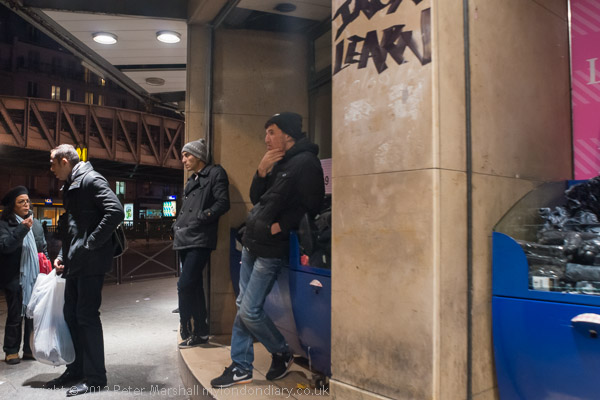
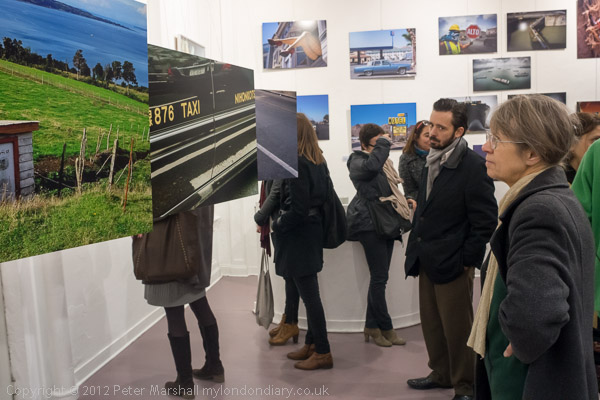
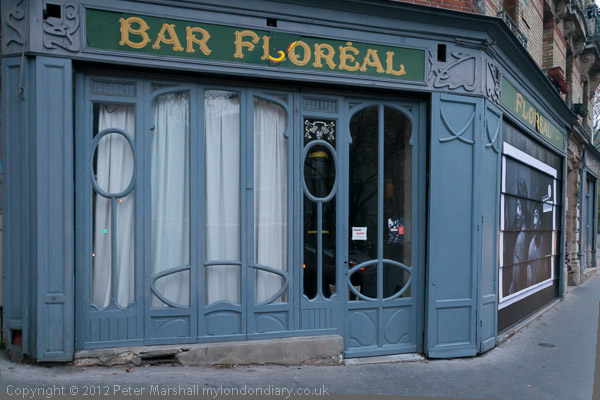
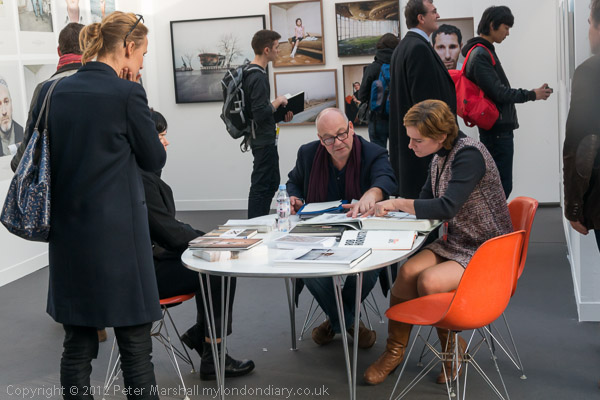
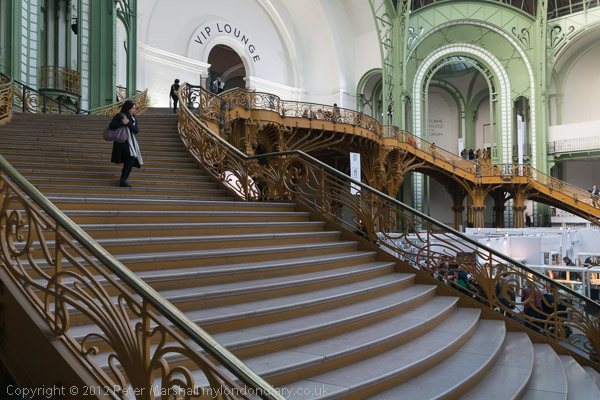
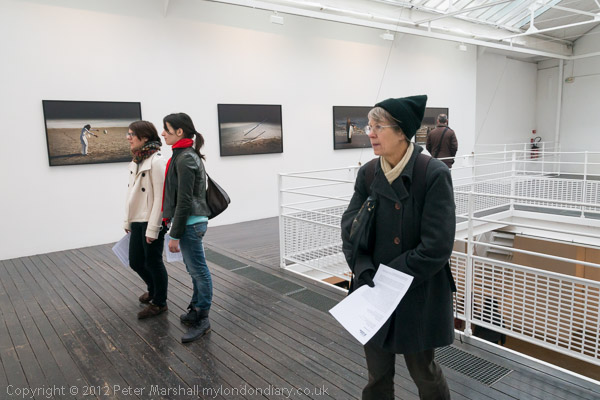
After lunch I took the Metro to Paris Photo – and this time I knew where the entrance was and the excessive security had gone – I simply had my pass scanned and walked in. I was also able to see the show of work by the Beckers, which I’d been stopped when I tried to view during the press launch. Predictably and perhaps appropriately it was extremely thorough and rather boring; though I admire the quality of their photography I find their overall approach with its rigid framework depressing.

© 2012, Peter Marshall

© 2012, Peter Marshall

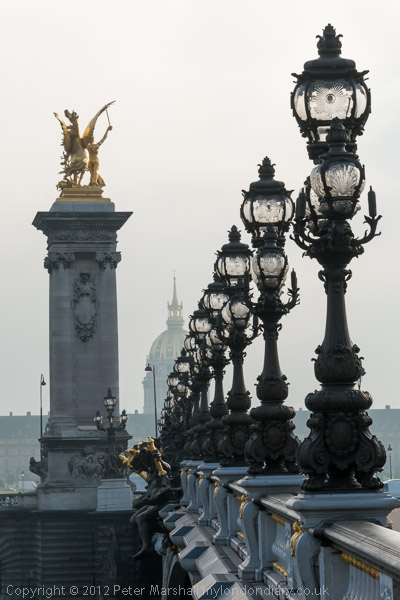
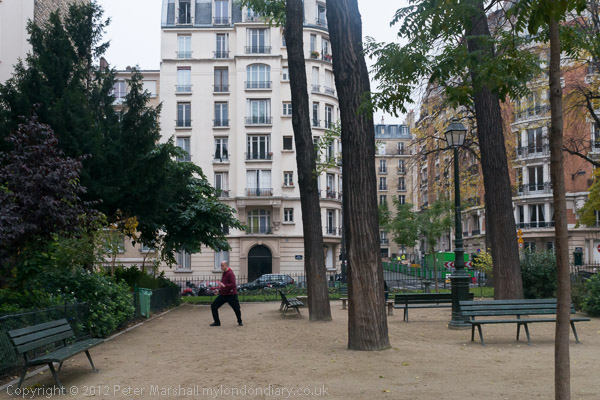
But I’d soon completed my tour around the whole show, and was keen to get out and into the sunshine which had replaced the morning’s dull cold drizzle. I walked across the rather incredible and ridiculously ornate Art Nouveau Pont Alexandre III, like the Grand Palais opened for the Universal Exhibition of 1900 and along the Quai d’Orsay. Apparently I managed to drop 3 different “gold” rings that I had never possessed on the way, a common scam but this was the only place I came across it – and serially – on this visit. As I passed the Assemblée nationale the band of the Republican Guard marched out, but the traffic defeated me as I tried to cross the road to photograph them.

© 2012, Peter Marshall

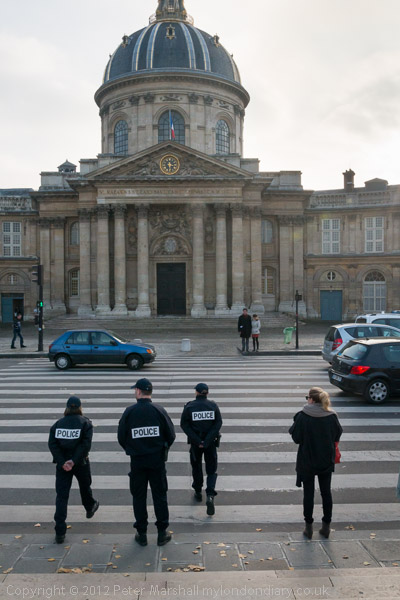
I was heading for the Institut de France, opposite the Pont des Arts, surely in danger of collapsing under the ever-increasing load of padlocks which are spreading from here across central Paris. These ‘love-padlocks’ are an ugly recent ‘tradition’ and I think a shame that the authorities don’t invest in some bolt cutters and remove the lot, though doubtless many will disagree; apparently they were removed a couple of years ago but have since sprung up in their millions. Perhaps Paris should follow Moscow’s example and provide some special iron trees for those who want to lock up their love symbols and adopt zero tolerance elsewhere.

In the Institut, l’Académie des beaux-arts was showing the work of Françoise Huguier, winner of the 2011 Prix de Photographie de l’Académie des beaux-arts – Marc Ladreit de Lacharrière. The prize enabled her to carry out a large-scale project ‘Vertical/Horizontal,Interior/Exterior: Singapore – Kuala Lumpur – Bangkok photographing the growing middle classes of South-East Asia. As well as being a part of the Mois de la Photo, this was also in the 2nd Saint-Germain-des-Pres Photo Festival which was also taking place. Hugier is well-known for her work in Africa and the far East, as well as for fashion photography, but I found this particular show just a little disappointing, somehow lacking a kind of decisiveness and focus.

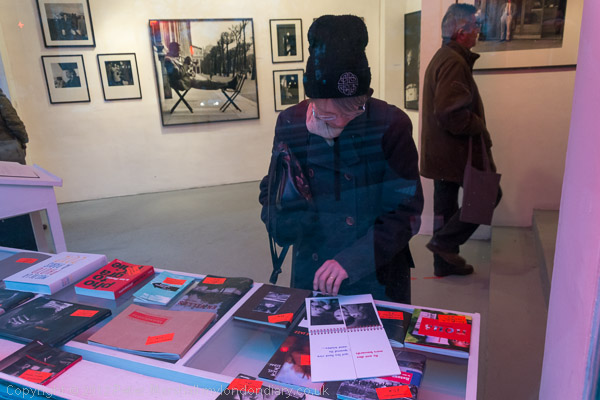
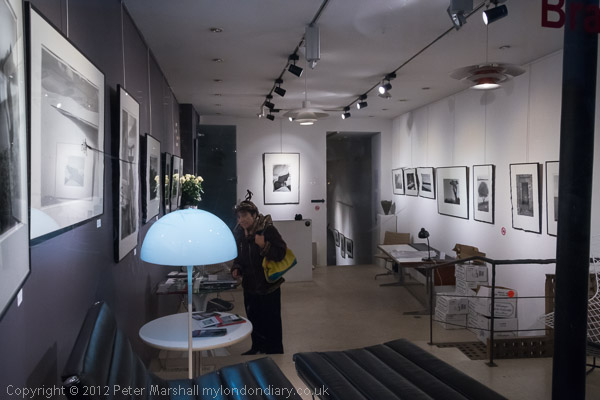
Around the back of the Institut, galleries came thick and fast as I explored the roughly 35 venues of the SGdP festival in the rue de Seine, rue des Beaux-Arts, rue Mazarine as well as a several other shows that weren’t listed. Time was short, so some got only a cursory glance to establish I had little interest (and in some cases the view through the window or door was enough) but in most I went in and walked around.

© 2012, Peter Marshall
A view from the street of Xavier Roy’s show

There were far too many to list them all, but among those I found most interesting (in no particular order) were Bernard Plossu‘s ‘Voyage Mexicain’ at Librairie Mazarine, Isabel Muñoz at Galerie Seine 51, a comparision of the American and Soviet dreams with work by Evgueni Khaldeï  (1917-1997) and John Craven (1912-1981) at Galerie Aittouarès, Thomas Jorion‘s ‘Palais oubliés’ at La Galerie Insula and a truly fine  show of work by French photographer Xavier Roy, ‘J’ai toujours rêvé de découvrir le Brésil…’  There is more information about the festival in the press dossier.

© 2012, Peter Marshall
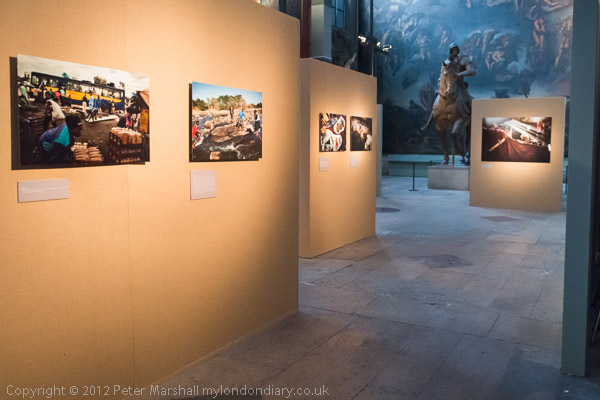
Part of Robin Hammond’s show in the Chapelle de l’Ecole des Beaux Arts

But certainly the most impressive location, as well as some fine photography was at the Chapelle de l’Ecole des Beaux Arts, an interesting building recently renovated, where Robin Hammond‘s project on Zimbabwe the prize winning entry in the 3rd prix Carmignac Gestion for photojournalism. The work too was stunning. Hammond worked for two years in the country and this April was arrested and held in jail for over three weeks for photographing without accreditation before released to leave the country.

My final call was at Galerie LWS for a show in the Mois, John Gossage‘s ‘The Thirty Two Inch Ruler’ at galerie LWS. Published in book form a few years ago, this was his first project in colour, and they were impressive prints even though I found the overall series a little too bland. Its doubtless the subject matter, the comfortable private estate on which he and many of Washington’s most privileged live. There is a good piece on the book on Muse-Ings.

© 2012, Peter Marshall

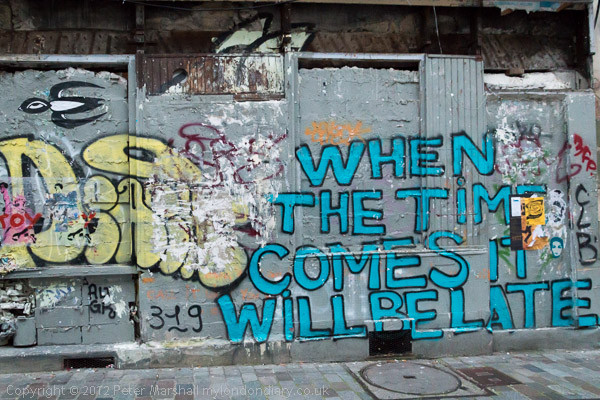
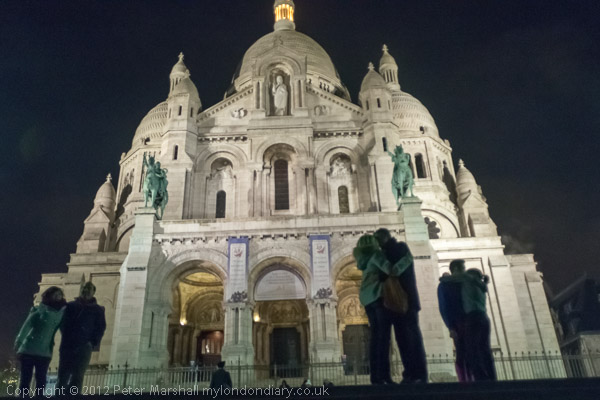
By now I was late, as I’d promised to meet Linda (who’d gone to see a film) back at the hotel to go to some openings. But dusk was falling as I rushed across Pont Neuf to the metro, and I couldn’t resist making myself just a few minutes later by taking a few pictures.
Continue reading Paris: Thursday Afternoon

Paris: Thursday Morning

Paris Photo doesn’t open until noon, so I had the morning to see some shows outside before returning to continue my work inside there. I suppose the kind of people who buy photographs don’t like to get up too early – or perhaps there is some other reason for them keeping the hours they do. I suppose it does mean some people will come on there after work as it stays open until mid-evening.

© 2012, Peter Marshall

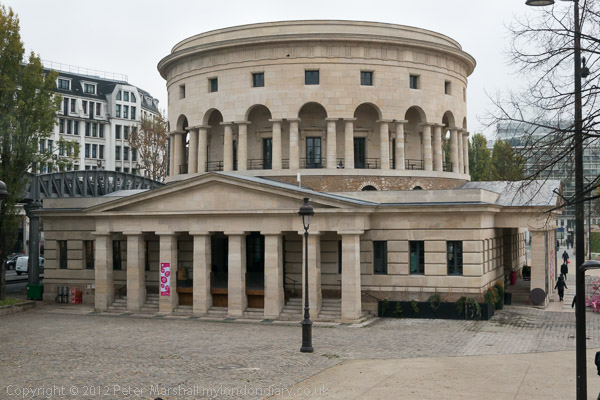
It was raining slightly and rather cold as we left our hotel and walked to the Place de la Bataille-de-Stalingrad, where I’ve previously been many times to admire one of Paris’s great buildings, the Rotonde de la Villette, a classical cylinder designed by Claude Nicolas Ledoux and built shortly before the Revolution as the offices for the tax collectors and guards who took the taxes on goods entering Paris. Now it’s been renovated and La Rotonde is a restaurant, but I’d not come here to eat but to see a Magnum show that was about to finish which was on the open area between it and the Bassin de la Villete.

© 2012, Peter Marshall

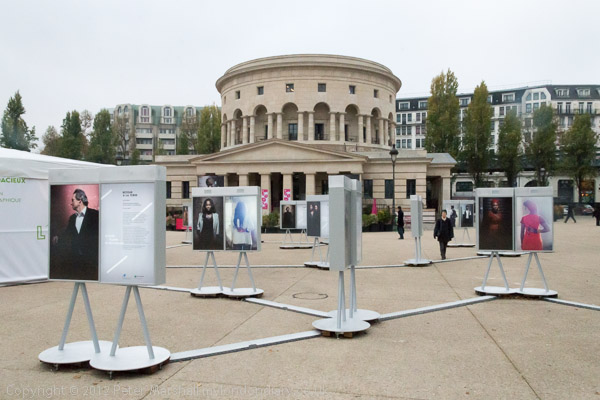
Surrounding a large closed tent were a number of double-sided stands, linked to the tent by a like the tentacles of an over-legged octopus. Each of the 36 carried a series of pictures of a young entrepreneur, the founder of a micro-enterprise, and they incorporated loudspeakers which told you their story. The photographs, as you would expect from Alex Majoli and Jonas Bendiksen, were competent, but this was largely good commercial work than portraiture with more depth. I listened to a couple of the stories, then left Linda listening and walked around the area taking more pictures.

© 2012, Peter Marshall

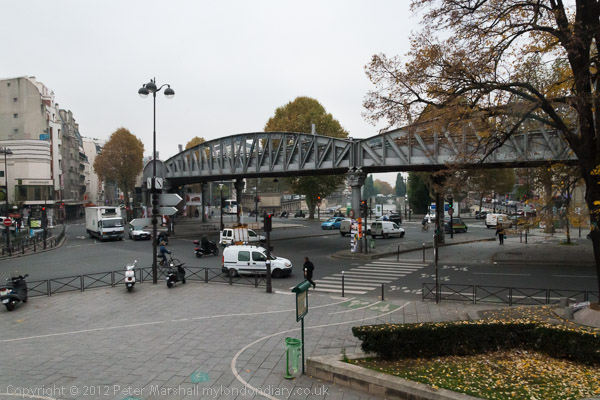
The area has been tidied up a lot in recent years, and what was once a slightly disreputable place is has gone up considerably in the world, although with many of the old canal-side buildings having gone and new modern offices and other buildings having sprung up it is rather less interesting. Some find the métro aérien whose viaduct goes across the square ugly, but it is certainly truly Parisian, and I rather admire its heavy nineteenth century ironwork.

© 2012, Peter Marshall

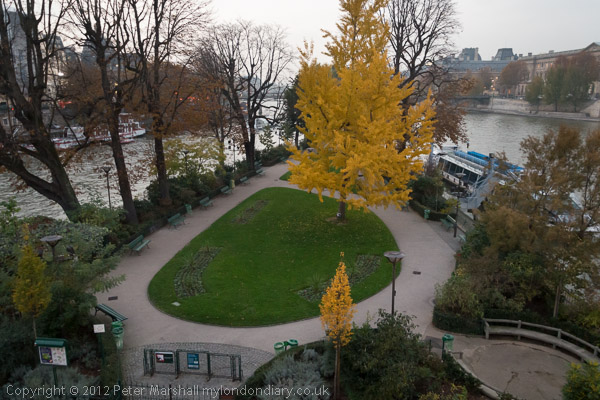
The trees are covered with bright yellow leaves – its the time of year when once I used to hide the colour film and work only in black and white, there are only so many autumn images I ever want to take – and I indulge myself a little, before turning back to the austere pavilion.

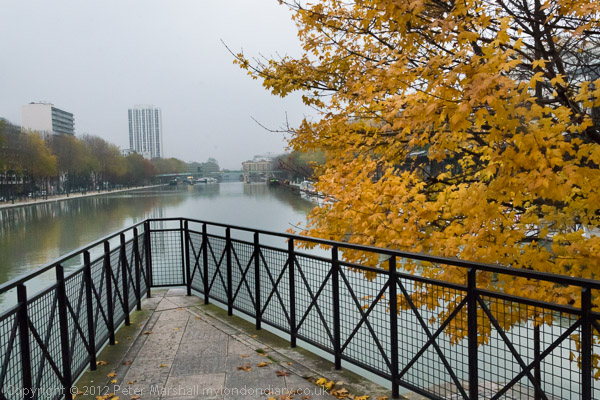
Eventually Linda has listened to enough of the stories and we leave, walking south down beside the Canal St Martin, past a couple of locks to one of my favourite Paris views – I have a salt print I made years ago hanging in my living room (I don’t quite go back to the Fox Talbot era, but got interested in trying out the historic processes including salt printing, platinum, gum bichromate, cyanotype and more that I had to mention in the history course I taught.) I like to go back there and see how it has changed and also try to make some slightly different views.

© 2012, Peter Marshall
Rue Bichat/Quai de Jemmapes, Paris 10e, 2012

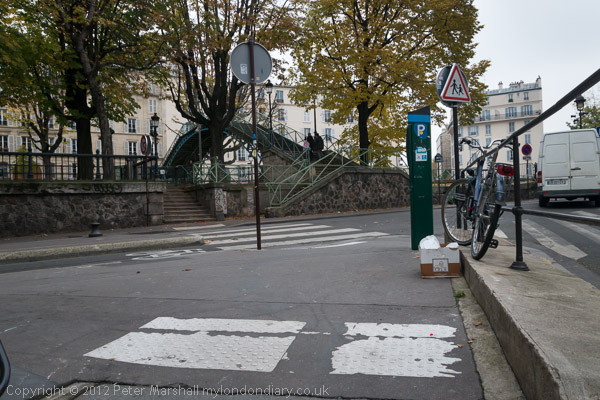
At this point I lost Linda who had gone to look at the park opposite while I was taking pictures, and I found I couldn’t get a signal to phone her. Eventually I saw her in the distance and we met up, but by now it was rather later than I’d expected, and we walked quickly down to the Place de la République, close to which were several galleries which were open from 11am. I’d written down the address of the first with the wrong street number, which made it hard to find, but being Paris, we found two other galleries with unlisted shows first, which were actually slightly more interesting.

© 2012, Peter Marshall

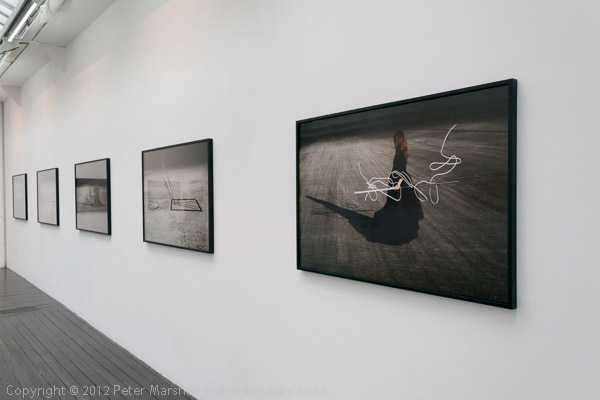
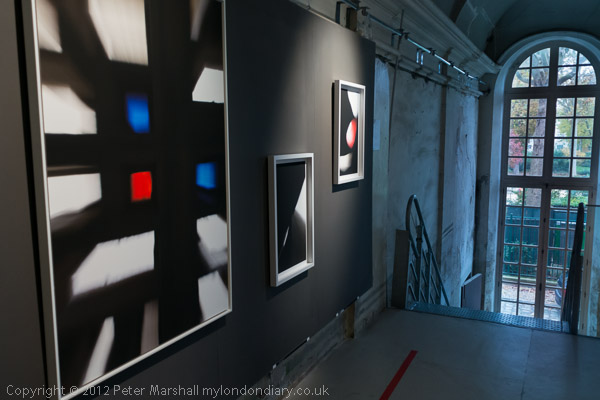
Our next stop was one of Paris’s nicer galleries, la galerie Les Filles-du-Calvaire  which was showing Corinne Mercadier‘s Devant un champ obscur. The lower floor (above) had a series of large colour prints of scenes taken in what seemed to be an empty and deserted building, all of which had been inverted to a negative.

© 2012, Peter Marshall

On the upper floor were staged images, some involving people with blocks or balls. it wasn’t really my sort of work. There is what seems to be a full set of the images on the gallery site, and if like me you are curious about the negative images you can copy them and drop them into Photoshop and then invert them (Ctrl+I). Of course I wouldn’t dream of posting Mercardier’s images treated in that way here, but here’s a more or less random image from my own collection (actually a crop from a panorama I was working with yesterday) treated in the same way. The clouds certainly gain in menace.

© 2012, Peter Marshall

© 2012, Peter Marshall
Gravesend, 2000

I know of photographers who always scan their transparencies as negatives and then invert them, claiming that with their software and hardware they get better results, though I’ve never found that to be the case. But certainly the negative world is a rather strange case as many photographers know, and back in the days when we all used black and white film we got quite adept at mentally flipping negatives to visualise the positive they would print. Colour negatives added a different dimension (and an orange mask) that made this – at least for me – largely impossible.

The first negative prints in the world of photography of course date from before W H F Talbot, who produced them in camera in the 1830s as ‘photogenic drawings’ (and a little later as calotype negatives), to the cameraless experiments of Wedgewood and others, and at Paris Photo there were a few examples of prints from the earliest photographically illustrated book, the splendid Photographs of British Algae: Cyanotype Impressions by Anna Atkins which she started to publish in 1843.

Mercadier’s large negative images were made from much more subdued subject matter than my trivial example, and the large expanses of white wall in the deserted building result in very dark images, powerfully so. They had a presence that I found lacking in the dream-like staging in her works in the upper gallery, which to me bordered on the ridiculous, a kind of game-playing of ultimate insignificance, bolstered by the kind of philosophical statements which the French education system glorifies and inducts.

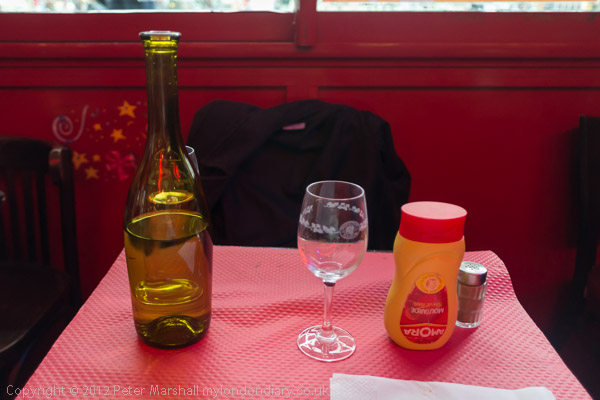
It was time for an early lunch, taken in a brasserie full of Parisians, many noisily celebrating the arrival of the Beaujolais Nouveau, a triumph of advertising over common sense and taste. I had to work in the afternoon and stuck to a single glass of beer with my extremely tasty plat du jour, Beef bourguignon with some deliciously cooked pastry wrapped potatoes and bread, though a red, but certainly not Beaujolais Nouveau, would have been even more appropriate.

Continue reading Paris: Thursday Morning

Paris – Wednesday Morning

© 2012, Peter Marshall
The park next to Espace Central Dupon

Fortunately I’d been able to pick up one of the Mois de la Photo OFF booklets at the Speos Gallery the previous evening, as this morning although I could log on to the hotel’s wifi it wouldn’t give me Internet access. Linda had also bought a copy of the Paris listing magazines which also had most of the major shows, so we were able to make some plans for the day.

While on line the previous day I’d noticed that this was the last day for one of the shows in the Mois de la Photo, and as it was, like our hotel, in the 18th arrondissement and open from 9am we decided to start there (though a little later in the day.) It would have been a longish walk so we took the Metro, and then sat for a while in the park next door to the lab enjoying the atmosphere (with a sound track of screaming infants playing on the swings) and eating a croissant or two before going in to see the show at the Espace Central Dupon, one of Paris’s best pro labs.

© 2012, Peter Marshall
The statement for the show by Transit at Espace Central Dupon

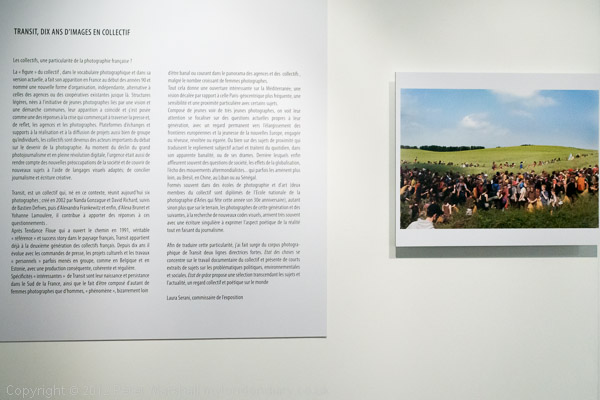
The show there was by a collective called Transit, celebrating their ten years of existence since they were founded in 2002 by Nanda Gonzague and David Richard – who were later joined by Bastien DefivesAlexandra Frankewitz and finally Alexa Brunet, and the text suggested that such loose collectives as this might be particular to French photography. I wasn’t sure about this, but it was an interesting thought, and some years ago I’d written a couple of pieces about a similar grouping, ‘Tendance Floue‘ (and last year here) which was referred to in the wall text as setting the pattern for such groups.

The show itself had some interesting work, some dealing with issues that I’ve also been involved with such as anti-capitalist protests and staged events, but with a truly annoying lack of captions. After some minutes I discovered a single double-side sheet on a table to the side of the show which had thumbnails and brief captions, and photographed it. Even this was defective, in particular that it didn’t tell you which of the photographers had taken the picture. It would have been rather better to have had captions on the wall next to the pictures as they were essential to appreciating the work. There are pictures that don’t need captions – but these certainly did.

From there the Metro took us to a show where I was confident of being able to pick up the printed brochure about the Mois de la Photo, at the Maison de l’Architecture en Ile-de-France, which was showing Jean-Pierre Porcher‘s ‘Le Corbusier, Une Promenade Picturale‘.

© 2012, Peter Marshall
Jean-Pierre Porcher’s Le Corbusier, Une Promenade Picturale at the Maison de l’Architecture en Ile-de-France

The images were large colour semi-abstract works made in some of Le Corbusier’s buildings, and it was possible in some at least to see the connection between the images and the buildings in which they were made, with some recognisable elements. Some were hung on the walls, but most were displayed in frames laid horizontally or at a slight tilt on top of a number of tables in the middle of the space.

The high quality inkjet prints certainly had a powerful presence, and were notable for the purity of their colours, though for me the effects, perhaps produced through multiple exposures and other tricks of photography were somewhat at odds with the clarity and precision of modernist architecture. The colour too in some images perhaps reminded me more of Mondrian than Le Corbusier. Again the captions were separated from the works, which were numbered but apparently displayed in fairly random order, making it a little difficult to find the several images based on the building with which I was most familiar, the Villa Savoye at Poissy, having photographed it myself a few years ago.

And as expected, I was able to pick up a printed copy of the programme for the Mois, an essential document for the rest of my visit. Of course the Mois has a good web site, but the logistics of going to see shows is complicated by dates and is opening days and times. Most smaller galleries only open in the afternoons, and are generally closed on Sundays and Mondays. Most places are closed on Mondays but shows that take place in business premises are generally open from Mondays to Fridays from some time in the morning until around 6pm. Lots of places are open on Saturdays, rather more on Saturday afternoons and rather fewer on Sundays – mainly in the afternoon. I think the well-prepared visitor would set up a spreadsheet or data base and spend several weeks planning their visit, but I use more primitive methods – like going through the booklets about the Mois and scrawling M for morning, SM for Saturday and D for Sunday at the side of appropriate entries. In previous years I’ve downloaded and printed out a PDF version to plan in advance, but this year I’d been too busy.

© 2012, Peter Marshall
After lunch

A second reason for going to the show at the Maison de l’Architecture was that it was on the way to the bistrot where I wanted to eat lunch, somewhere in the 20e, though it gets crowded enough without me giving it a free advert. Another thing I’d forgotten to do before I came to Paris was to check exactly where it was, but fortunately it didn’t take too long to find.

© 2012, Peter Marshall
Buttes Chaumont

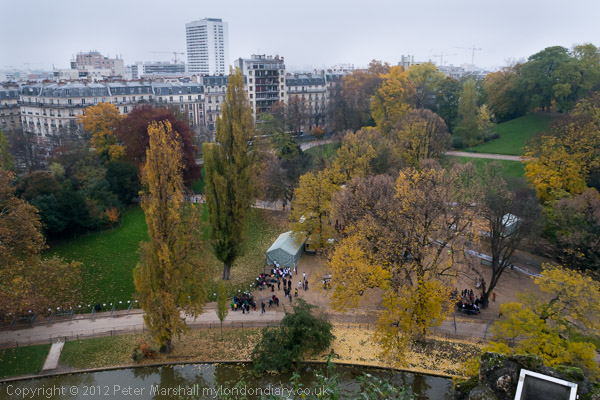
Afterwards we took a short walk to our favourite Paris park (full or larger screaming kids taking part in some sort of race), looking rather good in Autumn colours, before I decided it was time to make my way to Paris Photo.

Continue reading Paris – Wednesday Morning

Paris Openings – 13 Nov

© 2012, Peter Marshall
Yes, I was really in Paris!

We arrived at our hotel in Paris a little after 4pm, having left home around 5 hours earlier. The first thing we did when we arrived at Paris was to recharge our Navigo cards; rather like an Oyster card in London, but the 7 day fare is only available to cover Monday-Sunday, so we lost out slightly by buying it on a Tuesday. But since it costs roughly half the price of a similar Travelcard in London we weren’t too bothered.

We actually walked to the hotel, which I’d chosen because it was cheap and close both to the Gare du Nord where our Eurostar arrived and to a very useful Metro station. It was in an area I knew well, and one which has a fairly unsavoury reputation, but we’d stayed around there before and it hadn’t been a problem. And the hotel turned out to be reasonably comfortable and very quiet, despite being only a short distance from a couple of main roads and the Metro line.

Having taken my usual 2 minutes to unpack, out came my notebook computer, and after finding the hotel’s wifi password I was able to get online and on to the site for the Mois de Paris Photo OFF to check up on the events that I knew were taking place that evening. Fortunately on this occasion I managed to get a connection, as stupidly although I’d looked up the events a couple of days before I hadn’t noted down the details, and I had no printed documentation.

The Photo-OFF has a great web site, though only one page of it is in English, which tells you what it is: ‘The Mois de la Photo-OFF is organized by Paris Photographique, a non-profit structure specialized in the organisation of fine art exhibitions that showcase the work of emerging and established, independent, contemporary photographers. Organised by photographers for photographers, the aim of our exhibitions is to encourage emerging photographers to exhibit and sell their work‘ and just a little more, including the fact that there is “no other documentation available in English.” But you hardly need it as the rest is pretty obvious, although the translation feature of Chrome came in handy for the statements about the shows. As well as listings of all the 100 shows in the festival with pictures, details and maps it has a great calendar of events day by day, from which it was easy to find the four openings that were taking place that evening. Three of them were in roughly the same direction and we decided to go to these before finding a restaurant for some dinner.

Görkem Ünal‘s Mythologies was showing at the Speos Gallery in rue Jules Vallés in the 11e, opposite the Spéos Photographic Institute where she teaches studio photography. Born in Instabul she spent some time in the USA before settling in Paris ten years ago.

I found her work difficult to relate to, and the text that accompanied it, with sentences such as “Just like mythologies working in silence, the images of Görkem Ünal allow emptiness to exist as energy; energy of anticipation, of a secret foreseen which renders the mystery active” didn’t help me.  Although I found some of the individual images interesting, and there were some links both graphic and in terms of subject matter between some images to create a sequence the photographs for me didn’t become “the mirror of the soul.”  But perhaps I lack the kind of soul necessary for this work. Ünal has a blog on which you can see some more work,  as well as a website.

Our next call was at the Galerie OFR for ‘Insight Paris‘ by Gianluca Tamorri, born in Rome, who came to Paris in 2005 and began this project, self-publishing a limited edition book ‘75003‘ with 48 photographs in 2011. Although I found the show with only 13 images rather disappointing, it looks a lot better on-line on his web site where there are 115 photographs, many of them rather intriguing, taken on his daily walking around the city. I think the prints on the gallery wall were too large and perhaps in most cases lacked the intensity of the smaller on-line versions.  You can also read more about him and the project on his blog – where you will find an interview with him by Kai Berhmann for ‘Top Photography Films’.

OFR in rue Dupetit Thouars in the 3e looks to be a very good photography bookshop as well as a gallery space, but really I just don’t have the room for more books, and would have found it hard to carry them home so I forced myself not to buy one or two that I’d not seen before that looked interesting.

It was then a shortish walk through one of our favourite parts of Paris by the Canal St Martin to the third opening at Galerie B&B in the rue des Récollets, where Elise Prudhomme, one of the gallery managers there, was showing self-portraits examining questions about self-representation and self-awareness which she took in 1992-3. Like the two other photographers whose work I saw tonight she grew up elsewhere and settled in Paris.

Born in Philadelphia in 1970, Prudhomme started working with a medium format camera while studying Art History at Smith College, and she attended the Maine Photographic Workshops in 1991. Perhaps because of her training in the USA, the work in her show Auto-conscience stood out for the quality of the printing – perhaps not as highly regarded in France as in the USA. It also impressed for its coherence, although the question that came to my mind looking at some of the images was not the ‘Who Am I?’ of the photographer’s statement but ‘Where are you?’, with the surroundings sometimes seeming more interesting than the body, with a rather fine bath and more. Perhaps having an architect for a father gave her the fascination with space that some of these images display.

It’s worth clicking on the images on her web site to see the larger views, and I also enjoyed seeing the work ‘Le Jardin‘ and the colour images of Albert Kahn Garden in Boulogne-Billancourt.

Unfortunately I’d rushed out to catch these openings and while on the Metro realised I wasn’t carrying a camera, so there are none of my pictures from these three openings. I hoped I’d left it back at the hotel rather than on a train, and was very relieved to find it was there when we called back to look for it before going out for a meal. So here are a couple of picture taken after that to show we really were in Paris.

© 2012, Peter Marshall
Linda on the way back to our hotel after dinner

Continue reading Paris Openings – 13 Nov

Zoom to Fixed

 © 2012, Peter Marshall

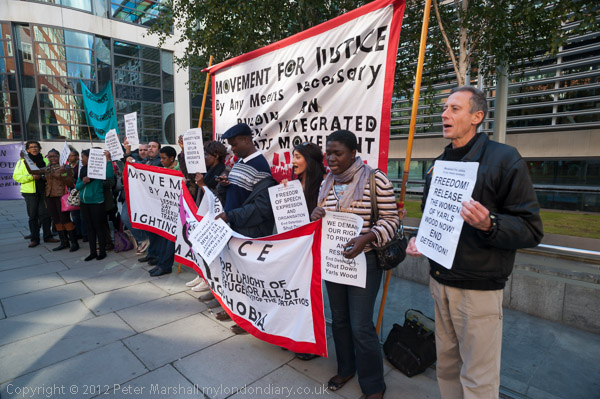
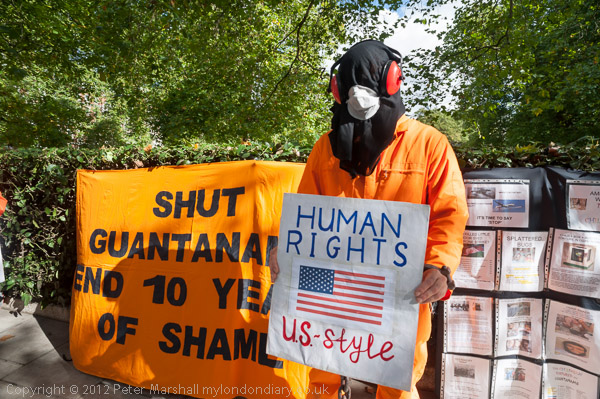
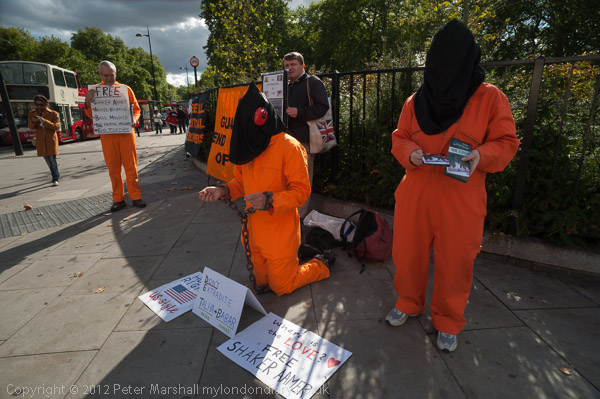
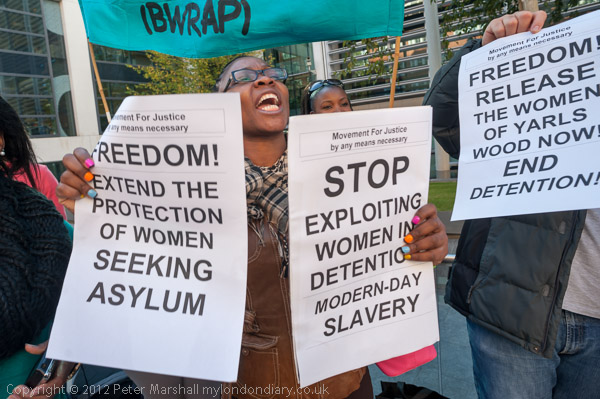
One of my favourite lenses, though not one that I’ve used a great deal for a while is the 20mm f2.8 AF Nikkor, which is a relatively small and light lens. Even with its lens hood it doesn’t make a huge impact on the front of the camera. I had it for a couple of years before I bothered with the hood, as I’d bought it on e-Bay without one, but more recently I’d got round to getting a cheap version of the HB-4 for hardly more than the cost of postage from Hong Kong. The main purpose of lens hoods for lenses this wide is of course to stop your fingers walking onto the lens and leaving their greasy prints to leave their marks on your images, invisible until you see the image large on your computer screen.

© 2012, Peter Marshall

I thought the 16-35mm had recovered from its soaking a couple of days before, but the next time I tried it out the electronics had completely gone – now autofocus would never work and there was no tiny buzz from the VR whether it was switched on or off. The time had definitely come to take it in for service.

It was a few days later that I got the bad news from the repair company. It had, the report said, been subject to impact and water damage and was in need of a new body. I was disappointed – surely one point of pro lenses is that they should take a bit of hard wear and not go legs up; what this lens had been subjected to was what I’d think of as normal professional use. If I can get away without having to have a new body after it (though there are a few bits I could do with a replacement for) surely a lens should.  The repair cost was almost half that of a replacement, which was a blow, and it would take around a week to get the parts and get the job done.

So for the next week or so – it turned out to be a little longer before I could go and collect it – I was without the 16-35mm. I had a choice of lenses available. I still have the old Sigma 12-24mm which covers the full 35mm frame, but is better used on DX, where it becomes an almost direct replacement in terms of focal length – an 18-36mm. I’ve also got a Sigma DX 10-20mm – which is a little smaller and lighter and gives me a 15-30mm equiv.

It was the weather that put me off the 12-24mm, which has a bulbous front element and can’t have a front filter fitted. I’ve been worried about this since I had to have another expensive repair to replace a scratched front element. All the wiping that you need to do in the rain isn’t healthy for optical glass, and while I don’t mind replacing a £2.50 best Chinese UV filter I baulk at the £250 or so for a new front element – as well as the 6 weeks it took Sigma to get one from Japan to London. The 10-20mm was more of a possibility, but although it was fine on a D200 body, I’m not sure about it on the D800E which is more demanding because the sensor is more crowded. Using it on the D700 was perhaps better, but the files are rather small, under 6Mp. So in the end I decided to try working with the 20mm f2.8 as my only wide-angle.

© 2012, Peter Marshall

The 20mm on the D700 was teamed with my usual 18-105mm DX lens on the D800, which may seem a strange way to use the D800E, but one that I really do like. At the wider end it’s a fairly mild 27mm equivalent and at the long end a useful but not extreme telephoto, but the real advantage is in the viewfinder where you can see outside the image area. I’ve moved from using it  with just a frame line for the smaller format to having the non-image area greyed over but still visible. It is incredibly useful to be able to see outside the frame – like with a rangefinder camera, though I’d perhaps like an option to make the grey area just a little less dull compared to normal.

© 2012, Peter Marshall

The only problem I found was that the 20mm wasn’t quite wide enough for a few things I wanted or needed to do, particularly when working as I sometimes have to with a pack of photographers. You do need 16mm at times – and there are even times when that isn’t wide enough, which is why I usually pack the 10.5mm DX semi-fisheye. If that isn’t wide enough you are trying to do the impossible. And that does work pretty well on the D800E, so well I’ve hardly though about replacing it by the 16mm FX equivalent.

During the couple of weeks I used it as my main wideangle I really got to like working with a fixed rather than a zoom lens again, and the smaller bulk and weight certainly felt better around my neck. But it is just a little less versatile.

Though I’ve also been using it at times when I’m not really working but just want to go out without a camera bag, just one camera around my neck. The 20mm on the D800 is a bit like a Tri-Elmar on a Leica (not that I’ve ever afforded one) but by switching from FX to 1.2x to DX you have a 20mm, a 24mm and a 30mm all from the one lens.

All the pictures on this post were taken with the 20mm f2.8 in FX format on the D700 and come from two stories, Shut Down Guantánamo, Halt Extraditions and Justice For Yarl’s Wood Women which you can see on My London Diary.

Continue reading Zoom to Fixed

London Festival Opens

Unfortunately I don’t have time to write fully about each of the five shows I attended on the tour before the opening party of this years London Photography Festival which was held in the Dog Eared Gallery where the major show ‘The Great British Public’ is taking place, particularly as I have a rush job to complete before I flee and lie low for a few days as the country suffocates under a sea of red, white and blue. But certainly this years festival is a quantum leap up from last years somewhat tame London Street Photography Festival, and perhaps if this progress continues London will soon have the kind of photography festival it needs, rather than two events – this and the East London Photomonth – that while interesting don’t really create the kind of buzz that London deserves.

One show not to miss is at the Guardian Gallery at King’s Place in York Way from 1-28 June 2012 open 10-6, 7 days a week. I suspect I have seen most or all of the pictures in Steve Bloom’s ‘Beneath the Surface’ before, because when Bloom left his native South Africa in 1977 he took the “small pile of silver-gelatin black and white prints” to the offices of the Anti-Apartheid Movement in London, and they sent him on to the International Defence and Aid Fund for Southern Africa who published and exhibited them, but that now seems an age ago, distant in terms both of time and sensitivity. It is hard now to believe the everyday nature of apartheid that emerges through his pictures perhaps even more than the more dramatic scenes. Accompanying the show is a free limited edition 24 page newsprint publication produced by the LFP together with the Observer, so go soon to get your copy before all 1000 disappear.

Its a short walk from Kings Place in York Road to the Minnie Weisz Studio in Pancras Rd, where her Camera Obscura is showing (Tue-Sun, 10am – 6pm until 29 June 2012), though you may want to allow yourself an hour or two to explore the redevelopment at last taking place to the north of Kings Cross and across the canal in the former goods yard site. It was in 1987 – 25 years ago – that I became involved for a couple of years with the Kings Cross Railway Lands Group after the first rumours of the comprehensive redevelopment emerged.

© 2012, Peter Marshall

Minnie Weisz’s work is particularly concerned about “buildings on the brink of change” and this area has thus provided plenty of scope for her photographs of room interiors. In some she turns the room into a camera obscura so that an upside down image of the outside world is projected on its surfaces, which she then photographs with a normal camera, sometimes choosing to display the room upside down so that the projected image appears the right way up. It was work that reminded me of Abelardo Morell, though the images in Weisz’ show that most appealed to me were her simple straightforward atmospheric images of deserted rooms with peeling paint.

A couple of doors down is the Hardy Tree Gallery, (named for the well-known feature of Old St Pancras Churchyard) showing the results from “a four year research project by London-based, Saudi photographer Wasma Mansour (1-30 June 2012, 10am-6pm, 7 days a week.) I don’t feel competent to evaluate the assumptions behind her work on the generalisations about Saudi women living alone and the effect these have on their “efforts to reconcile with their identities and asserting their sense of individualism” but for me her exploration with “a multidirectional photographic approach” did not seem to have reached the kind of final resolution that I found satisfying. The set of work I found most interesting did not feature the women but showed what I assume were areas of their living accommodation as still life. But perhaps this is a show that needs to be examined in greater depth than I was able to give it in my brief visit.

Next came the two mainline stations, and first was St Pancras, a building whose rebuilt interior I still find depressing at ground level, even more so when entered from the north-west end. The new concourse at Kings Cross is however more impressive – I just hope they will soon sort out the Euston Road frontage.

© 2012, Peter Marshall

The display at St Pancras is a small collection of work from the group show ‘The Great British Public‘ at the Dog Eared Gallery printed large on free-standing panels (until 1 July 2012, 24/7.) Handy if you are in a rush for a train or can’t afford the £6.50 for the gallery, and of course will be seen by many thousands more than the show, and acts as good advertising for the festival, but essentially adds nothing to the show (see below.)

© 2012, Peter Marshall

At Kings Cross there is a large display of panels of Contemporary London Street Photography, which although it will certainly attract much public attention I found disappointing (as too did the group of photographers I met there looking at it.) Although there were a number of good pictures (including several by personal friends), the whole long wall gave me a powerful feeling of deja-vu. Of course some of the pictures I had seen before (and I’m sure there were one or two that were in last year’s festival) but it was more that these were pictures very like pictures I had seen before and largely the kind of image that very soon exhaust themselves, pictures better suited to a digital world where the next image is a mouse click away or quickly changes to the next image in a slide show, sometimes only visible for a fraction of a second. It’s perhaps unfair on at least some of the photographers, but overall this was my feeling. There was something very dated about much of this work, and an over-reliance on graphic effect, a confusion of means as ends. For me photography is essentially about content and too often here it was lacking.

© 2012, Peter Marshall

The Great British Public group show at the Dog Eared Gallery in Field St, a short walk away down the Kings Cross Road (1-24 June 2012, 10am-6pm, 7 days, £6.50) is a ragbag, but at times an engaging one. Oustanding are set of http://chrissteeleperkins.com/personal.php portraits of centenarians, looking extremely young and healthy, and head and shoulders above the rest of the work in the room not least for the sheer professionalism, but also for the sensitivity of the photographer, Chris Steele-Perkins. Another very fine piece of work is Liz Hingley’s Under Gods, pictures from the urban multi-faith communities of Birmingham’s Soho Road, undoubtedly one of the finest recent British documentary projects, although I would have liked to see the prints a little larger (and better lit than some were for the opening.) Martin Parr’s few pictures from his Black Country project that he can still take good pictures when he puts his mind to it, even if sometimes in other work he seems to be coasting on his reputation, and there were a number of other pictures around the room that appealed to me even if I felt rather disappointed at the quality of some of the work on show.

There are of course other shows in the LFP, as well as talks and workshops, and you can find about about everything on the LFP web site.

Signs & London Festival

Let This Be A Sign

I was pleased to arrive at Swiss Cottage Library last night for the opening of what I think is the first show of the London Festival of Photography, “taking place throughout June with a focus in King’s Cross, Bloomsbury, Euston & Fitzrovia. ”  A little outside this both physically and temporally, ‘Let This Be A Sign‘ by Simon Roberts opened last night.

My journey had not been a good one, thanks to a broken-down train at Acton Wells that shut down the Overground service from Richmond, followed by lengthy delays on the longer alternative route via Clapham Junction with trains too packed for everyone to board and I almost gave up and went home. It was perhaps an appropriate introduction to a show that deals with the political and social effects of our continuing recession here in the UK, with nothing in our lives and economy quite working as it should.

This is an interesting show and it continues until 1 July, open with the library 7 days a week, combining 4×5 images printed large with collages of small digital images of protest placards and closed down shop fronts, text,  graphs, and a collection of actual posters and placards on the floor below (and I’m sure I’ve missed something.)  Although I’ve nothing against such a multifaceted approach, I felt it worked rather better in the free newsprint publication ‘This Is A Sign‘ by Roberts, available free at the library which I read at some length on my rather smoother journey home, than in the showcases and on the gallery wall.

We’ve seen several such newsprint publications in the past couple of years, and this, designed by FUEL and printed in an edition of only 2000 is like some others probably destined to become a collectors’ item, so go there soon and grab your copy.  It’s always difficult to know the constraints in mounting a show such as this, but I didn’t quite feel it gelled, and in particular the separation of the posters and placards, possibly dictated by security considerations, was unfortunate. Perhaps too this collection lacked the strength and diversity that those of use who regularly visited Occupy London or go to protests are accustomed to.

Roberts has taken on a large and important topic, and certainly one which is difficult to do justice to. It is also one which politically presents some problems for the council owned venue, and Camden is one of the Labour councils that last year saw angry protests blocking streets outside the council offices and an occupation of the council chamber as well as a high-profile campaign against cuts in its Library service.

Possibly fortuitously, his pictures of protest were made elsewhere, including a couple in the neighbouring borough of Islington, from Occupy Finsbury Square, where Islington Council, who had for many months supported the Occupy movement’s right to peaceful protest announced earlier this week that they would take legal action to regain possession of the site after many living there had ignored a legal notice ordering them to leave by last Friday.

But what I missed most in the show were people as people. Protesters were largely shown as crowds, and other images had people mainly as co-incidental inclusions, standing for example on a street corner looking – as was the photographer – at the after-effects of the riots. In the newsprint a page digital collage of images ‘Brokers with hands on their faces’ stands out from the rest of the work – not because the photography is better (it isn’t) but because it concentrates on people. Later I read the small print at the back of the publication and found that these pictures were not by Roberts but from the Brokers With Hands On Their Faces blog, images from Wall Street rather than the UK. Perhaps for me the strongest image in this publication/show was the one exception, placed deliberately after the brokers, it showed people queuing outside a Sheffield Credit Union.

Perhaps too the strengths of large format are not best suited to covering protest, and the images on display to some extent reflected its lack of flexibility. There are times when the extra resolution of 4×5 film adds a great deal, but I seldom felt it in these images, and in some the printing didn’t help to make the case. Seeing the work in newsprint works better because we have no expectations of higher quality, but also it helps to unify the various aspects of the show.

But this is a show worth seeing – and go soon and get your copy of ‘This Is A Sign’, complete with a blank placard on the cover for you to supply your own slogan.

————————————————————————-

Memories of Swiss Cottage & the Death of Large Format

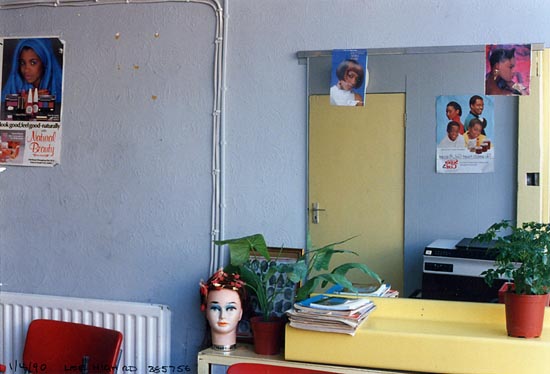
Of course like most openings it was perhaps more interesting for the people that I met and talked to, and few of those present seemed to be paying a great deal of attention to the pictures – though perhaps they had done so more before I arrived. Among those there was an old friend, Mike Seaborne with whom I organised a show  in the central space of this same library in 1993 of work by members of London Documentary Photographers, which included couple of dozen of my own pictures of shop-fronts and interiors, some of which are in the web project ‘Café Ideal, Cool Blondes, and Paradise‘, including this example.

© 1990 Peter Marshall
Lewisham, 1990

Soon after I also helped to organise and took part in two shows in the same venue for London Independent Photography. Apparently it was not possible to put anything from this current show into this larger central space, a shame as this is considerably more visible to the many users of the library who pass by on their way to take out and return books. At least they may see the placards on the ground floor entrance, although I managed to walk past without noticing them on my way in.

Mike and my conversation turned to new cameras, and in particular the Nikon D800E, which we agreed looked likely to make 4×5 totally redundant, so long as it is teamed with the high quality prime lenses which Nikon is now bringing out. Frankly I seldom feel the need for that kind of quality, and have always preferred to work with smaller formats – and if necessary with smaller prints. Curators and photographers I showed the ‘Café Ideal...’ project to in the 80s and 90s often said to me “If only you worked with medium (or large) format …” to which my response was always that for several reasons the work would simply not exist if I had done so, and that the prints were of more than adequate quality for what I needed, particularly as I’ve never been a great fan of large prints – for me part of the essential power of photography has always been that it is an intimate medium, producing objects that one can hold in your hands.

I’m still thinking of getting an 800E, but if I do so I would expect to be using it as a DX rather than an FX format camera for perhaps 99% of my work, and to continue working with my current Nikon zooms. I’ve found the 16-35mm f4 and the DX 28-105mm pretty amazing, at least with a little help from Lightroom’s automatic corrections, and you just don’t need huge files most of the time, though it’s great to be able to make them when you do.

————————————————————————-

Frederick Wilfred

More about the LFP at a later date. Glancing through the festival guide perhaps the most intriguing show is of work from 1956-62 by Frederick Wilfred (1925-2010), who I’d not heard of before despite the fact that we were both at times active members of the same photographic club (though perhaps at different times, and I saw the error of my ways in the early 1980s) which doesn’t open at the Museum of London until 16 June (it runs until 8 July) although you already can see a fine set of his work on line. Probably when I was around he was busy with his commercial work and portraiture.

One thing the two LFP shows have in common is that both include an element of audience participation. In the case of Wilfred, one thing I found annoyingly lacking on his web site were captions, and the museum  which has recently acquired 124 of his pictures is appealing to anyone who recognises the locations (some are of course obvious) or the people in the pictures are being asked to let the museum know.

But it is also a good reminder for us as photographers to make sure that our prints have captions on the back and our digital files include appropriate metadata.

More On May Day

Between the official London May Day march and photographing some of the Occupy London protesters at last managing to occupy their original target, the London Stock Exchange (although only on a token basis – and there are now more pictures on My London Diary) I photographed two very different protests.

I knew that the protests against workfare – unpaid labour that unemployed people are pressured to carry out at least sometimes under threat of losing their benefits – which had begun earlier in the day and had been continued by some of the marchers supporting UK Uncut and the autonomous bloc during the May Day march were expected to continue after then end of the march. I’d been given a hint that one group might target the company who run the scheme whose offices are in deepest Soho, around 15 minutes walk from Trafalgar Square. I left the rally in Trafalgar Square to check, but nothing was happening in the area – and I suspect the protesters were unable to find the place and turned elsewhere, or had simply changed their mind. It isn’t unusual for protests not to happen, sometimes even when they have been quite widely advertised, though I was sure that workfare protests were going to happen elsewhere later.

© 2012, Peter Marshall
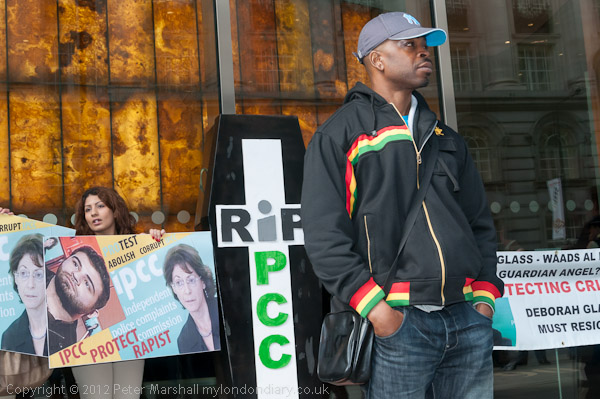
Placards, coffin and Merlin Emmanuel who was one of the organisers

From checking on this I caught a bus to Holborn, where I knew that there was going to be a protest against the so-called ‘Independent Police Complaints Commission’ or IPCC.  Set up in 2004 to replace a discredited body that was widely seen as simply there to deflect public anger without and prevent any real investigation or redress against the police, this replacement body has turned out to be equally lacking in independence or powers. Recently even its boss has admitted it needs reform, when it was not even able to question the 38 officers involved in the fatal shooting of Mark Duggan, whose killing by police sparked off last Summer’s disturbances.

Although in general the British police forces are among the best in the world, they have problems, and have unfortunately failed to deal with them. We can all name high-profile cases where the police have failed, have been shown to be racist, have used inappropriate levels of force, often with fatal consequences, have issued statements known to be false to the press, have lied in court evidence and more and of course there are many more cases that have not received attention in the media. We know that in general police look after their own, and there are few effective investigations of police corruption or abuses, and that prosecutions of police are extremely rare. Cases tend too be neglected, drawn out to excessive length and pushed under legal carpets on into the long grass. And the IPCC, staffed with a high proportion of former police has turned out to be some of the longer grass.

© 2012, Peter Marshall
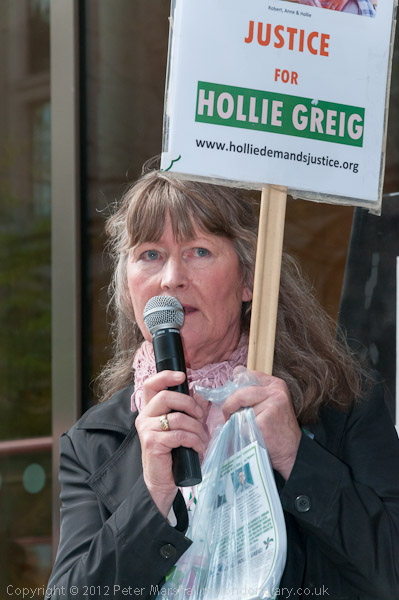
The Scots also have a system to not investigate complaints such as
those involving the abuse of Hollie Greig in Aberdeen

Photographically the main difficulty in covering the event was that little interesting was happening. There were a few posters, placards and banners, and a black coffin with the message RIP IPCC, but it didn’t add up to a great deal to make pictures with. It was just a very static event with people, including a number who were videoing the event well back from the speakers , making it difficult to take pictures without getting in their way.

What interest there was came mainly from the speakers, and some of these were rather undemonstrative, even while some of what they had to say was a powerful indictment of the police and the IPCC. It wasn’t easy to find different angles, and this wasn’t helped by a strong low sun. Things got a little more interesting for me later because of some of the people involved.

© 2012, Peter Marshall
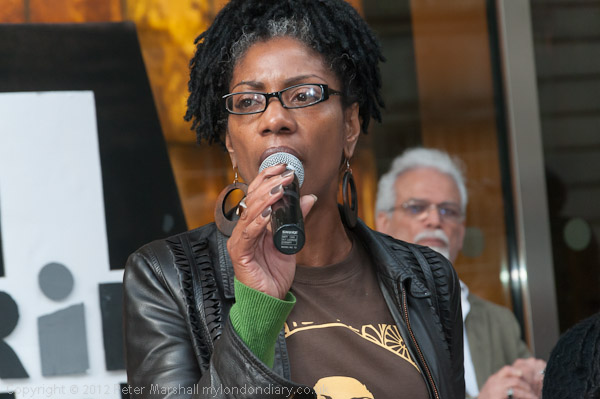
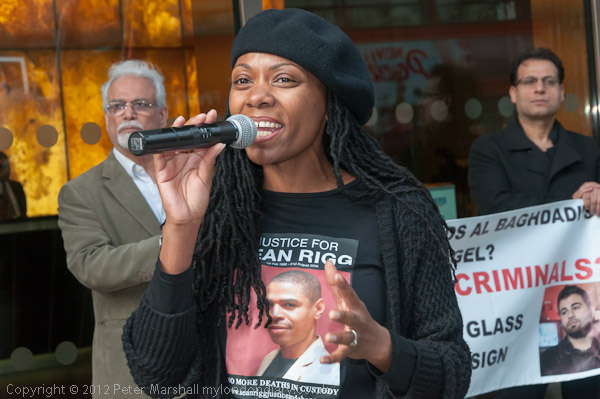
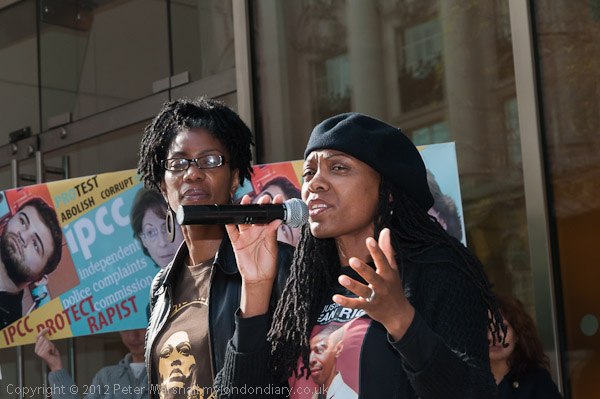
Marcia and Samantha, sisters of Sean Rigg, killed in Brixton Police Station in August 2008
© 2012, Peter Marshall

I’ve photographed Marcia and Samantha Rigg on various occasions over the years since their brother Sean was killed shortly after being taken in to Brixton Police station  in August 2008. As well as campaigning for a proper investigation of his death they have also become leading campaigners for the proper investigation of all deaths in custody and for effective control of police behaviour. Although they were limited in what they could say because of the forthcoming inquest, they gave damning testimony on the total failure and inadequacy of the IPCC.

© 2012, Peter Marshall

Although occasionally the sun went behind a cloud, using flash fill helped improve the lighting in the other images I took of them.  But working from the side the lighting with the sun shining almost directly into my lens was considerably more dramatic.  The kind of result shown here needed considerable work in Lightroom to burn down the sunlit areas as well as adding brightness and contrast to the shadows.

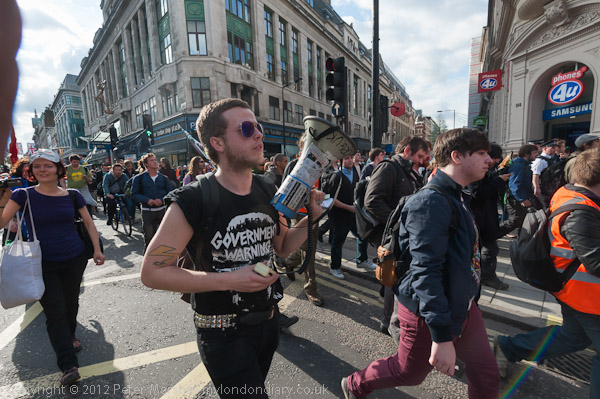
From here I got a bus back to Oxford St with a colleague. Getting on buses on days where extensive protests are taking place is often a mistake, as the traffic can get very badly held up, partly by protesters but often mainly by police blocking off much larger areas than the protest. We got stuck in Oxford St and could tell that something was happening when the police helicopter that we had seen from our seat at the front of the top deck was hovering was more or less directly above us. I spotted a crowd and police a couple of hundred yards away and we rushed downstairs. The traffic was completely at a standstill but the bus was between stops and at first the driver refused to open the doors to let us off, but my colleague and the other passengers persuaded him and we rushed to join the protesters running along Oxford St.

The light was tricky here too, shining low directly behind the protesters.

© 2012, Peter Marshall

That’s my hand at top left – without using it to supplement the ineffectual lens hood the image would have been a mass of flare – you can see a nice ‘rainbow’ effect at bottom right. I could crop it out, but that would lose some of the figure in blue below, which I think would be a shame. Most people don’t realise it is my hand, which after all was there anyway, so why should I remove it?

© 2012, Peter Marshall

A little later, in the Charing Cross Rd there was some nice rim lighting – and again fill flash was essential. One big advantage of modern flashes and cameras is that flash can be used at fast shutter speeds – 1/320th in this case.

© 2012, Peter Marshall

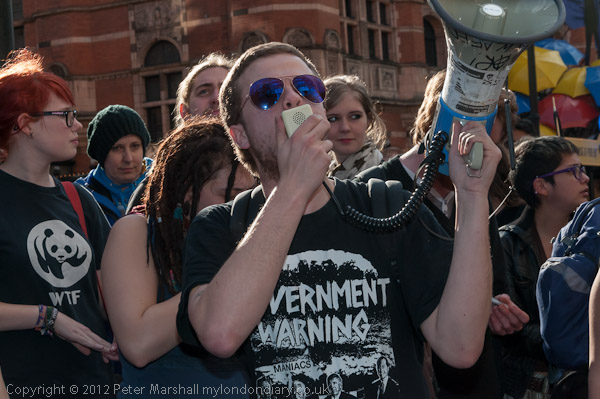
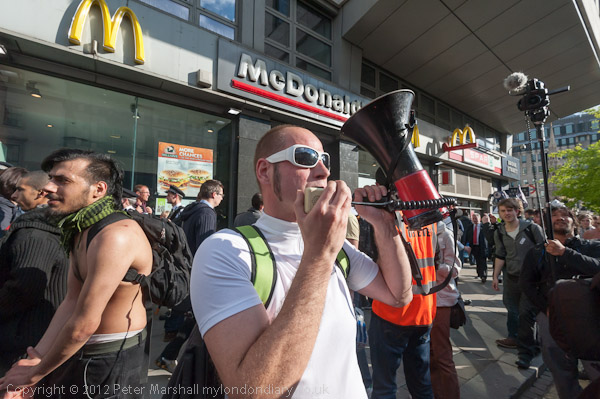
By the time we got to McDonalds on The Strand there was more strong side-lighting which made my picture of a man with a megaphone outside the store more effective – and this time I managed without flash fill, but with quite a lot of work in Lightroom.

You can now see my work from the whole of May Day on My London Diary:

London May Day March
Abolish The Corrupt IPCC
May Day Workfare Protest
Stock Exchange Occupied

________________________________________________________

My London Diary : Buildings of London : River Lea/Lee Valley : London’s Industrial Heritage

All photographs on this and my other sites, unless otherwise stated are by Peter Marshall and are available for reproduction or can be bought as prints.

To order prints or reproduce images

________________________________________________________

Lensculture May Issue

I’ve just been looking at the latest issue of Lensculture, “an online magazine celebrating international contemporary photography, art, media, and world cultures“, and as usual it is worth a look, including some fine photography. (If you read this post some time in the future you will find this issue in the Lensculture archives as No 33)

There are quite a few things I’ve seen before, but even some of those have been revitalised – for example the pictures from a new and expanded edition of Christer Strömholm’s great Les Amies de Place Blanche, first published in 1983, and an expanded version of Robert Adams‘s Prairie from 1978 (which I thought I had bought then but can’t at the moment find.)  Other favourite projects covered in the issue include Chongqing: City of Ambition by Ferit Kuyas (surely one of the best if not the best of the many essays on the new China) and there are other familiar works such as Jocelyn Bain Hogg’s remarkable book, The Family and Simon Norfolk‘s Burke and Norfolk.

But there is other work new to me, some of which I found interesting and just the odd thing that failed to touch me. But overall this is a great read.

Big Ride And More

It was a gloomy and damp day, the rain varying between the occasional spot and heavy downpour as I rushed from what for me counts as a early morning event – 10.30am at Tower Hill for Workers Memorial Day with speeches and wreath-laying at the statue of the Building Worker there to Park Lane in Mayfair for the Big Ride. Of course 10.30am isn’t really early, and only meant me leaving home around 8.45am, but I’ve long got out of the habit of early rising (and had not got to bed until after 1am.) On weekdays I don’t like to travel in the morning rush hour if I can avoid it, because it costs me two or three times as much for the privilege of often standing in a crowded train for 30 or 40 minutes. But this was a Saturday, so at least I was travelling rather cheaper and got a seat.

I arrived at Park Lane just a few minutes after the time I’d been told people would start gathering at Brook St, to see everyone around there cycling away, and thought I might have missed it.  Running with a fairly heavy camera bag isn’t my idea of fun, and I could have done without the 700 yard dash to find where the front of the ride was actually assembling and I was able to take some pictures.  The rain wasn’t too heavy, though it did cause some problems, and working as I do most of the time with a very wide-angle means their is no way to stop drops of rain getting on the lens, its effects usually impossible to spot on the small images on the back of the camera, and this made a few images unusable. Sometimes you are lucky and it isn’t in a really critical area of the picture, as in this case:

© 2012, Peter Marshall

You can clearly see the diffusion it has given on the top left of the sign reading ‘Grannies Want To Cycle Too’  although I’ve reduced the effect considerably in post-processing in Lightroom by darkening the area and increasing contrast and sharpness. You can see it again on the bottom of the flag in this picture:

© 2012, Peter Marshall

I was also trying hard to remember that 16mm is usually a mistake with bicycle wheels at the edges of the frame, and trying to work more towards the 35mm end of the lens.

Although the SB700 flash unit’s instructions are very clear about not letting it get wet, it seemed to keep working fine, and I needed a little fill from it for most of these pictures of people. I still am not quite used to the various buttons and switches on this unit, and after seeing the results  when I got home reached for my black tape.  Since I take more than 99% of the pictures on the TTL setting the unit now has a small piece of tape preventing me from shifting it from that position accidentally. It does take a bit of doing without the tape, but I found I had managed it. Similarly the switch which changes from even to standard and centre-weighted coverage is fixed at the even end. It’s easy to peel off the tape should I need to change the setting.

Incidentally I’ve been pleased so far with the SB700, though even on the wide setting I don’t think it has the same evenness of coverage I got with the SB800. But a little fall-off around the edges is often a good thing. Using the built-in ‘wide panel’ or  the clip on diffusion dome should give more even coverage for those pictures that need it. Without the wide panel in place on the full-frame camera the flash is reasonably even only for focal lengths of 28mm and above. With it the 17mm indicated on the panel isn’t quite true, but using this or the diffusion dome is generally pretty even, and with the two together, things are excellent. But there is a catch. Using the panel or the dome makes the unit much less efficient and increases the recycling time. So almost all the time I work without either.

It is largely a myth that these things make your flash softer. Neither greatly increases the size of the light source, and diffusion without an increase in size simply reduces the amount of the light emitted that misses the subject – unless there are suitable surfaces around to bounce some of it back. To get a softer effect you need a large diffuser or reflector.

For using as fill I now have the flash usually set at -0.3EV and the two camera bodies also with some negative setting, typically also -0.3 or -0.7EV. Often I seem to want a little less fill with the longer lens on the D300, so it’s convenient to use the flash compensation on the bodies to allow for this. Quite why Nikon hide away what is probably the most important information on using the flash in pages E23-E24 of the manual, after a lot of esoteric stuff on advanced wireless operation is hard to understand.

As usual I was spending almost all of the time between actually taking pictures holding my microfibre cloth over the front of the lens to keep it dry, though occasionally using it to wipe the flash too. Mostly it worked, as you can see in Big Ride for Safe Cycling on My London Diary, where there are some better pictures than in this post.

Continuing on the vaguely tech side of thing, here is a pair of pictures, one take on the D700 at 16mm with its normal rectangular perspective and the other on the D300 with the 10.5mm fisheye (almost impossible to keep raindrop free) and then converted to cylindrical perspective.

© 2012, Peter Marshall

© 2012, Peter Marshall

Of course they are from a different viewpoint but give a good idea of the different ways the two depict more or less the same subject.

After then end of the Big Ride (and again I was annoyed to find that while the organisers had said the finish would be near Blackfriars it was actually more or less at Temple, another unnecessary 700 yards I could have done without and which meant me arriving a few minutes too late) I dried out and warmed up in one of my favourite London galleries, the Courtauld Gallery.To be honest I wasn’t that impressed by the current show there, Mondrian || Nicholson In Parallel, though I did feel that while Nicholson’s work looked better for actually seeing the works, Mondrian is actually more impressive in reproduction. But the Courtauld has one of the finest collections anywhere of Impressionist and Post-Impressionist works.

Then, feeling rather better I took a bus to my final event for the day, in Whitehall, opposite Downing St, Support For Palestinian Hunger Strike. By this time the rain had almost stopped too. Again here is a pair of pictures taken with the 10.5mm and 16-35mm from a very similar position which I think demonstrate the uses of both lenses. It was of course a tableau set up for the media, the kind of thing I don’t generally relish.

© 2012, Peter Marshall

© 2012, Peter Marshall

________________________________________________________

My London Diary : Buildings of London : River Lea/Lee Valley : London’s Industrial Heritage

All photographs on this and my other sites, unless otherwise stated are by Peter Marshall and are available for reproduction or can be bought as prints.

To order prints or reproduce images

________________________________________________________