Gang of Two – Only In England

Around 45 years ago, two young men, both with a mission about photography bumped into each other in the offices of the British Journal of Photography and got talking. Despite their very different backgrounds they recognised each other as kindred spirits and became good friends.

One was the son of a respected English artist, who died only months after his birth, leaving his mother to bring up a family on a very restricted income; aided by support from various bodies including the Artists Orphans Fund she was able to send him to one of England’s oddest and most antiquated minor public schools, from where he went on to study to be a graphic designer. The other came from a large Irish Catholic family in the Bronx, where public schools were something rather different.

But both had studied at separate times with the same man, Alexey Brodovitch, a legendary graphic designer and art director, and had experienced the vibrant photographic culture in New York in the early 1960s where they found both had many common friends. Both too had very little regard for the small clique that made up the British photographic establishment of those times, and then and later both made themselves unpopular by saying what they thought about them and their limited perspective on the medium. There is a considerable contrast between what some well-known names now say about Tony Ray-Jones and their relationship with him compared with their views expressed at least in private while he was still alive.  John Benton-Harris continues to challenge with his widely-informed and forthright opinions on the medium.

The two men photographed together very occasionally, with most of Ray-Jones’s pictures being made outside London and most of Benton-Harris’s in and around the capital – John says they agreed to split the photographic country between them along these lines. But they worked together in other ways, educating the editors of Creative Camera and introducing them to many of the American photographers whose work they published, and John printed much of Tony’s work, both before and after his death. The show did contain at least 5 prints he had previously owned for many years, and probably other prints in the first section were among those he had printed for Tony Ray-Jones; certainly the majority were from negatives from which he has printed.

So I was very interested to hear John’s opinion on the show ‘Only in England‘ which featured both work that was printed by (or probably mainly for) Ray-Jones during his lifetime and also new prints made from work that the photographer had rejected as not being good enough.  After its showing at the new Media Space in London’s Science Museum, this opens today (March 28) at the National Media Museum in Bradford and continues until 29 June 2014.

After I’d written my own review of the show (and earlier I’d posted a short note based on the promotional video),  I had some lengthy conversations with John, and was pleased to hear that he was busy writing his own review. Since then I’ve asked him quite a few times how he was getting on with it and finally yesterday he was satisfied that it was complete and ready to be seen.

Finally, with a little computer assistance from me, the review is now up on John’s blog with a couple of pictures, at last completed to his satisfaction.  It is a long piece with the title ‘Only Baloney‘, a title which relates to one of Ray-Jones’s favourite phrases (I think borrowed from Brodovitch), as John mentions in his piece:

‘Instead we were given a lot of phoney baloney (Tony’s polite way of saying bullshit) about how a friendship that never was, and a methodology that has nothing to do with Tony’s way of approaching and commentating on existence by a photographer who claims so much respect and appreciation for Tony and his seeing, yet deliberately ignores the information and other evidence he left us and that is also clearly present in Tony’s prints.’

The review reads very much in John’s own voice and expresses his views about both the show and some of the aspects of the rewriting of photographic history it represents. John did give me permission to put the whole of his review on this site, and I may do so later, but for the moment you can read it on his The Photo Pundit blog.

I was pleased to find that his view is largely similar to what I had previously written about the show, though his close knowledge of both the man and his work gives his view a much greater weight. There is quite simply no one who can speak about Tony Ray-Jones and his photography with greater personal knowledge and authority, although many still seem to want to ignore his views.

And, also on John’s blog there is a great bonus. On March 7, artist Edward Mackenzie, another English former Brodovitch student (he recently moved back to this country and set up his studio in Stoke-on-Trent)  gave a talk at the Media Space, about  Tony Ray-Jones who he met in New York in 1966 him along with Tony’s brother, Philip Ray-Jones.  You can see the two of them in a photograph at the top of another post I helped John put on-line yesterday which is the text of Mackenzie’s talk. It’s an interesting and slightly different perspective of both the man and his work.

Women Are Beautiful

I suspect I would not have bought a copy of Garry Winogrand‘s ‘Women Are Beautiful‘ if it hadn’t been on sale, reduced from £5.95 to £4.50, as the figures still pencilled inside its front cover confirm. Not that I didn’t admire his work, but at the time I was pretty strapped for cash, a father with a wife and young family to support. You can pick up a copy now for around $400 up, more if you want the hardback.

I’ve since bought various other books by and on Winogrand, but this, his second book still remains my favourite, although at the time it was largely dismissed by the critics, savaged by some feminists and bought by very few. Which is why I got it cheap, and why it is rather expensive now.

I’ve almost got around to writing about it a number of times over the last few months, with several exhibitions of Winogrand’s work, and a giant heavyweight volume on him, 465 pages from SFMoMA/Yale, edited by Leo Rubinfien with essays by Sarah Greenough, Susan Kismaric, Erin O’Toole, Tod Papageorge, and Sandra S. Phillips and 460 pictures which I’ve not quite managed to finish reading, though I’ve spent quite a lot of time looking at the pictures. It’s a nice publication and, if you have room on your bookshelves, worth getting, but I think the considerably slimmer ‘Women Are Beautiful’ with its 85 or so plates probably tells you more about the man and his photography.

As well as a book, Winogrand also sold a number of copies a portfolio of the same name, and I think you can see most or all of the pictures (and the cover) from this at the Museum of Contemporary Photography at Columbia College Chicago.

This same portfolio of 30x40cm black and white prints can also be hired as a show from the collection of Lola Garrido through diChroma photography in Madrid. Currently, as
L’Oeil de la Photographie reminds me, this is on show until 23 March in Moscow. Garrido is quoted there as saying “He’s one of the photographers that has done the most for women’s liberation, The first to photograph women as they really are” although whether that view would have gone down well at the UCR discussion Confessions of a male chauvinist pig at the time of the show Rethinking Winogrand’s Women at the California Museum of Photography last year is open to doubt.

Certainly for me one of the attractions of the work was what seemed to be an incredible directness of vision, a spontaneity and an honesty. It wasn’t work that was fitted easily into the times, when any demonstration of male gaze was subject to denunciation as rabid chauvinism. Even now, to judge from the Rubinfien book and show, this work is difficult and under-represented, as commentators including Tyler Green and Nick Shere have noted.

The work from Women Are Beautiful was also shown last year in Worcester, MA, and you can see a viedo of curator Nancy Burns talking about the show at Worcester Art Museum as well as an article in The Daily Beast, which some might find an appropriate title.  The pictures there are reproduced  courtesy of the Fraenkel Gallery, San Francisco, where you can see more of his work from the project.

Most of the text in ‘Women Are Beautiful‘ is by Helen Gary Bishop, with a lengthy essay ‘First Person, Feminine‘, followed by a shorter note about her admiration for ‘Winogrand Women‘ who seem confident, “aware of the place they occupy in space and time.” She sees him as “genuingly attracted by the dynamics of the female being” and having “caught the conflict of the feminine creature: the body as object vying with the self as person.”

Winogrand’s own short contribution is to the point, but I think perhaps has some element of self-deception. He writes:

“By the term ‘attractive woman,’ I mean a woman I react to, positively… I do not mean as a man getting to know a woman, but as a photographer photographing… I suspect I respond to their energies, how they stand and move their bodies and faces.”

His was work that inspired me to go out and photograph on the streets too, with rather mixed results. Many but not all of Winogrand’s women were photographed on the streets of New York where I think street photography was perhaps rather easier and more acceptable. But while I can see why he wrote ‘not as a man getting to know a woman‘ I think it is impossible – and would be unnatural – for men (or at least hetero or bi-sexual men) not to see and react to women in a more visceral way than he suggests. Even the purest photographer can’t deny biology.

Marking the Meridian – The Line

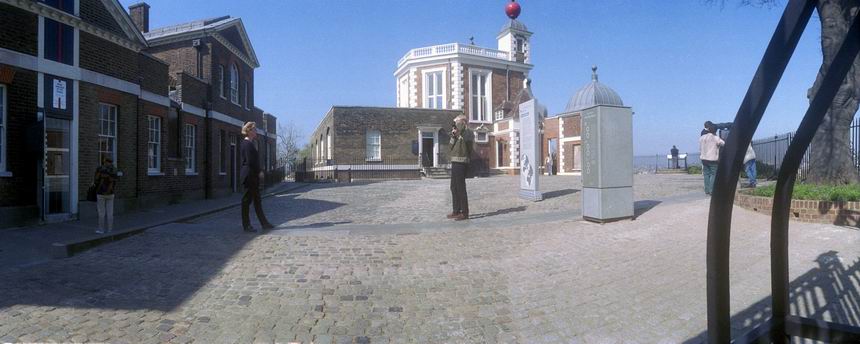
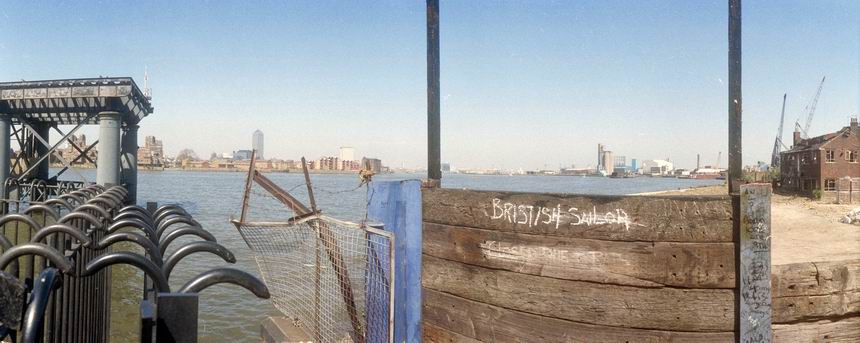
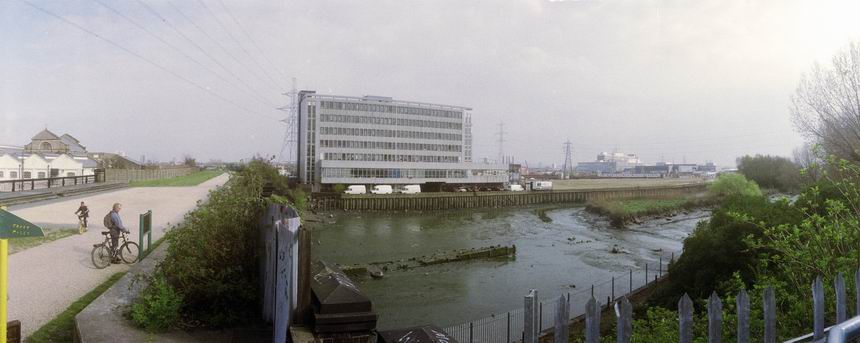
It seems a long time ago that in anticipation of the forthcoming Millennium I embarked on a photographic project to document the Greenwich Meridian in London, but it still came as a shock to work out it was almost 20 years ago that I started. The project obviously came from thinking about time, but also came after I’d completed a project on the DLR extension to Beckton using a series of panoramic images with a swinging lens Widelux camera. The long format was ideally suited to documenting linear structures of the DLR viaducts and I decided it would also be appropriate for the virtual line of the meridian.

At the time I was surprised to find the Meridian line unmarked both on the Ordnance Survey maps and only in rare places on the ground. When grants were being made for art projects to mark the Millennium (or at least the year 2000, 12 months before) I put in for a project to produce a series of Millennium walks illustrated by my images, exhibitions at public libraries and other venues close to the line to publicise it and also to mark key points on the routes by suitable pavement markers. It did not even reach the short list.

Now it is rather easier to walk more of the Meridian, with increased public access at various points on or close to the line. The line has also been added to the maps – with my 1999 edition of ‘Explorer 162’ having a green flash on its cover ‘Showing the Greenwich Meridian‘, and quite a few new markers were added around the year 2000.

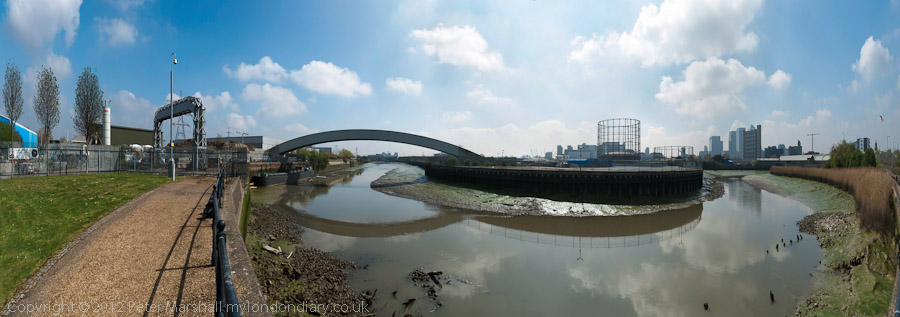
Of course the Meridian is marked at the Greenwich Observatory, both with a line in the yard where people like to pose a leg in each hemisphere, and also on the footpath just outside. There is another marker near the back of Greenwich Power Station, from where it goes along the river Thames, touching briefly again on the south bank near the Millennium Dome (where there is a rather nice linear marker.) It’s marked again on the north bank in the former East India Dock site but a little north of that was an area which when I carried out my project in 1995 was closed off to the public for around a mile, passing through the Poplar gasworks and then an industrial area adjoining the Bromley-by-Bow gasworks, before emerging to public view again at the Channelsea River south of central Stratford.

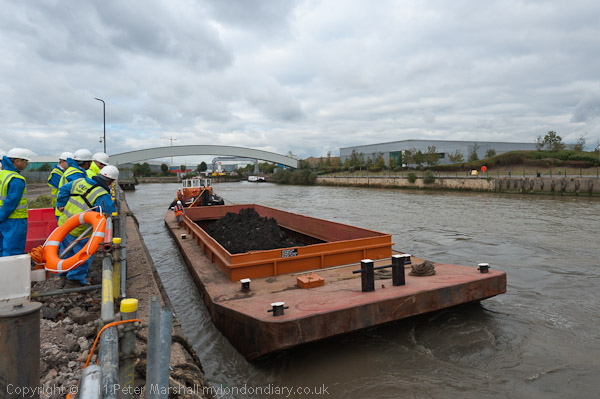
Since 1995 when I finished my Meridian project I’ve been able to access a couple of these areas and make more panoramas. West of Bow Creek I was commissioned to photograph the removal by barge of some of the highly toxic contaminated earth from the Poplar gasworks site, and on the east a walkway has been opened up from the Bromley gasworks bridge by the riverside down to the former gasworks dock, within a few metres of the meridian.

The dock itself, Cody Dock, is also the site a new social enterprise partnership with community and educational activities, and I’ve visited them and taken pictures on a couple of occasions – see Gasworks Dock Revived.

The promotional video for a new project ‘The Line‘ starts with images from Cody Dock, and its aim is to bring world-class modern and contemporary to a new sculpture walk more or less along the Meridian line – and to do so this summer by using already existing works. There are already a few fine works more or less on the line, and it would be great to add more. The project is to be crowd funded and you can contribute on Spacehive.

The Line will link Queen Elisabeth Olympic Park and the Millennium Dome (aka O2) and contain up to 30 sculptures. It will provide a great free walk (though you will need to get across the river – perhaps by that splendid white elephant cable car, which doesn’t come on a Travelcard) and will also go by the World Heritage site of Three Mills at Bromley-by-Bow.

It’s a splendid walk even without the sculptures. Phase 1 of the campaign to get on with the planning and organisation has a target of £146,429 and your pledge will only be charged if the project reaches its goal by St Valentine’s Day (Feb 14). Phase 2 will only start if this is reached and is for around £2m for insurance, transport, security, signage, an App and a book etc.

If you are a world-class sculptor with work currently not on show, applications are now open. But the rest of us can support the project by making a pledge online.

Epiphany

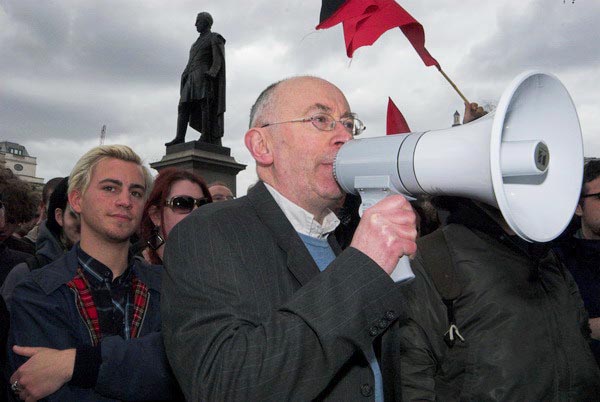
Bone, Ian Bone. I first met him around ten years ago, in Trafalgar Square on the edge of some demo or other. May Day I think. The radical fringe, autonomous bloc, black but very white. I crawled through a densely packed small crowd to where the anarchists were calling for revolt and attempting to clobber photographers who dared raise a lens. Elbows came in very useful, forearms parried fists and I pushed on and found myself photographing Mr Bone.

We met again over the years, and again, usually on the edges of protests, scarpering when the Bill arrived, leaving the youth death squad to be kettled, and I began to appreciate his tactical intelligence. Now it seems he’s a film star. And a director. Dark glasses. But is it the real Bone?

I’ve this memory or dream, standing in front of the lifts somewhere on the South Bank. RFH or perhaps Tate Modern, in a crowd. The lift doors open and Bone pushes in to a lift full of guys in dark glasses. No room for me. I run down the stairs to the lobby; no sign of Bone. No dark glasses. Check the bar. Not there. Sirens wail, blue lights flash along past St Thomas’s, over Lambeth Bridge.

Sitting in a chair in the cinema museum for the première on Sunday, talking to Bond, listening to him with his old mates from Swansea I sense a barrier. No trace of Swansea in him. Is this the real Bone I ask myself or have our spooks replaced him with a clone? Then on screen. Bone or an actor playing Bone? Film always lies, though some of the lies are beautiful, life seen through a glass of beer. Sparkling, not darkly.

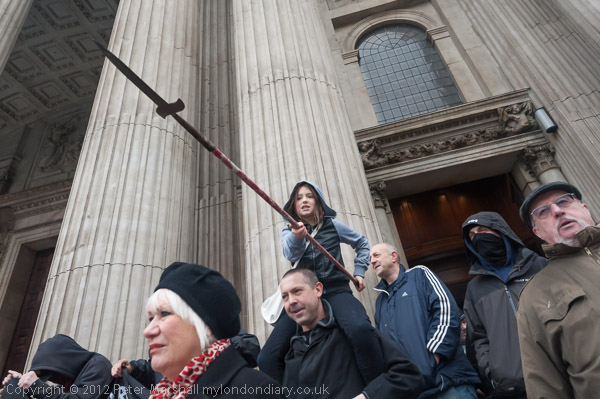
Epiphany. London insurrection, 1661 and 2013 (minus the hanging, drawing and quartering.) Don’t miss it, Almost the latest edit on Vimeo, sans credits – watch it. Mad photographer appears at times, comes into frame around 29:50; I go left at 30:11 when everyone else goes right. Fifth Monarchists storm St Paul’s yet again, with the aid of a piked Muggletonian.

Nice film Suzy. Sorry for not writing about it. Perhaps I will one day. Looking forward to the next part on the Muggletonians. Perhaps Bone is a secret Muggletonian – or you or me. Who knows?
Continue reading Epiphany

Fuji in Germany


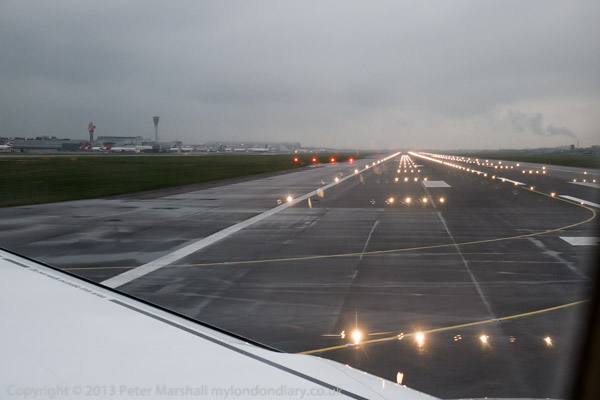
Moving on to the runway at Heathrow Fuji-X 18-55mm

For my trip to Germany last month I took just one camera – the Fuji X-E1 – and three lenses, the Fuji-X 18-55mm (27-83mm equiv), the Voigtlander 15mm (22.5mm eq) and the full-area fisheye Samyang 8mm. Along with a few 16Gb cards and four spare batteries and the charger.

Mostly I wanted to use a camera to photograph some family events, and the X-E1 is not a bad camera for discrete use; fairly small and quiet enough in quiet mode not to be noticeable in a room with a normal level of conversation.

The 8mm and 15mm don’t have image stabilisation, but I didn’t miss it. Possibly camera shake was lessened by the liberal application of the local beer to the photographer, along with the odd glass of Hugo, a drink I find just a little too sweet, combining prosecco, lime, mint and elderflower syrup. And there was also a rather powerful vodka-based concoction containing yoghurt. Together in moderate quantities I think these give about a two-stop advantage! But the 18-55mm has optical image stabilisation, and perhaps a few images at the longer end were sharper for it.


8mm Samyang

The Samyang is a remarkable lens, and the fact that it is a manual lens hardly matters at all on the X-E1, where there is seldom any need to focus. In fact I’d prefer to have a lock that stopped me focussing, as although for nearly everything  you can leave the lens set to infinity it is possible to focus down to 1 ft, at which point things more distant can get slightly unsharp.

One very small problem with the lens is that the camera doesn’t know the aperture in use, though of course it gives the correct exposure despite this. It’s just a little of a shock to look at the EXIF data and find you were apparently taking pictures at f1!

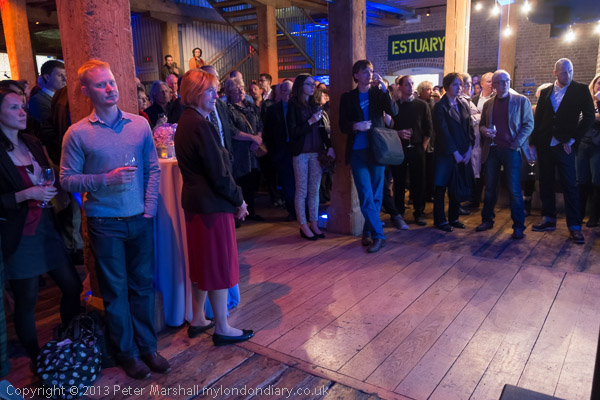
Most of the images with the Samyang – such as that above – were interiors in normal room lighting and I was working at its full aperture of f2.8. Even wide open it is already pretty sharp across the frame. Any lack of sharpness in these images was either from accidental shifting of the focus, subject or camera movement. And with exposures sometimes down to around 1/20s, subject movement was a real problem.

And as you can see the Samyang does give a different view. Although there is some of the normal curvature you expect from a fisheye – perhaps most obvious in the lines between walls and ceiling, the Samyang employs a different mapping to the usual equisolid projection in fisheyes.  This is the stereographic projection, which results in less distortion of objects at the edges and corners of the frame, giving the images a far more natural look. The figure at bottom left would have been noticeable distorted in a normal fisheye image, but looks almost normal here.

With other fisheyes, such as the 10.5 Nikon I’m rather fond of, its often essential to use software such as Fisheye-Hemi to give a more usable result, but correction is far less necessary with the Samyang. So you get the extreme angle without the extreme distortion. A small down-side to this is that if you do want to ‘correct’, Fish-Eye Hemi doesn’t quite get it right, though it does still generally do better than most other software I’ve tried*.


15mm Voigtlander

The Voigtlander 15mm is a great lens, but not great in poor light with its maximum aperture of f4.5 but it is relatively cheap and beautifully small. One problem is that it has a bulging front element that makes fitting a filter for protection impossible. Mine is in the old screw thread Leica mount, but you can now get the same lens in a Leica M mount, and for under £400 if you look around, a real snip compared with Leica prices. I have it fitted with a Leica M adapter and that then goes into a Fuji X adapter.  The 15mm also seldom needs focussing and the scale is generally accurate enough. I used this lens for years on Leica M and compatible bodies and its performance is fine. If there is any distortion it is never noticeable. Again for the EXIF everything appears as f1.

The 18-55mm is an f2.8 lens at the wide end, but by the time you zoom out to 55mm it is only f4, which rather reduces its utility in low light. Otherwise there was really nothing to complain about.


18-55mm Fuji-X and some laser lighting

The camera itself performed pretty adequately, particularly in low light, where most of the time I was working at ISO 3200. Increasing the Luminance noise reduction in Lightroom from my normal 27 to around 50 made the results much smoother (keeping the detail setting around my normal 20 and contrast 2.) There was significantly more colour noise than at ISO 640, but it disappeared with a ‘color’ noise reduction setting of 25.

I had no problems with the digital viewfinder in low light, but in bright conditions it was sometimes impossible to see detail. It was good enough to see which way you were pointing the camera and the limits of the frame, but hardly to see what the pictures would look like.

I really do wish Fuji could find a solution to the deep sleep mode which this camera descends into after switching itself off to save the battery. The quickest way to wake it up seems to be to switch the camera off and on again and wait the second or two for it to come back to life. By which time the picture has often flown.

Battery life is a problem too. The day we went on the most interesting visit I’d rushed out thinking we would be coming back before setting out on the main trip and I would pick up my camera bag before going out for the day. We didn’t and although I’d taken the camera, the battery was dead after the first picture or two. The camera needs a better battery level indicator too, as you only get the warning when it’s already virtually dead. Its generally necessary to take at least 3 batteries to be sure of a day’s work, and four if you are going to be busy. The batteries are supposed to last around 300 pictures, but its easy to run them down faster if you are showing people pictures etc.

Photographing at family parties as I was doing quite a lot of the while, the more interesting moments  are  often when people are moving.  I hadn’t bothered to take a separate flash, and it would have destroyed the mood at times to have used one. I did make a few images with the small unit built into the camera at a more public event when people were dancing, but wasn’t too happy with it. Its really something for emergency use only, though better than many built in flashes. Of course the flash isn’t much use with the fisheye, putting hardly any light into the corners, but it covers the 15mm surprisingly well. There is a brighter central area, but it is relatively easy to even out in Lightroom if you don’t want something of a spotlit effect.

A few minor niggles aside, I was impressed by the quality of the results, and was glad to have only a fairly light weight to carry around. The 18-55 zoom feels a little large on the camera, and for general use I think I might prefer to have perhaps a couple of prime lenses, perhaps the two pancakes (18mm and 27mm ), possibly adding the longer 55-200 zoom when a long lens was essential. Most days I’d prefer a second body too. If you are used to carting Nikons they are pretty light.

In further posts I’ll look more at the other pictures I took in Germany, and perhaps also about making use of the video mode on the Fuji X-E1.


*I think you could possibly use the free Panorama Tools if you could work out how to do it. I’ve got the best results by taking the image into PtGui and converting it to Mercator projection, trimming the output to give a rectangle and then resizing that to 3:2 aspect ratio, but that seems a lot of work and the difference is really quite small.

Continue reading Fuji in Germany

Estuary – Last Chance

It seems a very long time since I was enjoying oysters and other seafood at the opening of Estuary in mid-May at the Museum of London in Docklands, and like all good things it has to come to an end – and that end is on 27 October 2013 – this Sunday.

So this weekend is your last chance to see the show as a whole, although my images are also mostly on line on various sites – including a few here in the post Not A Drop in Bermondsey, and others in my book ‘Thamesgate Panoramas‘ or on the Urban Landscape web site, as well as in the on-line Museum of London Collection.

But there are other artists in the show, and some of their work is rather harder to find anywhere, and there is also something about having different views together in the same space.

The show is the largest contemporary art show the museum has attempted so far  with work by Nikolaj Bendix Skyum Larsen, Christiane Baumgartner, John Smith, Andrew Kötting, William Raban, Simon Robert, Michael Andrews, Gayle Chong Kwan, Jock McFadyen, Peter Marshall and Stephen Turner, and Time Out’s Critics’ choice described it as ‘Unexpected and thoughtful insights into this often overlooked but mesmerising environment.’ But it’s a little disappointing that I’ve not seen any serious critical review of the show. There is a short video made by the museum on putting on the show which is interesting, and also a video featuring the work of two of the artists.

Currently I’m beginning to think about another show next year at a central London venue where I will be showing work with artist Hilary Rosen. The central theme of the show is likely to be the River Thames, but I think most of the work will be different to that in ‘Estuary’.


Only in England

Only in England: Photographs bv Tony Ray-Jones & Martin Parr
Media Space, Science Museum, London 21 Sept 2013 -16 March 2014
National Media Museum, Bradford, 22 March 2014-29 June 2014

Admission £8, Concessions £5

It’s taken me a while to get around to writing this review since I went to see the show a week ago, mainly because I’ve been away from home, and although I had a notebook as well as a real notebook with the ten sides of notes I took at the Science Museum, I didn’t have with me the three books and various magazines containing work by Tony Ray-Jones (TRJ) for reference.

First let me say that anyone with the slightest interest in photography who is going to be near London in the next 5 months should visit this show at least once – and give yourself a couple of hours to do so. It really is one of the most significant shows of photography here in the UK for some years. If you don’t already know the work of TRJ (see my Tony Ray-Jones Discovered Yet Again), then you are obviously very new to photography, and it will be a revelation, and if you do know his work, you probably will not need my urging to make you want to see a large number of vintage prints again, though I think you may probably learn little new about him. But for all who were not around in photography in the 1970s, the black and white work by Martin Parr may come as something of a surprise, and it was certainly good to see his pictures from ‘The Nonconformists‘ again.

Although the two photographers both concerned themselves with ‘the English’ their approaches were very different. TRJ’s view was essentially ironic and surreal, witty and superbly framed, very much about the image rather than the subject, while Parr’s was documentary, concerned and often reverential, even loving. Their very different visions overlap in a few of the pictures in this show, but it was only perhaps in other projects and his colour work in the early 1980s that Parr really developed a kind of amused detachment towards the subject that perhaps derived from TRJ. TRJ was perhaps more interested in general themes, rather as his friend, photographer John Benton-Harris, styles himself, a visual sociologist, while Parr concentrates on the individuals and there eccentricities, a very English obsession.

The wall text states that all of the images in the first section of the show – the work that TRJ himself selected for exhibition and publication – was actually printed by the photographer. I rather doubt this to be the case, having listened to some of those who knew him – and at least one who printed his work both before and after his tragically young demise. There are stories – some in the show – which suggest that he was a skilled printer, but this hardly fits some of what I’ve been told. His time in the USA will have introduced him to the rather different attitudes to photographic printing there compared to the generally unsophisticated methods taught in the UK at that time. For many of us, texts like the Ansel Adams Basic Photo series ‘The Print’ came as something of a revelation.

What I think is true is that TRJ had a very good idea of what he wanted his prints to look like, and probably suffered a great deal of frustration in trying to get them so. Although I’d defer to those closer to the photographer, my guess on looking at the Media Space show would be that around half were made by him. Those we can certainly be sure of are the five images from his 1969 ICA show from Martin Parr’s collection. It’s perhaps a pity that an effort was not made to locate more of the images from this show for the current exhibition – I would certainly have been willing to lend the one I own. I don’t know how closely the selection for the Media Space show follows the photographer’s own selections, either for that show or his book dummies, but clearly all those in this first section of the exhibition were images that the photographer himself had selected as successfully representing his intentions.

Comparing the five ICA show prints with both the other prints in the show from the same negative and with the printing of other photographs does indicate some subtle differences, but clearly most but not quite all have been made with similar intentions, if not by the photographer himself by others responsive to his requirements. But I think TRJ would have been even more pleased with the prints made for ‘The English‘ at the National Museum of Photography, Film and Television at Bradford in 2004, and the reproductions in the accompanying book by Russell Roberts, ‘Tony Ray-Jones’ (Chris Boot Ltd, 2004) which I think are the best published versions of most of his work. Unfortunately if you haven’t already got a copy this is now advertised on Amazon at over $5,000! Though diligent searching may find a rather cheaper copy.

The remaining prints in the show, both by Parr and those selected from TRJ’s contact prints by Parr, were larger pigment inkjet prints (or as the labels rather confusingly call them, pigment prints.)  Parr’s own work may come as a surprise to those who missed the Camerawork show in 1981 or the various publications in magazines at that time about his work. I’ve always regarded  The Nonconformists – along with other black and white projects including his ‘Beauty Spots‘, shown at the Photographers’ Gallery in London in the mid-70s, as some of his more interesting work. It is perhaps a little surprising to see The Non-Conformists chosen in preference to Beauty Spots for this show, as the latter work shows very much more clearly the influence on the younger photographer of the work of TRJ. Perhaps it was felt to be too clear and the comparison not always flattering!

But Parr’s work in The Non-Conformists, if perhaps closer to the traditional British social documentary tradition is still an impressive body of work, and well worth showing, with some fine portraiture as well as some of the better-known images such as the storm hitting the tables of a Leeds street party of the figures sitting on the terrace of Halifax Rugby League ground, covered with grass or the plate filling at the Mayor of Todmorden’s inaugural banquet. There is a strength of feeling, a humanity, about most of these images which seems absent in much of Parr’s later work.

There are pictures that I imagine TRJ would have appreciated – for example of a cow watching and being watched as the Congregation make their way to Crimsworth Dean Chapel Anniversary. And the buffet lunch at Steep Lane Baptist did remind me a little of TRJ’s very different Blackpool picnickers  from 1967 surrounded by their paraphernalia but keeping very much apart on the front under an image of an idyllic couple entwined in a rural tableaux.

The inkjet printing and the relatively large scale of the prints I think enhances the work, bringing out more detail than I remember. Good injket prints like these can often allow greater subtlety than was possible in the darkroom days. And of course the pigment inks are generally far more stable than silver. Making silver gelatine prints has perhaps become more of an affectation than an aesthetic choice now.

For me the least satisfying and most problematic aspect of the show were the 50 ‘new’ pictures selected by Parr from the 2700 contact sheets in the TRJ archive (around 90,000 images.) As the wall text says “Parr did not attempt to reproduce Ray-Jones’s selection process but instead reconsidered the work with the benefit of over 40 years’ experience as a photographer, collector and curator.

There are photographers and collections of work for which such a process is necessary or even possibly desirable, but I remain unconvinced that the relatively small opus of TRJ, which was very intensively studied by the photographer himself is one. What we can be sure of is that every image in this part of the show is one that the photographer himself considered and rejected. His standards were exacting – and these images did not live up to them. I felt there were perhaps half a dozen that perhaps added something to his reputation, but the majority told us what we already know and his contact sheets on display in the exhibition show. Like many photographers, he worked hard to get his pictures exactly as he wanted them – and that like the rest of us, even the best of photographers mainly fail. We should celebrate his many successes rather than dwell on the others.

As a further text tells us “The prints are larger than those made by Ray-Jones, reflecting Parr’s aesthetic preferences, while retaining the tonal range and detail that Ray-Jones sought in his own printing.”  To give some figures, the TRJ prints are generally between around 8×6″ and 12×8″ and those made by Parr either 16×11 or 20″x13″ (though I didn’t have a ruler with me.) In terms of tonality, the new prints seemed very different to me from those by TRJ, much lighter and more open, and the attempt to match them seems to have been a fairly total failure.

The vintage prints in the show are small and intense, images that work well on a relatively intimate scale. Most of the ‘new’ work seems to me less interesting both because of its content – it lacks the incisiveness of the best images by TRJ – and also because of its presentation. This is an exercise that I feel reflects badly on him and also on what 40 years have taught Parr.

Even if what we are seeing is not the photographer’s best work, and perhaps rather poorly presented it still retains some interest if just as a larger version of a few frames of his contacts, though I did rather wonder if TRJ might at least be shifting uneasily in his grave. Like his earlier colour work which is also being published in a book, and the contact prints it may provide some insight into how he worked, but is not the work by which he felt he should be remembered.

So while this is a show not to be missed, with fine work by both Ray-Jones and Parr, it is not without its defects – and there are a few small clangers such as the reference to the photographer ‘Robert Kappa‘ and ‘the seasons‘ rather than ‘the season‘  (i.e. the ‘London ‘ season rather than the time of year) but it is great to see some of the fine collection of the National Media Museum on display in London as the first show in the Media Space. This aims to “showcase the National Photography Collection from the National Media Museum through a series of major exhibitions” and I look forward to seeing more. Though it would be better to have rather shorter shows and more of them than the almost six months of this show. For Londoners, Bradford was very much a move too far – it’s cheaper and quicker to get to Paris.
Life Force

Life Force magazine is a free, online, monthly reportage magazine which celebrates the art-form of the photo-essay. Started in 2011 it is sponsored by what it describes as “The quality British national newspaper, the Telegraph”, a publication I view with few positive feelings.

The paper, often referred to as ‘The Torygraph’ generally represents the views of the Conservative Party and its owners, the Barclay Brothers, reclusive British businessmen who also own the Ritz Hotel and much else. The tax affairs of the various companies they own have often been questioned and they are attempting, according to residents, to take over the Channel Island of Sark (they own around a third of it and have a castle on Brecqhou, an island a few yards away from the mainland which is part of Sark.)

But Life Force seems to be untainted by all of that. Its title an obvious reference to Life Magazine, it also gets in the name of the most famous British picture magazine on its front page where it states:

“It has been described as the “Picture Post of the 21st Century” – a photo-led magazine that explores the world and the human condition through the narrative use of photography.”

In its issues it has published some fine photography, living up to its “vision” to

use photo-essays to entertain and enlighten whilst at the same time never missing an opportunity to speak out for those in need or without a voice ”  and reflecting its  statement “We don’t believe in voyeurism or in the exploitation of those less fortunate than ourselves.

The title Life Force also refers to the kind of content it publishes, photo-essays that “capture life by observing and recording fleeting moments of human energy that are about hope, strength and optimism, despite perhaps adversity.”  It also reflects the desire that many photojournalists have – including its editor Damian Bird – to “empower those that figure in our photography.”

It really has published a great deal of fine photography – and you can still see the previous issued back to the start in Jan 2011 (click on the menu item  ‘*This month’s photo-essays* to see the content.) The list of contributors is impressive, with links to their web sites.

The October 2013 issue contains Greg Marinovich‘s Dead Zone, The Last Samurai by David James, Kashmir by Ami Vitale, editor Damian Bird‘s Camp Afghanistan,  Ladakh India by Kalpana Chatterjee, Senegalese Cotton by Sean Hawkey, Myanmar by Catherine Karnow, 21 Days in China by Raymond Gehman, Andrew Gehman‘s Mason-Dixon Line, an interview (with some of his portraits) with Terry O’Neil and work taken by David Eustace as a part of the advertising campaign for the Lumix G6.

All the essays are worth a look, though I found those by Marinovich, James, Vitale and Hawkey of most interest.  You can also possibly sign up for a monthly newsletter giving details of each new issue, though I’m not sure if this worked when I tried it.

The Queen Vs Trenton Oldfield

I first came across Trenton Oldfield on the web, where I read in 2008 about the ‘This is Not A Gateway‘ (TINAG) festival he had inaugurated together with his partner Deepa Naik. The first was held in Dalston and included over 40 events related to the urban environment including contributions from several photographers and film makers I’d met. The following year it moved to Spitalfields and I was one of the many who presented work at Hanbury St, presenting together with Paul Baldesare work from our then current show Taken in London and taking part in the discussions.

I’ve long had an interest in urban affairs, dating back to before I was a photographer in the 1960s, and this is reflected in some aspects of my work which you can see particularly on the ‘Urban Landscapes‘ web site and also in some of my self-published books. The first of these, written when I was aksed to contribute to a now defunct web site in 2005 but only published as a book after I’d exhibited it at the London International Documentary Festival in 2010 is the only of my books to date to have a little fictional story, setting out a series of pictures from my walks around north-east London in 1989 as having been taken in my wanderings with the legendary (and entirely fictional) author, Upton Trent. When I met Trenton a few years after writing this, his name immediately made me think of this work.

But most people will know Trenton as the man whose protest against the elitist nature of British society brought the annual rowing race between crews representing our most privileged universities to a halt. Our judicial system threw the book at him, not only giving him six months in jail, but making him pay for the privilege of being tried and found guilty, doubtless a process carried out with the involvement of many who had enjoyed a privileged education at Oxford or Cambridge.

Many – even some who thought his action wrong-headed and his ideas crazy – felt that his punishment was unduly harsh for a peaceful direct action, and there was more astonished indignation when it was learnt that Teresea May wants to deport him. As Rupert Myers commented in The Independent,  ‘the UK government is risking a cause celebre with a 21-century deportation‘. In Tories bring back Penal Transportation? here on >Re:PHOTO I wrote about the case, asking people to sign the petitions to stop the deportation on This Is Not a Gateway, and another at Change.org. If you haven’t yet done so, please consider signing them now.

But there is something more you can do. I’ve just got a copy of The Queen Vs Trenton Oldfield: A Prison Diary, published by the Myrdle Court Press (MCP) which he and his partner founded to advance the ideas of emerging urbanists and which has brought out three volumes of ‘Critical Cities‘. The book is more than the title suggests, and as it says on the site, “challenges many preconceived ideas held about prisoners and prisons. It offers an insightful critique of the prison industrial complex at the the outset of the privatisation of prisons in Britain. Importantly, it also considers the criminalisation of dissent and reductions in civil liberties.” It is available at bookshops for £12.99 or you can buy it direct online, (£2 postage to Europe including the UK and £3 worldwide) and there are some reviews on the MCP web site.

All the proceeds from the sale of the book go towards the payment of the court costs of £750, awarded against him in an unusual decision by Judge Anne Molyneux at Isleworth Crown Court. I’ve yet to finish the book, but it does seem a very interesting read for all those concerned with civil liberties and our prison system. I’m thinking of getting a second copy to give as a Christmas present too.

Dave Wyatt

A Facebook post from Photo-Democracy attracted my interest to work by Bristol-born photographer Dave Wyatt, and their web site has four of his works for sale. You can see a much wider range of his photograph in the seven projects on his own web site. Perhaps to me the most interesting series photographically are the two dozen black and white images in Olive harvest: Palestine, which seem to have a spontaneity absent in his colour work. But while the deliberately formal images of Thames Town: China’s new Suburbia have a weird fascination in the subject matter which is amplified by the absolutely correct vertical treatment within the square format, there are times in some of the other series where I feel that format becomes something of a straight-jacket.  Porto Romano: Living on Toxic Land departs from that and shows a much more visually lively approach that appeals to me greatly.

Photo-Democracy, a sister company of Chris Beetles Fine Photographs in London is an interesting business, though I think with a misleading name. It sets out to market decent photography at affordable prices – from £40 for an 8×10″ signed print in a ‘limited edition’ of 500, up to £1000 for a 30×40″ version of the same image in an edition of 10. It’s rather a pity that these are digital C-types rather than high quality inkjet prints – but this reflects a prejudice that still exists in some fine-art circles and which this site unfortunately presents as a selling point.  Personally I’ve only bought C-types in the last ten years when the extra cost of a good inkjet was an issue, and the more archival quality of good inkjet prints was of no importance.

Although it isn’t a way I would chose to market my own work, the scheme seems well thought out – and the site FAQ makes interesting reading about how it works for buyers, and I hope it succeeds in getting a decent return for the photographers concerned. And if it does widen the audience for buyers of photographic originals, perhaps some of them will begin to look outside of ‘Photo-Democracy’ for other photographers – including myself – who sell their work on the web as signed prints at reasonable prices. You can buy any of my pictures from My London Diary or my other web sites at similar prices to those of Photo-Democracy although only in sizes up to A3. And all my prints are high quality pigment ink jet prints.