Gillian Laub – Testimony

Gillian Laub (b1975, Port Chester, NY) is a New York based photographer who completed a BA in Comparative Literature at the University of Wisconsin before studying photography at the ICP in New York. Her show at the Bonni Benrubi Gallery in New York, An American Life, closes tomorrow, July 7, 2007, and is a series of large colour images that show often intimate moments in the life of her own extended family, in Florida, New York and the suburbs. It’s work that gives an insight into the life of some Americans, and certainly very proficiently done, with several images that I like considerably (Grandpa eating on the beach at Naples, Florida for example) but overall I had a certain feeling of deja-vu, not least because I photographed a very different family some twenty or more years ago with occasionally similar results.

(C) 1982, Peter Marshall
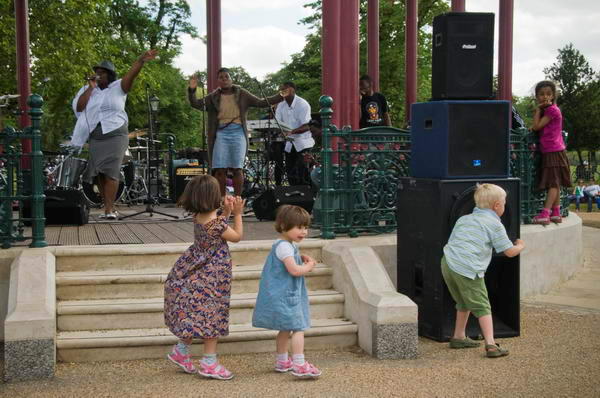
Joseph, Jan Willem & Samuel 1982 © Peter Marshall
(C) 1977 Peter Marshall
Samuel 1977 © Peter Marshall

Well, families are families, although in some ways it is what is in the background of these pictures that that is of more interest, setting Laub’s particular family in a social context, and perhaps seen most clearly in ‘ Jamie Practicing for the Family, Armonk, NY 2003′.

What I find considerably more interesting than ‘An American Life‘ are Laub’s images from Israel and Palestine, some of which were shown earlier at Bonni Benrubi, and can be seen in the fine PDF portfolio ‘Beyond Wounds‘, as well as on Laub’s own web site. This work, some of which is in her newly published Aperture book, Testimony, seems to be of entirely a different and higher order of magnitude. These images of Israeli Jews, Israeli Arabs, displaced Lebanese families, and Palestinians all caught up in conflict in the region, taken over a four year period have an incredible depth and complexity.

If you are in London next Thursday, 12 July, 2007, you can hear Gillian Laub talking about her book at the Photographers’ Gallery at 6.30pm, followed by a book launch and signing in the Bookshop. It’s a free event, and no booking is needed.

Family Album was the first web site I ever wrote, and is still on the Internet (with some very minor changes to the code.) I also wrote a feature for About.com, Family Pictures at About Photography, which became one of my more popular features on the site. The discussion about the problems of nudity in images of children it contains surprisingly caused some controversy, although only around five years after it was put on line.

Laburnum Street

Even if you’re a Londoner, you probably don’t know Laburnum Street. Haggerston has never been the most glamorous area of Hackney, itself on many measures one of the more deprived areas of the country. Even the artist-led regeneration that has brought Shoreditch, Hoxton, Bethnal Green and elsewhere back onto the map of London hasn’t quite got to Haggerston yet, although there are a few studios around in old industrial buildings.

It’s an area with quite a lot going for it. Walking distance from the city. A canal, with an increasing number of desirable waterside properties being built. A new city academy rising. The large Suleymaniye Mosque on the corner. And plenty of other new developments not far away. But for the moment its most interesting features are the lively and very ethnically mixed people who live in the area, and (C) 2007, Peter Marshall, long neglected by Hackney Council, closed without notice in February 2000, and the subject of a lively local campaign to see it re-opened.

(C) 2007, Peter Marshall

The pool is a listed building, and English Heritage want it retained as a pool, as do the locals. Hackney Council have worked on feasibility studies which include a 25 metre pool together with other uses for the west side of the site, and the pool campaign have added their ideas to these proposals through a people’s consultation. The plans for the future are there, but not the £21 million to put them into practice.

(C) 2007, Peter Marshall
This was the only pool open for the street party

The first Laburnum Street Party was organised in 2004 to celebrate the 100th anniversary of the pool, and to raise the profile of the campaign for its re-opening. I went to photograph the third party in 2006, and was pleased to have one of my pictures used as the main image on the flyer, poster and programme for this year’s party.

This year the event was bigger than ever, and attracted more sponsorship. There were around 75 street stalls of various types, including food, bric-a-brac and various informational stands. Two stages with performances of very different types and a childrens street parade, following workshops organised by Lucia Wey of Mush Arts, who I first met photographing the 2004 Shoreditch Parade. Free canal boat trips and various kids activities. So much going on that I could only photograph a small part of it, and was sorry to miss some of the acts I’d been looking forward to.

(C) 2007, Peter Marshall

Of course there were many other photographers there, as well as several film makers, including Dan Edelstyn whose hilarious film (with Hilary Powell) on the Olympics I mentioned here a week or so ago in More than the Olympics.

The weather was fairly kind to us, just a few minutes of heavy showers around lunchtime, and then some sun, and we made hay. Too soon it was time for me to go home.

More pictures from Laburnum Street Party 2007 on My London Diary shortly.

Pride & Climate Change

London carries on, despite the terrorist threat with two car bombs left close to gay nightclubs which fortunately failed to explode early on Friday morning. Saturday’s Pride Parade was much the same as last year, and if there were more police present, it was only noticeable in the several groups of officers actually taking part in the parade.

Despite the publicity and high figures given in the media (which perhaps relate to the whole festival) the Pride parade itself is now a relatively small event, a fraction of the size of the major political marches that make their way through London largely unreported by the press perhaps half a dozen times a year, although considerably more organised and more colourful. It seems to attract considerably fewer marchers than it did a few years back, with many more simply turning up for the events in Trafalgar Square and Soho.

Ten years ago, taking part in the Pride march was an important personal and political statement for many, sometimes marking their going public about their sexuality. Now it’s largely a fun event, although a few individuals and groups still attempt to get a more serious message across.

Much of the event has now settled into a pattern, with many of the same floats and costumes as in previous years, but there are some changes, and I tried to concentrate on these. Its an event where it is hard to get away from the stereotypes, because so many of those taking part embrace them whole-heartedly.

Pride 2007 (C) 2007, Peter Marshall
Many, especially from minority ethnic groups, use Pride as an occasion to stress their British identity as well as their gay identity

I seldom pose people for pictures, but at Pride, everything is a pose. Certainly as soon as people see a camera, most play to it, and its a game you can’t avoid, something you need to work with. Getting below the surface is often a problem, but at least the surface often fascinates.

What was new was ‘Bird Pride’, describing itself as a “Queer Femme Carnival”, organised by the Bird Club, whose aim is to “celebrate femininity on the queer scene”.

Pride 2007 (C) 2007, Peter Marshall
Bird Club ‘Specialist Warblers – Femme invisibility, so last YEAR’

More pictures from the Pride march on My London Diary shortly.

The two car bombs were on the route of the parade, and there were rumours that it was a badly failed attempt to attack the parade itself, but they didn’t appear to have put the marchers off. The crowds watching the event in Oxford St did seem rather lighter than normal for a Saturday, but this could have been more a matter of the weather, light rain interspersed with heavier downpours, which at times made taking pictures tricky, but some of the best opportunities were in pouring rain.

Photographing in the rain is a problem. In the old days, mechanical cameras such as my old Leica M2 carried on almost whatever hit them, and the standard lens at least had a lenshood that was a fairly effective rain shield. Keeping it under your coat when not in use, and an occasional wipe with a handkerchief kept you going through rain, hail and snow.

Digital cameras are more of a problem. I gave up on the Nikon D70 as unsuitable for London weather, but the D200 is much hardier. My main problems are with lenses. Larger filter sizes, more glass – in zooms in particular – mean more rain drops and more condensation inside lenses with changes in temperature and humidity. Zoom mechanisms pump in damp air, and also draw in moisture from the damp lens barrel. Increasing use of wide angle lenses is also a problem, as their lens hoods offer little or no rain protection – and the same is true of zoom lenses that start at wide angles.

Nikon’s 18-200mm VR lens is a great and very flexible lens, but becomes useless when there is even a hint of moisture in the air. Sensibly, I’d left it at home and was shooting with a Sigma 18-125 which holds up rather better. The Sigma 12-24mm has the problem of a large front element open to raindrops, but if you can keep it clear, also works well in wettish conditions. Handkerchiefs aren’t really a good idea, and in a special, otherwise unused pocket of my jacket I had a large, clean microporous cloth that saw frequent use to wipe both glass and other surfaces of lens and camera.

Sometimes I’ve improvised a plastic cover for camera and lens from a suitable bag, but such things get in the way. But these – or specially made camera rainwear – can keep you shooting in really bad weather. Unfortunately they don’t stop condensation inside the lens, which is often a problem – and all you can really do is wait for it to clear, or change lenses. ‘Pumping’ zoom lenses can sometimes help.

I decided I couldn’t face more rain to photograph the Pride rally in Trafalgar Square or the cabaret performances elsewhere, and in any case I had a mermaid to photograph.

Rising Sea Levels (C) 2007, Peter Marshall
Lucy warns about the perils of global warming – her arrow indicates sea level in 2012

The climate change event was designed as a reminder to Gordon Brown that this is still the most urgent problem we face. Without a planet that is livable on, none of the rest will matter. So far the politicians have largely stayed on the edge of the pool, hanging on to ideas of technology or carbon offsets to avoid taking the real action that is needed, talking about cuts in carbon dioxide emissions while these continue to rise.

Effective action is vital, before it is too late (and we hope it is not yet too late.) Energy saving that means more than turning off the odd light or buying a more fuel-efficient car.

More pictures on My London Diary now for Pride and Climate Change Rally
Peter Marshall

More than the Olympics

Yesterday I was fortunate enough to watch what may well be the best film to be made on the Olympics. ‘The Games‘, a 15 minute colour HDV film from Optimistic Productions by Hilary Powell and Dan Edelstyn is an at times hilarious staging of an alternative and surreal Olympics filmed on the unreconstucted Olympic site, with a hand-picked team of ‘athletes’ taking part in steeplechase, hurdles, synchronised swimming and more. It starts with flaming torches and ends (more or less) with an awards ceremony. Catch it if you can.

We’ve all heard how the London Olympics is to play a vital role in the regeneration of east London, although I don’t think anyone has yet come up with any remotely credible explanation of how shutting off and concreting over large areas of land currently open for recreational use and producing large and largely unwanted sporting facilities is going to help that much.

There may be some limited infrastructure improvements, although much of those were already on board from the Channel Tunnel Rail Link, with its new Stratford International station. Most of the claimed new housing and some other facilities claimed for the Olympic effect were also already on the way as a part of the Stratford City redevelopment, described as “the most ambitious development within the M25.”

But London 2012 is here and we have to hope for the best, even if it may be madness to expect that to be very much, though we can hope that a few crumbs will fall in appropriate directions. At the moment there is only the pain, as local businesses are forced out of the area and jobs and recreational and sporting facilities are lost, as well as access being restricted. All around the site, high blue fences are being erected to keep us out from July 2. Of course some areas have long been blocked off and well-used paths have already seen lengthy closures for work associated with the games. But the loss of Carpenters Road and Waterden Road in particular will cause considerable local transport problems.


Fences being put up around the Greenway, which should be reopened shortly.

You can see some more pictures from the area taken last Thursday on My London Diary.

Despite all the publicity, the Olympic area is only a small and relatively insignificant part of the regeneration of East London, and a relatively minor contribution to Stratford City. Close by are other large and important projects, in particular at Canning Town and the Royal Docks. The former Pura Foods factory in a loop of the Lea has now been reduced to rubble, and plans for a mixed-use development are close to agreement, with some 1,800 homes, a primary school, shops and more. On the other side of Victoria Dock, planning approval was obtained recently for the Silvertown Quays site, with 5,000 residential units, shops, offices, workspaces, community facilities including a primary school, restaurants and bars and other leisure facilities. This also includes a vast aquarium project, Biota!, in collaboration with London Zoo.

Victoria Dock, SE
Silvertown Quay site and Eastern Quay. The Millenium Mills are to be converted to flats.

West Silvertown already has the Brittania Village development and Eastern Quays, as well as stations on the DLR North Woolwich extension, the Thames Barrier Park and flats at Barrier Point. Two further key sites, Minoco Wharf and Peruvian Wharf are likely to be re-developed before long, although arguments still continue, particularly around the continued industrial use of Peruvian Wharf, and there are more prime riverside sites still to be redeveloped, as well as considerable redevelopment that has already taken place to the east of the Barrier Park, with again more planned.

This afternoon I’m leading a tour around the area, probably in pouring rain. Shortly I’ll post a link to an on-lilne version of this which I hope will encourage others to visit this fast-changing area. It will perhaps take your mind off the Olympics.

Yes, it’s how I saw it

Here is the text of an e-mail I received today, which I will quote anonymously – but otherwise in full:

—————————————————————————–

Hi in regard to you site as above, did you realise the pciture of the source of the river has a man who looks like he is relieving himself!! There is an issue of something wet and his arms are held in front, was this deliberate or have you not noticed?! OR is it yourself??

I’m not sure it is appropriate if on purpose, and if not the picture should have been checked!!

Would have been nice if the rubbish was cleared before taking the photograph too!

——————————————————————————

The site in question was named in the subject line. Its full title looks like something like this:

The Lea Valley

London’s Second River – The River Lea (or Lee)

from source to mouth – including the London 2012 Olympic site – photographed by Peter Marshall

and the second picture on the page is:

Source of the River Lea
33d56: The source of the River Lea, Leagrave, near Luton, Bedfordshire.
December 1982.TL 061 248

and is captioned as shown.

What kind of a world does my correspondent live in if he is in any doubt about what this picture shows, or somehow thinks that I might have not noticed what this guy, a few feet from me and the central point of the picture, is doing?

Had Bernard, shown here, informed me of his intentions in advance I might have got the exposure a little better, as the picture is a pig to print, and, before the advent of Photoshop, did need a little ferri to bring out its finer points.

Given the way the stream emerges – or at least did in 1982 – through a grille at the bottom of this concrete block looking far more like a sewage outfall than a sparkling rivulet, his gesture seemed appropriate. As too did the rubbish, which as a matter of good documentary ethics I would not have dreamed of touching,

I don’t often use potassium ferricyanide on prints, but applied on the tip of a fine sable brush here it made the smaller of the two streams stand out more clearly and impressively, leaving I thought no doubt as to what is was. Sometimes our work needs a little help in small ways like this, and so long as what we do is entirely in keeping with the spirit of the event I don’t think it matters.

More often I retouched prints to hide the accidents of photography – dust and scratches, but also occasionally to remove white spots that were actually present in the image. Unless I’m doing a feature on pigeons, then I have no qualms about removing or dulling down the evidence of their existence where it interfered with the reading of the image.

Entirely by fortunate coincidence, it was also pissing down when I started from the Thames at the other end of my journey along the Lea, though this time it was the heavens that had opened rather than Bernard’s fly:

Limehouse
33f33: Regents Canal Dock entrance to River Thames during torrential rain,
October 1982. TQ 363 808

I haven’t finished my Lea Valley web site, although there are a large number of my images on it already, starting from around 1981, and including much of my recent work, but with at the moment around a ten year gap in the middle. At the moment a significant part of the area is about to be radically changed into a giant building site, the location of the London 2012 Olympics, with the loss of significant wildlife habitats (and ironically, sporting facilities including one of London’s largest cycling centres, miles of angling along river and canal and various football and other sports pitches) along with the allotments mentioned here previously.

My pictures do give a good idea of what the area is like and things – both good and bad – that will be lost. I hope to continue photographing the Lea Valley – and my web site – to give an idea of how things have changed in the legacy of the games long after they finish.

Peter Marshall

Human Rights & Art

It was in the 1960s that I joined the National Council for Civil Liberties – now known simply as ‘Liberty‘, after seeing the way that travellers were being hounded by the police, giving up time to help prevent their eviction from otherwise unused derelict sites that had been flattened in the massive redevelopments then taking place in Manchester’s inner suburbs.

Over recent years I’ve photographed many events related to civil rights and human rights abuse in this country, as well as continuing to support ‘Liberty’ and also friends who have taken practical action to support people who our government have been denied both any benefits from the state and the right to work, leaving them destitute.

Saturday I’d hoped to see a performance by Mark McGowan, burning an effigy of Margaret Hodge as a protest against her statement that established British residents should be given precedence over economic migrants for council housing. But there were no traces of a fire on Camberwell Green at noon. Perhaps, as in Birmingham earlier this year, it had been prevented on health & safety grounds. I only hope the guys will be out stopping such things happening on November 5!

Instead I joined the ‘Human Rights Jukebox‘ in its progress from the Camberwell Magistrates Court to Peckham, another event in the Camberwell Arts Week. The ‘March of the Human Rights Jukebox’ was organised by Isa Suarez, who had a one-year artists residency in Southwark in 2006. The juke box included thoughts on people’s rights from many residents and diverse groups in Southwark, some of whom marched with banners along with it.

At the start of the event, the Dulwich Choral Society performed a specially composed piece by Suarez, including words from the ‘Jukebox’. On Clerkenwell Green we stopped for a impassioned recital (in French) by a black African poet, and in front of the old baths in Artichoke Place (now the Leisure Centre) there was a long performance by the band Deadbeat International as well as a short song by three musicians that left us wanting more. Deadbeat International also performed at various other points on route, including another energetic set at Peckham library. The march was led into peckham by a rapper, with some forthright views on human rights.

Accompanying the jukebox were the live art group ‘mmmmmm‘, Adrian Fisher & Luna Montengro, covered from head to foot in sheets of paper containing the complete text of the UN Universal Declaration of Human Rights, in both English and Spanish as well as the pages of a world atlas.


Article 11 of the UN Human Rights Declaration hits the shredder.

In front of the library at Peckham, mmmmm completed the event by unpinning the sheets from each other one by one, reading the clauses and feeding the sheets into a shredder (and when this gave up, tearing them up.) Each then poured cold water over the other and threw the shredded papers, so that they stuck to the wet clothes and skin. Finally we were all invited (in what we were informed was an Argentine custom) to jump once into the air for each of the 30 clauses of the Declaration.


On the way to the event, I’d jumped off the bus at the Oval, where ‘Stop the War’ and other demonstrators were protesting. Gordon Brown was apparently expected to arrive at 12.00 to watch some kind of game there. It was a very different kind of action to the ‘jukebox’ though both were political and art in their different ways, although only one gets arts council funding.

The Human Rights Jukebox was more cultural than political, involving the participation of various marginalised groups, including migrants and those who have suffered from mental illness (and artists who are too in some ways marginalised.) Of course the cultural is political as I’ve long argued, and, for example, we need a huge cultural shift to make any effective action on climate change possible. The imagery of the ‘Stop the War’ demo is stereotyped and so familiar that it is perhaps hard to see it changing any minds, and a more creative approach might be more effective.

I’m a supporter of ‘Stop the War’ and have been on many demonstrations. It’s hard to stomach that we had the overwhelming majority of the British people behind us, organised the largest demonstration the country has ever seen but failed to influence events. Perhaps the underlying reason was that the leadership failed to think creatively and call for decisive action when it was needed.

Peckham has a bad reputation, and at times deserves it, but in many ways it is a vibrant place and interesting things happen there and just along the road in Camberwell. You can see more pictures of the March of the Human Rights Jukebox, as well as a few of the Oval demo, and some great kids on their bikes from track in Burgess Park who called in at Peckham Library while I was there on My London Diary.

Naked Bike Ride – Problems

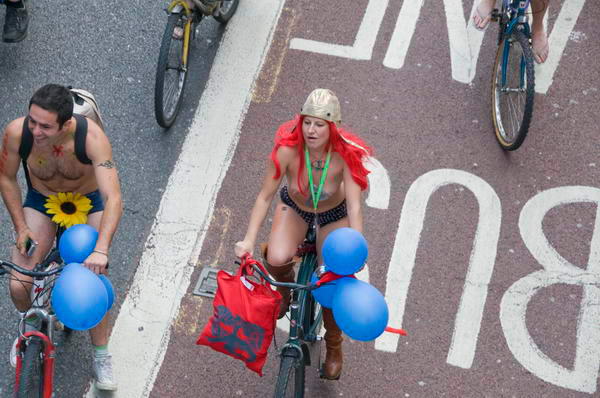
I have a few problems with the WNBR. No objection to nudity, certainly no objection to environmental protest – I’ve participated in many, though keeping largely clothed.

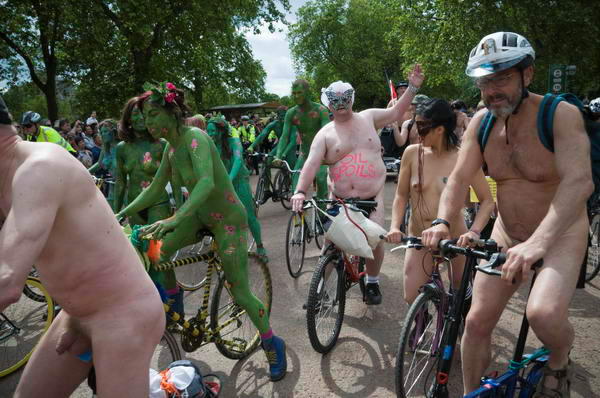
First, I think the ride is lousy at getting it’s message across. Far too few of the riders or their bikes even carry slogans. Almost zero leafleting as the ride goes through some of the most crowded streets of the capital. People do look, but they wonder what its all about and nobody tells them. And if there was a press officer around at the start they were in hiding.

This year too, the ride seemed much faster. Last year I ran a kilometre of the route with it, going considerably faster than the riders even though stopping occasionally to photograph them. This year, though I’m fitter, I struggled to keep up for a few hundred metres. Speed makes it even harder to read the text on those bodies that do carry it.

Perhaps one answer would be to try to recruit leafleteers from those who sympathise with the aims of the ride but don’t want to strip off, and get them leafleting in key areas such as Piccadilly Circus, Covent Garden, Oxford St etc.

Secondly, the London ride has what it calls a ‘photography policy‘, but might better be called a ‘no-photography policy’. It’s main effect is to make the organisers look silly, as although it has caused a considerable controversy, it seems to have little or no effect in practice.

New this year (or so I understand) were the “photo policy enforcement boards” which riders were encouraged to print and carry, bearing the message “this photo was taken without permission“, to be held as protection against intrusive photographers. I searched long and hard, but to my disappointment failed to spot a single one.

Last year I hadn’t read the photo policy, so it didn’t inhibit my work at all. Photography for me is in any case almost always a two-way affair, involving some kind of relationship between me and my subject. Unlike the proposers of photo policies, I think photographing from my typical working distance of around 1 – 2 metres with a wide-angle is usually less intrusive than standing back and using a long lens.

Last year I photographed many of the individuals on the ride (including some I knew from other, clothed, events), and only one person declined to have a picture taken (perhaps because she had just been photographed by another photographer.) With one group I came to an interesting arrangement (I’ll leave you to speculate, but it was a very warm day and I was hot and happy to oblige) before they too were happy for me to photograph as I liked.

WNBR

If people take their kit off in public places – where they have no reasonable expectation of privacy – they also can have no reasonable objection to being photographed. No permission is required, and the policy and those boards are a nonsense.

However, unreasonable behaviour is still unreasonable, whether or not some or all of those concerned are wearing clothes. We generally deal with it by making our complaint clear rather than claiming some right we don’t legally have. There are actually laws which can be invoked to prevent nuisance, but would not apply to photographers who behave reasonably.

If the organisers of events such as this feel there is a problem, then they could make arrangements in order to prevent it happening. There are actually some suggestions as to how this could be done on the ride wiki pages. Of course riders who for some reason want to hide their identity can do so by wearing masks.

WNBR (C) 2007, Peter Marshall

As always when photographing, if asked I gave people in my pictures my web address. After I posted some of the images, quite a few e-mailed asking for more pictures or larger files of their own image to print, and of course I sent them. The ride was a significant event for them and they welcome a good photographic record.

One of the very noticeable things in the event is the number of those taking part who are wearing little but a camera, including some very professional looking DSLRs and also video cameras. They too see it as something they want to photograph.

Actually I would have nothing against a reasonable photo policy. It might say something like “Photographers are requested not to pester any individuals who make it clear they do not wish to be photographed.”

The third problem I have is usage. What do I do with the pictures after I’ve taken them? What I certainly don’t want to do is to set up My London Diary as some kind of soft-porn site, so I’m very careful about what I post there. Again, given that the images are not model-released, I think even editorial use needs to be considered very carefully.

We also live in odd times so far as nudity is concerned, and there have been many who have suffered for taking images that most of us would feel unproblematic. Even owning widely respected photographic books has at times resulted in police warnings and prosecution. Most agreements with web hosting companies have very restrictive clauses on what may be posted, and in case of complaints I’m told some find it simpler just to close accounts rather than decide if the complaint is justified. As someone who runs web sites for several other organisations, posting doubtful material is a risk I don’t wish to take.

Much of my photography is made with an eye on history. Not generally recording major events, but the kind of minor happenings that contribute to understanding how we live. Quite a few of my pictures have already appeared in books about our current era, as well in various museum shows. In a few years time more of my WNBR pictures may come out too.

Some carefully selected images from the London 2007 World Naked Bike Ride appear in My London Diary.

If you took part in the race, think I may have photographed you and would like a copy of the picture but can’t find it there, you can email me to ask.
Peter Marshall

World Naked Bike Ride – News Values

If we are honest, after reading this heading, probably half of us are at this point hoping for titillation. Or I could shorten that last word considerably. Put crudely, ‘News Values’ demand tits.

10,000 marching for Palestine. Perhaps 3,000 Orangemen and women. A thousand or so naked or near naked cyclists. No contest, not even for the BBC. When I switched on Radio 4 for the 10 o’clock news there was only one London event. And there was no one there wearing a burkha.

Naked Bike Ride
We are a culture with a problem. A fixation on TV and in at least the red-top press with sleaze and sexiness. Not of course anything too explicit. I picked up a so-called newspaper on the train on my way home from photographing. Page after page of gossipy snippets about celebrities and their trivial behaviours, the ‘sexy’ dresses they wore or fell out of, their affairs. Not only claiming to be about actual people, although few of them have much relation to their media images, but even about the characters some play in TV shows. It all made such dreary reading.

After that came pages of adverts for so-called adult services, none of which I’ve ever dreamed of paying for, despite being considerably over 21. It was almost a relief to come to the sports pages, where massage probably did mean massage.

Somewhere hidden away in the corner of a page I did find some more real news. Around 50 words on the latest from Iraq. Ditto Iran. Drugs. A judge accused as a flasher.

Papers like that employ journalists to write the crap. Pay photographers to photograph it. Nobody needs to go there, its surely not that hard to earn an honest crust?

One organization working for proper news values is Media Workers Against the War, set up at the time of the first Gulf War, but now covering wider issues, though of course with a special interest in Iraq. It’s a site worth keeping an eye on, and supporting.

More about the Naked Bike Ride, and some of the problems I have with it in a later note.

London, Ireland – 200 Years of Marching

Unless you belong to one of the many Loyal Orange Lodges, last Saturday’s celebration of 200 years of marches by Irish protestants will probably have passed unnoticed, unless it literally passed you by (that literally really means literally, rather than its now more standard usage to mean metaphorically!) If you weren’t on the right street at the right time it will metaphorically have passed you by as it literally didn’t!

Orange March 1

So what are such marches about? Obviously about proclaiming identity. About celebrating protestant ascendancy. Community solidarity. Marking out your territory. And if it intimidates some of the Papes, that’s certainly no bad thing. Why else drumming as a martial art and all those piercing flutes?

Actually, I’m a Prod too. If extremely lapsed*. The thunderings of Paisley resonated (even on occasion literally) in the local chapel where most of my wider family worshipped if my immediate branch favoured the more intellectual Congregationalists. More middle-class, they had a better quality of church teas too.

Twenty five years ago I went to visit one of my aging aunts, then in sheltered accommodation. My eye fell on a headline on a newsletter on the sideboard, ‘Mixed Marriages’. It wasn’t as I first thought, some racist literature that had been pushed through her letterbox by the National Front, but from a supposedly Bible-based organization defending the Protestant faithful against the devious wiles of the Catholic opposite sex and their sin-dripping priests.

Even King James never authorized that, such religious venom isn’t in any bible I know. The snake in Genesis didn’t even bite, and the apple into which Eve sank her teeth and persuaded Adam to follow suit is notoriously indiscriminatory (or there would be little provocation for the article.)

Maybe now the Orange Lodge is just a social club bringing together like-minded men (and women in the women’s lodges) of the true protestant faith. Perhaps, given the Thatcher-accelerated end of manufacture there aren’t now the jobs for which membership used to be a sine qua non.

Park Lane in London is a long way from Portadown in 1807, where members of Loyal Orange Lodge No.1 took to the streets on 1 March that year. For anyone who either isn’t English or studied history after the Tories brought in the National Curriculum, King William III, then just Prince of Orange to us, successfully invaded england in 1688, and the first Orange association was formed a few days after he landed when he reached Exeter. As to exactly what our ‘Glorious Revolution’ acheived, and in particular the ‘Bill of Rights’ which followed, it’s still a matter of discussion. (10 marks) (Ans: Stuffing the Catholics (5 marks), Limited toleration of non-conformists (2 marks), Ridiculous Authority for Church of England (3 marks.))

Everyone I saw seemed to be having a good time, and although many of the tourists who stood to watch were likely to have been Catholics I can’t say any looked upset. And even if the drums might have beat louder as the passed Westminster Cathedral, I suspect Cardinal Cormac Murphy O’Connor would have smiled his little apologetic smile at this demonstration of Christian witness.

More pictures from the Orange March on My London Diary

Peter Marshall

*Jesus I can believe, but not the Church.

London Olympics – Green Disaster

Now it is official. The 2012 London Olympics will NOT be green. Just the same old corporate brownfield concrete Olympics as before.

London 2012 was offered a chance by the Manor Gardens Allotments and it has now finally turned it down. A chance to do something fresh and exciting, to incorporate a green centre into the Olympic site. But from the beginning it was obviously a long shot, something that the kind of large scale business-led planning couldn’t begin to appreciate.

The notice on the Life Island web site is short. “Following the granting of planning permission for the Marsh Lane replacement site on Tuesday evening, and negotiations with the LDA today, it was decided that the Judicial Review would be cancelled. It was to have commenced tomorrow the 14th June.”

I don’t attach any blame to Manor Gardens. They’ve put up a great fight, but with the provision of the Marsh Lane site they’ve obviously lost their major battle. The revised proposals for the site, including the removal and replacement of 880mm (almost 3 feet) of topsoil and the provision of 64 plots, each with its own shed, as well as a communal hut, should mean that allotment holders are back in business later this year, and the impact on the Marsh Lane site has also been slightly lessened. They are also to be allowed limited access to their existing plots to harvest their crops until September, and cash compensation, apparently of £850 each, for the disturbance as well as help with the removal. So there have been some fairly important gains from the plot-holders point of view. There is also a promise to relocate the plots back onto a new site within the Olympic area in 2014, although not on their current site, which I think is more likely to become a prestige housing development.

What we all have lost is an exciting Green vision of garden plots at the centre of the Olympic site. It will now just be the usual boring concrete acres with probably a giant corporate sponsored scoreboard where the allotments were. A desert with no real food – just fast junk from corporate sponsors, and you will be searched as you enter to make sure you bring nothing with you that doesn’t bear the correct sponsor’s logo.

This is Marsh Lane, where the allotments will be relocated:
Marsh Lane
taken in 2005. It isn’t an idyllic rural scene, but is an important area of open space, and one that has been vested in the people in perpetuity.
The allotments are just around the corner, where I photographed the ‘New Lammas Lands Defence Committee’ demonstrating against their loss last December:
Allotment relocation site
You can see more pictures from this event at:
http://www.mylondondiary.co.uk/2006/12/dec17-01.htm

I’ve made several visits to Manor Gardens Allotments. I was at the ‘New Year Feast’ which included the Hackney Wick Olympic Flame, and in March I went for a meeting with the Olympics Delivery Authority, who pulled out at the last minute, and went on to visit the allotments again, and in April I was there for the Spring Party.

Its not really a place that can be summed up in a single picture:
Manor Gardens
and visually it is very rich. No two sheds are the same, each carrying the traces of present and past owners. No two plots are the same.

You can’t really manage history, or at least not in the way that we try to do at the moment – and there is plenty of this attempted in the planning submission. In a way its like gardening. All you can do is plant things and give them the right conditions in which to grow. It isn’t matter of ticking boxes, meeting this and that requirement, detailed plans etc. Those give you something sanitised and lacking in interest.

I’m sad. Sad that as a nation we’ve lost vision, lost flair. Gained regulation, uniformity. No room for people like Major Villiers who endowed the Manor Gardens plots.

At the bottom of the lack of vision in Olympic planning is fear. Or, as they might call it, security. From July 2 the Olympic site will be a total no-go area, with all roads and footpaths closed. The allotments couldn’t stay because they are scared that gardeners will bring in bombs with their gardening tools!

Eastway and Ruckholt Road will continue to go through the site, possibly too the Greenway and Lea Navigation towpath, though these are subject to closures on the developers whim. If you want to see the Lower Lea before its destruction (aka regeneration) you only have a few days left before the lock-down.

You can see quite a few images from around 1980 to the present on my unfinished River Lea site and also, particularly more recent work on My London Diary; most of my visits to the Olympic site are listed under Newham, although some parts are in Hackney, and small areas in Tower Hamlets and Waltham Forest.
Peter Marshall