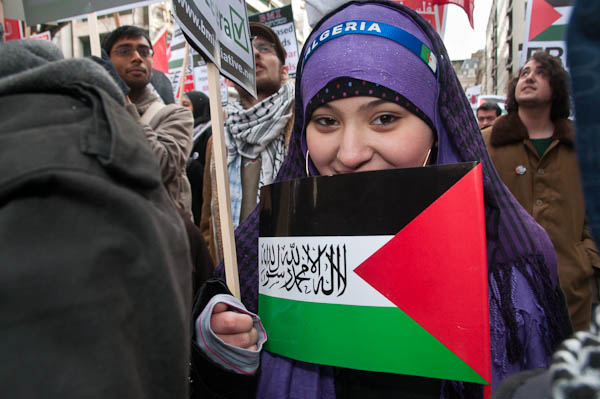
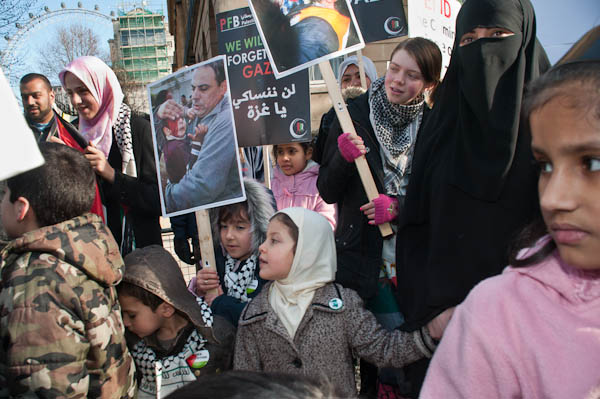
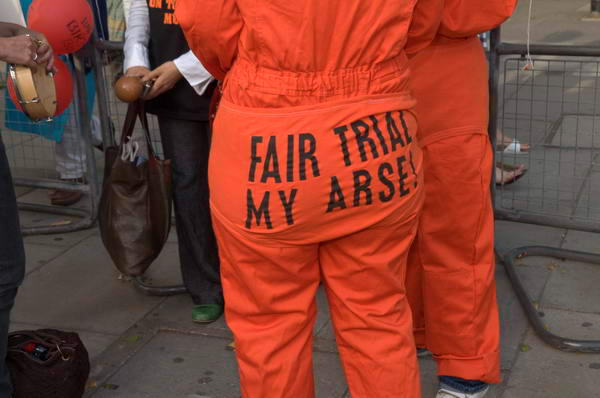
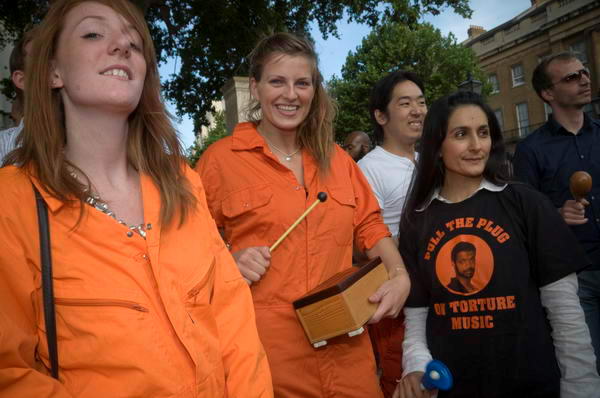
D700 at ISO 3200

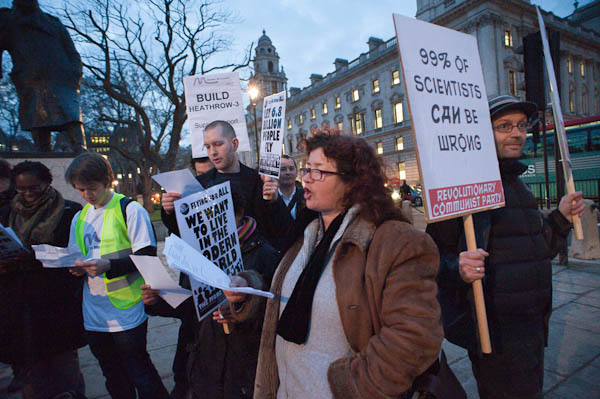
There were two demonstrations starting at 5.30 in Westminster, so it seemed a good occasion to try out the Nikon D700 at high ISO working with available light, though I also took some flash pictures with the D300.
© 2009 Peter Marshall.

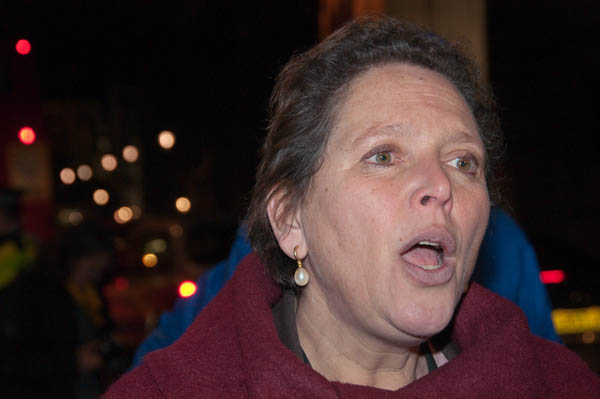
As the light fell, I started working at ISO 2000, and this shot at 1/60, f4 with the Nikon 20mm f 2.8 is  very usable, although my normal Lightroom settings for noise reduction left a little colour noise on 1:1 viewing – easily removed by a small increase in the ‘Color’ setting from 11 to 15.  There was also visible luminance noise, improved slightly by increasing the setting for this, although it wasn’t possible to remove it completely.

Most frames taken at 3200 were actually a little cleaner, suggesting that despite shooting on RAW, in-camera noise reduction is kicking in more strongly. Although there is a little noise, the overall quality is remarkable, and these images are fully usable. I wouldn’t anticipate having any problems even with the occasionally rather pernickety quality control on sites such as Alamy.  The noise is actually quite attractive – rather like film grain – so long as you remove the colour component.

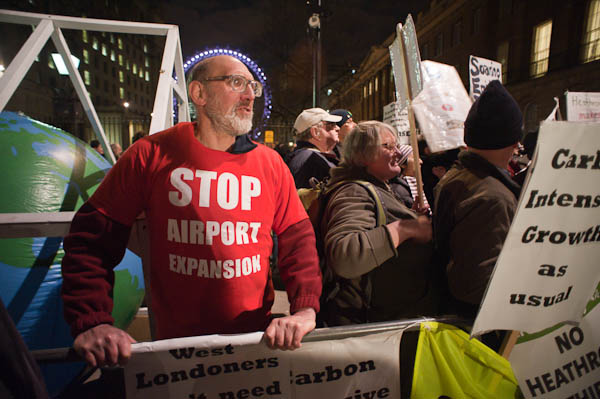
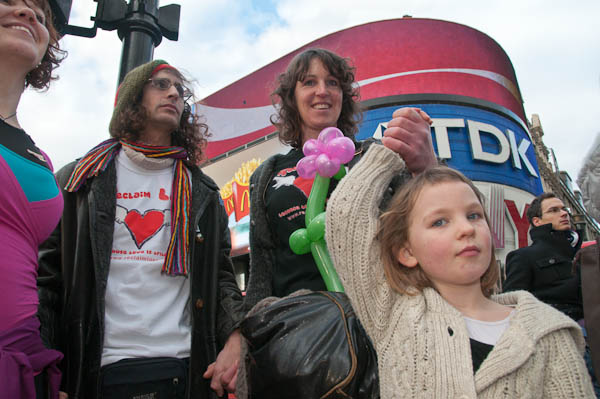
Here is a picture of two NOTRAG  supporters in Whitehall, taken at 18:15, 1/80 f4.5 ISO 3200, again with the 20mm.  In fact I suppose it is really at ISO 6400, as to keepthe highlights (except for actual light sources) I had to use a -1 EV exposure bias.

© 2009 Peter Marshall.

The main technical problem in this picture is not the camera but the colour and quality of the available light. Here’s a 1:1 section from the image

1:1 detail, ISO 3200
1:1 crop from ISO 3200 image on the D700

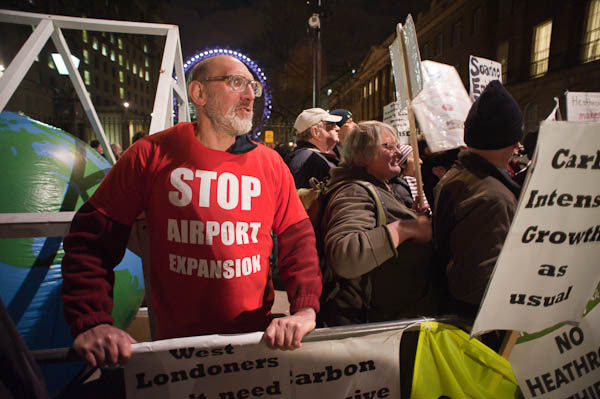
There is some noise visible, and a slight lack of detail compared with a low ISO picture, but overall the quality seems very usable. And in the city centre, ISO 3200 lets you shoot hand-held in available light, certainly with wide-angle lenses. Here are a few pictures I took later in the evening.
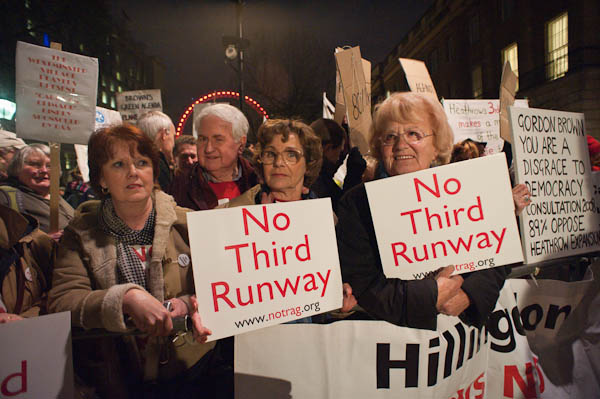
© 2009 Peter Marshall.

© 2009 Peter Marshall.

© 2009 Peter Marshall.

© 2009 Peter Marshall.

This last image shows what is now sadly the former Eurostar terminal at Waterloo (St Pancras may be fine for some, but the switch there and the huge sums spent on the high speed line from Kent to there have increased my journey times to Paris by on average 15 minutes.) And it’s a little of a cheat as a hand-held image because I was resting my hand holding the camera on a nice solid wall for the 1/6 second exposure.  But the roof detail is great at the left of the picture. Surprisingly for a 20mm image it seems not to have sufficient depth of field to retain sharpness to the end of the structure.  So a tripod would have been a good idea, allowing me to stop down and give a longer exposure, and doubtless the lens would also perform a little better stopped down. And it might even have been improved slightly by using a lower ISO.

Flash still has a big advantage in taking portraits in the street at night because of the poor colour spectrum of most street lighting, which makes it impossible to get normal skin tones.  But I can see that on the D700 I shall be shooting flash at higher ISO to, to retain more of the surroundings.
Plane Stupid Modern Movement

I think of the modern movement as an interesting historical time in art and architecture, exemplified in architecture by the work Le Corbusier (I hope to see the show about his work at the Barbican shortly), by the painting of Picasso, the photography of Strand and Weston. For all it’s new ideas and appeal at the time, it now seems curiously outmoded, dated perhaps even more than some of the work that preceded it.

Brasilia © 2007 Peter Marshall
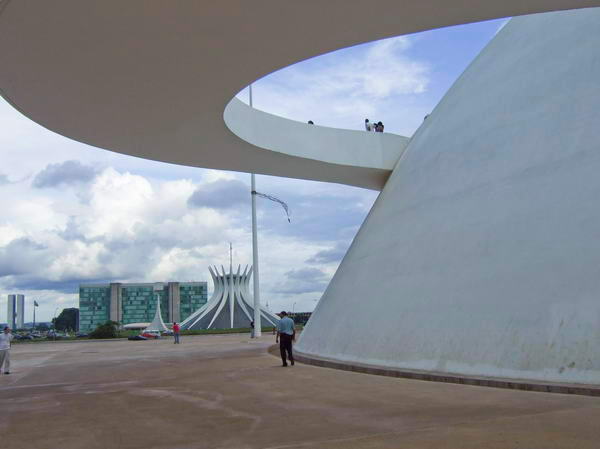
Museum, Cathedral, Ministries and Parliament buildings, Brasilia

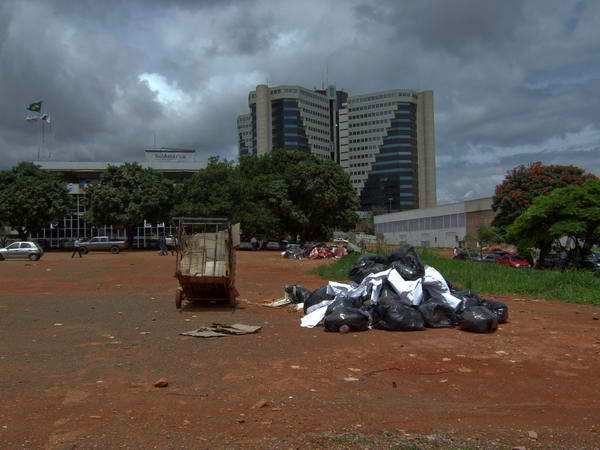
Perhaps it’s last great exemplar in urban design and certainly one of its grandest was the new city of Brasilia, which I was fortunate to have the opportunity to visit in December 2007. The planning of Lucio Costa and the concrete poetry of Oscar Niemeyer is certainly breath-taking, but it is a future vision with some very obvious cracks around the edges.
Brasilia © 2007 Peter Marshall

Modernism was certainly an interesting experiment, with lessons that continue to inspire, but not a model to follow. Rather than think in terms of machines for living we have perhaps moved more towards the idea of organisms that have to live together in an environment as a central theme.
© 2009 Peter Marshall.
‘99% of scientists can be wrong’

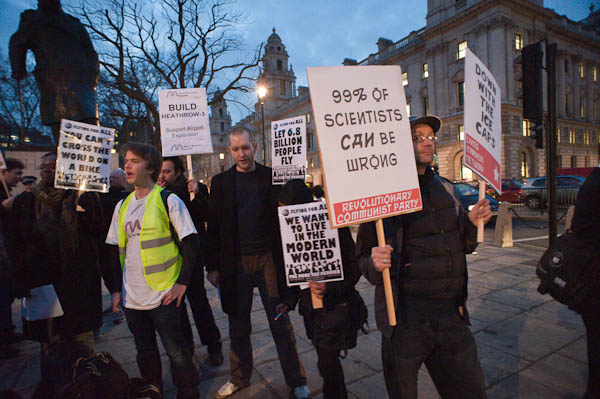
So the so-called ‘Modern Movement‘ (MM) set up by those associated with the old ‘Revolutionary Communist Party‘ is perhaps an appropriately named dinosaur, based on the outworn dogma of extreme free markets. On the evidence of Thursday’s demonstration, with around 20 people in Parliament Square, it is also a very small and poorly supported dinosaur. By contrast, perhaps fifty times as many were demonstrating against the building of a third runway at Heathrow just a few hundred yards away on Whitehall.

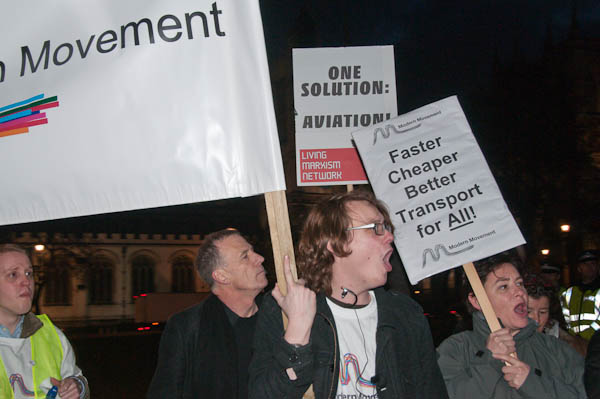
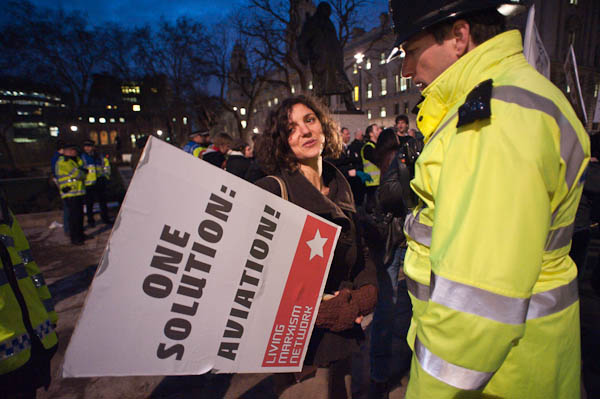
The intervention of a just a small handful from ‘Plane Stupid‘ who came to join in with placards that expressed in simple parody the ideas of the MM was effective beyond their numbers, and clearly linked the demonstration to the ‘Living Marxism Network‘ and the ‘Revolutionary Communist Party‘. Their placards read ‘One solution: Aviation!‘,’Down With the Ice Caps‘ and ‘99% of scientists can be wrong’, and their very presence caused a minor security alert across the whole of government offices in central London.

© 2009 Peter Marshall.
‘One Solution: Aviation’

One of the co-founders of MM, Alex Hochuli said in a TV interview (on Worldbytes, an internet TV station that seemed to have a connection with the demonstrators) : “the ability to travel, to see the world, to work abroad, to live abroad, to have other people come here is more important than dealing with climate change.”  There you have it. This is what their protest was about. The planet can go hang just so long as a few of us in the rich world can have cheap air travel.

© 2009 Peter Marshall.

On the square, police and MM stewards attempted to stop Plane Stupid protesters taking part in the demonstration (see comment – I may well have misinterpreted the reaction of the MM stewards.) The police gave a warning that they could be prosecuted for taking part in an unauthorised demonstration in the SOCPA area, while they insisted they only wanted to take part in a publicly advertised and authorised demonstration. While one man slipped apparently unnoticed onto the end of the short line of protesters and stood there for around half an hour before police finally removed him, a woman was prevented by police from taking part for most of the time I was there.

You can read more about the history of the RCP and the organisations associated with it on Lobby Watch although this has not yet been updated to include ‘Modern Movement’. There is more about this event on My London Diary with more pictures of those taking part.

I’m A Photographer… not a Terrorist

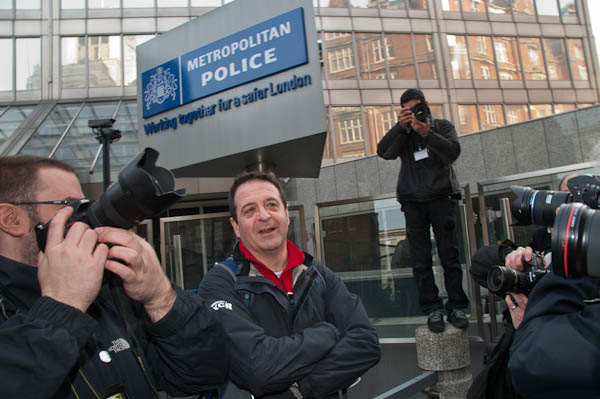
Photographers increasingly feel threatened when they take pictures on the public street. Sometimes they are actually threatened, both by vigilantes and by the police – and like most others who work on the streets, its happened to me. The police have even run a poster campaign against photographers – and in March last year NUJ General Secretary Jeremy Dear staged a one-man protest at New Scotland Yard to defend press freedom and the rights of photographers. Previously the NUJ and other journalistic bodies had agreed guidelines with the police about how police and press should work together, but these seldom seem to respected by the police. You can read more about the issues and the event in the >Re:PHOTO blog post ‘Photographers by the Yard.

Previously much of the legal friction between police and photographers had been over the wide-ranging powers of police under Section 44 of the Terrorism Act of 2000, which allows them to stop and search anyone within a designated area. The whole of London is one such area, and the powers, intended to be in force for a maximum of 28 days, are renewed indefinitely.

© 2009 Peter Marshall

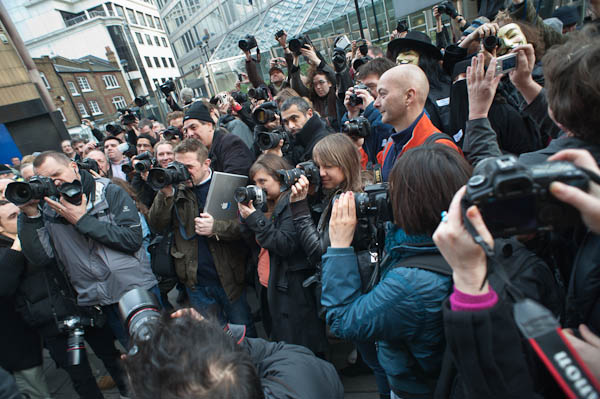
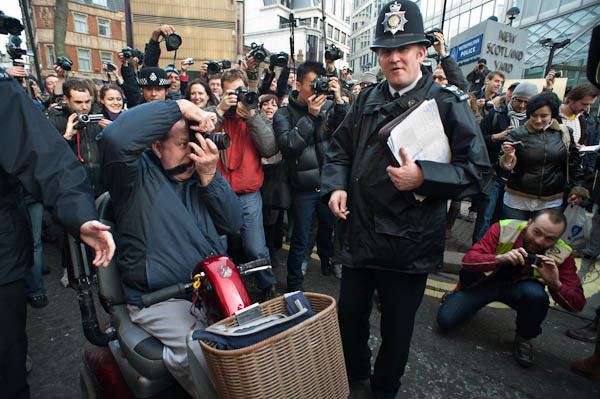
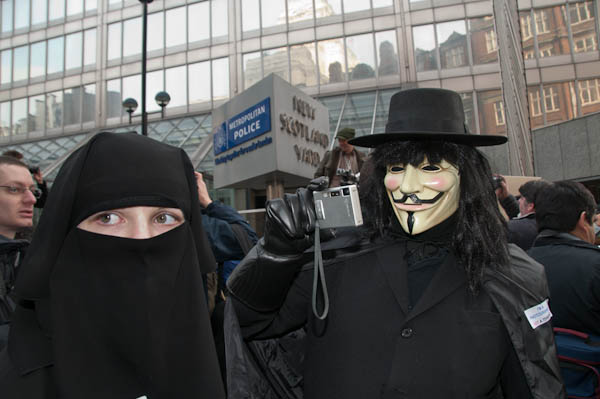
Monday’s demonstration – or rather ‘media event’, since it took place in the SOCPA designated area – was a rather larger event, with an estimated 400 professional and amateur photographers, and was organised by a small group of photographers to mark the introduction that day of Section 76 of the Counter-Terrorism Act 2008. It is now an offence to photograph any policeman, serviceman or intelligence agent in a way that is “likely to be useful to a person committing or preparing an act of terrorism,” or to publish such a picture – for example on a web site such as this.

© 2009 Peter Marshall.

You don’t have to be a terrorist or to make use of your picture for any terrorist purpose. If a court can be persuaded your picture might be of use to a terrorist, you can get 10 years in jail.  It is the kind of law that a few years ago we would have shrunk with horror at as clear evidence of a police state.

© 2009 Peter Marshall.

At the moment although we are lurching dramatically in that direction, our courts do usually provide some protection, and the law does give them some power in it’s statement: “It is a defence for a person charged with an offence under this section to prove that they had a reasonable excuse for their action.” It is perhaps hard to imagine – at the moment – a court convicting a journalist covering a demonstration for photographing the police.  But rather easier to imagine it being used – as with Section 44 – by police to harass photographers and prevent them from getting on with their job. Being held and searched for 40 minutes while on the way to cover an event can be a pretty clear interference with the freedom of the press to report.

© 2009 Peter Marshall.
Mark Thomas speaking at the event

More about the event and more pictures on My London Diary.

Arbaeen

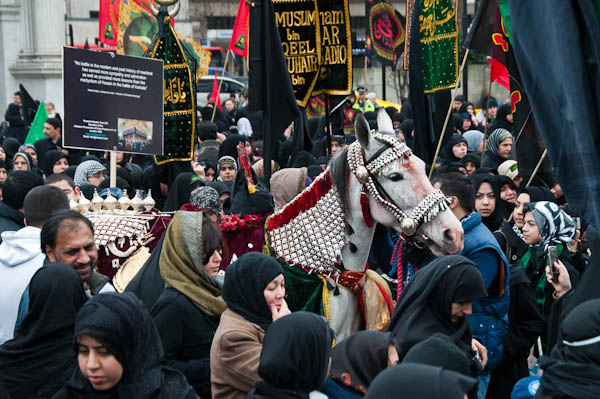
Arbaeen is an important festival for Shia Muslims, marking the end of 40 days of mourning to commemorate the massacre of the Imam Husain, the grandson of Mohammed, who along with his 72 companions were martyred at Karbala (now in Iraq) in 61AH (680 AD.)

© 2009 Peter Marshall.

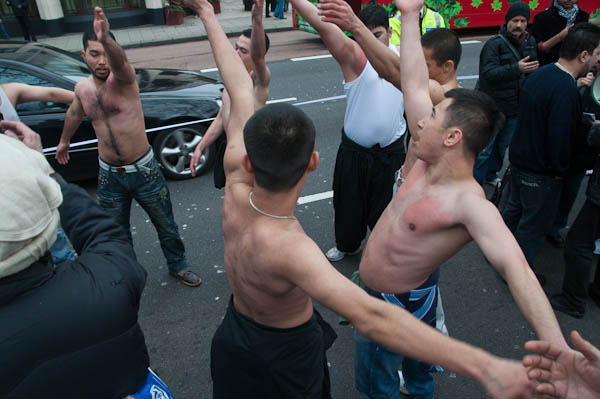
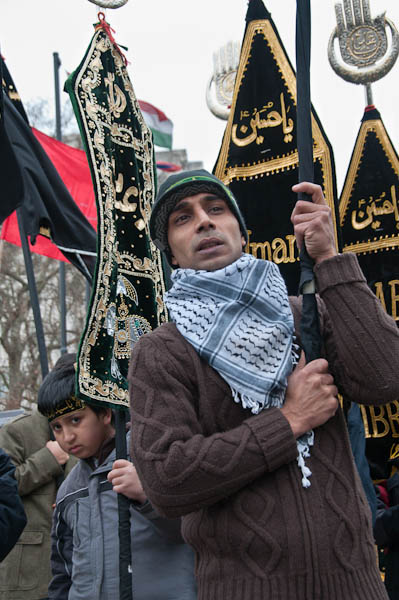
An Arbaeen procession has taken place in London every year since 1982, and it is a moving and colourful occasion in which several thousand Muslim men and women take part. After prayers and speeches they processed along Park Lane chanting and beating their breasts as a symbol of mourning. While for most this is simply a symbol of their deep feelings of mourning, for some it has a powerfully physical aspect as well.

© 2009 Peter Marshall.

In the procession were two large intricately carved metal models of Holy shrines (Shabbihs)  the cermemonial horse (Zuljanah) of Imam Husain and the cradle of Hazrat Ali Asghar, who only six months only was the youngest martyr at Karbala. There were also many standards, flags and banners.

© 2009 Peter Marshall

More about the event and more pictures on My London Diary

Reclaim Love

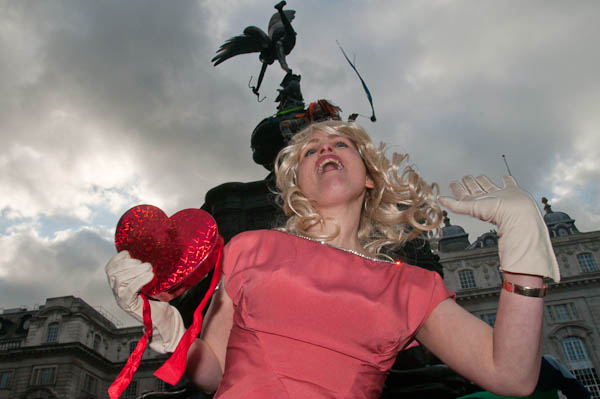
Last Saturday was St Valentine’s Day. My French calendar also informs me that it was also the day for St Cyrille and St Methode (is this a takeover bid for John Wesley?)  but I’ll pass on them.  Traditionally St Valentine’s day has become a great merchandising opportunity in which large hearts fill the windows of shops and the pockets of shop-keepers.

© 2009 Peter Marshall

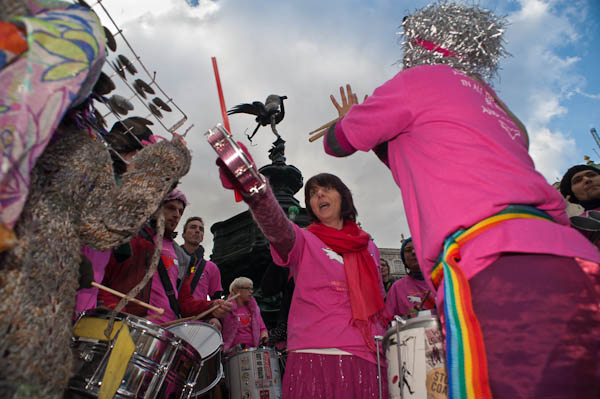
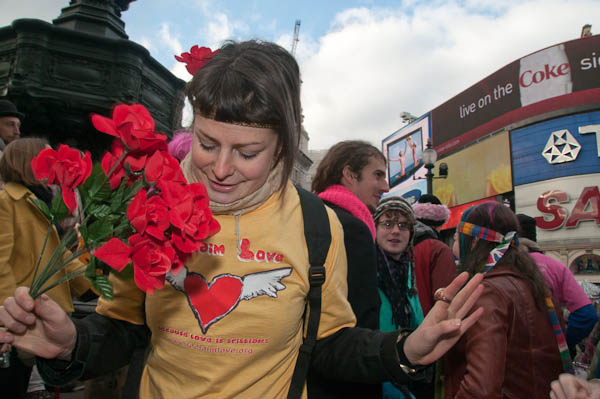
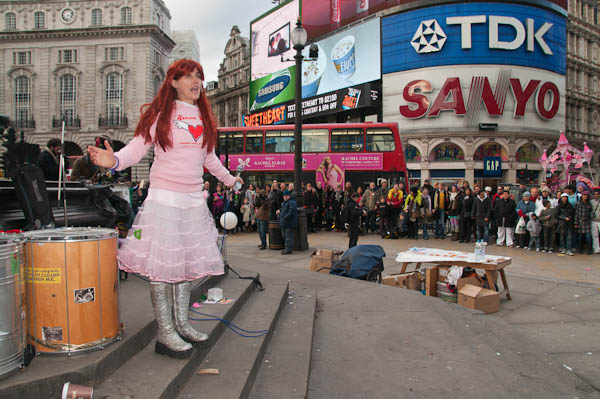
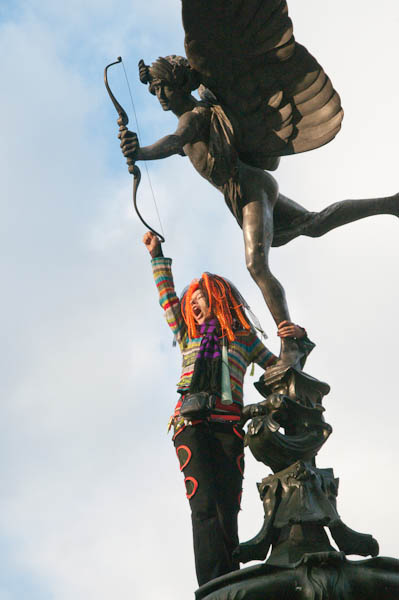
Reclaim Love, now in its sixth year, sets in opposition to the commercialisation of this festival of love.  Everything is free – including several hundred free t-shirts, free hugs, free food, music and being together and enjoying each other’s company.

© 2009 Peter Marshall

Love comes free and it is the greatest force in the world is the message behind this annual festival organised by – who else – Venus.   And it’s an event that is spreading around the world, with Reclaim Love events this year in countries including Iceland, Finland, Spain, Italy, India, Pakistan, Australia and elsewhere.

© 2009 Peter Marshall

At 3pm, Venus organises everyone present to hold hands to form a large circle around the whole area, rushing herself to join it and send out a message of love to the world.

© 2009 Peter Marshall

And then the partying continues under the statue of Eros.

© 2009 Peter Marshall

More about the event and more pictures on My London Diary, where you can also see pictures from some previous years –  2005, 2006, 2007 and 2008.

Peter Goldfield

It was with great regret that I heard this morning of the death of Peter Goldfield who gave so much to many photographers through the workshops he ran at Duckspool as well as his own photography and teaching at various universities over the years.  He was a clever and kind man who was always a pleasure to meet and although I’ve seen him only infrequently over the years I’ll miss him; it is a great loss for photography in the UK, and of course much more so for his family and close friends to who I extend my sympathies.

I first came across Peter, like me a Londoner born in 1945, in the room above his pharmacy in Muswell Hill in the early 1970s. Goldfinger Photographic was for many of us an introduction to ideas of fine printing particularly with the publication of the Goldfinger Manual, and perhaps more importantly was the source of that Holy Grail for fine printing, Agfa Record Rapid, imported specially by Goldfinger and not otherwise available in the UK.

A couple of years later I met him briefly at his home nearby and was introduced to his family before being driven by him to a workshop – I think it was with Lewis Balz – at Paul Hill‘s Photographers’ Place in Bradbourne, Derbyshire.

It wasn’t the first visit there for either of us, and it was a place that played a vital role in both of our lives, particularly pivotal for Peter. It was perhaps surprising we hadn’t met there before, but we found we knew many of the same people and similar ideas, as well as appreciating many of the same photographers. For him the forming experience had been a workshop with Charles Harbutt, while for me a series of meetings with Raymond Moore made a lasting impression.

You can see and read much more about him on his web site (he started on the web in 1995, the same year that I wrote my first web site.)

I went to two workshops at Duckspool, where Peter and his wife Sue were splendid hosts, and have happy memories of both. One was with Charles Harbutt, and it was indeed a memorable and thought-provoking experience; perhaps had I met him 20 years earlier it would have changed my life too.  The second, in 1998, was with Leonard Freed who I warmed too rather less, but it was great to be at Duckspool again.

I wrote an article about the experience for a small magazine I was editing at the time, London Independent Photography’s LIPService, and I’ll reproduce here most of the text from that, as well as the pictures from the workshop I used to illustrate it. I hope it will bring back some fond memories to some of my readers as it does to me.

Duckspool

Readers who have yet to make it to Duckspool are missing one of the more rewarding and intensive experiences available to the photographer. The chance to work with one of many well-known photographers (including John Blakemore, Mark Power, Martin Parr, Homer Sykes, Fay Godwin, John Davies, John Goto from this country and distinguished visitors such as Judy Dater, Susan Meisalas and Charles Harbutt) as well as the other keen and often very talented photographers who are your fellow travellers.

Sidmouth, 1998 © Peter Marshall

Your only difficulty is in chosing which workshop to attend. Probably the best advice is to read the workshop descriptions very carefully and to talk to as many people who have already The best-known photographers are not always the best teachers so you may get better value from some of the less familiar names. One workshop I’d recommend from personal experience – and I know has changed some people’s lives radically – is Charles Harbutt’s. (Peter Goldfield went to it at the Photographers’ Place and decided to sell up his business and found Duckspool!) One of the first photo books I bought was Harbutt’s Travelog published by MIT in 1973.

Sidmouth, 1998 © Peter Marshall

Since 1986, Peter and Sue Goldfield have opened the doors of their rural Somerset home to photographers with some 25 workshops this year – and you really are made to feel at home. The accommodation in shared rooms is comfortable and the food was even better than when I last visited some five years ago, which takes some doing. However possibly not every workshop will have a meal cooked by a visiting French chef and enjoy one of the best pub meals I’ve had, but the Goldfield standard is in any case a hard one to beat.

Sidmouth, 1998 © Peter Marshall

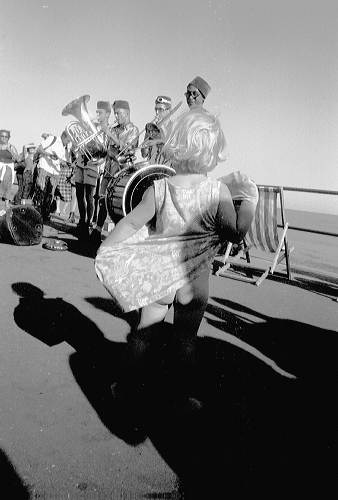
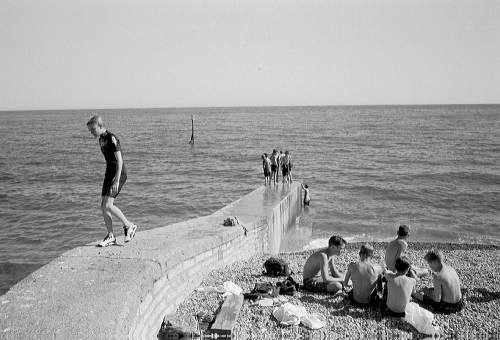
I’m told the darkroom is much improved since my last visit, although I didn’t use it, with developing and contact printing being done expertly by the artist in residence (thanks again Julia!), leaving us more time to talk photography and take pictures (we photographed Sidmouth, then in the throes of its annual Folk Festival – reducing the average age on its streets by a factor of at least three – which climaxed with a torchlit procession to the sea).Some people also made use of Peter’s expertise in the digital darkroom, with interesting results. My only regret was having to leave Duckspool at the end of the workshop (worse, a little before the end, as I had a train to catch) as there was so much more I would have liked to have done and said. And the food!

London Gaza Slide Show – My Pictures

One thing I didn’t mention in my earlier piece on the Photo-Forum meeting was what in some ways was the highlight of the meeting for me. Jeff Moore had invited photographers to send in up to 12 images from their coverage of events related to the attack on Gaza, and had put these into a slide show.

Most of the pictures were from the many demonstrations in London – as you can see from My London Diary I covered eight of them in January, (with another two so far this month – too late to send in for this event.) So I had plenty of pictures to choose from, despite having lost most of my work – an 8Gb card full – from the big march on 3 Jan (see Lost Masterpieces?)

Unfortunately this is a show that won’t be available on-line, because as well as containing some pretty good pictures it was also a great lesson in different approaches to events. Because so many of us had sent in work they had to be show a little too fast on the evening.

What I can show is my own set of 12 images, appearing on the blog at 450 pixels wide, but as usual here you can see them larger by loading the actual image in your browser. In Firefox you right click and select ‘view image.’ If you still use Internet Explorer there is probably a way to do it, but the best way would be to upgrade to Firefox!

© 2009 Peter Marshall.
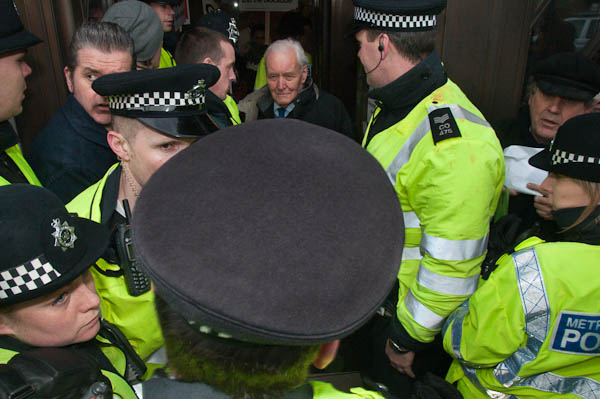
Tony Benn emerges from the BBC after delivering a protest letter about their failure to run the Gaza appeal, Jan 24

© 2009 Peter Marshall.
Demonstration at the Egyptian Embassy, 2 Jan

© 2009 Peter Marshall.
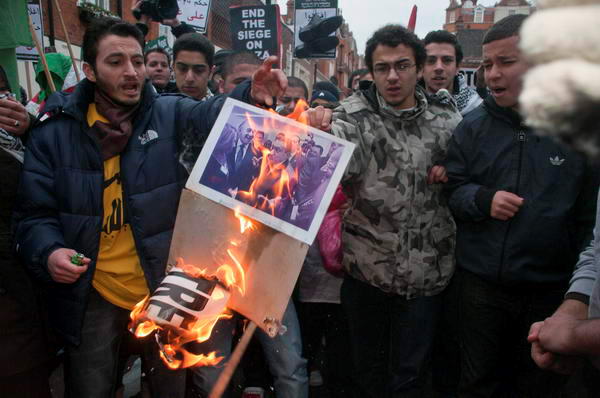
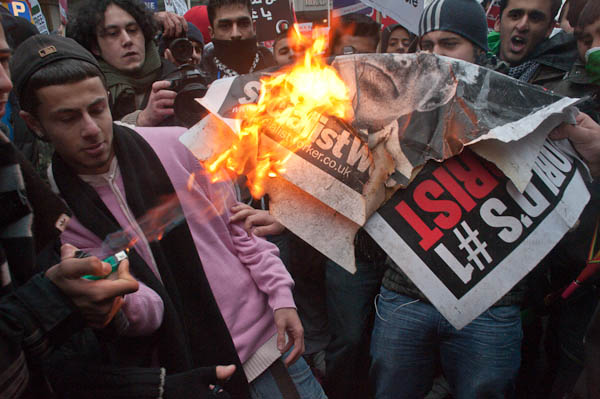
Protesters burn Camp David photo at Egyptian Embassy, 2 Jan

© 2009 Peter Marshall.
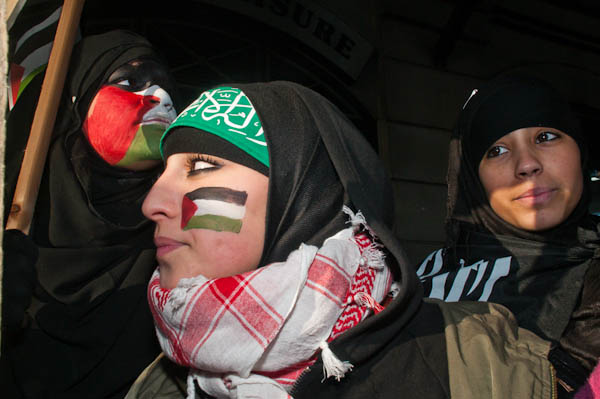
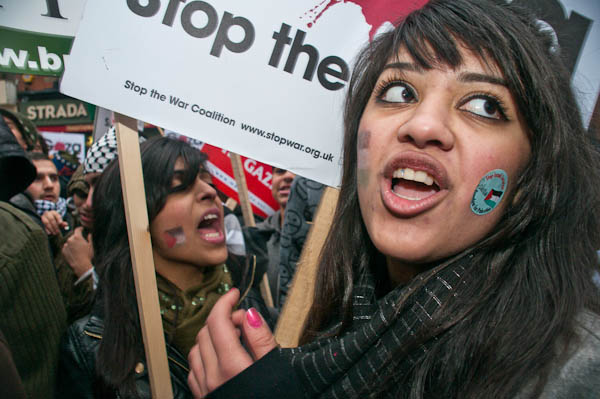
Women with Palestinian face colours at the start of the Jan 3 march

© 2009 Peter Marshall.
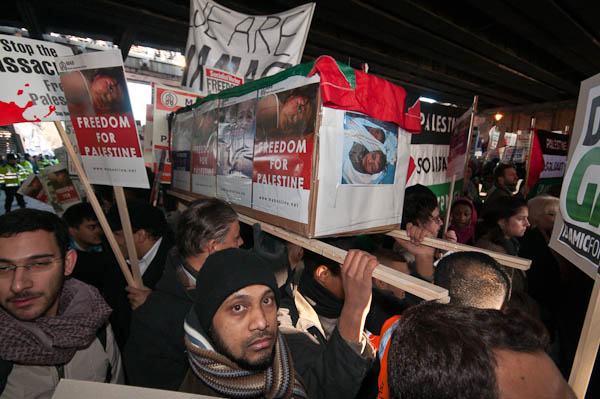
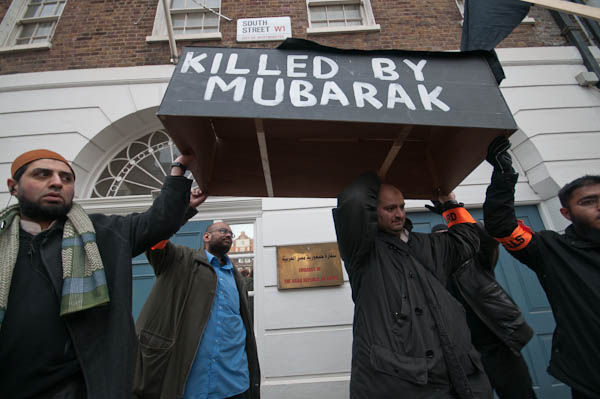
Protesters carry a coffin in Jan 3 march

© 2009 Peter Marshall.
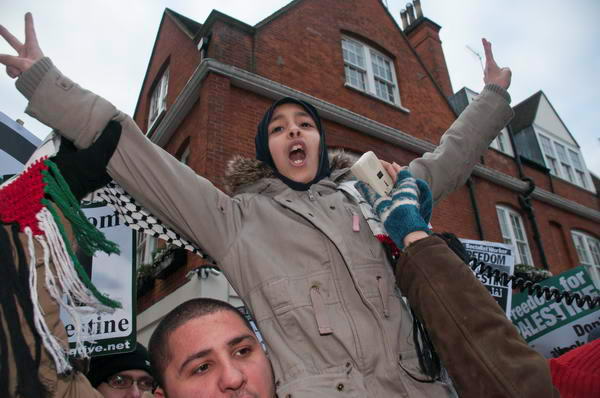
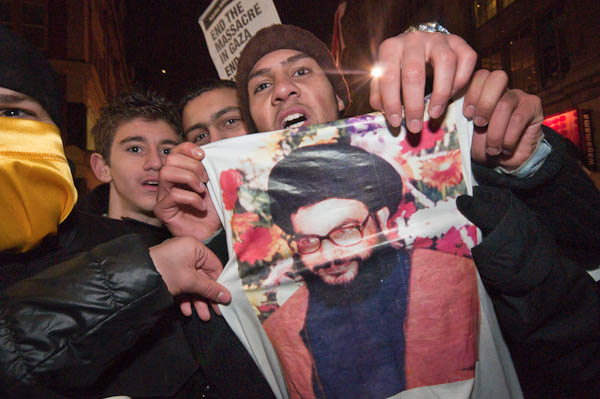
Young protesters opposite the Israeli embassy
, Jan 7

© 2009 Peter Marshall.
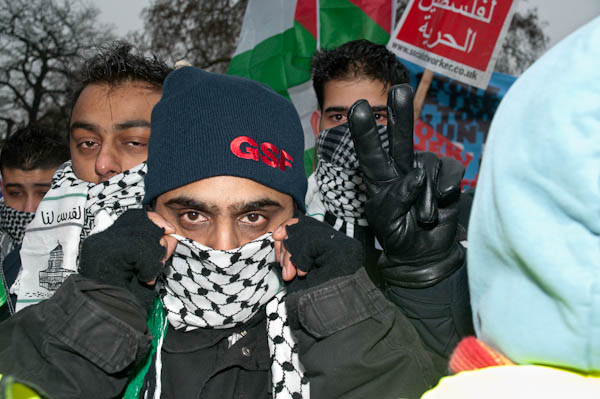
On the march, Jan 10

© 2009 Peter Marshall.
Opposite the Israeli Embassy on Jan 10

© 2009 Peter Marshall.
Opposite the Israeli Embassy on Jan 10

© 2009 Peter Marshall.
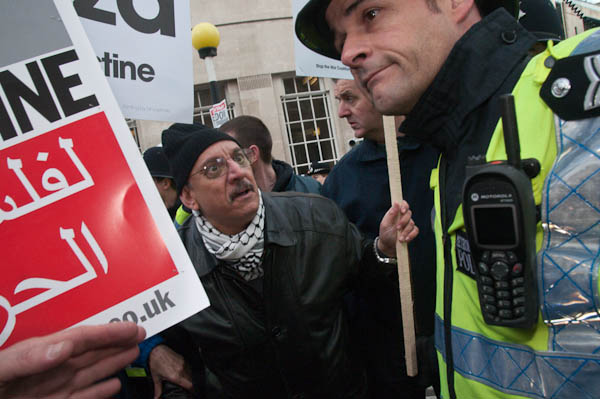
Hizb ut-Tahrir demonstration at the Egyptian Embassy, Jan 11

© 2009 Peter Marshall.
Police clear demonstrators from outside the BBC, Jan 24

© 2009 Peter Marshall.
In Portland Place at the rally on Jan 24

Largely missing from my coverage were violent incidents with pictures of demonstrators attacking police and – rather more evident in the photographs shown – police attacking demonstrators – and these produced some of the more interesting pictures in the show. Partly mine was a deliberate choice of how I wanted to present the events – these incidents were only a very small part of the whole –  but there were other factors, not least that these demonstrations often dragged on fairly late into the evening and I had other things I wanted to do. These were events being covered by large numbers of press photographers – unlike some of those I cover and I didn’t feel my presence was needed.

Children Protest for the Children of Palestine

© 2009 Peter Marshall
Whitehall demonstration for the children of Gaza and for all children of Palestine

Many children were killed and injured in the Israeli attacks on Gaza and many others have been killed over the years in other Israeli raids and military actions in Palestine.

On Sunday afternoon, children, together with their parents, came to Whitehall for a protest opposite Downing Street organised by the Islamic Human Rights Commission and the Palestinian Forum of Britain. There, with banners and slogans they forcefully called for an end to the fighting and killing of innocent civilians and for a free Palestine. The captions for the pictures are text from their placards, some of which also carried horrific images showing children injured and killed in the attacks.
more pictures

An Open Letter to Obama

© 2008 Peter Marshall
One of President Obama’s first actions was to stop the unfair trials at Guantánamo Bay. But there is still more to do
 

Dear Mr President,

I’ve never met you, but like millions of others I felt that your election offered the chance of a new start for the United States of America, and was heartened by what you had to say about many things, not least about Guantánamo Bay and the use of torture.

I write to you on behalf of someone I’ve never met, nor have you, who once lived in the city I work in, London. And although I know you are extremely busy there is something that would only take you a few seconds that would possibly save his life, as well as sending a powerful message that you mean to follow fine words with fine actions. It would take you three words. “Release Binyam Mohamed.”

Binyam (as well as fellow Londoner Shaker Aamer)  has many supporters here in the UK, and according to his lawyer is in a very poor state. As well as still suffering from his previous torture and deprivation his hunger strike makes his condition very dangerous, and unless released and given proper treatment he is likely to die in Guantánamo .

© 2008 Peter Marshall

The British government has I understand made a request for his release. So far as is known the only problem of any sort over his release is the embarrassment it might cause to US and possibly also British security services if he is able to tell his story in full. This cannot be a valid reason for prolonging his unlawful imprisonment by a single second.

I don’t expect a personal reply, but it would be great to hear the news and see the pictures of Binyam and others returning to their homes, friends and families. I know there are problems with returning some of the prisoners who might be imprisoned or tortured on their return, but there can be no justification for keeping people like Binyam, where no such problem exists, in custody at Guantánamo a second longer.

You can say it. “Release Binyam Mohammed.” Yes you can!

Please do. And soon.


More on Binyam and the protests in this country against his detention on My London Diary, Jan 2008July 2008 andJan 2009.

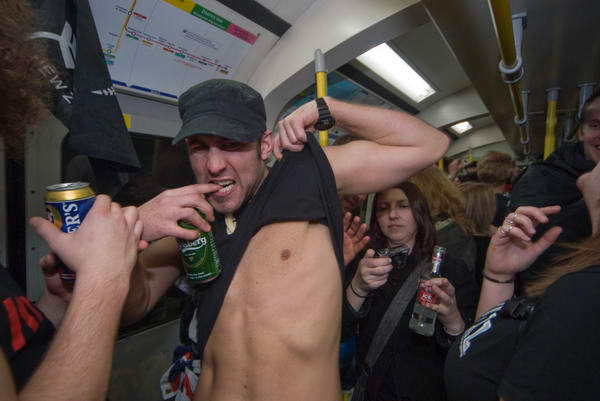
Kiwis v Boris?


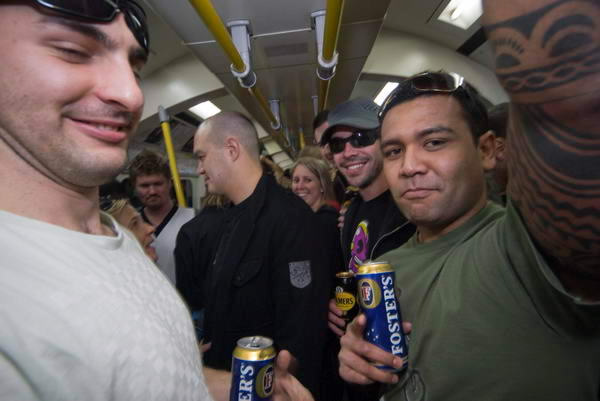
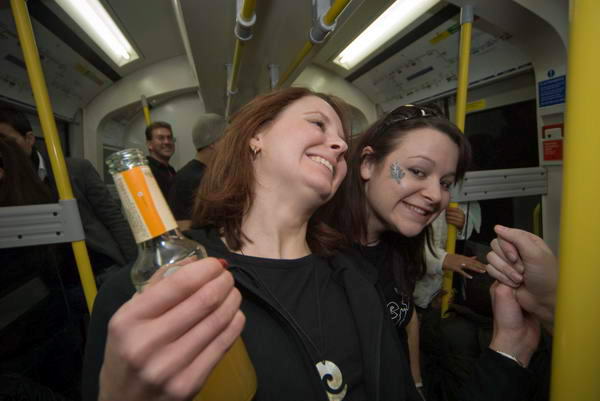
Circle line pub crawl, Feb 2008

Today New Zealanders were celebrating Waitangi Day, and in the UK this means the Circle Line pub crawl. Presumably back in New Zealand they manage to celebrate it some other way.

© 2008 Peter Marshall

I don’t know how this year’s Waitangi Day revellers coped with Boris’s dictat against alcohol on the tube, but last year’s event was a lot of fun.

© 2008 Peter Marshall

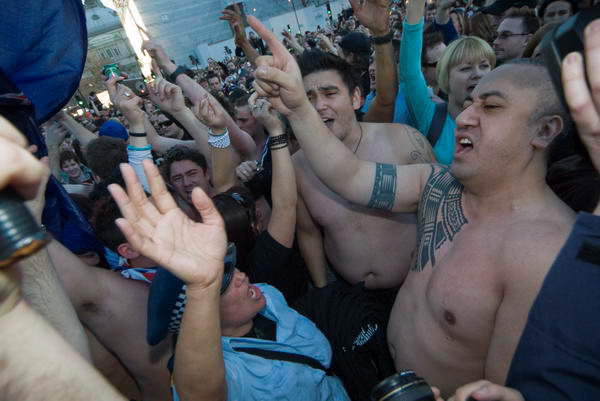
And of course one of its main features is a haka at Parliament Square, filled with perhaps 10,000 Kiwis. Of course drinking alcohol in public had been banned there before last year’s event – and you can see exactly what difference it made in my pictures from the event on My London Diary.

© 2008 Peter Marshall

I was sorry to miss it this year.