You can’t photograph Sewer Gratings

The latest silly story about photographers being arrested is about Stephen Clarke, arrested in Manchester for allegedly taking photographs of sewer gratings. Watch the video here.

The police also took a DNA sample and it is not on the police database, despite a ruling that such action is illegal at the European Court of Human Rights. Once the police have your sample, getting off the database is not easy.

© 2009 Peter Marshall.

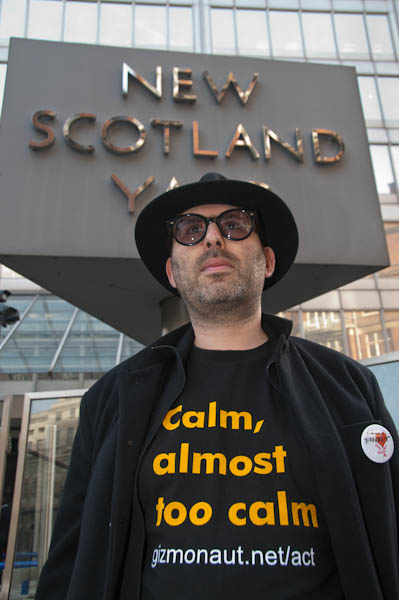
One man – perhaps the only one – who has managed it is David Mery, arrested in July 2005, three weeks after the London bombing – and six days after the shooting of Jean Charles de Menezes – while entering  Southwark tube station on 28 July for being “calm on arrival, almost too calm” and having a largish rucksack and a strong French accent. You can read about his struggle, eventually successful – to have his DNA record removed from the database on his web site.

South London for Gaza

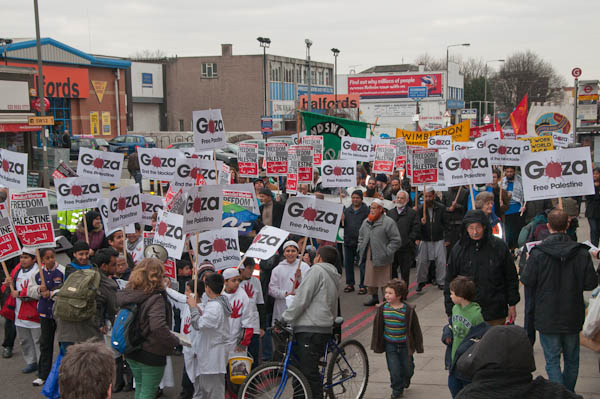
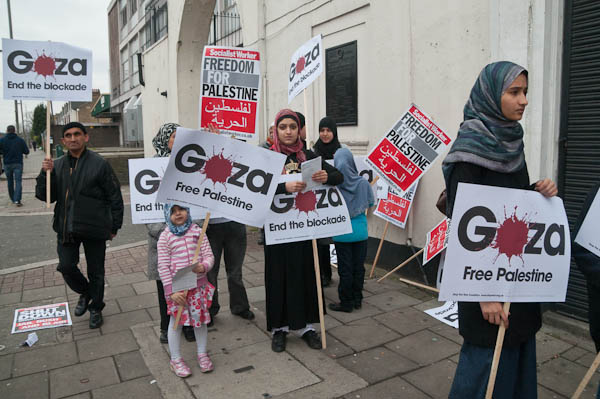
Saturday’s South London March for Palestine, called by Wandsworth Stop the War Coalition was supported by many organisations from south of the river and made its two mile route through the busy main roads of Balham and Tooting.

© 2009 Peter Marshall.

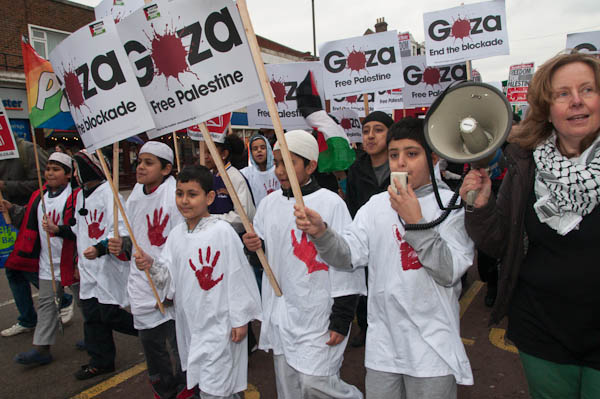
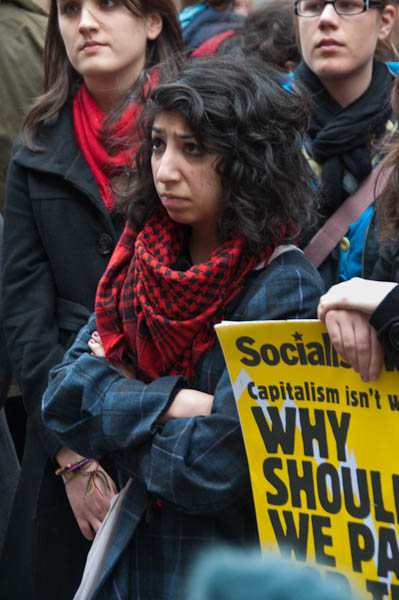
Almost three hundred people gathered outside Balham Mosque for the start of the march, including many families, and there were banners from several trade union organisations, as well as the many placards from Stop the War and Socialist Worker and rather fewer from Palestine Solidarity  Campaign.

The march had strong support from Muslims in the area, and apart from starting at the Balham Mosque it ended with a rally at the Tooting Mosque which unfortunately I couldn’t stay for.

© 2009 Peter Marshall.

For once it was an event it was a delight to photograph. Friendly people, helpful stewarding (other Stop the War stewards could certainly learn from this) and no hassle at all from the police,  who cleared the traffic and otherwise more or less kept out of the way, although they did insist that the march kept on moving. It was after all going down one of the main routes out of London to the south, the A24 Balham High Road/Upper Tooting Road, both also lined with shops and busy with shoppers on a Saturday afternoon.

© 2009 Peter Marshall.

It made quite an impressive sight going along the road, as well as a great deal of noise. Many people stopped to watch it go past and many showed their support by waving and applauding. The march was led by a group of very energetic young boys in white t-shirts with blood-red hands marking them, closely followed by some of the women of all ages  in front of the main banner which was mainly held by men – with Lindsey German of Stop the War joining them a little way down the road.

There were also several photographers from the local papers present, so I hope it got some good local coverage. I posted a short report on ‘Indymedia’ which is more or less as you can also read on My London Diary, where you can see many more pictures.

SHAC City Shakedown

I’m against cruelty to animals. But even more I’m against cruelty to human beings and some of the actions taken by animal rights activists appear to me to have involved this. However there does appear to be a great deal of demonisation going on in this area resulting in heavy-handed policing and some draconian sentencing by judges. And of course, much of what you read about animal rights activists (and much else) in the papers or even hear on the BBC is simply sensationalist fabrication, usually around a very small and far less dramatic kernel of fact.

It would however be hard to exaggerate some of the cruelty that does go in in testing chemicals on animals and in intensive food farming in this country and in fur farms abroad. We should have adequate legislation on animal welfare and it should be much more rigorously enforced. But I feel much more inclined to support things like the RSPCA‘s ‘Rooting for Pigs‘ campaign (and eat bacon from pigs that are well-cared for) than the ALF.

I’ve also benefited from drugs that have been tested on animals – and I probably wouldn’t be here without them. So I’m not entirely opposed to animal testing, though I think there should be much tighter restrictions, that it should be limited to testing of essential drugs (and not cosmetics or cleaning products etc) and that there should be much more effort put into developing alternative testing methods. Again I’d very much support the RSPCA’s approach to the use of animals in research.

© 2009 Peter Marshall.
SHAC get ready to march from Bank

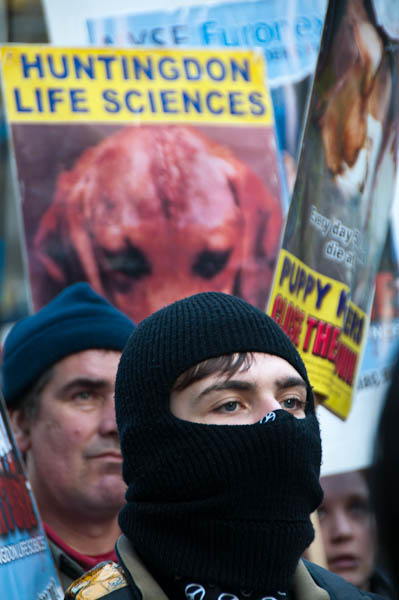
Stop Huntingdon Animal Cruelty (SHAC) runs a global campaign to close down Huntingdon Life Sciences, the largest contract testing laboratory in Europe, exposed on many occasions by journalists, on TV, by ex-workers and by animal rights activists – including SHAC – for various inhumane practices, breaking or ignoring regulations, incompetence and more. Home Office inspectors have also been found failing to enforce regulations.

Some of the more horrific evidence that has emerged has been about the treatment of primates captured in the wild for experiments at HLS; the company tried to stop publication of some of this material with an injection but this was overturned after a lengthy court battle. Fresh appalling evidence on their primate trade came out last year. SHAC have also exposed terrible conditions in farms breeding animals for use by HLS, as well as cruelty at some of HLS’s customers.

© 2009 Peter Marshall

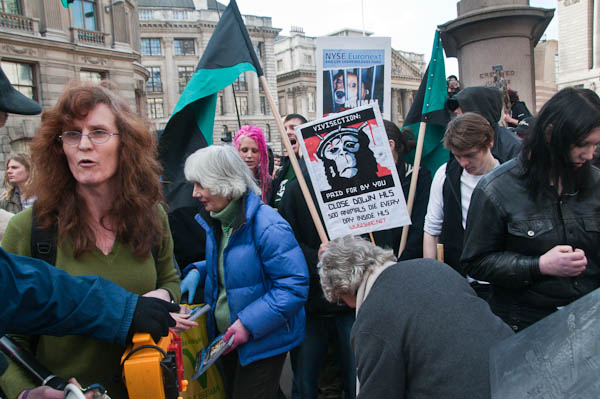
The demonstration in London by SHAC last Friday was impressive in several ways, not least in the wide range of people in the 300 or so it attracted and their obvious dedication to the cause.  The march around London was to draw attention to the financial backing for HLS from the Bank of England, and also by major shareholders including Barclays, H P Morgan, Merril Lynch and AXA Investment Managers and it ended at the London NYSE (New York Stock Exchange) Euronext which lists HLS shares for trading.

© 2009 Peter Marshall.

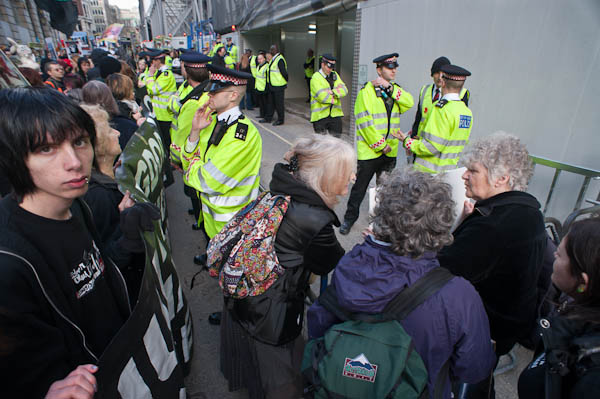
This was a well-ordered demonstration that hardly merited the extensive police presence, although the City of London Police do appear to have a more even-handed approach to demonstrations than some other forces.

© 2009 Peter Marshall
At NYSE Euronext where the demo dispersed

More at Stop Huntingdon Animal Cruelty on My London Diary.

Ashes & Repentance

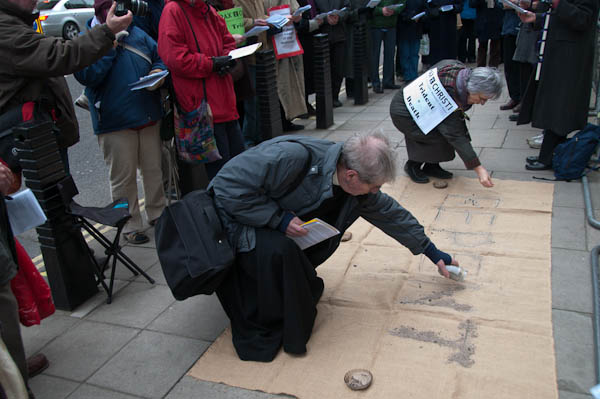
On Ash Wednesday in 1982 members of Pax Christi and Christian CND went to the Ministry of Defence in Whitehall and held a religious service in protest at Britain’s reliance on nuclear weapons and the mass destruction of innocent populations these would cause were they ever to be used.

Every year since they have come back with the same message:

© 2009 Peter Marshall

in a Liturgy of Repentance and Resistance, although it’s exact form changes from year to year.

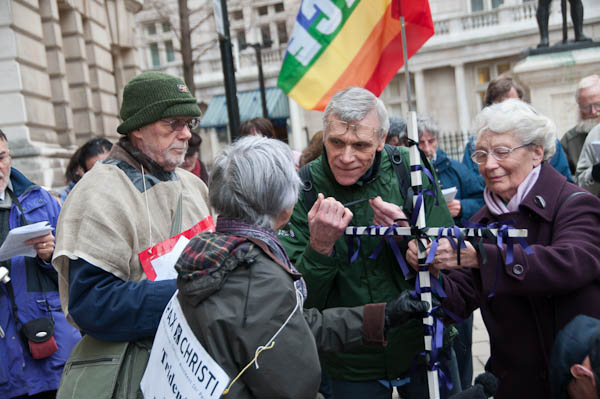
This year, outside the Old War Office, black and purple ribbons were tied to a white cross as prayers were said for those killed in wars and violence:

© 2009 Peter Marshall

It’s hard to see why we hold on to our nuclear weapons, difficult even to know who they are meant to deter now, after the end of the cold war. It was a policy that never made a great deal of sense, keeping a peace that it was in any case in no one’s interest to break.

Now it is far more about national prestige, “keeping a place at the top table” particularly in the UN, and not really about defence at all. I don’t think anyone can imagine a believable scenario in which we would deliberately fire our nuclear missiles (even if the US would give us the permission necessary.)

Far easier and much more likely are the possibilities of misuse and of these  dangerous weapons being stolen by terrorists.  The government lost all the arguments over Trident replacement but still decided it must go ahead, despite the dangers and the enormous sums of money involved. And it is of course that which is the real driver.  These weapons may be useless and outmoded, their use certainly against all reason and international law, but the profits for a small group of the rich and powerful are huge. It’s decisions like this that tell us who really runs the country whichever government is apparently in power.

More about the event and pictures on My London Diary.

Students on the March

I was fortunate to have been born in the era of the Welfare State. Not only did I grow up on clinic orange and cod-liver oil (a doubtful privilege) but education was free, or largely so. When I had to start school early because my mother was in hospital I went to a private nursery (it even called itself an ‘Academy’ to show it was posh) but that didn’t last – I was “too rough” and was expelled at the age of three.

© 2009 Peter Marshall.
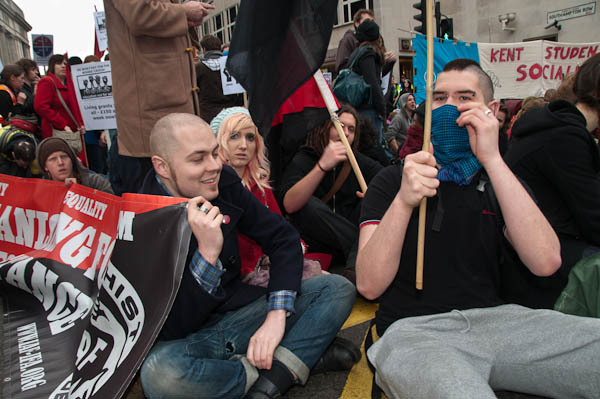
Students stage a sit-down in Southampton Row

But after that it was on the state, all the way from four until I graduated. My father’s earnings were low and I got a full grant to cover my living expenses at university – and managed to live on it. Of course none of us paid fees. But things are very different now than in those days when even the labour party beleived in socialism.

Of course it is much easier to get into university now. Where there were once educational hurdles there are now colleges clamouring to attract students and the money they bring – although competition for the more popular courses and places is still intense.

© 2009 Peter Marshall.
Listening at the rally before the march

So I had a great deal of sympathy with the students and their protest last Wednesday.  More about it and of course more pictures on My London Diary.

Full-frame and the March of the Corporate Undead

I still don’t believe that in the longer term we need 36s24mm sensors and the rather large and clunky DSLRs that these entail, but for the moment at least, cameras like the Nikon D700 do offer considerable advantages when working in low light, and I had a good opportunity to exploit this on Tuesday.
© 2009 Peter Marshall.
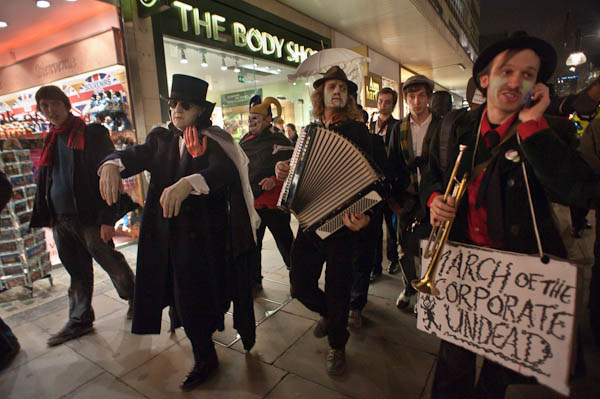
The Body Shop, Oxford St

It isn’t hard to take pictures at night with digital cameras, but available light action shots such as this, even lit by the relatively bright lights of Oxford St are beyond DX format cameras such as the Nikon D2oo – on which I was also shooting, but with flash.

Interestingly, my tiny Panasonic camcorder, with its minuscule sensor, also did pretty well under these light conditions.  Of course the image format is smaller, but it does make me wonder whether we are getting as much as we should from DSLRs.

I liked the idea of the troupe of zombies staggering past ‘The Body Shop‘ in their March of the Corporate Undead, but without half a dozen flash heads and a team of assistants, there just wasn’t enough light to get a usable result with the D200.  Above ISO1600 it really struggles.  This picture was taken at ISO 2000, 1/80 f3.5 and would have been a little better if I’d used ISO 3200 and stopped down for a little more depth of field, as the lettering and figure at the extreme right is just slightly out of focus.

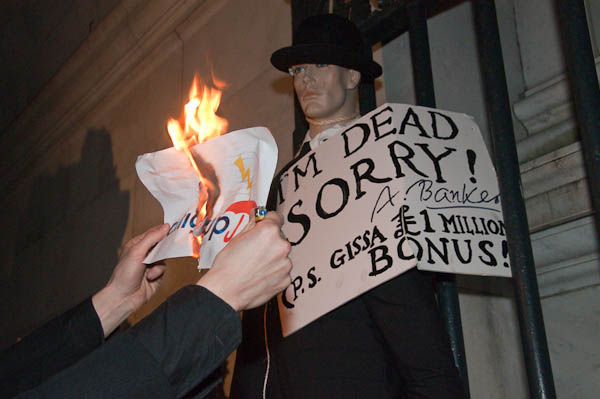
Some of the action, particularly the hanging of the dead banker at Tyburn (Marble Arch) was a little too dark even for ISO 3200 and flash became essential. When  one of the protesters set fire to sheet of paper and threatened to burn the dead bankerI was a little worried the flash might blot out the flames, but the results were fine.
© 2009 Peter Marshall.

Although I put in the stuff about speeds and apertures, most of the time when working I simply leave it to the camera and flash, which have all these automatic things that generally handle the technical stuff better than me. Of course you do sometimes have to give them a hand, often by dialling in a little exposure compensation, or altering the shutter speed or aperture and letting the camera’s smart program setting make the necessary compensation.

One thing I find handy at times when I shooting – particularly at the start of each event – is to take an exposure reading from a typical subject and then make appropriate settings for the camera’s manual, shutter priority and aperture priority modes.  It helps if you do decide you need to switch to manual not to have to spend 20 seconds twidding the shutter speed dial from when you last used it for a long time exposure. It helps even more when (as I often do) you press the wrong button and change mode when you meant to dial in a little exposure compensation.

This pancake day event got a little publicity – even in the Evening Standard, and some fairly silly comments by one blogger about it possibly scaring children. Who would get my vote for twit of the week, if there hadn’t been an even greater idiot at the event who kept on standing in front of photographers and getting in the picture. And yes, of course, he was holding a compact camera.
London 2012 & Rose-Red Empire

 London 2012


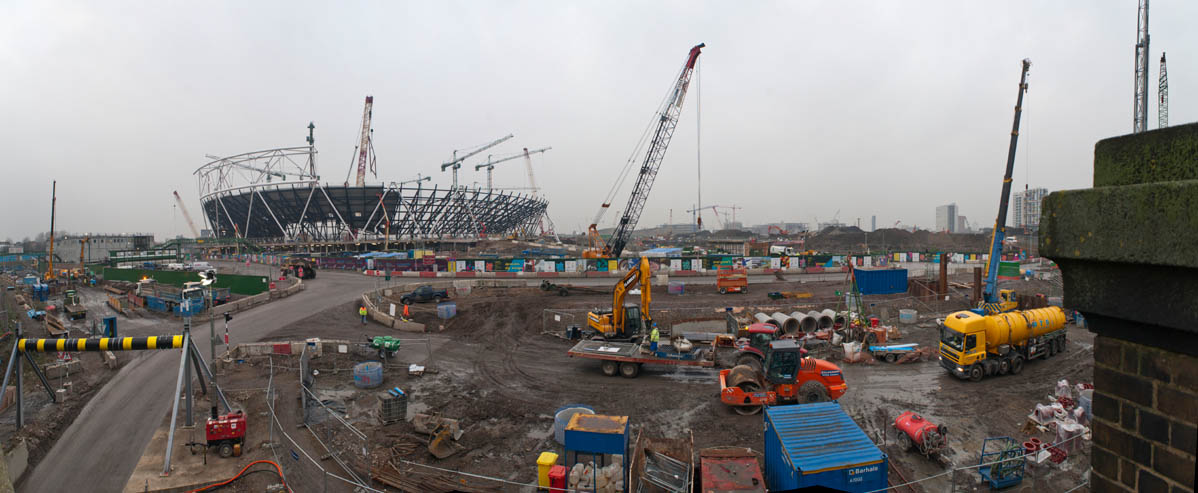
In 2005, this was the view from the Greenway where it crossed over Marshgate Lane; now it looks like this:

with the Olympic stadium taking shape amid a complete re-creation of the landscape. You can see many more of my pictures of the area covered and surrounding the Olympic site from the 1980s to 2005 on my Lea Valley site,  and more current work in My London Diary, for which I try to add a roughly monthly progress report.

I’ve photographed various panoramas around the area over the years, working with several swing lens cameras (and the relatively cheap Ukrainian Horizon 202 is probably my favourite – when the first one wore out after around 10 years I immediately ordered another) and later also with the considerably more expensive Hassleblad XPan equipped with a 30mm lens. This gave close to the maximum angle of view that makes sense as a rectilinear perspective – any wider and the edge-stretching becomes silly.  Swing lens cameras get over this problem, but their cylindrical projection adds another of its own that makes them tricky to work with, giving curvature in all non-vertical lines except for that along the exact centre of the image(where usually you try to place the horizon.)

Now I most often use a normal DSLR, taking several exposures and joining them with PTGui, which allows a choice of projections, including rectilinear and cylindrical but also others. The latest version (8.1.2)  has added more possiblities, including ‘Vedutismo‘ which I used for the above panorama (see a larger version)  which keeps all lines that pass through the centre of the image straight.  There is also a modified version of the cylindrical projection, ‘Mercator’, (added in version 7.0) which is also of interest.

You can see February’s London 2012 site pictures here.

Rose-Red Empire

On Saturday I went to see the show ‘Rose-Red Empire‘ at Danielle Arnaud contemporary art in Kennington, which accompanied the launch of Iain Sinclair’s latest book on Hackney (it continues until 15 March – see website.) Show and book include material on the impact of the Olympics on Hackney,  and a film by Emily Richardson brought back memories of the Manor Gardens Allotments as well as the Bow Back Rivers.  The show does include some photographic work, as well as paintings and other media, but the photography in general disappointed. Perhaps the best was in ‘The Book of the Brook’  by Iain Sinclair, produced as a unique single copy with his own photos tipped in, along with other material, simple honest and un-pretentious records of his observations on walks around the largely hidden parth of Hackney Brook.

Here’s a picture that I think Sinclair might appreciate:

© 2007 Peter Marshall
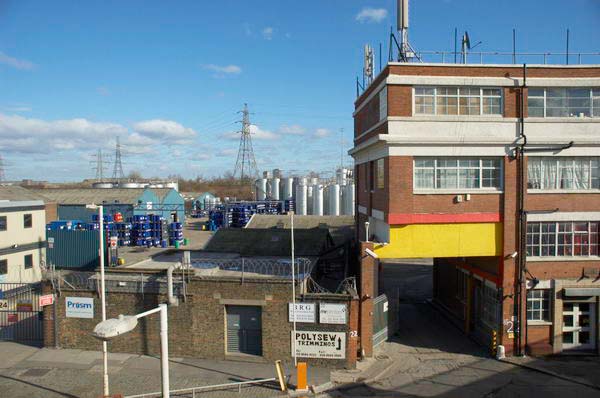
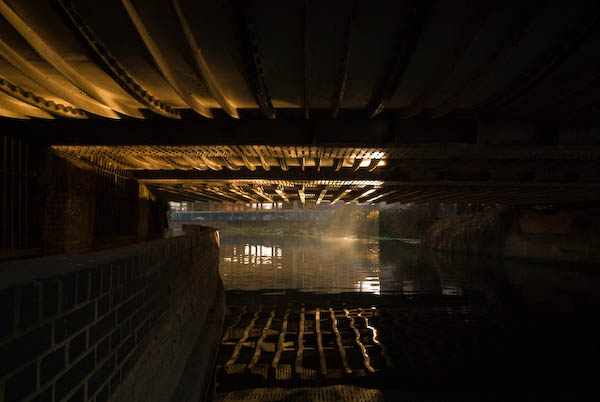
Northern Outfall Sewer and Lea Navigation
.

and I made it without a kayak.

Keep the Post Public

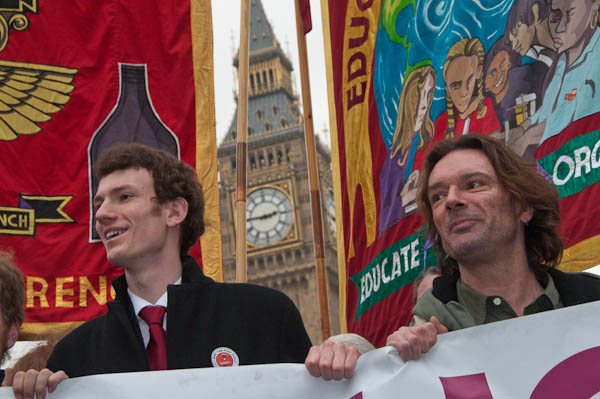
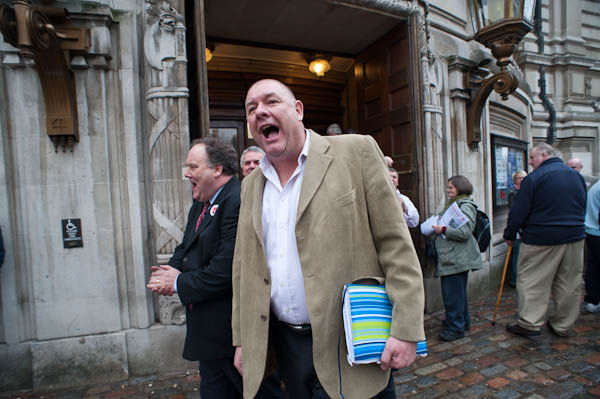
Postal workers held a rally at Methodist Central Hall in Westminster on Tuesday to protest at government plans to part-privatize the postal service. The government argue that this is necessary to protect pensions and to modernise the service, but it seems likely that any company taking over mail deliveries would only do so if the government picked up the pensions bill in any case.

© 2009 Peter Marshall.

The real problem with the post is that earlier measures allowed private companies to cream off the easily delivered profitable parts of the service, while leaving the Royal Mail to continue the expensive universal delivery service – including the delivery of its competitors post at regulated prices.

To provide a level playing field, these should have properly reflected the fact that the competitors were not required to provide a universal service.

© 2009 Peter Marshall

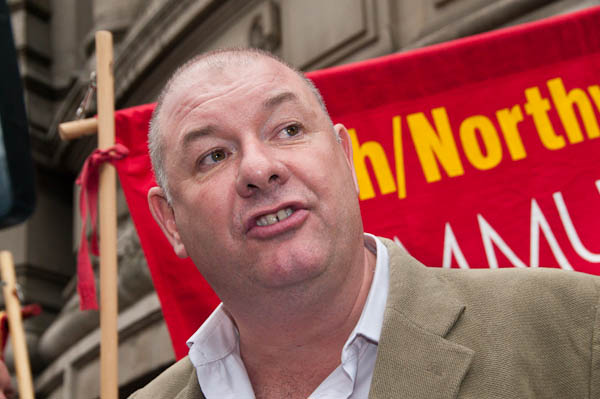
After the rally, I photographed the postal workers – including the Deputy General Secretary (Postal) of the Communications Workers Union Dave Ward, and CWU General Secretary Billy Hayes, as they came out into the street and walked down for a short demonstration in Parliament Square.

© 2009 Peter Marshall.
Dave Ward, CWU

More pictures on My London Diary

Worshipful Company of Poulters Pancake Race

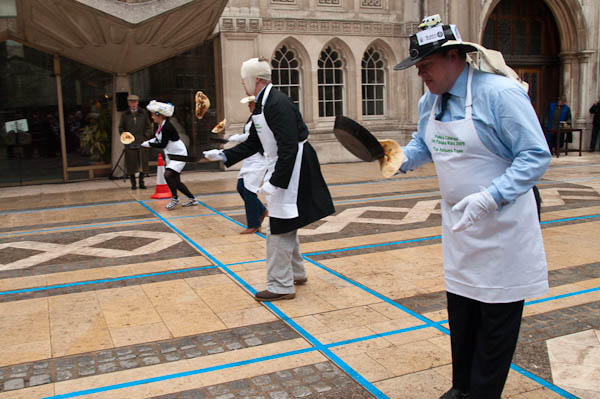
It’s a shame that the Pancake Race is unlikely to feature in the London 2012 Olympics, because it’s perhaps the one sport in which Britain still leads the world, and we seem to have plenty of talent in training. I had decided to give pancakes a little of a rest this year (and I’ve never been a great fan of eating the things) but couldn’t resist a couple of pancake-related events, the first of which was the Shrove Tuesday Pancake Race organised by the Worshipful Company of Poulters, and held – with the permission of the Chief Commoner, in the Guildhall Yard.

This is a highly organised event with a large number of timekeepers and other officials, who ensure that the rules are kept and time penalties are levied for those who toss their pancakes outside the prescribed zone or fail to toss them at all, and for ladies whose dress is above the knee.

This is a charity event, run in support of the Lord Mayor’s Charities, but despite a great deal of fairly reserved fun, the truly competitive nature of the city emerges in these inter-livery races. Although the rules are old-fashioned – in the masters race those taking part wear their badges and robes and skirts or dresses are required for the ladies race, the times are impressive.

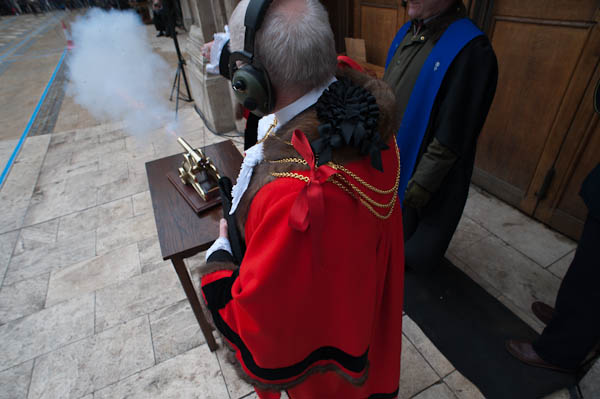
Photographically there are plenty of moments to catch, but two gave me  a special satisfaction, though I don’t think they are the best pictures I took. The races are started using a small cannon, and I just caught the right moment when the event was started, with a flame and smoke coming from the barrel. I could have done with ear-protectors too!

Another slightly unusual moment came during one of the races. Each heat had 4 people taking part, and halfway down the course they had to stop and toss their pancake, before running to the end turning round and doing the same on the way back.  In one race the four were more evenly matched than most and arrived in the tossing zone together and I got a picture with 4 pancakes.  The man closest to me had been the first to toss, and has just failed to catch his pancake cleanly – he managed to grab it with his left hand in the next frame that I took (not on line.)

So although it may not be a great photograph, it is a bit like hitting a jackpot on a fruit machine, where all the dials have ended up on a pancake!

The guilds are a part of our ancient traditions, but this race is only in its fifth year, and I’ve photographed three of these and put the pictures on My London Diary (and as I was taking pictures, someone said “you’re the man with the web site”.)  As well as this year’s pictures, you can also see those from 2008 and 2007.

Al-Haq Sue UK Government

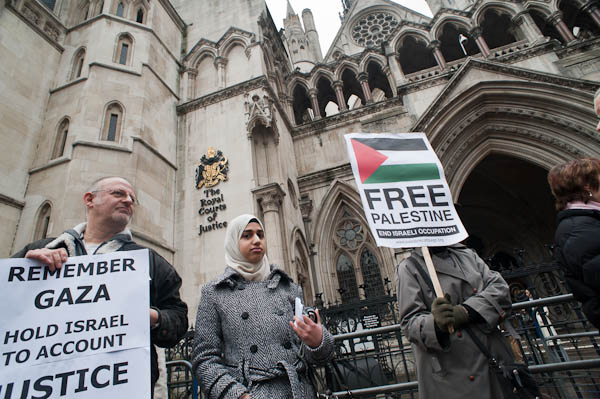
The Palestinian human rights group Al-Haq filed a claim for judicial review before the High Court of England and Wales on Tuesday challenging the government’s failure to fulfil its obligations with respect to Israel’s activities in Palestine.

They call upon the government to publicly denounce Israel’s actions in Gaza and in the continuing construction of the wall, to suspend arms related exports and government, military, financial and ministerial assistance to Israel and to UK companies exporting arms and miliatary technology and to insist the EU suspends preferential trading with Israel until that country complies with its human rights obligations.

They also ask that the government should give the police any evidence of war crimes committed by any Israelis who intend to come to the UK.

© 2009 Peter Marshall.

A small group of demonstrators were outside the court to support the application on Tuesday and a press conference was held including solicitor Phil Shiner of Public Interest Lawyers (PIL) and Gaza Legal Aid Fund trustee Mary Nazzal-Batayneh.

More pictures on My London Diary