More From Outer Surburbia

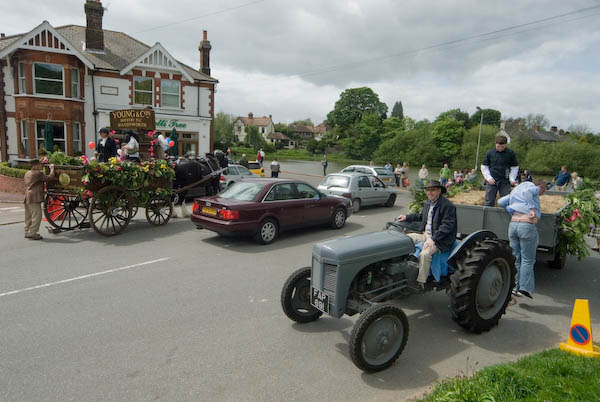
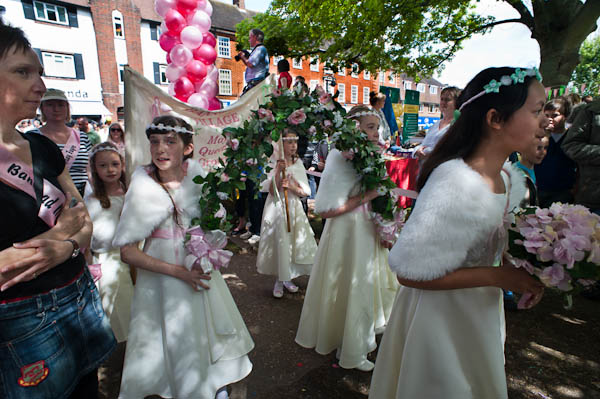
The second of my incursions into outer surburbia last Saturday was to Walton on the Hill, part of the Surrey pony belt around the southern fringes of London. Like Pratt’s Bottom its a  area with a village settlement pattern set in green belt aspic, now populated by SUV man and of woman) a curiously rural commuter enclave between M25 and the rows of houses of suburbia proper.

© 2009 Peter Marshall.

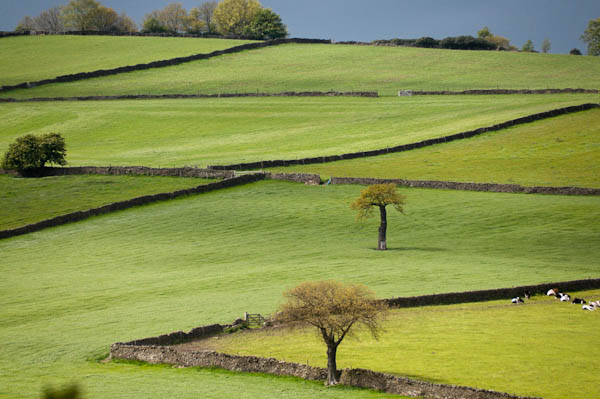
Of course I’m sure its a very pleasant place to live, where cricket, warm beer and the Festival of Britain atmosphere still thrive, but it does gives me a strong feeling of déjà vu, or perhaps more appropriately déjà vécu. Outer suburbia isn’t outer space or even Outer Mongolia, but that drive around the M25 does seem somehow to slip into a parallel universe where at least in some respects time has just not passed as it has elsewhere.

© 2009 Peter Marshall.

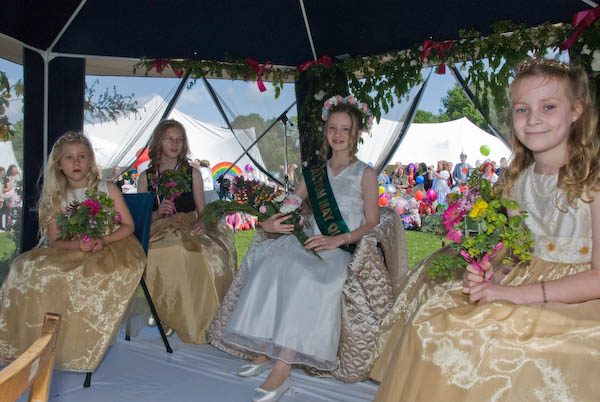
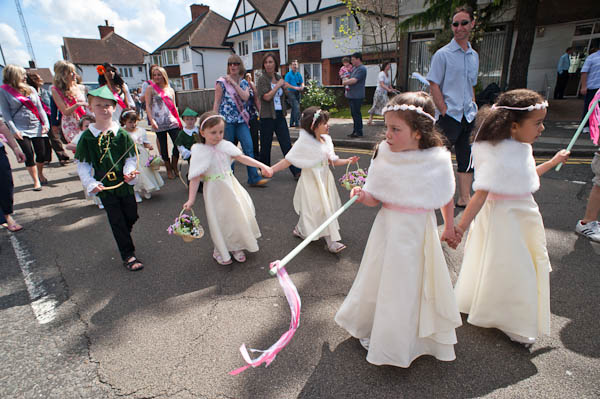
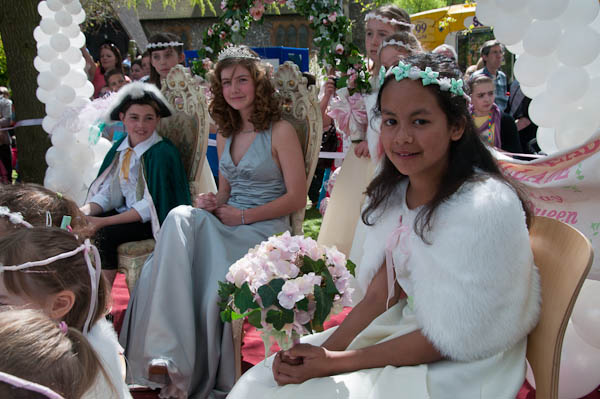
The name of the event, a May Pageant, certainly has a ‘New Elizabethan‘ resonance, although perhaps surprisingly the event dates from the late 60s rather than the mid 50s.  But truly I don’t mean to knock it. The event shows a real spirit of community that has been largely lost in our cities, and an emphasis on the local that is perhaps something that will be needed if we are to have a sustainable future.

This year I photographed the procession to the fairground and then retired to the rather pleasant pub from where it starts,  but in May 2007 I made a rather more inclusive record, from the start:

© 2007 Peter Marshall

through the whole of the May Queen crowning there

© 2007 Peter Marshall

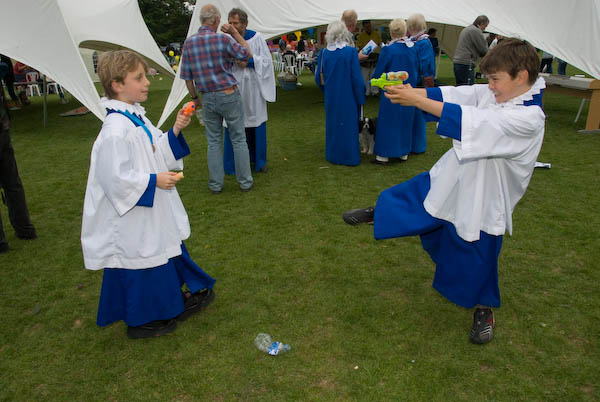
and the whole of the fun of the fair, including maypole and belly dancing, pig and balloon races, fights between choirboys and sumo wrestlers,  Wild West Shoot-outs, Red Riding Hood and the wolves.

© 2007 Peter Marshall

Pratt’s Bottom or Pratts Bottom?

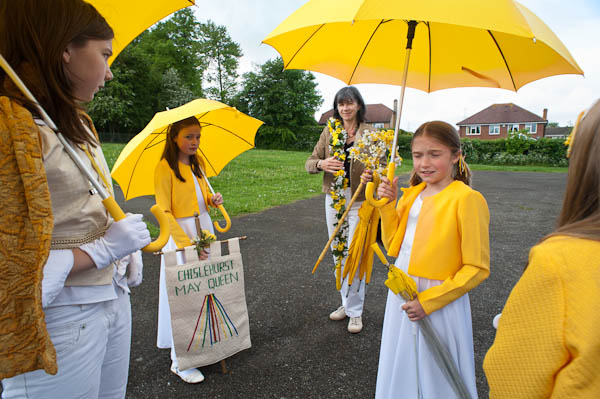
I suppose you can understand why the people who live in Pratt’s Bottom seem to prefer it without the apostrophe. It’s a rather nice village on the SE outskirts of London, a mile or two from the nearest station. Last year I’d also gone to photograph the crowning of the Pratts Bottom May Queen (no apostrophe!) and arrived a little late for the procession, running up the longish hill after a longish and damp walk from the station and arriving rather out of breath just as the procession got to the village green.

This year I got up earlier and got a lift from a friend, another photographer, and we arrived early to find an empty windswept field with a few swings in the corner. But a van full of a cadet marching band and one small girl in yellow, escorted by her father and also looking for the procession confirmed we were in the right place. Ten minutes later the rain had started and more girls were beginning to arrive.

© 2009 Peter Marshall. John Mcdonell
Chislehurst May Queen were one of five May Queen groups in the procession

Fortunately by the time the procession was ready to leave the rain had stopped and the sun had come out and it stayed dry as we ran up the hill behind the band, keeping up a fast pace to try and warm themselves up.

© 2009 Peter Marshall
The crowning

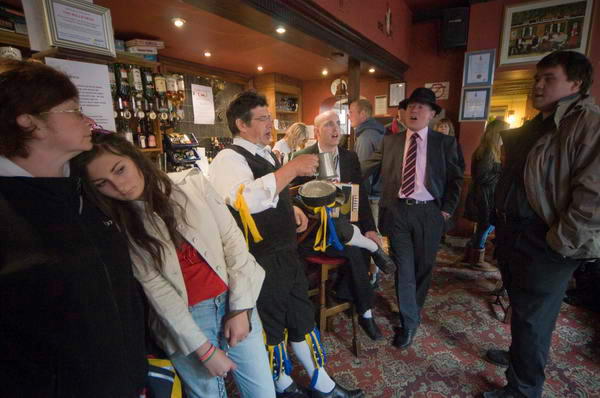
The crowning in the arena was a short event and the fete was officially opened and we walked away to go to our second event of the day. Which was a pity, as Pratt’s Bottom has a rather nice pub facing the fete, which I’d retired to to avoid the rain last year, and photographed the Morris Men. But at least this year I hadn’t got wet – and last year my Nikon 18-200 had seriously jammed with nasty grinding noises (repair cost around £100) while this year it continued to work!

© 2008 Peter Marshall

Nigerian Good Neighbour Wins Case

On 6 May 2009, Ayodeji Omotade appeared in Brent magistrates court more than fourteen months  after he was forcibly removed from a British Airways flight to Nigeria before it took off from Heathrow.

In an earlier post, Good Neighbour on Trial?, I wrote:

Ayodeji Omatode, an IT consultant living in Kent, boarded a British Airways flight at Heathrow on March 27, 2008, going home to Lagos for his brother’s wedding. Along with other passengers he was appalled at the maltreatment of a Nigerian man being forcibly deported on the flight and he made his views clear.BA employees called the police to deal with Mr Omatode, and more than 20 officers boarded the plane and dragged him off; he was handled roughly, thrown against a wall and then into a police van, arrested and held for eight hours. BA banned him from flying with them, didn’t return his fare and only gave him his luggage back a week later – damaged.

© 2008 Peter Marshall
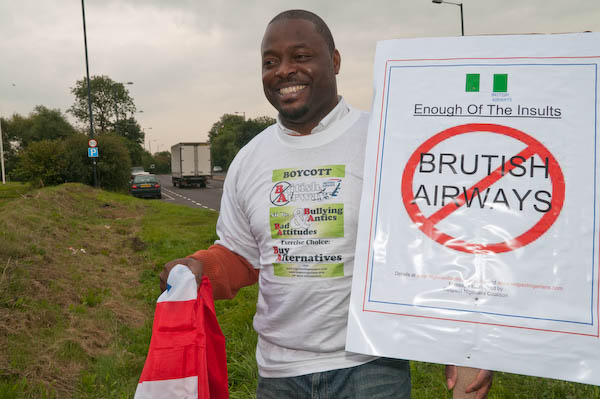
Protester outside BA’s Waterside HQ near Heathrow

My post came after photographing a demonstration organised by the Respect Nigerians Coalition. They called on BA to apologise and compensate Mr Omatode, to withdraw their allegations and their ban on him flying and improve its attitude to customers and stop practices that make it appear “arrogant, uncaring and discriminatory.” Other UK groups supporting the campaign and call for a boycott of BA flights until these demands were met included the All African Women’s Group and Global Women’s Strike.

Yesterday he was cleared of behaving in a threatening, abusive, insulting or disorderly manner towards the crew, and the district judge decided he had made a “forcible but polite complaint” and that there was no evidence he had been threatening, abusive, insulting or disorderly towards BA staff.

There were nine witnesses called by BA, including their own staff, police, G4 security and immigration officers, but their evidence contradicted each other. Mr Omatode’s defence was  impeded by BA, who refused to make the passenger list available to his defence lawyer, and he was only able to call two witnesses as well as his own testimony. You can read a fuller account in The Guardian.

Mr Omotade commented:

“It has been a horrific experience for me and my family, going through a year of criminal proceedings in which British Airways, the Metropolitan Police, Immigration security officers, and the Crown Prosecution Service constructed a false and malicious case against me.”

and

“The truth has finally prevailed, and I have been completely vindicated.  I spoke out as I expect anyone would do.  I paid a price because I could not look the other way. I am in the process of putting my life together again.  Justice has been served.  I have been delivered from the claws of British Airways corporate tyranny.”

It was indeed an expensive case for him, as he was refused legal aid, and although the Nigerian High Commission had promised to help they failed to do so.

Mr Omotade is demanding an apology and full compensation for his coast and the brutal treatment he recieved and for his family in Nigeria who had to buy clothes and wedding rings to replace those he was bringing out with him from England.  He also wants to know from the immigration authorities what happened to the man who was being deported.

A BA spokesman stated that they had a legal obligation to carry deportees and therefore any call for an apology should be directed to the police and CPS. Since it was their staff who called for the removal of Mr Omotade and later persisted with the false allegations and ban this appears a ridiculous position.

More pictures from last year’s demo outside BA’s Waterside HQ on My London Diary.

Strangers Into Citizens

 © 2009 Peter Marshall.

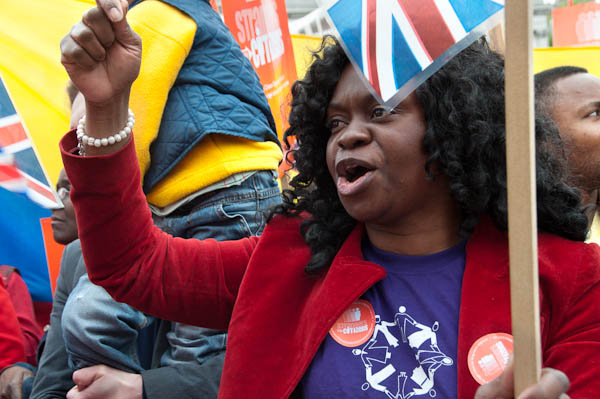
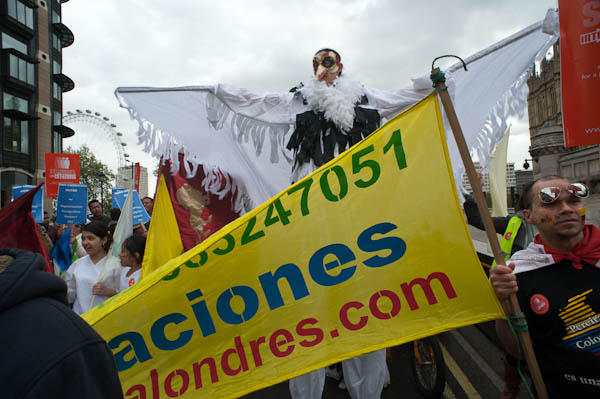
A packed Trafalgar Square all waving Union Jacks and singing ‘God Save the Queen’ is not my idea of a demonstration, and I turned to the photographer next to me and suggested we compete with a rendition of the ‘Internationale‘ (which later he told me he had as a ringtone.) But ‘Strangers into Citizens‘ is not a typical demonstration and most of the tens of thousands there had started the event in one of seven crowded religious services around the capital, though I’d passed on that and joined the several thousand mainly Latin Americans halfway through their march from the Elephant outside Lambeth North tube.
© 2009 Peter Marshall.

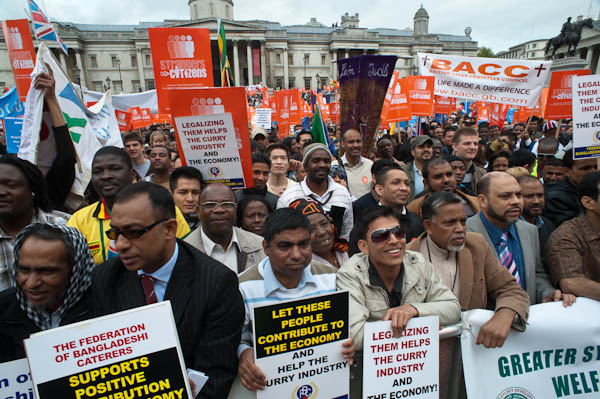
Perhaps 90% of the crowd filling the square were migrants (or the children of migrants) with representatives from almost every country around the world. Although the march had been lively, the rally was a little turgid at times, with speaker after speaker representing so many different interests – religions, political parties, trades unions, ethnic groups and more – who have all backed this initiative. But it ended with quite a bang, a short but fiery set from Asian Dub Foundation, Bangladeshi drummers and some very lively African dancers.
© 2009 Peter Marshall.

‘Strangers into Citizens’ is organised by London Citizens, a new type of popular movement for justice for the poor in our society, combining trade unions with churches and other groups and pressing for improvements in pay and conditions for the lowest paid workers – who include many migrants.

Strangers into Citizens calls for a pathway to give long term irregular migrants a right to earn indefinite leave to stay in this country. Current best estimates are that around 725,000 people are currently living in the UK without a documented right to remain.  They include asylum seekers whose cases have not been determined or who have been refused but have not been removed and those who have stayed on after temporary visas or permission to stay has expired.

Many of them are working and paying taxes; some are exploited by employers who take advantage of their status to pay wages below the legal minimum and to avoid making proper insurance contributions. Many could make a much greater contribution to our economy if they were able to make proper use of their qualifications.

Strangers into Citizens propose that those who have been here for more than four years should be elegible for a two-year work permit. At the end of this they should, “subject to criteria such as an English language test, a clean criminal record and valid references from an employer and community sponsor” be granted indefinite leave to remain.

These people are with us, many taking a valuable and active part in the communities in which they live. An amnesty for them makes sense on moral, religious, practical and economic grounds – at current removal rates it would take over 30 years and cost around £8bn to forcibly remove them, and they make a positive contribution to our economy.
© 2006 Peter Marshall

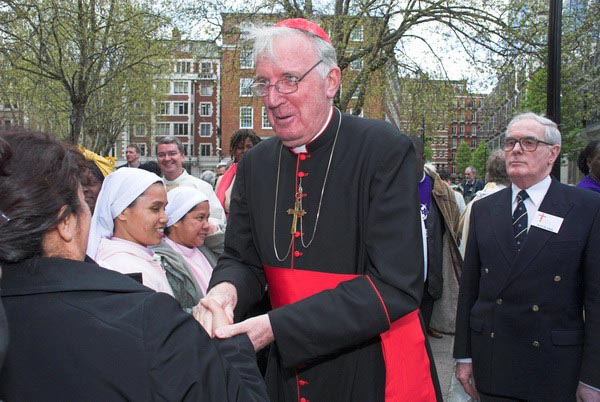
I photographed the rally at which Cardinal Cormac Murphy O’Connor launched Strangers in Citizens three years ago in May 2006, as well as later demonstrations, and it has wide suport from churches as well as Jewish and Muslim organisations and the key NGOs in the area. The campaign, led by ‘London Citizens’ has the support of members in all the main political parties – and people from them spoke at the rally. The Mayor of London, Boris Johnson has also supported it and the Liberal Democrats have adopted it as party policy. Like Green MEP Jean Lambert, one of the speakers at today’s rally, the problem I have with it is that it does not go far enough. Although it might cover 450,000 of those living here without documents, it would still leave some 300,000, many of whom also have a very good case for the regularisation of their position. And although the campaign stresses that this would be a ‘one-off’ amnesty, I see a clear need for a continuing policy to allow those who contribute to the country to attain legal status.

One point made very strongly at the rally was the need to challenge the use of such terms as “illegal immigrant”, a derogatory and inaccurate term used to stigmatise migrant workers and to justify increasingly draconian action against them. People are not illegal, although most of us at times break laws – it is hard not to. Those in this country without proper papers are in general more law-abiding than the rest of the population as it is in their interest not to attract the attention of the authorities. Most want nothing more than to lead a normal life and contribute to the society in which they are living. The French have a rather better term, “sans-papiers”, those without papers, the “undocumented.”

Forced removal of all those without permission to remain – as demanded by the racists –  would be extremely expensive, costing around £8 billion, and with the current resources for enforcement would take over 30 years. Trying to speed it up would be even more expensive. Whatever views people hold on immigration we need a policy that recognises the scale of the situation and takes sensible action. In my view it is also wrong to call it a “problem” – the real problem for us would be if these people were no longer here to do the jobs that nobody else wants to do.
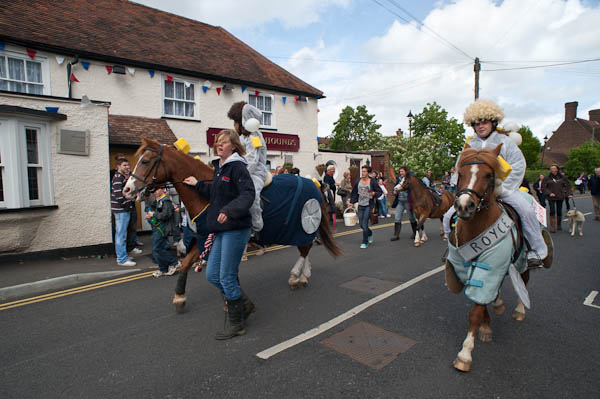
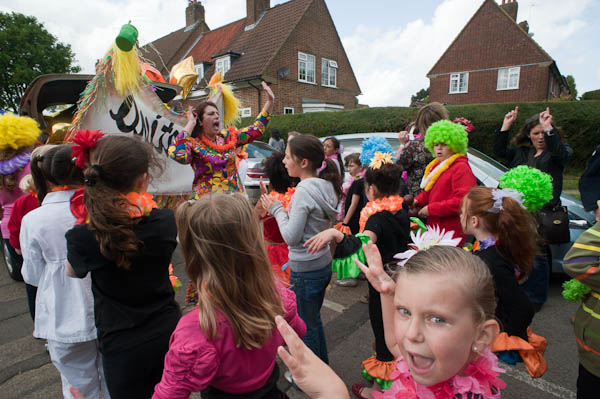
Banstead May Fayre

I started photographing May Queen festivals  in 2005, when writing a lecture about photographer Tony Ray Jones who died tragically young in 1972,  I came across a picture he had taken at the London May Queen Festival in the 1960s. This seemed to fit rather nicely into the work I’d been trying to do about suburban life, and Google and a fair amount of persistence led me to take the train to Hayes, Kent, where I had found the annual crowning of the London May Queen was still taking place almost 40 years on.

Taking pictures of young girls isn’t always without problems, but I talked to people about what I wanted to do and most of them were happy – and certainly once they had seen the pictures from that event I got invitations to photograph at other May Queen events. By last year – when I photographed two events in April and three in May (as well as some maypole dancing) I felt I had enough work for an exhibition and book – but was disappointed when a show at a major venue was called off on financial grounds at the final stage. I’m still hoping it will happen at some point and a book still seems likely, though it may not be for several years.

© 2009 Peter Marshall
Procession in Banstead High St, 2009

This year I’ve been working on other things, but I decide to take another trip to Banstead, where I’d photographed their May Fayre in 2006, as this year they were celebrating their 25th May Queen.  As well as this year’s May Queen there were ten previous Queens in the procession.

© 2009 Peter Marshall.
Entering the Orchard for the crowning ceremony

The May Queen plays an important part in the May Fayre at Banstead, which also involves many other local groups. In 2006 there had also been local press photographers taking pictures, but the local press has now more or less disappeared. Of course there were many amateurs taking pictures, doubtless some of them taking good pictures (as yet none appear to have found their way to Flickr) but I think it’s important to record events such as this as a part of a wider context.

© 2009 Peter Marshall.
The May Queen (centre) now wearing her crown

More of my pictures from the event on My London Diary.

May Day the Stalinist Way

© 2009 Peter Marshall

Hearing on the radio the news of Stalin’s death in 1953 is one of my earliest precisely datable memories.  At the time it was still possible to think of him warmly as ‘Uncle Joe’, whose stand against Hitler had made it possible for us to win the war. Without him history would have been different, and Britain would most likely have suffered a German conquest and occupation.

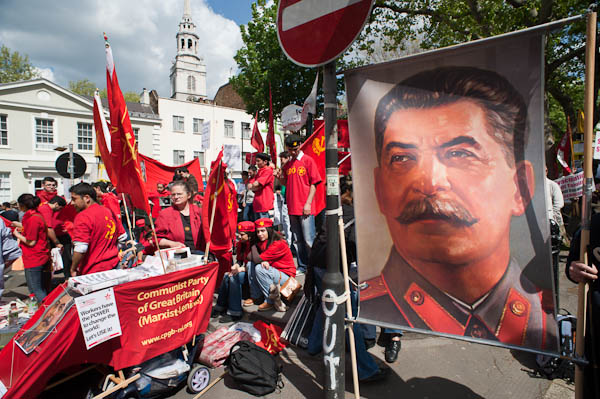
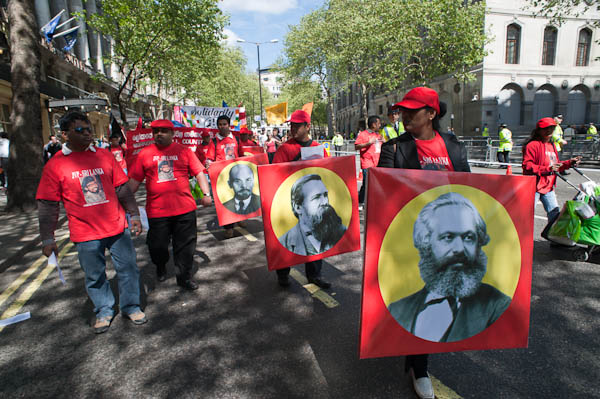
But of course we now know much more about the ‘Great Terror’, the ruthless purges, the show trials and the estimated 20-30 million who died under his orders. Few of us would now want to march behind his portrait, as a number of groups in the May Day march in London do.

© 2009 Peter Marshall.

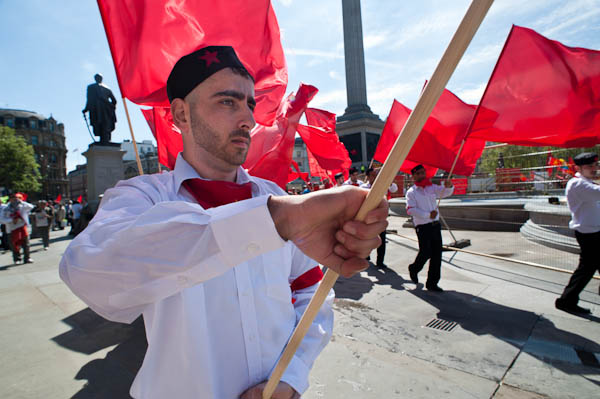
As well as the usual large groups of Turkish and Kurdish communists, there are also many other groups in the march, headed by a number of trade union banners. It’s a real shame that May Day is not a Bank Holiday, when a rather larger and more representative event might be expected.

© 2009 Peter Marshall.
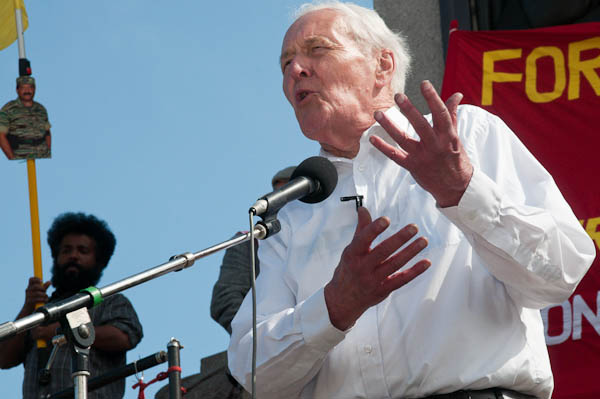
Unusual animation from Tony Benn

The rally in Trafalgar Square is dominated by the trade unions, and many marchers didn’t stay. The final speeches were the most interesting, especially with a very lively Tony Benn who now seems to be getting younger with every public appearance.

One trade unionist missing was Jack Jones,  whose funeral Tony Benn and some of the others had attended earlier in the day.

On the march was a sizeable block of Sri Lankan Tamils who went on to join the continuing demonstration in Parliament Square against the continued assault by government forces on civilians and Tamil Tigers confined in a small area a couple of miles wide.  Considerably unwelcome was another group of Sri Lankans,  the Sinhalese JVP, a party now part of the Sri Lankan government, and whose intervention stopped the government considering a federal solution and led to the all-out attacks on the LTTE.

© 2009 Peter Marshall.
The JVP on the March

More about the event and lots of pictures on My London Diary.

No Half Measures

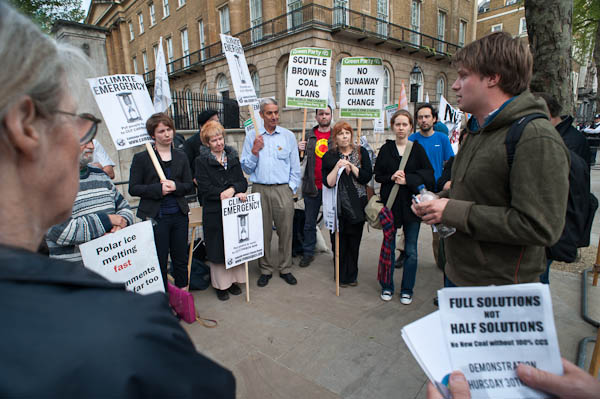
Green campaigners demonstrated opposite Downing St on Thursday 29 April against the Government’s intention to allow the building of new coal-fired power stations with only limited carbon capture.

© 2009 Peter Marshall.
Joss Garman from Greenpeace addresses the demo
Coal is inherently the  ‘dirtiest’ of fuels, releasing large quantities of carbon dioxide on burning. Current carbon capture and storage technologies can cut emissions by around 20%, still leaving a massive pollution.

Our government want to build new coal power stations despite this, promising that in 15 years time unless all the carbon can be captured they will be close. As several speakers, including Green MEP for London Jean Lambert pointed out, it is by no means certain that 100% CCS will be achievable, and almost certain that if it isn’t no government will close down these dirty power stations.

© 2009 Peter Marshall.

More on the demonstration on My London Diary.

WMD in London

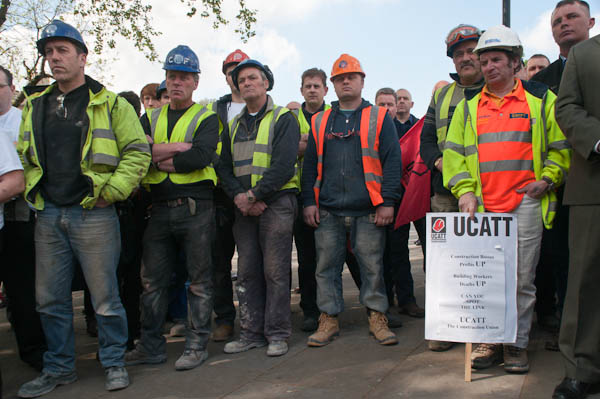
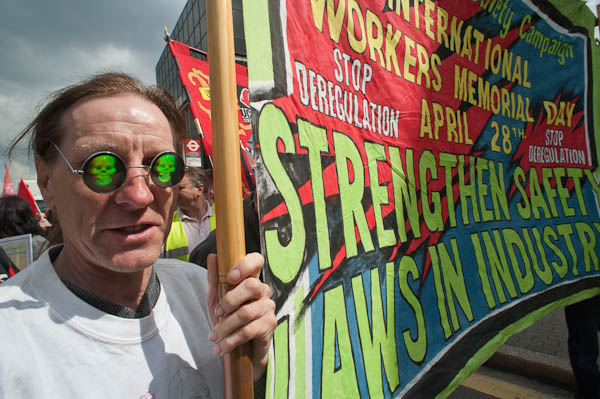
April 28 is International Workers Memorial Day, recognised in many countries around the world. Consultations are taking place over recognition by the UK government, with construction workers union ICATT pressing for it to be made a Bank Holiday, but at the moment although WMD was observed in various places in the UK it remained rather easy to miss in London.

People do get killed at work. Many if not most are not killed by ‘accident’ but because of a deliberate flouting of safety practices. ‘Accident’ rates are  higher among small firms and sub-contractors, where the financial incentive to ‘cut corners’ is higher.

© 2009 Peter Marshall.

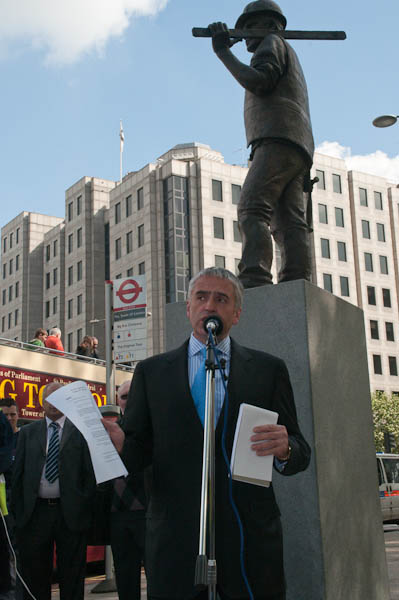
The main London demonstration started at the statue of the Unknown Building Worker in the pavement by the south side of the road at Tower Hill. Unless you are catchng a bus there you are unlikely to see it as most pedestrians walk along the underpass and miss it. There were apparently great problems in finding a suitable location for this statue, but it is a shame it isn’t in a rather more prominent place – just a hundred yards or so west near Tower Terrace would be better.

© 2009 Peter Marshall.

Most of those taking part in the march and rally were construction workers, many in work clothes and carrying hard hats. Also present were relatives of some of those killed – there are roughly 80 such deaths a year (as well as many more who die from exposure to asbestos.)

Not far away the march stopped for a short period of silence outside a site where a worker was killed in March, before going on to the London offices of the Health and Safety Executive. HSE staff there complain about the number of inspectors being cut – and less inspections being made. There are very few prosecutions brought, and even when these are successful, penalties are often virtually negligible. We need much tougher laws, better enforcement and sensible sentences to improve safety at work.

© 2009 Peter Marshall.

You can read a fuller account of the march and rally with more pictures on My London Diary

Visteon Workers Win – But Fight Continues

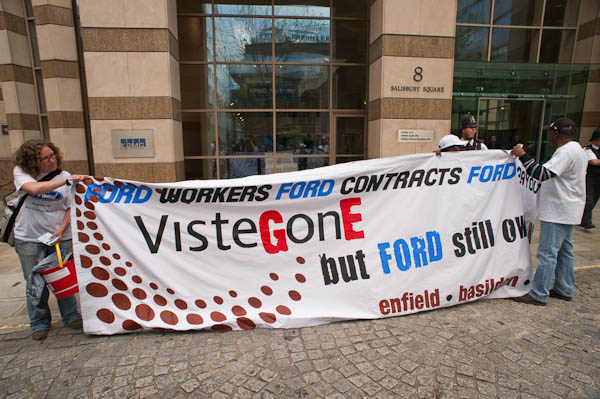
One of the better pieces of news on May Day was that the occupation and picketing by sacked Visteon workers in Belfast, Enfield and Basildon and the strong support given by their union, Unite, has led to a greatly improved offer on severance pay, which the workers have now voted to accept.

The deal, achieved through the kind of fighting spirit I witnessed on my visits to the plant at Enfield shortly after the factory occupation started and when the workers came out of the works following a court order has been described as “ten times better” than the initial offer, with most workers getting six months or a year’s pay. The campaign also benefited from considerable support by students and trade unionists who brought supplies and joined in the pickets and demonstrations at the plant.

© 2009 Peter Marshall.

One of the workers from Enfield gave a powerful address at the Trade Union May Day rally in Trafalgar Square, stressing the need to stand up and fight for your rights – as these men and women did.

However, despite this victory there is still a battle to be fought over pensions, which highlights our unsatisfactory laws governing company pension schemes.  Legislation is needed to ensure that money paid into these by employees and employer should be entirely separate from company accounts and not something that can be lost.

© 2009 Peter Marshall.

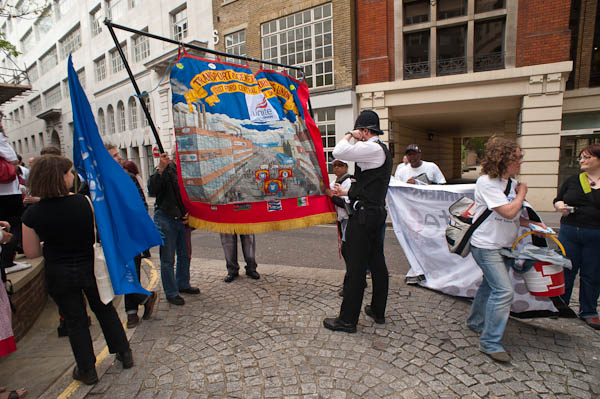
After the rally in Trafalgar Square, workers and supporters held a picket outside the offices of Visteon administrators KPMG just off Fleet Street (once of course the home of the UK Newspaper industry.)  They demanded that their pension funds be restored to them.

© 2009 Peter Marshall.

There were speeches from several of the workers, including Raymond who had spoken earlier at Trafalgar Square, as well as one of the local Unite officials. The picket was also supported by London anarchists, including members of the London Branch of the IWW (Industrial Workers of the World),  and trade unionists.

© 2009 Peter Marshall.