Rogue Frames and the f0.0 lens

I don’t know whether I’m unlucky but I do seem to get some fairly inexplicable problems with cameras. Back in April I suddenly found that while taking pictures my Nikon D300 had suddenly decided to switch from using program mode to manual, and then to set the rather unlikely speed of 1/8000. Since I’d been shooting on around 1/250, this gave considerable underexposure and it was a few shots before I noticed. I do suffer from wandering fingers and it’s just possible that I had twiddled the dials while intending to do something quite different, but I rather doubt it.  Apart from anything else, I make a point of always leaving the manual setting on 1/250 f8 as a handy starting point under normal conditions, and there had been no reason to change it that day.

But even more curious were 5 or 6 rather dark frames that appeared on Sunday. I was using the D700 with my new f2.8 HSM Sigma 24-70mm zoom, and the first 960 exposures were more or less spot on.

I didn’t notice it at the time, but scattered through the next 250 or so exposures are 5 or 6 rather dark frames. I was taking pictures at Kew Eco-Village, and for frame 972 I have a perfect histogram and the settings show I’m in mode P, 1/500, f11 and 24mm.

© 2009 Peter Marshall.

Frame 973, for reasons best known to the camera, was apparently taken using mode A, 1/5000, f4*  and 8mm*, while 974 is back to the identical settings as 972.

© 2009 Peter Marshall.

By giving +4.0 stops of exposure in Lightroom, and pushing up the brightness, I can actually see and image, but it’s as if I had shot at perhaps ISO 12,800 rather than the indicated ISO 400. You can clearly see the difference even when reduced to web size.

© 2009 Peter Marshall.

I didn’t change the settings for 973, just pressed the shutter again. I hadn’t changed lenses and the widest that lens goes is 24mm. I’ve no idea what those asterisks mean – and despite its 444 pages I don’t think the D700 manual tells me. I’ve tried asking Nikon support, but they don’t have a clue either.

In Lightroom I can actually reclaim a rather noisy but possibly usable image from 973, and I also learn that I took it with my 0.0mm f0.0 lens…

Of course as photographers, you will be surprised that the frame was actually under-exposed. 1/500 at f11 isn’t that different in terms of exposure value from 1/5000 at f4 – perhaps 1/3 stop less, or the equivalent of perhaps ISO 650, while the actual result looks more like ISO 6400 or faster. So the camera is lying about the exposure it actually gave.

Yesterday I actually took around 1150 frames on the D700 working on several different things in various locations. A few used the internal flash, and all were shot using RAW. The battery was still up for more when I finished, but perhaps in future I’ll try and remember to change it whenever it gets below around 50% and see if that gets less rogue frames. But battery life when I used my first digital camera was less than a hundred frames – sometimes considerably less. It’s an area where we’ve really seen a dramatic improvement.

I’ll also perhaps try to look at the back of the camera rather more often. I actually don’t like to do so, finding ‘chimping’ disturbs my concentration.

Do other photographers suffer from this and similar problems?  Odd frames that the camera has obviously thrown a wobbly on – if not identical to mine. If so I’d like to know – please either comment or e-mail me (petermarshall(at)cix.co.uk – replace the (at) with the @ character.)

Cameras are now computers. So we shouldn’t be surprised if occasionally they crash or give obviously nonsense results, or even hang.  All of the digital cameras I’ve used have occasionally stopped working. The D100 had a little hole you could poke a pen down to reset it, but that seems to have been left out on recent models.  If your camera starts playing up or simply stops working, usually simply removing the battery then replacing it will reboot it and sort things out.

And if anyone actually finds that f0.0 lens, I’d like to borrow it for some available light work at dead of night!
Let Them Work

© 2009 Peter Marshall.

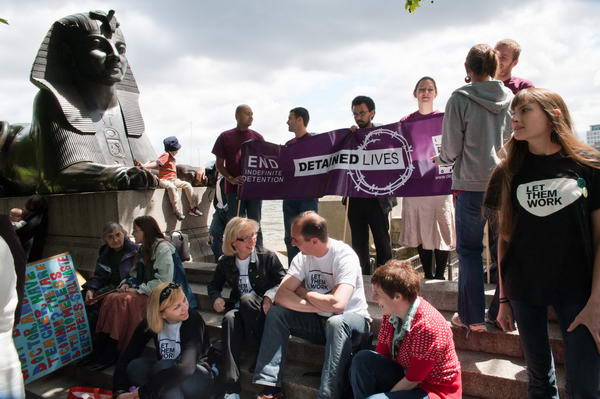
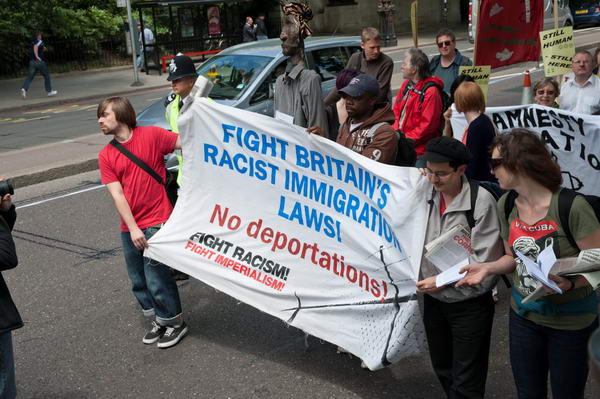
As a part of Refugee Week, London Amnesty Local Groups  and others including the Refugee Council organised ‘Still Human – Still Here‘,  a march starting at Cleopatra’s Needle on the Embankment to a rally in Trafalgar Square. As well as marchers with placards and banners, there were a number of large puppets depicting refugees from different countries.

Among the other groups taking part in the march were the London Detainee Support Group ‘Detained Lives‘, Refugee Action, members of the Let Them Workcampaign, supported by Student Action for Refugees (STAR), Refugee Council, TUC, Brighter Futures, Barnardos, and Still Human Still Here,
Fight Racism! Fight Imperialism! and the Gay Activists Alliance International.

© 2009 Peter Marshall.

The UK’s treatment of asylum seekers is often inhumane and seems driven more by a desire to look tougher than the right wing on immigration than any sensible response to the issue. A report by the Independent Asylum Commission last year stated that our treatment of asylum seekers “falls seriously below the standards of civilised society“. In particular, as many including MP Iain Duncan Smith have commented, “the policy of making asylum seekers destitute is mean and nasty and has not worked.”

Many of those who come here have skills that would contribute to our society – and are keen to do so. One placard pointed out that there are over 1100 medically qualified refugees on the BMA database. Others emphasized the considerable contribution made by famous refugees, both historical, such as Isambard Kingdom Brunel, and more recent refugees including Rashmi Thakrar, the founder of Tilda Rice, the first company to bring Basmati rice to the West, who arrived in Britain in 1972 when Idi Amin expelled Ugandan Asians.

Allowing refugees to work would also reduce dependence on public funds and avoid the degrading hardship faced by those who are forced to depend on charity and handouts. It makes sense in every respect, but to do so might leave Labour exposed to attacks from the ultra-right. Labour are running scared of the BNP.

Stopping locking up asylum seekers and would-be migrants in immigration detention centres when they have committed no crime would save considerable public expenditure and avoid the current denial of justice when many of them are unable to have access to advice and legal support. The detention centres – run by private companies to maximise profits at the expense of the detainees – have been repeatedly condemned for their mistreatment of those in their care.

Our treatment of refugees is a disgrace, and New Labour’s record in this area is sickening. There really is something gravely wrong with the priorities of British media (and perhaps the British people) when so little is made of this and other major issues and so much of the relatively minor expenses fiddles by our politicians.

More pictures on My London Diary.

Zombies Dismember Gordon Brown

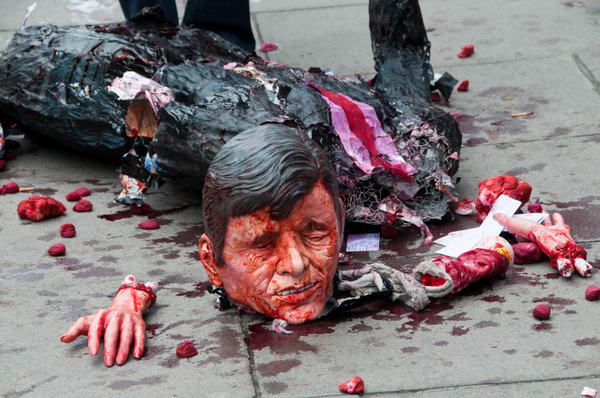
Thursday I was splashed down the back with Gordon Brown’s blood. It was a clean shirt, and a new one or else I wouldn’t have minded. It’s soaking in cold water now and I just hope it will all rinse out.

© 2009 Peter Marshall.

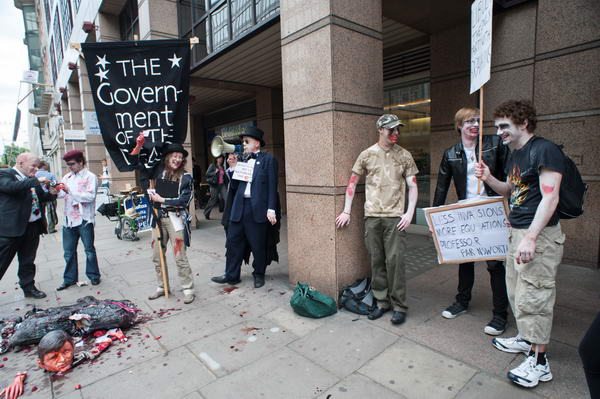
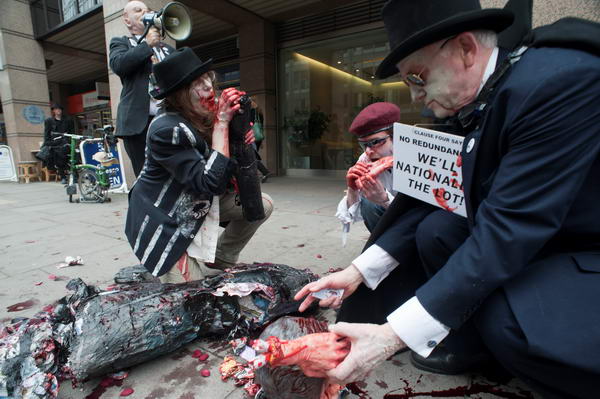
Brown himself was in a sorry state. I’d watched his head torn off and his limbs dismembered, and now the zombies were trying to eat the revolting bloody mess from inside his torso. The dummy (it is really was a dummy, not just a figure of speech about our revered leader) was in pretty poor shape, rather like New Labour, outside whose HQ on Victoria Street we were. Even the best efforts of the zombies to bring him back to life were fruitless.

© 2009 Peter Marshall.

At the megaphone, Professor Chris Knight was calling for New Labour to go, and for a new Labour Party to return to socialist values, starting with the re-adoption of Clause 4:

“To secure for the workers by hand or by brain the full fruits of their industry and the most equitable distribution thereof that may be possible upon the basis of the common ownership of the means of production, distribution and exchange, and the best obtainable system of popular administration and control of each industry or service.”

Around Knight’s neck was a placard with a simple solution for a current problem: “No Redundancies – we’ll nationalize the Lot!

Membership cards for the real The Labour Party were handed out, signed by the new General Secretary, Chris Knight, who led the small assembled crowd in ‘The Red Flag’, and unlike most party conference delegates he actually knew the words.

The meeting was then addressed the Political Commissar for Zombie Wrangling of the Government of the Dead, one V I Lenin, who carried a poster misquoting himself from 1918, “I want to support the ‘New’ Labour Party in the same way as the rope supports the hanged man“, complete with a small gibbet and hanging skeleton.

© 2009 Peter Marshall.

A police community support officer had come and talked to the demonstrators and had moved away after declining to join the party and asking them not to stay for more than half an hour and to tidy up after them. The New Labour offices are in the area where permission is required for demonstrations, but this piece of street theatre probably qualified as a ‘media event’, for which apparently permission is not needed. It’s a fine distinction, but one that saves considerable police time.

The event was also watched by a couple of rather low-key security men from the New Labour offices, one taking photos. The only slight unpleasantness was when a man going into the offices barged angrily through the people standing around watching, and then came back to threaten one of the photographers who had protested at his rudeness. He withdrew when a number of people – including the security men – came up to him and quickly guided him inside. From his attitude I thought he might be from the No 10 Press Office, but his language was insufficiently colourful.

More pictures on My London Diary

Speak Out!

Some events are important but don’t really offer a great deal for the photographer to work with. On Saturday lunchtime at the Angel in Islington I went to a demonstration against the shameful way that we treat people who want to come and live in this country and to contribute to our economy. Some come seeking asylum, some for other reasons, but whatever restrictions we have on immigration, we should treat people fairly and humanely. At the moment it is only too clear that we do not.

We have policies that stop people from working but fail to provide proper support. That imprison people who have committed no crime (and set up special prisons for the purpose, run for profit by companies that are apparently without morals.) We have a Borders Agency that seems to take delight in operating procedures that deny people proper legal representation and  that appears to be institutionally racist. A government that seems determined to outflank the racists on the right hand side in an attempt to gain electoral advantage.

© 2009 Peter Marshall.

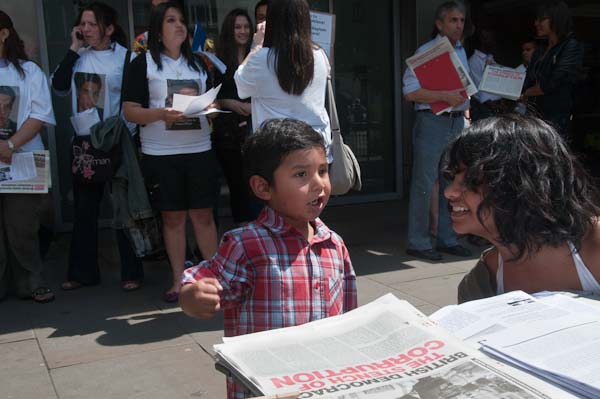
The people in the background of this picture are from the Suarez family.  One of their young members who grew up in this country – where all his family now live – faces deportation because of a juvenile offence.  He’s one of the successes of our system in that since then he hasn’t been in trouble again. But a few years later he is threatened with deportation to a country he left when he was six and has no family. His case has gone to the European Court of Human Rights, but our immigration officers don’t care about that – they tried to deport him without waiting for the legal process to take its course.  He’s still here only because all his family turned up at Heathrow to protest when they tried to put him on a plane.  They will probably try again and hope they can get away with it without the family noticing.

© 2009 Peter Marshall.

But it was Christina who made me thing and feel most at the event. Nineteen years old, her husband is in Campsfield Detention Centre awaiting deportation, breaking up their young family. She had never spoken in public before, and broke down in tears. It was hard to keep on photographing, but I felt I had to, to do what little I could for her case – and to put the pictures and her story on news sites as soon as possible.

More about the event, the cases and more pictures on My London Diary.

Carshalton Carnival Procession

Last Saturday I went to St Helier in south London, at the centre of what was one of the largest council estates in London, to photograph the start of the Carshalton Carnival procession. It’s theme was “planets and stars” as 2009 is the UN International Year of Astronomy.

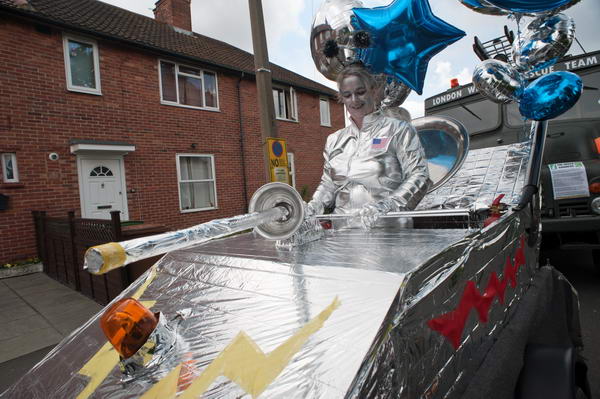
There’s something I rather like about this picture with its contrast between the high-tech space image and the very prosaic row of houses in the background.  As well as the caption in the background, not all visible, but is seems to say London Rescue Team.  The vehicle behind is of course a green goddess.

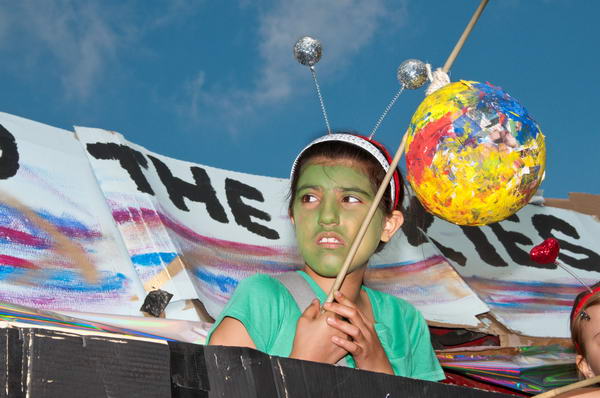
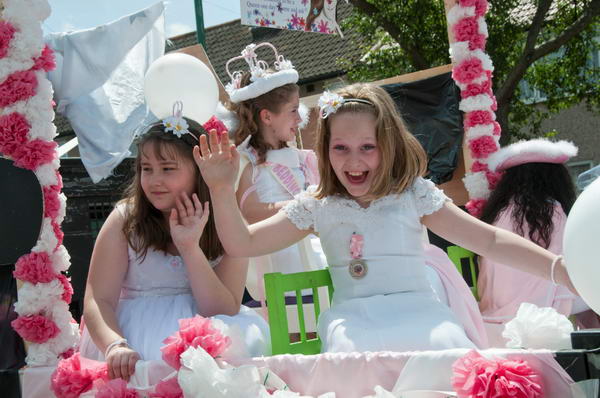
But my main interest was that three May Queen groups were taking part in the procession. Two came as May Queens and the third were dressed as aliens in keeping with the theme.

© 2009 Peter Marshall.
On the Wallington May Queen float

But I’m not quite sure how pictures like this will contribute to my continuing project on May Queens, but its all a part of trying to build up a wider picture.

© 2009 Peter Marshall.
The Beddington May Queen float

But there were others that more obviously fit into the project.

Of course there were other groups taking part, and you can see more of the pictures from the event as usual on My London Diary.

Agustí Centelles (1909-85)

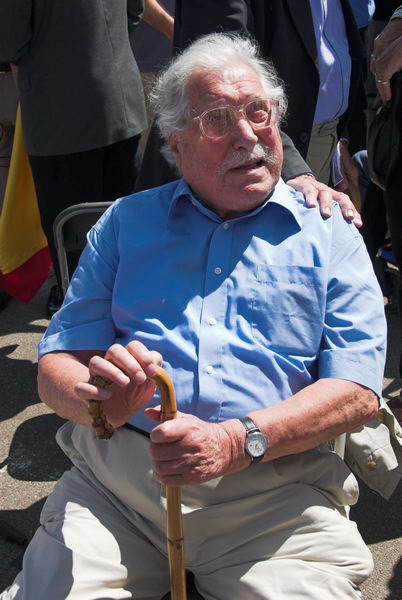
This morning I listened to the Today programme as I washed up the breakfast things and heard an interview with Sam Lesser, one of the seven remaining Britons who went to Spain with the International Brigade, all of whom have now been made Spanish citizens and given Spanish passports.

Sam Lesser © 2006, Peter Marshall
Sam Lesser in 2006

But of course as well as those thousands of brave individual who went to Spain to fight for freedom, there were many Spaniards also fighting.

And when we think of the photographs of the Spanish Civil War, probably we immediately think of Robert Capa – and in particular his ‘Falling Soldier‘ picture.

But of course there were also Spanish photographers. Or in the case of   Agustí Centelles (1909-85), Catalan photographers.  A photojournalist in Barcelona, he became an official photographer for the Republican government, and even managed to continue using his Leica when interned in the Bram refugee camp in France in 1939.

When he fled to France in February 1939 he took several thousand negatives with him. Later, when France was occupied by the Germans, he decided to return in secret to Spain, but left his negatives hidden in a house in France, as his pictures could have incriminated many Spaniards and led to their persecution by Franco. It was only 40 years later, after the fall of Franco that he could return and reclaim his work.

An exhibition of his work from 1936-9, “Agustí Centelles: journal d’une guerre et d’un exil, Espagne–France 1936-1939” opened at the Jeu de Paume (Hotel de Sully site) in Paris yesterday and continues until 13 Sept 2009. You can read more about it in French on their site, and also in English on Art Knowledge News. There is also an extensive collection of his work on line at VEGAP – I’ve not yet looked at all 336, but what I have seen is enough to convince me that  we should be thinking of him as the major photographer of the Spanish Civil War.

Too often we think of events that happen abroad – particularly in the majority world – only in terms of the photographs made by photographers from the  Western agencies who travel there – almost as if photographs that don’t come from Magnum or VII  or Getty or Reuters somehow aren’t real.  Agencies such as Drik should have changed the way we see the South by now.

New Topographics Revived – No UK Show

In 1975, I was one of many youngish photographers to be excited and to an extent influenced by the work shown in an exhibition at George Eastman House curated by William Jenkins called “New Topographics: Photographs of a Man-Altered Landscape.” Not that I went to Rochester, but I read the reports in the US magazines, looked at books and catalogues, and at pictures which did come over to exhibitions here, and even went and did a workshop with one of the photographers included, Lewis Balz. (The full listing of those included: Robert Adams, Lewis Baltz, Bernd and Hilla Becher, Joe Deal, Frank Gohlke, Nicholas Nixon, John Schott, Stephen Shore, and Henry Wessel Jr.)

I think you can see a certain influence in some of the work I’ve done since then, particularly on the urban landscape, a genre central to the show.  Without it I don’t think I would have set up the Urban Landscape web site, or produced many of the images on it – such as this of the DLR at Blackwall:

Blackwall © 1984 Peter Marshall
DLR Blackwall, 1994, Peter Marshall

The NPR article on the show, with a slide show of a dozen images that is worth viewing at full screen – for once you really do get larger images, not just fuzzier ones, is surely quite wrong to state that the paradigm shift this show produced “was imperceptible at the time.”  To photographers such as myself it was as imperceptible as a thunderbolt.

The reason for the feature is that a new version of this show, new version of this seminal exhibition, organized by  George Eastman House with the Center for Creative Photography at the University of Arizona opens at GEH on Saturday, June 13 and runs until Sunday, September 27, 2009. As well as 100 works from the 1975 show, it also has “some 30 prints and books by other relevant artists to provide additional historical and contemporary context.”

After Rochester the show will travel to eight international venues.

  • Los Angeles County Museum of Art (Oct. 25, 2009–Jan. 3, 2010);
  • Center for Creative Photography (Feb. 19–May 16, 2010);
  • San Francisco Museum of Modern Art (July 17–Oct. 3, 2010);
  • Landesgalerie Linz, Austria (Nov. 10, 2010–Jan. 9, 2011),
  • Photographische Sammlung Stiftung Kultur, Cologne (Jan. 27–April 3, 2011);
  • Jeu de Paume, Paris (April 11–June 12, 2011);
  • Nederlands Fotomuseum Rotterdam, the Netherlands (July 2–Sept. 11, 2011);
  • Bilbao Fine Arts Museum, Bilbao (November 2011–January 2012).

Like me you may well be devastated but hardly surprised that no venue in the UK is on this list. After all it is a major photography show, so you can’t expect the Photographers’ Gallery or the Hayward or the Barbican to take much interest.

Pure Genius – Only 13 Years One Month late

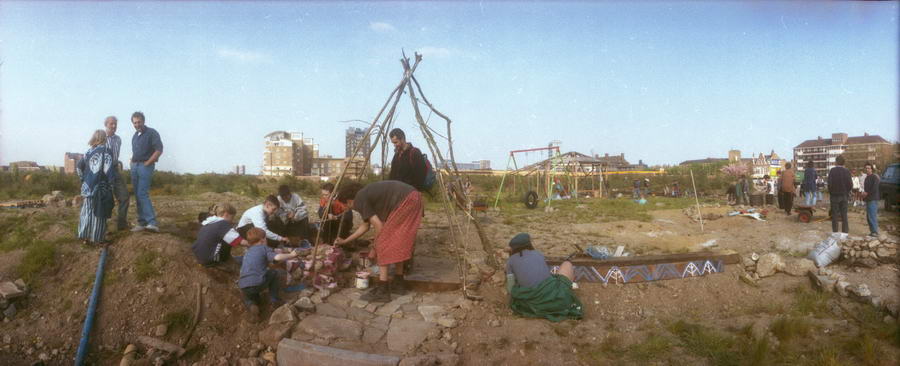
I’m not sure now why the virtually only pictures I took at the ‘Pure Genius’ land occupation in 1996 were made on a swing lens panoramic camera. Perhaps there was something about the open spaces of that site – now occupied by tall luxury riverside flats – that made me want to think panoramic.  But I exposed two complete rolls of film in the Horizon – 42 exposures, and just 5 black and white images, I think on a Leica.

© 1996 Peter Marshall
‘Pure Genius’ site, May 1996

The site was a large one, 13 acres, and by the time I took these pictures on May 6 the activists from ‘The Land is Ours‘ had already begun to transform the site, erecting buildings and preparing the land to grow crops.

I was reminded of this 13 years on by the news that a group inspired by this earlier ‘The Land is Ours’ action had occupied a long empty and overgrown site next to Kew Bridge as the Kew Eco-Village.  I took a little detour to walk past there and take a look on my way home on Sunday but as nothing much seemed to be happening and I didn’t want to miss my train home (only hourly on Sundays) I didn’t try to make contact. Perhaps I’ll return another time when more is happening.

You can watch a video of the occupation, look at a local blog, Here Be Dragons (I met The Dragon – and Green Dragon Lane is just a few yards away)  and follow KewEcoVillage on Twitter and there is a Facebook group too.

I made some quick scans from the 1996 pictures and have put nine of them on My London Diary . They aren’t great scans, as I made them like contact sheets, with the negs still in their filing sheets, so they are a bit dusty and a few of the negs were not quite flat…  And using the Epson V750, some of these colour negs are a little too dense to give good scans,  correct colour balance is murder, and you get some light leakage around the edges… Considering everything they are not bad at all on screen.

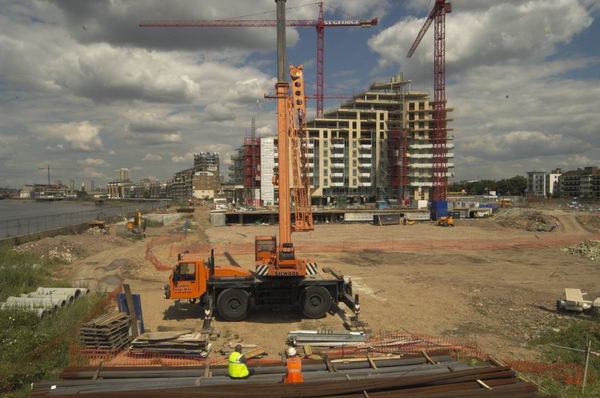
The Wandsworth/Battersea Guinness site remained empty for years after the TLIO occupation was ended forcibly after five and a half months. Eight years later, in June 2004, I returned and took this picture of the new flats that were going up, and work was still going on on the last block on the site last year.

© 2004 Peter Marshall
Former ‘Pure Genius’ site, June 2004

The 1.8 acre site next to Kew Bridge has been empty and awaiting development since it was cleared in 1992. It should be a local scandal given the housing shortages (and high prices) in the area that the local council hasn’t stepped in at some point and taken over the land for social housing. Given the current economic climate, it seems unlikely that the current owners, St George West London Ltd, who bought the site in 2003, will be able to start  building in the near future.

Their first planning application was turned down, and their second made last year for a 2 acre site including the next door pub includes a new pub, shops, offices and 170 residential units has not yet been approved. You can read more about the proposed development and its problems on the Strand on the Green site.

The Horizon that I bought cheaply around 1996 produces negatives around 56x24mm and they have a horizontal angle of view of approximately 120 degrees. The rotating lens produces what I think is called a cylindrical perspective. It has a nice clear viewfinder that is not 100% accurate but pretty good for it’s type and very bright. The built-in spirit level appears in the viewfinder making it easy to use this camera hand-held – for many pictures getting the camera level is essential, as otherwise the horizon will be nicely curved. When the camera is used upright, all vertical lines remain straight, but any non-verticals that do not pass through the centre of the image will be curved.

Incidentally you can still buy a very slightly updated version of the Horizon, the Horizon 202 (there are other models too) either under its own name or marketed as a Lomo. The difference is in the price – and possibly the guarantee – and of course you don’t get to call your pictures Lomographs, which may be an advantage.

I bought a replacement Horizon on eBay a couple of years ago for about half the cost of the equivalent Lomo in the bookshop of a well-known London gallery. The first lasted me around ten years of fairly regular use – several hundred films at least, though it had needed some minor repairs that I’d been able to make myself. Not bad value for a panoramic camera costing well under under £200 (now just slight over since the pound has gone down.)

More from Stratford Marsh

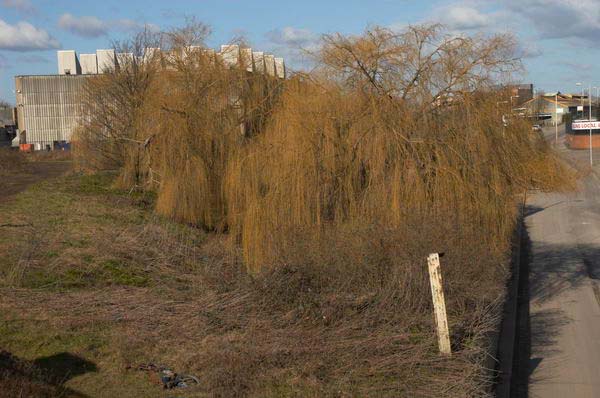
It saddens me a little now to walk on the Greenway across Stratford Marsh to remember what has been lost. The business estates and small works etc of course were not to everyone’s taste, although there were some modest but pleasing buildings among them, but there were some invigorating areas of minor wilderness, and some lush willow trees along the Pudding Mill River, along with some nice little touches of the picturesque.

© 2005 Peter Marshall
Willow trees by the Pudding Mill River on Marshgate Lane, 2005
© 2005 Peter Marshall
The trees were at the left of this scene – June 2009

So much has now gone, and so many areas are now inaccessible – as for example:

© 2006 Peter Marshall
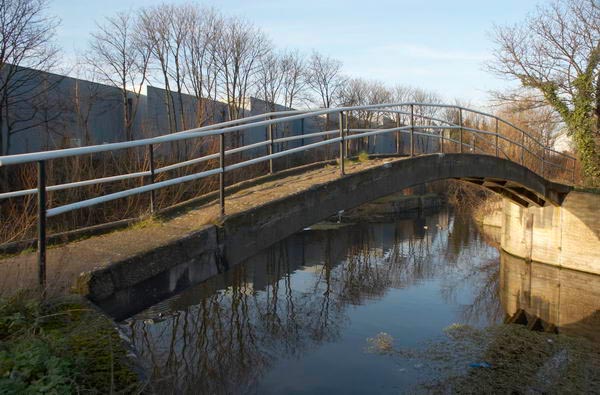
Bridge over Pudding Mill River at junction with Old River Lea, 2006

You can see many more pictures of the Olympic area, including Stratford Marsh on my River Lea site, including some from the 1980s as well as since 2000. When I get time I’ll add more from the 1990s, when the waterways and footpaths in the area were all cleaned up and neatly signposted for walkers.

Saturday I went to take pictures to show the progress being made in covering the area with concrete for the Olympics, and made some more panoramas:

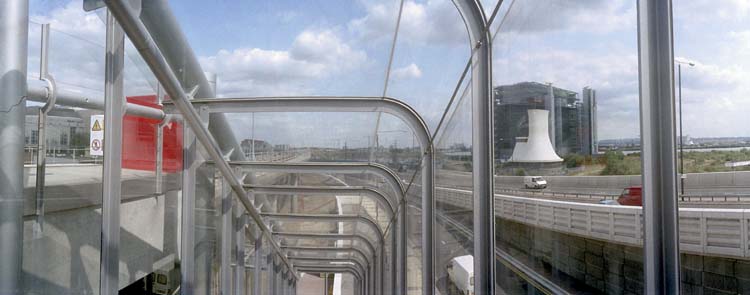
© 2009 Peter Marshall.
The opposite side of the Greenway to the Olympic stadium

You can see this rather larger, and also panoramas including the growing Olympic stadium and other pictures of the site on My London Diary.

Unfortunately the section of the Greenway south of the main railway line to Stratford High St is closed until Spring 2010, with a detour in place across to Pudding Mill Lane at Pudding Mill Station and down this to Marshgate Lane and Stratford High Street. This is to allow the roadway under the railway to be dug out to allow double-decker buses to pass under.

Poplar Walk

Poplar isn’t an area of London I know particularly well, although I’ve walked around it a few times and taken some photographs. I’ve found more to interest me just down the road in the Isle of Dogs, to the west in Limehouse, or along the Lea and Bow Creek  to the east and north.

But it was very pleasant to take a walk around on Saturday afternoon in the company of around 18 other people and be led around by Bridget Cherry, who together with Charles O’Brien and Nikolaus Pevsner wrote the definitive volume on the architecture of East London in the ‘Buildings of England‘ series – she started work with Pevsner in 1968  and was editor of the Pevsner Architectural Guides from 1971-2002.

The walk was one of half a dozen ‘Story of London’ trails organised by the Heritage of London Trust in association with Pevsner Architectural Guides, and although you’ve missed the chance to be guided personally by the experts you can still download a copy of the walk from the web site. (Or you can instead use the book, which includes rather more buildings and generally more detal than the walk, but is a little less convenient to carry than an A4 sheet.)

© 2009 Peter Marshall.
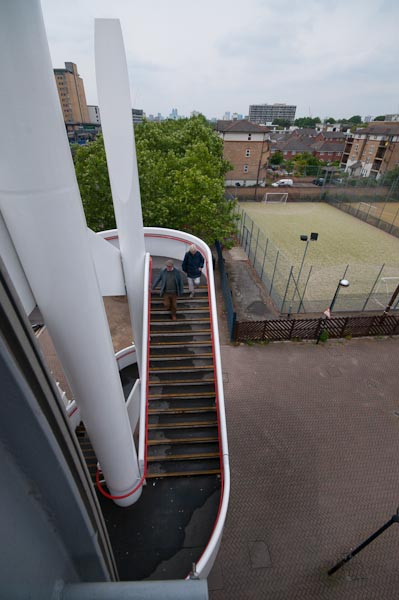
I thought I needed some people on these stairs – and one
of them turned out to be Bridget Cherry

The walk started just below the stairs in this picture and related the buildings around Poplar High St and the East India Dock Road to the development of the area from the 17th century to the current day.

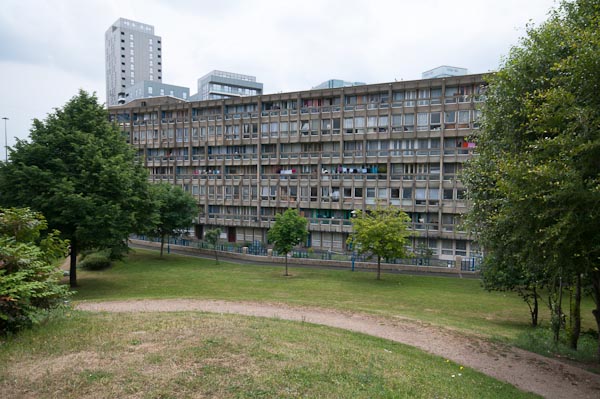
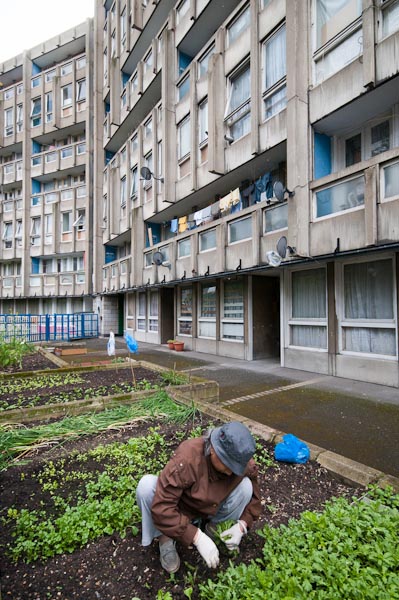
The most recent building mentioned on the walk is also one of the more controversial. Robin Hood Gardens, completed in 1972, has been encouraged by the council to get into very poor condition, partly by simple neglect but also by using it as a sink estate and permitting overcrowding. They want to demolish it and rebuild on the rather large site (and some people would undoubtedly make large amounts of money from doing so.)

© 2009 Peter Marshall
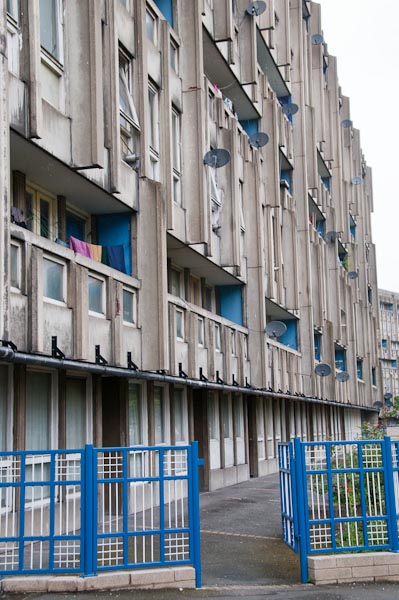
Narrow balconies overlook the park in the centre of the development; the outer side has wider ‘streets in the sky’ for access

Many tenants like the estate (though some hate it) and it still seems basically an excellent solution to a difficult problem, and a unique one. I was more than surprised to find it was not a listed building – it is a major work by two of our best-known architects – and shocked to hear that it was turned down. I’m sure the grounds must have been more to do with the politics of the situation than architecture.

© 2009 Peter Marshall.
Almost a country park in the middle of a city

© 2009 Peter Marshall.
Growing salad crops

You can read more about the area and the walk and see more pictures on ‘My London Diary