Repent!

Although I’ve photographed a lot of religious events I still sometimes find them a problem. It has nothing to do with the actual beliefs held by the people I’m photographing, but more about feeling that I am intruding on something private.

It’s something I seem to feel more strongly with Christians, and also it is only with Christians that I’ve had people object to being photographed.   So while I can go into a Gurdwara and be told “photograph anything you like“, in some churches I’ve been told I can only take pictures when the worship is over.

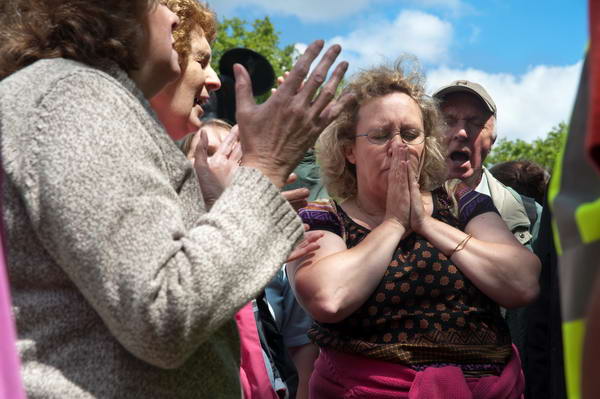
So on Saturday I wasn’t quite sure what reaction I would get when I went to photograph the March of Repentance, but in fact I was made welcome by the stewards running the event.  Even so, I felt the need to work with somewhat more reserve than normal when photographing the groups of people praying – they didn’t object, but I just felt a little uncomfortable at times, and ended up taking considerably more at longer focal lengths than normal for me.

© 2009 Peter Marshall.

This was with the 24-70mm at its long end, and I took two versions, one focussed on the closer hand and the second with the woman at right sharp. Both actually work quite well, though I prefer this, with the woman slightly unsharp.

Of course, where longer lenses really come into their own is for pictures like this:

© 2009 Peter Marshall.

Using the D300 with the Sigma 70-210 gives a an effective 105-315mm, and this was taken from just outside a small ring of people praying, with an equivalent focal length of 270mm.

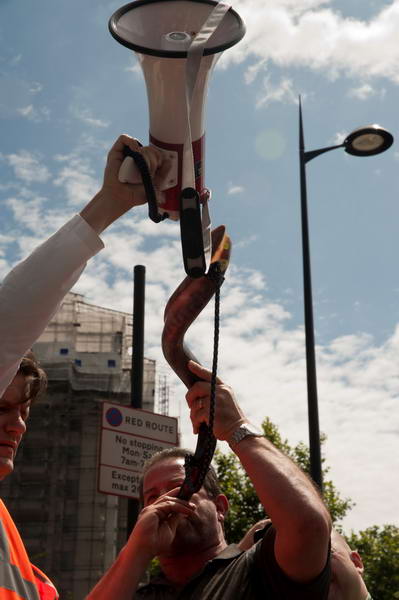
As always at events, you need to try and think what is going to happen, as well as concentrating on what is actually happening and thinking how to solve the visual problems involved. The guy standing at the front of the march holding a ram’s horn was obviously at some point going to blow it, so I made sure to be there when he did. What I hadn’t expected was that instead of just sounding the Shofar, he was going to blow it into a megaphone. It’s perhaps something that sounds better in USA-speak when that electrical device is called a bullhorn.

© 2009 Peter Marshall

It isn’t the greatest picture I’ve ever taken (and I think I could do a little dodging and burning to improve it ) but I think it records a key moment, and I was surprised I was the only photographer among several there to be in a suitable position to take it.

More about the event and more pictures on My London Diary.

Pig Party

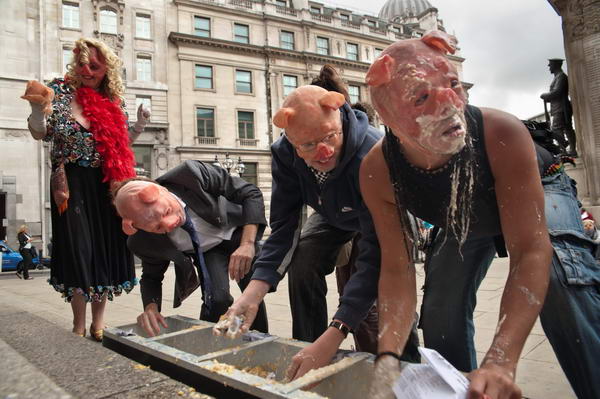
© 2009 Peter Marshall.

The trough is at the bottom of the steps to the Royal Exchange in London, at the very centre of the City of London. I’m lying down a couple of steps higher and looking through the viewfinder to take a picture of three guys with pig masks with ‘Miss Piggy’ looking on. In the trough is pig swill, or rather a mix of flour and water and scanned copies of fivers with a pig over the Queen on them.

It’s perhaps a more interesting protest than most, organised by Chris Knight and others from the G20 meltdown team to mark the fact that obscene bonuses have returned to the City of London.  The taxpayers put millions into the banks and now the banks are rewarding the guys responsible for losing millions with silly amounts – for some more than the lifetime earnings of ordinary workers for a year’s gambling on the markets.

Photographically there were a couple of problems. Pig swill did fly around rather, and a number of my shots were ruined by  lumps of it on the front glass.  I kept checking and wiping the lenses, but soon decided to put the Sigma 12-24mm away. I’ve just collected it a couple of days ago from a repair at Fixation (my preferred repair firm, located in Vauxhall) when they replaced the front element that had got damaged over several years of abuse.

The Sigma 12-24mm is a great lens. It isn’t particularly small or light, but despite being so wide has relatively little distortion, at least when used on DX cameras like the Nikon D300. Straight lines stay pretty well straight and unless you are doing architectural work really never need correction. It works well on autofocus, which isn’t always the case for extreme wide-angles, and I’ve come to rely on it for a lot of my work.

But I bought it around five years ago, soon after it first came out, and the one problem with the design is that the bulbous front element made it impossible to fit a protective UV filter.  Over the years that front element got more and more marks and little scratches, and eventually I started to find that pictures taken into the light showed excessive flair.

I asked the guy at Sigma, and he said, no problem – we can replace the front element, so I took it into Fixation. They did the job, though it took over a month for Sigma actually to supply them with the necessary glass, and I collected a shiny as-new lens a couple of weeks ago.

One of the reasons I bought the Sigma rather than the Nikon 12-24 was that it can cover the full 24x36mm frame. Although five years ago Nikon was still saying it would never produce a ‘full-frame’ camera I wasn’t convinced. Although technically it probably wasn’t necessary, I thought that perhaps marketing pressure would push them into it – and I turned out to be right.

So I can either use the 12-24 on the D700 – where 12mm is really very very wide, or use it on my D300 where it works as an 18-36mm equivalent, a great focal length range and also even better quality as it’s using just the central part of the lens.

Sigma build quality on the EX lenses seems to me to be considerably better than that of the Nikon lenses I’ve used – mainly from the cheaper range. This and the 24-70 HSM – with which the picture above was taken, the 12-24 having been stowed away safely in my bag – feel really solid. The 12-24mm has a built-in fixed petal lens hood, but the 24-70 is removable, but considerably sturdier than the hood on my Nikon 18-200, which seems nasty cheap plastic.

The picture needed a little fill-flash, supplied by a Nikon SB800, quite simply the best flash I’ve ever used, though not quite up to hard usage. I’d only just collected that from Fixation also, having had to have a new flash tube fitted. Labour cost around three times the price of the part, but I’m told that Nikon charge considerably more for the job.

More about the event and more pictures on My London Diary as usual.

Photo-Op Impossible

I’m not a fan of ‘photo-ops’, arranged scenes set up for the press to take photos. Of course in a sense almost all the events and protests I photograph are arranged, and often very much with the possibility of press coverage in mind, though sometimes – for example too often with Stop the War events – you find the stewards do their best to frustrate photographers trying to get good pictures. So much so that I remember one time where we all sat down with our cameras on the tarmac in front of a march going down Park Lane.

But photo-ops are well meaning attempts to present what the organisers think will make a good picture.  Usually the problem is that they are just boring, and also many of us like to have a little more chaos and show things how they are.  Of course some of the press photographers are very much to blame – they like having things made easy for them.

There are photographers working for newspapers who like to set everything up. My heart sinks when one such decides to take charge of an event and to “set things up so we can get some good pictures” and procedes to get in the way of all of us and produce some massive cliche.  Of course sometimes you can still continue to take pictures, ignoring their concept and perhaps concentrating on smaller parts of the subject. He may want a wooden image of all 27 bishops present but you can still photograph the one who  is telling his neighbour a risque joke – and the reaction it causes – even bishops don’t respond too well to herding.

Another hate of mine is “Lets all move back boys, and we can all get a good picture”, usually coming from someone who saw a picture opportunity too late to get there. Or perhaps just can’t be bothered to change to a wide-angle lens. It’s always said when if anything I’d like to get in closer. You can be too close to people when photographing them – and when the only possible lens to use is a fisheye you probably are, though I do like my full-frame (on the D300) fisheye.

Yesterday,  a demonstration outside the Ministry of Energy & Climate Change  (from both title and policies its hard to tell whether they are for or against it) came one of those almost impossible to photograph ideas, with protesters getting down on the roadway to try to spell out the words

SAVE
VESTAS

with their bodies. It was a scene that demanded to be photographed from around 100 ft above, and my feet were firmly on earth.

[Vestas Blades UK  are the only UK manufacturers of wind turbine blades whose owners want to move production to the USA to take advantage of government funding available there – no connection with matches or curries.]

They made quite a wide target, and even with a 12mm ultrawide on the D300 I had to stand well back to get the whole message in.  Although it was obviously hopeless I took a few frames, though with a less wide lens to minimise distortion.

© 2009 Peter Marshall.

Then I switched to the 10.5mm fisheye and moved in close to the people on the ground. With its 180 degree diagonal view (and 147 degrees horizontal) getting everyone in wasn’t a problem. I got as high as I possibly could by a ‘Hail Mary’, holding the camera at arms length above my head and pointing it down towards them. It still wasn’t high enough, but the best I could do. I could perhaps have gone in a little closer, but I knew that I might need plenty of subject matter around the central scene for the later work.

© 2009 Peter Marshall.

Then at home it was time for Photoshop, and some perspective correction and cropping and more. I spent far too long trying out various approaches that gave results like this.

© 2009 Peter Marshall.

Not a great result, but I think the best I could do in the situation.

More about the actual event on My London Diary shortly.

Wikimedia, Gage and Orphan Works

Whenever two or three photographers are gathered together issues of copyright are seldom far away, and increasingly they hit the news too.

Almost all the pictures on this site are by me. When I wrote and blogged for a commercial site (About.com) for eight years I was required to have explicit written consent for any images used other than those that were unequivocally in the public domain, and its a policy that I’ve stuck to pretty rigidly here. After all, I don’t like others taking my images in vain.

The strength of the Internet is very much in how it links sites together, and takes users on some fascinating journeys. If I want readers to see an image by another photographer, I’d generally prefer to take them to that photographers website, where as well as the image I refer them to they may find other things to interest them. A good link is much more than an image.

Wikimedia and the NPG

Three things about copyright have come to my attention recently. The first hit the national news when the English National Portrait Gallery (NPG) threatened Wikipedia over the uses of images from its collection.

The pictures in the collection are clearly out of copyright, being paintings of considerable age. The dispute is over whether the NPG can claim copyright in its reproductions of these images.

Despite the fact that it takes skill and considerable expense to make accurate photographic reproductios of paintings, it would seem to me to be something that was clearly and deliberately outside the traditional definition of copyright. This clearly stated that it must involve articles of artistic intent rather than those that were a matter of mechanical reproduction.

So far as I’m aware, British courts have never been asked to rule on this specific matter, and although at least one leading UK copyright lawyer has given his opinion that such works are copyright, I’ve heard others express a differing view. In the US, the case of Bridgeman v. Corel gave a clear decision that such works were in the public domain, but still many museums continue to claim copyright.

Phineas Gage

A similar case exists over the privately owned daguerreotype of Phineas P Gage 1823-1860 in the Wilgus collection. I can’t get too worked up over it  –  it isn’t a great example of the daguerreotype art although Gage is mildly interesting – an early victim of an industrial accident, he was a railway builder who had his head pierced through by an iron rod he was using to pack gunpowder which exploded prematurely. Although the rod went in his left cheek and out through the top of his head, he survived for a further 11 years. The photo shows him holding the large rod and with a missing eye.

The dispute here was largely that the image was originally placed on the web site with a visible watermark across Gage. Following a rather furious Internet spat, the owners have re-posted it with the watermark across the case – possibly more interesting than the actual portrait!

Private Ownership and Public Institutions

Both these cases are essentially not so much about copyright as about the business interests of the owners of the original in supplying high res images for reproduction. Owners of public domain images are in general under no obligation to put them on the web and have every right to charge a fee for supplying files, and to impose a suitable licence on their use.

A note on the Gage page states: “High resolution photographs without a watermark are available for reproduction. Contact us for information on usage fees. For several years we have had an informal business supplying images in our collection to publishers, film, and television producers for a modest fee. We often grant permission for educational and non-profit usage, asking only for a credit line and, perhaps, a copy of the publication if it interests us.” I find it hard to find fault with this.

For the National Portrait Gallery, the situation is I think different. It is a publicly funded body, and it’s my and others taxes that have paid for these images and indeed for their reproduction. The pictures belong to us and it is a central part of the NPG’s remit to make them available as widely as possible. Hard to see a better way to meet its obligations than by allowing Google to use them.

The NPG appears to have a poor reputation over its attitude to reproduction of works in the collection. In the comments on the  Wikimedia blog you can read this from someone working for a UK publisher:
I’d just like to say that the National Portrait Gallery is one of the worst offenders in the world in its digital practices. The terms and conditions (quite apart from the cost) associated with getting permission to use one of their images – itself a pretty offensive idea, I know – are so bad that you can’t really afford to do business with them.

This is particularly bad because the NPG often holds the only good image of a historical figure. I’m publishing the only book in some decades about a minor 18th-century writer, for instance, whom the NPG owns the only contemporary painting of. It’s the obvious choice for a cover image. But we can’t afford the money or the legal obstacles, so it’s not on our cover. Instead we’re using an obscure etching of a sketch made towards the exact same painting.

If I had to name one museum or gallery in the UK as the chief villain in this all-too-common story, the NPG would be the one.”

It does seem likely that a compromise will be reached in this case also; an NPG spokeswoman is reported by the BBC to have been said that they would be willing to supply medium resolution images of its public domain works to Wikipedia.

Orphan Works

The third thing that I read a month or two ago was a post by Dan Heller on the “odds between the myth and reality of the OWA” (Orphan Works Act.)

What I think this makes clear is that the problem that photographers – or at least 99% of photographers – have is not the likely consequences of the OWA, but with US Copyright Law as it has been since 1976 (at least.) This essentially went against the terms of the Berne Copyright Convention in requiring registration of works at the US Copyright Office for effective copyright protection.

As Heller states, “99% of photographers don’t register their works. So, for them, the OWA is inconsequential.

He goes further to argue that for the 1% who do register the OWA is “a new sales opportunity, one that cannot be compared to any other: the searchable database might allow users to find your works.”

This post in May was Heller’s first in association with PicScout, a partnership that didn’t long survive the posting.  The PicScout bot, used by Getty Images, Corbis and others to discover unauthorised image usage, has aroused some strong feelings on the Internet, for example being described by William Faulkner  as “potentially criminal and certainly unethical.” Faulkner points out – among other things – that it’s behaviour is expressly forbidden in the terms of usage of Getty Images’ own web site.
Emergency Alternative Parliament

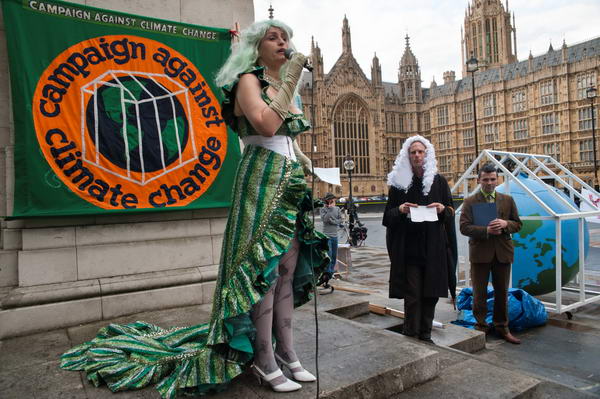
I’ve photographed demonstrations organised by the Campaign Against Climate Change for around ten years, at first of course on film and now on digital. Often they’ve had some nice visual touches that make life easy for photographers – one of the earlier occasions I remember involved a rather attractive female ‘tiger’ being pushed through London on a bed, which was fine until the wheels fell off!

© 2009 Peter Marshall.
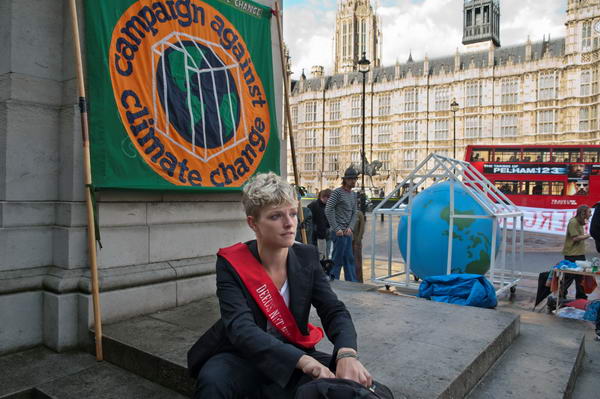
Tamsin, banner, greenhouse and Parliament. And a bus

But one thing that’s made life difficult for us in recent years is their trademark globe in a greenhouse. I’ve yet to find a sensible way to really use it in any photograph over the years, though it was less of a problem than usual.  It even sort of fits quite nicely into a few pictures, with the Houses of Parliament behind.

The demonstration was in Old Palace Yard, tucked in behind Westminster Abbey facing Parliament. It’s just a little frustrating that it’s almost impossible to see ‘Big Ben’ (or rather its clocktower)  from there, although I did manage to get the odd picture where it peeps around an edge.

© 2009 Peter Marshall.
Big Ben can just be glimpsed from Old Palace Yard

But at least there were a few things to add visual interest, not least the ‘Green Queen’ who looked suspiciously like a mermaid I’ve often photographed. Tamsin Omand with her ‘Deeds Not Words’ sash and the ‘Speaker’ also added a little, although considerably less once he lost his wig. It’s apparently the most daring constitutional change our current government has yet made.

© 2009 Peter Marshall.

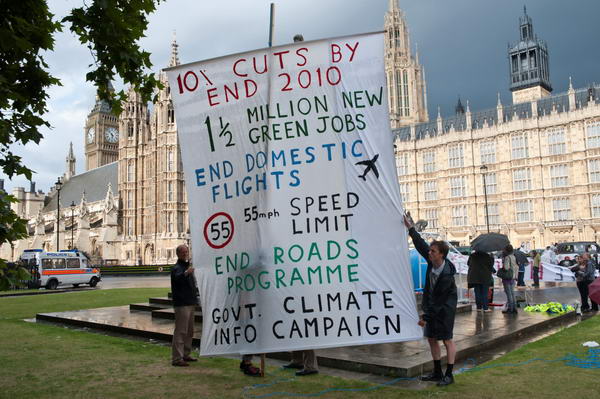
Of course people are interesting, but it has to be said some more so than others, and trying to produce varied images from a succession of speakers can be hard. Some give photographers a tough time, keeping their eyes closed or looking down. You can see what I made of them – and other pictures from the event on My London Diary, as well as something about the purpose of the event. The banner in the second picture has a pretty good précis!

The lighting was interesting at times, with sunshine and showers, though unfortunately no rainbow in the right place (or anywhere else.) The rain was a bit a a nuisance, but fortunately all three lenses I was using have lens hoods that help a little, and the occasional wipe with a microfibre cloth kept cameras and filter free of drops.

Swan Uppers and Downers

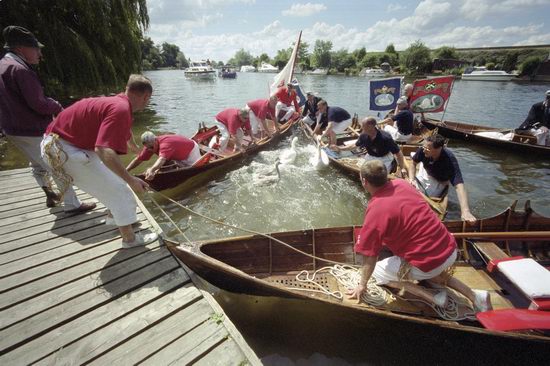
Although traditionally the Swan Uppers started their journey up the Thames at the City of London, in recent times they have missed out the tidal river, starting just a few miles upstream of Teddington at Sunbury lock. In recent years I’ve joined them on my bicycle at Shepperton or Chertsey, cycling with them along the towpath to lunch at Staines (which they took, appropriately, at the Swan Inn) and then in the afternoon going on with them to Windsor.

This year, the Uppers have deserted that stretch of the river altogether and start their journey at Eton College boathouse. I might have considered joining them there, but for the fact that it is going to be a royal affair, with the Queen expected to join the event at Boveney Lock.

I’m not in favour of the monarchy – it’s a shame we’ve still got one. I find the continuing interest in the press on the royals depressing, and have no wish to add or encourage it in any way.  Even if I did want to take pictures, royal events are bad news for photographers not in the exclusive clique of the royal rota with very limited opportunities and heavy security. So Monday is a day I’d choose to avoid.

© 2001 Peter Marshall

Back in 2001 I was still using film, and the best pictures I made were panoramic format using the Hasselblad XPan with a 30mm wide-angle, though the picture above was I think made with the Konica Hexar – I think of it as the Leica M9, though the build quality wasn’t quite there, but it had autowind and rather better metering than the M series. You can see more pictures – including a few of those pans on My London Diary, as well as those from 2004, 2005, 2006, 2007 and 2008.

© 2008 Peter Marshall

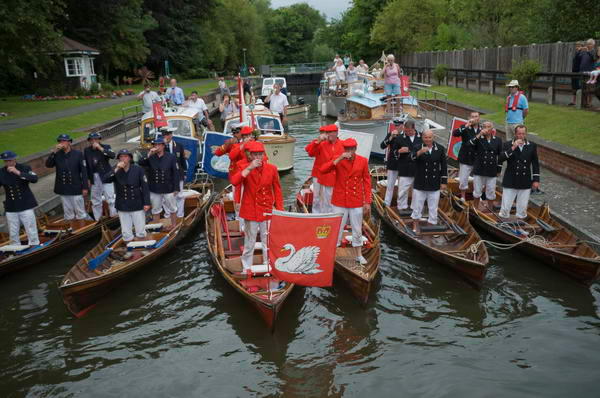
Of course Swan Upping was always a royal event – the guys in the red jackets making the loyal toast in Romney Lock are the Queen’s Swan Uppers, but she didn’t come down from the castle to the lock.

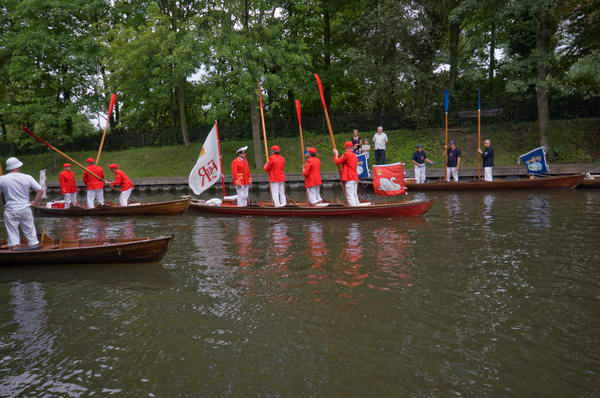
I didn’t bother to photograph this part of the event until 2007, when there was a real fear that swan upping might be coming to an end. Photographing the loyal toast is pretty simple, as all the boats are in the lock and pretty static. Much harder is the salute between the crews at the end of the day which used to take place a few hundred yards downstream, where the river banks are lined by trees and bushes. It’s also spread across the width of the river, with the Dyers two boats close to one bank and the Vintners on the other. They come to a halt and stand up holding oars vertical, giving the two boats containing the Queen’s men a cheer as they pass through the middle, also standing with their oars raised, and returning the salute.

© 2008 Peter Marshall

This is about the best of a rather poor crop of my attempts to photograph it.  I had hoped I might do better this year, and was disappointed to learn of the changed schedule.

Black Friday – Still Catching Up

Last Friday was Black Friday here. Literally in that around 10am when I was getting down to work on my computer, the screen suddenly went black and the system started to reboot.  My hope were raised as Windows loaded again, but dashed a few seconds later when I got the message “Windows has recovered from a serious fault” and then everything went black again – and this time the computer didn’t reboot.

I used to work a lot with computers and have often fixed other peoples, but this had me beat. I couldn’t persuade the system to boot from a CD, and nothing looked obviously wrong when I opened up the box, though it was very dusty!

I unplugged the inessentials and tried again with no luck, and eventually I gave up, sulked for a bit, then called out a repair service. They told me an engineer could come in around 4 hours, though after4 hours they phoned to revise that to 6.  I’d hoped to go out and take pictures but instead found myself staying in for the call.

The good news was that he eventually got it going. The bad news that it took him an hour and a half at expensive rates, and that he couldn’t really identify the fault.  Removing the memory then replacing just one of the four memory modules brought it back to life, but it continued to work when all four were replaced, and all passed the memory tests on his diagnostic software.  Perhaps it was just a poor or corroded contact, possibly on the memory but perhaps somewhere else on the motherboard, disturbed by the pressure on removing and replacing memory. Perhaps a short circuit somewhere broken.

So I now am considerably poorer, have lost a day’s work on the computer and half a day’s photography and have a computer with a doubtful motherboard. It could well go again any time, though at least I can now do everything that worked for that engineer without having to pay anyone else!

If there is plus point it’s that it’s made me think more carefully about what I can do to save things if the system does go again. While waiting for the repairman I set up email on another computer, and checked that I had all my essential files backed up on an external hard disk (most of them were there.)  I also installed a copy of the free Raw Therapee v2.4 conversion software – it’s an old computer that isn’t powerful enough for Lightroom or recent versions of Capture One Pro, and none of the software already on it could read D300 or D700 files.

Raw Therapee does seem to produce decent results, but trying it out in case I needed to process the job I had booked in for the following day I was soon very aware why I use Lightroom. And very relieved that the computer was up and running when I needed it.

Firstly, workflow and in particular the much better design of the interface. Raw Therapee seems too much of a community effort, with everyone wanting their own particular bell or whistle included, rather than picking the best approach.

Then I’ve become entirely addicted to the various possibilities of Lightroom’s ‘Adjustment Brush’ – allowing local adjustment of exposure, brightness, contrast, saturation, clarity and colour – in any combination. Being able to define presets for particular purposes is extremely helpful – I’ve got one called ‘Remove Highlights’ and another called ‘Spotoff’ – which works well together with the supplied preset ‘Soften Skin’.

And finally the whole output side  is easier to use – and I’ve set up all the presets that I need for different purposes.

I haven’t quite managed to catch up with what I missed, and haven’t quite decided what to do about the computer. The serviceman suggested it was probably time to think about a new one as it’s hardly worth replacing motherboards these days and systems are now so cheap. But it seems so wasteful.

And of course I’ve been checking my backups, although I lost none of the files on my hard disk – except for the anti-virus that was corrupted and had to be removed and re-installed. But today I’ve been busy writing out more of my images on to DVD.

DVD may not be good for long term storage, but there is something satisfying about a box full of disks that you can take out and put into almost any computer. Of course I also have the files on removable hard disks, the latest a 1 Tb Toshiba USB 2.0 model that cost me under £70 (now £75) and will store around 80,000 NEF RAW files. I’m happier with belt and braces.

Although digital photography has many advantages – and I often mention some of them – it has made us entirely reliant on computers. If you’ve not thought about what would happen if your computer suddenly stopped working, now would be a good time to do so.

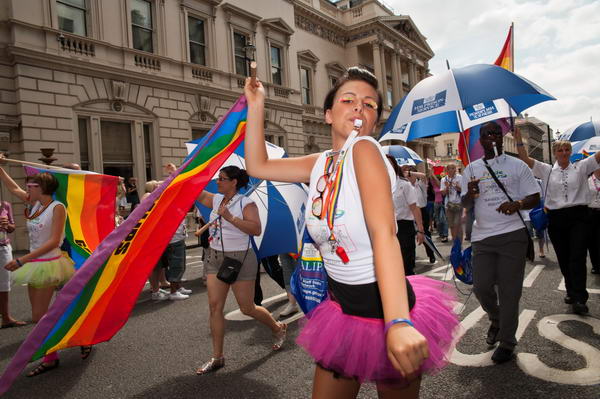
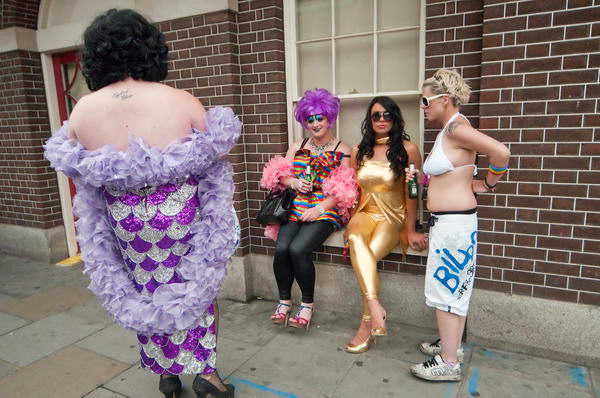
Pride 2009 – and nearly a fall

I failed to photograph the only slogan I saw at Pride that made me laugh or at least smile; one of those times when you see something and for some reason don’t photograph it, intending to do so later. But later seldom happens.

So I didn’t get a picture. But it doesn’t really need a picture – and probably why I didn’t photograph it was that it didn’t make a good picture. “ASEXUALS don’t give a F**K” amused  me, but not visually.

© 2009 Peter Marshall.
HM Prison Service: “Banged to Rights”

Fortunately quite a lot did visually appeal, and I took rather a lot of pictures, and despite a few technical problems quite a lot of them came out. Enough certainly to make editing a real pain.

It had been a good night on Friday, and I probably still wasn’t fit to drive a camera – fortunately they can’t breathalyse you for it. For some reason I left the D300 on a high ISO setting for an hour or so while taking pictures, though fortunately I managed to set the D700 to something sensible. Working with two bodies, I had a Sigma 12-24 (equiv 18-36mm) – just back from repair – on the D300 and another Sigma, the 24-70 HSM on the D700. So for that time the wide-angle shots were taken at silly settings like ISO 3200.

© 2009 Peter Marshall
For mysterious reasons this was taken at ISO 2500

The results were noticeably more noisy than I’d like. With the D300, I’m fairly happy working at ISO 1600 if I have to, but try to avoid anything faster. For the first time in a year or so I found the noise reduction built into Lightroom wasn’t enough and had to turn to specialist noise reduction software.

There are I think several programs worth considering to reduce noise, and when I used to seriously review software I was given free licences for all of them. But two years ago I moved to a new PC, and could no longer get them to work. Fortunately that old PC still works, and I switched it on for the first time this year to process these images.

The 3 programs that I recommended after my tests – and still recommend – are Imagenomic Noiseware Pro, Neat Image Pro and Noise Ninja, all capable of excellent results. For these pictures I actually used Noiseware, but either of the others would have given similar results.  You can actually download a free ‘Noiseware Community Edition’ for non-commercial use, which gives similar results although a few options are disabled. Its main limitation – at least if you only want to work with jpegs – seems to be that it is a standalone programme rather than a Photoshop plugin.

I sent a disk of mixed files taken at normal and high ISO to a library the day after Pride (I’d already e-mailed a few) and viewing them on my 21″ screen at 15″ wide the difference in quality is only noticeable on close inspection. At 1:1 it’s a little more obvious, but not greatly so. There is just a slight difference in colour quality that I think you can see even in the web files – more pictures on My London Diary – but frankly it’s still so much better than we would have thought possible just a few years ago.

Last year I wrote very little about Pride, but of course did take pictures I did give some links to some work from earlier years.

Remember Spain

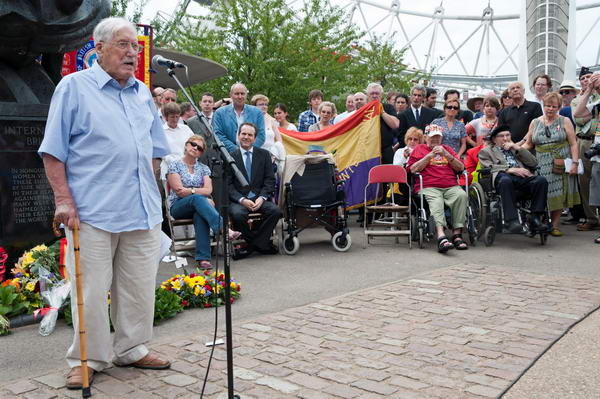
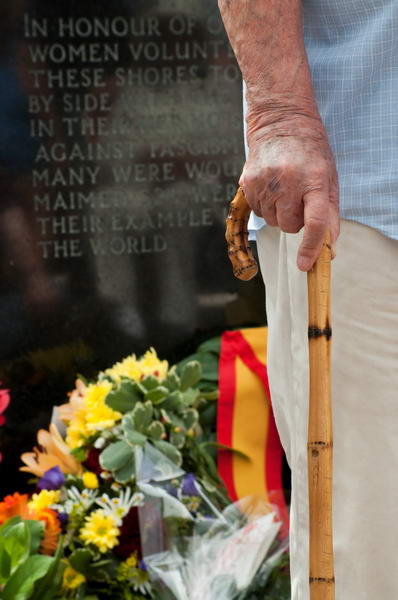
In most recent years I’ve managed to attend the annual commemoration for the British volunteers who travelled to Spain to fight against fascism in the Spanish Civil War in 1936-9.  Each year fewer veterans of the war are able to attend, with only seven British veterans still surviving, all in their 90s or older. Although that is a remarkable figure, a third of the known surviving veterans from the Republican side.

© 2009 Peter Marshall.

Our government refused to act, even making it illegal to send aid to the legitimately elected Spanish Government that was being attacked by Franco,  but over two thousand men and women from Britain, socialists and mainly communists, made their way to support Spain; over 500 dying there.

One veteran whose absence at the ceremony this year was deeply felt was Jack Jones, one of the truly great British figures of the last century as a trade unionist and activist, and former head of the International Brigade Memorial Trust.  Sam Lesser, at 95 one of the younger veterans of the war, gave a moving tribute to his life.

© 2009 Peter Marshall.

Others who died in the past year were Bob Doyle, Bernard McKenna and Rosaleen Ross. McKenna, who came from a poverty-stricken Irish family in Manchester, had been wounded in two battles, recovering to return to the front and was then captured by the Germans and interrogated by the Gestapo. Unlike most others he was not executed but spent some time in an Italian prisoner of war camp.  He was repatriated in a prisoner exchange in 1938 – and got a bill for repatriation- £4 – from the Foreign Office on his return. It was still unpaid when he died last year.

You can see more pictures from this event at the International Brigade Memorial in Jubillee Gardens on the South Bank,  on My London Diary, as well as some from the events in 2007, 2006 , 2005 and 2004

The Unpredictability of Doves

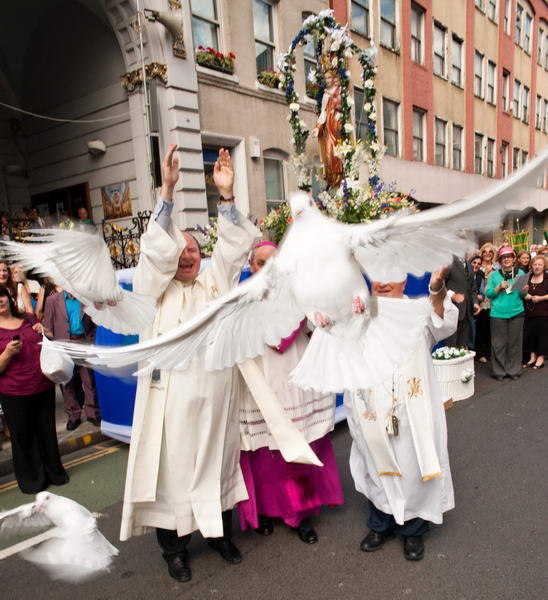
Today was the Procession in Honour of Our Lady of Mount Carmel from St Peter’s Italian Church in Clerkenwell, London, an event which was first celebrated in 1883 and there is nothing else like it in London. For some reason it took place a week earlier than usual this year, and perhaps for this reason the numbers attending were a few less than in previous years.

© 2009 Peter Marshall.

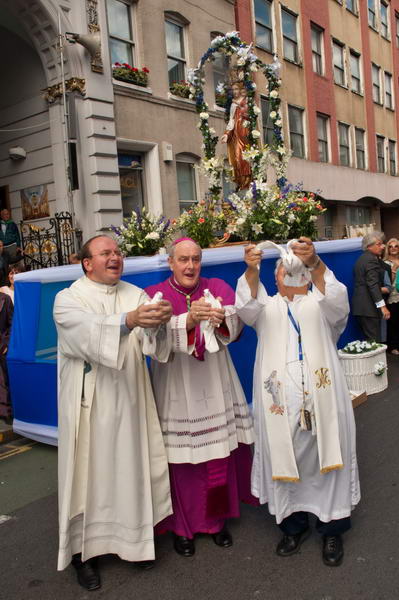
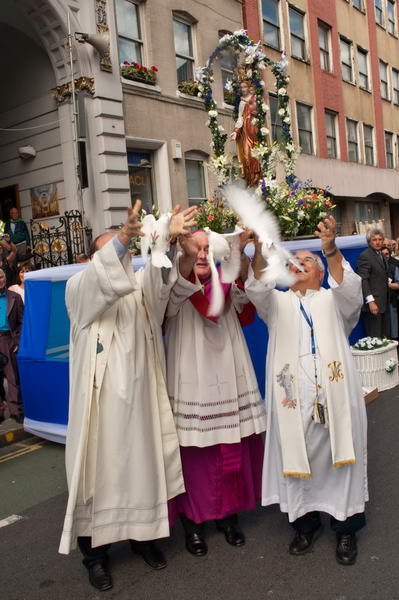
I’ve been fairly lucky in previous years photographing what is perhaps the key event in the procession, the release of the doves.  This year I was a little further away from the three priests as they stood holding the doves than I would like – at events like this you have to cooperate with the other photographers present, and usually they like to stand quite a lot further back than I would choose (what, after all are wide-angle lenses for?)

Because of this, I was using the Sigma 24-70 lens rather than the 12-24 that I had fixed on the other camera. I’d decided to leave it on the 24mm setting, although this was a little on the wide side for the men holding the birds, I knew I wouldn’t have time to zoom once they were released, agnd given the entirely unpredictable nature of their flight, the wide angle gave me a better chance of actually getting them in frame.

The sun had been coming in and out, and I was shooting with fill-flash, set to -1 stop on the Nissin Di622 which I’ve been trying as a cheap alternative to my SB800 – currently in for repair.  The Nissin works more or less like the built-in flash, using the camera controls. I’ve had some problems with it providing too much light, particularly with close subjects, and I don’t think it can cope with sync speeds faster than 1/250s which the SB800 can, but generally it seems a decent alternative to the Nikon at around a quarter of the price of the SB900 which has now replace the SB800.

Unfortunately I’d forgotten to switch to the high frame rate mode on the camera, so when the doves were actually let go and I held the button down I was only getting 3 fps, while the camera can give 5fps (more with extra batteries.)

Although it isn’t really possible to guarantee results in situations like this, if you stand in an appropriate place with the right camera settings you stand a much greater chance than if you don’t.  So yes, I was lucky to get the picture I did, but I was reasonably prepared for it.

I don’t know what the wingspan of a dove is, but not huge.  Although I’ve cropped all the pictures of  the release this one retains the full width of the 24mm focal length – used in portrait format. At a guess I’d say that the dove was about 2 feet from my lens when I took the picture.

The other amazing thing is that all three doves are in the picture.  Below is the sequence of frames that led up to this image. I think from the second image the pictures are at 3 fps. As  you can see, none are of particular interest.

© 2009 Peter Marshall.

© 2009 Peter Marshall.

© 2009 Peter Marshall.

© 2009 Peter Marshall.

More pictures from this event shortly on My London Diary.