Field of Remembrance

This year because of illness I’ve missed several remembrance events I would otherwise have photographed.  But while I was in Parliament Square earlier crosses with poppies were already being planted in front of the abbey. This set commemorate the submarines that have been lost, the two larger blocks representing the First and Second World Wars.

© 2009 Peter Marshall.

My own father was in the First War.  He was fortunate always to be a little behind the front line because of his job, and although he got given a gun and stood on guard duty occasionally he was never taught to fire one (and didn’t ever know if it was loaded or not.)  His wasn’t a dramatic story or one involving great bravery and he suffered no significant injuries; it is the story of an “ordinary” man caught up in events.

At his call-up medical the doctor discovered he was deaf in one ear and asked him if he really wanted to go, and he said he “might as well.”  Quite unusually 119377 Marshall W F eventually became  3rd “Ack Emma” in the Royal Flying Corps where his extensive experience and skills could be put to good use in keeping the planes flying.  Late in life he wrote a brief memoir of the first 40 or so years of his life, including the war years.  These two extracts are exactly as he wrote them:

Corporal said “Put it down here“. I pointed out that the pit was on the other side of the lorry, and it was only sensible to put it over there.  I was reported and had to go to see the Sergeant -Major.  He said that I was on active service and people were often shot at dawn for disobeying orders.  I told him I didn’t expect to live very long, and if he liked doing that sort of thing it was OK by me.  He told me to clear off and not be so silly .  I rather think he had a word with that corporal.  I didn’t hear anymore about it…

Chinese coolies prepared our sites and probably erected buildings; and of course they dug the petrol holes out.  There was every nationality represented amongst the troops and auxiliaries.  It was amazing how varied an organisation the armies were.  There were lots of horses, mules and bullocks pressed in to do the work.  Then there were the Tommies and the Frenchies and all the other fighting men, all colours, marching backwards and forwards – Colonials, Indians, Africans; we had an Empire then!  Our armies were advancing then, and we had to keep up with them.

I thought particularly of that second quotation when hearing the disgusting nonsense talked by the leader of the British Nationalist Party, Nick Griffin, trying to hi-jack the war (in his case particularly the1939-45 war, but the same kind of thing was true in that war) to support his party’s racist policies. Without the active support of the very peoples he would like to deport we would have lost both wars.

Not of course that our main parties have kept faith with those people who fought for the UK and were British subjects, most of whom were denied the right to enter the UK under the Macmillan government’s panicky Commonwealth Immigrants Act 1962 and later of their remaining and largely meaningless status with the British Nationality Act of 1981 under Thatcher. Labour’s record on the subject is no better.

New Nuclear Power?

Having grown up in the era when nuclear power was going to make virtually free electricity in unlimited amounts – at least according to the industry – and having seen the fiasco it really was I’m unconvinced that nuclear power is the answer to any problem.

© 2009 Peter Marshall.
Decommissioned power station on the Blackwater at Bradwell, Essex

And of course I’m still unconvinced we have any real answer to the huge amounts of nuclear waste that our existing and decommissioned power stations have built up, yet alone the increased amounts power stations on the ten sites announced yesterday will produce. Apart from Bradwell, other exisitng sites to be reused are Sizewell, Suffolk , Hartlepool & Heysham, Lancs, Hinkley Point, Somerset, Oldbury, Gloucestershire and Wylfa,  North Wales, and Sellafield in Cumbria, which is joined by the two new sites nearbty, Braystones and Kirksanton.

© 2009 Peter Marshall.
Bradwell, Essex

Not that I’m against nuclear entirely. Their is one huge nuclear power source whose greater use I entirely support. It’s called the sun.

Even in the UK it can be a useful source of energy, though probably more by its effects on making air and water move around in various ways.  We have more than enough wind to meet our energy needs, even before we start to add in other renewables.

Of course there are problems in the kind of expansion of wind energy that we need, and in particular those caused by the failure of our government to act. Allowing the one factory in the UK producing turbine blades to close.  Failing to make promises about the future return for renewable electricity and to use EU funding  for the proper purpose (and using it to promote agro-fuel production, adding to the problem.) Failing to give any real lead over planning for wind farms and so on.

© 2009 Peter Marshall.
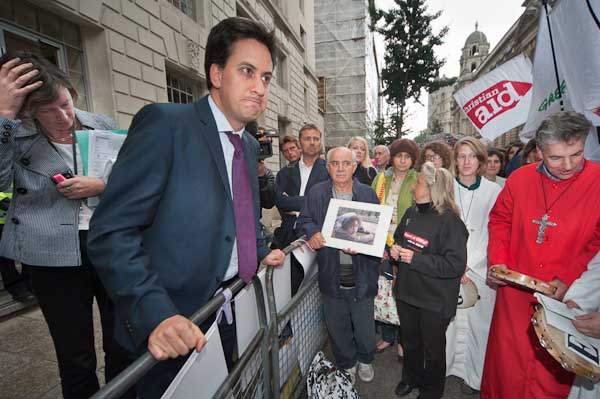
Ed Miliband faces critics at the DECC

Another area of failure has been over cutting energy use, concentrating on a few easy targets and neglecting the major places we need to make cuts. Going down false(or at least highly unlikely) roads such as carbon capture and storage and carbon trading.

The government have been working hard to give themselves a green gloss, but overall is it any more effective than Mrs Thatcher’s ‘Keep Britain Tidy campaign?  Not of course that the opposition look much more likely to get things done. It’s almost enough to make me join the Green Party again.

© 2009 Peter Marshall.
Bradwell, Essex

Apologies for the rant, but I find it hard just to watch my planet going down the tubes.

The locals used to find the River Blackwater had nice warm water downstream from the power-station and there is a nice white sand beach just a little downstream.  I imagine the new station – if it ever happens- will be built close to the old, and make use of at least some of the existing infrastructure. Given it’s really only a short distance from London it’s an incredibly isolated place, with huge fields of organic wheat being harvested while I was there for a week in the summer.

Writing for Free

Although I now write ‘for free‘ that hasn’t always been the case, and may not always continue to be so. For eight years I wrote about photography for money (as well as out of obsession), and in a good month it made me enough to live on. Not that the readers paid directly for my content, but that the site I was writing for made quite a lot of money from advertising of various kinds. Often bloody annoying, but it paid my bills.

Almost all print magazines rely on advertising to pay for the content – the cover price is seldom enough to do so. On the web, few publications have managed to make a significant income from any source, but it can be done. There are a few excellent sites that do get money from subscriptions and from advertising, but for someone like me who has chosen (if only after being sacked) to go it alone, it isn’t easy.

This site – and ‘My London Diary‘ on which I present my own photography do very occasionally generate sales of my prints or fees for reproduction, but the return is very small for the hours of work I put in. Essentially I subsidise the writing of these sites by other activities, including sales  through agencies, the occasional commission and so on. I’m always happy to consider suitable work in the London area – and every blue moon the site throws up a job from someone who likes what they see.

But I’d like to spend more time writing, and writing seriously about photography is very time consuming. A considered review of a web site, show or book really requires several days of work, and the longer features I used to write weekly on photographers and aspects of photography took even longer.

A D Coleman is a writer on photography whose work I admire – though of course I don’t always agree with his views.  But where I’m a hundred per cent with him is in the series of features on his Photocritic site, Jeff Ward Wants My Writing — Free – #1 and #2. 

He quotes Ward as saying”the future should be open and accessible [online] repositories.” and that “Monetized knowledge is suspect, for me at least — I don’t buy it.”

Unless someone pays for it, much of it simply won’t be written, or at worst we may be limited to writing by academics and museum curators – although they are usually pretty good at marketing their work for secondary payments – and there is no criticism implied in that. But already doing it for a living they have the choice of goivng it away should they decide to do so.

What we need is some financial model that encourages and rewards good writing – and also of it goes without saying, good photography that is worth writing about, something which is also gettting increasingly hard to market.

The number of readers of this site are an order of magnitude less than the site I was paid to write for but still significant. This blog, >Re:PHOTO,  got over 86,000 page views for in October, and there were roughly the same number for My London Diary.  And neither are the kind of site that people are likely to arrive on by accident, so this represents a significant audience, and I’m very pleased that people think it is worth reading my rambles and viewing the pictures.

At the moment I’ve no plans to introduce adverts, as I like the the site without them, but it’s hard to see how I can keep it that way in the longer term as income from photography seems generally to be declining. And the advantage of getting money from writing is that I would be able to devote more time to writing rather than doing other things to keep bread on the table.

In #3 of the series, written on Sunday, Coleman  talks a little more about “the project I subsidize, organize, edit, and publish online, the Photography Criticism CyberArchive, a deep repository of historical and contemporary texts on photography and related matters by a wide range of authors.”  I suppose I should declare a sort of interest. When he wrote to me about this some years asking if I would be interested in putting any work in there I certainly wanted to do so but the small print of my lengthy contract with About.com, Inc made it impossible for me to do so.

This didn’t mean then that that galleries around the world were free to rip off my stuff, although many did, while others who asked had to fill in forms and pay and send the fees to About.com, though I wasn’t always sure that I got my 50% from them it did sometimes happen.  And of course students etc who asked were always told that so long as it was properly acknowledged they were free to quote me.  I often wondered what proportion did ask, and certainly in the early years before anti-plagiarism software came into wide use could claim – probably with some substance – to have gained degrees at a number of US universities.

But, rather more seriously, the fact that I couldn’t put work into the PCCA in the longer term has meant it is no longer available at all. About.com withdrew it from the web a few months after they terminated my agreement, and neither they nor I can use it without paying the other. In perpetuity. Or possibly until a large group of former employees decide to take out a class action.

I have of course rewritten a few pieces, and posted these, but it is time-consuming, bringing things up to date, correcting errors and simply changing my mind or having new thoughts means it takes at least as long as producing the original, and with several thousand pieces (of which perhaps a few hundred are worth republishing) its a daunting prospect.

Fortunately I was rather more careful with images. Apart from those of a purely instructional nature – such as how to load a film tank – I was careful only to use pictures of my own that I had previously published elsewhere and grant About.com a specific single use licence just the same as those I was required to get from other photographers except for truly public domain imagery.

So when I put up a slide show of my images from Paris – and here’s a fairly random image from it –
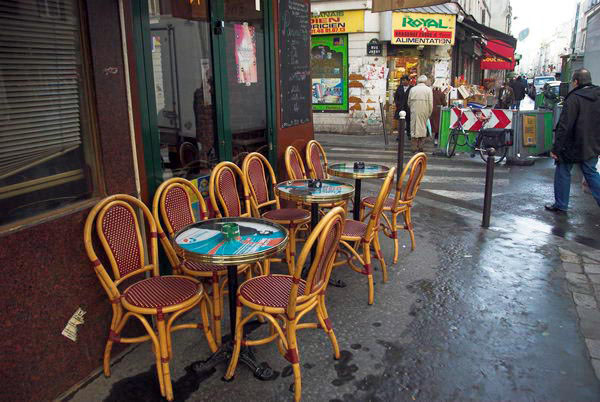
© 2006 Peter Marshall

they were from a set that I’d previously published on my own web site, where you can still see the thumbnails and full 58 images, including a few from Paris Photo where I’d still like to be going in a week or so’s time. But I’ll j ust have to make do with looking at those pictures from previous years, including last year’s PARIS SUPPLEMENT to My London Diary.

Back to the PCCA. It makes content available by annual subscription for personal study etc.  As he makes clear “it’s really designed with institutional subscription in mind — a situation in which one subscription fee would pay for access by a sizable user base.” Students and academics often forget that much of the material on the web they can access without payment they can only do because their institution has paid for a licence to services such as JSTOR .

But PCCA at the moment is subsidised by Coleman, partly because its content base is not large enough and also in a highly specific area, so attracting relatively few subscriptions, but mainly because unlike larger services such as Lexis-Nexis or JSTOR it is set up to look after the interests of the creators, paying them for their materials, rather than those of the publishers.

I’ve contributed a few essays to academic journals over the years that are now available through JSTOR. Of course there was no payment for the material by the journals, and I was never asked permission for them to put it on line or otherwise reuse it. Journals will get something for allowing their material to be used, but not those who actually provided the material.

You can read more about the details of PCCA in the feature and also at it’s web site.  We are promised more features in the series.
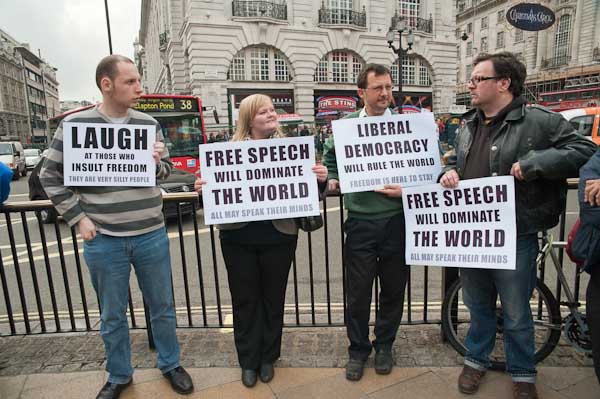
A long Brew – but Brown finally gets the Message

It was over four years ago that along with a smallish group of demonstrators I walked onto Westminster Bridge to photograph an illegal demonstration calling for a ‘Tobin Tax’. I knew what it was, and that it had been proposed by Nobel prize-winning economist James Tobin (1918-2002) in 1972 as a microtax – perhaps 0.1% – on currency dealings that would be so small as to not affect actual currency deals but would be enough to put a real drag on speculation.

It was a proposal taken up by charities concerned with the effect of speculation on the poorer countries in the 1990s (and given some support by French President François Mitterrand) and early 2000s, when they also suggested that a very small levy – perhaps 005% – would enable the wealthy countries to actually meet the promises they had made on overseas aid. For several years I had a large poster about the proposal on my kitchen wall.

As I wrote in 2005: (when I still hadn’t found the Caps  key)

the aim was to deter speculation on currency movements, thus giving the elected governments greater control over their fiscal and monetary policies, and reducing the power of unelected speculators (who include some of the larger multinational companies) to affect the markets. Exporters, importers and long-term investors would all benefit from less volatile exchange rates, and the revenue raised by the tax could make a significant contribution both to the revenue of national economies and also for international development projects.

© 2005 Peter Marshall

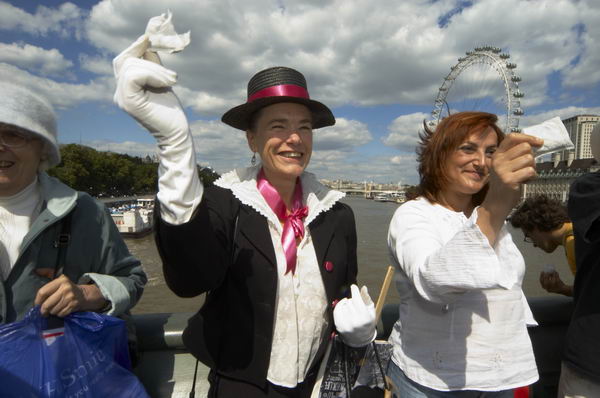
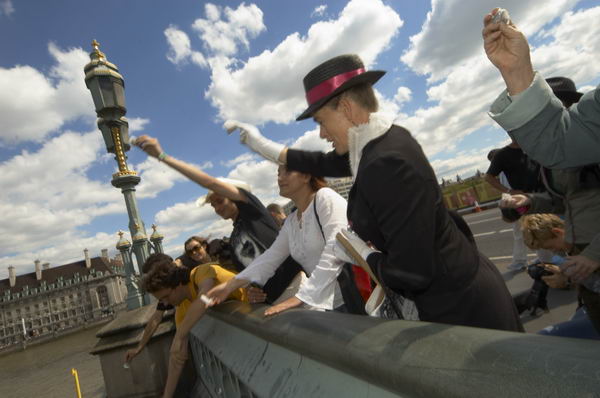
as a small gesture of support for the tobin tax, another illegal demonstration took place in westminster this afternoon, unnoticed by police. a small group of demonstrators, again following an example from boston – although this time from 1773 – chose tea as a way to symbolise their protest. each threw a teabag, produced by one of the giant corporations, from the middle of westminster bridge into the river thames below.

© 2005 Peter Marshall

As you can see, I hadn’t at the time quite perfected my technique for  mid-air hovering that such events really require  – and it still needs a little more work.

© 2005 Peter Marshall

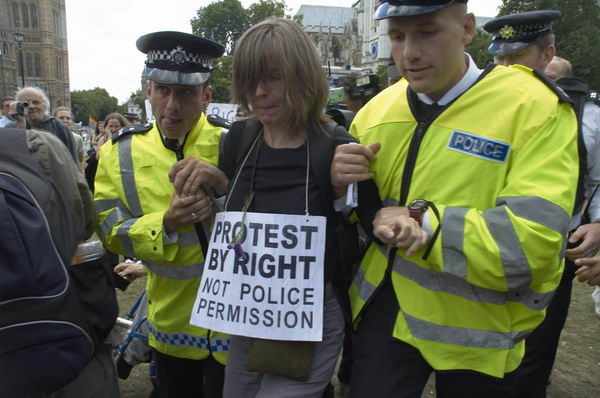
I really was pleased that the police didn’t try to arrest the protesters. I’d watched (and photographed) earlier in the day as police arrested and led away five protesters simply for peacefully holding a banner in Parliament Square, ashamed at seeing my country become a police state.

When Lord Turner brought up the idea of a Tobin tax again at the end of August, it seemed very much an idea whose time had come, and another leading Nobel prize-winning economist, Joseph Stiglitz backed the idea at the start of October, saying that the technical problems which would have proved impossible in the past were no longer an obstacle with modern technology.

It came as a surprise to hear Gordon Brown adding his support yesterday. Perhaps after five years those tea bags had really brewed. Less of a surprise that the US immediately turned the idea down, but at some time Obama will have to decide to stand up to the bankers, so it may yet happen.

Gazopa

We’ve already seen image search engines that claim to be able to find a particular image on the web, and services such as PicScout’s Image Tracker seem to have had considerable success in tracking usage for the big agencies who can afford to use it. Because it relies on a “fingerprint” created from the image rather than a watermark, it claims to be able to spot even images that have been cropped or manipulated.

TinEye is another “reverse image search engine” with the big advantage of currently being free to use (although they intend to add some extra paid-for services at some time. Tineye is very easy to use –  just right click on any web image and select “Search Image on TinEye.” The only problem is that when I’ve tried it with my own and other peoples images that I know are on several places in the web it often hasn’t found them, though it is a lot better now than when I first tried it.

There are some examples of what it can do on the site. At the moment they claim to have scanned 1,143,177,077 images from the web; I don’t know how many there are in all, but the largest figure I’ve found on a single search on Google Images is 1,600,000,000.

Idée also have a PixID service which can identify usage of images in both print and on-line for “editorial, celebrity and entertainment firms, news wire services” and others, and is I imagine relatively expensive, as well as Pixmiliar which looks for similar images.

Similar to this is Gazopa from Hitachi America which is now in a public beta and you can use it on the web or download it for your iPhone should you have one.  It lets you choose an image on your computer on on any web site, upload it and it will then find similar images. Possibly.

As I’m sitting here feeling sorry for myself just starting to recover (I hope) from swine flu – the letter offering me the vaccine came this morning, very much too late – I had time to try it.

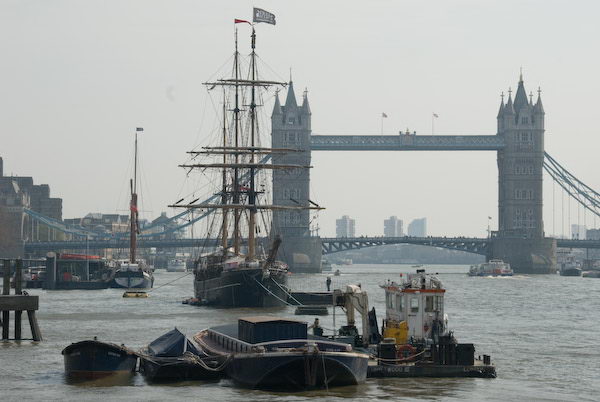
The first few pictures – typical things I take  like demonstrations – it could obviously not get it’s head round at all, so I thought hard and tried to give it something easy. How about one of London’s most recognisable buildings, Tower Bridge? And a picture that showed its very distinctive shape clearly:

© 2007 Peter Marshall

and was rewarded with my first (and only) success.  Of the 30 images on the first page of the thousand it selected there were actually 4 of Tower Bridge.  I tried with some other well-known buildings from London,  and other cities with no luck. A night image of the National Theatre did return night images, but not of anything remotely similar.

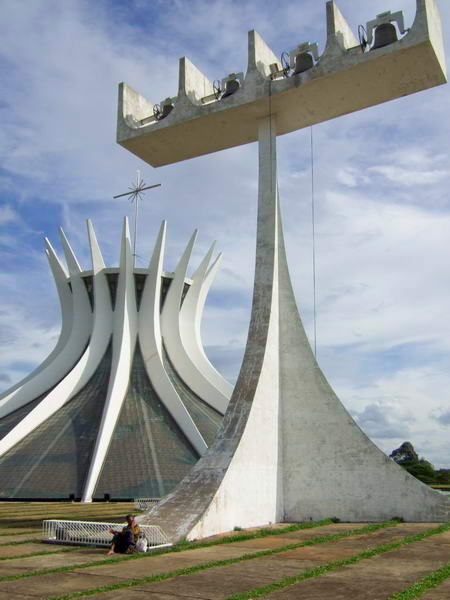
© 2007 Peter Marshall

The bell-tower and cathedral in Brasilia doesn’t look to me much like the Japanese woman or the polar bear that GazoPa produced in response and although there was one other church it was in a very different style. The still ife image of two bottles was perhaps a little more understandable.

© 2009 Peter Marshall

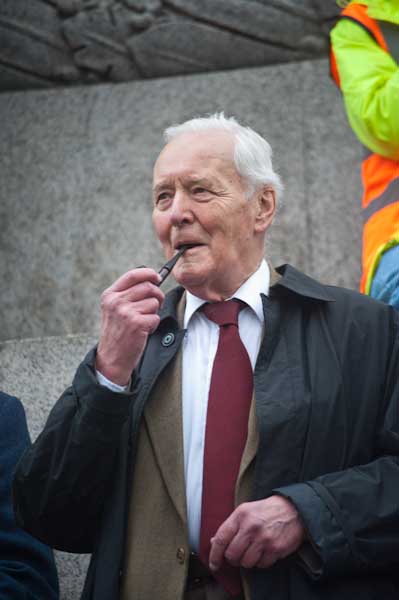
GazoPa also has a face recognition feature, so I thought I’d try that and fed it a picture of Tony Benn, complete with pipe, thinking there must be many thousands of similar images on the web (including hundreds of mine.)  Searching normally perhaps the most interesting match – at third closest was of what looked like an amateur burlesque dancer, though further down the list were three men with pipes but otherwise no resemblance.

Switching to ‘Face’ mode gave a different set of matches, with several of the same kissing wedding couple, several women between five and ninety and a small child in a push-along cart. But perhaps those carved heads of four US Presidents on Mount Rushmore were a nod to his political nature. To be fair there was just one of the first 30 pictures that did bear a very slight resemblance to the man, and who was looking in a similar direction, but I think the matching algorithms still need a little improvement.

© 2009 Peter Marshall

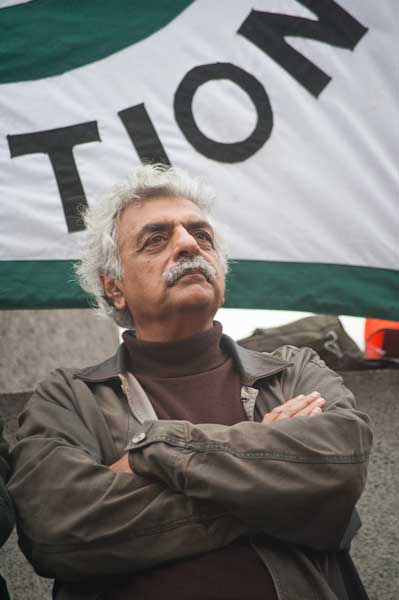
Just to give it a fair chance I thought I’d also try it on Tariq Ali who  had been standing next to him on the plinth in Trafalgar Square, a couple of weeks ago. Perhaps I can see a very vague resemblance to a cat, but the pig just isn’t fair! And ‘Face’ mode doesn’t make anything better.

I’ve not posted any of the results here – as if PicScout picks up any from its clients it could bankrupt me. But you are welcome to try any of the images here – or on My London Diary – on Gazopa. If you find any really good examples perhaps you could post them as a comment – just the URL of my image and any comment you want to make would be fine.

Fotofest – Birmingham Mark II?

I was a little surprised to see a picture by Vee Speers at the top of the press release for the Fotofest International Discoveries II show which opens today in Houston and continues until December 19.  Of course I really love her pictures, but I’d hardly call her a ‘discovery’ given the amount of previous exposure of her work, not just the The Birthday Party, first shown in Australia in 2006 which is now on show in Houston, but also previous work including ‘Bordello‘ which first shown in Italy in 2002.

© 2009 Peter Marshall.

I first met her at Birmingham at Rhubarb Rhubarb in 2007, though she first attended in 2005. In 2007 her pictures were on the wall of the room where I was looking at portfolios, one of several fine photographers selected for the show ‘Otherlands‘, though I’d seen her work previously in magazines. Surprisingly Birmingham doesn’t get a mention in the Fotofest release, although it was most probably there she met the senior curator of Fotofest, Wendy Watriss, who was a fellow reviewer.

© 2008 Peter Marshall

Chinese artist Wei Bi’s re-staging of his 80–day experience in a Chinese prison — a sentence received for making a photograph. His large black and white photographs are minimal, showing a surreal relationship between near expressionless guards and disoriented prisoners. One of his images appears at the top of an earlier press release.

Alejandro Cartagena, born in the Dominican Republic lives and works in  Monterrey, Mexico and at Houston he is showing large-format brilliantly coloured images of the dramatic and ever-expanding suburban development of the area. He has shown work widely in Mexico for around 5 years as well as contributing to international group shows. I particularly like some of the ‘NewWork’ on his site.

Minstrel Kuik Ching Chieh was born and raised in a Malaysian fishing village but she studied photography in southern France. You can see her work, including RRose which is being shown at Houston on her blog.

Christine Laptuta produces work about the mystery of land, “its ambiguity, disruption and rhythm.” She chooses to represent ordinarily vast landscapes in multiple printed miniature platinum/palladium contact prints.

The constructed landscapes of cities are focus for Rizwan Mirza‘s photographs. His shadowy nocturnal images reflect the tension between the mysteries of darkness and the lighting.  Born in Liverpool he studied with John Blakemore in the early 1990s and also came to Rhubarb Rhubarb in 2008, although the previous year he showed at various galleries and festivals including PhotoEspana, Madrid, Spain. His work was also on show – not in FotoFest – in Houston in 2008.

Born Tokyo 1948,  Takeshi Shikama has been showing his black and white photographs of trees since 2004, and “The Silent Respiration of Forests” first appeared in a Tokyo gallery in 2006.

Working between Seoul, London and Paris, Korean-born MiMi Youn was one of the three winners of the Lens Culture – Rhubarb Photo Book Awards in 2008 along with Kurt Tong who divides his time between China and the U.K and has photographed a little-known and officially banned element of ancient Chinese funerary practice; Joss Paper or “Spirit Money.”

Brian Haw Harrassed by Police

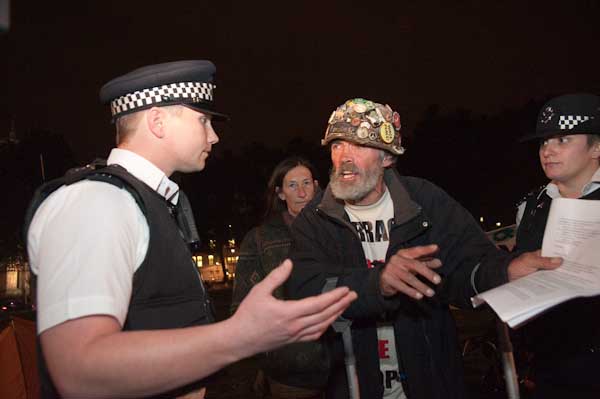
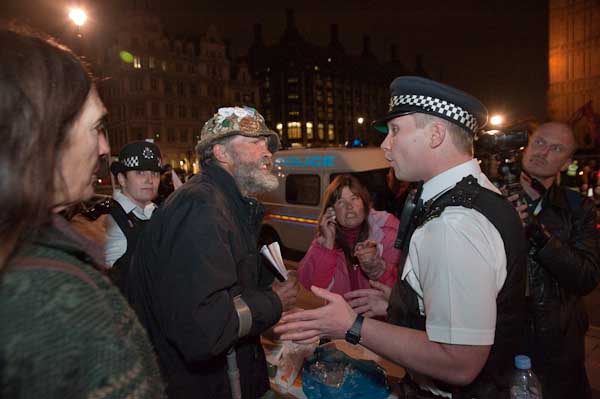
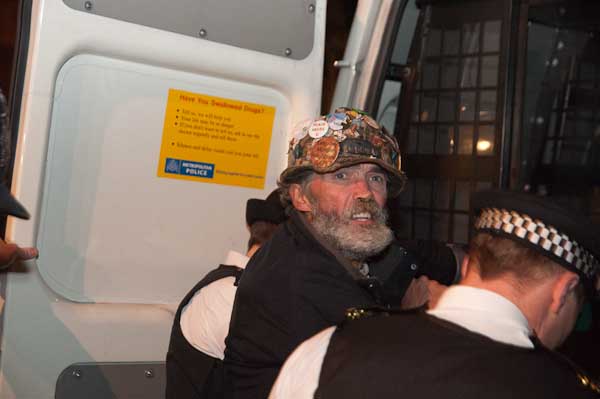
I suspect the small group of police who came to Parliament Square around 7pm on Friday thought that there would be few people around, and will have been a little surprised when they started arguing and arresting Brian Haw to find they were being photographed by two freelances and an AP staffer, as well as another freelance shooting video.

© 2009 Peter Marshall

The event appears to be a part of a long-standing campaign of harassment against the peace protester who has been in the square since 2 June 2001 – eight years and almost five months. Over the years police have made various legal and illegal attempts to remove him, and the government passed a law to try and do so – but messed up the drafting. So Brian is still there, still making his appeal to the conscience of the nation to stop the killing – particularly the killing of children – in Iraq and elsewhere.

© 2009 Peter Marshall.

I couldn’t understand the argument the officer was having with Brian, but each seemed to be accusing the other of not having acting lawfully. Eventually Brian was pushed and pulled along on his crutches, still protesting and lifted into the back of a waiting police van.

© 2009 Peter Marshall

I returned the following morning and he was still in police custody at Belgravia Police station, but about to be taken into court. Apparently his immediate release was then ordered. When I came back later in the afternoon he was back in his usual chair in the square.

© 2009 Peter Marshall

Although I was working very close to Brian and the police, I was careful not to get in the way, and had no problems, although things got a little hectic as he was actually put into the van, and I had several  unsharp frames as I was pushed by police and other photographers.

Almost all of the arrest images were shot at ISO 3200, f4.5, 1/60 and using flash. The flash can’t handle subjects very close to the camera and over-exposure of these was a problem in some frames.   Although I moved around the action as much as possibly, there is just too much similarity between the various shots I took, as you can see on My London Diary.

Friday Zombies

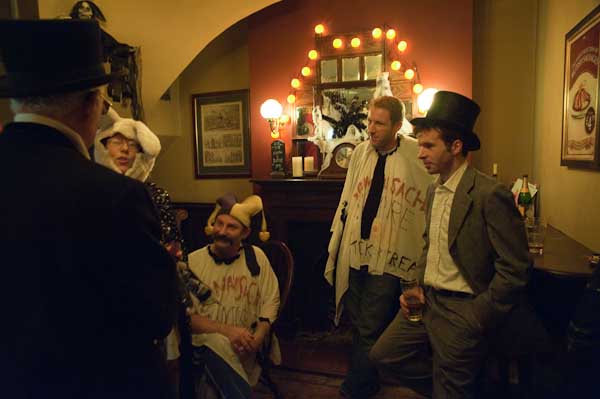
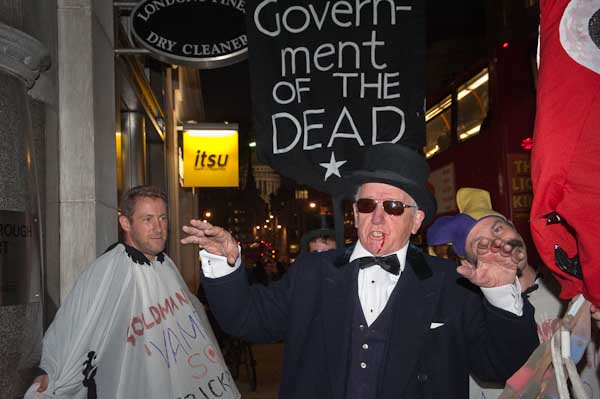
Since it was Halloween weekend, it wasn’t that surprising to have two zombie-themed protests on the streets. The first, by the ‘Government of the Dead’ led by Christ Knight was meant to catch bankers and other city workers going home, but work now seems to stop pretty early on Fridays, and the part of Fleet Street where Goldman Sachs have their office was dark and deserted by the time the small group of protesters arrived around 5.10pm.

Considering that the Facebook page for the ‘Goldman Sachs Giant Vampire Squid Trick or Treat‘ had 97 confirmed guests and 389 ‘Maybe’s, the actual attendance of six was rather disappointing. The idea for the event came from Matt Taibbi who wrote  in Rolling Stone and Goldman Sachs:
The world’s most powerful investment bank is a great vampire squid wrapped around the face of humanity, relentlessly jamming its blood funnel into anything that smells like money…

The group met in the Old Bell pub a few doors away, and lighting in there was low.  Using the D700 I was able to shoot by available light at around 1/8 or 1/10s at f5 – stopping down from f2.8 for more depth of field. At 24mm a reasonable proportion of images were reasonably sharp if I chose moments when people weren’t moving. I was shooting at IS03200, but at -1.33 eV, which I think means ISO 8000.

© 2009 Peter Marshall

Colour isn’t great, but that’s mainly down to the lighting, and viewed at 1:1 one of the guys has moved just a little too much, but otherwise sharpness is fine and my default (low) settings for noise reduction have done a pretty good job, though if I needed to I could improve on it.

Outside it was darker still, and flash was the only answer.  I should have switched to aperture priority perhaps working at around f5.6, but I left the camera on program and it chose f10. Which was fine for the flash but meant I picked up less than I would have liked from the ambient light even though I was working at ISO 3200 and 1/60 s.

© 2009 Peter Marshall

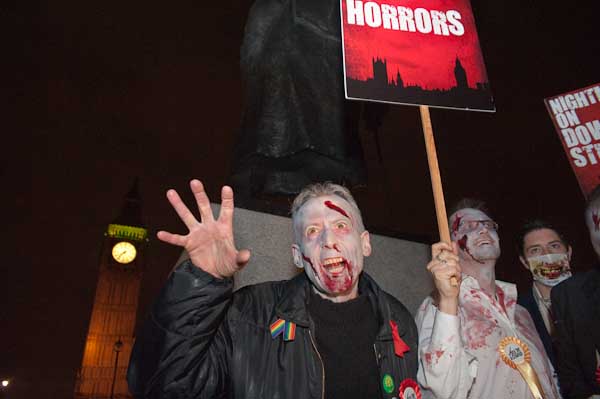
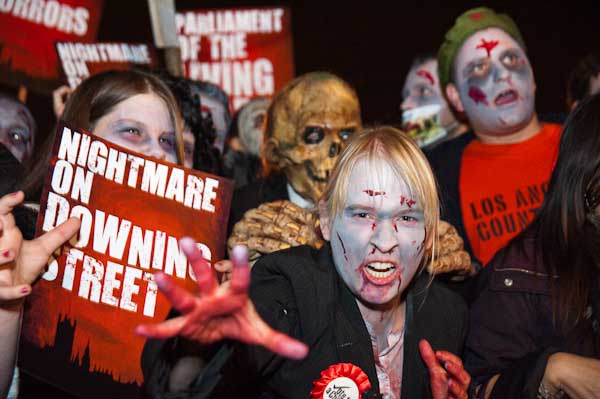
The second group of zombies were ‘The Parliament of the Dead’, protesting at the Houses of Parliament, calling for a referendum to create a fair voting system. There were certainly more of them.

© 2009 Peter Marshall

By now I had switched to aperture priority and was working at f5 (still at ISO 3200, 1/60) and Big Ben in the background was reasonably sharp when I was working at the wide-angle end, but perhaps got a bit too out-of-focus at the long end of the 24-70 zoom.

© 2009 Peter Marshall.

The floodlighting on Big Ben is just a little too weak for it to really stand out against the night sky, though perhaps an extra stop – working at 1/30 rather than 1/60 would have helped.

Some of the pictures aren’t bad, but I didn’t feel anything I took quite gelled. Perhaps there were too many rather similar zombies, and too many mainly amateur photographers getting in the way.

You can see more pictures of both Goldman Sachs and The Parliament of the Dead as usual on My London Diary, along with more details about the two protests.

Catching up – Afghanistan

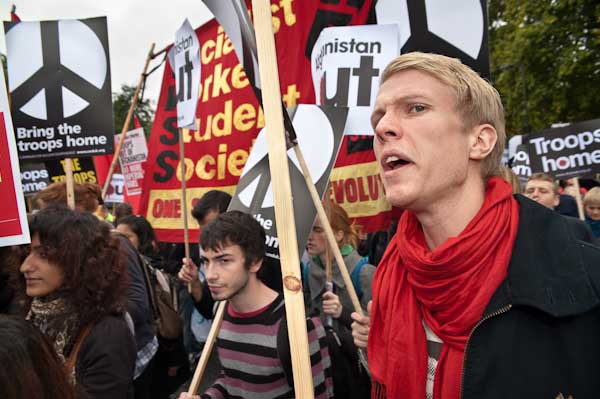
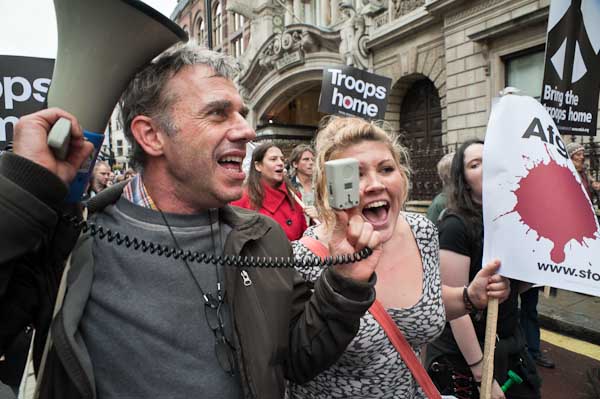
I’ve had a busy couple of weeks and there are quite a few events I’ve photographed and not mentioned here, starting with the march calling for troops to be brought back from Afghanistan. Given the strength of public opinion in support of this it’s perhaps surprising that there weren’t more than the respectable 10,000 or so taking part, but perhaps it reflects the very different reasons some have for calling an end to this war which is seems we can only lose, and which is killing more and more British soldiers.

Certainly not everyone opposed to it would want to march with Stop the War, CND and the BMI who were the organisers of this march. We are also just seeing the start of mainstream politicians beginning to say what the left has been saying for a long time; I’m rather surprised that the liberal democrats haven’t already come out firmly against the war.

Photographically the main problem was the weather, a dull day, very dull at times, and with the occasional little burst of rain.  Fortunately the D700 is pretty well noise free at ISO 800, and that was fast enough to work at a decent shutter speed with apertures around f4-f5.6. Most of the time I was shooting on the Sigma 24-70 f2.8, and I like to avoid full aperture whenever I can; it’s usable, but definitely a little soft compared to f4. After that, stopping down is only really needed to get more depth of field, particularly at the longer end of the lens.

I took some pictures without flash, but some of them look a little colourless, almost drained. Flash does tend to add a little warmth and colour under lighting conditions such as this though I was generally keeping the amount pretty low.

Here’s a picture that shows this and that I like:

© 2009 Peter Marshall.
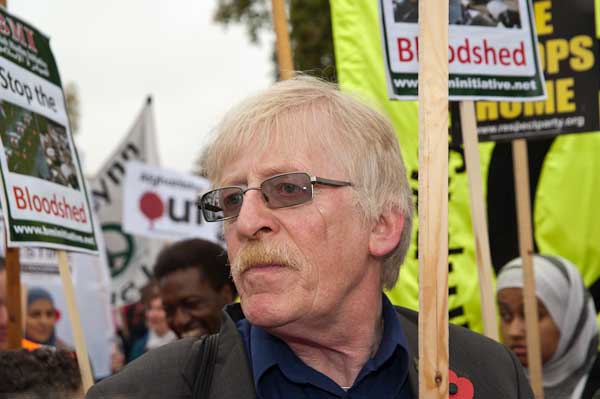
Peter Brierley who told Tony Blair “you have my son’s blood on your hands.”

The stewards were holding us a short distance back and there was a very tight scrum of press and others in the minutes before the march started. Quite a few pictures I took – even like this one at 1/250 – have camera shake because other photographers were pushing me from all sides. The len was at 65mm and aperture f8  and for some reason I was using spot metering – which is really better when you have plenty of time and can think what you are doing.  I was pleased to have two posters with the word’Bloodshed’ on them in shot.

I stood close to the start and watched most of the march go by, photographing close in and using the full range of the zoom. It’s an interesting exercise in thinking and working fast to try and frame compositions as people walk by and also enabled me to spot a few people and groups to photograph later.

© 2009 Peter Marshall

This was one I liked, and again the flash livens it up a little (24mm, 1/250 f7.1) and enables me a lot more freedom when I come to develop the image in Lightroom – where I could choose to ‘burn in’ the figure at the right to the exact tone I want (perhaps just a little darker than above.)

Here’s one I took later on the march without flash, and although I think it’s a good image, I just can’t get the same kind of colour quality.

© 2009 Peter Marshall.

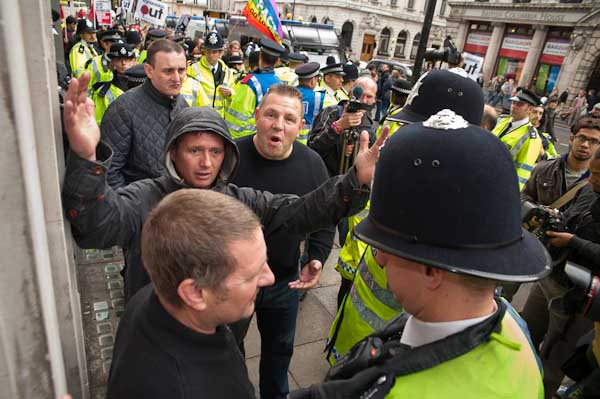
For once I walked the whole distance – which actually means I walked it several times, going back and forth taking pictures. And I took quite a few pictures of both audience and speakers in Trafalgar Square. But suddenly there was a disturbance at the back of the square, and several of us rushed out from the press area at the front of the plinth to cover it. Four Leeds supporters, in London for a match at Millwall had decided to heckle and insult the speakers, and the crowd had taken it badly, calling them racists and chasing them out. They were rescued and escorted by a largish group of police and it wasn’t easy to get clear pictures. As usual the answer was to think ahead and I was lucky when they stopped at exactly the right spot where I had chosen to stand on a ledge a couple of feet high and could look down on the scene.

© 2009 Peter Marshall.

Overall I was for once quite please with my afternoon’s work. No major disasters and quite a few pretty decent pictures. You can make up your own mind about them on My London Diary.

Brian Griffin – Olympic Portraits

I was in two minds as to whether to accept the invitation to the National Portrait Gallery‘s launch of the NPG/BT Road to 2012 Project. The decision to have the games in London is arguably one of the greatest British tragedies of the 21st century to date and it’s legacy for the Lea Valley and East London likely to be only slightly less damaging than Enola Gay’s flight over Hiroshima in August 1946.

But of course the games are going to happen in around a thousand days time, and it’s good to see anything positive that comes from it – such as this project. Brian Griffin is certainly one of the best portrait photographers currently working anywhere in the world at the moment, and it would he hard to think of a better person to photograph those people connected with what is – whatever I think about it – a major project. The six images unveiled today are the first of 20 by him, and commissions to other photographers will bring the total to 100.  I hope those others chosen to work on the project will also be chosen on merit rather than, as so often happens in such things, for political reasons.

I’m not against sport. In my youth I played for various teams, getting a medal myself at the age of ten as a part of an all-conquering wolf club soccer team that included three players who went on to play professionally and at 16 I knocked over ten seconds off my Borough’s record for the quarter mile, finishing a hundred and fifty yards ahead of the next runner. But in my view games are for playing rather than watching and taking part is more important than winning. I think it’s a part of the Olympic Ideal, which doesn’t seem to have much part in our official professional programme for sport.

© 2009 Peter Marshall

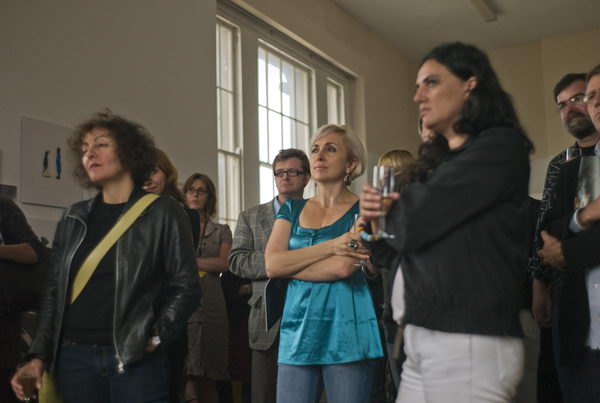
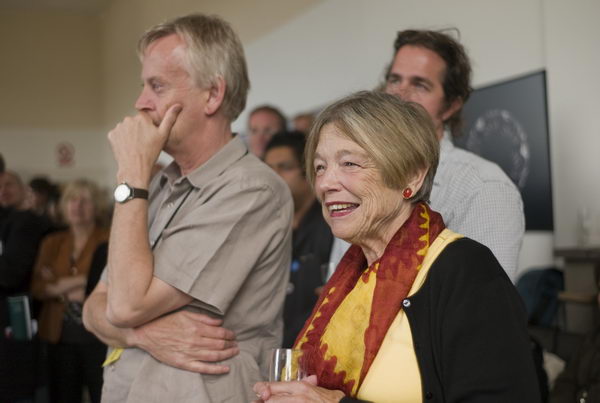
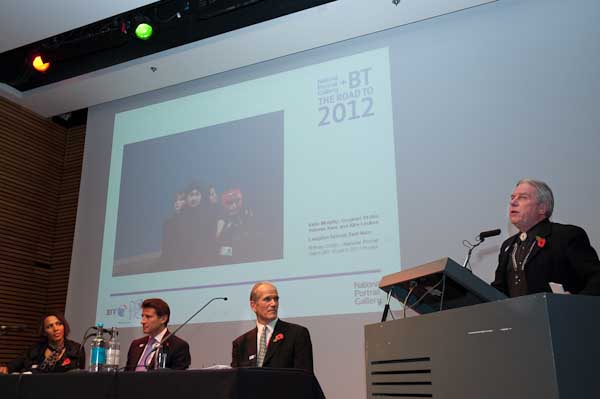
Sandy Nairne, the Director of the NPG opened the event and was followed by rather predictable speeches from Lord Coe and Dame Kelly Holmes, but it was photographer (or artist) Brian Griffin who was the star performer, talking about some of his experiences in making the pictures and his thinking behind them.  Above the speakers throughout the presentation was his picture of four from the thirty East London young people who went to Singapore to support the games bid, and he told us how he had decided to from them into a single sculptural group, but when he had taken what he thought was his picture, Alex Loukos in his red boxer’s helmet, jumped out from the group and made the image that he quickly captured and we saw on the screen.

© 2009 Peter Marshall

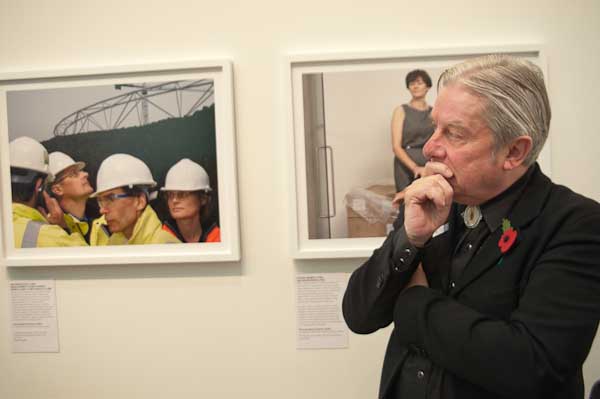
Although Brian stressed that he thinks about his work as a fine artist, he still has the openness to the moment that makes his work truly photographic, and nowhere was this shown more in the set of six images that was unveiled at the event than in a picture of four civil engineers in hard hats under the Olympic stadium which for me – and several others at the event whose opinions I respect – was the outstanding image of the set. I was told that he has also taken a very fine portrait of Lord Coe, but this is apparently being held back for a later date.

© 2009 Peter Marshall

You can see all six pictures on the NPG site, under the heading ‘The First Commission’ and read some of Brian’s comments about them on the London2012 blog.    (Unfortunately I’m not allowed to post the pictures here at a size I think useful – so you will need to click on the links to see the work.)

Brian writes there “So, for example, the portrait of Jonathan Edwards and Denise Lewis. The colouration of this image, in the steel and glass environment of the building, echoes the feeling from a painting by the pre-Raphaelite Sir Edward Burne-Jones. The portrayal of Denise also leads me to the Edward Burra painting ‘Harlem’.”

© 2009 Peter Marshall

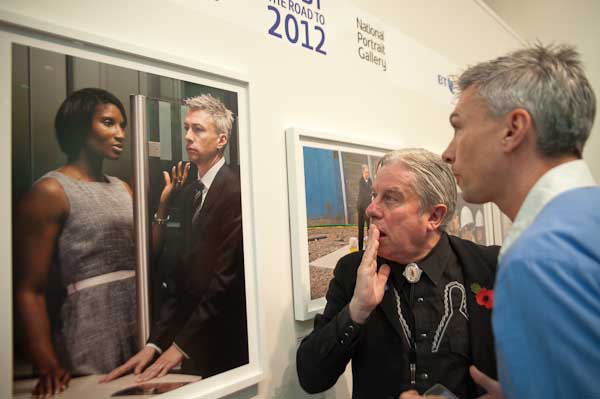
In front of the actual print, my immediate thought was “Beam me up Scotty!”, and there is a definite “Star Trek” feel to this image, exaggerated perhaps by Jonathan’s hair looking like he’s got his hands on the Van der Graf machine and a slightly unreal quality about Denise Lewis’s skin tone and gesture which is a little more apparent in the actual print than in reproduction. However you see it, it remains a striking image.

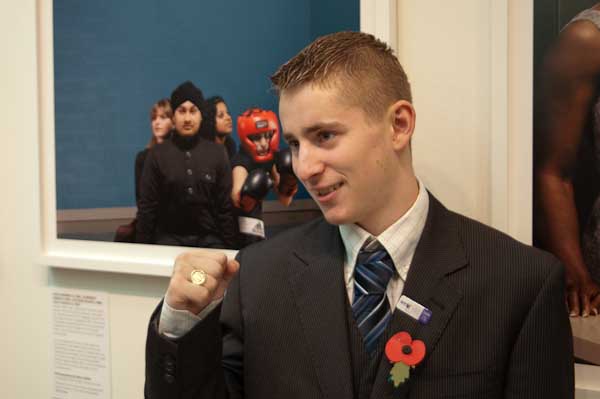
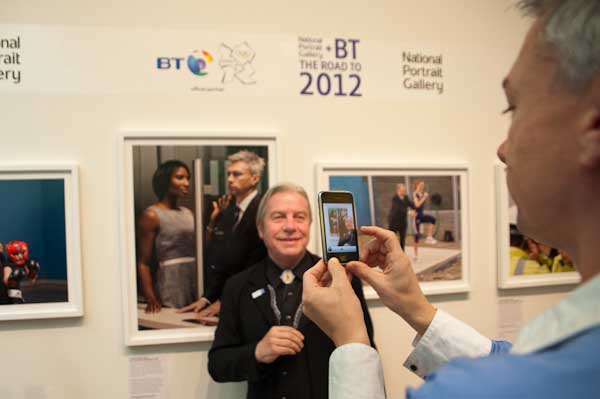
Of course all of the pictures are excellent in their own way, and it was a bonus to have a number of the sitters present at the event. Not only could we see them with their pictures, and at least in some cases photograph them, but also I was able to catch one of them, triple-jumper Jonathan Edwards, getting his own back by taking Brian’s picture in front of his portrait.

© 2009 Peter Marshall

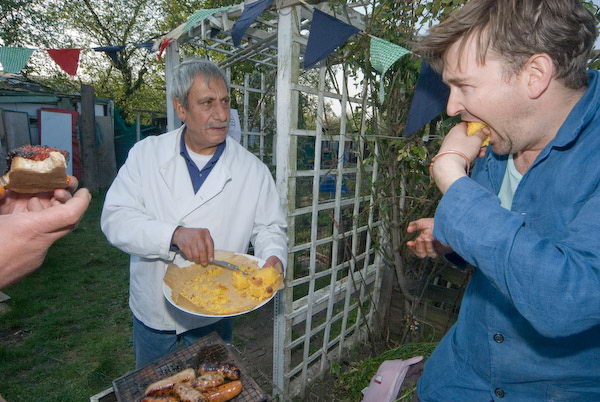
It was good – as always – too meet Brian again, and also of course some other old friends and a few new ones. But as I left the picture below flashed into my mind and I felt a sudden sadness about the missed opportunity to make this a Green Games and incorporate the Manor Gardens Allotments into the site – and to see how Brian might have photographed Hassan and Sam and all the others.

© 2007 Peter Marshall
Sam Clark tries some of Hassan’s cake – which was great – while I wait for Sam’s sausages
Manor Gardens Allotments on the Olympic site, April 2007
.
Peter Marshall

More pictures from the NPG/BY Brian Griffin event on My London Diary shortly.