You want to make money?

PDN Pulse has a feature on the top-selling microstock pictures of 2009 showing some of the examples.  It is more than depressing to look at them and think that this is how to make money at photography.

Or photography and bad Photoshop in some cases. One of the comments reads “hideous. I’d rather prize my teeth out with a butter knife than look at this garbage” and its hard not to agree.  But these guys are making a good living from it, while many if not most good photojournalists struggle to keep going at the moment.

But as I keep telling myself, I don’t do it for the money, though I do need some money to keep on doing it. Some things are worth doing, other things just aren’t. Whatever they pay.

On which subject, from Twitter this morning I found a link to Don’t Be Scared of the F-Word When Exploring New Business Models by London / New York based freelance commercial photographer Jonathan Worth on Black Star Rising, in which he argues that doing things for free can be worthwhile. It’s worth reading (sorry!)  and I’m very much in agreement that it is sometimes a good and even profitable idea. But just not in the vast majority of cases, when people just want to rip us off and the chances of our benefiting in any way are close to zero.

And yes, I do a lot of things for free, not least this blog and my posting of work on sites including My London Diary, the River Lea/ Lea Valley, London’s Industrial Heritage and the Urban Landscapes web sites.

Saturday in Tragalgar Square

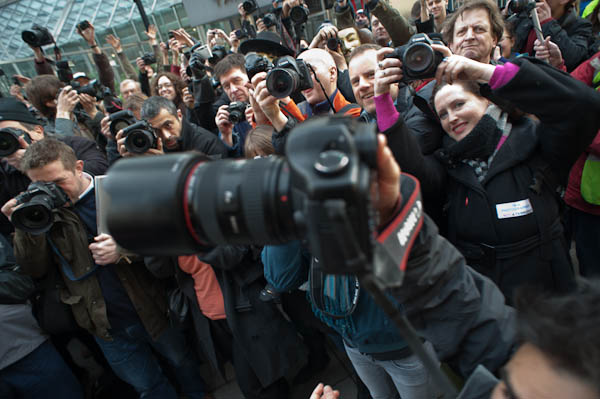
If you are a photographer – or simply someone who cares about our civil liberties, and can get to London on Saturday then I hope you will join us for the mass photo gathering in defence of street photography organised by I’m a Photographer, Not a Terrorist (PHNAT) at 12 noon.

© 2009 Peter Marshall.
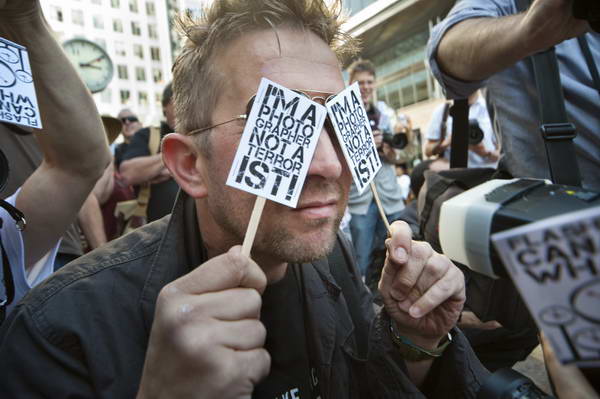
I’m a photographer not a terrorist flash mob at Canary Wharf, Sept 2009

This is one of a series of protests by photographers against harassment by police while taking pictures, and in particular about the use of legislation aimed at preventing terrorism against people exercising their right to take photographs in public places.

Of course it isn’t just police. I think the latest silly incident involved a student taking pictures at Hounslow Central Tube station on a Sunday afternoon. I used to live just down the road, used it often (and probably took pictures there)  and can certify that no sane terrorist would ever bother to attack it.

The paranoia doesn’t just affect photographers of course. Eighteen months ago, just a hundred yards from where I live, a young student decided to hold a one-person peace protest, holding a placard “Stop training murderers” outside the building used by the Army Cadet Force (not as the paper says “an army base”.)

Eight police, including armed officers and dogs, swooped on his house to arrest him, while a helicopter hovered overhead. They arrested him under the Terrorism Act, took his books and computer and kept him in jail overnight. In the morning he was charged under the Public Order Act, and on the advice of the duty solicitor, accepted a police caution.

He has now realised how misguided this was (and that solicitor should be struck off) and is trying to have the caution rescinded.

© 2009 Peter Marshall
Photographers protest at New Scotland Yard, Feb 2009

It comes shortly after a ruling by the European Court of Human Rights that Section 44 stop and searches are illegal (the UK government has announced it intends to appeal.)

I’ll be there (and so too will Jess Hurd, back from Haiti and one of those involved in setting upPHNAT) and over 1400 people have signed up for the event already on Facebook.

I hope to see you there!

Brighton Bash

Monday I took the train to Brighton, sometimes described as “London by the sea” which is pretty ludicrous as it has a very different feel to the capital. I did just glimpse the sea as the train rolled into the station – around a 45 minute journey from Clapham Junction, but that was it, as I was headed up into the hills to the north-east, a short bus ride away to Moulsecoomb Wild Park, an area of downland preserved as a park when it was bought by the Brighton and Hove Council in 1925.

I was there to photograph a protest against a weapons factory on an estate hidden behind the trees on the edge of a railway cutting. Parts from the factory there ended up in the bombs that were used in Operation Cast Lead. the 22 day Israeli attack on Gaza that killed 1417 Palestinians and had ended exactly a year earlier. This demonstration was the latest in a whole series of protests against the arms manufacturer EDO MBM/ITT organised by the Brighton-based Smash Edo campaign over around the past five years, including the Carnival Against the Arms Trade I photographed in June 2008.

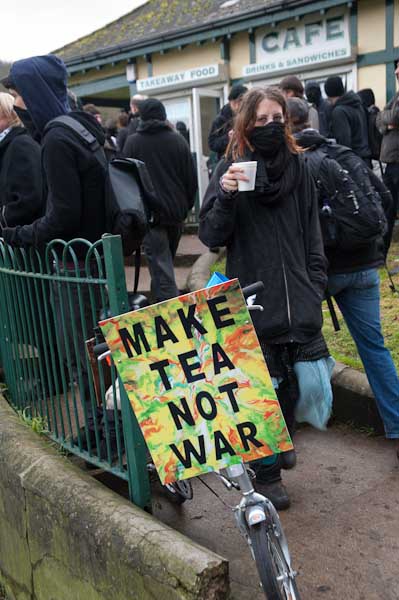
What was extremely civilised was that the meeting point for the demonstration was a café, and I walked in and ordered a mug of tea to find it full of photographers. We could have had a union meeting on the spot.
© 2010, Peter Marshall
Make tea not war

Those years of demonstration have also been years of confrontation and harassment by the police although during Monday’s demonstration the police did appear to be trying to adopt a less confrontational approach in some ways – and during the several hours I was taking pictures they clearly did not want to make any arrests – though they did make five after I left.

But they were clearly also not prepared to let the protesters get the the factory to demonstrate their, blocking off the road leading to it. And although the protesters more or less surrounded the factory estate during the protest they did not manage to break through the police protecting it.
© 2010, Peter Marshall
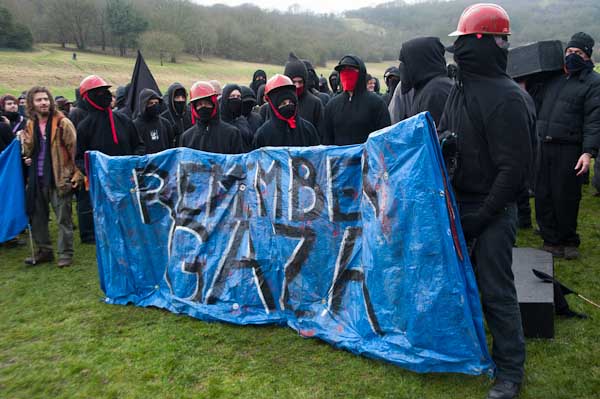
The dress code for the event was black – and mask up. A few decided not to wear masks.

This was an event when neither the police nor many of the protesters really want to be photographed – although the organisers of the protest do want press coverage and send out press releases. The organisers suggested that those taking part wear masks as both police and press would be taking photographs, and we were, in our rather different ways. At least one police officer was using a long telephoto on a Nikon DLSR  to record pictures of individuals taking part, while others were using Sony camcorders to make a record of the action.

The march stopped on the main road where the demonstrators could see a strong police road block on the road leading up to the factory. I’d gone ahead at this point intending to photograph both the police block and then the marchers coming up towards it, and had climbed up about 20 feet on the roadside bank to get a good view. Unfortunately, at this point at least three quarters of the marchers decided to try to find another route, running up the hillside a few hundred yards behind me into the woods.

So I had to run up the hill too, and it was a pretty steep climb, and I began to feel my age. There were a couple of younger photographers with me but I soon decided to take my own time rather than try and keep up with them as we climbed perhaps a hundred feet.  Then I was on my own in the middle of the wood and having to choose paths, trying to work out a likely route that would intercept the way the protesters would go.  Not too easy as I’d never been here before, but I decided that since there were around 250 of them that they would get pretty spread out – mostly the paths were only wide enough for a single file – and I would be bound to come across them.
© 2010, Peter Marshall
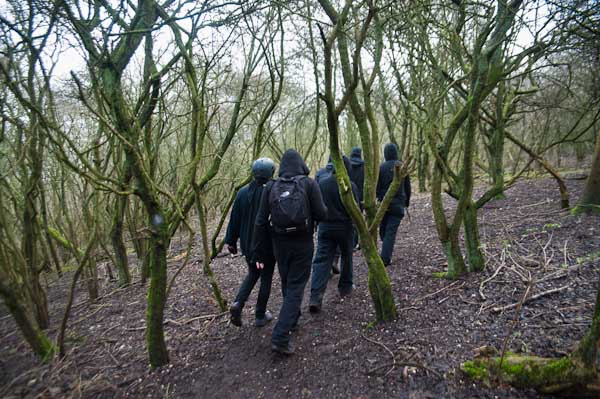
The front of the long column marching through the woods
Eventually, about seven minutes later I did, and I think I’d found a more direct route as I saw the head of the long and spread out column coming towards me.  For the next ten minutes or so we wandered single file through the woods, passing quietly behind one group of police horses waiting on the edge but then we were seen by a group of police with dogs in the wood in front of us. They shouted from around 50 yards away and told us to go back or we would get bitten, and although they were too far away behind trees and bushes to get a picture I didn’t feel inclined to go closer. Although police recognise and sometimes respect a press card, police dogs don’t.

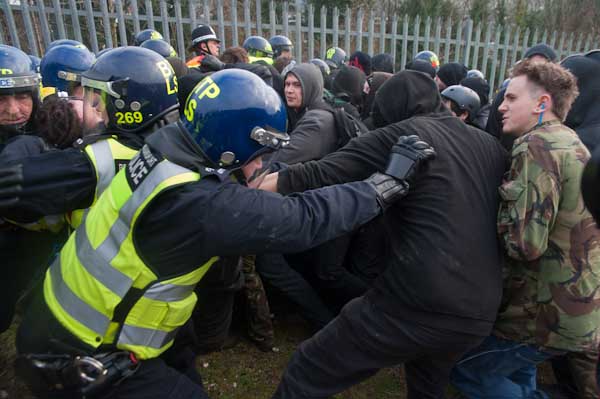
The protesters were even less keen to continue than me, and took a path away from dogs and out of the wood on the other side, where more police were waiting. For the next half hour or so, police and protesters seemed to be playing a game of some sort, with the police letting protesters through then chasing them back and finally stopping them on a path close to the factory.  A couple of times the police brought in their horses to disperse the demonstrators, and the dogs were used again to threaten demonstrators who had entered a factory site next to the arms factory under a fence.  There were a couple of major scrimmages, and police armed with riots shield also lent a hand. One protester was injured slightly by a baton to the head, but otherwise it was mainly a matter of pushing and shoving. Really the only thing missing was a ball.
© 2010, Peter Marshall
A lot of pushing and shoving, but most protesters hung back and watched

And of course I and all the other photographers were trying to take photographs. At times there was rather a crush of photographers on some narrow paths, and tree branches really did get in the way of pictures. I did get pushed rather a lot by police, although I took care as always to keep out of the way. But a few police do sometimes seem to have a mindset that says that anyone with a camera is by definition in the way. And couple of times a police photographer gave me a fairly hefty shove so he could get a shot – where normally photographers would have respected that I was there first!

Eventually the demonstrators tired and decided it was time to go back to meet up with the rest of the protesters, and we walked back through the woods, this time accompanied by a few police officers, and down the hill to the road into Brighton.

By this time I was rather tired, and my feet were hurting. I hadn’t bargained for all the hill-climbing and off-road walking and so hadn’t worn suitable footwear. So I wasn’t pleased to find that the protesters were setting off to march back the couple of miles into Brighton, and nor were the police. A quarter of a mile down the road they tried to block the road, but chose a bad place as many of the marchers simply walked through a car park and around the block.  Their second attempt wasn’t a great deal better either, and it wasn’t until the march was almost in the town centre that they did manage to stop it fairly effectively.

However it was obviously too late.  The march could hardly be kept where it was blocking a major road, and once let to go on it could not be controlled in the open space of The Level and the city streets leading away from it. Issuing a Section 14 order stating it could not proceed into the city centre was surely a waste of time.  As the police withdrew and came to a wider space officers rather stupidly grabbed the odd protester and others simply walked past – and eventually all had to be allowed to proceed.

I’d had enough by this time and went to the station for a train back to London and home. I think it had been an effective demonstration, getting considerable publicity in the local paper and another step in the fight to close down the arms factory.  Pictures and stories – including mine front-paged on Demotix – published elsewhere helped to raise the profile of the campaign outside tle local area. You can see the pictures from the day on My London Diary.
Join the Heathrow Airplot

I have a personal interest in Heathrow Airplot. Not just because I live near Heathrow Airport and am very much opposed to its expansion – for years I’ve been arguing that we should be running it down and eventually closing it to make better use of the land.

Almost since the start I have been one of the now over 60,000 “beneficial owners” of this former orchard in the centre of the Middlesex village of Sipson which would be wiped off the map if the third runway goes ahead. Although I suspect that a way would be found to overcome the legal obstacles that Greenpeace hope that the existence of so many owners would put in the way of compulsory purchase of the Airplot I still think that joining the Airplot is a useful way of supporting the campaign. It’s quick and free and I urge you to take a look at it and join if you support it – and you can do so wherever you live around the world.

© 2003 Peter Marshall
No Third Runway rally at Harmondsworth, June 2003

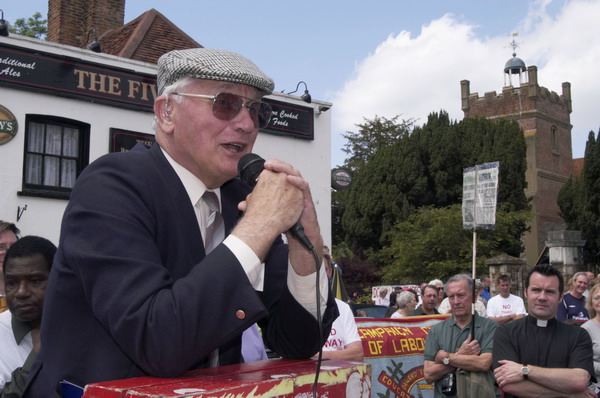
I first photographed the campaign in 2003 when we marched from Sipson to a meeting on the village green at Harmondsworth on a beautiful June afternoon. After the speeches I went to walk around inside the wonderful medieval Tithe Barn at the side of the church, specially opened for the day, and then into the Five Bells to sample a pint (or two) of a beer specially brewed to support the campaign.

© 2009 Peter Marshall.
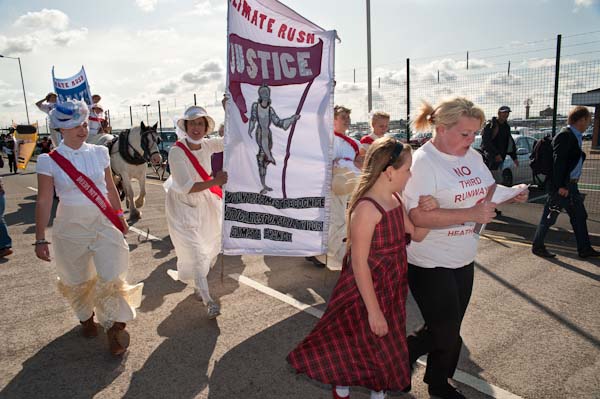
Climate Rush and NoTRAG at the fence around Heathrow, Sept 2009

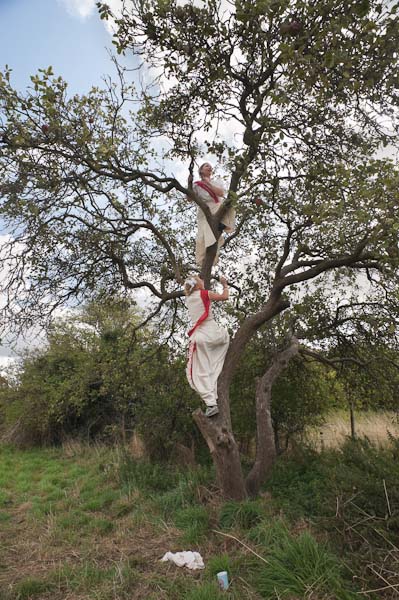
Since then I’ve photographed a number of other events organised by NoTRAG and other groups opposing the expansion, and last September I was at the Airplot itself for a couple of days when the Climate Rush was camping there at the start of their march with caravans to the West Country and held a Celebration of Community Resistance involving groups from around the British Isles.

© 2009, Paul Baldesare
Climate Rushers picking apples on the Airplot, Sept 2009

Tent City – Jason Parkinson

I first met Jason Parkinson when he was filming a demonstration outside Harmondsworth Detention Centre – one of our special prisons for immigrants – a few years ago, when he was getting a bit of harassment from the police who were refusing to believe his UK Press Card was genuine ( a too common police trick), and since then I’ve come across him filming at many of the protests I’ve covered. He’s one of those guys who manages to get in the right places to film, stands up to people and asks awkward questions, and is also an excellent film editor.

© 2010, Peter Marshall
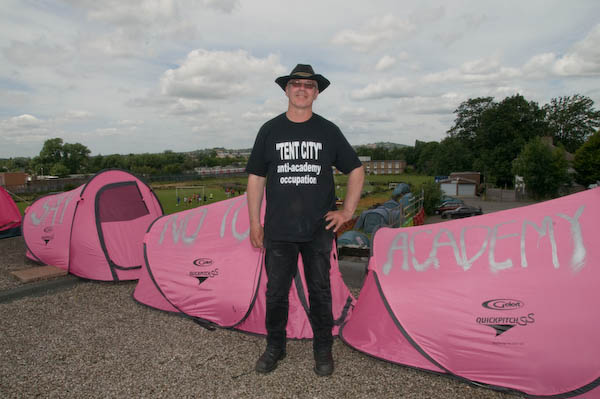
Hank Roberts on the roof at ‘Tent City’ protest
You can see his trailer for the 30-minute documentary Tent City Occupation on YouTube, where there are also links to some of the other short clips he has posted over the more than two years he has spent investigating the setting up of a privately funded City Academy in Wembley.  His work has laid bare much of the shady dealing behind the story as well as showing the fight put up against the scheme, led by local teachers who realised the issues involved. This is a story that should become a national scandal and I hope that Jason’s film will make it so.

I visited the occupation on the site for the new Academy in July 2008 and here in part is what I wrote about it then:

Teachers in the London Borough of Brent are among those who have been taking to the tents in the occupation of Wembley Park Sports Ground, just a hammer throw or two from the well-known stadium. They know that the government’s program to establish City Academies has failed to deliver the promised results, and that putting one in the area will only damage the exisiting three good schools in the area. Wembley doesn’t need a new school – and if it did, handing £30 million of public – our – money over to private enterprise to run one simply crazy.

The area is also one of the more congested parts of London. More school places will mean more school runs, especially from the southern areas of Brent where there is a shortage of space. The sports ground is also used by local groups, including a nursery school, sports groups (a football practice was taking place while I was taking pictures) an three small businesses creating local employment, all of which will find it hard to find alternative venues and are likely to close.

It’s also hard to know why a political party that campaigned against the academy in the elections which got it into power in Brent should perform a sudden about-turn and not only decide it has to be done, but that even though the site won’t be ready for several years it has to start straight away in substandard accommodation. It is a change of policy that has encouraged allegations of illegality – and may be challenged in court.

Do watch the trailer – and vote for it on YouTube.  You can read the whole of my account and see more pictures on My London Diary.
Rainy Day in London Town

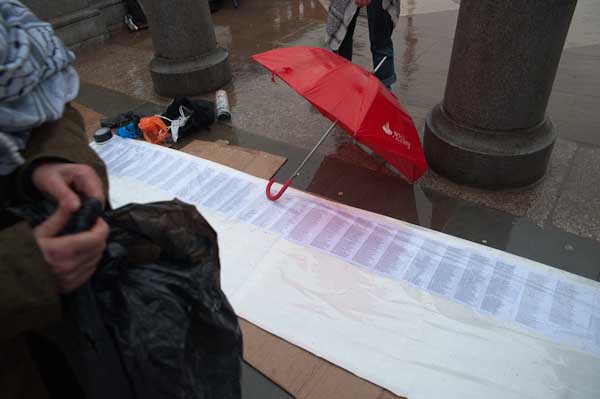
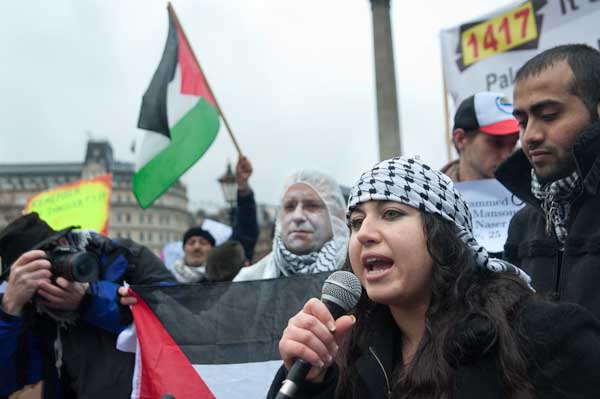
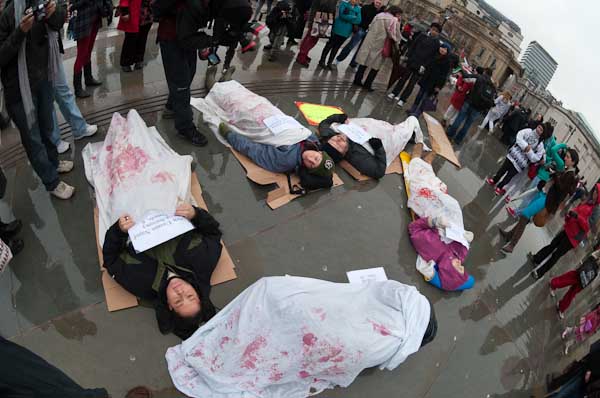
Yesterday was too wet for a die-in. The International Solidarity Movement had hoped to get 1417 people to lie down on the paving in Trafalgar Square as a graphic reminder of the 1417 men, women and children killed during ‘Operation Cast Lead‘, the 22 days of Israeli attacks on Gaza a year ago.

© 2010, Peter Marshall
All 1417 names on the list

The figure is disputed and comes from the Palestinian Centre for Human Rights, with the Israeli human rights organisation B’Tselem giving a slightly lower figure of 1387 and official Palestinian and Israeli sources differing rather more. But a great many certainly were killed, and the great majority of them – over a thousand – were non-combatants. Again the two more believable sources  give figures of 313 or 320 children in the overall figure. By contrast there were 13 Israeli deaths, including three soldiers killed by “friendly fire.”

(The figure of around 1400 is in one respect an underestimate, in that Palestinians are dying all through the year as a result of the Israeli blockade limiting their access to medical treatment; deaths due to this cause in the 22 days are not included in the estimates.)

Unfortunately due partly to the lousy weather with heavy rain rather fewer than expected turned up. Well under half of those who had signed up on Facebook as coming actually turned up to collect the names they had been allotted, though fortunately there were quite a few who for one reason or another hadn’t signed up.  But for whatever reason the event was still well over a thousand people short. Although it seemed quite a sizable crowd in a corner of the North Terrace, it was still perhaps only a fifth or less of the number who died in Gaza.

Not only was it too wet to lie down on the pavement, it was also really too wet for photography, at least as the event started. I was walking around holding up an umbrella with one hand and a camera with the other. An umbrella is a real pain, particularly in even slightly crowded situations for the way it limits your mobility. Photography, or at least this kind of photography, is all about getting into the right place to take pictures. Well at least that’s the sine qua non. “F8 and be there” is all very well (so long as you realise that being there sometimes needs almost millimetric precision) but you still need to release the shutter at the right time.

You need to learn how to get through small gaps in crowds fast, to slide into positions, to duck and weave to where you need to be, but really it’s impossible when you are holding an umbrella, and particularly so when everyone else is.

And then there’s the lack of a third hand to hold and use the cloth that you will need – even under an umbrella – to wipe the drops of rain off the filter. I use a microfibre cloth that isn’t bad, but really a genuine chamois leather is still better, though it costs several times as much. I went for the false economy and regret it every time it rains.


Fortunately the rain stopped for the speeches

I think almost all of the pictures were taken on program setting, though several times I used the “flexible program” facility, turning the handy thumb wheel to change the aperture or shutter speed.  I was also working on ‘”Auto ISO” with the camera ISO  set as ISO 800. The light was dim but changing,  giving some quite varied settings.  There were rather too many frames where the Sigma 24-70 was wide open at f2.8, and slightly higher lower ISO setting might have been better. The lens is usable wide open, but noticeably better at f4. I would welcome the ability to set a maximum lens aperture at which the ISO starts to increase when in Auto-ISO mode. With this lens for normal use I’d like it to start increasing ISO at f4 and only open up to f2.8 once the upper ISO limit had been reached.

© 2010, Peter Marshall
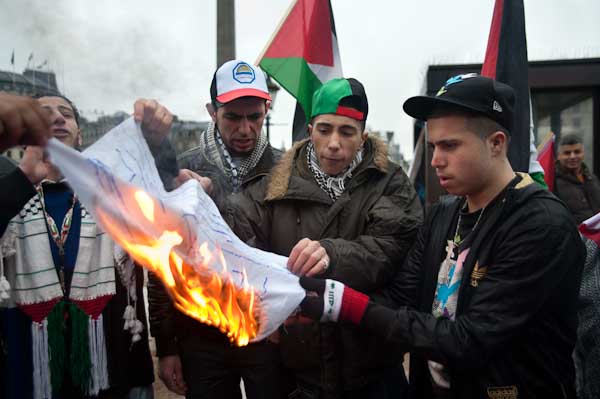
Anti-Zionist flag burning has become a ritual

I had thought wrongly that AutoISO worked with the set ISO as the minimum and was surprised to find some of the pictures I took had used a lower ISO – down as low as 320 in at least one case.  In fact the vast majority of images were taken at ISO 800, although according to the manual the lower limit when using AutoISO is always ISO 200.  But ISO 800 was a better base to work from under the light conditions, so I’m pleased it seems to do so, though mystified why it chose to use lower values for these particular frames rather than simply alter the aperture and shutter settings as it could have done.

© 2010, Peter Marshall
A few people did stage a die-in for the cameras at the end of the event

Incidentally Nikon did release a firmware update for the D700 recently, which I’ve downloaded and applied and recommend; if you have a D700 you should now be using Firmware Version 1.02.

USA – 8 Years of Shame

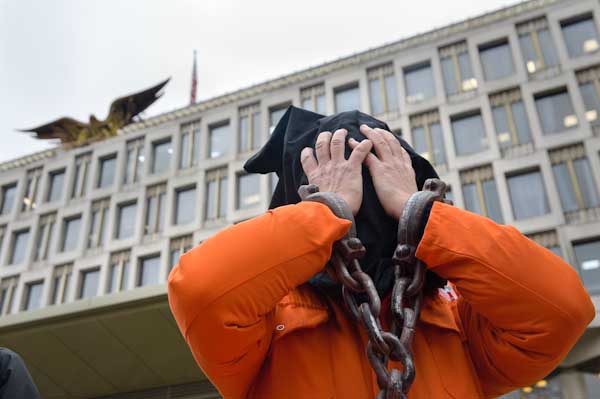
Yesterday, 11 January 2010, was 8 years since the USA set up the prison camp at Guantánamo Bay, although some of the prisoners have been held longer in various black holes around the world either by the US or on their behalf by others.  The choice of the site showed a disregard for international law, and the treatment of the detainees flouted the international conventions. You can read more about Guantánamo on Andy Worthington‘s site and book.

I’ve already posted pictures and text about the event on Demotix (where it made the front page), Indymedia and of course with more pictures on My London Diary  so I don’t need to recount the details here. This was the picture that Demotix put on the front page:

© 2010, Peter Marshall

Visually, the eagle is the obvious thing to include in the picture (and it would have been nice to have more of the flag too, but the lack of wind wasn’t really cooperating.)  Obviously a symbol of USAmerica – why they put it there.  But also a symbol of power and of freedom, the freedom to soar like an eagle, which the detainees don’t have. Instead of being free to spread their wings, their arms are manacled, and hands drawn back in, onto the hooded face. I liked the symmetry of the pose and I think I got the cropping just under the arms – and rather fortunately of the chain – just about right.

© 2010, Peter Marshall

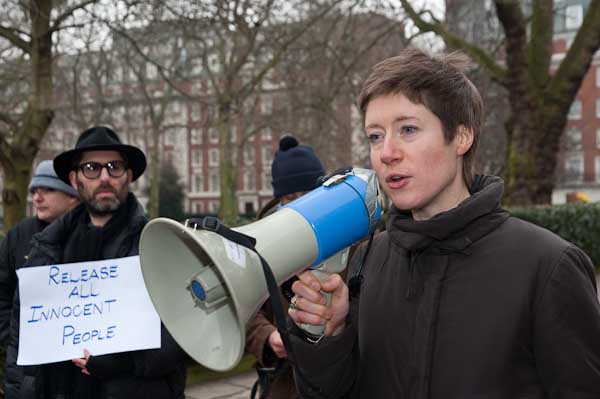
Another image I liked was of one of the speakers, Chloe Davies of Reprieve, which has provided legal defence for many of the detainees, over 50 of their clients have already been released- although over 30 are still held. I saw I could more or less line up the end of the megaphone she was holding with an appropriate message held by another of the protesters, “Release all innocent people” and it was almost as if this message was emerging from the megaphone.

I had to work very quickly, and wasn’t helped when I was trying to get in the exact right position when another person with a camera came and stood in front of me.  So it could have been improved a little.

Most of these pictures were taken with the Sigma f2.8 24-70mm which continues to impress me both with its performance and its weight!  But I also took a few mainly portraits with the older lightweight 55-200mm DX format Sigma. Apart from just a little vignetting at the wider end (cropped in some images) it really does a grand job. I’m not sure  Joy Hurcombe will thank me (or Sigma) for this, but the full size original is really biting sharp and detailed, with not the slightest hint of camera shake despite being taken at 1/100s at 200mm focal length.

© 2010, Peter Marshall

Some Tech stuff

Taking the pictures wasn’t a great problem, other than that while the guys in the orange jump suits were posing there was a bit of a scrum of press and others.  And it was one of the dullest days you can imagine, though that was hardly a problem – I simply set the base ISO to 800 and the minimum shutter speed to 1/100th using auto-ISO on the D700.  I had the camera on aperture priority at f8 and the I’d chosen ISO 2000 as the maximum ISO.  So nearly all the non-flash pictures were taken at 1/100th at f8, though there we just a couple where even ISO 2000 wasn’t quite enough and they were exposed at 1/80.

Adding the SB800 flash appears to peg the ISO at the lower setting of the auto-iso limits m- in my case ISO800, while in aperture priority mode you of course set the aperture (and I left this at f8 the.). In aperture priority (or program mode) the slowest allowed shutter speed is set by custom function e1 – and I had that set to its fastest possible value, 1/60s (a shame it doesn’t let you set 1/125.)  It was used for almost all the flash pictures, with just one or two having sufficient light to use a faster speed.

In fact the easiest way to use the flash is to work in manual mode, where you set both aperture and shutter speed, but if you want to switch rapidly from working with and without flash you then need to alter the manual settings or switch to another exposure mode as you switch the flash off – and it’s all too easy to forget.

One very simple mistake – which I made to start with but immediately noticed – is not to slide the flash quite all the way into the flash shoe.  You can do this and still manage to turn the lock, and the flash will still fire, but I think on full power, usually resulting in severe overexposure.

Nikon doesn’t actually give much information about how the accessory flash units actually work with the camera in either the camera or flash manuals.  But usually it just does work.

Actually the picture above was underexposed. I’d thought that the matrix metering would compensate for the largish area of sky, but it didn’t. Added to the -2/3 stop of exposure compensation I’d dialled in on an earlier shot to avoid clipping highlights, it was really a little too far under for comfort, but a little tweaking in Lightroom restored it to reasonable health.

Bright orange jumpsuits are a bit of a challenge, and Adobe’s standard camera profile doesn’t handle them well. I made my job much easier by using the  “untwisted” profiles I wrote about a couple of months ago.

Ban on Islam4UK

This morning’s announcement of the banning of Islam4UK came as a little – but not much – of a surprise to me, and is another sign of a growing loss of our traditional British acceptance of eccentricity and the more lunatic fringes of thought. Although perhaps the suggestion by Home Secretary Alan Johnson that this group of a very few men (and I think they were mainly men) possessed with the kind of peculiar delusions that were demonstrated in their plans for a revamped Trafalgar Square and Buckingham Palace (now sadly removed from their website) were a real terrorist threat are probably equally delusional.  It is rather as if Parliament had decided to ban engineering in the UK and announced a ban on the works of Heath Robinson.

© 2009 Peter Marshall.
British Muslims for Secular Democracy protest against Islam4UK

Islam4UK is a group I’ve twice missed photographing, once when I got tired and went home before a confrontation between them and several hundred in the ‘One Law for All’ campaign last March, and then last October when they cancelled their ‘March for Sharia‘ through central London, but a counter demonstration by both moderate and right wing groups still went ahead.

Al-Muhajiroun was quite probably more of a serious threat, along with Omar Bakri Muhammad (and both were banned some years ago.)  But although Islam4UK claimed to be its successor (and its leader Anjem Choudary was previously one of Al-Muhajiroun’s leaders)  it appears to have attracted little support and almost universal condemnation from British Muslims – but considerable attention for its media-grabbing proposals from the UK press. “Mad Muslims” seem always to be good for circulation.

In the BBC news bulletin that carried the announcement seconds after it was made public, the suggestion was made that another Islamic group, Hizb ut-Tahrir Britain, should also be banned. Bakri split away from this group in the 1990s, having helped to build it up, because he found its policies insufficiently radical.

© 2004 Peter Marshall
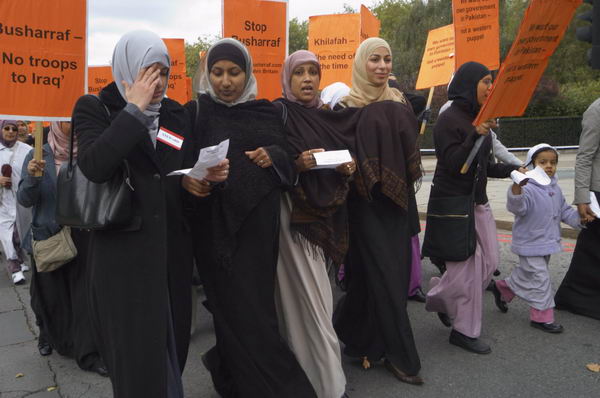
Women in Hizb ut-Tahrir march, October 2004

I’ve photographed quite a few of their public events in London since a 2004 when they held a rally and march  by a thousand or two supporters to the Pakistani High Commission against Presidents Bush and Musharraf, calling for a caliphate in Pakistan.  They were back at the embassy again (now its Obama and Zardari)  on 5th December last year but I was busy with other things.

© 2005 Peter Marshall
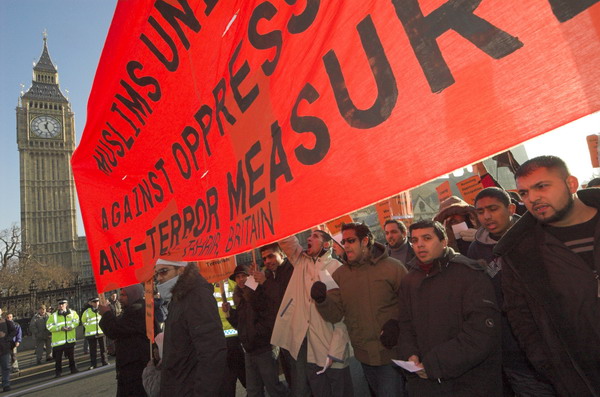
Hizb ut-Tahrir march against anti-terror measures , October 2005

In 2005 I photographed their “March For Iraq, Palestine, Kashmir And Chechnya … Before They Make It A Crime” which also opposed the extradition of Babar Ahmad* to the USA, the prescription  of non-violent Islamic organisations (including Hiszb Ut-Tahrir Britain,) and other measures that attempt to silence legitimate political dissent.

© 2004 Peter Marshall
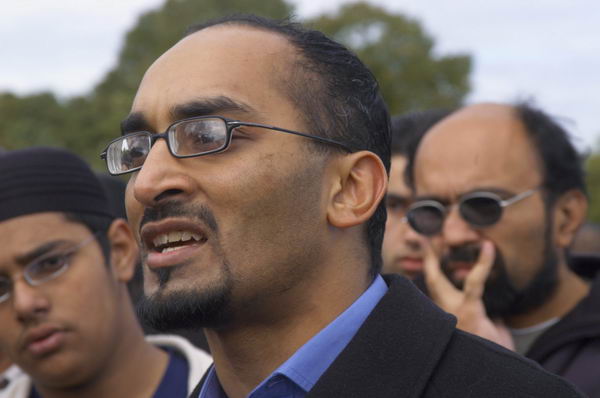
Shaban ul-Haq, Hizb ut-Tahrir Britain, 2004

Obviously Hizb ut-Tahrir is a considerably more serious political organisation, but although it aims to restore a Caliphate in the Muslim world, its states that it “does not work in the West to change the system of government, but works to project a positive image of Islam to Western society and engages in dialogue with Western thinkers, policymakers and academics.

While I would not want to live in the kind of Islamic state proposed by Hizb ut-Tahrir and find some of their views inconsistent with my own understanding of human rights and equality (as some of those of more extreme Christian groups and others also are) I am not aware of any justification for banning their activities  here in the UK, although I’m sure it would be a popular decision in Pakistan.

© 2005 Peter Marshall
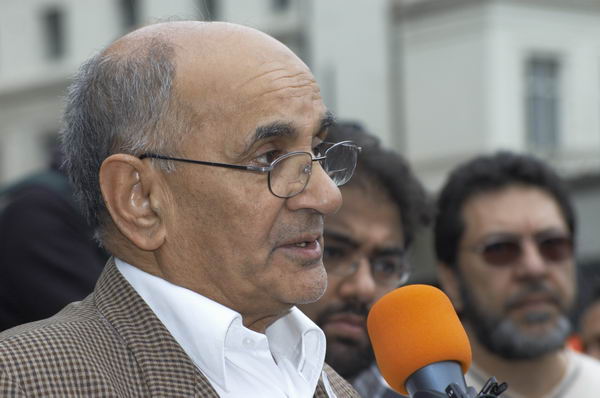
Babar’s father Ashfaq Ahmad speaks at Hizb ut-Tahrir rally, 2005

Babar Ahmad, arrested and brutally assaulted by the Met Police in December 2003 (the High Court concluded he was the subject of a “serious, gratuitous and prolonged” attack and they paid uyp £60,000 compensation) has been held in prison without trial since the USA applied for his extradition on charges of being involved in web sites supporting Chechen and Afghan insurgents. A decision is expected shortly on the review by The European Court of Human Rights of his extradition case.

Sudan Drums

Sudan was an area where British colonialism messed up in the nineteenth century with General Gordon being failed by the government and much more.  From 1899 to 1956 it was essentially a British colony, and for the last 30 or so years run as more or less as two different countries, a largely Muslim north and a largely Christian south.

Although the south and the north reached some kind of agreement in a peace settlement five years ago following two lengthy civil wars, fighting and civil rights abuses continue, particularly in Darfur in the west of the country. The peace settlement called for a referendum in the south to decide whether to remain in Sudan in January 2011, and the international Sudan365 campaign which was being launched on January 9, 2010 brings together groups working for peace and human rights in Sudan and a free and fair referendum in a year (actually now just under 365 days).

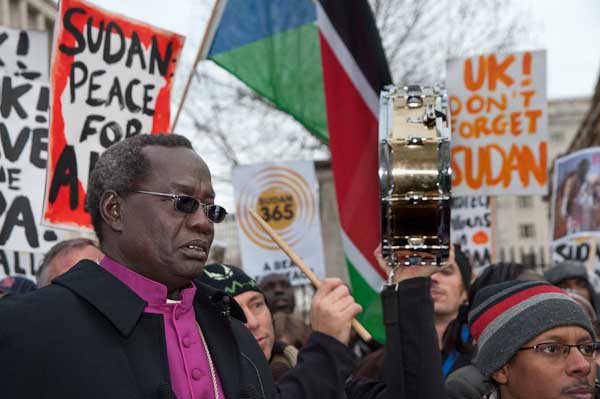
Photographically it was a fairly simple event to cover , with demonstrators in a pen on the pavement in Whitehall, although the police were occasionally being a little unhelpful and quite unnecessarily attempting to keep the pavement in front of the demonstration clear rather than routing passers-by through the wide empty gap behind it, and I was occasionally asked to move. They also refused to allow the organisers of the demonstration to have speakers there – and to my surprise they failed to insist on doing so, unlike several previous demonstrations I’ve photographed there.

© 2010, Peter Marshall
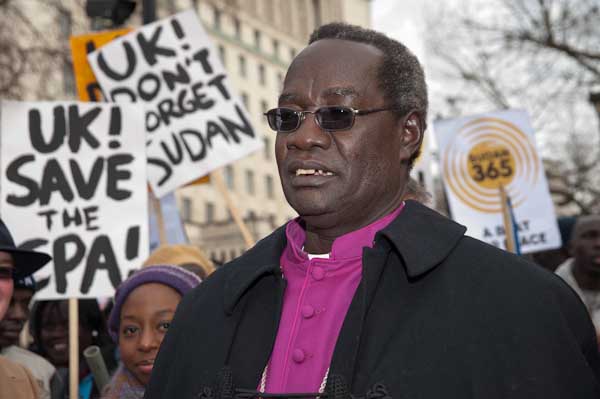
Archbishop Daniel Deng – difficult to get a good picture

The event had attracted some media attention, though mainly from broadcast media rather than print, and BBC radio 4 had interviewed the major speaker, the Sudanese Archbishop Daniel Deng earlier in the day (and did so again on Sunday morning.) Of course we all want peace, but his interviews- and the well-received address he gave at the protest – seemed to me politically lacking (as perhaps too is Sudan365.)  Perhaps not surprisingly he was feeling the cold in London, even with a red jumper under the purple.

Since the protest was called ‘Drums for Peace‘ it would have been nice if he would have actually beat one at least for a few minutes with everyone else, but he could not be persuaded to do so, presumably feeling it wasn’t the kind of thing an archbishop should do. Apparently he is meeting Gordon Brown on Monday- and I hope the other party leaders too.

© 2010, Peter Marshall
The nearest I got to photographing him playing a drum

I did photograph him speaking, but he held the microphone close to his face all the time and spoke without any gestures or expression and so the pictures weren’t great.  A few of those when he was posing the the middle of the demonstration are a little better, but lack the kind of interest and dynamism shown by the demonstrators. And dark glasses are seldom a plus point when you are trying to make a portrait.

© 2010, Peter Marshall

The second speaker was much more interesting to photograph, though again not easy, as there were only a few moments when she lifted her eyes from her typed pages. But there were some great faces in the crowd of demonstrators as you can see in the rest of my pictures from the event on My London Diary.
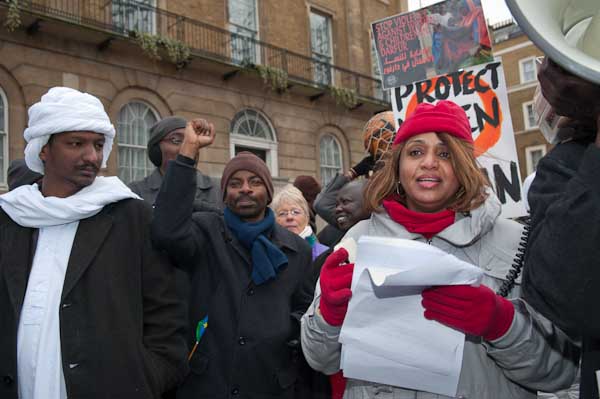
But by the time she had finished, I’d decided it was time for me to go also. Elsewhere on My London Diary you can see several other protests about Sudan I’ve photographed previously – all concerned with the continuing genocide in Darfur, in April 2007Sept 2007 , April 2008 and May 2008.

Darbis Murmury

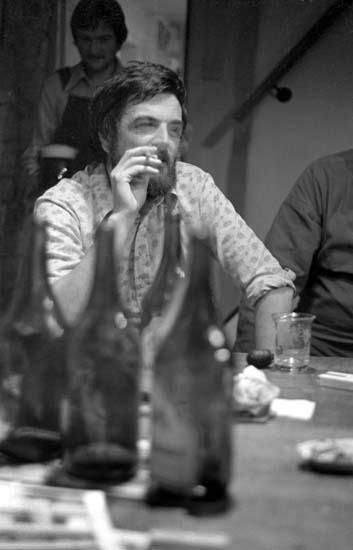
Ten years ago I wrote a short piece on my experience of attending a series of workshops with Raymond Moore and Paul Hill at Hill’s ‘Photographers Place‘ in Bradbourne, Derbyshire for William Bishop’s ‘Inscape‘ magazine, accompanying a few of my pictures of the people concerned – including some of Ray.

© 1976-7, Peter Marshall
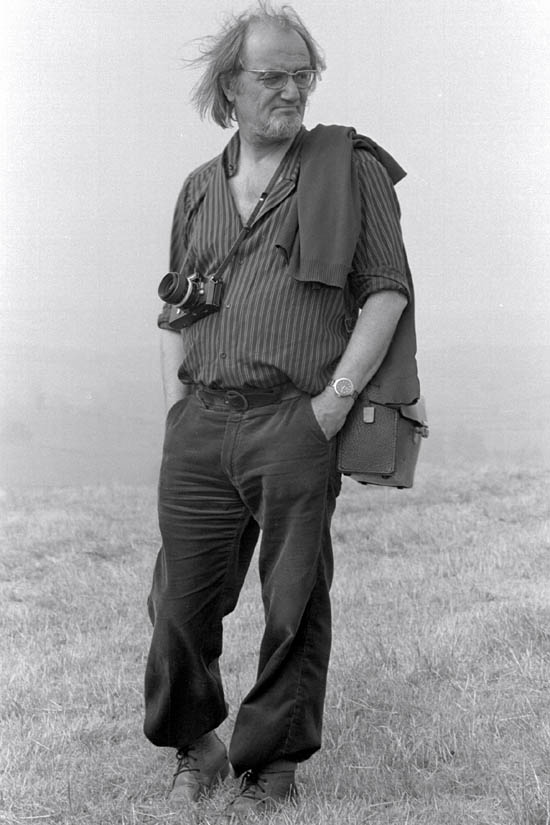
Ray Moore

The title ‘Darbis Murmury‘ came in part from my two-year-old son’s description of where I had gone for these weekends, but was also refers to Ray’s book, Murmurs at Every Turn as well as of course my own memories.

Ray’s comments on my own pictures were both critical and inspirational, and did much to set me off on my own route in photography. Seeing his work and his attitudes towards it and towards photography were also vital.

Today I looked for the article I wrote for Inscape and some of the pictures I had taken of people during the workshops, and found a half-finished web site I had written. Just a single page with the text more or less as it appeared in the magazine surrounded by almost 30 thumbnails linked to the pictures.

© 1976-7, Peter Marshall
Paul Hill

It took me a couple of hours to sort out the site and make a few corrections, but you can now see all the pictures and the text of Darbis Murmury, more or less as I wrote it and the web site ten years ago.