After the March

After the March for Homes on Saturday, which ended in a rally outside City Hall, next to Tower Bridge, I was cold, wet and tired and wasn’t feeling at my best. So I got on a bus and made my way home, despite it being obvious that quite a large group of the protesters were clearly intent on other actions. I missed an opportunity for some interesting pictures, but there are times when I feel I just have to stop. It wasn’t as if there weren’t plenty of other photographers around to take pictures.

When I started photographing at protests, it was partly because so few others were doing so, outside of the really big events. Even now there are some where I’m the only photographer present – and my presence there and getting their story out becomes more important. But of course even if there are no photographers, almost every protester now has a phone and is taking pictures. Sometimes its hard to photograph events because so many of those taking part are either themselves taking photographs or looking at the photographs they have already taken rather than taking an active part in the protest.

The March for Homes was against the current redevelopments taking place in London, building expensive flats which are mainly sold abroad to overseas investors, many of whom leave them empty most or all of the year. Buying for investment pushes up the price of properties across London, and is making it impossible for most Londoners to buy or increasingly even to rent a place to live.

Councils across London, many Labour run, are selling off estates with realtively low rent accomodation, particulary the large council estates built shortly after the second World War to meet the housing needs of Londoners. One of the larger schemes so far was the Heygate Estate, a well-planned award-winning estate at Elephant & Castle. Over the years the estate had been neglected and needed repairs, and had deliberately been used to house anti-social tenants, many with drug and mental health problems. ut most who lived there liked the area; they would have liked to council to do more for the estate, but the council decided the site was an asset they could realise.
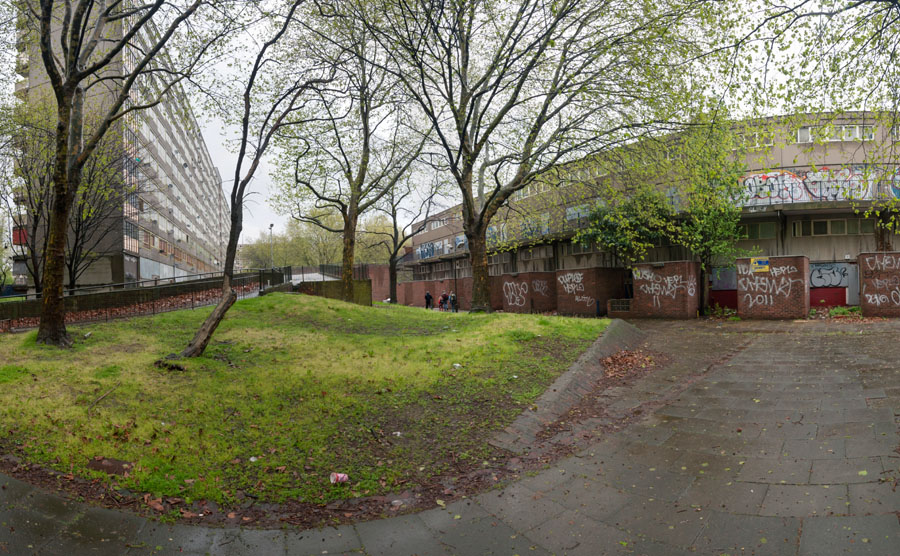
Of course they got it wrong. The costs of moving out tenants and leaseholders who didn’t want to move turned out to be much higher than they anticipated, and took many years longer than they had bargained, despite compensation for owners mostly at around half the market value. Individual councillors may well have benefitted from sale, and there were certainly treats from the developers, who ended up getting the site at perhaps a fifth of the true market value, but the council lost a large amount on the sale.

But the real losers were of course the people who had lived on the Heygate, some now in estates at the far-flung ends of Southwark, others in inferior private accomodation at higher rents, and leaseholders either having to take on large mortgages or move to the fringes of London. And the many thousands on the waiting list for social housing with the stock available greatly reduced by the demolition.

It isn’t correct to talk of the new Elephant Park that is now being built as a luxury development, though certainly the new properties will be expensive. But they will probably be less spacious and no more luxurious than those that they replaced, and are likely to have a shorter life-span.
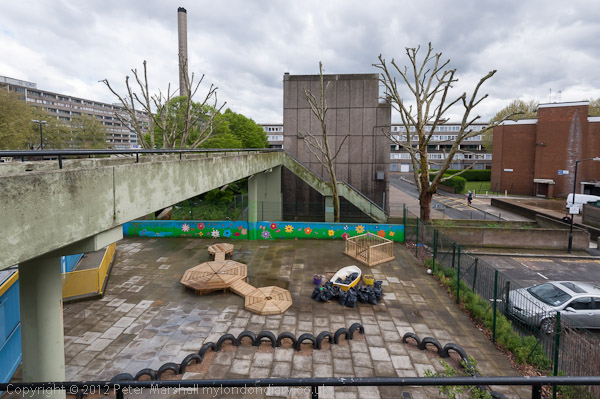
Having made a shameful mess of Heygate, Southwark have now begun the same process on the neighbouring Aylesbury Estate. Its a larger estate and lacks the architectural quality of the Heygate, and again has been allowed (or encouraged) to deteriorate. Initial plans for ‘regeneration’ under the ‘New Deal for Communities’ (NDC) set up by Laboin 1998 led to a ballot across the estate in 2001 in which a 73% majority among those living there wanted to keep the whole estate as council housing. The story around Aylesbury is complex, and you can read more about it on the Southwark Notes blog.

From City Hall, protesters went on the briefly sit down on Tower Bridge and to protest inside the expensive flats currently being erected next to it. Some then marched down to the former Heygate estate and then on to the Aylesbury estate where they re-opened and occupied a part of a block, Chartridge, that had been cleared for demolition.

Although I haven’t yet made it to the occupation as I’m not yet entirely fit after my exertions on Saturday, I have been around the Heygate and Aylesbury estates several times in the past, most recently on a guided tour Walking the Rip-Off in 2012, from which the pictures here mainly come.

On that tour we went inside a few properties on the Aylesbury Estate, and the flats were well-designed and relatively spacious, rather more so than those of the new properties planned to replace them.
Poor Doors Again


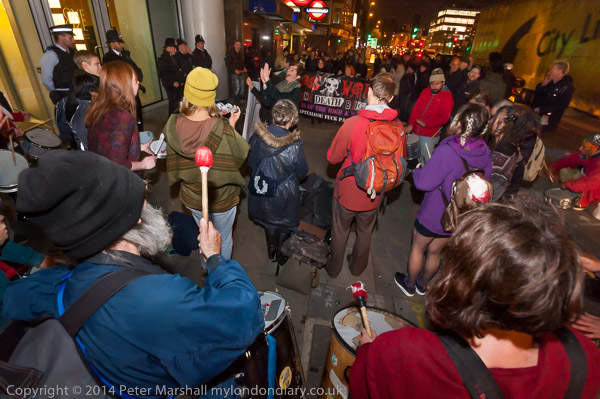
Musical Poor Doors October 18, 2014

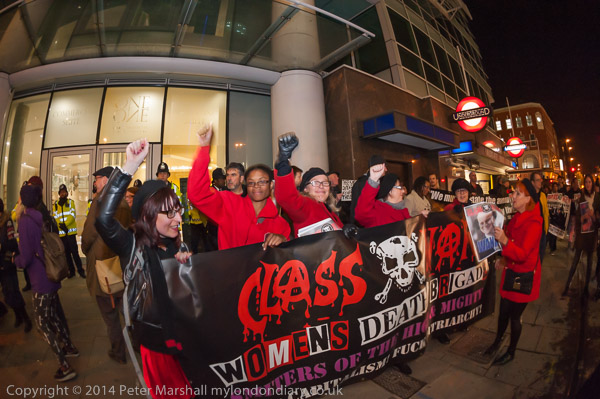
Last year I photographed a whole series of protest outside one of London’s prestige blocks, One Commercial St. Organised by Class War, these started small, with less than a dozen protesters at the end of July, but built up week by week to around a hundred, with a couple of larger events in October and November.


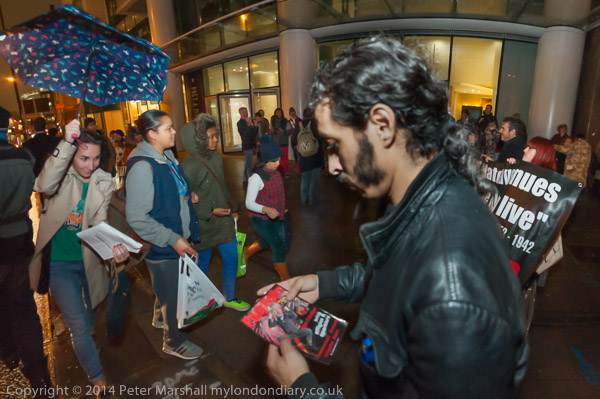
Wet night at Poor Doors October 29, 2014

I didn’t quite go to every one of the protests, missing I think two of the weekly Wednesday evenings when there were events elsewhere I felt it more important to cover at the same hour. But I was pleased when it seemed in November that the new owner of the block had agreed to talks and it seemed wanted to resolve the issue. Not just because it seemed to be a victory for the protest against social segregation, but also because travelling across London for the hour’s protest every Wednesday was having too much of an imposition on my life and work.

Travelling there for the 6.00 pm start to the protests by bus in the rush hour was slow. Tube would have been faster, but whenever possible I like to use the bus, and it cuts my expenses as I travel free on it, but have to pay on the tube. It isn’t that expensive, but this was a long project for which I expected little financial return. At first, getting back by bus was fast, but for later events traffic in the city was completely disrupted by evening road works, and on one occasion when I was in a hurry I got off the bus and walked and ran the last couple of miles.

And while in July the protests were taking place in daylight, by October and November it was dark throughout. We had a lot of wet weather too, which didn’t make life as a photographer easier.


Poor Doors Guy Fawkes burn Boris November 5, 2014.

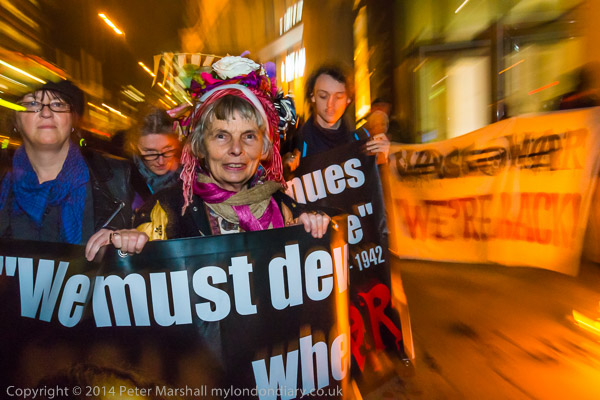
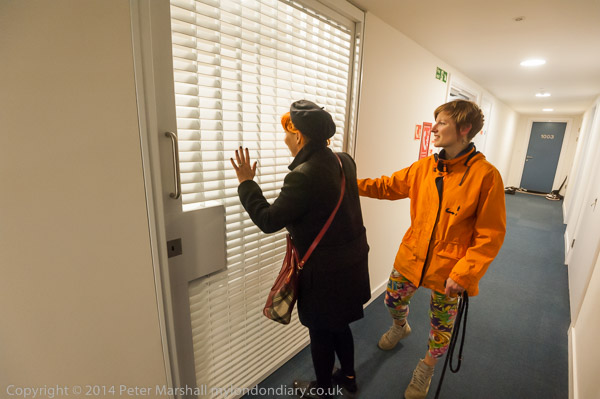
But perhaps the hardest thing, especially for the regular weekly protests, was going there and striving to produce something different every week. It was helped at times by the protesters, who also felt a need to do something new. Class War does like to have a little fun at its protests. So there was a special celebration on November 5th, complete with a guy, Boris Johnson, who mysteriously burst into flames and burnt for a surprising length of time, and at the final protest in the series what was billed as an attempt to get into the Guinness World Book of Records with large numbers of their notorious posters of leading politicians, and when, along with Lisa Mackenzie from Class War, I got a tour of the two areas inside the building.


Class War Women in Red November 12, 2014

The initial meeting between the protesters and the owner was encouraging, and he seemed keen to resolve the issue, and there were apparently discussions with those living in both the expensive and ‘affordable’ sections of the property about how a resolution could be achieved. It didn’t seem to me to be an insoluble problem – as I had found when taken for a tour by one of the residents, there was no problem in accessing the ‘poor’ side of the building from the ‘rich’ area by a separate lift from the ground floor.


‘Bye Bye Redrow’ Poor Doors Street Party November 19, 2014

It would perhaps have required a little interior redesign to allow all residents to enter the building the same way and then have the separation between the two groups inside the building, but I think it would have been possible.

But a few days ago, the protesters met with the owner again, and were told there were to be no changes to the arrangements for a separate ‘poor door’ in the dingy side alley. It looks almost certain that the protests will soon begin again, though it isn’t clear what form they will take. Perhaps I will find myself being busy on Wednesday evenings again, but I rather hope it will be something a little different.

Continue reading Poor Doors Again

Worth Publishing?

_DSC8829-s600

I’ve just been reading an article on the web site of the US National Press Photographers Association,(NPPA) about research they funded into ‘what makes a photograph memorable, shareable, and worth publishing.’ Eyetracking Photojournalism is certainly an interesting read for photographers and the study showed that people could tell the difference between professional and amateur photographs, at least from the pool of published images they showed to the 52 participants in the study.

The study involved an analysis of the eye movements made by people as they looked at the images and also interviews with those taking part, who were asked to rank images in various ways.  And the NPPA were obviously very pleased that it showed that people could recognise the difference between the work of the professionals and UGC (user generated content) and appreciated the professional work.

This is only the first of what the NPPA promise to be a series of four posts, and we will shortly be able to see the 200 pictures used. While I applaud any study that shows the audience appreciate good photographic work (even if the accountants don’t) I do have a few doubts, not least because of the rather average (and sometimes downright poor) professional photography that many of our news  media are prepared to use.

Of course, none of us are always at our best.  And sometimes the picture we get, while not being brilliant, is the only picture available, and there are some of my own like this that I wince at when I see them in print. I know I could and should have down much better. But rather more frequently I see lacklustre images by others being used when I know that much better – either my own or by other photographers – were available.

We do exist in an age of image saturation, with more photographers than ever taking more pictures and submitting more through the various channels available. I hope that studies like the NPPA one will encourage the media to try and discriminate a little more over which pictures they choose to publish, but I fear it will have little effect. Speed and cost are now more important than quality.

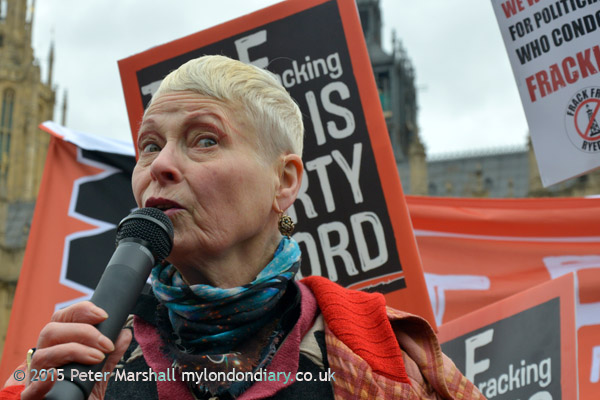
But I was pleased to see the picture at the top of this post which I took on Monday being used in at least one publication. I’ve photographed Vivienne Westwood on a number of occasions, and took a great many pictures of her at this event, of which this one, for me at least, stood out.  Her expression is of course the main thing, but also I think I got the framing right – just enough information for it to be clear what she is speaking about and where she was speaking.  

There were possibly another hundred photographers taking pictures (the kind of situation I hate) but I’ve yet to see another that seems to me more than routine. And I think – perhaps I’m kidding myself – that it well illustrates some of the things that people in the NPPA study are quoted as saying.

Continue reading Worth Publishing?

In the Shadow of the Pyramids

Legally I should probably preface this post with a warning that no one should take investment advice from me. I have a proven track record in losing money, particularly in 2007, although I knew what I ought to do then but just couldn’t be bothered. Like I can’t be bothered to switch energy suppliers and all the other things our government thinks we should all spend our time doing.  I rather liked it the old way where we had a Gas Board and it saved a lot of thought. And certainly if we’d subsidised British Rail the way we have the privatised companies we would have a much more joined up, cheaper and better railway system. As well as still being passengers and taking trains from railway stations – and be spared those highly annoying announcements thanking us for travelling on Southwest Trains; if there was any alternative we would be taking it.

Actually I have changed energy suppliers, but not on cost grounds, though I think changing to Ecotricity has saved me money. But they are certainly a nicer company than most and kinder to the planet, and I’m happy to give them a little free advertising on this otherwise deliberately advert-free zone.

But if you want a good investment in a photo book, my advice (for what it’s worth) is that you should be putting your 88.60 Euros (prices differ in various countries) into an order for In the Shadow of the Pyramids, a Project by Laura El-Tantawy described as:

“a first person account exploring memory and identity. With images spanning 2005 to 2014, what began as a look in the mirror to understand the essence of Egyptian identity expanded into an exploration of the trials and tribulations of a turbulent nation. The result is dark, sentimental and passionate. Juxtaposing the innocence of the past with the obscurity of the present, the book is an experience, edited to look like a one night’s encounter. A peaceful and tranquil day suddenly turns violent and chaotic, it’s claustrophobic, until a new dawn rises and there is hope again.”

I’ll buy it not because I think it will be a good investment, with a smallish print run of 500 copies which has already won an award as a dummy, but because I think it’s an interesting work – as you can explore from the front page of the web site.

It also seems to be an interesting example of book design, getting away from the simple formula that we can now all do for ourselves through services such as Blurb. I’m not sure my books will ever be a good investment, though I know they have been appreciated by a number of buyers, and they are certainly likely to be rather rare, so who knows?  UK buyers in particular can usually get any of them cheaper direct from me.

Breach of Copyright

You may have seen this picture recently, as it has appeared over 80 times on the web, many in the last week, at times clearly with a Demotix watermark – indicating it is unlicensed. A few of the instances were probably taken from my own web site, with my discreet watermark cropped off the bottom.

I took this picture in London in July 2011, at a protest organised by Anjem Choudry, apparently MI5’s favourite Muslim honeypot, Muslim Extremists March For Sharia Zones.

Here is the context from my web site:

Around 70 men from Muslims Against Crusades marched from Leyton to Walthamstow calling for the setting up of Sharia Controlled Zones in the UK which ‘Islamic rules’ would be enforced by Muslims.

and the caption on Demotix is:

“Muslim man holds up ‘Sharia Controlled Zone’ poster at protest calling for Britain’s first Islamic Emirate”

and on my own web site: ‘

The controversial ‘Sharia Controlled Zone’ poster that has gone up in several East London boroughs’

I’ve not looked at all of the uses made of it on the web, but those I have seem to be using the image as evidence of ‘no go areas’ in the UK, which clearly it was not. Most also seem to be Islamophobic in tone, some rather rabidly so.

It may be that a few of those sites have licensed the image from Demotix (or Corbis etc) and I will in a few months time get a few pounds for my work – the fees Demotix charge for web use are derisory. I’ll look through the sites and decide if there are any that might be worth chasing up for payment, though I doubt it as few seem to be UK based.

I may also report it to Demotix, but I doubt they will be of any help, and the time I would have to spend on chasing up all these instances would be enormous. Its vital that we have copyright laws, and sometimes photographers can benefit from them (as I’ve done on a few occasions) but much of the time they only benefit the large multinational agencies who have the time and resources to pursue infringers around the world.
Continue reading Breach of Copyright

‘Page 3’ on the way out?

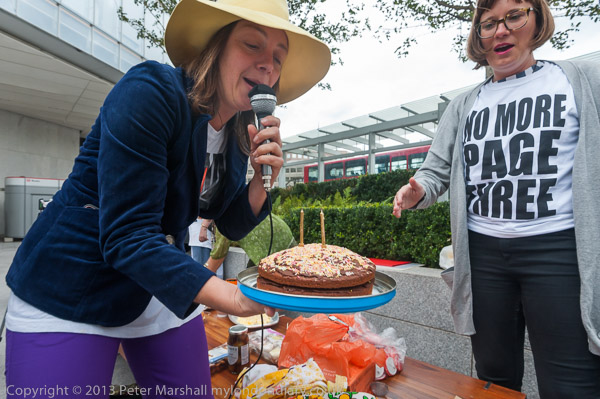
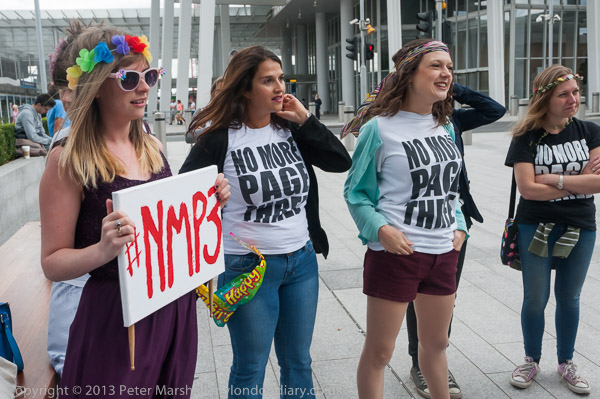
Five months ago, in August 2014, I photographed the second anniversary party of the ‘No More Page 3‘ campaign, held on the courtyard outside the new offices of News International facing London Bridge Station. A  few weeks later I wrote about it on this blog, in the post ‘No More Page 3‘.

In the news today, there were reports that The Sun has abandoned its practice of publishing these ‘topless’ images daily on the page, and in today’s issue the spot was occupied first by a couple of women  in bikinis running along a beach in Dubai, though later editions apparently displaced them with the story of the death of a long-running Coronation Street soap star. Something which is news, if not news that I have any particular interest in, having last seen the programme before she joined it 43 years ago.

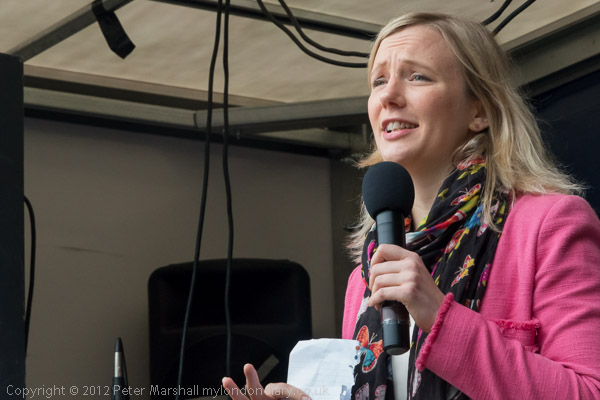
What was interesting this morning was to hear the BBC’s  tame media commentator talk about this without mention of the campaign which was undoubtedly what prompted newspaper owner Rupert Murdoch to consider dropping the daily feature and to finally order its demise. It was left to a woman MP also taking part, Stella Creasy to mention them, after which he rather grudgingly admitted that ‘No More Page 3’ might have played a small part.  ‘Like’, I thought, ‘it wouldn’t have happened without them.’

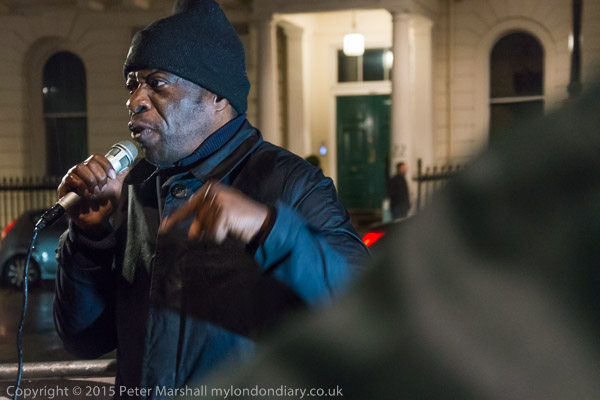
Stella Creasy, Labour MP for Walthamstow speaks at an anti-racist event in 2012
It’s hard not to conclude that there is a conspiracy to play down the role of protests in promoting change. People often tell me it changes nothing, but it is perhaps the only way most ‘ordinary people’ can influence events. I do believe that it is important to vote (and vital to vote for the right people) but it’s even more important to get out there on the street with banners and placards, and to organise and sign petitions.

Of course, protest does often become respectable in long retrospect, and its importance can even become overstated. Slavery still continues despite the valiant efforts of Wilberforce and the abolitionists, and the racism that underlay it is perhaps now on the increase.

So far, the ‘Page 3’ success – not yet confirmed by The Sun, but reported by another Murdoch mouthpiece – seems a very partial one.  A step in the right direction to a newspaper which publishes pictures of women simply because they are making news.

Continue reading ‘Page 3’ on the way out?

Slow Recovery

I’m sitting typing at my notebook, and using it to copying my files from 2007-8 from an old external hard disk onto my new Drobo 5N NAS. And rethinking how I intend to backup my work. This is a slow process, as the hard disk is only USB2, and at around 15Mb/s the 500Gb will take around 8 hours.(Later I found the speed roughly doubled if I actually plugged the Ethernet cable into the router, rather than just assuming it was connected and transferring over the wireless link.) I’ve another 9 disks to go through, some larger, though I’ll not transfer everything to the new system.

To my right, my desktop computer is still chuntering through Chkdsk on my drive G:, all 3TB of it. It’s now got on to telling me that there are around 450,000 files that need fixing and is looking at each in turn to tell me it can’t fix them. It says that it is 10% through, but I don’t believe the figures. Probably it will finish some time early next week. Meanwhile I’m doing the best I can with the notebook.

I got all ready to take pictures yesterday when I got a message telling me the event had been cancelled. There was a suggestion I might cover something else, but unfortunately by the time I read the message it seemed to late to get there.  I don’t have Lightroom installed on my notebook – I decided the screen was too small and the keyboard and pad wouldn’t make it worth having. I could install it now – or put it on my smartphone as the licence allows, but instead I’ve decided to work in RAW + Fine jpeg mode until I get back onto the desktop machine. I do have an old copy of Photoshop I can use to do some adjustments.

The Drobo has advantages and disadvantages. It should protect against a hard drive failure, enabling me to replace a failing disk without losing work, and it should also allow me to increase the capacity of the system by installing disks of higher capacity. It also means that should my computer go down I will be able to easily access all my files from any other computer I attach to the network. And it is certainly convenient to have access to so much work in the one place.

Its big disadvantages seem to me to be that it is a proprietary system, and that it is also a single point of failure. So while I’m backing up my files to it, I’m also looking at keeping at least one other copy of all important files elsewhere.

I’ll store the old external hard drives carefully – and hope they remain in working order unused. And I’ll keep another attached to my main computer to store current work, replacing that as it gets full. I suspect that they will remain usuable if stored well – at least so long as we still have hardware with USB ports.
I still have boxes full of CDs and DVDs with most of my digital work (and some scans) on them, going back now in some cases around 20 years. Despite the health warnings many have given over the years, so far these have remained readable – I did always look for disks which were supposedly of good quality. I gave up writing work to these around a year ago when with 32Mp files things really got out of hand. And some of the scans and panoramas come to around 250Mb a time, which makes DVD at 4.7Gb look rather small.

I’m thinking now of going back to them, though only for storing a copy of the jpegs that I develop from Lightroom – a much more manageable proposition. An alternative would be to use USB memory sticks, given the low prices of 64Gb USB3 sticks; again people say these are not suitable for long term storage, but those I wrote when they first came out remain readable. I’ll also consider getting a Blu-Ray – perhaps external – writer which are now available at a reasonable price, and 25Gb media at around a quid a piece, but I’m less sure about them.

Of course I should be using cloud storage, but I trust that less than I do optical media. Who can say which companies will still be in business next year – or whether the promises they make will be kept? And cloud storage for all of my work would be prohibitive in cost. It does provide a valuable safeguard against theft, flood or fire etc, but perhaps I’ll ask a friend to keep a small bag of memory sticks or box of disks instead.


Pegida Problems

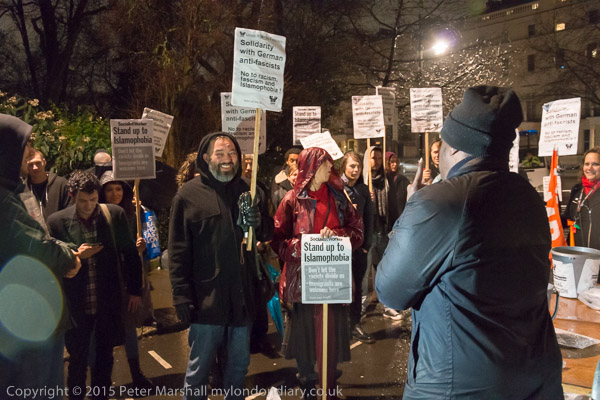
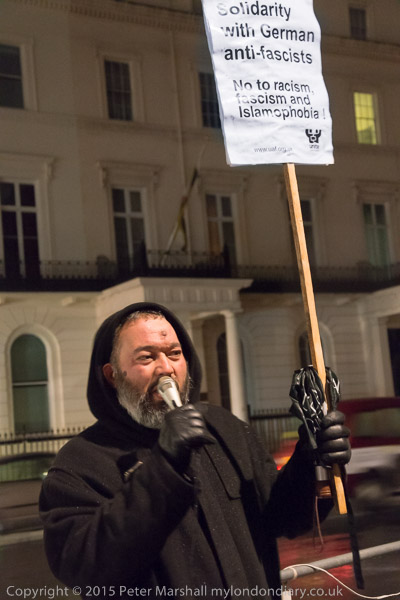
It was a dark, damp night, with fluctuating rain, occasionally slackening to a standstill and at other times almost filling the air with fine drops, so fine it was deceptive, hardly appearing to be raining, but soaking everything and looking down I saw streams of water flowing across the barrel of my lens as it stuck out from my coat.

Any sensible person would have taken one look at the weather and decided they had better things to do than hanging around on a street corner as we were on the corner of Belgrave Square, in a dark area penned off by barriers, and most of those who had signed up for the event on Facebook had clearly come to that conclusion.

And it was dark. There were lights across the road, but even the bare winter trees of the square seemed to create an area of shadow. A small group of photographers chattered gloomily, one saying “they don’t tell people about this at media school”; standing in the cold, dark rain certainly is a less glamorous side of being a photographer.

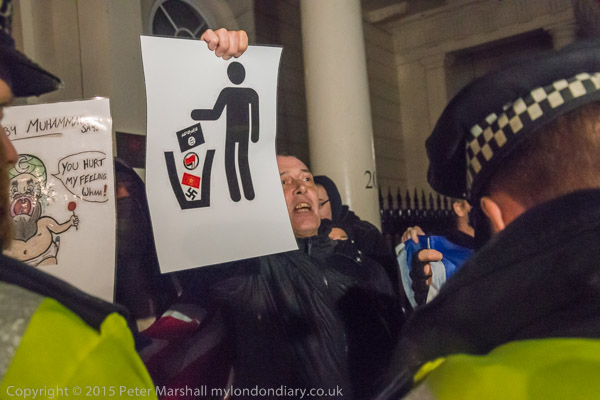
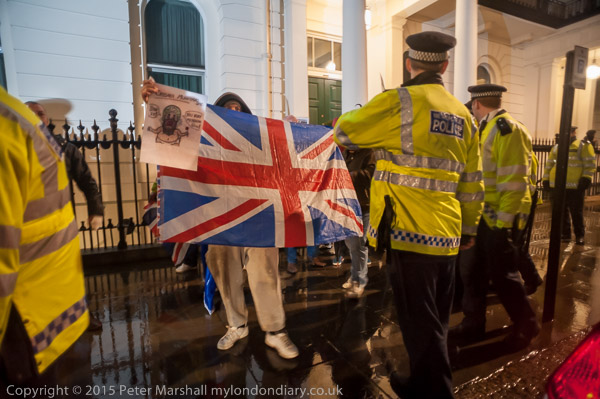
I don’t like working in the dark. I don’t really have the best equipment for it, with no fast lenses for the Nikons, and good though the Nikon flash system can be, in the wide outdoors flash is seldom a good answer. Suddenly there was something to photograph, a man carrying a Union Flag walked past the Unite Against Fascism pen and started shouting insults as police came to move him on.

I rushed to the scene, framed and pressed the shutter release and absolutely nothing. It was too dark for the lens to focus. Just what focus assist is designed for, but Nikon thoughtfully disable it just for those occasions when it’s most necessary. Or at least only let you use it if you are using single-servo (S) focus mode AND you are either using auto-area AF OR have the centre focus point selected in other modes.

I fiddle with the camera in the dark, but before I’m able to solve the problem the guy has been led away to a pen 50 yards down the road where a few other right wing extremists are being looked after by police.

It isn’t the only problem I have with the D700. A few minutes later when I’ve been taking pictures using manual exposure, 1/30s at f2.8, I hear it making a rather more lengthy exposure and find it has altered the ISO to 800 from the 3200 I had set, and changed mode and set the aperture to f32. Clearly it is suffering from mad camera disease. I fiddle with it a bit more and find I do have auto-ISO set, which doesn’t account for the rest of the changes, but the camera begins to work more sensibly when I turn this off. I think it’s probably suffering from old age, I will have been using it for six years next month, and has taken over 370,000 pictures (according to the EXIF data) well over twice the minimum rating of 150,000. Probably it’s due either for an expensive service or replacement. As it has a few other peculiarities perhaps a replacement would make more sense. You can get a D700 in good working order with a reasonably low shutter count but some cosmetic damage for under £500, but probably it’s time to upgrade.

If the camera is now doing its best, with the SB800 attached the system is still playing a few tricks, with seemingly random exposures, and I more or less give up on the flash. There is occasional and rather unpredictable light from several people using video lights on their cameras, often a real nuisance as I have to keep moving as it shines direct into my lens, but at times giving me some dramatic lighting (though of course very flat for those who are supplying it.)

I have the camera set to ISO3200, but also have the exposure compensation at around -2 stops. Working without considerable compensation gives results that are just too bright – and can end up looking as if they are taken in daylight rather than at night. Despite the compensation I think the results are what you would expect at in terms of image noise from ISO3200.

Much of the time, having set the ISO and compensation I actually work using manual exposure in any case, taking no notice of what the camera meter indicates but looking at the image on the camera back and in particular the histogram. I kept wishing I was using the Fuji XT-1 because I think the electronic viewfinder would be better than an optical one; the Nikons do have ‘Live View’, but it’s clunky and you only see it on the camera back, and I find unusable for taking still images of action. The faster lenses for the Fuji would also have been useful. But my XT-1 body is currently in for servicing.

The video lights  of several people working with video let me work without flash when the small group of right wingers (they seem to come from the various overlapping groups I’ve photographed before – EDL, South East Alliance, NF, Casuals United, Golden Dawn… and for this occasion some at least of them have called themselves UK Pegida.

Police led them off from the embassy and took the street leading towards Victoria Station. I thought about following with them and taking more pictures, but decided I’d had enough, and walk off in a different direction to get a bus, while the UAF vigil continued.

The following afternoon a friend of mine showed me a cheap LED light – under £30 –  he has bought that seems considerably more powerful than those I’ve previously tried – as the more expensive models used by the videographers clearly are too. I’ll perhaps give one a try – and report back later.

More about the event at Solidarity with German anti-Pegida – and more pictures.

Continue reading Pegida Problems

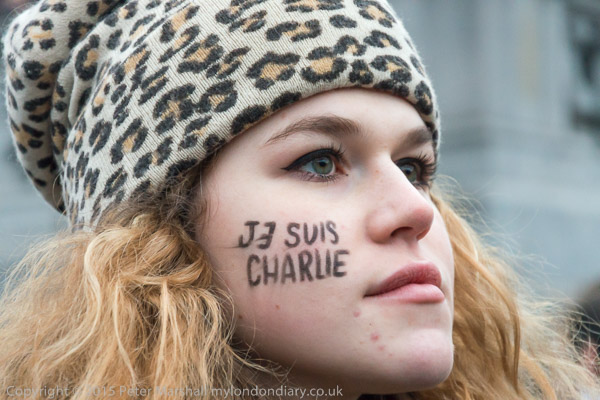
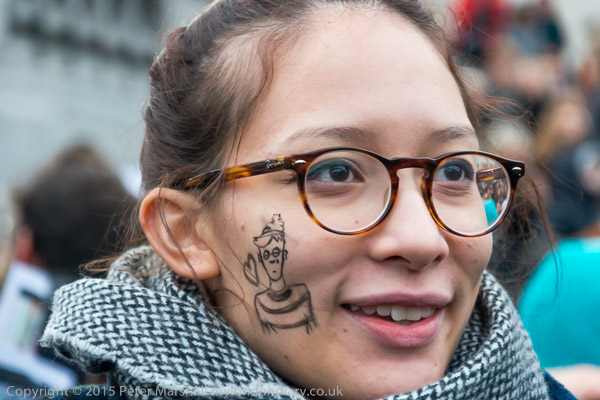
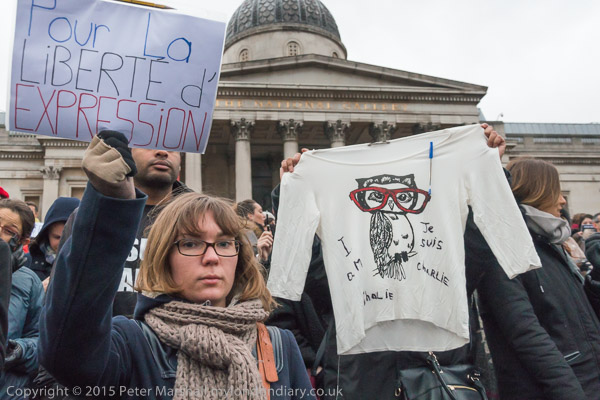
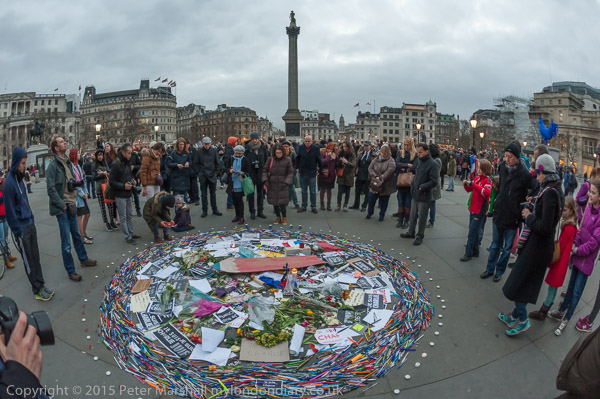
‘Je suis Charlie’ London – Clegg et Sylvie

I’d decided some months ago that on Sunday 11th January, as on too many previous January 11ths I would be covering the event to mark the anniversary of the setting up of the illegal Guantanamo Bay prison camp, and decided to stick to that decision even though the major news event in London was the ‘Je suis Charlie’ vigil in Trafalgar Square. So I only arrived there after I’d spent over an hour outside the US embassy, at just after half past three, and had expected to miss the French Ambassador.

A large crowd filled the square and the steps up to the National Gallery when I arrived but there was nothing obvious going on, so I plunged into the crowd and worked my way across the square taking pictures. I really didn’t feel I was getting a great deal, and knew that many other photographers were doing much the same as me, and had more or less decided to give up.

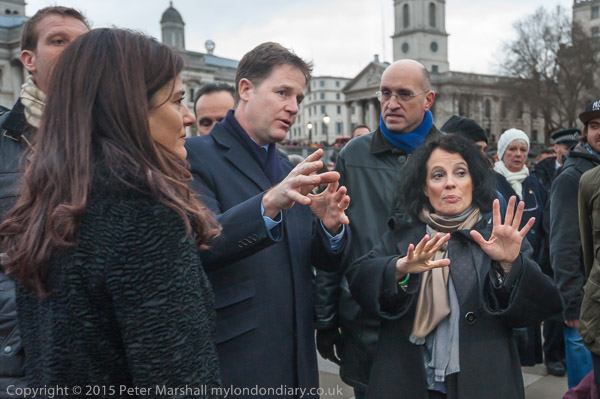
I’d walked around to the front of the square, in front of an empty and taped off area in front of the plinth and was looking at the crowd, wondering if I could take a good overall picture, when I noticed a commotion in the centre of the crowd, with cameras being raised above photographer’s heads to take pictures. Something was clearly happening, and I made my way in that direction, to meet with security men hustling obviously important guests away through the crowd. There were people at the front I didn’t recognise, then I saw a man being interviewed as he walked along who was vaguely familiar. Could it be Nick Clegg? I walked backwards taking pictures, and he stopped as a French woman grabbed his arm and complimented him on his French accent, asking where he had learnt it. “At school” he told her and after a second or so moved on, by which time I had seen the French Ambassador behind him. The two came together and I took a few pictures as they walked along, not easy as there were people in the way and a horde of press photographers was just catching up with us. After a few yards I decided I’d got my pictures and gave up, leaving the others to chase after them.

I don’t much like working with the kind of press pack you get around celebrities at events such as this. I don’t like being barged and pushed when taking pictures, though at times I try and stand my ground. And I find the pictures that people get in such situations are seldom of much interest to me – if apparently loved by editors.

I decided it was worth trying to take some more interesting pictures to go with the few of Clegg and Syvie and made my way on into the crowd from where they had come, finding a few things I was happier with.

There was supposed to be a projection of the French flag on the National Gallery at 4pm, but they appeared to be having some technical problems, and after 20 minutes of waiting with just one projector apparently working with a test pattern on the wall I saw a 139 bus across the square and decided to get on it.

Back home I tried to get the pictures to Demotix. Their server kept dropping the connection. It wasn’t until after 9.30pm that I managed to get the 25 pictures uploaded. Then they held it up more making a stupid change to the headline…

You can see 25 pictures from the event on Demotix now (I’ve corrected the headline again) – and shortly with the story (which Demotix no longer publishes) on My London Diary.

Continue reading ‘Je suis Charlie’ London – Clegg et Sylvie

December 2014

December was a month when I took rather fewer pictures than most. In the first couple of weeks there were several work-related Christmas celebrations, some of which took me away from covering events, then the last ten days or so were spent mainly with my family.  I seldom post pictures from these and other private events on-line, partly to respect the privacy of family and friends, but also because they are probably of little interest outside of those taking part.

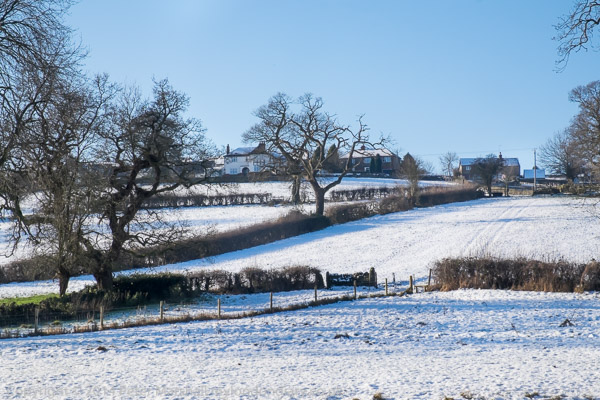
We do however go on a number of walks together, mainly away from cities, and some of the landscape pictures may be of wider interest, and I’ve included pictures from several of these in My London Diary.

As always, the links give more information and a link to more pictures from the event.

My London Diary Dec 2014


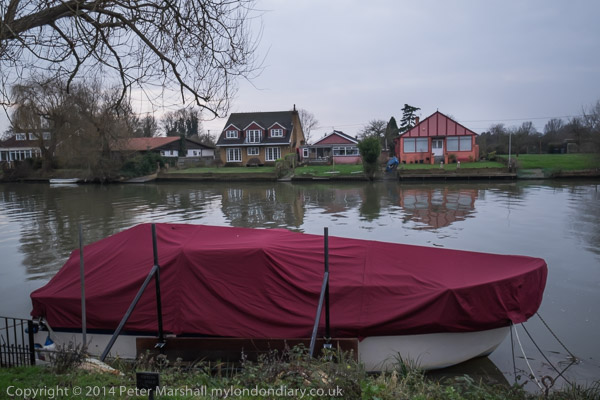
Staines & Laleham

Derbyshire Snow

Belper Walk
Boxing Day Walk
Don’t Buy Israeli ‘Blood Diamonds’
Occupy Democracy Return To Parliament Square

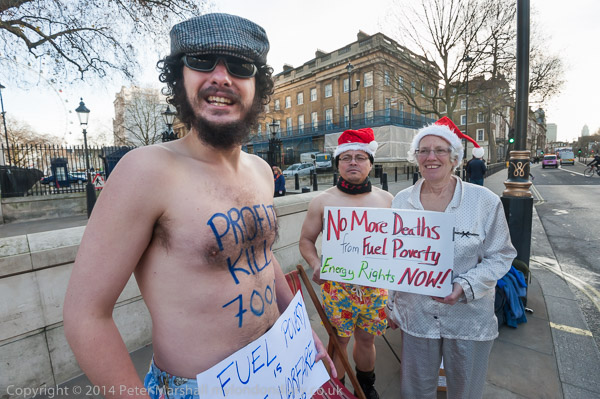
Dying For Heat
Birthday Vigil for Chelsea Manning
Release Shaker Aamer from Guantanamo
Father Pleads ‘NHS let Baby Olivia Live’
Sack Boris over 90% youth & education cuts

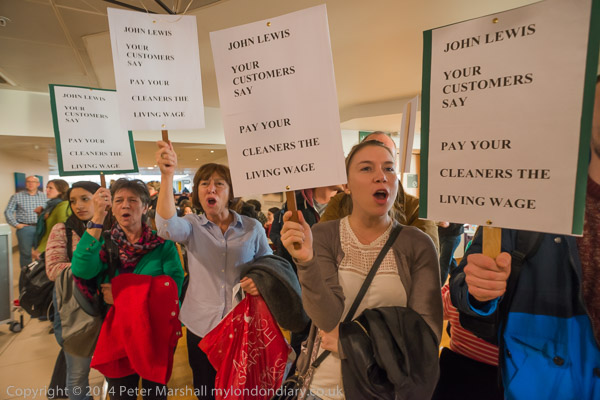
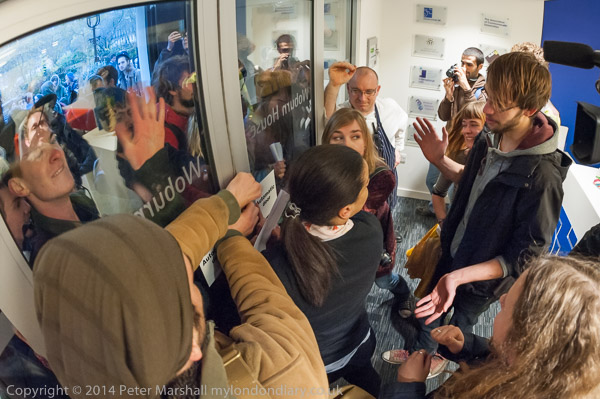
Cleaners Xmas Protest in John Lewis
Class War: ‘Evict Westbrook, Not New Era’
‘Santa’s Naughty List’ Living Wage
Dickens & Lincoln’s Inn

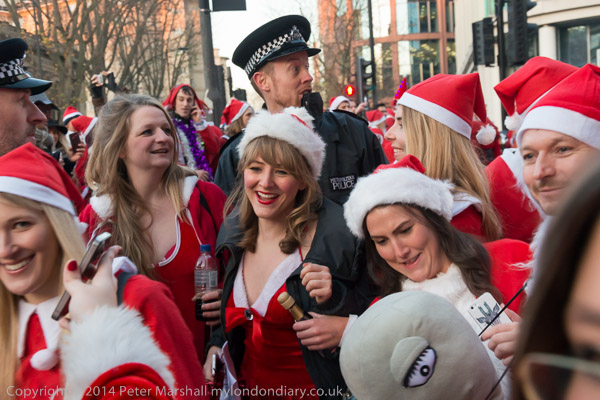
Santacon North London
Fossil Free Nativity – Churches Divest!
South London March for Free Education
Santacon Start in Clapham
Lewisham Housing Action

Students Occupy Universities UK
Student bodies spell out ‘NO FEES’

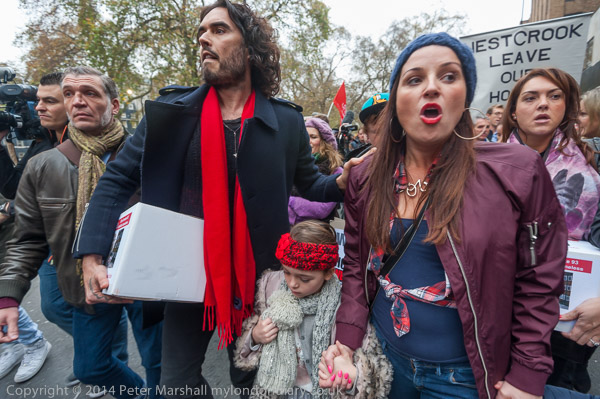
Russell Brand marches with New Era

Continue reading December 2014