Staging, Manipulation &Truth

An excellent post on the New York Times Lens blog on a subject I’ve often written about, Staging, Manipulation and Truth in Photography, with comments from some well-known photographers, including Stanley Greene. The post is their response to the survey of photographers who entered for this year’s WPP contest that I wrote about a while back in my post The State of News Photography.

Greene puts some of the blame on digital, reminding us that he put contact sheets into his book ‘The Open Wound’ on Chechnya so that people could see how he was working and thinking and ending with the comment:

There’s a lot of good guys out there, but there’s also a lot of bad guys who are giving us a bad rap. And a lot of bad guys who are getting awards. It’s up to the editors and photo festivals to hold photographers’ feet to the fire.

The problem isn’t so much in staging pictures, but in passing staged pictures off as news. It’s no surprise that Gene Smith gets a mention for his practices, and certainly some of his greatest images would not pass the test for news, but his great photo essays were perhaps never presented as news. We were always aware that ‘Nurse Midwife‘ or ‘Country Doctor‘ were collaborations between the photographer and the subject and a certain amount of staging was probably inevitable.

Bill Brandt too comes to mind, producing some great images, many if not virtually all of them staged. A story I’ve often repeated is of someone commenting to him about an image of an old sea-captain he had been sent from London to Liverpool to photograph, and saying how fortunate that the man had a particular lamp next to him, to which Brandt replied it was not a matter of luck, he had taken it with him to make the photograph. Again there was no pretence that this was news.

Some of the other comments in the Lens post reminded me of my own experiences, and I’ve sometimes been shocked at how some photographers stage news images.  I often think their pictures ought to be accompanied by that short phrase that often was found below images in some magazines, ‘posed by model.’

If you have posed or set up your pictures, then your caption should indicate this. Under some of mine you will sometimes see captions like ‘Jane Smith poses with her ukelele‘ (not that I’ve ever to my knowledge photographed anyone called Jane Smith playing a uke) or ‘the handing over of the keys to the property was re-staged for the press’ to make clear that my photograph was not of the actual event. And if you photograph a ‘photo opportunity‘ you should also – as Santiago Lyon of AP says, make that clear. It isn’t hard to do, though it is perhaps harder to get editors to actually read and take notice of captions.

Michele McNally of The New York Times who headed the jury for the 2015 World Press Photo contest puts it clearly: ‘A staged photo is not acceptable in news pictures that are thought to depict real-world situations and events.’ Photographers need to make sure that they do not mislead in this way.

Greene says in the quote above ‘It’s up to the editors and photo festivals to hold photographers’ feet to the fire.’ Perhaps it’s also up to photographers to name and shame colleagues too where they know that award-winning news images having been staged.

Dignity Under the Hammer

I imagine everyone reading this will have heard of Sotheby’s, one of the leading auction houses in the world, not least for photography. I’ve never actually been to an auction, though I’ve walked past their building in New Bond St often enough, and have been to shows in their S|2 gallery opposite their rear entrance in St George St. But I have often looked through their catalogues of photography sales on-line – and there are some interesting images in their next Paris photography sale in November 2015.

But on July 1st, I wasn’t going to Sotheby’s to make a bid for the hand-painted dollar bill by Andy Warhol that sold that night for £20.9 million, or any of the other high-priced contemporary art works that gave them a record sale of £130.4m. Take the m off the end of those prices and I might have considered them, though I would still find some of the amounts paid rather high. But the art market and the photography part of it in particular is simply crazy, and not about art but about money, a subject I have a relatively small interest in.

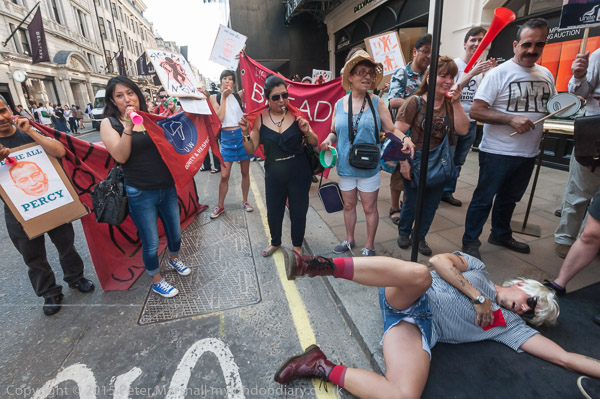
The workers I was going to photograph do have concerns about money, though previous actions by their union, the UVW (United Voices of the World) very grudgingly got their employer to pay them the London living wage. Although they work at Sotheby’s, cleaning up the place and carrying around those ridiculously expensive artworks, they are not employed by Sotheby’s.

At the time their union actions won the living wage – and contractual sick pay above the statutory minimum – they were employed to work in Sotheby’s by CCML (Contract Cleaning and Maintenance London Ltd.) But Sotheby’s then ended the contract with CCML and made a new contract with Servest, who presumably were able to offer a lower cost service because they decided to renege on the agreement previously reached with CCML, refusing to pay the backdated payments that had been agreed, refusing to honour the agreement over sick pay, stating they were doubtful that they would pay the increased London Living Wage due in November and taking unfair disciplinary action against one of the union reps.

The union, the UVW, is one of several grass roots trade unions set up by low paid workers who feel the traditional trade unions have – except in a few branches – failed to stick up for the lowest paid in the workplace, particularly where they also represent those on higher pay. Regrettably, some trade unionists have regarded attempts to acheive the living wage as an attack on pay differentials and have even sided with management in keeping some workers on the minimum wage. Many of the lowest paid in London are migrant workers and not native English speakers, and some unions have found this hard to cope with – and trade unions are not immune to racism.

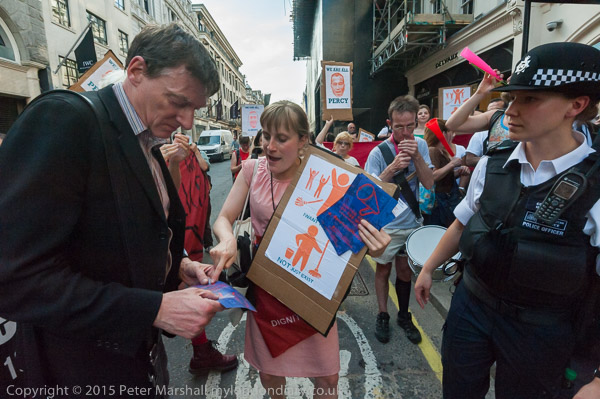
These new unions have brought a liveliness to protests that is seldom seen in the traditional union actions, with noisy protests where people parade and sometimes dance, blowing horns and whistles and banging drums. They want people to notice they are protesting, and it is certainly hard not to, and also they make clear with speeches, placards and banners why they are protesting. Some of the protest at Sotheby’s was in Spanish – the language of most of the cleaners – but it was also in English, and the ‘3Cosas’ that they were calling for were contractual rather than statutory minimum ‘Sick Pay, Holidays, Pensions’ and they wanted them ‘Now!!!’

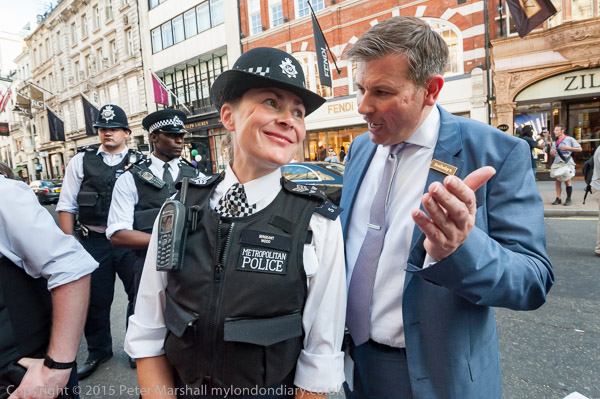
Their chants could certainly be heard by everyone attending the auction at Sotheby’s as well as everyone else in the area. There was considerable tension between police and protesters, with the police trying to move the protest away from the entrance to Sotheby’s and to keep traffic along the street moving.

The protesters wanted to make their protest at Sotheby’s and to make those going into the auction aware of their cause and were not attempting to stop people entering or leaving, but the police seemed to the protesters to be siding with Sotheby’s and trying to minimise the impact of the protest. One of the managers did seem to spend a lot of time trying to persuade the police to be more assertive and clear the protesters away, and reinforcements did arrive and made an attempt to do so, pushing some of the protesters aside, but despite threats of arrest the protesters stayed around in front of Sotheby’s, though leaving the entrance slightly clearer.

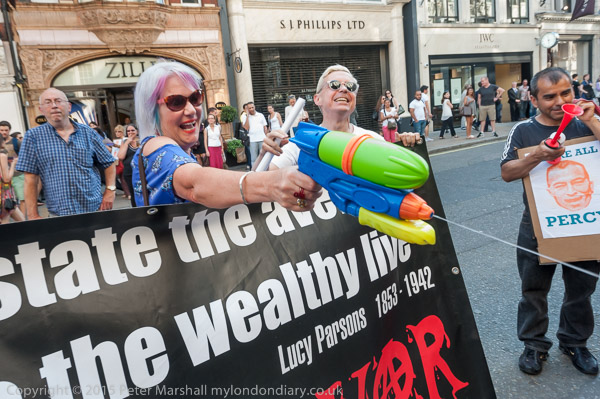
As well as the UVW, the protest was also supported by a number of individuals and other groups, including other low-paid and victimised workers and their union branches and Class War, who injected their usual humour into the event, coming armed with water pistols and staging a mock shooting in front of Sotheby’s, as well as some dancing and mime.

Photographically it was a fairly straightforward event, working mainly at close quarters with the D700 and the 16-35mm (used in all the pictures on this post) with just a few longer shots with the D800E and the 18-105mm. The light was good, though the black carpet and awning over the entrance to Sotheby’s did create some deep shadows in that spot, otherwise the fairly bright but low contrast shade in the streets was easy to work with. There were a few times when police seemed over-officious telling me to get off the road, and a few times I was pushed out of the way, but most of the time things were polite and the atmosphere was reasonably friendly. I had to leave before the protest finished, but there were no arrests while I was there.

The day after this protest, 4 cleaners who had taken part in the protest were stopped going in to work, effectively sacked. Following another protest two were reinstated, but protests have continued to get the two most active union members their jobs back. As I write this, the UVW have called off another protest scehduled during tonight’s auction at Sotheby’s as talks have been agreed which it seems likely will end the dispute. It is a dispute that should never have happened, as Sotheby’s are making record profits and the amounts involved in giving their low paid workers decent pay and conditions are relatively small.

More information and pictures at Sotheby’s ‘Dignity under the Hammer’ protest.

Continue reading Dignity Under the Hammer

RIP ILF

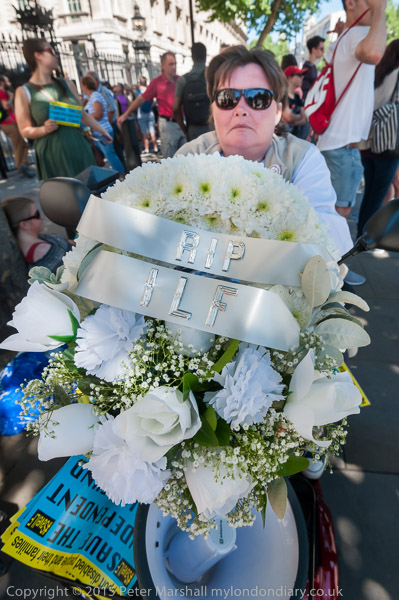
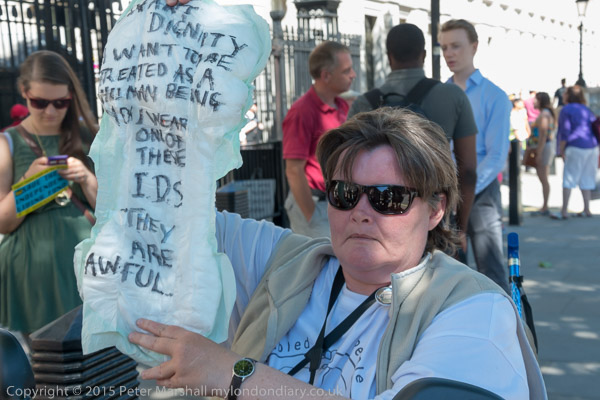
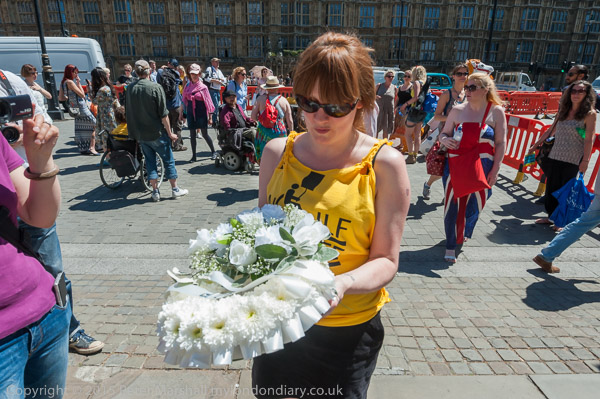
Paula Peters of DPAC, carrying the ‘RIP ILF’ wreath on her mobility scooter above, had a few minutes earlier written a message for Iain Duncan Smith on an incontinence pad : ‘I want dignity – I want to be treated as a human being – You wear one of these I. D. S. They are awful‘.

When IDS began his programme of ‘welfare reforms’ he obviously decided that the disabled would be an easy target, their disabilities making them unable to stand up against the cuts in the benefits that had been gained over the years of campaigning. It was clearly a mistake, and one that those campaigns over the years for equality for the disabled should have warned him about.

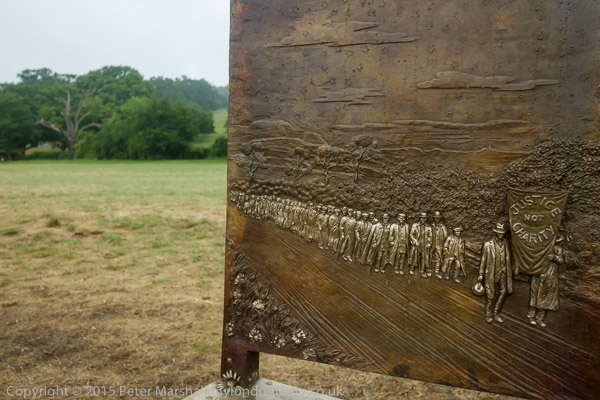
Disabled People Against Cuts (DPAC) and other groups like Black Triangle aren’t the first groups of disabled people to stick up for their rights.  One of the chairs in Hew Locke‘s The Jurors artwork at Runnymede depicts the 1920 march to a rally in Trafalgar Square from Leeds, Manchester and Newport behind a banner reading ‘Justice not charity‘ and the same slogan was used for protest marches in the 1980s and 1990s. The Disabled People’s Direct Action Network, DAN, was formed in 1993, and at least one of DPAC’s current activists has the tattoos to show his membership.

In the past few years, DPAC have been at the spearhead of protests against the cuts and against unfair ways of cutting the support to the disabled, such as the Atos administered computer-based tests of work capability, now taken over by Maximus (see Maximus – Same Circus, Different Clowns.)


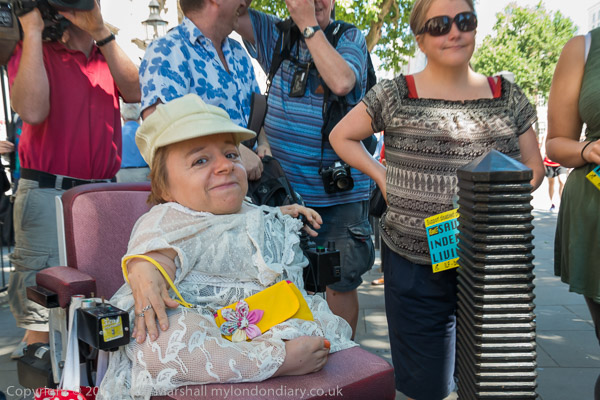
Sophie Partridge, disabled Actor, Writer & Workshop artist

The Independent Living Fund was set up in 1988 to provide support for severely disabled people who need intensive, high-cost care to combat social exclusion on the grounds of disability. It could provide them with personal assistants so they could continue to live in their own homes, and for many of them to work and have a social life.  Funded by the Department for Work and Pensions it was run as an independent public body, and supported around 19,000 disabled people at an average annual cost of around £17,000 per year – around 60% of the average cost of a place in residential care.


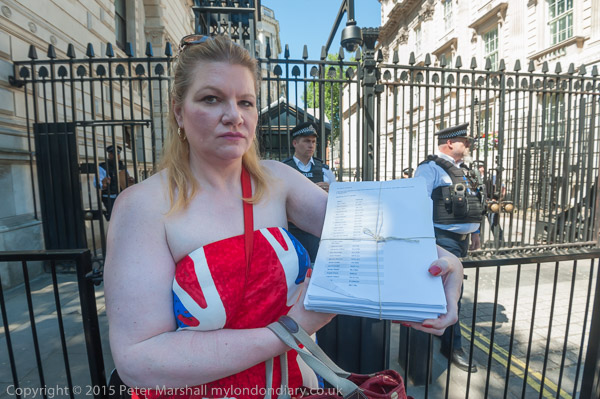
The petition to Downing St

The government’s idea was to shift that cost from central to local government, which it was engaged in savagely cutting, but to do so without providing any ring-fenced funding. In practice this is likely to lead to many of those on ILF being given dangerously low levels of support – those notorious 15 minute calls by care workers – by cash-strapped local councils leaving the disabled unable to take part in normal life, those working being unable to continue, and the kind of indignities that will leave them for long periods of the day and night in incontinence pads, not because they are incontinent, but because there is no one to help them reach a toilet.


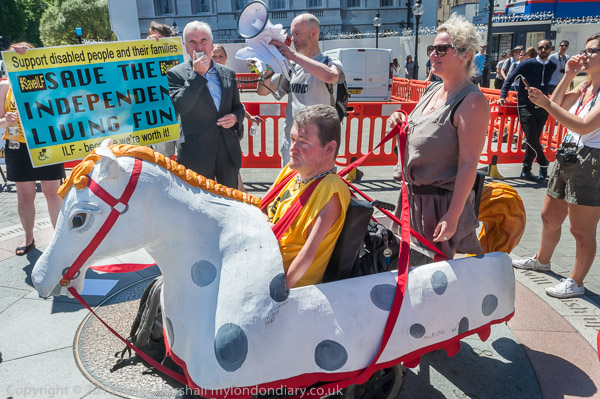
John McDonnell MP speaking and John Kelly in Schimmel, the equine star and proud battle horse of the Threepenny Opera

Possibly part of the motivation for the government decision to close the scheme made in 2010 (when it closed to new applicants) was that providing support to the disabled did enable them to protest. The fight to keep the ILF was a long one, both on the streets and in the courts, with the court of appeal ruling in 2013 that the Minister for Disabled People had breached equality duties when deciding to close the ILF. But in the end they could only delay the truly evil day, and the ILF ended on June 30th 2015

The police at Downing St rather surprisingly accepted the petition that was delivered for David Cameron, but would not take the ILF wreath, which was laid instead opposite Parliament in Old Palace Yard.

More pictures at DPAC’s ILF Closing Ceremony on My London Diary.

Continue reading RIP ILF

Pride Again?


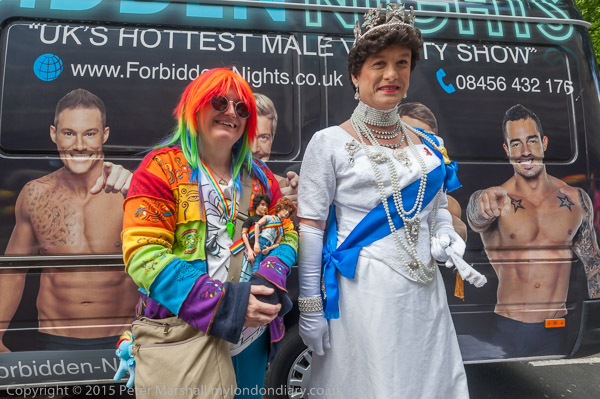
I got the Queen to pose for me with her friend – and found another ten photographers had come to my side

Every year I wonder whether to photograph the annual Pride Parade in London again.  And so far every year with one or two exception I’ve decided to do so, though back in 2007 I wrote here:

Ten years ago, taking part in the Pride march was an important personal and political statement for many, sometimes marking their going public about their sexuality. Now it’s largely a fun event, although a few individuals and groups still attempt to get a more serious message across.

One exception came in 2005, when my younger son inconveniently picked the same day for his wedding and my photographic services were required elsewhere. And in 2003 I was in Edinburgh on the day it happened.  Back in 2006 I had a show Ten Years of Pride at the Museum of London, and I think this year was the 20th London Pride I’ve photographed.

Over the years Pride has become a much bigger and more organised event and it is now one of very few events I bother to get accreditation for because of the size of the crowds that come and watch it, particularly around Piccadilly Circus and Trafalgar Square. But little of what I do really needs it, and certainly until fairly recent years I never bothered.

Pride is so large now that corporate sponsorship is vital, but as always it comes with a cost, changing the nature of the event. But this year there did seem to be a little more getting back to the grass roots and more political engagement and a little less corporate gloss.


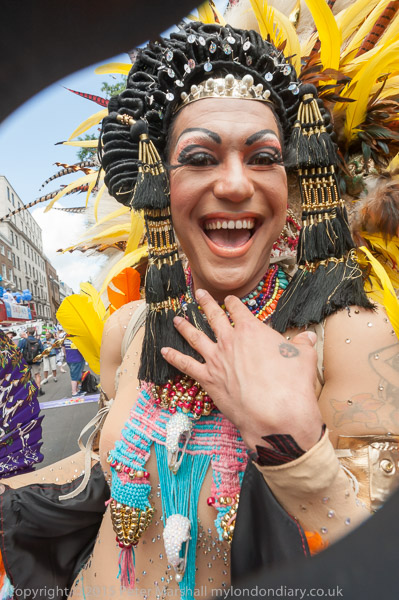
My lens-hood slips around and adds an unwanted frame

Getting accreditation does mean having to arrive early to go to the Press office and pick up stuff, which was a bit of a nuisance, and meant I was at Baker Street where the parade forms up rather earlier than most of the paraders. It was a very slow start to the day and if I’d had any sense I would have found something else to do for an hour or so. But many of the places I might visit don’t open until rather late, and it was in any case a little early for a beer. Sometimes I settle down somewhere and read a book, but often I’m too psyched up to read.


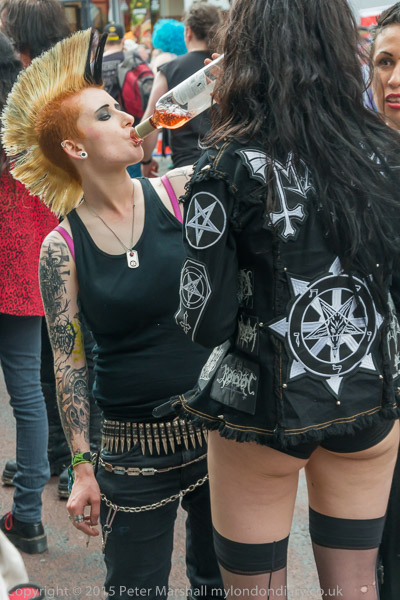
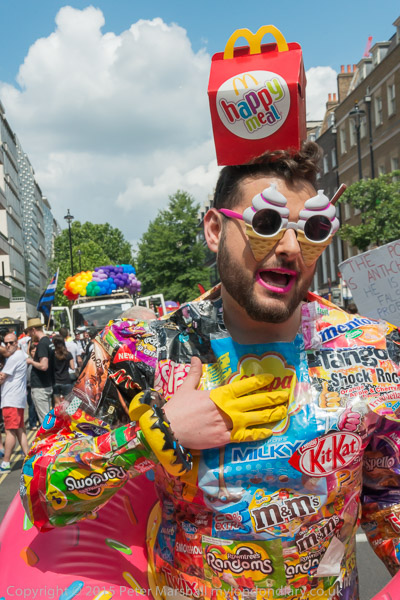
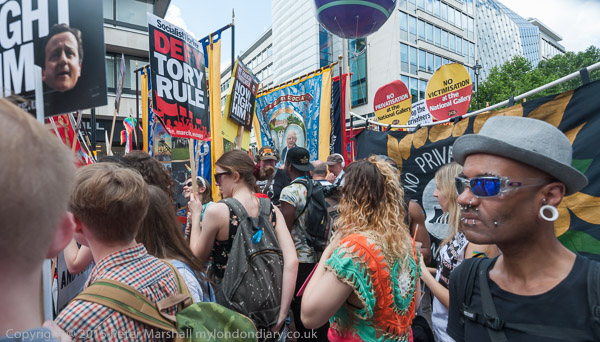
Pride was perhaps a little more political this year than for a while

Eventually things got busier, and by the time the parade was starting at noon things were pretty frenetic.  I went up to the front a quarter of an hour before it began, and then began to work my way slowly towards the back taking pictures. It was well over an hour later that I came to the people still waiting to set off at the back of the march. I should probably have stayed longer and taken some more pictures, but I was already late for a meeting with Class War.

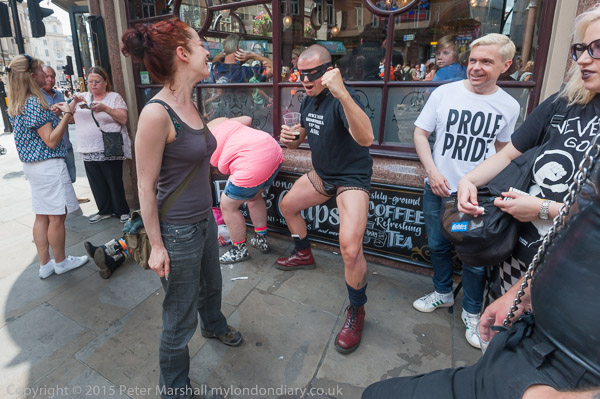
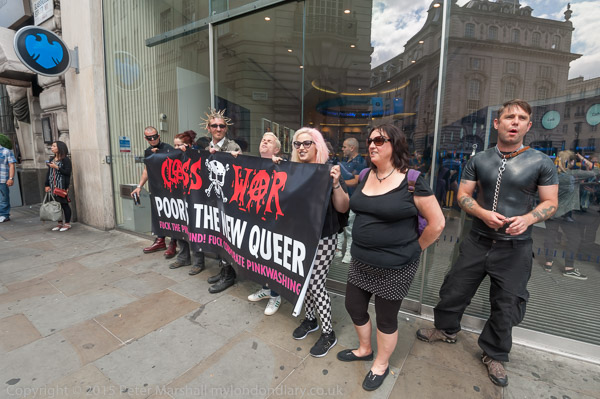
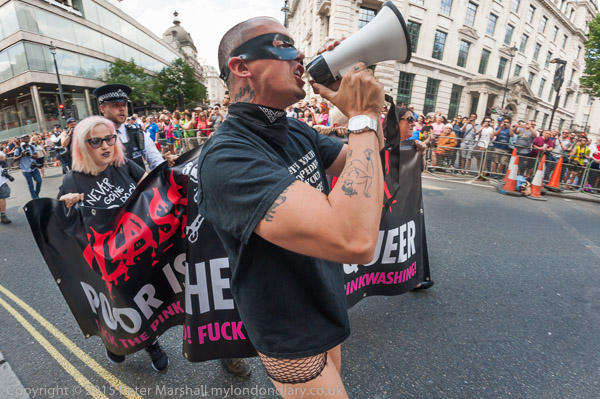
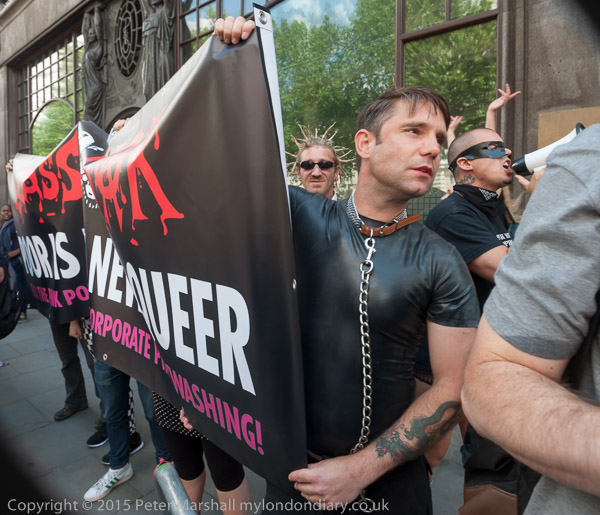
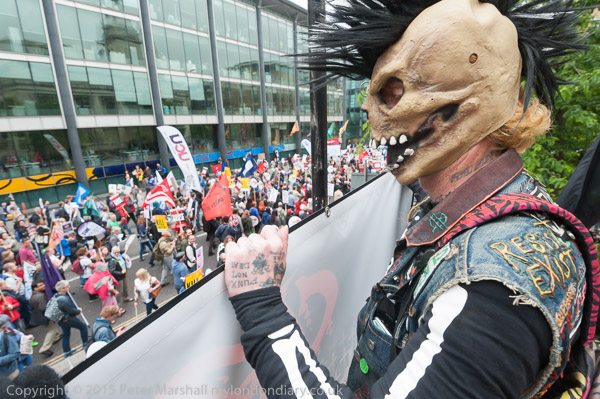
I took the tube from Baker St to Piccadilly Circus and walked into the pub where they were going to be and found no one there.  Eventually I found a small group outside just around the corner and joined them, still waiting for others to arrive. Class War had decided to protest at Pride, and had come with a new banner with the message ‘Poor is the new Queer‘ and ‘F**k the Pink Pound, F**k Corporate Pinkwashing!’  They were not the only protesters, and another group had arranged a funeral procession for Pride, which had attempted to go along a part of the route, but I’d decided that I would be unable to cover that as well as Class War.

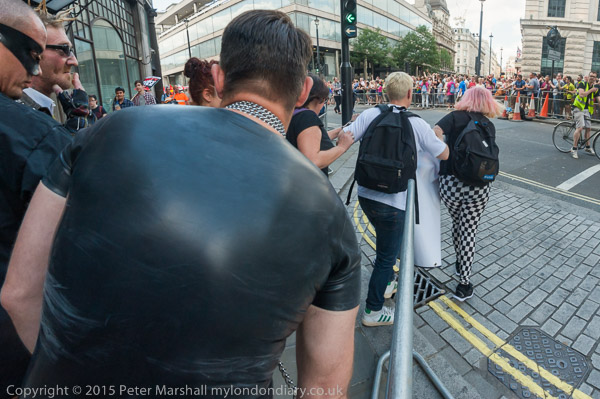
The small group of Class War protesters made their way to the parade route through Piccadilly Circus as the parade arrived, but the crowds were too thickly packed behind the barriers for them to get through. They held a short protest in front of the Barclays Bank there, which closed its doors, and then moved off quickly to find a less crowded part of the route on Cockspur St.

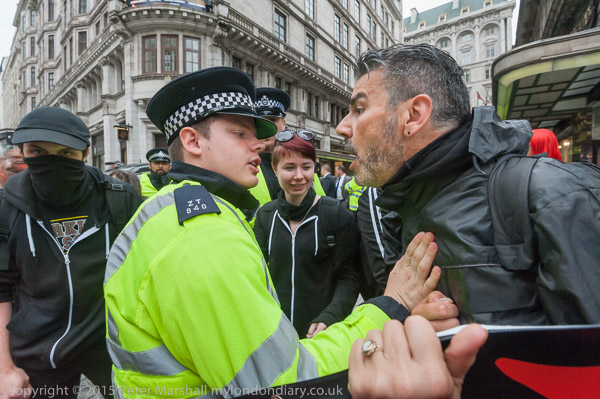
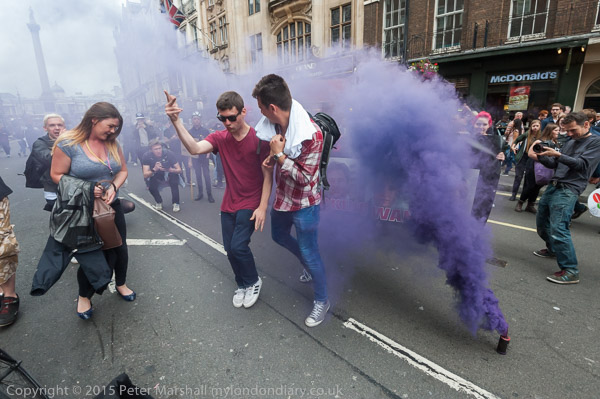
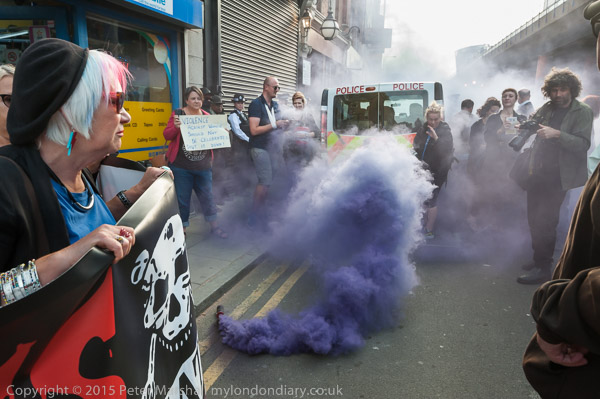
As the front of the parade approached, they unrolled the banner, unhitched one of the barriers and ran out in front of it, with a mauve smoke flare attracting attention, and I followed them onto the road to take pictures. They were soon escorted back off the road and I continued to photograph, though rather impeded by an amateur photographer who move in front of their banner, to the consternation of several of the press pack who had now arrived.

I’d thought in advance that I would probably be working at a very close distance and had decided to use the 16mm fisheye on the D700 along with the 18-105mm (27-157 equiv) on the D800E when a longer view was needed. It was a pretty good combination, but once Class War were back behind the barrier and I was still on the other side, after  a few frames I quickly changed back from the 16mm to the rectilinear 16-35mm.


Cropped to remove some of the vignetting by the out of position lens-hood

And there I caused a problem, because I had the lens-hood on that lens, although there was no need for it as that side of the road was in shade. And in my rush to change lenses and the general excitement, I managed to knock the shade out of its proper condition. As often in the heat of the moment, it was some time before I realised this, obvious though it is in the viewfinder, and I took a number of frames with it vignetting at top right and bottom left.  Images seldom work quite as well cropped to remove the vignetting, and sometimes I’ve lived with it there, usually desaturating it to remove a rather noticeable blue edge. The image above is probably better for losing a little at each edge, but there is still some vignetting visible.

Class War soon saw a squad of police heading in their direction and quickly melted away in the crowd. I followed some of them down into the subway from where they emerged without a police escort on the east side of Trafalgar Square and made their way to a nearby pub, where I said goodbye and went to photograph another event.

Many more pictures at Pride Parade (my pictures overstate the political aspects of the event as these interest me more) and Class War protest ‘corporate pinkwashing’.

Continue reading Pride Again?

Against Austerity

I got to Bank early for the March Against Austerity on June 20th because I knew it would get crowded. It was hard not to think back to previous events there,including the G20 Meltdown in 2009, where police came determined for a fight, having stoked up public hate against the protesters through the media over the previous week with predictions of violence and riot. What the organisers intended as a carnival of protest (though a very small minority of protests were intent on mayhem) ended up with police wading in, extended kettling, baton charges and the death of a bystander. Photographers were injured – one of my friends later got a large sum and extensive dental treatment and legal costs from the police for a totally gratuitous assault, another had his arm broken, and there were many more with minor injuries. And of course many protesters were also injured by the police, almost entirely those who had come with every intention of protesting peacefully.

I’d been fortunate then and left before the trouble really started to cover another event at the other end of town. By the time that finished it was too late to go back to Bank, as police had the whole area cordoned off and were not letting press in (or out.) It did mean I missed the chance of some dramatic images, but long ago, back on May Day in 2000 as I watched the riot police storming in to attack protesters I decided that I would where possible avoid being in such violent confrontations. Which I have more or less managed to do. Part of that decision was not to buy or carry the protective equipment which are now a part of many photographers standard equipment – helmets, shin pads and the rest. I’m a photographer not a para-military.

But on this day I expected things to be fairly quiet and orderly. Why? Because of the cuts that the protest was against. Police have suffered from them, and seem seldom to have either the resources or the will to oppose protests as they used to. There were a few police around, but hardly more than you might see on a normal day in the City, though rather more van loads sitting and waiting in case.

Class War and End Austerity Now

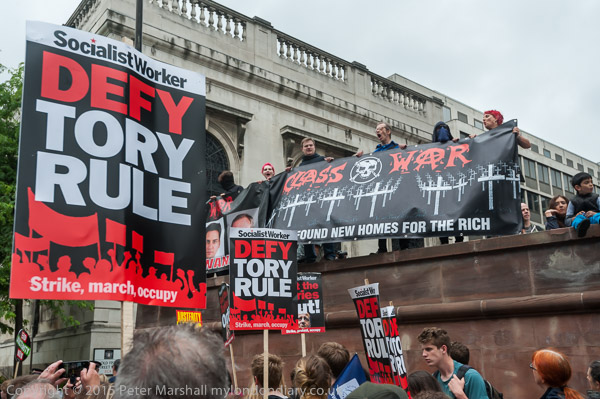
After a while I left in search of Class War, who had been dismissive of the plans for the march and rally, calling for direct action. Their published plan had been to meet up at St Paul’s Cathedral, but that was occupied by another event and they were nowhere to be seen. I wandered down to the route of the march, looking on Twitter for some clues as to where they might be without success. I’d taken a couple of pictures of the march when I realised something was happening just a few yards further on and it was Class War.

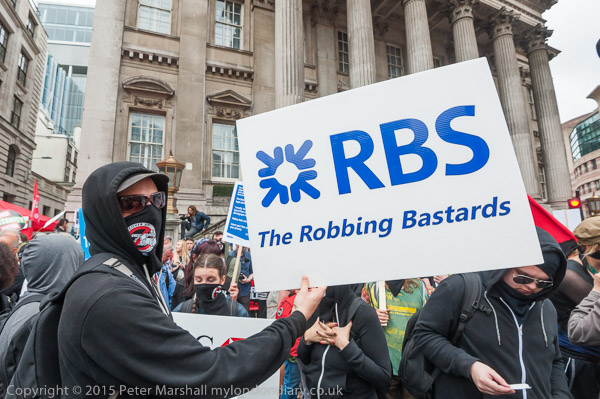
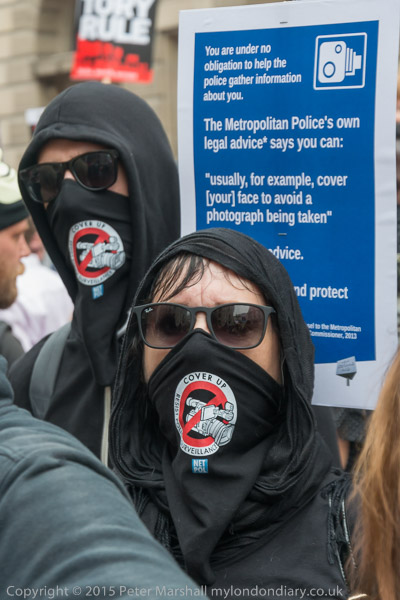
Some of them were standing with banners on the edge of a small courtyard which overlooked the street, and others were at the bottom of the steps down from this. As well as the banners and some unusual dress they were drawing attention to themselves by letting off smoke flares.

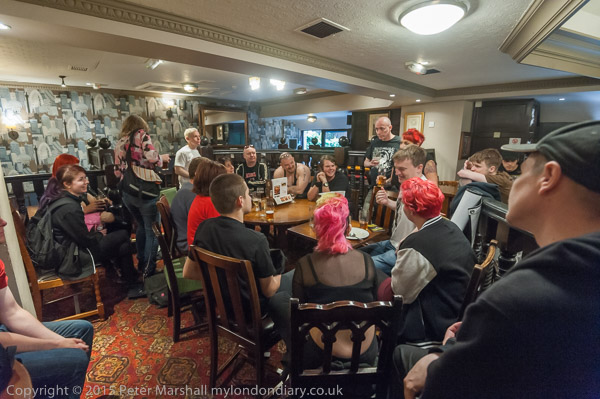
I stayed with Class War, photographing the rest of the large march as it passed their position. At one point, police briefly massed behind them as if to pounce, but then melted away. As the end of the march passed them, Class War tagged on for a couple of hundred yards, then turned off into the city alleys in search of a pub, followed at an indiscrete distance by the bill. The city isn’t their territory, and the search was fruitless until they chanced upon Ye Olde London on Ludgate Hill. I went inside with them while their escort waited on the other side of the road.

Although I’d found Class War, I’d also missed them, and a group of them had led a breakaway group of around 500 from the march down to the Elephant in support of the occupation of a pub there which has been bought to be closed down and opened as yet another estate agents. It was too late to try and join them by the time the news came through, so I settled down with a pint or two and listened to the discussion of what those in the pub intended to do next.

Class War at the Savoy

Eventually there was a decision to go to Westminster, where the rally after the march was taking place. Some were keen to take the tube, but others couldn’t afford the fare and they decided to march, and they turned out and set off, followed by the small group of police who had been waiting outside for an hour or so. As they crossed Lancaster Place, one of them called out for them to run to the Savoy, and they broke away from the police. But there were more police already at the Savoy who moved them away as they stood with banners and stopped a few of the taxis going in and out.

Class War in Whitehall

As it looked as if the police might be about to make some arrests, Class War ran off down the Strand and into Whitehall. There they met some of the marchers who were leaving the rally and stopped for more protests, meeting with a sound system and dancing in the street before going to protest in front of Downing St.

There were a few short speeches, some more dancing, and a smoke flare got thrown over the gates into Downing St. Quite a few people from the rally going past on their way home stopped to join them, but the light rain that was now falling dampened things a little. The police stood and watched but did nothing. When Class War decided the police were likely to make a move, they rolled up their banners and rapidly moved away with the crowd towards another pub to decide on further action. I’d had enough and I went home.
Continue reading Against Austerity

Climate Lobby

People going to lobby their MPs at the Houses of Parliament is seldom a good thing to photograph. Mostly the actual meetings take place inside offices either in Parliament itself or in Portcullis House around the corner, and even if you can get in to these meetings there usually is little to photography. The last time I actually lobbied my MP we went in as a small group to the St Stephen’s Tavern, just across the road from Big Ben and I did take one or two pictures, but the lighting was all wrong.

So when groups are taking part in a mass lobby of Parliament, they usually have a photo-call or a rally beforehand, at which there are rather greater opportunities for taking photographs. The Climate Coalition’s mass lobby was a little different to most, partly because of the scale and instead of going into Parliament to see MPs they had arranged for the MPs to come out and meet their constituents.

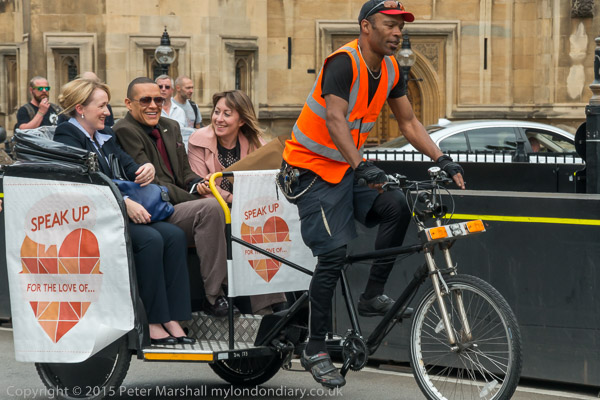
The various constituencies were each allotted a position along a long line stretching through the gardens next to the Houses of Parliament, across Lambeth Bridge and then down the Albert Embankment back towards Westminster Bridge – spread out along about three-quarters of a mile, with a cycle rickshaw service being provided to take the MPs as close as possible to their places.

I’m not sure quite how many MPs made it, but I think it was something like a third of the 650 MPs, but they were spread out not only in distance, but also across a two hour period. I’d started early, when just a few MPs and people come to lobby were around, and after photographing the few groups I could find in Victoria Tower Gardens, went off to cover a couple of other protests – the regular weekly vigil for Guantanamo prisoner Shaker Aamer in Parliament Square, and, a short walk away, a protest opposite Downing St for free speech activist and liberal blogger Raif Badawi, sentenced to 1000 lashes (essentially a slow death sentence) in Saudi Arabia.

Badawi was given the first 50 lashes in January, but the following Friday the second flogging was postponed as he had not recovered sufficiently, and so far it seems the scheduled weekly floggings have not been resumed. The sentence has however been confirmed and now UK government ministers seem to be excusing the Saudi authorities rather than joining in the world-wide condemnation, valuing UK arms sales above human rights.

Today comes the news that Badawi has won the annual Pen Pinter prize established in 2009 in memory of established in 2009 in memory of Nobel winning playwright Harold Pinter for championing free speech.

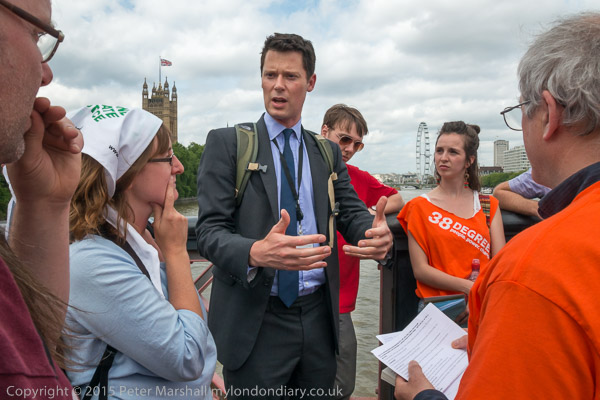
By the time I’d finished photographing this and returning to the Climate Lobby many of the MPs had been and gone, but I was able to run along and find those still talking and take a few pictures. It was hard on Lambeth Bridge because the pavement is so narrow and the groups were very crowded close to the MPs.

MPs are a pretty mixed bunch, and listening to them interacting with their voters I was surprised by a few of them, who seemed to have little understanding of the urgency of climate change, and were lecturing their constituents rather than listening to their views. But most seemed to share their concerns. I’m not sure that lobbies like this have any real effect.

After the lobby there was a rally, with speakers on the top deck of an open-top bus, which made them a little hard to photograph, especially with the sun behind them. A few were too short to be easily seen over the side of the bus, and it would have been good to have had some kind of platform for them to stand on.

As usual, the audience were more interesting than the speakers, as you can see in the pictures at Climate Coalition Rally. Images from the lobby are at Climate Coalition Mass Lobby.

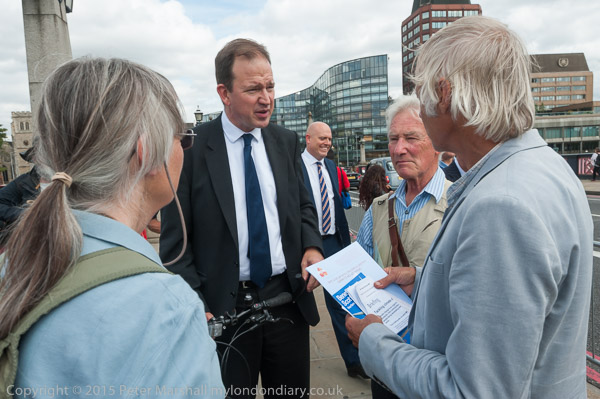
But at least at the rally the names of the speakers went up on a screen, though I missed one or two. Writing the captions for the pictures of the MPs took some time, working out who the MPs in the pictures were from my notes; fortunately some of the constituency labels were visible in the images. MPs often wear their ID cards with their name, but somehow these nearly always seem to be showing the wrong side. I often wish I made clearer notes, but I think you will find all four of the MPs shown above and most of the others have their correct names in My London Diary.
Continue reading Climate Lobby

August 2015 complete


Class War protest against Ripper sick tourist attraction in East End – 12th August

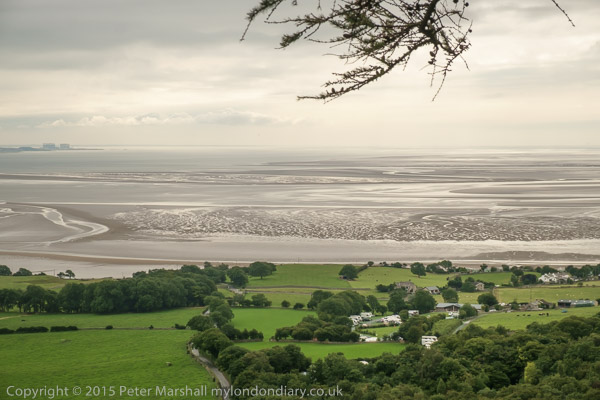
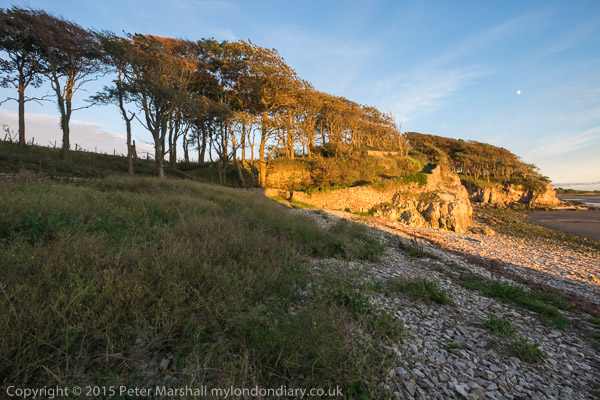
Only just over a month behind time! Includes my holiday pictures from one of England’s smallest designated AONBs (Area of Outstanding Natural Beauty) a designation that adds to those larger areas of outstanding landscapes which are National Parks, and is rather more specific. Arnside & Silverdale AONB is only 75 sq km and includes “almost 100km of well-maintained footpaths and narrow lanes and byways” most of which we walked in our week there.  And the walking was more important for me than the photography, though there are a few half-decent snaps, all made with considerably lighter Fuji-X cameras & lenses rather than my usual Nikon gear.

It was good to get the news that after another 48 days of strike action the dispute at the National Gallery appears to have been resolved and that PCS rep Candy Udwin shown in my picture below has been reinstated.

Aug 2015


Morecambe Bay with Heysham Nuclear Power Station at left from Arnside Knott
Silverdale Holiday
Stanwell Moor Walk


Zita Holbourne and Lee Jasper of BARAC
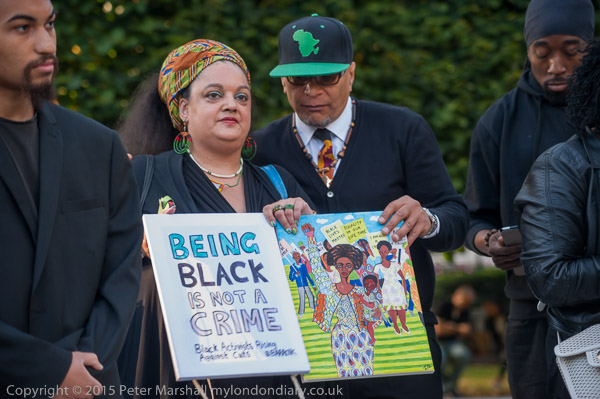
BlackoutLDN solidarity with Black US victims


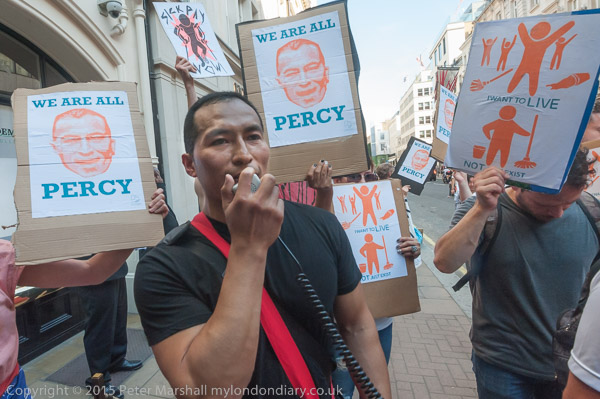
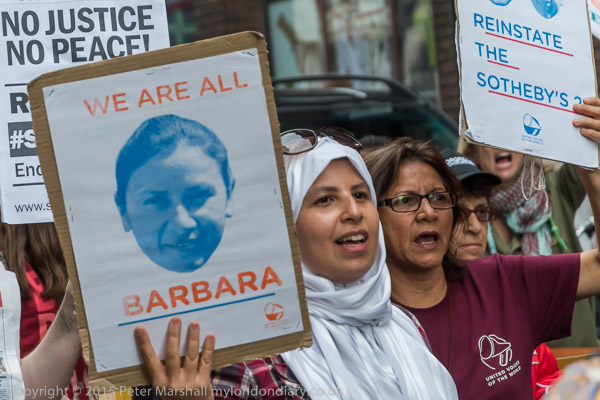
Protesters call for the reinstatement of Barbara and Percy, sacked for protesting for better conditions
United Voices – Reinstate the Sotheby’s 2
16th ‘Stay Put’ Sewol silent protest
Kurdish PJAK remembers its martyrs
Kashimiris Independence Day call for freedom
Sikhs call for release of political prisoners
Equalitate at Tate Modern
London Views


Candy Udwin, sacked by the National Gallery for her trade union activities as PCS rep
National Gallery 61st day of Strike
Marikana Mine Murders protest at Investec
Class War protest Ripper ‘museum’ again


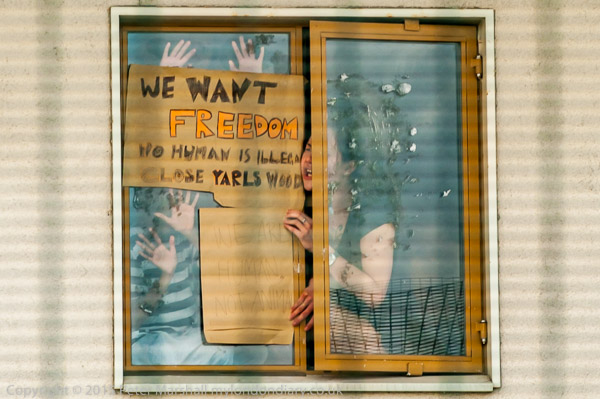
Asylum prisoners in Yarl’s Wood greet protesters from behind a tall fence. Windows only open an inch or two.
Close Down Yarl’s Wood


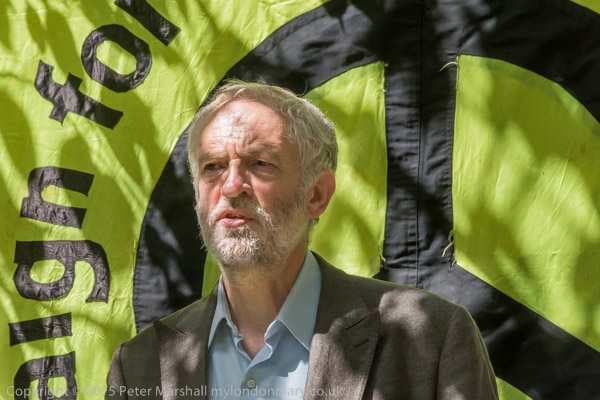
Jeremy Corbyn sings – ‘Don’t you hear the H bombs thunder’ rather than the National Anthem!
Hiroshima Remembered 70 Years On


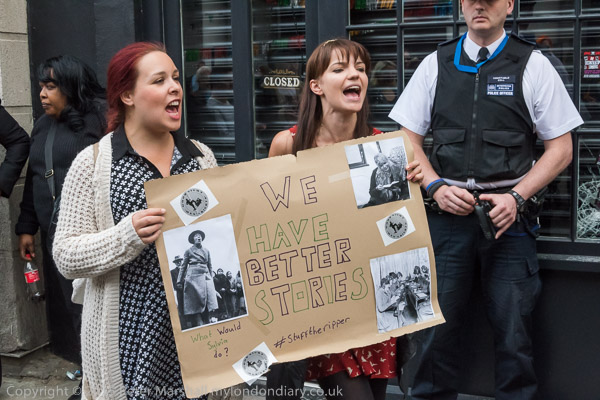
Feminists say ‘We have better stories’ with images of the suffragettes and other women in East London.
Class War at Jack the Ripper ‘Museum’


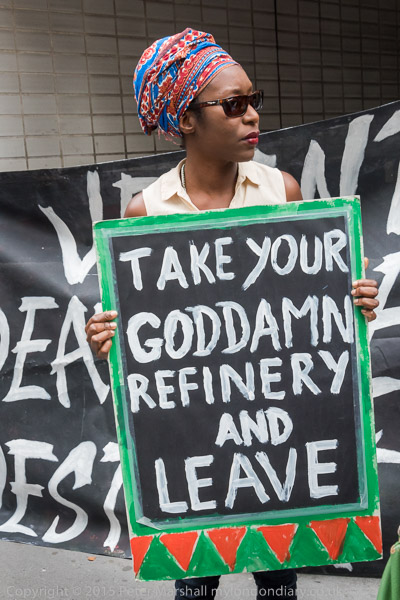
A placard with Arundhati Roy’s message to Vedanta ‘Take your goddamn refinery and leave’.
Foil Vedanta at mining giant’s AGM
Nitrous Oxide – ‘My Mind, My choice!’


Safia & friends from Focus E15 with a message for ‘Robin the Poor’ Wales, Mayor of Newham.
Focus E15 & Boleyn Ground campaign together
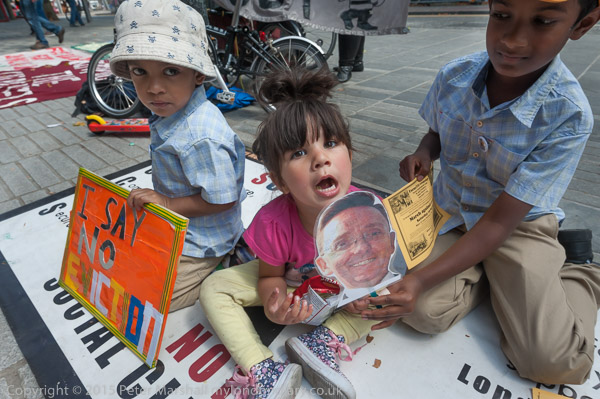
Boleyn ground fight for Social Housing

Continue reading August 2015 complete

Cable Street Ripper Horror


Cable St 70th anniversary, October 2006

I wasn’t at Cable Street in 1936, but was expecting to be there today, 79 years to the day after the ‘battle‘, but yesterday Class War cancelled their planned protest against the Jack the Ripper Museum there. It isn’t really a museum of course, although the owner pretended it would be, getting planning permission to open a museum celebrating the history of women in London’s East End.

That would have made an interesting museum, but would have been unlikely to make the kind of money the owner was obviously after in setting up the tacky tourist attraction that has now opened. Several protests have taken place there, and there is now little doubt what most people in the area think about it – and if anyone still has any doubts about its nature they should read the review by Fern Riddell on Storify or the article based on that in the Independent newspaper.

Fern Riddell is a historian who specialises in the period and in the area, and a consultant on the BBC’s Ripper Street series, so someone whose opinion is of value. Her conclusion: ” it’s not a museum. It’s a poorly executed shock attraction.”

Earlier in their planning, before the change of purpose, the Museum had consulted a friend of mine formerly from the Museum of London who was shocked to hear her name being used to attempt to give the ‘museum’ credibility and made it very clear to the owner that this was entirely unacceptable, getting an undertaking from him not to do so – which he has now broken.

I photographed protests by Class War outside the ‘museum’ on August 5th and 12th, and filed my pictures in the usual way. There was no interest in the protests from the media and none of my pictures were used at the time. Both protests were relatively peaceful, though one small pane of glass was cracked. The protesters held up the traffic on a minor road for some minutes, made a lot of noise, and on the second occasion let off a few flares.
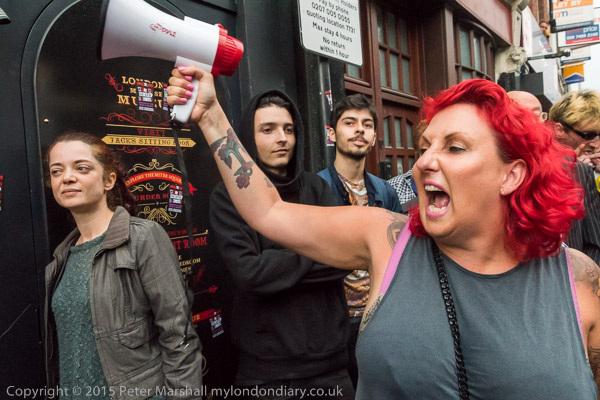

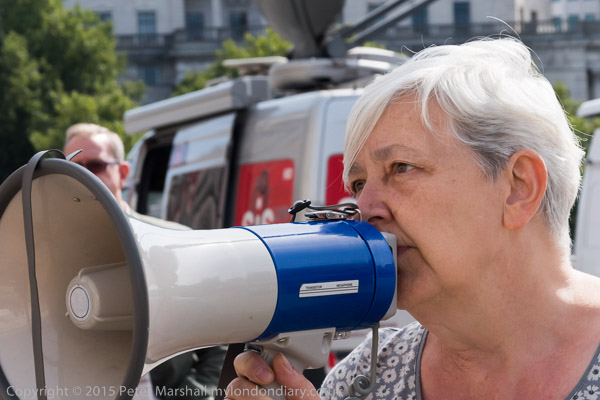
Lisa McKenzie at protest against the Ripper ‘museum’

In the last week, one of my pictures taken at the protest on August 5th has  appeared in several newspapers, some of them more than once. The reason is that some of the same people who organised the ‘Ripper’ protests also organised an anti-gentrification street party in Shoreditch a week ago on Saturday night.

Around a thousand people turned up and took part; I didn’t go although I had been asked to, because I’d had a busy day and its quite a trek from where I live. There was music, masks, dressing up and Class War’s banners; a lot of chanting and shouting, flares, arguments with police who tried to stop it – and some fighting with police when they started pushing people off the road.

I wasn’t there, but many others were with cameras and phones and I’ve seen the videos and heard people’s stories. There were two fairly minor incidents in which two shop fronts were attacked. There was a lot of angry shouting, and the glass of an estate agents window was cracked, and slogans daubed on a hipster-run ‘cereal shop’.

There were a few other nasty incidents recorded on video, including a police attack on a young woman which could have been really serious, and there were a few injuries and some arrests. But it is the cereal shop incident that has apparently enraged the newspapers, causing them to throw as much mud as they can at anyone connected with Class War, whether or not they were around at the time.  Someone even invented a story about the protesters – many of whom also campaign for animal rights – ripping a dog apart with their bare hands for the press. Though there were no real witnesses.

The woman with a megaphone in my picture became one of their chief targets, with some articles that can only be described as vitriolic, although she had left the protest before any trouble occurred. It’s a picture I like because it shows her as a strong and determined woman, and one which I think celebrates her and the working class culture from which she comes.

She left school shortly before she was 16, taking time off school with other women from miner’s families to support their striking men, worked 10 years in a stocking factory, then in shops etc, living in the notorious St Ann’s district of Nottingham. She became a single mother and at 30 took an Access course, going on from there to study at Nottingham University for a first degree and then her Ph.D.

Back in 1970 I bought a book, a Penguin Special, ‘Poverty: The Forgeotten Englishmen‘ by Ken Coates and Richard Silburn, based on their studies in St Ann’s (though the cover photograph by Roger Mayne was I think from North Kensington.) It was this book which inspired Lisa McKenzie to study the area she lived in and knew – and which ended up in her doctorate and the book ‘Getting By‘ that came out earlier this year.*
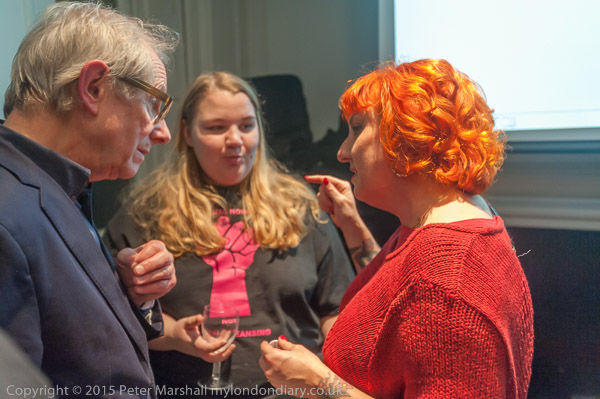

Ken Loach, Jasmine Stone and Lisa McKenzie, author of ‘Getting By’ talk at the book launch

Hers is really a great story of success, a positive story that my picture I think celebrates, but in the media she is portrayed as the devil, an ‘academic‘, someone who obviously doesn’t know anything about the lives of ordinary people. They suggest she is wealthy and privileged and using the lives of the poor for her advantage, but she is in a job that almost certainly pays less than the average wage and her work is all about supporting working class people and their values.

Once you put work into an agency you lose control over it. I’m sure there are uses for which my agency would not supply pictures, publications they would not supply images to, but these were articles in the mainstream press. Companies which almost any agencies would supply images to in good faith. You can’t vet articles when you are supplying pictures, and nor should you be able to or have to. We should demand higher journalistic standards from the press.

But perhaps all is not lost. I cling to the hope that many readers – even of the gutter press (and more seems to be aiming for the gutter at the moment) will see the picture for what it is – an affirmative image of a strong and obviously working-class woman protesting against the horror of a ‘shock attraction’ that glorifies ‘nameless violence inflicted on nameless women’. And perhaps there will be many, particularly working-class women who are less scared of the idea of a strong working-class woman than newspaper editors.


* Any journalist writing about her who had done even a few seconds of research would have found this information about her in an article in The Guardian: The estate we’re in: how working class people became the ‘problem’. It comes up as the second item when I search for her on Google.
Mooning Around

Seriously bad photographs were splashed all over the Internet yesterday, and Petapixel has a good selection of these moonshots in People Just Found Out How Bad Smartphones Are at Photographing the Moon.

I got as far as struggling out of bed in the middle of the night – not an unusual event at my age, and having emptied my bladder did put on a coat and wander into the garden looking for the moon, eventually finding it over the roof of the house and realising I could have seen it just by looking out of the bedroom window. I wasn’t too impressed although the moon was half eclipsed and looking rather orange in the darker segment, and went back to bed.

An hour or so later I woke again, and rolled out and took the few steps to peer through the curtains at the now fully eclipsed circle for a second or so before returning under the covers to sleep soundly until my radio alarm came on at the normal hour. As I listened the the news of the eclipse with a woman astronomer waxing lyrical about the experience, it did occur to me that I might have found it slightly more spectacular had I bothered to put my glasses on in the middle of the night.

Several photographer friends did post their moon images on Facebook in the morning, and they were reasonably impressive, certainly standing out among the amateur efforts, some of which were even worse than those featured on Petapixel. But I hadn’t thought it worthwhile trying to photograph the event myself.

Of course I have photographed the moon on various occasions, but it’s always been disappointing. What looks large and bright always comes out small and dull in my photographs. We seem to always see the moon as much larger than it is, due to some curious feat of mental image processing. That tiny speck in one of my holiday pictures above really did seem quite large in the sky, but on an image this size just looks like some nasty little blob.

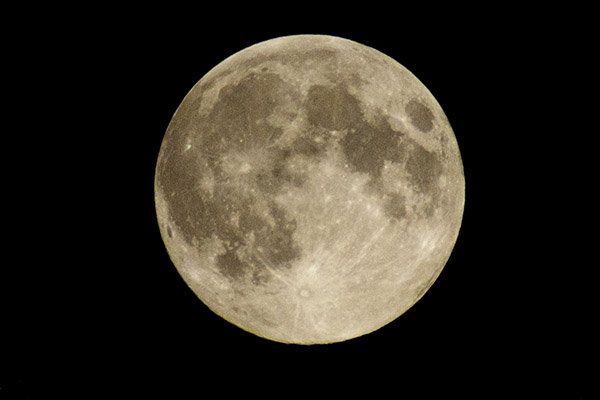
But here is one I took earlier. During one of last year’s three ‘supermoons’ I went out into the back garden and took this hand-held with my 70-300mm lens on the Nikon D800E. The lens isn’t at its best at 300mm, but I stopped down to f8 to give it a chance. Even at ISO 200 I still only needed a shutter speed of 1/1000.  For sunlit scenes, the ‘Sunny 16’ rule says 1/ASA at f16; 1/200 f16 gives the same exposure as 1/800 f8, pretty well spot on in this case. The sky wasn’t as dark as it is in the picture – but was a sodium orange from all of the street lights around, and I cheated by darkening it in post-processing.
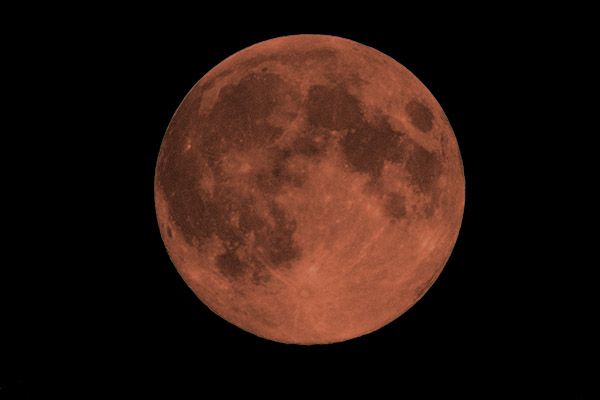
Even at 300mm, the moon isn’t very large on the full frame, but I cropped it drastically for the above image. It’s hardly exciting, but it does show the difference between using a camera and a phone. And if you want it red, you can ask Photoshop:

Of course the interesting photographs of the eclipse show the moon in a landscape or frame of some sort; one friend set up his tripod and tried to track the various phases of the event – and by far the most interesting was as it half disappeared behind the chimneys of the house across the road. I think the more dramatic images were probably taken with lenses in the ultra-long range, perhaps 1000mm, and will often have involved making two exposures, one from the moon and a longer one to get detail in the scene and combining the two. Perhaps you could use the HDR mode that some cameras provide.

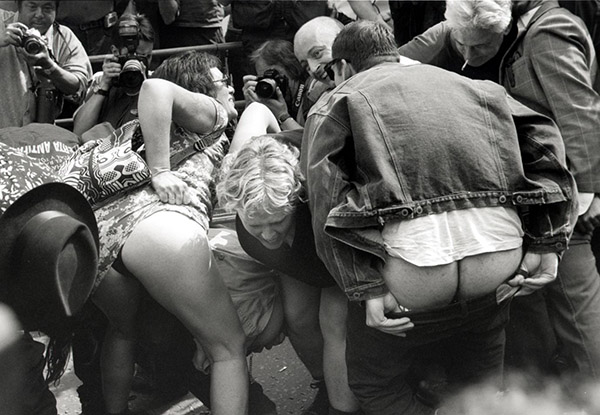
But for a rather more interesting ‘moon’ photograph, here’s one I took 15 years ago outside Buckingham Palace, at a protest by the anarchist Movement Against the Monarchy. They had hoped to have a “2000 bum salute” at their Moon Against the Monarchy in June 2000, but a huge police presence intimidated all but a determined half dozen or so into keeping their backsides covered. Shortly after this picture was taken, a group of police rushed into the crowd and arrested an innocent French tourist, who had the misfortune to be wearing the same style of John Lennon glasses as one of those who had dropped his trousers.

Continue reading Mooning Around

Shaker Aamer to be freed


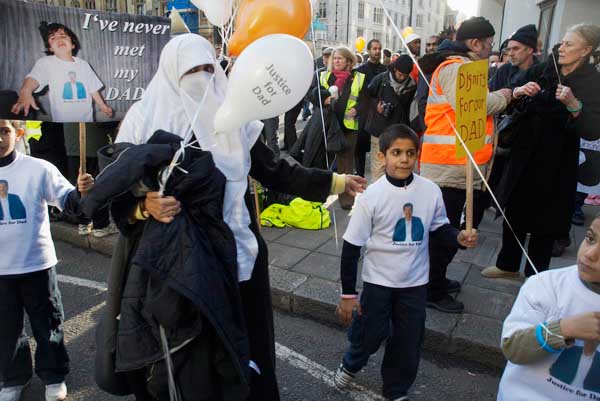
I’ve never met my DAD. London, Jan 2006
Shaker Aamer’s youngest son, now almost 14 was born a few months after his capture

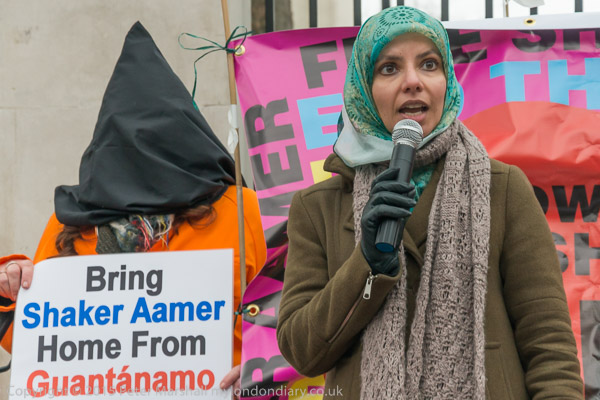
At last, the news we have waited too many years for. Finally, Shaker Aamer, the last UK prisoner in Guantanamo is to be released.


Joy Hurcombe of the Free Shaker Aamer campaign, June 2015

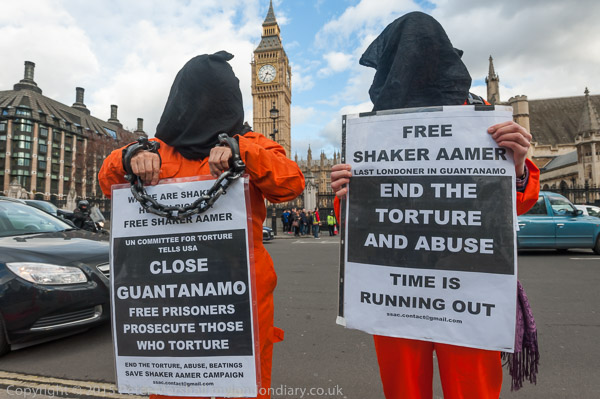
I’ve long lost count of how many times I’ve photographed and written about protests to free Shaker, including many of the regular protests by the London Guantanamo Campaign and the Free Shaker Aamer campaign.  The first I remember covering was in January 2006, when a protest march called for the release of nine people with British citizenship or right to remain where still held there, Shaker Aamer among them.


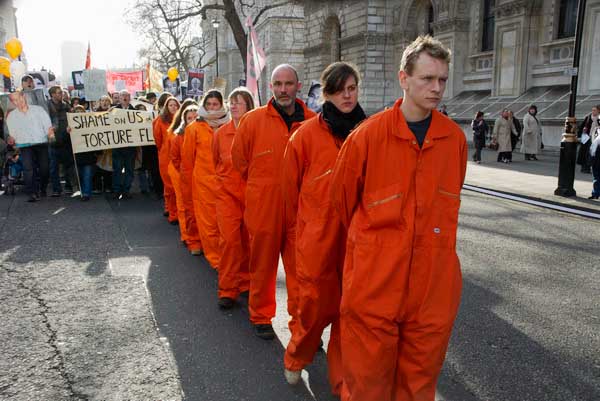
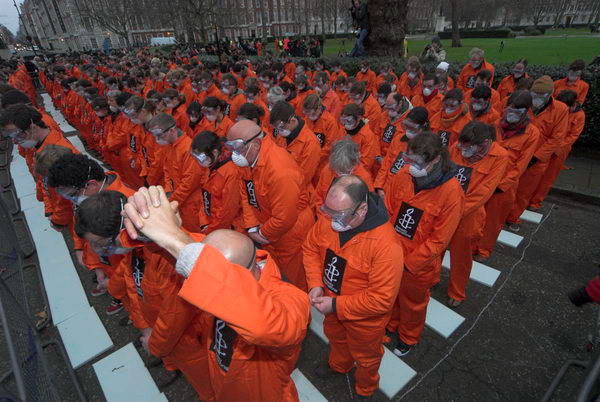
Those orange jump suits were soon a familiar sight at protests. London, Jan 2006

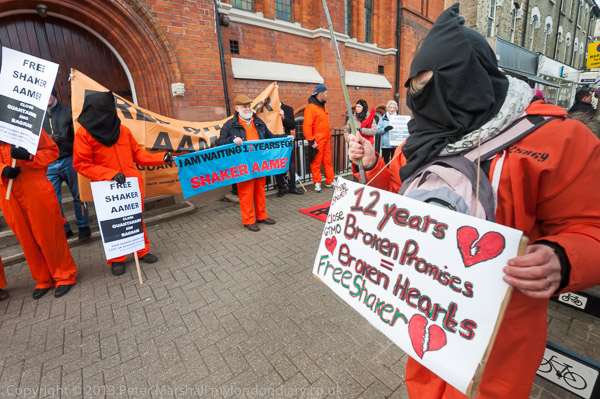
Those jump suits caused be no end of photographic problems, which I’ve written about over the years, because they were so bright – and often fluorescent – and in an area of the spectrum which often causes difficulties.


Battersea, Nov 2013

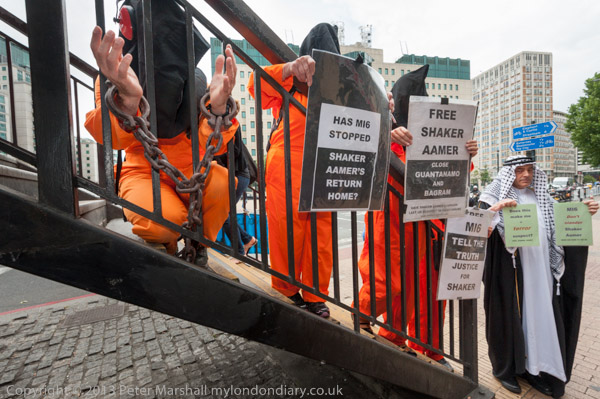
The Free Shaker Aamer campaign has been coming to stand opposite Parliament every week while it is in session for several years, and I’ve photographed them many times, as well as at other protests they have had outside the MI6 headquarters in Vauxhall and in Battersea, close to where his family lives.


Vauxhall, Aug 2013


Amnesty International protest at US Embassy, Jan 2007

Every year since 2007 I think I have photographed events to mark the anniversary of the opening of Guantanamo, some outside the US embassy, others elsewhere in London. There have also been protests on the anniversary of Shaker’s illegal rendition to Guantanamo from Bagram, on St Valentines Day, Feb 14th, 2002.


Aisha Maniar, organiser of the London Guantánamo Campaign speaks at Downing St, Feb 2015

It was news that was welcomed by almost everyone, including politicians of all the main political parties who have supported the campaign for his release. Almost everyone, except perhaps someone in the BBC, who invited a spokesperson from the US right wing Henry Jackson Society to come on and spread some unsubstantiated lies about him, telling anonymous rumours that the US authorities were unable to find any evidence for as if they were facts. Had their been any real evidence they would never have cleared him for release, even for Saudi Arabia, as they did first eight years ago in 2007 and again two years later.


One of the many protests by the Free Shaker Aamer campaign every week Parliament was in session. Feb 2015

Its hard to understand why, and it certainly can’t be explained by their usual ideas about balance. Perhaps the only credible explanation is that it was the start of a campaign by MI6 and the US security services to discredit the eye-witness evidence that Shaker may give about torture and their part in it, both at Guantanamo and before that at Bagram. Shaker too when in Guantanamo stood up for the other prisoners; one of few there among detainees and jailers understanding and speaking both English and Arabic, he became both a translator and an advocate. The BBC claims to be above such things, but unfortunately often bows to political pressure, as we have seen in the past week in their failure to cover #piggate.

Two posts on the protests in June:

Magna Carta justice for Shaker Aamer
New MPs Stand with Shaker

And too many more on My London Diary to post them all.

Continue reading Shaker Aamer to be freed