LIFE Force

I had forgotten about Life Force*, a ‘a free, monthly, on-line, photo-led magazine which celebrates the art-form of the photo-essay‘ which has been available since the January 2011. The back numbers are still available and over the years it has built up a interesting and varied collection of stories, though perhaps not all of them are truly ‘great photography and pushing the boundaries of the medium to explore conciousness and human perception, by harnessing the unique power that photography holds to capture a moment for analysis.‘ But there is plenty worth looking at, including work by a number of photographers I know as well as some I was surprised to find I didn’t.

The November 2015 issue has seventeen stories, some old, some recent. Rather than talk about them all, I’ll perhaps mention just three of more local interest.

Tonight several of my friends will be out photographing in Lewes where the Firework Societies will be celebrating, including burning a giant effigy of David Cameron with a pig on his lap and another of Seb Blatter. Patrick Ward‘s pictures of the Lewes Bonfire Societies which he was able to cover as an insider give a good impression of the activities, though perhaps they lack a little of the excitement I’ve seen in some other images from these events.

I was more than a little envious at seeing Unseen London by Peter Dazeley who has gained access to photograph the ‘hidden interiors of some of London’s most iconic buildings, from Tower Bridge to Battersea Power Station, Big Ben to the Old Bailey‘ and has done so with great care. Although I’ve actually been inside quite a few of the places in this set, either I’ve not had the opportunity to take pictures or have had to make do with hurried snaps, full of other visitors. The only man in Dazeley’s set is a founder at work in the Whitechapel Bell Foundry, an image which for various reasons I feel does not fit well with the rest of the set.


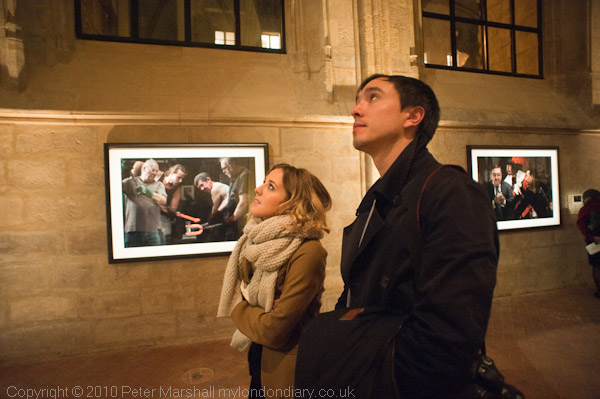
At the Paris opening in 2010 © Peter Marshall

Finally you can see Brian Griffin‘s Black Kingdom, work I have written about before when I attended the opening of his show of in Paris. You can see more pictures from that opening on My London Diary. Good though the work by the others is, his is perhaps the only one of the three I’ve mentioned that I feel is any way ‘pushing the boundaries of the medium to explore conciousness and human perception‘, though there are other essays on the page that could also be considered to have done so.


*I’ve not added links to the individual issue or essays as these are not permalinks and will change presumably when the December 2015 issue is published. To find them after that date you will need to use the ‘Back Issues’ link at the top of the home page and then select the November 2015 issue.
Continue reading LIFE Force

Are photographs ever portraits?


John McDonnell MP, Shadow Chancellor of the Exchequer speaking at yesterday’s ‘Grants Not Debts’ protest

I take a lot of pictures of people, some of which I share here and rather more on My London Diary. I’ve also photographed many others, including members of my own family and friends I know well. Quite a few of those are framed and hanging on people’s walls, while those I’ve taken of public figures have featured in various magazines and newspapers. Some are better than others but most are pretty routine, like yesterday’s picture of Shadow Chancellor John McDonnell, a man I know and have photographed on many occasions over the years.  It’s not a great image, but you can find worse of him every day in the newspapers.

But I’ve never thought of myself as a portrait photographer. And always rather questioned the whole idea of a photographic portrait. I think there are valid examples – for instance Alfred Stieglitz‘s truly intimate work on Georgia O’Keefe springs to mind, but there I’m thinking not of a single image, but of a whole set of images,beautifully presented in the 1978 Metropolitan Museum of Art publication ‘Georgia O’Keefe – A Portrait by Alfred Stieglitz’ which on the front dust-jacket flap states ‘His idea of a portrait was not just one photograph but a series of photographs that would be a portrait of the many aspects of a person.’ (The book is still available from book dealers at a ridiculously cheap price for such a well-produced and important work.)

There are many other pictures of people that I like, many of them good or even great photographs but few which really reach into the depths of a person in they way the best painted portraits do. Though its also very clear if you take a walk around inside – for example – the London National Portrait Gallery that there are many bad painted portraits as well as many poor photographic portraits both in the permanent collection and in their annual prize shows for photography and painting.

But even among photographers whose work I admire greatly, their ‘portraits’ are often the weakest work. Even with a master like Cartier-Bresson there are images which without the name of the famous sitter would probably never have been printed. (Some of his better portraits  along with some images that certainly are not portraits and one or two that perhaps fail to display his master touch and were clichés even before he made them are linked in the Portraits selection on his Magnum page.) And newspapers and magazines are full of poor or indifferent if sometimes technically competent images of people.

What got me thinking about this was a video created by The Lab in conjunction with Canon Australia in which they set up six portrait photographers to photograph the same man, giving each a very different story about him. Looking at what you can see of their results on the video published in the story by Shutterbug, each produced a very proficient image based on the story they were given, particularly as they were given only ten minutes (though often photographers have to do with considerably less, while painters often have months rather than minutes.) But I don’t think any of them was really a portrait of the person, rather an illustration for the story they were told.

Continue reading Are photographs ever portraits?

Jerusalem Day

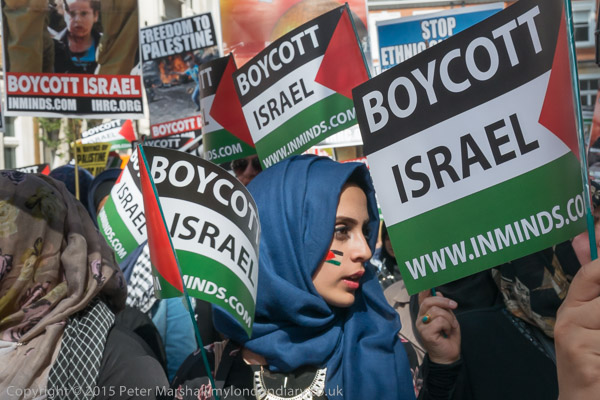
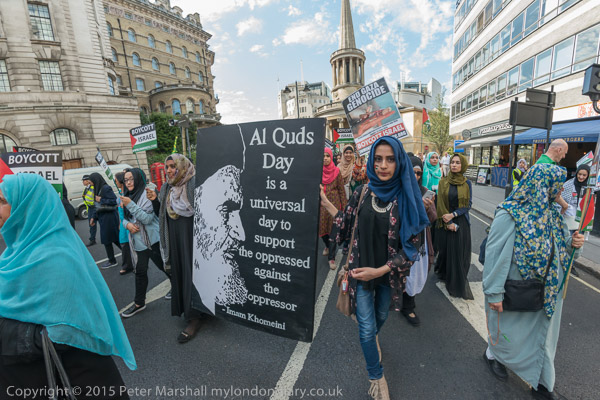
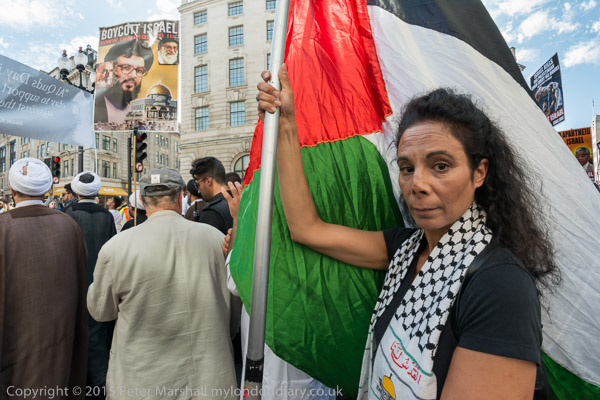
Al-Quds is the Arabic name of Jerusalem (and its Quds in Persian) and in 1979 the Iranian Supreme Leader Ayatollah Khomeini invited “Muslims all over the globe to consecrate the last Friday of the holy month of Ramadan as Al-Quds Day and to proclaim the international solidarity of Muslims in support of the legitimate rights of the Muslim people of Palestine.” He also said it was “a universal day to support the oppressed against the oppressor.”

In Iran there are large state-sponsored protests against the Israeli domination of Jerusalem in particular, but also more widely against Israel’s repression of Palestinians in Gaza and the West Bank, and in support of the Palestinian cause. As well as in Iran, there are protests in a number of other countries around the world, including the UK. Here a major part of the protest is the call for a boycott of Israeli goods.

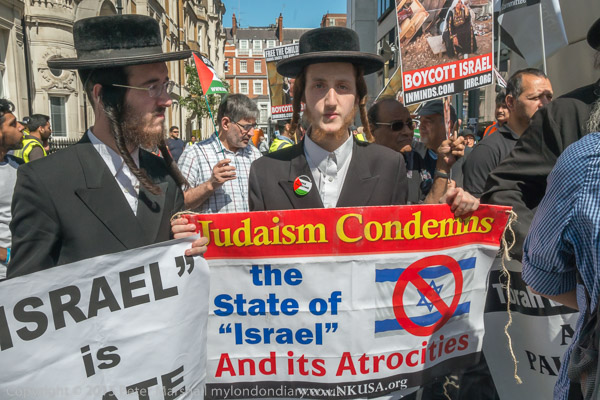
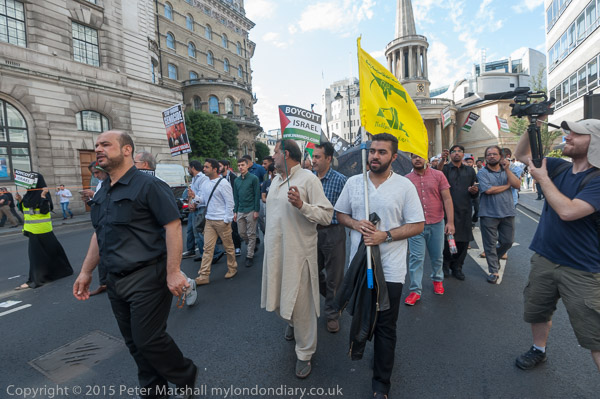
Although most of those actually marching in London are Muslims, including many from Birmingham, Manchester and other cities with substantial Muslim populations, the event is also supported by some non-Muslim groups, including the Stop the War Coalition and several Jewish groups including Jews for Boycotting Israeli Goods and the anti-Zionist ultra-orthodox Neturei Karta who oppose both the State of Israel and Zionism on religious grounds.

The march has been taking place annually in London for over 10 years (I think I first photographed it in 2006, though possibly I took images in previous years on film) and has attracted criticism from some Jewish and ultra-right groups, as well as various Iranian opposition groups – the march is organised by the Islamic Human Rights Commission which is thought to receive funding from Iran.

I’ve seen little evidence of anti-Semitism on these marches, and have seen the stewards take action to remove a clearly anti-Semitic banner. Clearly everyone marching is against Zionism and Israeli attacks on Palestinians and their human rights. One of the more curious spectacles on one previous march was s to see members of a neo-Nazi group, some with clear records of anti-Semitic actions hurling the insult of anti-Semitism at Jews and Muslims marching side by side and sometimes arm-in-arm through London.

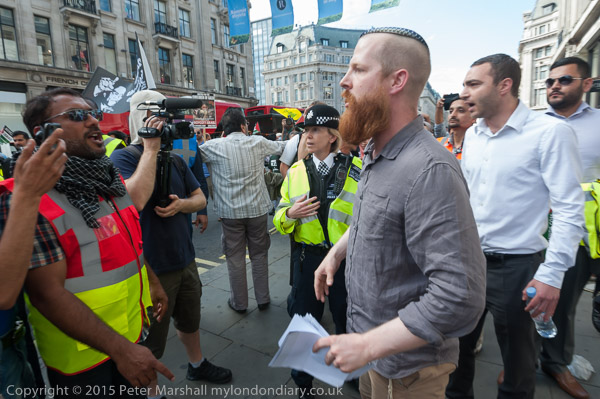
For the past couple of years there have been no real counter-protests – last year a pro-Zionist shouted and threw vegetables from an upper-floor window at the marchers and this year a young man shouted at the marchers and handed out misleading leaflets about how well Israel treated the Palestinians, arguing with some of them until the police led him away.

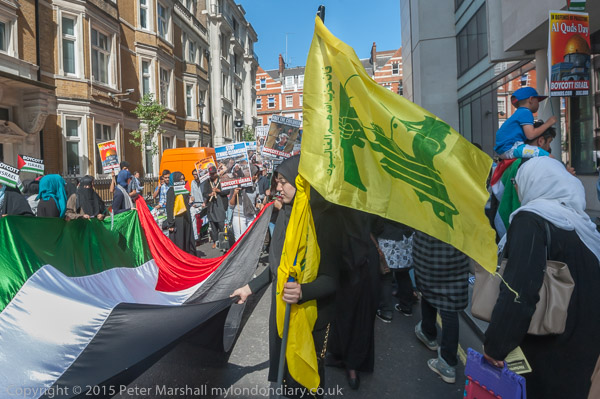
One complaint against the march has been that many on it carried Hezbollah flags and some have said this is illegal. The flag serves for both the military wing – which is proscribed – and the political party which forms a part of the Lebanese government, which, at least in the EU and UK, is not proscribed. There were in any case very few such flags in evidence at this year’s march -and I was looking carefully for them – a handful among the several thousand marchers.

Because of the origins of the event I was also particularly keen to photograph banners and posters which referenced Ayatollah Khomeini – and again these were relatively few. Overwhelmingly this is a march in support of Palestine and calling for its freedom and an end to Israeli aggression and repression there.

My pictures also include many more of women than of men on the protest, mainly because most of the women are in Muslim dress, while the men, apart from the religious readers wear the kind of casual dress that you would see on any high street. Just a few women turned away from my lens, but most seemed rather keen to be photographed, and I had no problems in taking pictures, something which has occasionally been a problem in the past at some Muslim events.

More on My London Diary at Al Quds Day march.

Continue reading Jerusalem Day

September 2015

Just over a month behind, last night I put the finishing touches to my posts on My London Diary for September 2015.


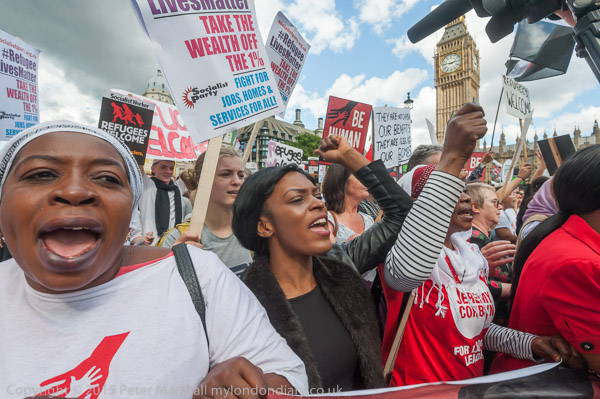
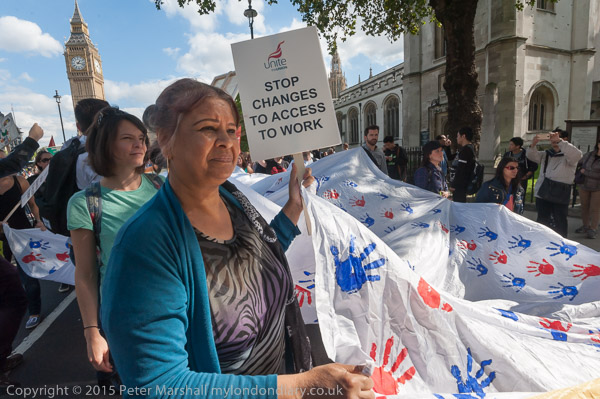
Refugees are Welcome Here march reaches Parliament

It was a busy month yet again for me, with over thirty stories, partly because of the DSEi East London Arms Fair – or rather the protests and events around it taking place, something which happens every two years.

It was also a very interesting month, with the election of Jeremy Corbyn as Labour Party leader and his appointment of John McDonnell as Shadow Chancellor. I’ve photographed and talked with and listened to both of them speaking many times over the years, but this has meant that both of them have been too busy to attend the events I’ve photographed this month.

Knowing both of them the media response to the election has been ridiculous in the extreme – as have been the comments of both government and some Labour party politicians. The establishment is clearly running scared and throwing all kinds of ridiculous assertions at them. They clearly give the Labour Party its only hope of winning the 2020 election after its recent failures and would also put the country under rather better management than it currently enjoys, though whether they would be able to break the stranglehold of the city and the ultra-rich is debatable. I think in the end they are both far too reasonable and conciliatory to really make the radical changes the country needs, but I still have some hope for the first time in some years.

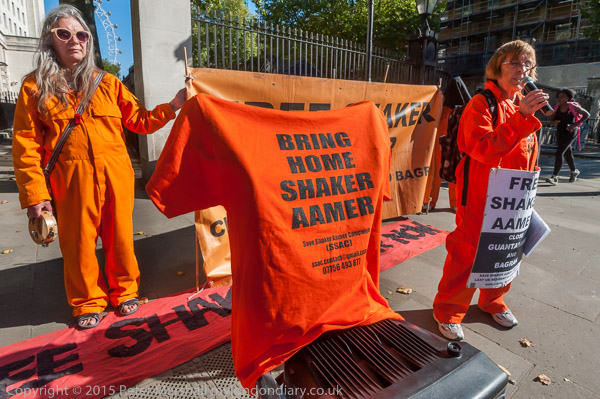
People often tell me that protest is useless and never achieves anything, but they are simply wrong. Two series of protests I’ve been photographing appear to have reached at least a reasonably successful conclusion this month, with an agreement being reached after 100 days of strikes at the National Gallery, and also apparently between the UVW and Sotheby’s, though I think details have yet to be finalised. The protests over refugees have so far only led to a minor shift in the Government’s position, but I think we may see more, and finally Shaker Aamer was released a couple of days ago and is back in a London clinic.

Continue reading September 2015

Victimised Workers


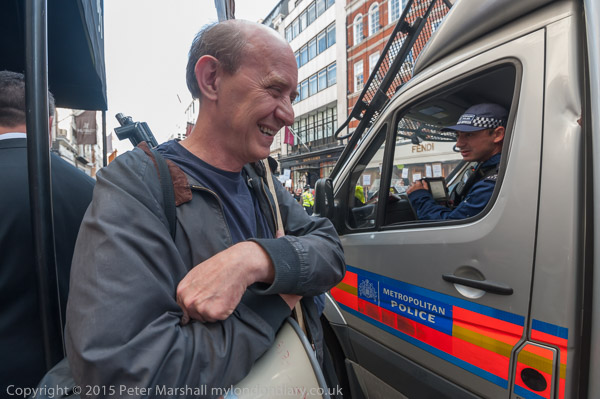
Sandy Nicoll from SOAS Unison smiles at police who ask him to move outside Sotheby’s

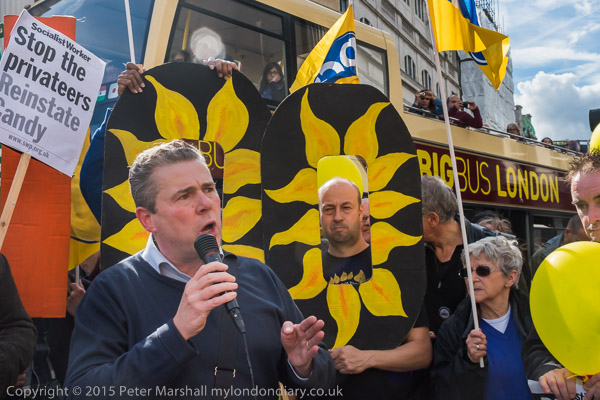
This will be a rather shorter post than usual (I hear murmurs of “Thank goodness” from readers) because I’m rushing to leave for an emergency demonstration called because Sandy Nicholl, SOAS Unison’s branch secretary has just been suspended by the SOAS management on grounds of gross misconduct.

As in other such cases, the allegations made against him appear to be false and in any case would not be grounds for their action, but are simply victimisation for legitimate trade union activities that annoy the management.


The SOAS Unison banner which Sandy brought to the protest at Sotheby’s

On the evening of July 8th I was taking pictures of a protest over another case of victimisation, where Sotheby’s had effectively sacked four workers for taking part in a legal demonstration calling for proper sick pay, holiday and pensions arrangements. As so often, the union involved, the United Voices of the World, was supported in its protest by other trade unionists, including other victimised union reps such as Candy Udwin from the National Gallery and Alan Brown from Bromley Council, and, as at many other such protests, by Sandy Nicholl with the SOAS Unison banner.


Sandy and Candy Udwin behind the National Gallery strikers banner

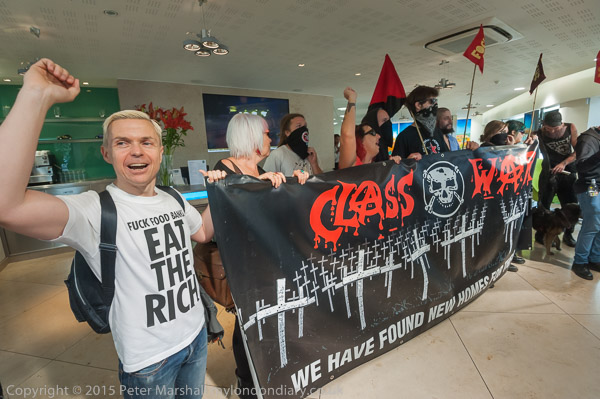
Of course there were others giving their support to the UVW, notably Class War, who had brought their water pistols, megaphone and ‘We have found new homes for the rich‘ banner and infused the occasion with their usual theatricality. Others making their presence felt included some from Lewisham People Before Profits and OSE (Open School East) Artists.

But at the centre were the UVW, and their General Secretary Petross Elia, standing up to some fairly extreme harassment by police who had obviously been leaned on very heavily by Sotheby’s and their influential friends to try and counter the protest rather than – as they should – facilitate it.  It’s a line on which police almost always favour the rich and powerful.


Police surround Petross Elia, refusing to look at him as they push him away

One of the placards which you can find if you search the images at Sotheby’s 4 sacked for protesting I think sums things up nicely; the text reads ‘Your worker’s rights are bad for my business!!’  But they are rights enshrine in law and the law should prevail, and in this case, eventually after some further months of struggle it seems as if here and at the National Gallery it has.

Now I’m off to SOAS to see more people standing up for the law.

Continue reading Victimised Workers

Budget Balls and More

The trouble with working on a Wednesday“, one military gentleman once remarked, “is that it cuts into two weekends“. I don’t like it either, as usually it’s the day of the week when I catch up with some of the little routine things that need doing regularly, none very important but a nuisance if I don’t do them. When you are a freelance and your work is largely driven by when other people decide to do things that you want to photograph you lose the kind of structure that most employment provides, and I find it good to have one fairly fixed point in the week.

Not that I don’t work on Wednesdays. I’m sitting here on a Wednesday writing this and later – after I’ve been out on a few errands in my local town centre – I’ll be putting in several hours of work on getting my web site closer to date, and perhaps also another few on getting images ready for my next book. But I’ll be ignoring the several possible events in my diary for today, interesting and possibly financially rewarding they might be, largely because it’s a Wednesday. If they had been on yesterday I would have gone.

It has to be something that I’m really interested in to get me out on a Wednesday, and on July 8th there were several such events taming place, some because it was Budget Day. Of course I wasn’t going to get out of bed to take the usual ritual picture of the Chancellor that the papers would almost certainly run (though a large squad of press photographers lined up for the non-event the chances of any particular image being used are fairly low) but quite a few people would be taking the day as an opportunity to protest at the various cuts in welfare spending that were bound to be announced.

Prominent among the protesters were of course DPAC, Disabled People Against Cuts, and I’d received a message from one of the organisers that as well as the widely advertised ‘Balls to the Budget’ protest at Downing St, they were (as usual) planning a little surprise later.

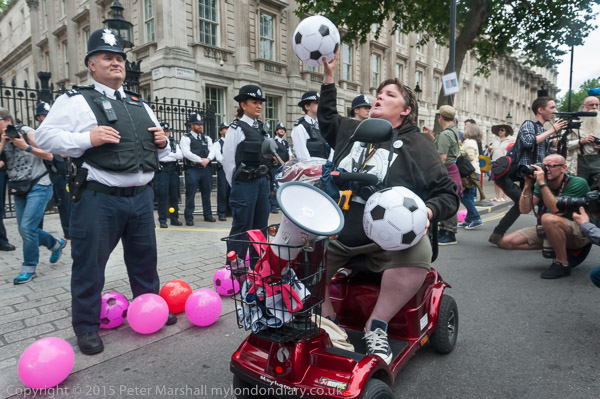
What makes the picture of Paula Peters of DPAC attempting to throw a football with a message into Downing St for me is the policeman standing watching, thumbs tucked behind his waistcoat, standing in a row of pink and orange balloons and balls. Of course her message didn’t reach the gates into Downing St, though a number of others did manage to get kicked or thrown into that high security zone.

It isn’t really a picture that fits the 35mm format frame and would be better cropped a tiny bit at left and quite a lot at the right. Sometimes I do crop images before filing them, but often I’ll leave them un-cropped, knowing that too many editors have an apparently irresistible urge to desecrate images by cropping; if I crop to perfection they will then crop to destruction.


D700, 16-35mm at 16mm, 1/400 f10 ISO 640

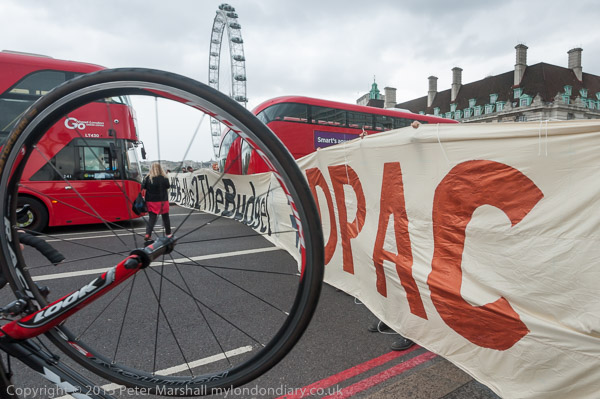
The little surprise turned out to be a 23 metre (75 foot sounds much bigger and better) long banner which they ‘dropped’, hanging on tightly to it over the Albert Embankment wall facing the Houses of Parliament with the message ‘#Balls2TheBudget #DPAC’ before bringing it up to join the other DPAC protesters, some in wheelchairs who had be then marched from Downing St to block Westminster Bridge.

It stretched all the way across the road and it was difficult to get a clear view of it for the buses it blocked and the protesters and other people taking pictures particularly those using their phones. Though I welcomed the cyclist who rode up to it at speed  before jumping off his bike just before it to give me the picture above.

The picture would perhaps have been better with a slower shutter speed to give a little blur as it was still rotating, but was able to nicely frame both it, the larger wheel of the London Eye and the banner. It was nice to have something a little different, and I had very little time to make the image before the cyclist lowered his bike. More pictures at DPAC blocks Westminster Bridge.


Paula Peters and Boadicea

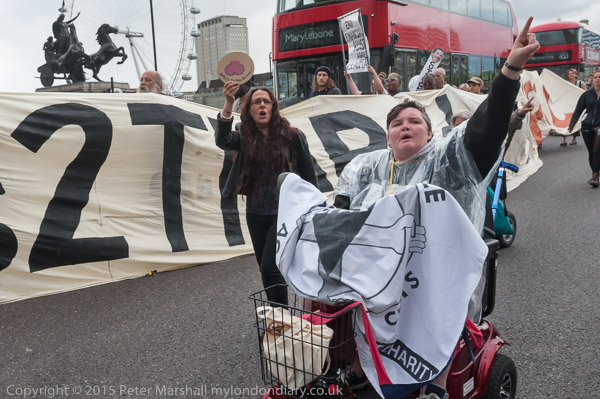
As protesters left Westminster Bridge they were led towards Parliament Square by DPAC’s Paula Peters on her mobility scooter, and as she came up to the statue of Boadicea – also in her chariot – I made a number of attempts to show the two of them together. I think this was the best, with Paula’s gesture echoing that of the statue in the top left. Boadicea probably burnt the town where I now live but was eventually defeated by the Romans. Paula’s chariot as yet lacks the scythes.

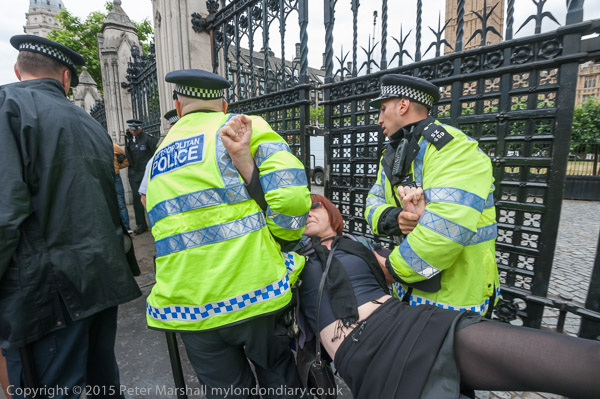
As the pictures in DPAC Parliament Square Budget Day protest show, the protest continued, for a while blocking traffic in Parliament Square. The police are faced with something of a dilemma by the protests by people in wheelchairs, realising the terribly bad publicity they would get by using the kind of tactics they use against other protesters. So while they may fairly forcibly drag away ambulant supporters, those in wheelchairs – at least while the press are around – are generally treated with rather more care.

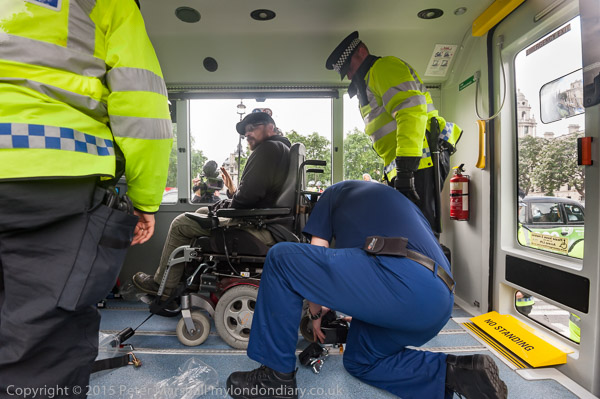
At this protest they had to hire a special vehicle which took quite a while to arrive to transport DPAC’s Andy Greene, locking down his motorised wheelchair with great care. Unlike police vans, it had large windows, and I was able (despite a little harassment by other officers) to photograph through them. They also took away pensioner Terry Hutt in the large and otherwise rather empty van. Two others arrested had left earlier in a more normal van. By the time I arrived at the police station in Savile Row an hour or so later, Andy had already been released, unusually fast as the police usually seem to prefer to hold people for long enough to release them in the early morning after most transport for them to get home has stopped as a little punishment even if they can’t find anything to charge them with.

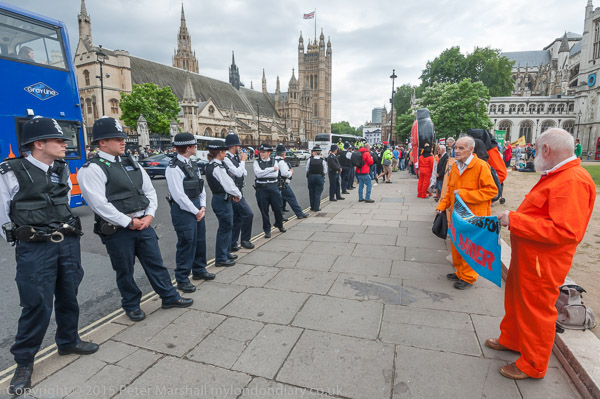
DPAC’s was not the only protest in Parliament Square, with people from several current industrial disputes in London – at the National Gallery and council workers from Barnet and Bromley – coming together for a Joint Strikers Budget Day Rally, and the usual Wednesday lunchtime Save Shaker Aamer weekly vigil who were confronted by an unusually large number of police lines up along the length of the pavement.

Their persistence in calling for the release of Shaker and for him to be returned to be with his family in Battersea seems to have eventually been succesful, though as I write he is still held there. Obama has given the required notice of his release and he could have been on a plane last Sunday, but the authorities at Guanantamo apparently couldn’t handle both that and a visit by three US Congressmen. Quite what has been holding it up since then I don’t know, but I hope it won’t now be long before he is home.

This wasn’t the end of my work on that Wednesday, but I’ve got jobs to do, so I’ll continue another day.
Continue reading Budget Balls and More

Dartford to Greenhithe (part 3)

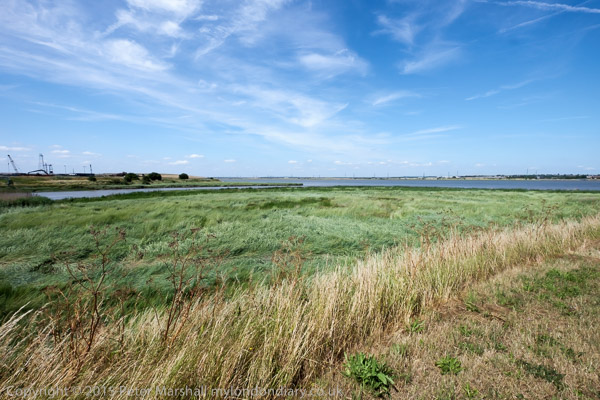
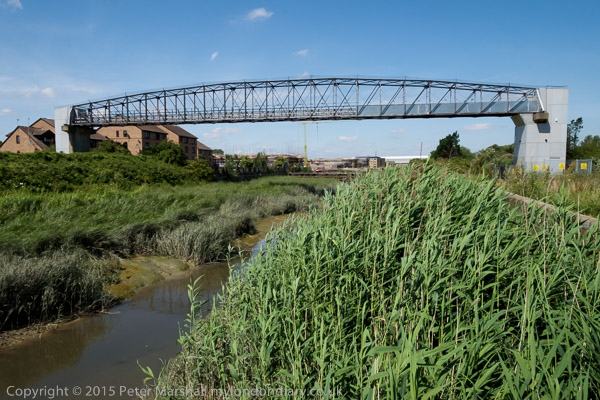
The mouth of the River Darent is a pretty empty area, emphasized by the wide-angle lens. Across the Darent is  the Darent Industrial Park, mainly hidden behind earth embankments, on the northern edge of the Crayford Marshes. Across the Thames are the Aveling Marshes and Purfleet. Behind me as I took the picture were the Dartford marshes, mostly drained farmland, and Long Reach stretches away to the right out of picture.


Mouth of the River Darent,        © 2003, Peter Marshall

The view from the other bank of the river mouth is more interesting, as this picture I took in January 2003, shortly after I first got a serious digital camera, the Nikon D100 shows.

Here at Long Reacg was a desolate location used for London’s smallpox and fever hospitals, at first on hospital ships moored in Long Reach and in tents close to these, then also in the more permanent buildings of Long Reach Hospital and Orchard Hospital built in 1901-2. A little further inland, Joyce Green Hospital with almost a thousand beds was built in 1903, making a total of over 2000 beds for smallpox victims in the area and the ships were sold off. All of the hospital buildings are now gone, virtually without trace.

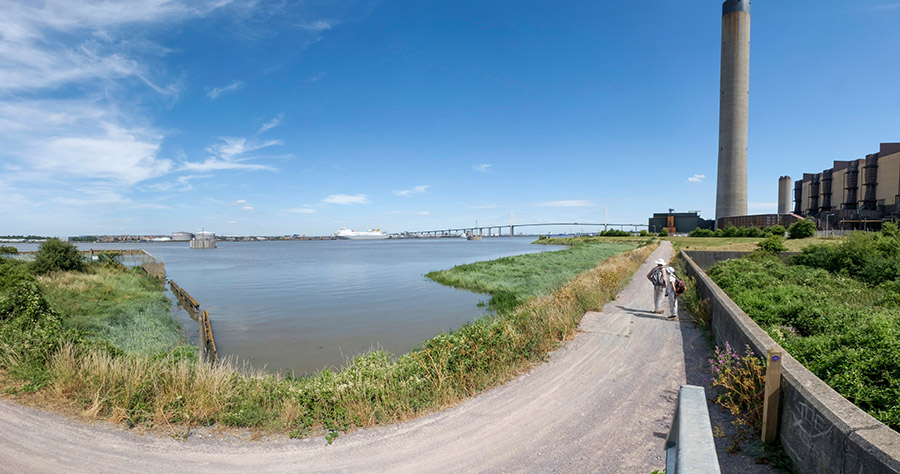
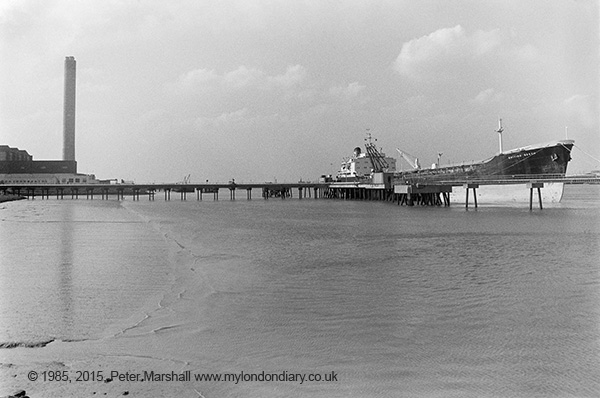
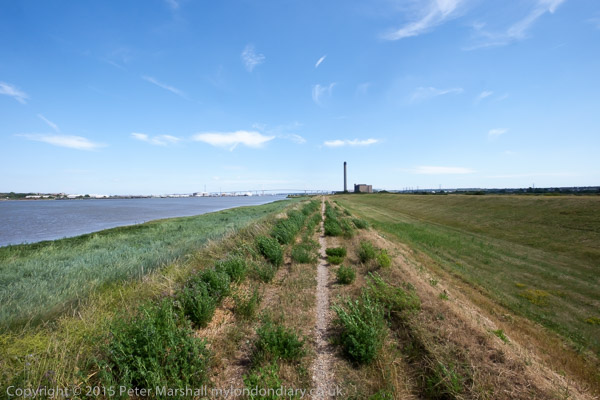
Instead in the distance we now see Littlebrook Power Station. The first of four power stations opened here in in 1939, using coal brought by rail, but later this and the other power stations on the site were oil-fired. Littlebrook D replaced the earlier stations in 1981 and only ceased operation in March 2015.  Climate Camp came here as well as Kingsnorth a few miles downstream in 2009, but I was in Edinburgh and missed it.

Past the power station you can see in the distance the Dartford Bridge (Queen Elizabeth II Bridge) which opened in 1991 and although not itself part of the motorway connects the two ends of the M25 which come to the banks of the river, along with the two Dartford tunnels. Bicycles are unfortunately not allowed on the bridge or I would probably have been up there taking pictures. You have to use a free transfer service, provided I think by Land Rover, but I’ve never done so. Before the power station is a sewage works, not visible from the distance, though very noticeable by its smell when you get closer. And a little inland is a shooting range, the sounds from which, along with a slightly more distant moto-cross circuit accompanied us for the next couple of miles.


British Beech discharges oil at Littlebrook, September 1985

The panorama was stitched from four exposures in portrait format using the Fuji 10-24mm (15-36mm eq) zoom and has a horizontal angle of view of around 148 degrees. I haven’t quite got the power station chimney vertical yet. There was as you can see plenty of blue sky and those sun-hats were pretty necessary, though I wasn’t wearing one – my hair is still fairly long and thick enough to give protection.

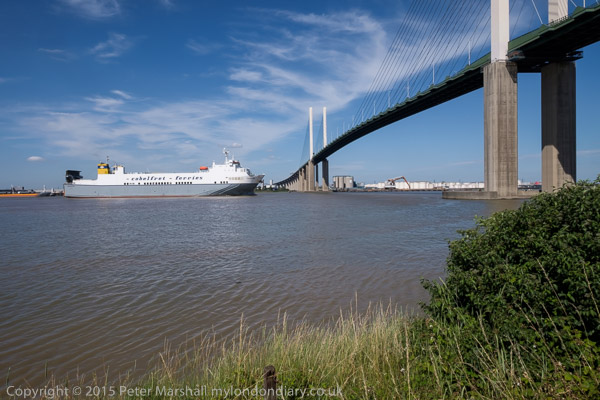
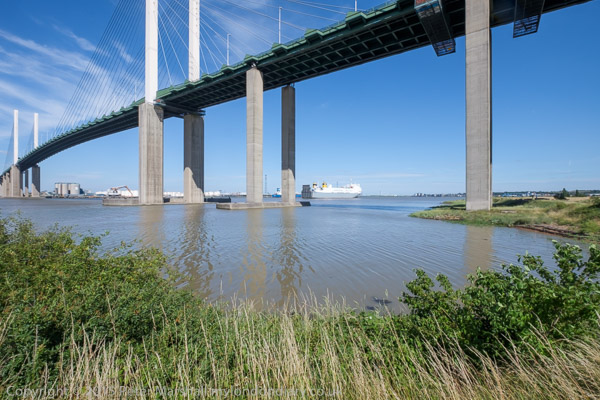
Close to the bridge on the opposite bank at Purfleet, the daily Cobelfret ferry to Zeebrugge was preparing to leave, and we stopped close to the bridge to photograph it going under, as well as admiring a rather nice cloud formation.

Even in this relatively confined river, the ferry was still going at quite a lick, and was soon under and away. We could see it for a long time as it went past Grays and turned towards Tilbury.

By now I was getting rather tired. It wasn’t a long walk but the hot sun virtually without any shade was wearing and I hardly stopped to take any photographs as we went past Crossways and the Freightliner Terminal and on to the station at Greenhithe, and most of those that I did I soon deleted.

Pictures from the walk are at Darent Valley Path & Thames.

Continue reading Dartford to Greenhithe (part 3)

Dartford to Greenhithe (part 2)

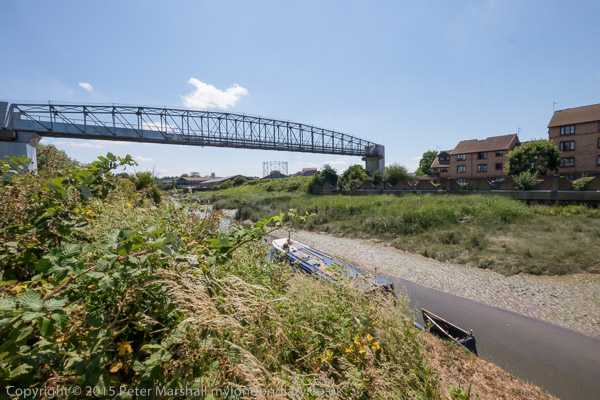
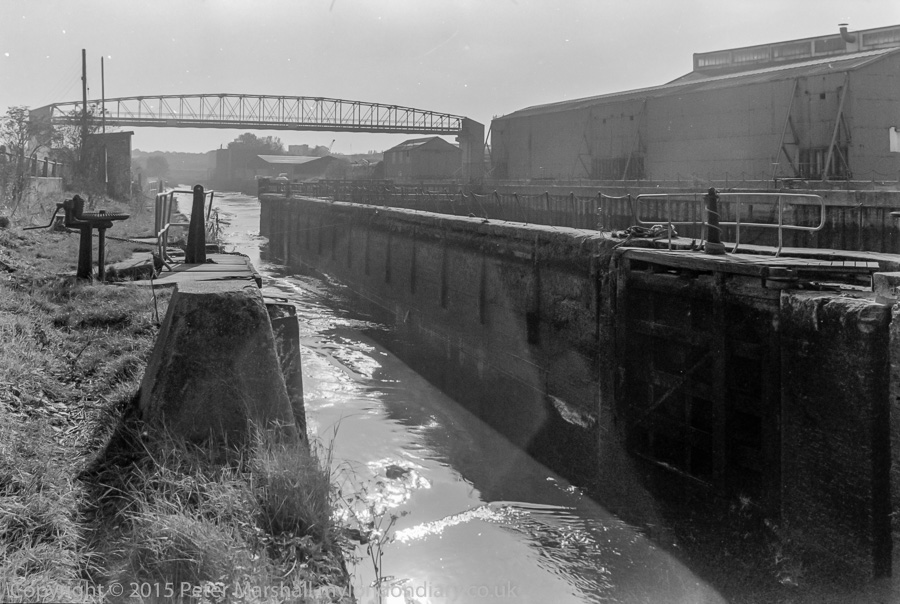
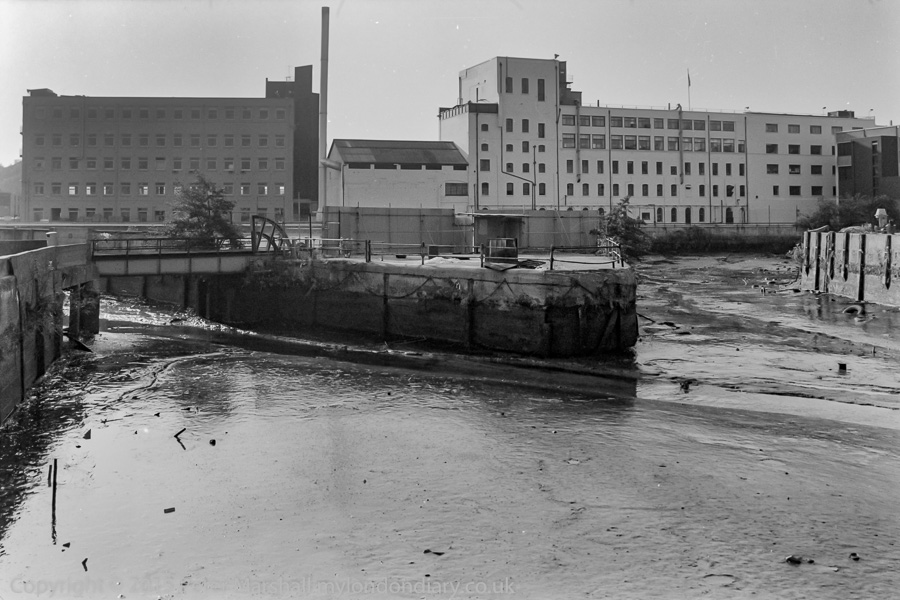
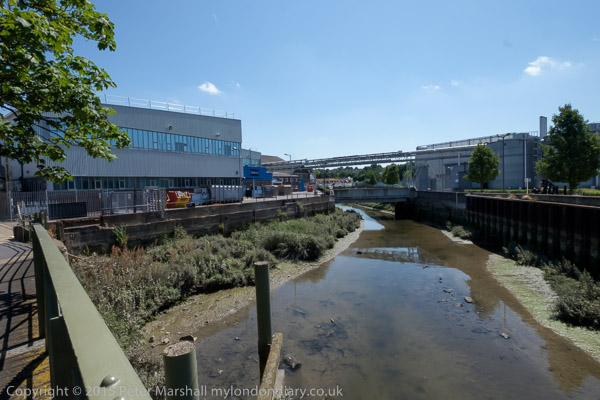
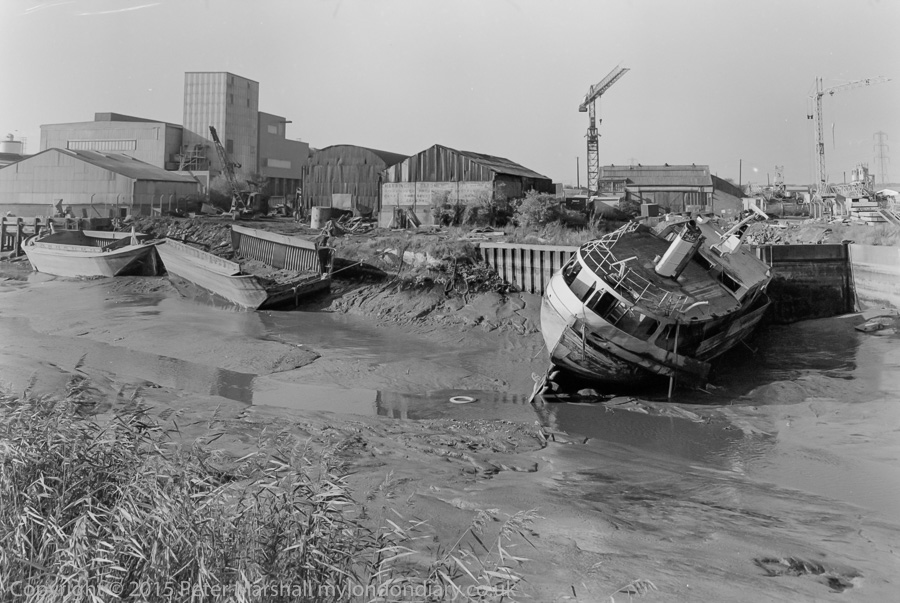
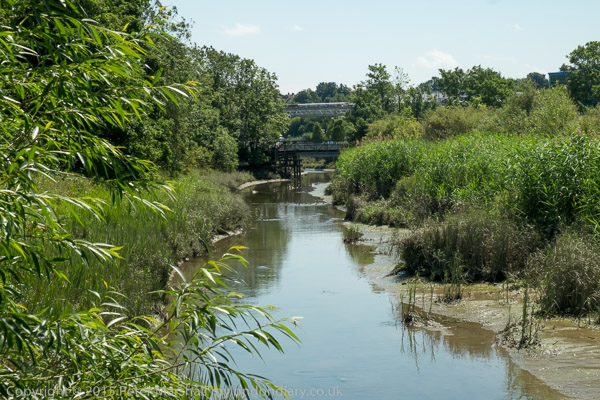
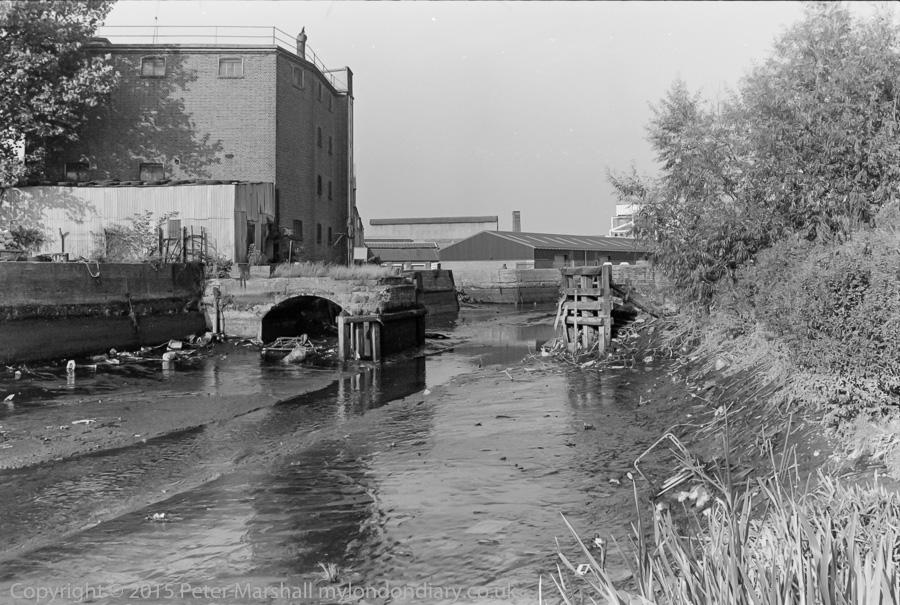
Because Dartford Creek was a navigation (used at least since Roman times, it was improved by an Act of Parliament in 1840, with work completed in 1844) bridges across it had to allow for the passage of the vessels using it, presumably in its heydays Thames sailing barges. At this point there was a lifting bridge, but by 1985 the bridge itself had disappeared.  It doesn’t look a great deal different now, though perhaps a little harder to see as the vegetation on the banks has grown considerably.  The riverside path itself has been considerably upgraded and there are more fences to keep people away from the banks, and the brick building close to the bridge replaced by an undecorated large modern shed.

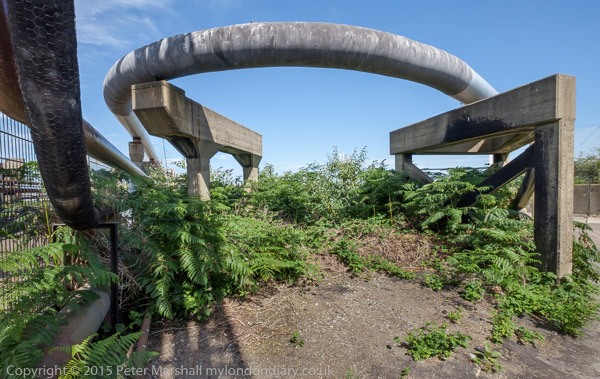
The pipe bridge looks a post-war construction, and once I think linked parts of the pharmaceutical works on both sides of the river; now on the west is a new housing estate, and little sign of anything to the east. But even at the date it was built, a high clearance was deemed essential, though sailing barges had probably given way to diesel.

By the footpath now are signs about the activities of the Friends of Dartford and Crayford Creek, and a little further on at Dartford Lock we came across one of them, working away at the vegetation on the bank. There was a hot sun and he was sweating and happy to stop for a few minutes and tell us about the navigation and the work of the friends – and told us to look out later for a yacht which was to try and enter the river from the Thames in a couple of hours on the rising tide.

Next to where he was working a narrow boat was moored. This year apparently saw the first boats to come up above the lock since 2006 and the first to be moored overnight for 40 years. Thanks to the ‘Friends’ the lock has been made more usable, with a stretch of over 200 ft of quayside cleared to allow mooring.  The port has silted up considerably over the years, and become covered with grass and weeds in places – according to the link there are now “mud banks over amost 80% of the total port area to heights varying from half a meter to a meter and a half.” and the stream at low tide as little as six inches deep. The port used to handle boats with a draught of one metre, and Dartford lock was a barrier to retain water above it to maintain a minimum depth of around 0.6 metres.

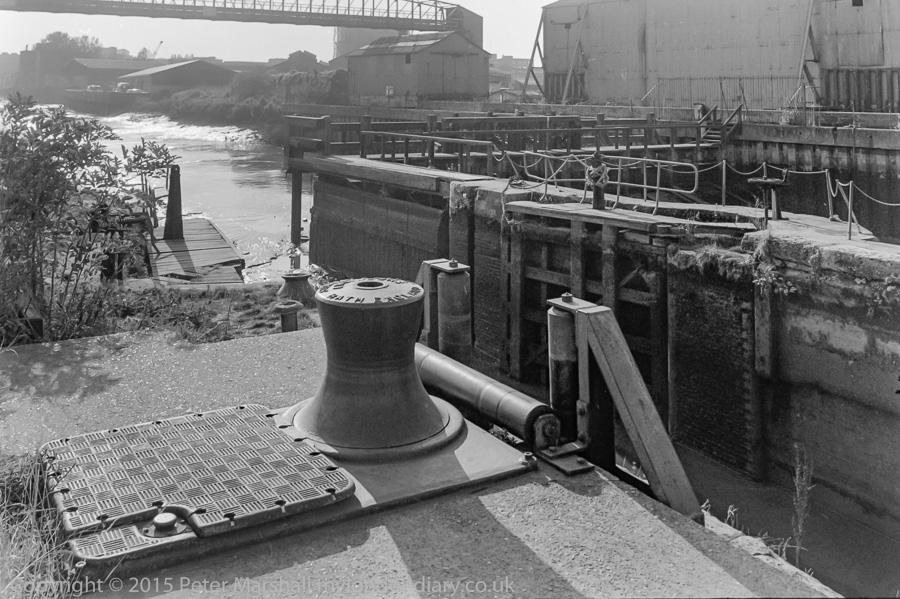
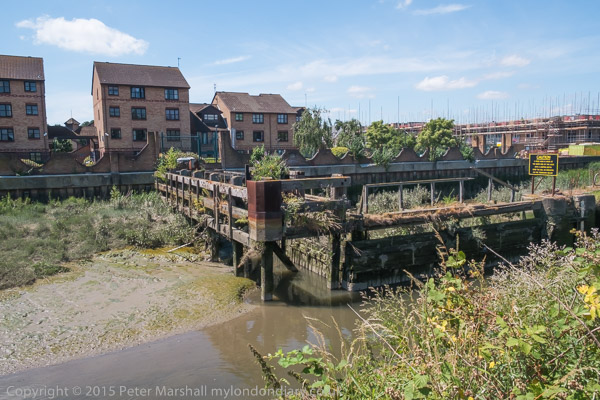
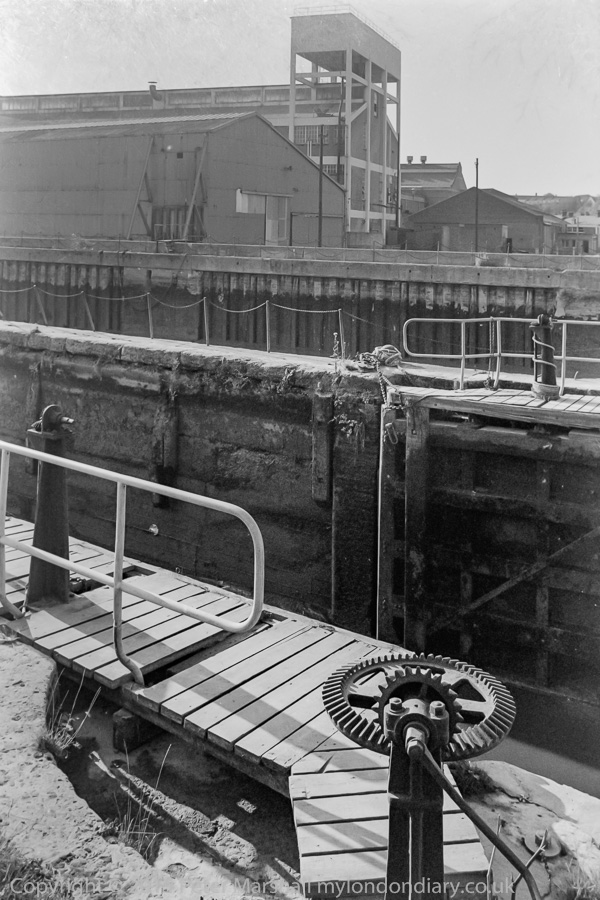
Back in 1985, the lock with its single gate appeared to be still in reasonable condition, possibly even capable of working, though obviously not well kept up, and the landing stage at the left clearly rather dangerous. I didn’t take many pictures – and here I think I was fairly clearly trespassing so perhaps fewer than I might otherwise have done. You can see there is far less mud on the bank at right and considerably less vegetation on both sides, though the older picture was taken in October when some might have died down slightly.

Things have clearly deteriorated since then, although the ‘Friends’ have carried out some work, getting the gate to open more fully and cutting down the flow of water around the lock, which was preventing the cill (or sill) in the lock from carrying out its purpose of maintaining the river level above it.

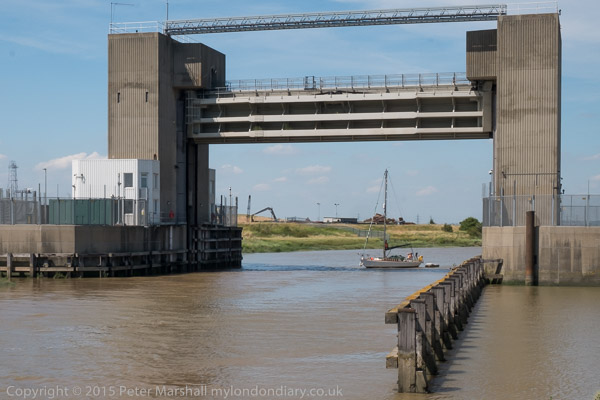
Below the lock the path is perhaps less interesting, following a winding path on an embankment with the river on one side and the long stretch of fairly empty fields and marshland to the east. There used to be a fireworks factory (and some of its isolated buildings remain) and further away an isolation hospital. In the distance you can see the Dartford Bridge and the now disused Littlebrook Power station, and as you get closer the Darent Tidal Flood Barrier and the River Thames. You pass the northern bypass (now renamed Bob Dunn way after the university that University Way was supposedly to lead to changed its mind about coming here) and the mouth of the River Cray (also part of the navigation.) It’s a pleasant enough walk, but one with no shade at all and we were pleased to find a hedge close to the flood barrier where we could sit at least partly in shade to eat our sandwiches.

From where we were sitting we could see the mast of a yacht turn into the mouth of the Darent and I jumped up and ran to photograph it as it made its way under the flood barrier – with plenty of clearance – and made its way up river with the incoming tide and under power.  It had hoped to get under the low bridge at Bob Dunn Way (with mast lowered) but I read later from the ‘Friends’ Facebook Page that the tide was too high when it reached there.

Pictures from the whole of this 2015 walk: Darent Valley Path & Thames

Continued at Dartford to Greenhithe Part 3)


For the walk in 2015 I was working with my newly arrived Fuji-X 10-24mm (15-36mm eq) on the X-T1 and the Fuji-X 18-55mm on the X-E1. Both excellent lenses which it is hard to fault in any way. I also carried but didn’t use the Samyang 8mm fisheye, probably because I was walking with two other people, and its a lens that makes me take a long time thinking about composition. The 10mm was wide enough for what I wanted to do, and considerably easier to use.

The only problem I had (apart from the cursed Fuji deep sleep mode – where the quickest way to elicit any response from the camera is to switch it off and then on again – a relatively minor annoyance with landscape, but which essentially makes the cameras hardly usable for covering protests) was that the times on the two cameras were not synchronised. It’s great to have clocks in cameras, time-stamping every image in the EXIF data, and I rely on it to put my images in order. But it would be nice if they kept time better. Though both were set at some point accurate to the nearest second, they were about 45 seconds apart. Yes, I should check and synchronise regularly.

Lightroom does make it very easy to select all the images from one camera and then adjust the time of all of them by the same amount, but I hadn’t done so when I wrote out the images for the web site, so you may notice the odd one out of order.

Back in 1985 we had no such problems. All I had to rely on when taking pictures was a notebook, and I wasn’t too good at making entries in that. But at least images were fixed on the film in the order that they were taken, and looking at the contact sheets I could normally reconstruct walk in my mind.

The Olympus 35mm shift lens I took most pictures with at the time was a fairly early version and not multi-coated as later otherwise identical versions were, and was fairly liable to flare and ghosting. You can see a neat but large hexagon in one of the images above. Working with scans does enable at least some recovery of what in the darkroom would have been very difficult negatives.

Continue reading Dartford to Greenhithe (part 2)

Dartford to Greenhithe (part 1)

It was a hot summer day (something I’ve not too often had the chance to write this year) when we took the train to Dartford to complete a walk along the Darent Valley Path to the mouth of the River Darent, and then along by the Thames to Greenhithe.

Dartford has change considerably over the years, and the industries that dominated the north of the town when I first walked this way back in the 1980s have now gone, and most of their buildings too, though as yet little has replaced them.


Welcome Foundation, Dartford 1985

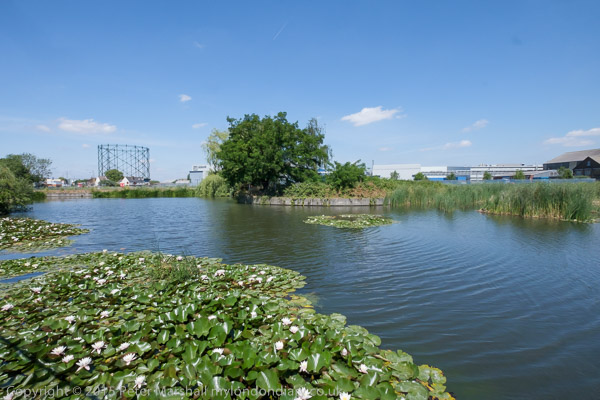
The picture I took back in 1985 was from the railway station, or rather through the open window of a train at Dartford Station, and the building in it has now gone completely. The pond still remains, and I photographed it through the railings on Mill Pond Rd, looking to the left of my older image.  The view straight ahead was rather empty.

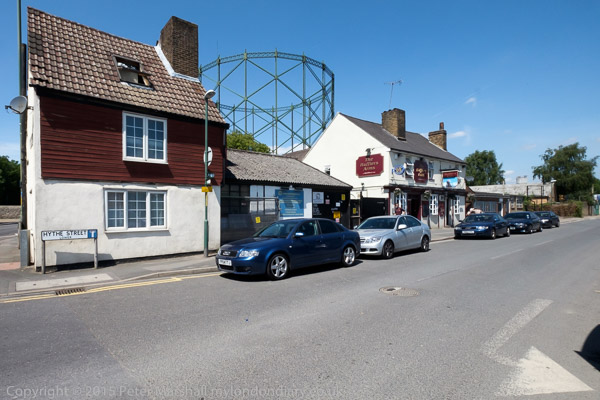
Hythe St and The Huffler’s Arms in the top image didn’t seem to have changed a great deal, though I didn’t have time to stop to admire its interior. But the pub was as reminder that Dartford had been a port, with boats coming up the river from the Thames to wharves here.

You can see the back of the building facing the pond at the right of this picture.  It was quite hard to see exactly where I had taken some of those pictures back then, with little but the river remaining, though some were readily identifiable.

A public slipway next to the bridge taking the footpath across the river here was cleared by the Friends of Dartford and Crayford Creek and the first boat launched here for decades in March 2015.

Although I know I walked along this footpath, before that I think I had gone into the large car park for the pharmaceutical works and perhaps on to a bridge higher upstream, but Glaxo or GSK (as Welcome became) had filled in and built over much of the basin and culverted streams in the years between my visits.  I think I was last around here at the start of 2013, though I’m not sure if I walked this path then.

Back in 1985, there was still considerable evidence of the navigable waterway, but the Dartford & Crayford Navigation (Dartford Creek) was essentially completely abandoned the following year, and the low Dartford northern bypass bridge opened in 1994 makes navigation tricky.  Back in 2006, some intrepid sailors managed to get a narrow boat up to Dartford showing it was still possible – and on their way out they also explored the short arm of the Crayford Navigation.


The creek banks are now overgrown close to the centre of Dartford.

Even back in the old days, navigation was not straightforward, and teams of men were needed to assist the passage of boats, particularly against the tide. Ufflers (or Hufflers) were men with very long poles – perhaps 15 ft – that they could put in the mud to get a purchase as they pulled barges along the creek to the wharves, and were of particular use on those creeks where no suitable towpath for horses existed. Usually they worked in pairs or sometimes three men together.  Probably from Dartford they would be needed to take the barges down against a rising tide to arrive at the mouth of the river near high water so they could enter the Thames.

Continues in Dartford to Greenhithe (part 2)

Pictures from a previous walk from Eynsford to Dartford, mainly along the Darent Valley Path are at Walking the Darent Way  and you can see the pictures from this section (and the continuation to Greenhithe) at Darent Valley Path & Thames.

Black and white pictures in this post were taken in 1985 using an Olympus OM1 and Ilford XP1 film. Most of the pictures I was taking at the time were made the the Olympus Zuiko 35mm f2.8 shift lens, long my favourite lens and still one of the best lenses made for 35mm – it has a 62mm image circle rather larger than the 43mm needed to cover the full frame which gives it an advantage, and easily slides to project any 36×24 rectangle of that larger circle onto the film. After years using it, I still sometimes find myself trying to slide other lenses. Of course we can now correct perspective in Lightroom or Photoshop, but it isn’t quite the same, and I sometimes find myself wishing I still had a lens with movements.

It would of course be easy to fit the OM lens with an adapter to the Fuji-X cameras that I was using for the colour images here (with Fuji 10-24 and 18-55mm lenses) but on the smaller sensor it would be a 53mm equivalent rather than a wide-angle, and the shifts of much less – if not zero- use. But I’ve just found and started to read a test of this and some other ‘PC’ lenses on a Canon full-frame body. Fitting OM lenses to a Nikon is kind of possible, but probably not for the 35mm shift.

I don’t think Fuji will come out with a full-frame X series camera. There would be little in it for them (or for photographers given how well the 1.5x cameras work.) Full-frame is largely a matter of prestige rather than performance, and Nikon were right when they said the APS-C format could deliver the goods – even though they ate those words a few years later. Almost none of us needs full-frame except once in a blue moon. 99% of the images I make with the D810 (and before that with the D800E) I make on the smaller format, despite now having a full frame lens on the camera. If Fuji ever do make the leap, like Nikon it will be for marketing rather than photographic reasons.

Continue reading Dartford to Greenhithe (part 1)

Ahwazi Action


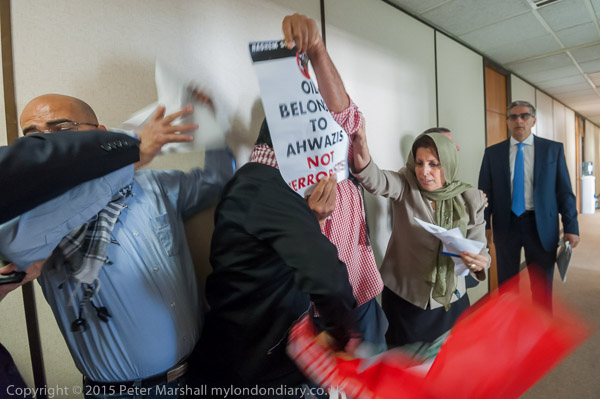
Protesters rush past people in the narrow corridor at the BICC offices

I don’t much like taking photographs inside buildings. So often the light is poor or difficult to work with, and spotlights and windows both tend to mess up autoexposure, even with matrix metering which is supposed to cope with such things. It’s all fine when you have plenty of time to make readings and set settings, but can be tricky when you are working under pressure.

And in NIOC House I was certainly working under some pressure. I wasn’t there by invitation, but had rushed in following some Ahwazi Arab protesters. I’ve mentioned them before, but for anyone who isn’t sure, you’ve probably read about the Ahwazi homeland even if you’ve never heard of it, as it is supposedly the inspiration for Genesis’s garden. The death-knell for the Ahwazi Eden came with the discovery of oil there by the Anglo-Persian oil company in 1908, since when Iran, aided in the years before the Iranian revolution by the UK, has been trying hard to eliminate the Ahwazi people and culture.
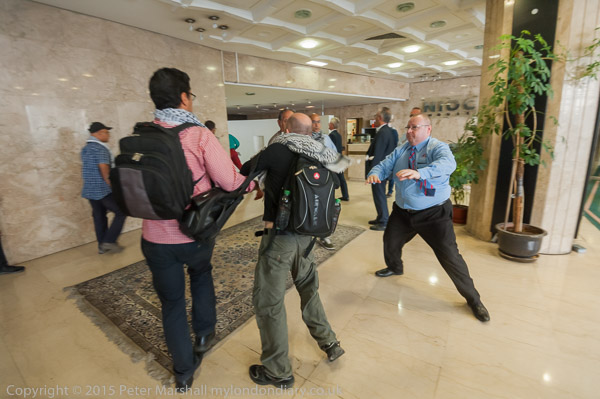

Peter Tatchell’s green shirt disappears around the corner as other protesters face security in the foyer

Even before the recent moves to lift sanctions there have been continued links between the UK and Iran, with NIOC house, less than 5 minutes walk from Parliament, at the centre. Few people walking past would know what goes on in there, or indeed that the initials stand for National Iranian Oil Company. It’s surely significant that although its address is always given as Victoria St, the only entrance normally in use is tucked away at the back on Tothill St.

Back in April I went into the foyer with a small group of Ahwazi protesters (see Ten Days of Rage for Ahwazi Intifada) and at the end of June received an invitation from the Hashem Shabani Action Group to join with them and the Peter Tatchell Foundation in an attempt to gate-crash secret UK-Iran business talks taking place in the offices of the British Iranian Chambers of Commerce (BICC) inside NIOC House.

I met with the group outside Westminster Abbey, were Peter Tatchell gave a short briefing on what they were proposing to do, and in particular on the non-violent nature of the protest. Also present were two other photographers I knew, along with two videographers and an intern.
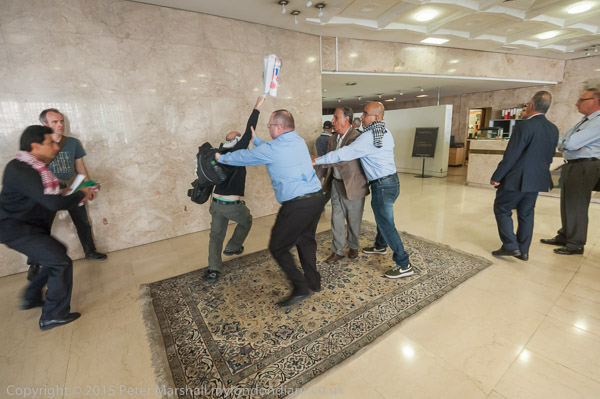

Security fail to stop an Ahwazi protester who runs past them.

I was more surprised not to be stopped by the building security as I followed the protesters who pushed past them and rushed to the stairs, along with the other two photographers; the videographers were a little slower and were apparently stopped in the foyer.

Had I known in advance that the meeting was on the sixth floor I might have declined the offer to attend the protest, and rushing up the stairs I was rather worried that I might not make it without collapsing, though I actually caught up with some of the protesters who were half my age. Despite being pretty totally knackered, put of breath and with a heart thumping at an unhealthy rate I was still able to follow the group as they ran along the corridor to the rooms where the meeting was being held.
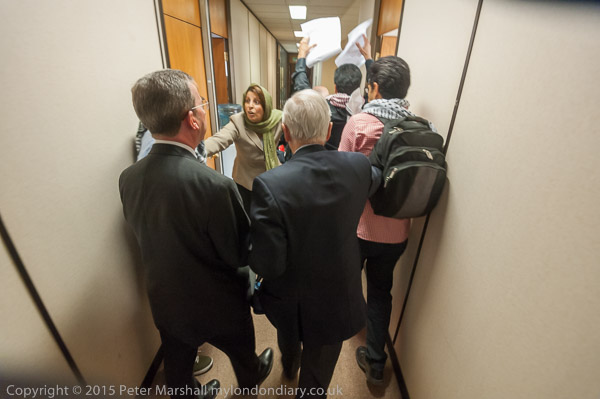

More attempts to stop the protesters in the narrow corridor – and a trace of vignetting from my lens hood knocked slightly out of position

There was a certain amount of pushing and shoving in the corridor, and there were people telling me I couldn’t take photographs, but as none of them told me who they were and what authority they had to stop me I proved remarkably deaf. Everyone was a bit confused, but eventually we went into the room where those at the meeting were about to enjoy what looked like a very decent buffet lunch. Things inside the room were a little more civilised, with many seeming to totally ignore the protest and continue with their conversations, but when we got back into the corridor and were on our way out things became more hectic.
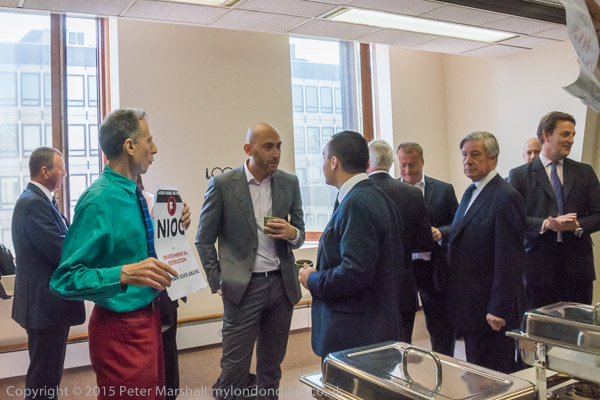

Peter Tarchell confronts some of those waiting for lunch who take little interest

Coming out of the meeting room I took the wrong door and turned left towards the stairs rather than to the right and missed the opportunity to photograph the best known politician attending the event, Lord Lamont. I was at the wrong end of the corridor with people blocking my way when he was confronted by protesters, though both the other photographers were close to him and were able to get pictures. A few of the people who were trying to stop the protest did get rather physical, and one young Iranian, thought by the protesters to be an agent, obviously completely lost his temper, and had to be pulled off by some of the other staff after he assaulted one of the other photographers, knocking him to the ground and causing minor injuries.
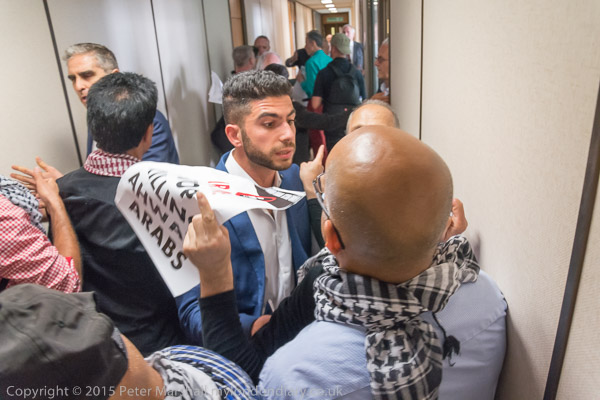

A young Iranian man gets angry with the protesters. I can’t get past to the end of the corridor where protesters found Lord Lamont

At least I didn’t get more than a little shoving around, but photographically I was having problems with the D700 which had started to fail to focus and also over-exposing, both extremely annoying. It wasn’t really possible to try another lens on the camera as there was quite a lot of people milling around and I was getting pushed around as I was taking pictures. The light in the corridor was giving me exposures around 1/30 f4 (wide open on the 16-35mm) and with overexposure giving me even slower speeds and considerable subject and camera movement quite a few exposures were unusable. I would have been better to have used the fixed 20mm f2.8, but I hadn’t thought to put that in my bag.
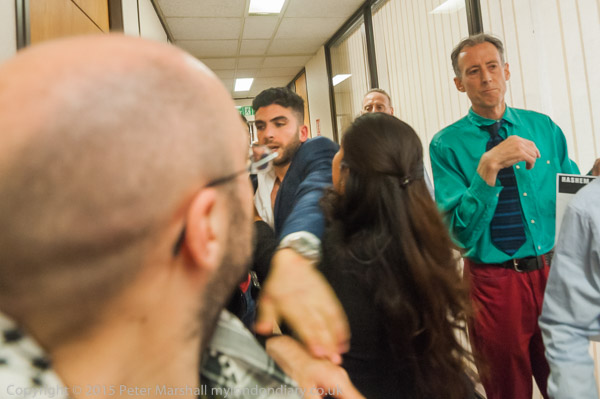

A colleague tries to hold back the young Iranian who has been assaulting protesters

The 16-35mm f4 isn’t really a lens for low-light action, and is also big and heavy, and my lens is beginning to show its age. A year or so ago it needed a very expensive service, almost to the point it wasn’t viable. Now it does seem to be getting a little temperamental, and though it was working properly when I took a few pictures of the group outside NIOC after the event, occasionally since then I’ve had to switch to manual focus.

At fairly close range even at 16mm there isn’t a great deal of depth of field at f4, and manual focus in poor light isn’t too easy with modern cameras and lenses designed for autofocus. Back in the days of film with cameras like the Olympus OM4 and a suitable choice of focussing screen manual focus was much more viable. And with cameras like the Fuji X-T1 that use an EVF, manual focus is again easy, though too slow for rapid moving events like this.

Eventually we left, walking down those six flights of stairs again (I don’t know why they didn’t take the lift down, but I had to stay with them in case anything happened.) In the ground floor lobby we were stopped by police, and told that we were not under arrest but could not leave, even though we photographers showed our press cards.

We sat around in the lobby for three quarters of an hour while the police decided what to do, complicated slightly by the complaint of assault against the young Iranian. Police advised the photographer that his assailant – who they went and found and questioned briefly – probably was protected by diplomatic immunity and he decided not to press charges. The police came round and asked everyone for names and addresses which we gave and then we were allowed to leave. It was good to get outside.
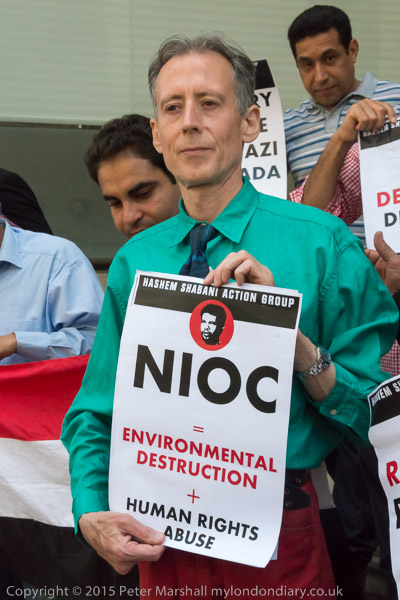

Peter Tatchell poses with the other protesters outside at the end of the protest

Although I don’t think any of the protesters (or photographers) was later arrested, certainly some of the non-violent Hashem Shabani Action Group, named after Arab-Iranian poet and human rights activists Hashem Shabani, executed for peaceful opposition to the Iranian regime in January 2014, have been harassed by police. Some influential UK politicians with busiiness interests in Iran, including some of those at this meeting we visited, have called for the organisation – which says “Our weapons are pens. Our bullets are words” to be banned as a terrorist organisation.
Iran says that Shabani confessed to being a member of the terrorist group “Al-Moqawama al-Shaabiya Al-Tahrir al-Ahwaz” which appears to be a figment of Iranian state imagination. The confessions made by Shabani and others came after extensive torture. Press TV reported the confessions and sentence claiming that the Al-Moqawama al-Shaabiya (People’s Movement) is backed by the US and UK, but there appear to be no reports of the organisation nor its supposed activities except from these Iranian government sources. Unfortunately the UK seem more interested in backing Iranian interests and ignoring  human rights issues in Iran in general and in particular the persecution of the Ahwazi people.
Continue reading Ahwazi Action