Die-in for Calais

I don’t like to travel. Perhaps when I was younger it might have been a little different, but now I always like to get back home at night, preferably in time for dinner and a glass or two of red wine, but certainly in time for bed, though when I’ve been out taking pictures I often find myself still working on them into the early hours of the morning.

When in 1983 the Greater London Council under Ken Livingstone fought the  Tory government to bring in zonal fares and the travelcard, it made it possible for me to work in a sensible way all over London. Even when victories like this led to the Thatcher government plunging London into chaos (from which it still hasn’t quite recovered) by abolishing any London-wide government, these transport initiatives remained – while London’s seat of government was sold off as a luxury hotel.

I sometimes tell people that I turned down a job simply on the basis that I couldn’t get to Letchworth on a travelcard; it isn’t quite true – I really turned it down because I wasn’t offered enough to make the extra time and cost worthwhile.

I do occasionally work outside the capital, but only when things interest me enough and when I feel I’m up to it. Even in London I often get tired after a few hours of work and come home missing an event later in the day – when twenty years ago I would have kept going all night. Now I need to get home, take pills, rub on the cream, eat regularly on a suitable diet and keep up the injections.
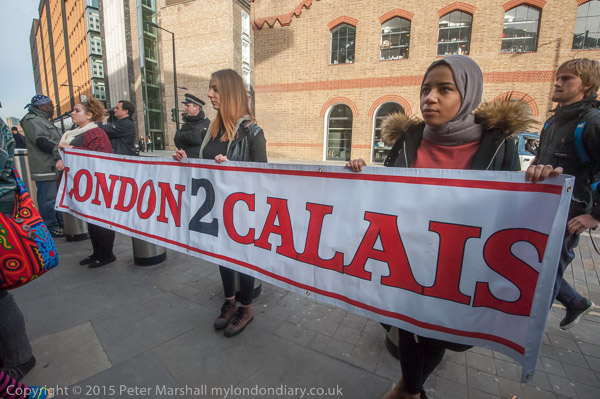
This is all a very lengthy preamble to cover up me feeling a little guilty about not having been to Calais to photograph the people camped there in the ‘Jungle’. I’ve signed the petitions, made the odd donation, but never actually gone there, though I’ve had the opportunities and invitations. But of course there has been no shortage of photographers who have done so, and sometimes I wonder if it has been too much of a media circus, with some of those living there feeling they are in a fish tank.

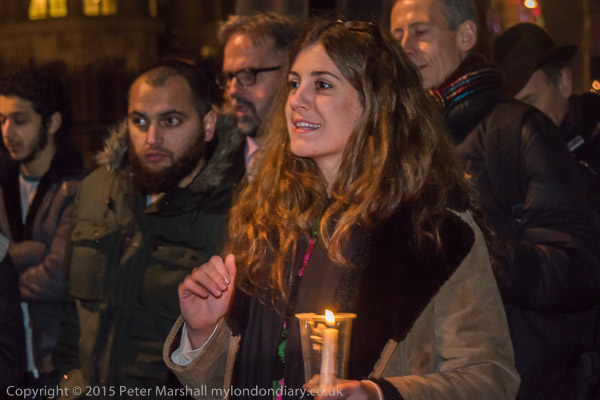
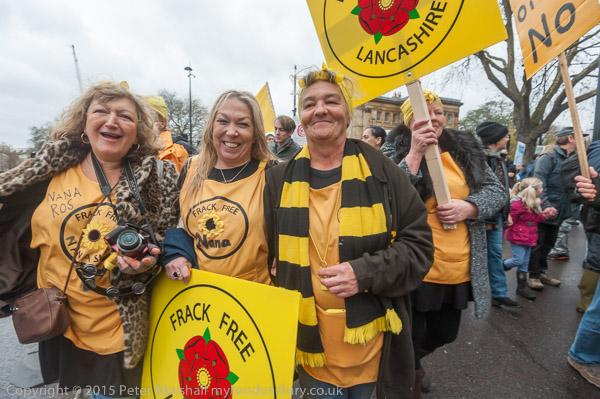
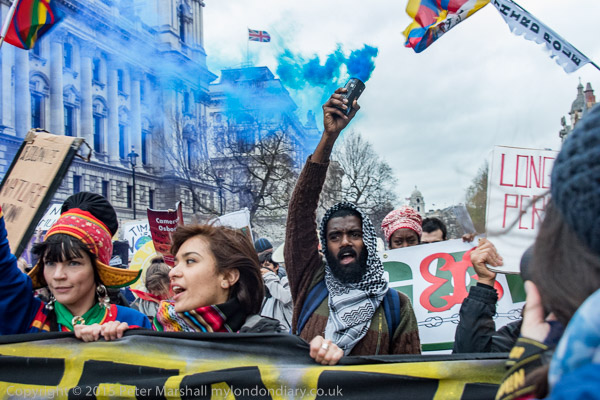
I was very pleased to be able to support a protest by some of those who have been going to Calais and taking positive action to support those stranded there – who include several hundred unaccompanied children who actually have the right to come to the UK as they have family members here.  Our government is refusing them entry – and nine months later and after Parliament has said they should be let in is still dragging its feet. A few have now been allowed to come here, but many more remain in the Calais mud.
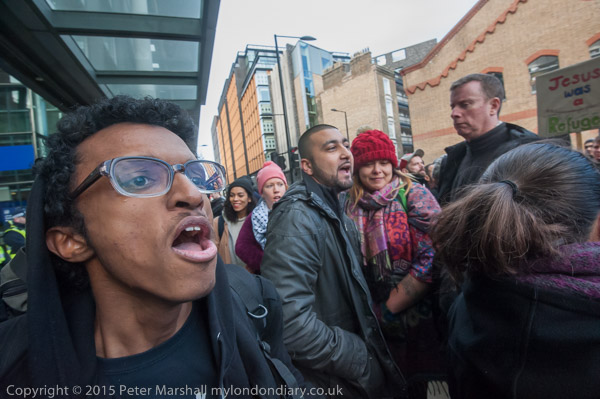
Government policies under Theresa May at the Home Office and now Prime Minister are quite clearly racist, and driven by pandering to the racism of our right-wing press.

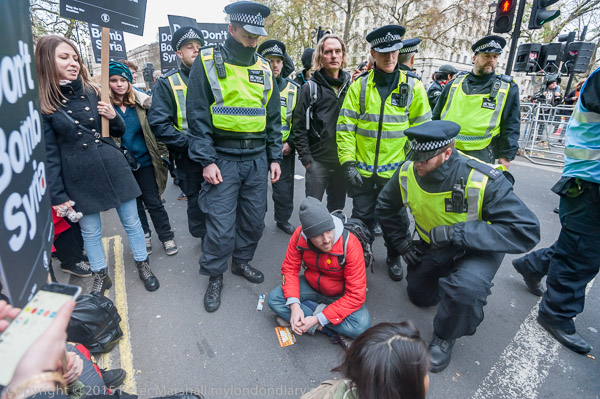
Police stopped the protesters from entering the Eurostar terminal at St Pancras International, and tried to move them away from the entrance, although the police were far more of a barrier to passengers trying to enter than the protesters who made no attempt to prevent them entering.
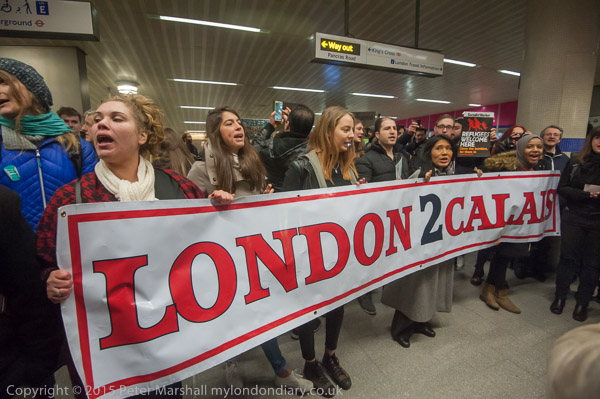
After a number of short speeches the protesters marched down to the Euston Rd, and then rather surprised the police by rushing down into the Underground, where police again stopped them from entering the main shopping area under St Pancras.
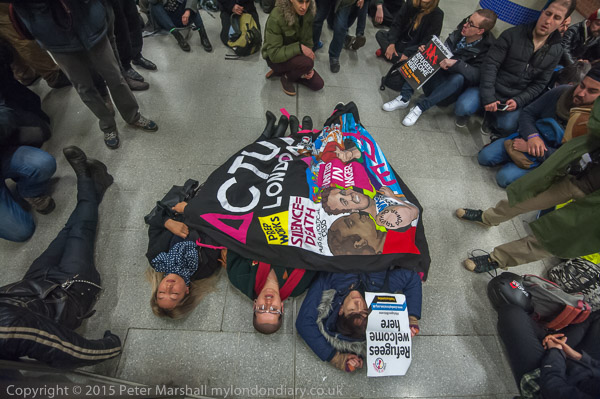
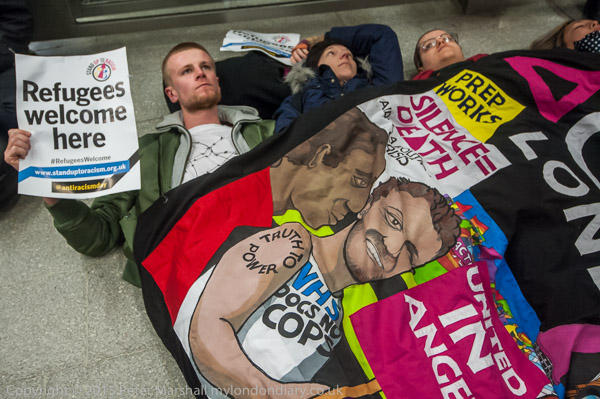
The protesters then staged a ‘die-in’, led by a group with a colourful banner, ACTUP London, a group I’d not met before who describe themselves as “a diverse, non-partisan group of individuals united in anger and committed to direct action to end the HIV pandemic, along with the broader inequalities and injustices that perpetuate it”. Others sat down around them, while speeches and chanting continued. After around 10-15 minutes everyone got up and the protest ended.

Photographically the protest presented few problems, although at times it was difficult with other photographers rather getting in the way – and you can see a few cameras on the edges of some of my frames.  Light levels in the Underground area were reasonably high and unlike most night scenes the lighting was fairly even. I was working at ISO 3200 and ISO 4000 and getting exposures around 1/80 or 1/100 at f5 (with exposure compensation at -0.3 or -0.7 Ev) and the results seemed remarkably good, with relatively low noise and decent colour.

Artificial lighting is often rather a problem with some light sources giving eerie effects, and often scenes have various different colour lighting, often producing rather unnatual effects, but here it seemed very consistent, with a colour temperature around 3700K and needing just a small magenta tint, typically +9 in Lightroom.

You can read more about the protest and see the rest of the pictures at St Pancras Die-In for Calais refugees.
Continue reading Die-in for Calais
Nathan Lyons (1930-2016)

Almost the first proper book of photographs I bought when the medium seriously began to catch hold of me was by Nathan Lyons. I’m not sure whether it or Charles Harbutt‘s ‘Travelog‘, both published by The MIT Press came first on my bookshelves. Neither was the kind of book you would find in British bookshops, but Coo Press in London’s Doughty St, home of Colin Osman’s Creative Camera also had a book shop and a mail order service. These first two volumes I almost certainly bought by mail, but in the following years I spent several happy afternoons browsing in the bookshop – where photographers were always made welcome, even those like me who had little to spend.

Notations in Passing – Visualized by Nathan Lyons‘, in the words on hte back of the book: “Snapshots – a series of images – cool – haunting – a modern iconography – a compendium of images by one of the most significant teachers of visual arts – a careful exploration in perception – a series with its own continuity and time relationships – commonplace justapositions – sequences – notations in passing – 96 photographs by Nathan Lyons...” was certainly an eye-opener for me and I think for many ohters.

It’s a book that I can see traces of in much of my own rather different photographic work over the next few years, opening up new possibilities and seeing new subjects. Ideas of framing that still inform my work, moving away from the stultification of the rule of thirds and other nostrums. Using images within images, reflections text and more.

Lyons was one of the great teachers of our medium, but one I only knew in print, and he appears to be relatively little known here in the UK. You can see some of his work on the Bruce Silverstein Gallery site, and read many tributes to him across the web:

Selected Obituaries

In Memoriam: Nathan Lyons, 1930–2016 Eastman Museum;

Tribute to Nathan Lyons, 1930-2016 in’Eye of Photography’ by Bruno Chalifour;

Nathan Lyons, Influential Photographer and Advocate of the Art, Dies at 86 New York TImes;

Nathan Lyons, Photographer, Educator and Visual Studies Workshop Founder PDN.

Meeting Shaker

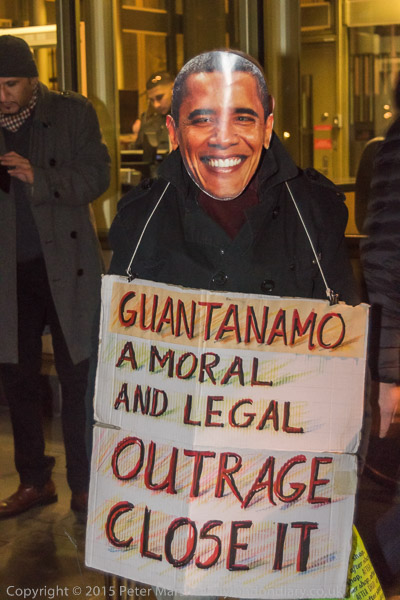
Progress at shutting down the US prison camp at Guantanamo Bay has been painfully slow, and President Obama’s pledge to close the camp, which has brought shame on the USA has seemed increasingly empty, though not entirely due to him.  There can be few thinking Americans who don’t feel setting up the prison was a terrible mistake, and one that has harmed their country’s standing in the world, as well as increasing the risk of terrorism it was meant to combat.

The whole sad record shamed the US in the eyes of most of the world; the tortures approved by the Bush administration both inside Guantanamo and at Bagram and elsewhere – and the still continuing mistreatment there, the illegal renditions to there which also compromised many other Western countries. Many if not most of those taken there had little or no connection with terrorism, but were simply in the wrong place at the wrong time, or had enemies who took advantage of US naivety.

But the whole idea was a contradiction, an attempt to impose law by breaking all the laws which govern international conflicts, and one which made far more enemies. It perhaps wasn’t surprising in that it came from a country whose agencies supported and trained many of those now causing it most grief in the Middle East.

I’ve been photographing London protests against Guantanamo for at least ten years, and they still continue, and will do until the last prisoner is released. In recent years a major focus of many of these was to call for the release of the last Londoner held there, Shaker Aamer, a charity worker who lived with his family in south London and was kidnapped in Afghanistan and sold to the US authorities there.

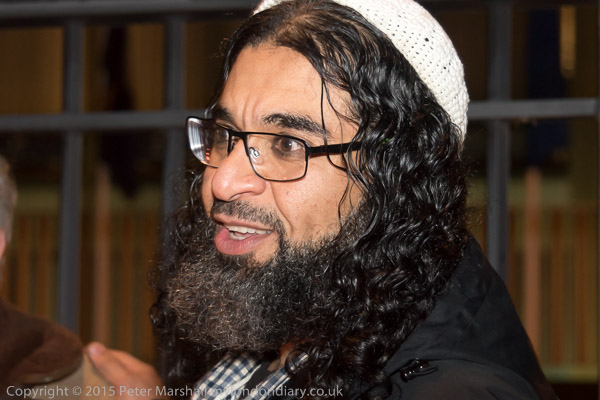
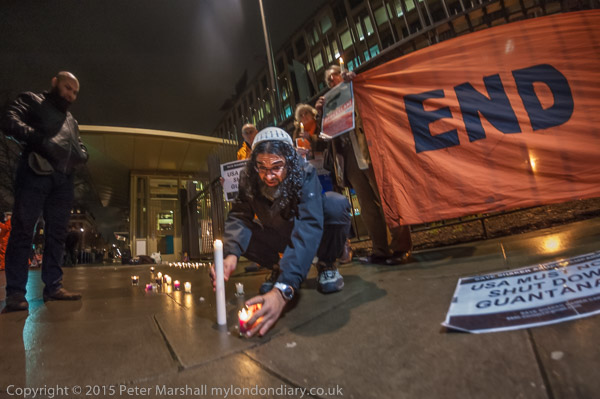
Recently released, Shaker Aamer attended the vigil outside the US embassy along with six other UK former detainees, and it was a great pleasure for me to be able to meet him, speak with him, shake his hand and be hugged by him.

Ahaker had spent almost 14 years inside the prison – after torture by the US in Afghanistan. In Guantanamo he had been subject to further torture and beatings as well as prolonged periods of solitary confinement. There was never any credible evidence against him, and he was cleared for release under the Bush administration, then again when Obama was in power.

He wasn’t release not for anything he had done in Afghanistan, but for what he had seen and heard when he and other prisoners were being tortured. As someone fluent in English as well as Arabic he served as a translator and gave support to many other detainees. He was a witness who could give evidence that would damn both the US and UK security agents who took part in torture – and they kept him inside as long as they could.

Photographically there were the usual problems of working in the darkness in front of the US Embassy;  I think it has its own special kind of darkness, with just a few areas of brighter light in front of its aggresively ugly facade, surrounded by a tall fence behind which armed police walk up and down.

I used flash with some images taken with the D810 and the 28-200mm in DX mode – and at the longer focal lengths there was no alternative, but it rather spoils the atmosphere of a candlelit vigil, though there are a few images where I managed to get a good balance.

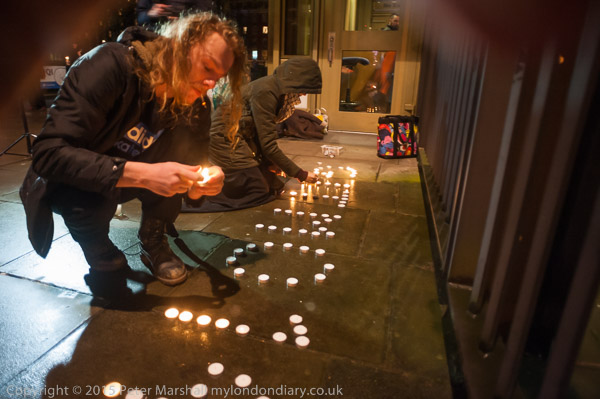
Mostly I was working with the D700, and as well as using the 16-35mm (at 20mm in the image above), there were also some images for which the 16mm fisheye was invaluable, as in the picture at the top of this post of Shaker Aamer lighting a candle. For that, at ISO3200 and wide open at f2.8, the shutter speed was 1/30s and the file was a few stops underexposed! I was holding the camera out low in front of me as I crouched in front of Shaker.

It would perhaps have been good to have the camera in ‘Live View’, but I think the image would have been too dark to be a great deal of use. And I don’t find it easy to get the camera to take pictures when I want it too when using this mode – it really is rather clunky. So I took a number of frames and hoped. Of course it would be hard to miss the main subject when using the extreme wide view of the fisheye, and I hoped to be able to crop the image (after straightening the verticals with the Fisheye-Hemi plugin).

There is another frame along with many more images from the event at Guantanamo 14 Years on and in some respects it is a better picture, helped by a stop more exposure. But most of the time, Shaker was looking down at the candle he was lighting, and you can’t see his face so well.

Continue reading Meeting Shaker

My First Day with a camera in London

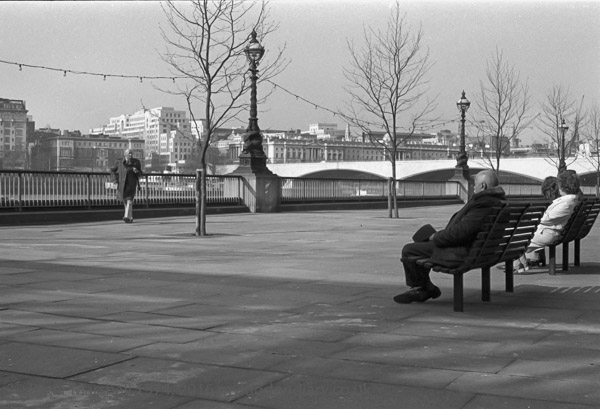
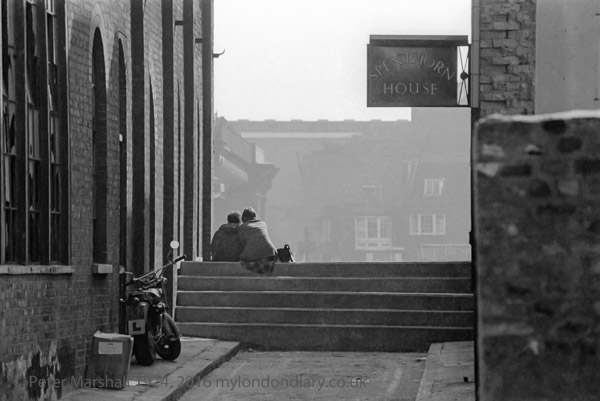
I find it hard to think back and imagine the first time I came to London with a camera, and have little memory of the occasion. What I do have is two contact sheets (and the corresponding Tri-X negatives) but the only information outside of the images are the file letters, 3k and 3l, probably assigned at a later date.

In my first few years of learning to be a photographer I tried to keep images from different types of subject in different files, and the ‘3’ seems to have been a general photography file, including sports, portraiture, theatre photography and more, with negatives and filing sheets at some point assigned the letters a-z in what now appears to be a fairly random order.

At the time I took relatively few photographs and didn’t feel the need for much of a system, though file ‘4’ seems to have been reserved for my pictures taken in Europe. Fortunately it wasn’t too long before I saw the error of my ways and began to file my black and white negatives in order of taking (or at least of processing) and, since April 1986, under the year and month of taking. Of course things are much easier with digital where everything comes with EXIF metadata.

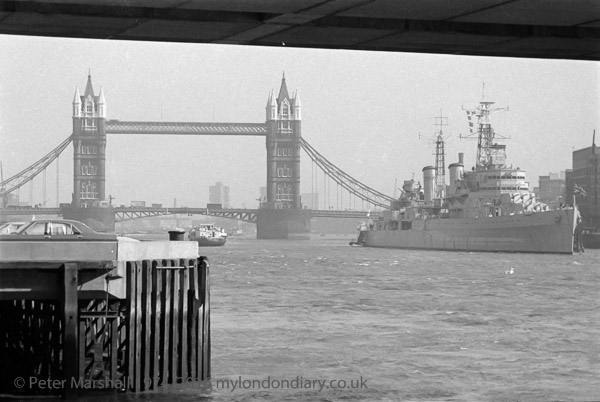
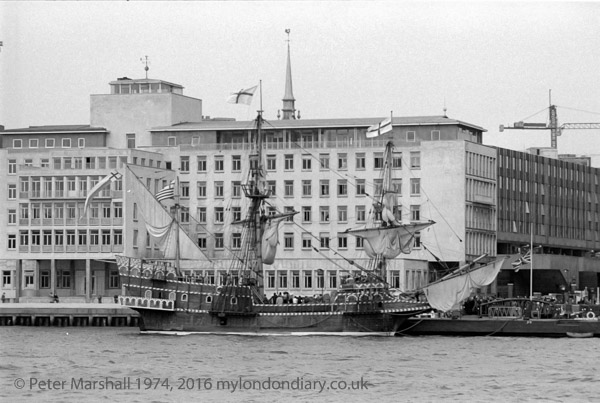
Probably anyone with access to a newspaper library would be able to fix the date more precisely, as several of the pictures show the remarkable ‘Golden Hinde II’, a remarkable reconstruction of Sir Francis Drake’s galleon in which he circumnavigated the globe from 1577-1580, moored at Sugar House Quay next to the Tower of London, with crowds waiting to board.

The ship, usually known as the Golden Hind, was launched in Appledore, Devon in April 1973, although its ‘maiden voyage’ was only made from Plymouth in late 1974. At some stage before this it came to London where I photographed it.

Around this time I had just bought an Olympus 35SP to replace one of two Russian cameras I had been using. It seems likely that these images were taken just a few days before this arrived, as the last 9 frames of the second film show this in various images, including one close-up of the viewfinder which shows the rather dull view from our first-floor Bracknell flat from which we moved in August 1974.

From the trees in several of the London images, they were clearly taken in winter, and so the pictures must date from either late 1973 or early 1974.

The pictures will have been made using a Zenith B, a sturdy, tank-like Russian SLR. The ‘B’ model came without the built-in exposure meter of the ‘E’ but was available with the superior 58mm Helios f2 lens (of pre-war German design) and on the page linked – where it is the fifth camera down – I see that the type I used is now “very rare to find”.

I will have been using a handheld Weston Master V exposure meter, which had a large selenium cell, and came with a curious white plastic ‘Invercone‘ to enable incident light readings. Made in Enfield in north London – or rather ‘Middlesex’, these were incredibly reliable, needed no battery and had only one real fault – the wafer-thin glass above the needle, which was easily broken as the meter dangled free from its cord around your neck. After several expensive repairs I cut and glued some rather thicker perspex on top of where the glass should have been.

As well as the ‘standard’ 58mm I also had with me another Russian lens, a telephoto, probably the 135mm Jupiter f4, copied from the Carl Zeiss pre-war Sonnar.

Photography with this equipment was rather slower than with modern cameras, but it was probably more the cost of film that kept the number of exposures made during the day to 49 – and explains why there are no real duplicate images. Two frames are hopelessly over-exposed, probably because I forget the need to manually stop down the lens to the taking aperture after focussing. Two are ruined by slight fogging, a consequence of loading film into cassettes from bulk with a bulk film loader to cut costs. One is sadly out of focus, rushing to get a picture, and a few seem rather ordinary – such as two pictures of St Paul’s Cathedral.

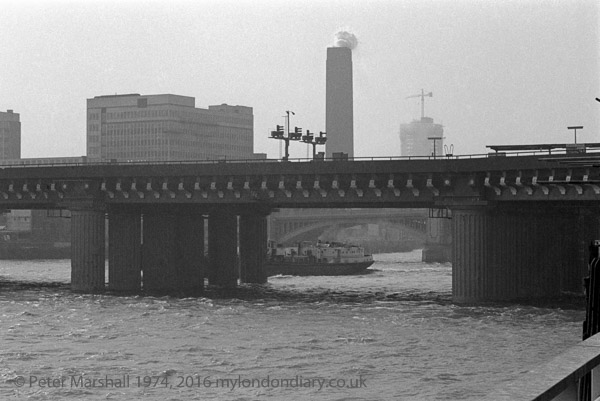
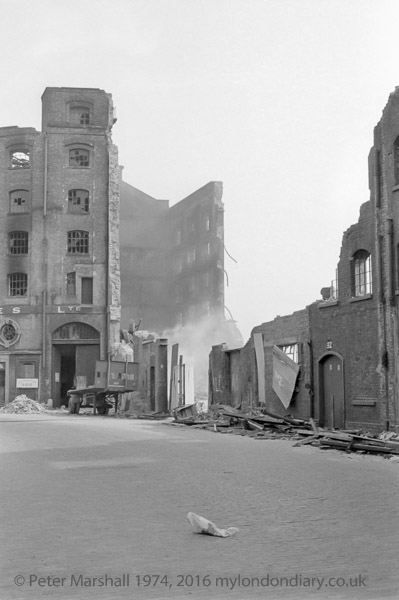
There are also no really great images, though most have some interest, some rather more than when they were made because of the changes since they were taken – little smoke now emerges from Bankside Power Station. But there was one picture which I think became very important to me, of warehouses being demolished on the riverside beyond St Katharine’s Dock, which is really the only one of these I remember taking, and which prompted me to begin to explore London’s disappearing docklands.

See these and the rest at My First Day with a camera in London.

Continue reading My First Day with a camera in London

Climate Action

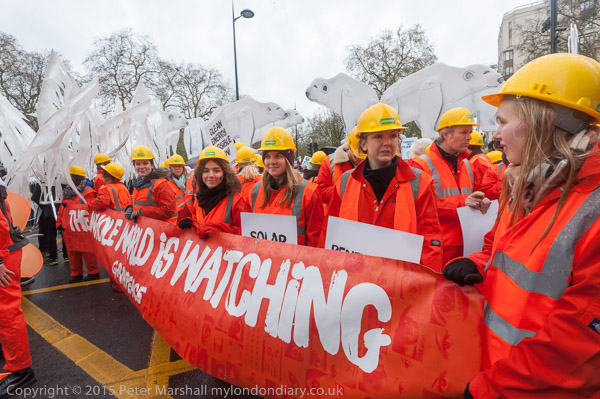
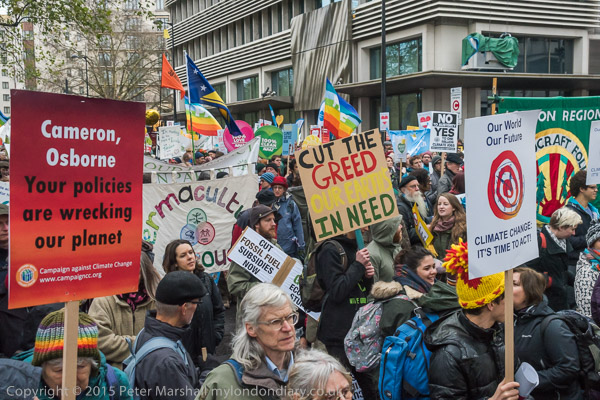
I had mixed feelings about November’s March for Climate Action, one of the larger of several thousand events around the world on the weekend before the start of the COP21 talks in Paris. Of course we need to get action on climate change. I first got involved in environmental issues in my student days, though it was a little later that people really began to become widely aware of the problem of the ‘Greenhouse Effect’ and the importance of rising carbon dioxide levels, although this had been pointed out over a hundred years ago – the role of carbon dioxide was first theorised in the 1820s and experimental evidence came in the middle of the nineteenth century.

It was obvious to Alexander Graham Bell back in 1917 that the world needed to move away from the unchecked burning of fossil fuels and towards alternative energy sources such as solar energy, but it is still something that successive governments here have failed to take with the necessary seriousness – and that our current administration is actually back-pedalling on.

We’ve had climate protests and marches in London for some years now; I think the first that I put on My London Diary was back in 2002, when I wrote (all in lower case):

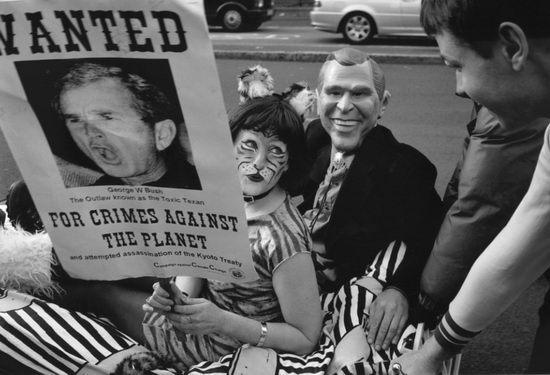
climate change is a threat to our continued existence on the planet. actions such as bush rejecting kyoto are grossly irresponsible, putting the short term interests of US companies before the planet. hence the demo with bush in bed with the esso tiger.

On that occasion there were problems with the protest – apart from it being ignored by the mainstream media – with the wheels coming off the bed carrying Bus and the Esso tiger coming off as it was pushed up the slight incline of the approach to Westminster Bridge. In later years the Campaign against Climate Change have organised many larger and more successful protests, and I’ve photographed most of them.

In more recent times, many other groups, including some large and well-funded charities, have come together to organise large climate marches, with groups such as the CACC being pushed to the sidelines. While its good that more people are becoming involved – and attracting more publicity – it sometimes has resulted in some of the real issues being sidelined.

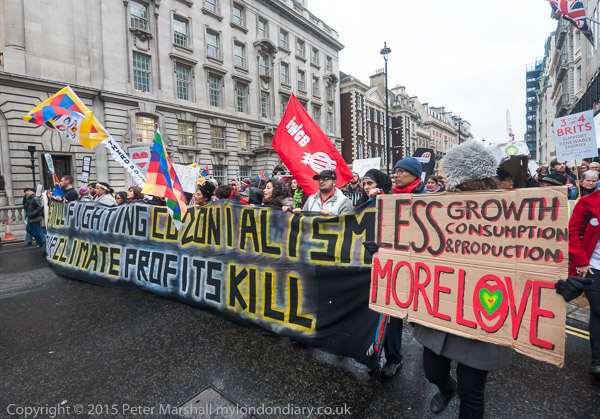
This year the wheels rather came off the protest,, when at the last minute some of the big charity backers decided that the Global Frontlines bloc which had been scheduled to lead the march was too radical for their taste, demanding global system change rather than minor adjustments. They tried to replace them with the main march banner along with performers in carnival animal costumes.

It wasn’t a change the protesters were going to take lying down, and they regrouped in front of the main banner. This was the first time that I can recall that a security company had been employed to act as stewards for a protest march, and ordered to remove the Global Frontlines bloc they made threats, and tried to do so, with some pushing and shoving. The protesters simply refused to move, simply moving back after they were pushed away. In my hearing the organisers asked the police to intervene, but to their credit they refused.

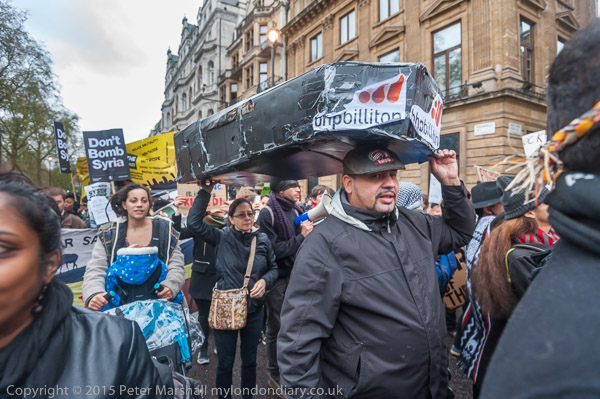
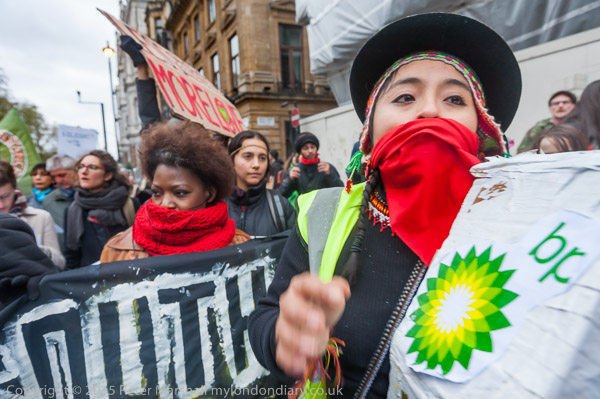
The banner at the front of the bloc read ‘STILL FIGHTING CO2ONIALISM YOUR CLIMATE PROFITS KILL’ and there were others with anti-colonial messages including ‘Extractivism is Colonialism’ and other anti-mining sentiments. Apparently what worried the more conservative charities most was the message ‘British Imperialism causes Climate Change’ as well as two coffins naming companies BP and BHP Billiton.

Eventually the protest split into two marches. First came the Global Frontlines bloc, who marched along the planned route, with a sit-down blocking Pall Mall a few yards from BP’s head office, as a protest against that company’s environmental destruction around the world and its collaboration with brutal repression of workers in some projects.

The rest of the march was held back for around ten minutes to create a gap between the furry carnival and the Global Frontlines. But other protesters also moved in front of the main banner, and by the time those sitting down on Pall Mall decided to continue, the march had more or less become one again as it went down Whitehall to the rally on Millbank. But there was a very bad taste left in my mouth.

The rally was frankly anodyne, and I met a number of long-term climate campaigners who told me that their groups had not been allowed to take part in it, as those in charge were determined that it should not be ‘political’.  There had been politicians and others at a rally on Park Lane before the start of the march, but only those of the protesters close to the stage were able to hear.

More pictures at Global Frontlines lead Climate March and
March for Climate Action Starts

Continue reading Climate Action

Nat Geo World

When I first saw the reports of a Photoshop cloning error on a Steve McCurry print widely reported after having been spotted by Italian photographer Paolo Viglione I decided there really wasn’t a lot more to say.

It seemed a careless error, and one that surprisingly hadn’t been spotted, but such errors aren’t difficult to make, and don’t necessarily result from any attempt to mislead. Years ago, when making a black and white print for sale, I’d done something similar, while cloning out a scratch from the negative late at night, my stylus had inadvertently dropped onto the tablet, probably as I briefly dozed, and added an extra piece to a shoreline. Fortunately I’d noticed it later, but only as I was taking a last look at the print before sending it to the customer, and was able to make a replacement print without the glitch.

It is something that probably wouldn’t happen now, even though I probably fall asleep at the computer more often, because I very seldom feel a need to use the clone tool now, as Photoshop’s other spotting tools have improved immensely over recent years. But it used to be the only real way to do the job back in the early days. I think the worst that has happened recently when I’ve nodded off has been to spill a glass of a rather good red wine across my keyboard. Doing so woke me with a start and I immediately tipped the keyboard upside down and there were no lasting effects, but I deeply regretted the loss of the wine, the last of the bottle, which I’d been keeping as a special treat for when I finished processing.

One of several prints on display in my bathroom is a large panoramic image of a house and garden, unsold after an exhibition where it was on public display for over a month. I can’t go in there without noticing a small error in the stitching process – it was made from three exposures – which means one of the windows in the house has a small part missing from its central white-painted vertical. I didn’t notice it in my careful inspection of the file, nor when it was on display, and if any who saw it at the show did, they said nothing. It hung on my own wall for several weeks before I noticed it, but now, although small and unimportant in the image, it seems glaringly obvious every time I use the bathroom.

Most of the time we see what we want to see, and not necessarily what is there, and I think that is perhaps one of the points behind photographer Peter van Agtmael‘s view on the McCurry controversy, ‘Why Facts Aren’t Always Truths in Photography‘. It’s an article I find rather disturbing, though entirely in agreement with his “very important qualifier” that “Any photographer working predominantly in a photojournalistic context needs to be rigidly transparent about digital manipulation“, and it is hard to dispute his statement that the best we can hope for in the intensely subjective craft of photojournalism is “a coherent personal truth.”

But in the piece he does seem to be acting as an apologist for a fellow Magnum member, even if one he says he hardly knows. Because it isn’t the silly and unintentional slip in that street photograph from Cuba that is at the heart of the controversy but the other examples of intentional deception that have emerged. And it is hard to believe that what we have seen is not just the tip of an iceberg.

The National Geographic Magazine
formed an important part of my early life, much of it spent, at least on rainy days, leafing through a large pile of the magazines covering the 1930s which had come to us after the death of a more affluent relative, along with his splendid stamp collection – he had worked for the General Post Office and made the most of his connections. The articles were at times rather tedious, but the black and white photographs spoke more directly, showing us how people around the world lived – and dressed, or not.

Coming back to ‘Nat Geo‘ years later was something of a surprise, with Kodachrome bursting out all over, but while presenting its rather over-enthusiastic view of the world, the emulsion was at least not susceptible to manipulation by photographers, though one could hide a great deal in its black shadows. But it would appear that with digital things have changed. Perhaps the revelations now being made will result in rather more editorial control.

I don’t warm to Nat Geo, which just somehow now seems far too American and politically not at all to my taste. That the National Geographic Channel is owned by the Fox Cable Networks division of 21st Century Fox, and the magazine since 2015 is part of a new partnership, National Geographic Partners, controlled by 21st Century Fox, perhaps says it all. But read ‘A Trip Around Steve McCurry’s Photoshopped World‘ by Paroma Mukherjee to see an Indian view of the photographers take on India.

Finally I’d like to mention an article in The Online Photographer, ‘C-E-R: Why we shouldn’t say “post” or “Photoshopping” any more‘. It’s not I think a very useful contribution, but one that reflects the anxiety some photographers feel about their own practices with images.

Post-processing or ‘post’ is just a useful term to cover everything that happens between when the file – raw or jpeg – emerges from the camera to when it appears on paper or screen. It isn’t really ‘after processing‘ as the article suggests, but ‘after exposure‘ processing’ If you want a more accurate term you could expand it to ‘post-exposure processing‘, but I’m all for keeping things short.

I’m not sure it is useful or possible to separate ‘correction‘ and ‘enhancement‘ as the article suggests, or to set clear limits as to what is allowable in photojournalism or documentary work (while in some other areas of photography clearly there are no limits on this or on the final category, ‘reworking‘.)

But what does seem clear to me is that this third element is simply something that should always be avoided by photojournalists and documentary photographers. And if Nat Geo aims to be anything more than a glossy travel-porn mag it certainly needs to give the photographers who work for it very strong guidance to that effect.

Epson Scans

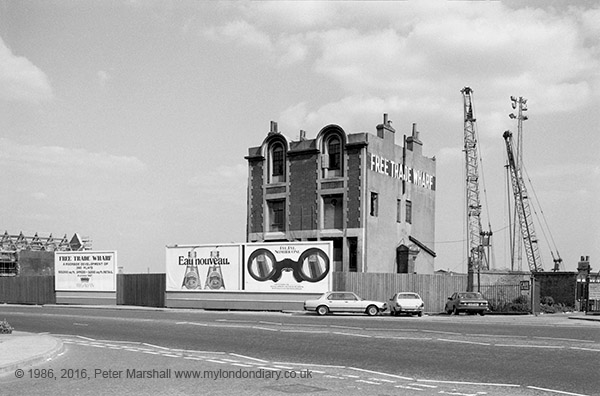
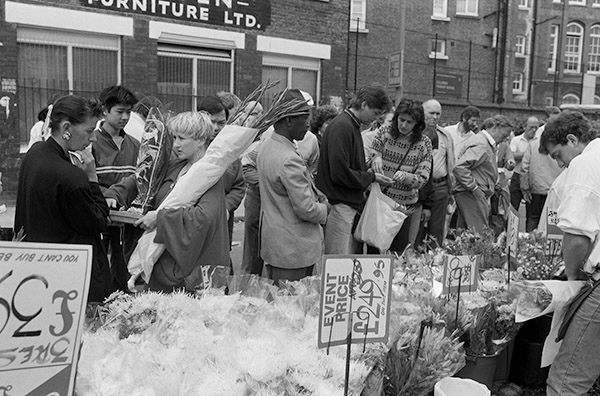
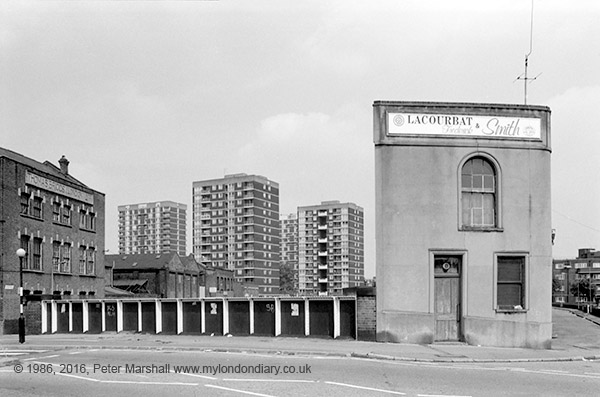
Today I’d doing some serous scanning despite it being a lovely day to go out and perhaps take some pictures. But I’ve a busy few days over the weekend and don’t want to get tired before this. I’m trying hard to finish a whole month of black and white work – July 1986. The pictures here are just a small sample from those I took that month, all in London.


Free Trade Wharf, Limehouse, London. July 1986

But before I started did something I should have done several years ago but always put off – something I’m definitely Grade A* at.

I’m scanning today with the Epson V750 flatbed; it’s much faster than the Minolta Dimage Multiscan Pro, and with care the results are virtually as good. I’ve been having problems with the Minolta – the Firewire interface has become unreliable, working for a few scans then giving up halfway, and it had become very difficult to use. It’s the way most of these scanners eventually fail.

The scanner also has a SCSI interface, but getting the SCSI card I have to work in my current computer might be difficult – though I mean one day to try. But SCSI is really now a thing of the past.

For some time I’ve been photographing negatives instead of scanning them, and I had everything set up using the D800E – and then that decided to internally destruct. Again another thing I mean to try is to get it working sufficiently to use for this, but that’s another job I’m putting off. And although the images were sharp and detailed I also had problems with getting even illumination across the frame.

So I decided to use the Epson V750 flatbed that I have on my desk and have mainly used for making scanned ‘contact sheets’ and as a photocopier, or a quick method of getting web-size images from slides or negatives. It is a capable scanner, and the only real reason for not using it before is that I had other ways of scanning negs that were just marginally superior. I’ve used the V750 both at home and elsewhere to produce scans for books by a couple of other photographers, and they have been very happy with the results.

A new Neg carrier

One of the problems that I think Epson themselves acknowledge is that the 35mm filmstrip negative holder just isn’t quite up to the job. They’ve never I think said so, but when they came out with the V800 it had a new holder. Unlike that provided with the V700 and V750 it was not glassless but incorporated anti-Newton’s rings glass as well as more flexible height adjustment to ensure correct focus.


Columbia Market, London. July 1986

Looking at the pictures in the reviews, some of which commented on the improved design, it looked as if it would fit the D750, and I checked this was so before ordering one – rather expensively – from eBay. As well as the A-N glass, it also has better height adjustment than the D700/750 holder. Overall it does seem possible to get flatter negatives and better overall sharpness – though before things were already fairly good

Having the glass does of course make dust more of a problem. But with care and a powerful blower brush, along with the Pro Co Statbrush 2000* conductive brush I used in the darkroom and a lint-free cloth or two it isn’t too bad – and Photoshop sees off much of it very quickly. I seem to get slightly less dust spots than with the Minolta, and so far none of the problems with Newton’s Rings that sometimes plague my Minolta scans. It was an effect I hardly saw in the first year I used the scanner, then told another photographer I hadn’t seen them, after which they became a real problem.

Cleaning under the scanner glass

For several years I’ve been looking at the V750 and seeing smears and dust on the underside of the platen glass; I could clean the top easily, but these remained. The manual didn’t help, and on several occasions I’ve done a quick search on the web and read dire warnings from various people and decided perhaps it didn’t really matter.


Bridge over Regent’s Canal, Bridport Place, Islington, London. July 1986

This time I was a little more assiduous in my search, and found a few people who said it was a quick and easy job. A link to Epson’s exploded drawings of the scanner on the ‘Better Scanning’ site which has a page about dismantling various Epson models confirmed it was a matter of lifting the lighting module off from the scanner bed and then revealing and removing 4 screws and the top would lift off. And so it did.

The hardest part was removing the four plastic plugs which hide the screws, which I did by kind of digging at their edges with a craft knife and easing them up. They have a V on their top and are easy to spot, one fairly near each corner of the glass bed. Once the screws are removed the top can be pulled off – mine caught a bit at the front a needed a little persuasion. Fortunately fitting it back on again after cleaning turned out to be as simple.

Using Epson Scan

The Epson scanner software isn’t bad when used in ‘Professonal’ mode, though some features – like the ‘Thumbnails‘ which always seem to crop your images are best avoided. I do a Preview scan, click the Normal tab if thumbnails have appeared, then drag a marquee roughly around the first neg I want to scan, and click to ‘zoom’ in. It’s best then to adjust the marquee to be entirely inside the image area to avoid any black and white areas outside the frame which might affect exposure before clicking on the auto-exposure icon.

Auto-exposure will always give a less than optimal result, but does get in you the ballpark. It’s best to keep the Histogram panel open all the time you are scanning and click on the ‘show output’ button to check if there is any black or white clipping. Adjust the input values to get rid of all or almost all of this, then move the midpoint slider to get the image looking roughly how you want it.

I can’t see any real point in not having the output as the default visible in this panel as it is what you really need to see, although sometimes you might want to be able to view the input. It’s one of several minor annoyances about the software, but otherwise it works well. I could instead use Vuescan, which I’ve used with the other scanners, but somehow never bothered with the Epson. Perhaps I’ll download the latest version and give it a try, certainly when I start to scan some colour negs.

It’s best to scan in 16 bit grey for black and white (48 bit RGB for colour) as then you can make final adjustments to brightness and contrast in Photoshop (or other image editor.) You are going to have to open the images in Photoshop anyway to retouch the dust etc. So concentrate on getting all you can from the neg by avoiding clipping.

Re-adjust the marquee boundaries to the edge of the image, and then you are ready to scan. Of course you will have already set the directory for the image to save in and for it to be saved as 16 bit tiff, as well as a suitable stem for the name – to which Epson Scan with add 001, 002…


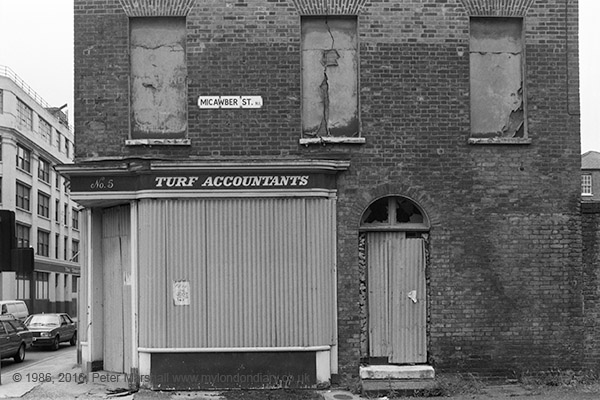
Closed Turf Accountants, Micawber St, Islington, London. July 1986

When the scan has saved, click on ‘Full’ in the preview pane, shift the marquee to the next image on the page you want to scan, and then ‘Zoom’ to view it and adjust exposure. Only use the auto-expose icon if it comes up way out, otherwise it is generally quicker to adjust from the previous values. And ‘unsharp mask’ has a habit of sneaking itself on. You don’t need it – if you want sharpening, Photoshop can do it better.

One further hint. Always go through the negs and decide exactly which are worth scanning – I mark the contact sheets, but if you don’t have these, you can write down the negative numbers. Otherwise if you are like me you will end up scanning twice as many.


* Not quite as effective as those Polonium 210 based StaticMaster brushes we used to use, but which now appear unobtainable in the UK. Quite safe so long as you remembered not to stir your tea with them!

Continue reading Epson Scans

Don’t Bomb Syria

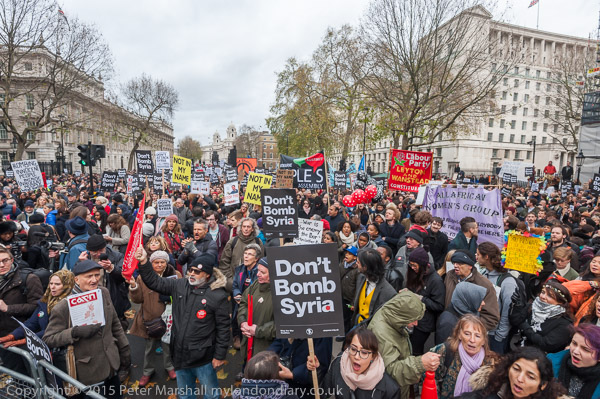
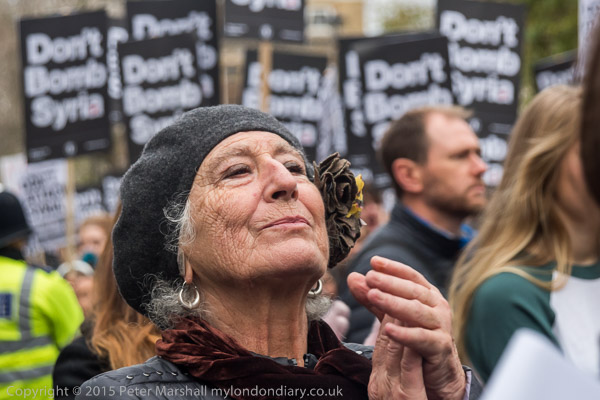
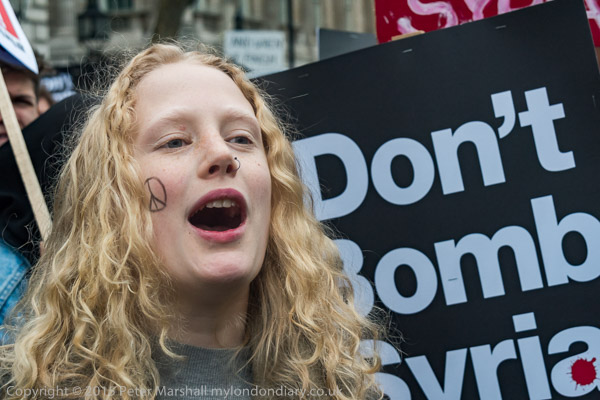
Don’t Bomb Syria was a big protest, attended by several thousand people, and obviously rather larger than the police had planned for, and it soon became obvious that their attempts to keep traffic flowing had been a mistake. It’s hard to think of any road in London which is a vital route – there are always other ways to drive from A to B, and there are often closures for various ceremonial or sporting events, but sometimes the whole purpose of policing protests appears to be to keep traffic moving.

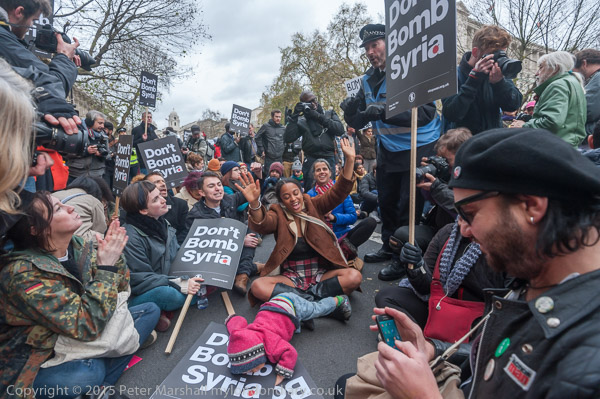
The numbers present forced them to  close the southbound carriageway a few minutes before the rally started, but they continued to keep traffic flowing northbound, having to keep clearing off groups of protesters who kept coming onto it from the pavement to get closer to the speakers. Finally enough people decided they had had enough of the police action and a large crowd moved on to the road and after a while sat down and blocked it.

London has been very slow to take the obvious move of pedestrianising some of its central areas; while many suburban high streets are now traffic-free, Oxford St is still full of traffic and Parliament Square remains a large traffic island. Almost everyone feels that Trafalgar Square is so much improved after the North Terrace was finally pedestrianised in 2003 – except for the National Gallery, which is upset by the buskers and ‘living statues’ who lower the tone by performing there. Much as I hate ‘living statues’,  and would certainly welcome some form of cull, it is far more pleasant now than when the area was full of buses, lorries and diesel fumes.

I wasn’t happy with some of the speakers at the protest, although I agreed that a military intervention by the UK at this time was unlikely to have any positive effect. We should have acted much earlier, though not directly, rather than speaking in support the Syrian opposition and against the dictator Assad but refusing to give those who opposed him any material support.

While the Russian position perhaps made it impossible to act directly it would have been possible to find ways for the Syrian rebels to have much more effective defence against the air attacks of the Syrian regime, and to stop the huge oil exports, mainly smuggled through our ally Turkey which have largely financed ISIS.

What I waited for in vain as I photographed the speakers at the event was for anyone giving a view from the Syrian opposition – instead we got many of the same speakers who get paraded at every Stop the War protest. Some of them are worth listening to, others too predictable to be really worth the effort. And several did stress the need to take effective action about the Turkish oil smuggling that is funding ISIS – something the Russian bombing and press releases have made us all aware of.

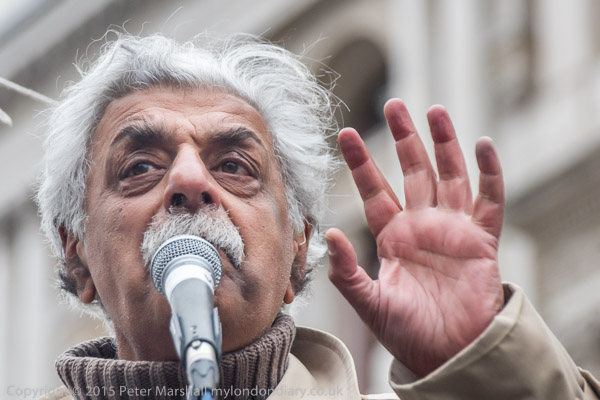
From a purely technical point of view it is always a pleasure to watch and listen to speakers such as George Galloway and Tariq Ali, whether or not what they are talking makes sense (and usually at least some of it does.)  Some of the others can reliably be expected to speak good sense, but  as I say in Speakers at Don’t Bomb Syria

” I was left waiting and wanting. There with notebook poised ready to write down the names of the speakers representing the Syrians and the Syrian Kurds, who should surely have been at the forefront of this protest rather than so many old ‘Stop the War’ war-horses. None came, not because none were available or willing to speak, but because the politics of those most closely involved don’t accord with those of Stop the War.”

Eventually I lost interest in the speeches and concentrated on the large group by now blocking the road, as you can see in the third part of my report:  Don’t Bomb Syria Blocks Whitehall.

After around an hour, people were beginning to leave, and the arrival of more police who then went around telling people they would be arrested if they continued to sit in the roadway fairly quickly persuaded the others it was time to end their protest.

Continue reading Don’t Bomb Syria

Gear Sense

One post I’ve read on Petapixel sums up many of the things I’ve often said or thought about photographers and gear. The 11 Stupidest Things Photographers Say About Gear is worth a read, as is a series it refers to on fstoppers.

They compared the same scene photographed on leading Canon, Sony and Nikon cameras and asked people to rate the 3 images and say which camera they came from. And the results showed that there was very little difference between whether they photographed the studio scene on a Canon 5DsR, Sony A7RII, or Nikon D810.

Not only was there no real difference in detail, resolution etc, there was an almost identical colour to the three images. I still think there are differences in colour between the images produced by the three cameras, but these are down to differences in how the auto white balance works rather than anything inherent to the camera. And the differences are easily corrected in post-processing.

But the main differences between the three marques are in handling. How convenient is the control layout, and the menus. Which way do zooms zoom? and where do you have to line up the dots when changing lenses, and which way do you turn them. I’ve used Nikon for over 12 years now, and I still find it much easier and faster to change lenses on a camera that works the same way as Leica does. But the buttons etc on Nikon seem so much better than the interface on Canon. And so on. My ideal SLR camera would still be the Olympus OM4, but no one has ever made a digital version of that – and of course I’d like some updates such as auto-focus and high speed flash sync.

Of course the publication of their results was greeted with controversy, and some valid points were made, in particular about the lens used for testing with the Sony, So this led to ‘We Tested the Sony A7RII AGAIN for All the Sony Fanboys‘ and the results were more or less the same: Most People Cannot Tell The Difference Between Nikon, Sony, and Canon High Res Files. And most of those who tried and mainly got it wrong were photographers.

Perhaps I should be pleased that one of the cameras I use came out marginally top on the test, but quite frankly I could not tell the difference and suspect it was probably not statistically significant. But at least it does reinforce my own feeling that the extra pixels in the 50Mp Canon EOS 5DS R are of no significance.

I’m actually thinking of going back to DX format for my next camera – I’ve always thought there was – as Nikon for some years maintained – no real advantage in the larger FX format. It wasn’t that the results were any better, just the larger sensor meant the cameras had a better and brighter viewfinder.

My ailing D700 is still taking good photographs – at least when I manage to point it in the right direction at the right time with the right lens. But its days are surely numbered (and a service that would address its current faults would cost more than its worth.) I’ll probably replace it by another Nikon, but can’t at the moment decide whether to buy a D750 or, when they get into the shops, a D500. Or perhaps by the time I’ve made my mind up there will be something new available to change it!