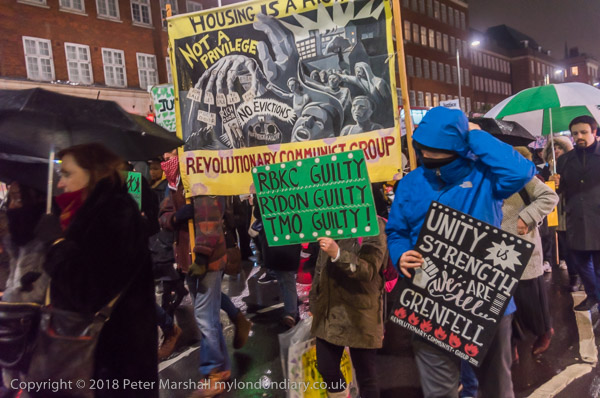
Grenfell & Ladbroke Grove

As the survivors and friends and family of those who died in the Grenfell tower disaster recently finished giving their testimonies to the public inquiry, it is perhaps appropriate to point out that this is part of a longer history of contempt and neglect of the North Kensington community by the local council and national bodies.

Back in the 1960s, the Westway was built  as the A40(M) through the area, an elevated section of the A40 and a part of the London Motorway Box or ‘Ringway 1’ scheme which was to provide  motorway standard roads  (it lost motorway status in 2000 when taken over by the GLA)  across the city and involved demolition on a massive scale. Such was the devastation and public outcry caused when construction started that the massively costly scheme was abandoned in 1973 and the Westway, along with the nearby West Cross Route also in North Kensington along with the East Cross Route from Hackney Wick down to the Blackwall tunnel and on to Kidbrooke completed.  The ‘Homes before Roads‘ campaign persuaded the Labour Party to re-examine its transport policy, and the project was cancelled in favour of traffic management and investment in public transport when they took control of the GLC.

It was no accident that the completed routes were driven through some of London’s most deprived areas, particularly in North Kensignton, areas where opposition was expected to be weaker and the needs of the local communities judged to be of less importance.  But community in North Kensington turned out to be stronger and better organised than anyone had expected, and at the completion of the road the devastated area beneath and around it was given in 1971 to the North Kensington Amenity Trust (now renamed the Westway Development Trust), to be reclaimed and developed this land for local community use.
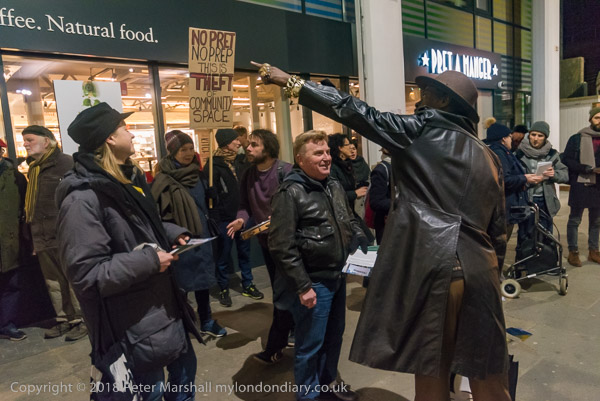
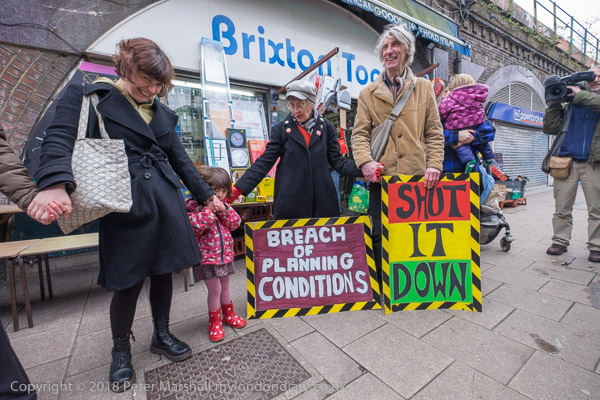
In recent years many locals see the Westway Trust as having become largely a commercial enterprise with close links to Kensington & Chelsea Council (RBKC).  Westway23 is a local action group set up to represent the interests of the community in those 23 acres dedicated to community use. On Feb 9th they protested on Ladbroke Grove outside the newly opened  Pret-a-Manger, on the ground floor of the site of the £6k per term  Notting Hill Prep School LTD (NHPS) in what had been the “Westway Information Centre, a building left in trust to the surrounding community and central to life in North Kensington.”

This abuse of public assets  was by “the Council, then under the leadership of Nick Paget-Brown, and Rock Feilding Mellen” who “were pursuing an asset-sweating strategy which prioritised the commercial value of public land, casting such issues as residents’ consent, public access, and public amenities as minor concerns.”

When the concil’s leadership after Grenfell was replaced by Elizabeth Campbell and Kim Taylor-Smith, they promised there would be change and they were listening to the people, and Westway23 called on them to reconsider the plans, and point out that the 23 acres which the Trust was set up and entrusted to protect for the community is now 80% used by commercial interests.

They state:

“Reducing the land available to the community in order to facilitate the expansion of a £6k per term prep school is, in our view, a misuse of the land; and the use of council funding to pay for building development works is a misuse of public funds. The School’s decision to sublet part of their lease to corporate interests – that not only do not enhance, but actively threaten, the mix of independent and community led activities on the 23 acres – demonstrate a worrying level of ignorance from the School about the interests of the local community. ”
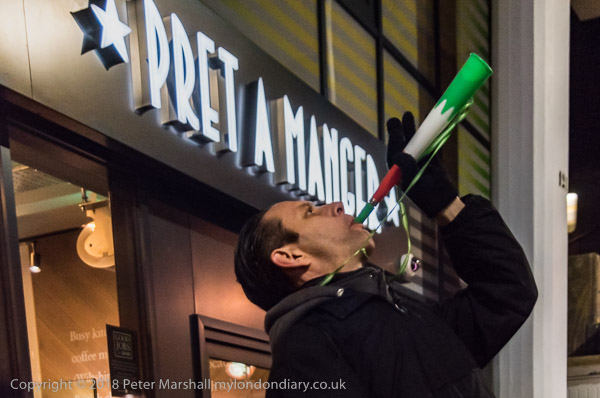
Further they say that  RBKC has broken its planning guidance by letting another chain into North Kensington, rather than an independent business.
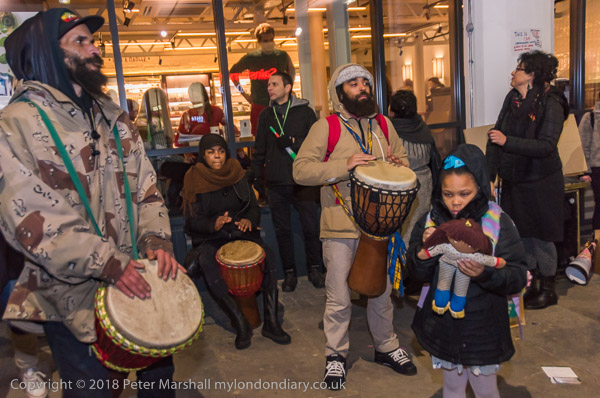
The protest started slowly  but soon developed, particularly with the arrival of some African drummers and was still going strong when I had to leave, intending to keep up the noisy picket until the shop closed. So far RBKC still seem oblivious to the complaints of the local community, either about this or on other local issues.
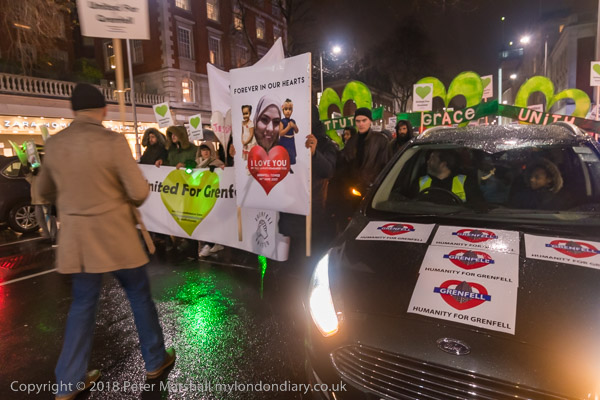
A few days later I was back again in Kensington, this time outside Kensington Town Hall, where the 8th monthly silent march for Grenfell Tower was going to begin, the organisers having decided to move it there to make in much more visible in the borough. It began its march down Kensington High Street in pouring rain and by the time it turned north into a more dimly lit street I was soaked and my cameras were also getting rather wet.
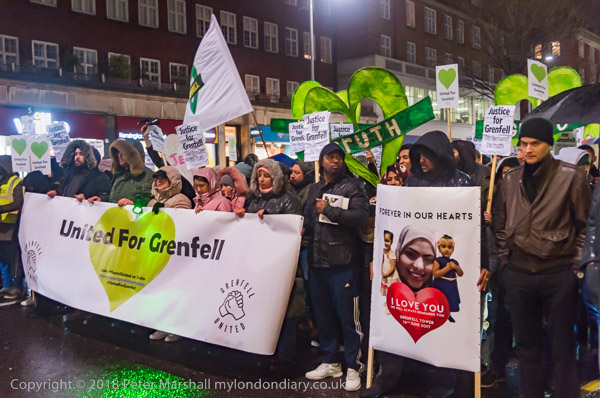
I was cold and miserable. When one of my cameras actually stopped working I stopped working too. The street was dark and there would be few opportunities to take pictures before we reached its destination close to Grenfell and Latimer Road station, almost a mile and a half away. I abandoned the march, and made my way the 500 metres to Kensington Olympia station for a train.

I fished my ticket out of my trouser pocket, and put it into the barrier gate, which took it in but then nothing happened. The ticket, which had got slightly damp from the rain had stuck inside, blocking the mechanism. Fortunately there was – as there is always supposed to be – a man in uniform by the gates and I went and told him what had happened. He came over and got out his key to open the machine – only to find it would not fit as it had got bent. He could let me through but I needed the ticket to complete my journey. He had to walk over the footbridge to the opposite platform, borrow a key from another employee, come back and could then open the machine to return my ticket. By which time my train had come and left. Fortunately it’s a fairly frequent service, but I was still almost half an hour late getting home.  And by the time I got there my cameras had dried off and were working again.

More pictures at:
Ladbroke Grove Pret-a-Manger land theft
Grenfell Remembered – 8 Months On

There are no adverts on this site and it receives no sponsorship, and I like to keep it that way. But it does take a considerable amount of my time and thought, and if you enjoy reading it, a small donation – perhaps the cost of a beer – would be appreciated.

My London Diary : London Photos : Hull : River Lea/Lee Valley : London’s Industrial Heritage

All photographs on this and my other sites, unless otherwise stated, are taken by and copyright of Peter Marshall, and are available for reproduction or can be bought as prints.

To order prints or reproduce images

________________________________________________________
Class War and the Shard

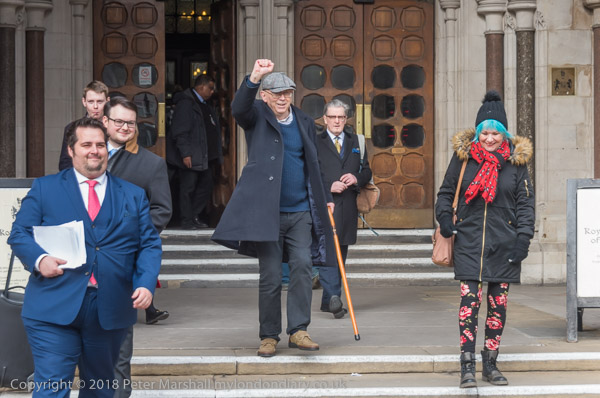
Class War continued their successful court record, with Ian Bone raising his fist in a victory gesture for the photographers (I think there were two of us) as he makes his way out of the High Court in the Strand, where lawyers acting for the Qatari royal family had tried to get an injunction to prevent a Class War protest against the ten empty £50 million pound apartments in The Shard, and to claim over £500 in legal costs from the 70 year-old south London pensioner. Smiling at the left is his brief, barrister Ian Brownhill who on hearing of the attempt to stifle legitimate protest had offered to conduct Bone’s defence pro bono, and at right, Bone’s partner, Jane Nicholl.


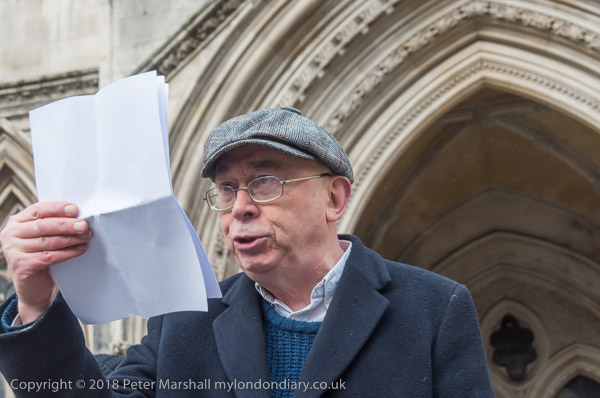
Ian Bone proudly reads the description of Class War presented to the court by lawyers for the Qatari Royal Family

Class War are a much misunderstood bunch, bringing out an existential fear in the hearts of the bourgeoisie, and in particular of the press and police force. At some of their protests they have been outnumbered five or ten to one by uniformed officers, with a number who look suspiciously undercover hanging around. The idea of anarchism still arouses a class memory of bombs, sieges and the mob running in the streets, but Class War is more an anarchy of ideas, with actions as spectacle rather than armed struggle.

Despite their small size – or perhaps in part because of it – they have been remarkably effective in many campaigns, particularly those around housing and low pay. Some of their own campaigns – such as the series of around 30 ‘Poor Doors’ protests I photographed – have shown a remarkable tenacity and have done much to bring the issues to wider attention. Led by a small core, hard for undercovers to infiltrate, they have at times attracted the support of hundreds of others. It’s not a group with membership or rules but a truly anarchist lack of organisation, a group of friends who share common ways of thinking about politics and life and are prepared to act – and anyone who thinks and acts in the same way can be Class War too.

“Want to get involved? We have no leaders, no bureaucracy, no fees and you don’t have to sell a paper! Just come along to an action and get involved.

Join in * Reject cynicism * Life’s more fun with Class War!”

Though it does require a good sense of humour, they are deadly serious about politics and the need for change, for a society that works for the ordinary people rather than being arranged for the one percent, and they and others in groups close to them often bring out some of the more glaring inequalities that those at the top would prefer to keep hidden. We all know that there is a housing problem in London, and that much of the building that is going on over London is not aimed at reducing this, but at allowing largely foreign investors to profit from rising property prices, buying luxury flats which will often never be used, just sold a few years later when their value has risen – with developers publishing investment proposals suggesting huge rises and quick profits.

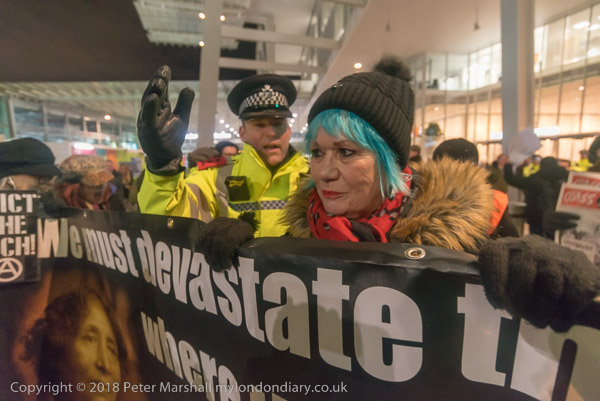
At their protest outside the Shard, Class War pointed out that the ten £50 million pound apartments in it have remained empty since the building was completed, and that developers currently plan to build a further 26,000 flats costing more than a million pounds each, many replacing current social housing, when London has a huge housing crisis with thousands sleeping on the street, and over 100 families from Grenfell are still in temporary accommodation. Official figures show that despite the huge and increasing need, London is losing several thousand properties at council rents each year.

Although the court decision had made it clear that the protest was permitted outside the Shard, so long as the protesters did not enter the property, police still insisted that Class War move further away, across the road.

Their attempt to justify this seemed even more pathetic than usual, suggesting that Class War, who were standing to one side of the normal pedestrian routes, were causing an obstruction; there was a clear obstruction, but this was caused by the line of police officers. But Class War did take their banner across the road, though some members continued to protest as the court had allowed on the clearly marked edge of the property.

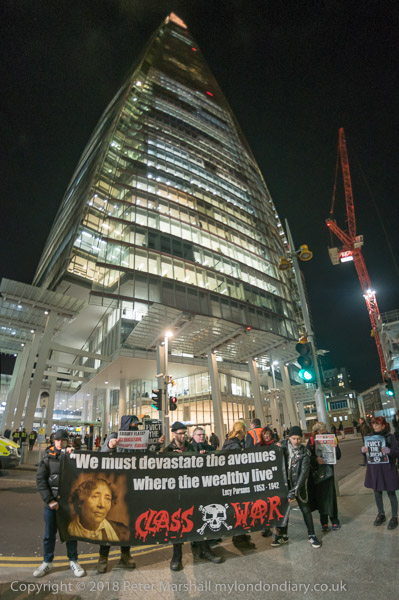
The Shard presents something of a challenge to photograph from a close distance, and even from across the road it was hard to show the building as a whole as well as the protesters. Even my 16mm fisheye couldn’t do the job sensibly in landscape format, and I had to turn it 90 degrees to get it all in.

While the software I use to convert perspective does a good job with landscape format images, it doesn’t cope well in portrait format. Playing a little in Photoshop with its Adaptive Wide Angle and a little more fiddling, including a change in aspect ratio and a little image rotation can produce a straighter result for the tower, which may be more acceptable.

More pictures on My London Diary:

Class War protest at Shard
Class War victory against Qatari Royals

There are no adverts on this site and it receives no sponsorship, and I like to keep it that way. But it does take a considerable amount of my time and thought, and if you enjoy reading it, a small donation – perhaps the cost of a beer – would be appreciated.

My London Diary : London Photos : Hull : River Lea/Lee Valley : London’s Industrial Heritage

All photographs on this and my other sites, unless otherwise stated, are taken by and copyright of Peter Marshall, and are available for reproduction or can be bought as prints.

To order prints or reproduce images

________________________________________________________
Underneath the Arches

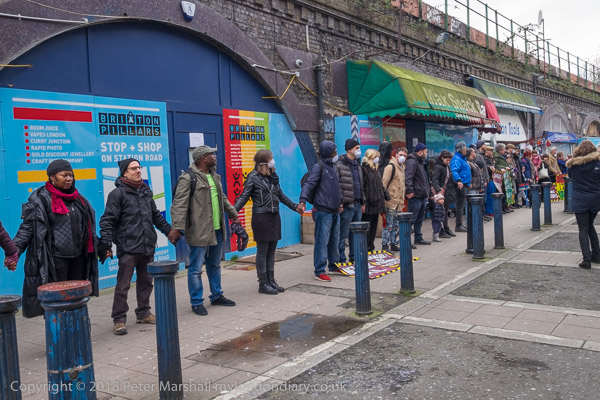
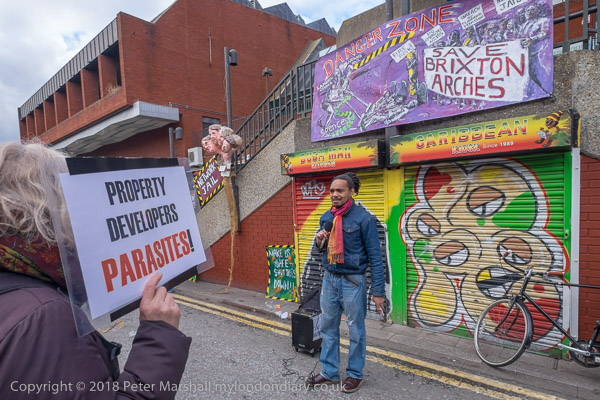
The campaign to save the Brixton Arches, or rather the 39 traders with businesses in the arches and kiosks under the railway line between Atlantic Rd and Brixton Station Road began around three years ago, when Network Rail announced their plans to “regenerate” the area.

These businesses, some of which had been going since shortly after the war, have been a vital part of the ‘heart’ of Brixton, in the centre of its market area. Mostly they sold useful things – like fish, carpets, tools, fabrics, white goods, along with down to earth cafes etc. Prices were generally keen and the businesses served the neighbourhood.

Network Rail’s regenerations plants aren’t for a major change in the structures. A railway arch is a railway arch. They will strip them out, put in new floors, replace electricity and water pipes, but the properties will remain basically the same. But the rents won’t.

Their plan enables them to evict all the tenants, ending their tenancy agreements. And after their limited work to increase the rents. To actually TRIPLE the rents.

Some of the existing tenants were offered places after refurbishment. William Hill and H&T Pawnbrokers are apparently being allowed to stay in place while their premises are being refurbished – presumably they came to an agreement on the rent hike. Only 9 of the other businesses have been offered space in the refurbished arches, less than 25%, though Network Rail have always claimed it would be 75%, a figure obtained by excluding traders and sub-tenants who were in the majority from their calculation.

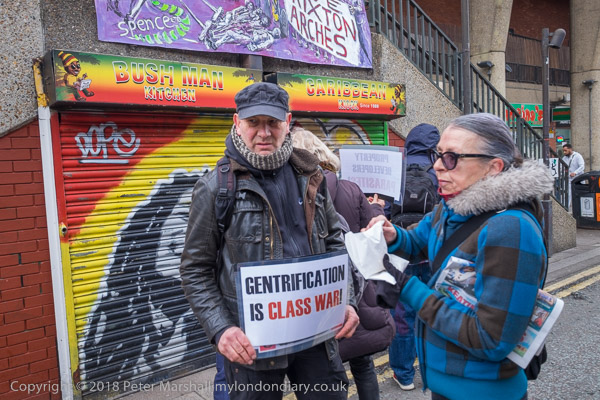
The actual number who return will almost certainly be less. Few businesses can survive the long gap in their operations, and probably few will be able to afford the new higher rents. Probably over 80% of them will be new businesses, which will need to work with high margins to meet these rents. Shops which will cater to the richer younger population moving into Brixton and changing its nature. Gentrification.

Has the fight for a little over three years – it finally ended early in April – which this protest celebrated been worthwhile? Although the battle has been lost, (and given they were fighting both Network Rail and Lambeth Council this was always almost inevitable) there have been some gains.

Network Rail wanted all of the occupants out of the arches with no right to return. Nine isn’t a huge number but it is nine more than zero. And while the three quarters who are new businesses will pay the tripled rents from the start, those who return will see the increase to these levels taking place over seven years.

During the fight, businesses were able to keep trading, some for a matter of months, but the final three managed another 3 years of trading. And tenants who had only been offered statutory compensation later received significant discretionary payments.

It’s also a battle which has united many in the community, and which will perhaps make Lambeth Council a little more cautious and almost certainly delayed for a year or two their long-term project for the gentrification of Brixton. But there will be more fights coming up before long unless we see significant reform in the local Labour party.

More on My London Dairy at Save Brixton Arches: 3rd Anniversary Action

Introducing the event was spoken word artist Potent Whisper, who you can see speaking at it on YouTube.  His book ‘The Rhyming Guide to Grenfell Britain‘ includes ‘Save Brixton Arches’ which you can also watch on YouTube under the title ‘#OurBrixton.

______________________________________________________

There are no adverts on this site and it receives no sponsorship, and I like to keep it that way. But it does take a considerable amount of my time and thought, and if you enjoy reading it, a small donation – perhaps the cost of a beer – would be appreciated.

My London Diary : London Photos : Hull : River Lea/Lee Valley : London’s Industrial Heritage

All photographs on this and my other sites, unless otherwise stated, are taken by and copyright of Peter Marshall, and are available for reproduction or can be bought as prints.

To order prints or reproduce images

________________________________________________________
Save the NHS

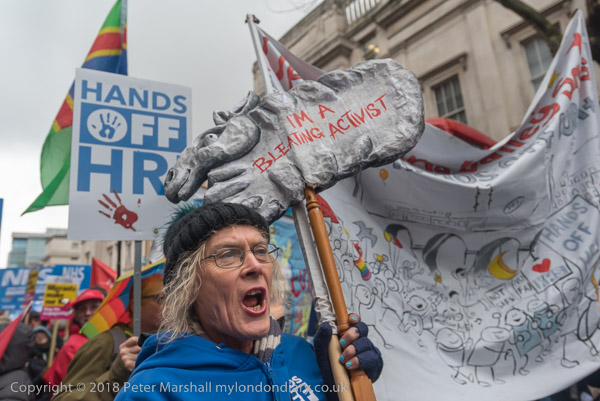
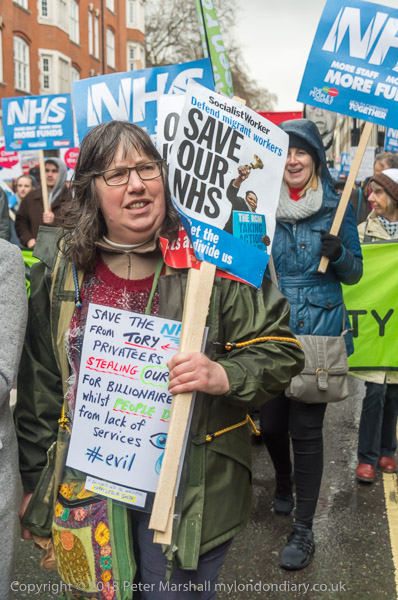
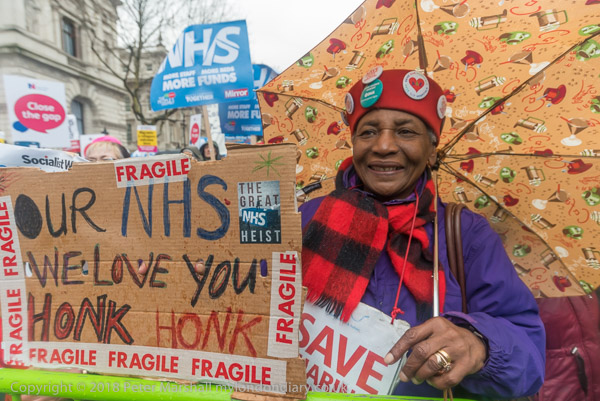
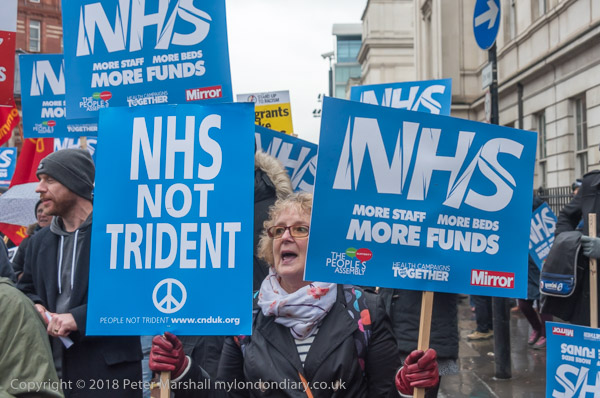
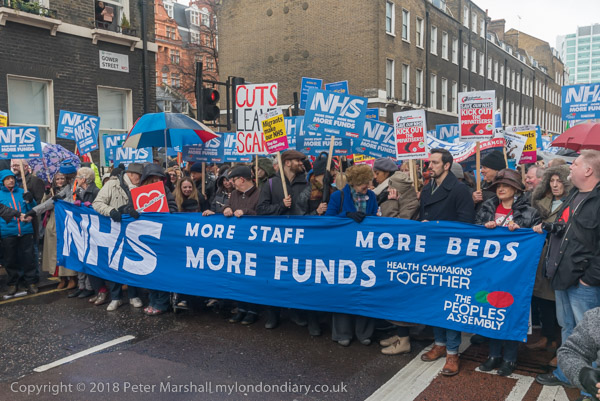
For a large protest which had tens of thousands marching through London, February’s ‘NHS in Crisis: Fix It Now!‘ protest got remarkably little news coverage. As so often I got the feeling that had it taken place in another country it might have got a higher profile. But it was in London, and organised by Health Campaigns Together & The People’s Assembly Against Austerity and was opposed to the growing takeover of the NHS by private companies, doubtless many of which are connected with the few billionaires who own most of our newspapers and other media organisations.

They don’t of course control the BBC, but this increasingly takes its definition of ‘news’ from the commercial media and also largely supports the status quo; there are some fine journalists working for them and reporting from abroad, but things happening in the UK are largely seen through the eyes of presenters and backroom staff with Oxbridge degrees and former positions in Conservative student and other organisations. It isn’t of course possible to entirely hide the current crisis in the NHS, but you can hide the worst of it, blame everything except government cuts.

And of course there are other mistakes that the government is responsible for. The programme of PFI hospital rebuilding, begun by John Major but largely taken over and hugely expanded by New Labour will continue to be a huge drag on the NHS for another 30 or so years, And the success of the NHS in keeping us alive longer had added to its own troubles.

Despite some of the lies put about by largely Tory politicians, we still have a health service that is the envy of much of the world, free at the point of use. But it is one that is run by politicians who have written at spoken about replacing it by a US-style system which refuses many treatment and bankrupts others. We all know about the appalling shootings that take place far too often in US schools, but for many parents whose children are shot the financial consequences add to the grief at the loss or injury of their children, with huge bills for hospital services. We get a good health service (despite some problems) and we get it on the cheap.

The NHS needs more funding. We all know it, which is why that huge lie on the Brexit bus was so effective, though most who thought about it knew at the time it would never pay up. Cancelling ridiculous ‘prestige’ projects such as the replacement of Trident could go some way towards funding it properly, and taxing the corporations that make huge profits in the UK but avoid paying their taxes would certainly help – by a conservated estimate we lose £300bn a year through big business off-shoring, roughly twice the total NHS budget, but probably we need to pay more tax directly for the NHS, though increases in income tax and national insurance. I’ve already signed a letter to the Chancellor of the Exchequer telling him I’d happily pay another penny on my income tax to go directly to the NHS.

Of course there are places in the NHS where savings could be made. It’s hard to understand why it apparently costs the NHS around £12 to provide a month’s supply of aspirin which I could buy at the pharmacist for around 30p, or why they pay a US company £3,000 for a month’s supply of a drug which can be bought as a generic from an Indian company for £40. But Trump wants to put up the charges that US pharmaceutical companies make to the NHS, saying they are getting them too cheaply.

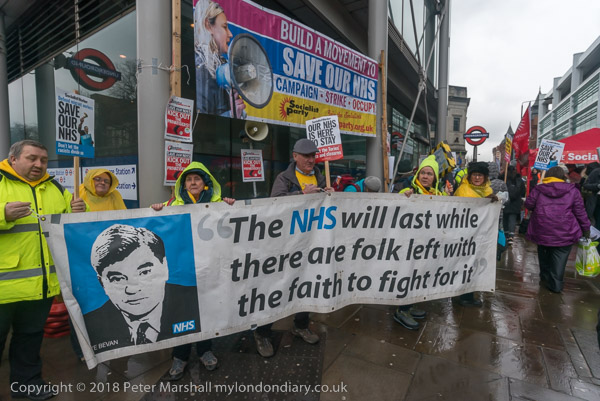
The NHS is currently slipping away from us, increasingly privatised, currently with the introduction of US-style medical care by Accountable Care Organisations, siphoning cash from the NHS into the pockets of shareholders – including many leading mainly Tory politicians. Its also becoming increasing clear that the 2012 Coalition Government Health and Social Care Act has created a terrible mess and is in need of radical surgery or rather replacement by measures that bring the NHS back under properly accountable control. Aneurin Bevan may never have actually said “The NHS will last while there are folk left with the faith to fight for it” (it was actually the invention of a TV script writer) but the need for that fight is greater now than ever.

Fix the NHS Crisis Now

______________________________________________________

There are no adverts on this site and it receives no sponsorship, and I like to keep it that way. But it does take a considerable amount of my time and thought, and if you enjoy reading it, a small donation – perhaps the cost of a beer – would be appreciated.

My London Diary : London Photos : Hull : River Lea/Lee Valley : London’s Industrial Heritage

All photographs on this and my other sites, unless otherwise stated, are taken by and copyright of Peter Marshall, and are available for reproduction or can be bought as prints.

To order prints or reproduce images

________________________________________________________
Brixton Portraits and GDPR

Rather fewer photographers now have shops with windows to display examples of their work, and of course it was only those who made a living from social photography – weddings, portraits etc – who sold their services to the general public for whom it made sense. Now, most people take their own portraits, apart from those usually hideous examples produced by school photographers which parents are blackmailed into accepting so that schools can have a photographic record of their pupils (or rather ‘students’ now that you graduate even from nursery schools.)

Of course there are parents who like them, but when I was a teacher I was opposed to them on principle; not just because they generally had the same degree of originality as a photobooth, but because I knew that they put parents on low incomes into the position of having to either pay for them and go without necessary food or clothing or disappoint their child and force them to take the pictures back to hand in at school.

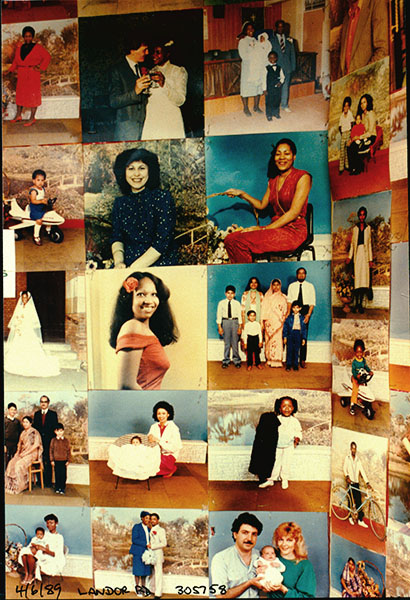
But good social portraiture is a rare skill, and during the late 1980s and early 1980s I carried out a project that involved photographing in and through many shop windows across London, and this included many photographer’s windows. I photographed a detail on one in Landor Rd in 1989 which I think must have been Harry Jacobs studio window; the caption states 4/6/89 Landor Rd 305758, where the 6 figure number is a Grid reference, though these were not always correct to the last figure. The image is a scan from a commercial enprint, which I could locate quickly as these are filed by the 1km grid square in which they were taken.

I’m sorry that I don’t appear to have taken a wider view of the shop front, but this picture is unusual for me and I think means that I realised the value of his work. As with many of the pictures in this series it was taken on a Sunday morning, when most shops were closed as this usually enabled me to work undisturbed. I do remember thinking that it would be worth going back and finding out more about what appeared to be a remarkable social record, but I never got around to doing so. And perhaps a little over ten years later I noticed the shop no was no longer there.

Soemone from the Photographers’ Gallery had clearly also noticed the work, and three years after Jacobs retired in 1999, with an archive of almost 60,000 photographs they put on a show based around his work in 2002, discussed in The Guardian. His son wrote a short piece, My Father the photographer which was published in The Evening Standard.

The Photographers’ Gallery apparently decided at the time that for photographs taken before the 1988 Copyright Act they had to get permission from the subjects to exhibit them. I’m not sure that was true, but although we have had no such problems from then until now, it is possible that things may be different again under the EU General Data Protection Regulation (GDPR). But you can rest assured that the GDPR allows processing for the purposes of journalism, and I think for art. The problem with the work by Jacobs was that it had been taken as a commercial agreement between the sitter and photographer and the sitter’s permission was probably required for it to be shown as art or documentary. My photograph above is clearly a work of art!

The Freelance Branch of the NUJ (a union to which all journalists in the UK should belong) has published an excellent guide to the GDPR for Freelances, which is generally reassuring, though it does point out we should all have registered as data controllers under the Data Protection Act 1998 and should continue to pay the £40 per year this involves.

You are also required to take proper steps to protect your data, which would include using strong passwords or physical locks on devices including computers, backup disks and memory sticks etc. The article makes clear that as journalists you can use the exemptions for free expression to avoid giving any information in response to ‘subject access requests‘ and that journalism is explicitly exempted from the ‘right to be forgotten‘. Something which may upset some is that the advice suggests that there may be problems under GDPR in using cloud storage.

Back to Harry Jacobs. My reason for mentioning him is that Lambeth Council are for once doing something I approve of, with a show of his work in the Town Hall. A Snapshot of Brixton: Harry Jacobs and the Empire Windrush opened on Friday 25th May and runs until Friday 6th July. Open M – F, 09.00 – 20.00

Back to the Elephant

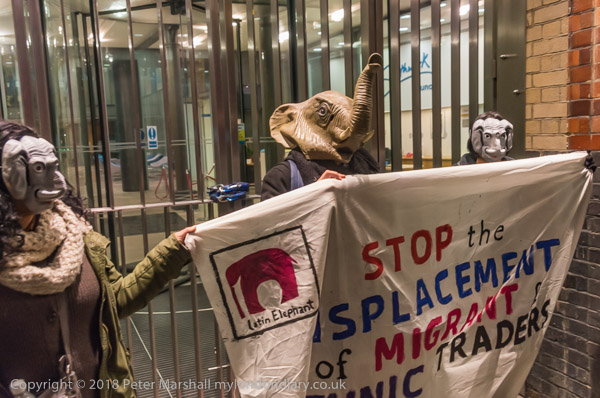
Though not actually to the Elephant, but to the dark street outside Southwark Council Offices near London Bridge for a protest outside where a Southwark Council meeting which due to vote on plans by developer Delancey and the council which would destroy the Elephant & Castle centre and the community around it. At an earlier meeting the decision had been deferred to allow Delancey to come up with new proposals to meet the community objections.

Although they had made some changes, the proposals were still nowhere near acceptable, but the protest ended in something of an anti-climax. While the protesters had been hopeful that the plans would be turned down, instead the council voted to put off the decision until a further meeting to give Delancey time to submit a revised proposal.

There seems to be little hope that the revised plans will be very much better, but whether they will then be approved is hard to predict. It looks as if the council cabinet that backs the private developer has enough power to keep the redevelopment on the table until the opposition in the council gets worn down enough to pass it.

So it remained likely that the redevelopment would at some point go ahead, and that most of the protesters worse fears about social cleansing etc. will be shown to have been justified, while the developers and a few in the council offices do very nicely for themselves, with some moving to lucrative private sector jobs.

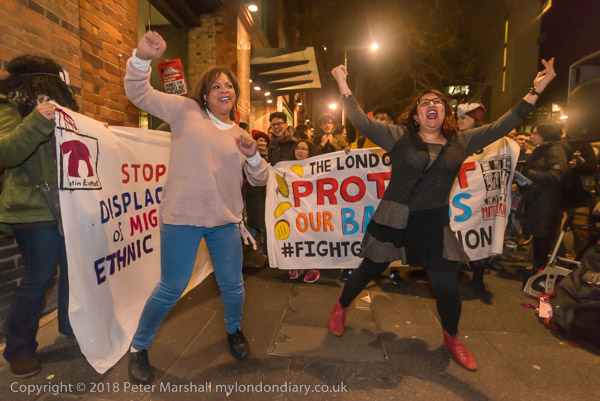
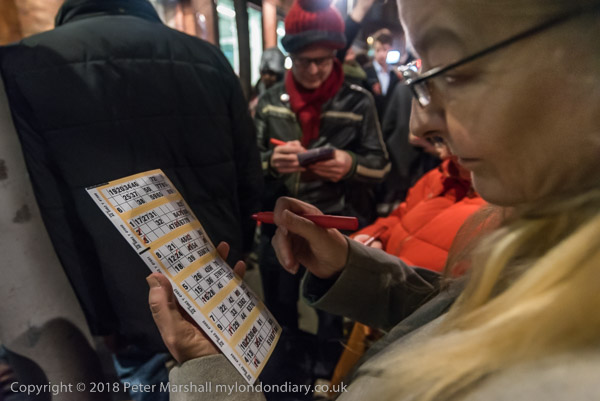
The protest was unusual, featuring Latin dancing and bingo, representing just two of the groups who will lose out. And of course elephants.

The struggle here is of course part of a wider struggle in the Labour movement, with Southwark COuncil dominated by right-wing Blairites, members of ‘Progress’, a group in the party opposed to many of its present policies and including many dedicated to the downfall of Jeremy Corbyn.

So far the Labour right have managed to maintain control of important aspects of the party machinery, which has allowed this group to continue as a Thatcherite fifth column inside the party, but with increasing support  both in the party and in the nation for the new policies this may change. It has long been clear that the party’s only hope of re-election is to unite behind a leader – like Corbyn – who rejects the old and failed Blairite approach.

Estate regeneration, as first proposed under Blair, was one of the party’s better policies, but failed in essentials like taking the needs of the estate residents and others on council waiting lists into account and accounting for the clever tricks of developers.  With proper consultation which actually took the residents views seriously and relatively small sums of money to renovate and refurbish, along with sensitive infill to provide new council-owned properties, most of the estates now being demolished could have a useful long-term future – as the schemes put forward by ASH (Architects for Social Housing) and others have demonstrated.

Many of the estates targeted so far are not those most in need of regeneration, but often some of the more viable estates, chosen because their position and scale means huge profits for private developers.  Many of the estates from the 1960s, though possibly in out of fashion styles, are better built and to higher standards in many respects to their new replacements, and with refurbishment and maintenance would have long outlasted current builds.

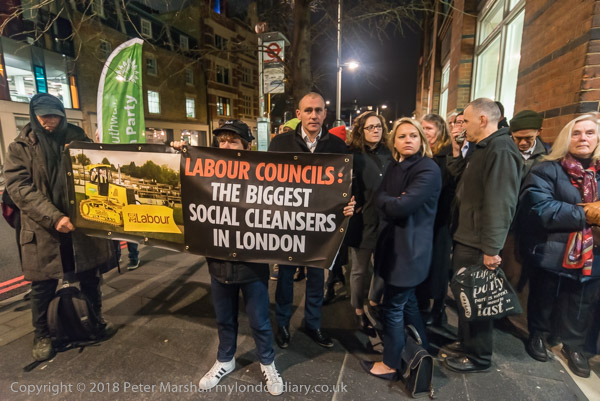
Class War’s poster ‘Labour Councils: The Biggest Social Cleansers in London‘ is of course correct, because Labour controls most of London’s councils. And while Tory councils might well see social cleansing as one of their aims (as Dame Shirley Porter did as Leader in Westminsterwe expect Labour councils to work for all their residents, including those in social housing, and their failure to do so is shameful.

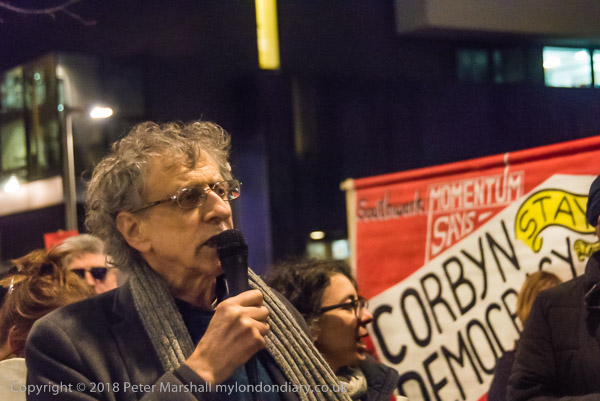
One of those who spoke at the protest was Piers Corbyn, who told us he had talked to his younger brother who was determined to see a change.  I worked hard to get the name Corbyn visible behind him as he spoke, with people keeping getting in the way, but I finally managed it. Southwark Momentum just didn’t have their banner up high enough at the protest, and a few months later failed to get enough of those they supported nominated for the council.

Bingo and Dancing for Elephant & Castle

______________________________________________________

There are no adverts on this site and it receives no sponsorship, and I like to keep it that way. But it does take a considerable amount of my time and thought, and if you enjoy reading it, a small donation – perhaps the cost of a beer – would be appreciated.

My London Diary : London Photos : Hull : River Lea/Lee Valley : London’s Industrial Heritage

All photographs on this and my other sites, unless otherwise stated, are taken by and copyright of Peter Marshall, and are available for reproduction or can be bought as prints.

To order prints or reproduce images

________________________________________________________

Afrin Matters

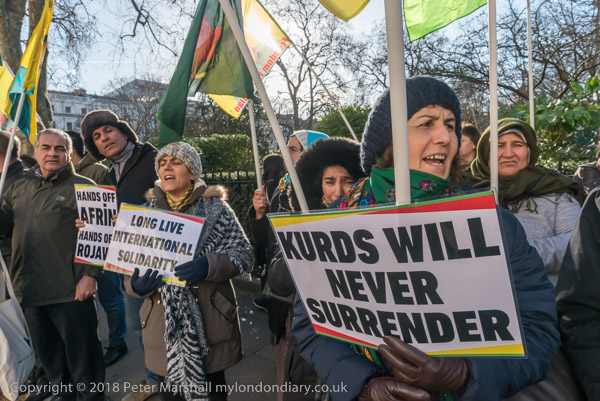
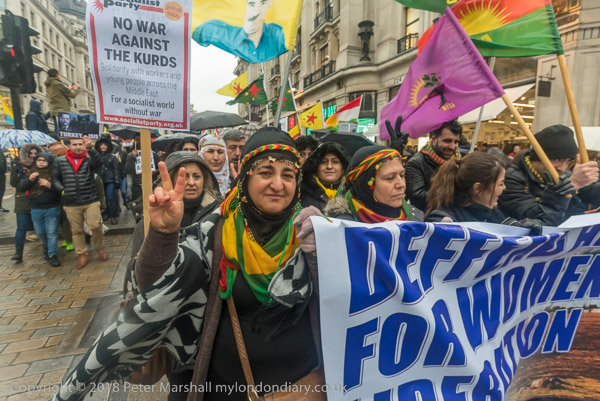
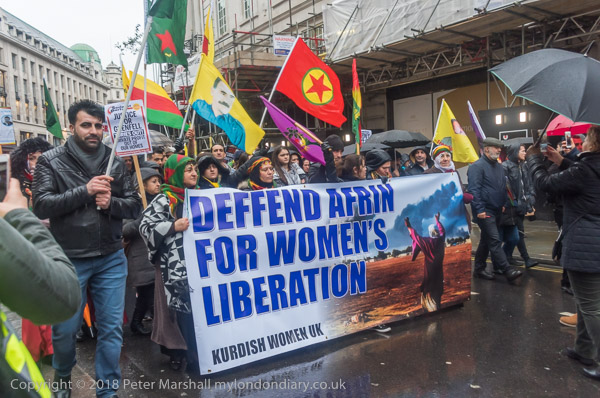
On 19 January 2018 Turkey announced that it was going to attack Afrin, a Kurdish area on its border with Syria, and an outlying part of the largely autonomous mainly Kurdish area, The Democratic Federation of Northern Syria widely known as Rojava. Turkey has been at war with the Kurds inside Turkey for many years, in a long campaign to eliminate the Kurdish culture, and Kurdish national leader Abdullah Öcalan has been held in solitary confinement in a Turkish prison since he was captured with US help in 1999.

President Erdogan launched the Orwellian-named ‘Operation Olive Branch’ to attack and destroy what he called a “nest of terror” on Turkey’s borders, claiming that the Kurdish forces there, the YPG and the YPJ are simply forces of the Kurdish PKK, banned in many countries as a terrorist organisation. He also claimed that he would be fighting Islamic State forces, which have no presence in the area.

Many might see the PKK and the 1984 Kurdish uprising when its military campaign began as an inevitable response to the attempted Turkish elimination of Kurdish identity. For many years it was a criminal offence to use the Kurdish language, even in private, and many were imprisoned for it. The wearing of Kurdish clothes, the use of Kurdish names and other aspects of Kurdish culture were also banned. Although there was some lessening of the anti-Kurdish laws in the 1990s, the situation for them and all opposition groups has worsened considerably over the past year or so, with Erdogan increasing military operations inside the country and imprisoning many of his political opponents.

Erdogan claimed that the attack on Afrin would also be against Islamic State, but Turkey has provided the major support for IS, by taking part in the smuggling of oil from their occupied regions, as shown very clearly by intelligence reports published by the Russians when they first became seriously involved in military support for the Assad regime in Syria. The only IS fighters in Afrin are some from the forces defeated by the Kurds who are now fighting with Turkey against those who defeated them.

Eight days later a larger protest took place against the attacks led by Turkey, again with the Kurds defiant. But the Kurds in Afrin were clearly out-numbered by their attackers, largely armed with rifles while the Turkish Army is large and well-equipped. But like much else that now happens in Syria it was probably the Russians whose action – or in this case, failure to act that would be the determining factor.

The Russians back Assad, and Assad rightly sees the Turkish invasion as an attack on Syria. But Russia also sees the advantages of a closer relationship with Turkey, hoping by doing so to weaken NATO of which Turkey is a member. Once the Russians had allowed the Turkish Air Force to operated unhindered over the area a military victory for the Turkish invasion seemed inevitable, even it it might be slow. Two months later they had occupied the centre of the city, with Kurdish forces withdrawing but promising to keep up military opposition through guerilla warfare. Though the war was won, it is not yet over.

Erdogan had promised to advance further towards the rest of Rojova, but his moves in that direction have met with opposition from the US who had previously allied with the Kurds to fight Islamic state. The US had stood aside and watched the invasion of Afrin but so far seem to be standing firm against further Turkish advances.

Defend Afrin, stop Turkish Attack

Stop Turkey’s invasion of Afrin

______________________________________________________

There are no adverts on this site and it receives no sponsorship, and I like to keep it that way. But it does take a considerable amount of my time and thought, and if you enjoy reading it, a small donation – perhaps the cost of a beer – would be appreciated.

My London Diary : London Photos : Hull : River Lea/Lee Valley : London’s Industrial Heritage

All photographs on this and my other sites, unless otherwise stated, are taken by and copyright of Peter Marshall, and are available for reproduction or can be bought as prints.

To order prints or reproduce images

________________________________________________________
IWGB Protest Outsourcing in Academia

I like to photograph the protests organised by the IWGB (Independent Workers Union of Great Britain) both because they are noisy, lively and generally photogenic, but also because I think it scandalous the way low paid workers are treated.

I’ve written often enough about out-sourcing and how it is used by companies to try and evade their duty as responsible employers, hiding behind the convenient fiction that they have no responsibility towards these people whose work is essential to the running of their organisations because they pay another company to employ them. It simply doesn’t wash.

As well as low wages and the legal minimum conditions of service – holidays, sick pay, pensions – outsourced workers also generally suffer from poor and sometimes despotic management, with overwork and bullying rife. Many too are on zero hours contracts, a legal fiction which is effectively a non-contract which works only in the interests of the employer and lays employees open to various unfair practices.

I’d gone to photograph the protest by cleaners, receptionists, security officers, porters and post room staff at the central administration of the University of London who had been on strike and picketing since the early morning. The picket over (severely restricted by Thatcherian anti-union laws) they were joined by other workers and supporters and myself for a loud rally in the early evening.

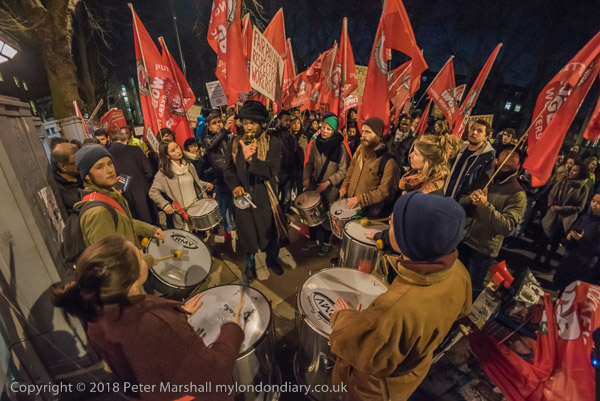
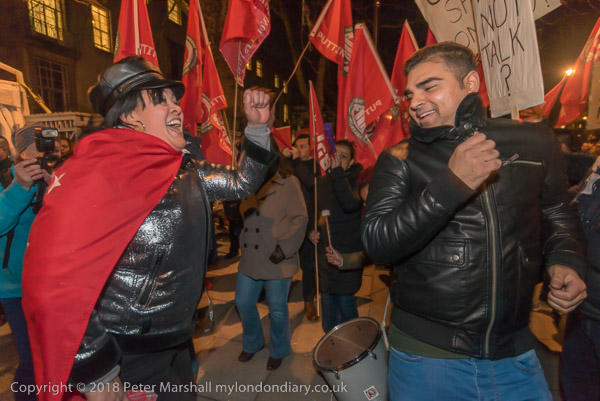
There was music on a PA system, much waving of flags and shouting of demands, and a great samba band all reminding the University that its workers are demanding to be directly employed. And at the end a number of speeches by the workers and their trade union leader, as well as other trade unionists in support.

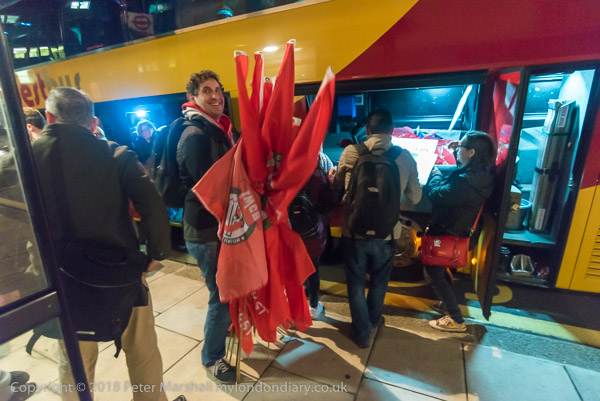
And there was then a surprise. Well, by then it was not a surprise to me as one of the trade union leaders had whispered in my ear (though given the noise level I think he had to shout) earlier what would happen, and a double-decker bus arrived and we were invited to go on a mystery tour to another location where the IWGB are in dispute.

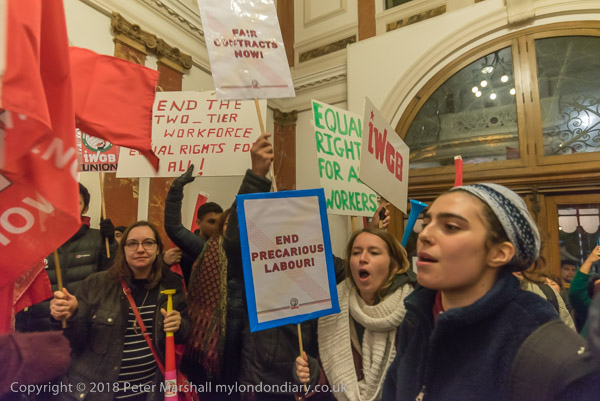
The location was not announced (though I had been told) so that the police and others listening could not warn those at our destination, where the IWGB hoped to be able to walk in and protest in the foyer. I wasn’t entirely pleased with the idea, as I was getting rather hungry and wanted to get home where dinner was waiting, but it was an opportunity not to be missed. The journey through London in the evening rush hour was hideously slow but eventually we were dropped off just around the corner from our destination, and got ready, walking quietly towards the doors. Two people went ahead and held them open as we arrived and walked in with two security guards helpless to stop us.

We were at the Royal College of Music, another academic institution that outsources its cleaners to evade its responsibilities, and where Tenon FM who recently took over the cleaning contract decided to unilaterally cut hours in half and change shift times, telling the cleaners they must work at times most already have other cleaning jobs. The cleaners now threatened with dismissal for refusing to accept the new hours.

After 12 minutes, the police arrived and ordered the protesters outside, where the protest continued on the pavement. One of the police officers was clearly incensed at the way the protesters were behaving and seemed likely to arrest some of them, but his colleagues restrained him. The protest appeared to be lawful and the police should not be taking sides as he so obviously was.

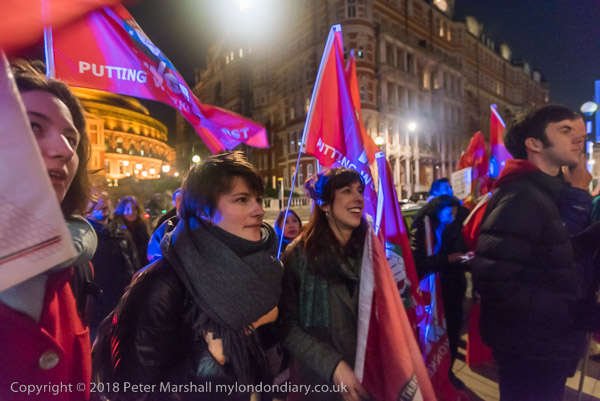
Flashing blue lights from police cars make photography a little unpredictable, and produce some strange effects, which are seldom too appealing. The high-output blue LEDs have a very limited spectral range, turning everything directly illuminated by them an intense blue. But the protest appeared to have settled down and I felt nothing much else was going to happen, so I left for home and food.

More on the two protests at:

Cleaners rush into Royal College of Music
End Outsourcing at University of London

There are no adverts on this site and it receives no sponsorship, and I like to keep it that way. But it does take a considerable amount of my time and thought, and if you enjoy reading it, a small donation – perhaps the cost of a beer – would be appreciated.

My London Diary : London Photos : Hull : River Lea/Lee Valley : London’s Industrial Heritage

All photographs on this and my other sites, unless otherwise stated, are taken by and copyright of Peter Marshall, and are available for reproduction or can be bought as prints.

To order prints or reproduce images

________________________________________________________
Homeopathic Advertising

I was attracted by a post by Shaun Curry Co-founder of Pixelrights on their blog, We laughed then decided it wasn’t funny at all largely because of the phrase ‘Homeopathic Advertising’ he invents in it.

It tells the story of how the UK Government Trade & Investment office (UKTi) approached him to use one of his pictures “in their new ‘GREAT Britain campaign’ “the biggest ever integrated Government international marketing campaign” with funding of £30 million” and which they say would be seen in “120 countries!!” Which sounds like good news except all that they were offering the photographer from that £30million was ‘exposure’.

After he contacted them suggesting they should pay for its use, they did offer him £100. Now for us people who sell stuff for use in newspapers and magazines that would not be an unusually low fee for single use – but this was a major campaign and they wanted to secure the “images for 2 years, with above and below the line advertising rights.”

Basically this means using the image in all sorts of media, both mass media – print, web, TV – and in more personalised advertising such as direct mail, email… If like me you are an advertising virgin (I did come close to selling an image to some clothing company a few years ago, I think it had some name like Gap, for a few thou, but they changed their mind at the last minute) you might want to read more about Above and Below the Line, but basically it means big bucks.

Quite how big – and how much to ask should UKTi get in touch with you and want free use you can work out from the Association of Photographers online usage calculator. You need to start by inputting your BUR or Base Usage Rate, which they advise should never be less than your normal day rate, and would include a single use of the image.

The calculator then allows you to multiply this for the various rights the client wants, including the type or usage and the countries in which the image would be used. If you try it out for the UKTi’s claim you are almost certain to end up somewhere well north of £10,000 – for which they were offering a byline.

Even on Alamy, putting in some details of just one of the uses can come up with four figure sums though I suspect many customers opt for vague things like ‘Marketing package’ at around $50 rather than paying for their actual usage. If I was at Alamy I’d take a close look at what UKTi have done with any images they have bought.

Curry found out he wasn’t the only photographer they had tried it on. They approached someone else with a similar image who also wasn’t going to play ball. I have a nasty suspicion they will have gone on trying other photographers until they found one who fell for it, probably someone who is a near-starving photojournalist who thought that getting a hundred (or even two if they had to raise their offer) wasn’t a bad deal, perhaps someone like me who found his best sale so far on Alamy this month was $20.

£30 million is a big budget, and photography is a vital part of the campaign. UKTi should be prepared to pay a reasonable price for it – and heads should roll there if people are prepared to compromise the project with derisory offers like this.

America First

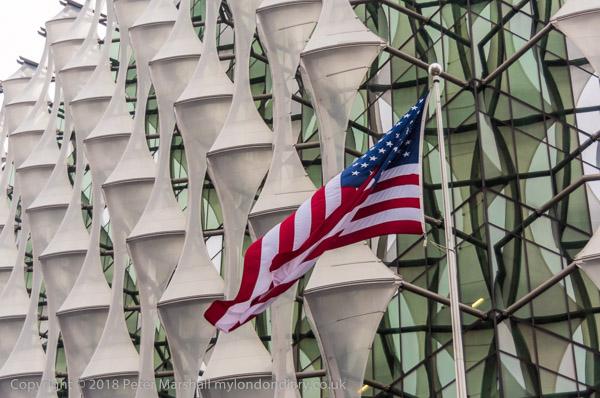
Not the protectionist policy of President Trump, which I rather hope the rest of the world will take exception to and stand up against, perhaps by similarly excessive tariffs on US natural gas or some such, but I photographed what I think was the first protest at the new US Embassy in London.

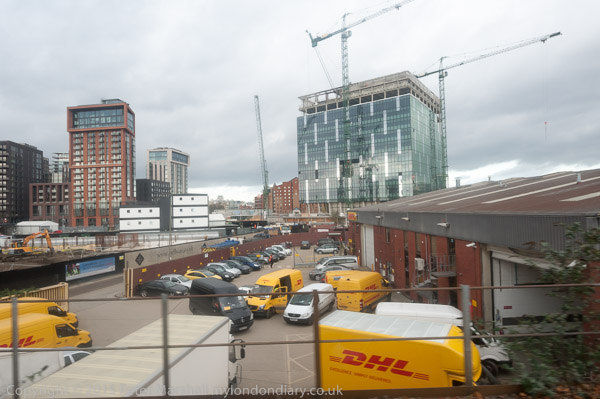
It’s a building I’ve been keeping my eye on for some time as it has risen up from the ground at Nine Elms as my railway journey to London takes me past it several times each week, and I’ve often taken the odd snap in passing – the one above in December 2015.

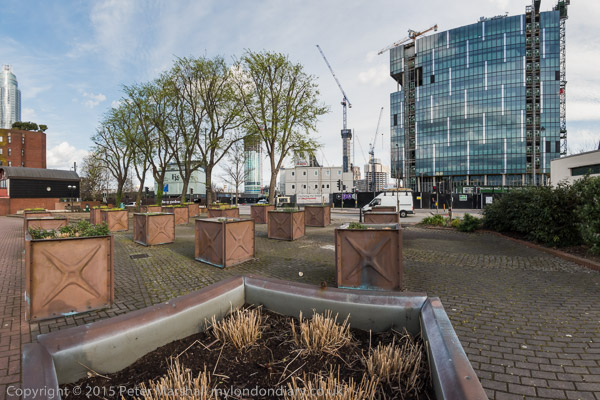
A few months later I had an hour or so spare and took a walk around the area, though most of it was a building site and still closed to the public, but I could photograph from the road or the Thames Path.

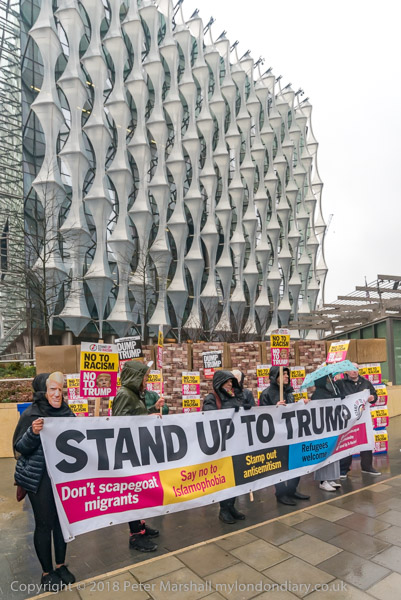
I’m not sure the building was improved by these plastic thingies on its sides, or rather three of the four sides, but it doesn’t really have a great deal else going for it visually. It does stand out from the mediocrity with which it is surrounded, but it might have been better left naked. It wasn’t a good day for photographing the area, with alternating light and heavy rain, but I took a few pictures and told myself I’d be coming back again before long for another protest.

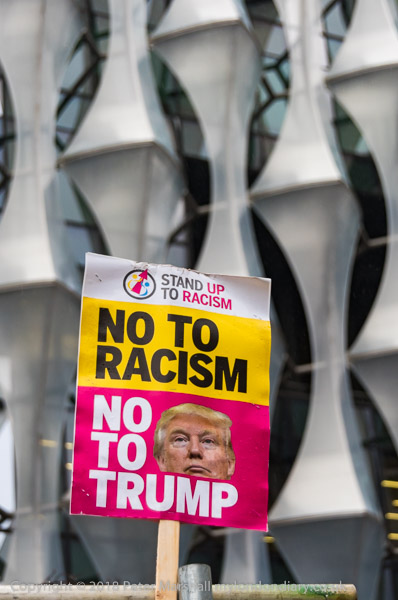
The protest by Stand Up To Racism was on the anniversary of President Trump’s inauguration. The protest was prompted by his racist description of African nations, Haiti and El Salvador as ‘shitholes’, and included a rather too graphic poster related to it, which you can see, along with other pictures of the event at US Embassy – No to Trump’s racism.

There are no adverts on this site and it receives no sponsorship, and I like to keep it that way. But it does take a considerable amount of my time and thought, and if you enjoy reading it, a small donation – perhaps the cost of a beer – would be appreciated.

My London Diary : London Photos : Hull : River Lea/Lee Valley : London’s Industrial Heritage

All photographs on this and my other sites, unless otherwise stated, are taken by and copyright of Peter Marshall, and are available for reproduction or can be bought as prints.

To order prints or reproduce images

________________________________________________________