Notting Hill Carnival- Café Royal Books

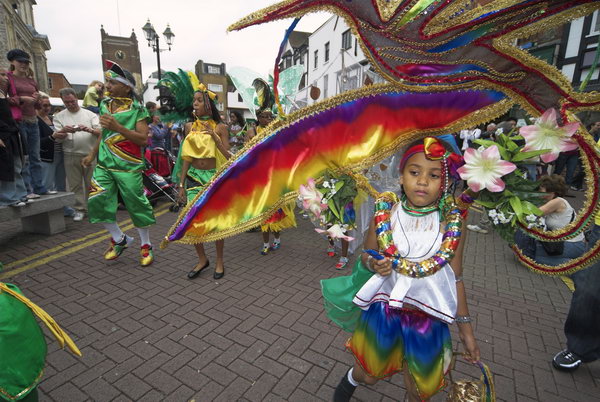
It’s carnival time, or almost so, though I’m not sure I will be going this year. I came late to Notting Hill, only discovering it in the 1990s but was immediately captivated by it, our largest street festival. For the next fifteen or so years I went every year I was in London, spending two days taking photographs and then a further several days recovering my hearing. Carnival is a hugely visceral experience, where you feel the sound and your whole body vibrates, and I wanted to try and capture something of that in my pictures.
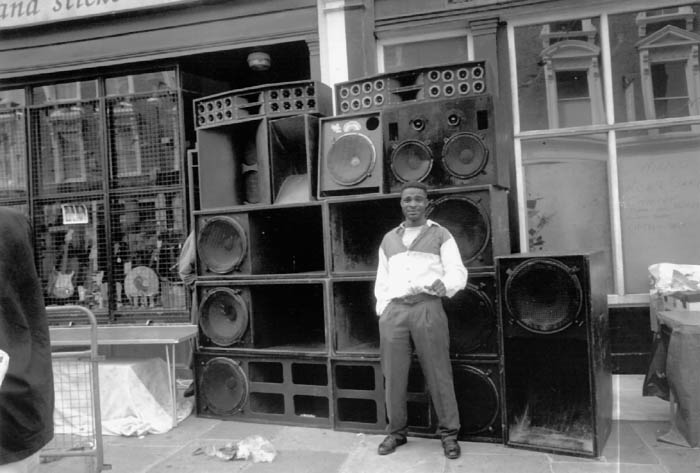
Of course carnival is a very colourful event, and I did photograph it in colour, but somehow it was the black and white images I also took (and some years only took) that somehow managed – at least for me – to convey the spirit of the event.
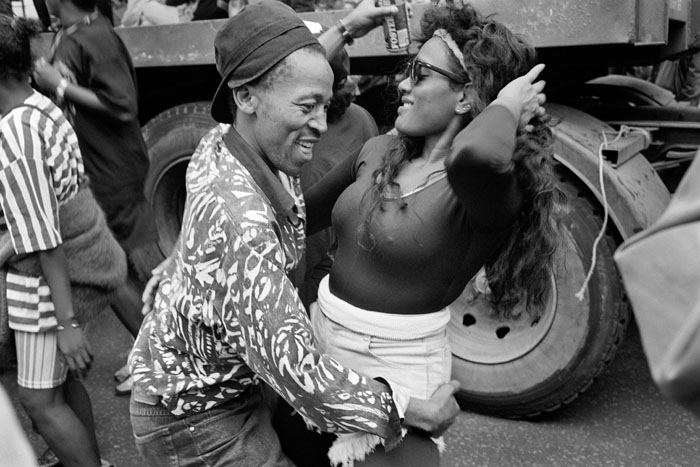
Some of these pictures were among the first of mine to be put on a web site, Fixing Shadows, back in 1994 or 5. Fixing Shadows was one of the earliest web sites to show photographs on an internet that was only just beginning to display images as well as text. The site is still on-line, though the scans, made on a black and white only flatbed scanner, while effective, are not quite up to current standards.

Later, J David Sapir, who as well as setting up Fixing Shadows, a site ‘concerned with photographs of historic interest and with contemporary straight photography in general‘ was editor of the Visual Anthropology Review, commissioned fellow academic George Mentore to write the leading article in the Spring/Summer 1999 edition (Volume 15 number 1), Notting Hill in Carnival in which, as well as his writing about Notting Hill in particular and carnival in general from an anthropological viewpoint, also featured 20 of my pictures, each accompanied by a sometimes lengthy comment by Mentore.

Those of you with JSTOR or similar academic logins will be able to read it, but those without can only access the first page of the text  – and none of my photographs – without payment. (The issue also contains an excellent article by Darren Newbury, Photography and the visualisation of Working Class Lives in Britain, illustrated by work by Paul Trevor, Nick Waplington and Paul Graham.)
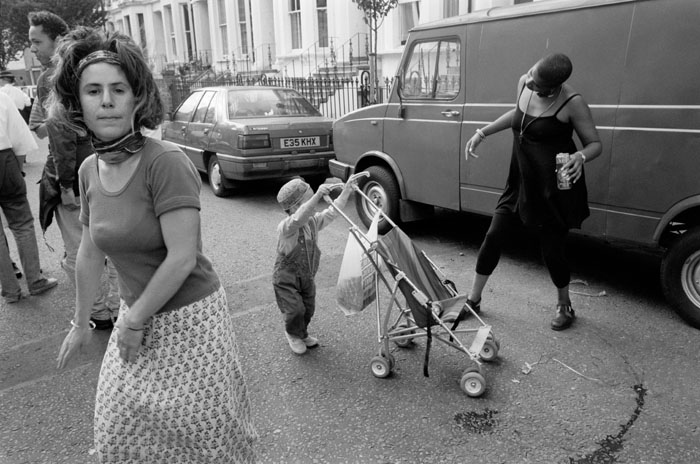
Since 1999 a few of the pictures have appeared here and there and in 2008, twenty of them were a part of a show ‘English Carnival‘ in London’, also still on-line.
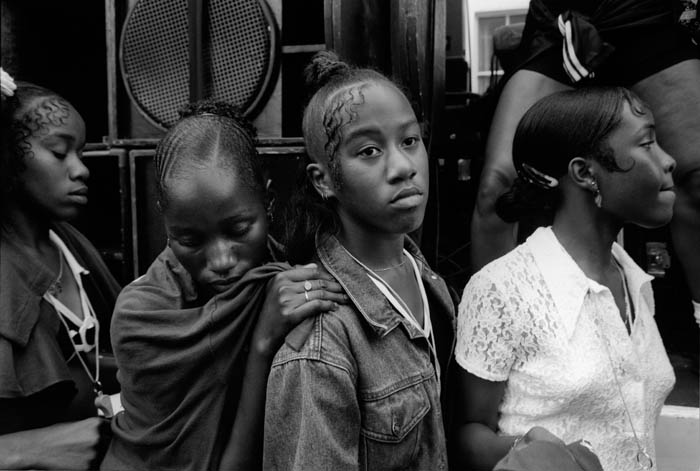
I’m delighted to say that Café Royal Books have now published ‘Notting Hill Carnival in the 1990s‘ and for a mere £6.00 you can buy a copy of this 36 page issue with 18 of my pictures, including just a few that I’ve not printed or published before.
Notting Hill Carnival in the 1990s

More from a long May Day

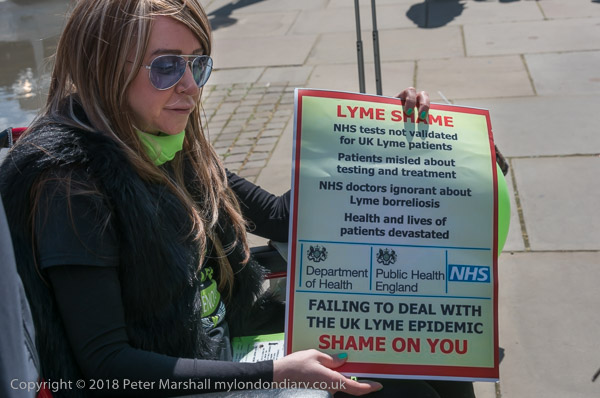
The rally outside Parliament to publicise the dangers of Lyme Disease and call for government action had no particular connection with May Day. The Chronic Lyme Disease Support Group UK has been campaigning for some years to get the NHS to take Lyme disease more seriously and to get better testing and treatment for sufferers, as well as to raise public awareness of the danger of tick bites and the correct way to remove ticks from pets and people. It isn’t clear why the NHS is so reluctant to take action over the problem.

I was fortunate to have photographed one of their earlier protests in May 2015, a few months before taking a holiday in Silverdale. Both I and several of my friends on the holiday suffered from ticks, finding them attached to various areas of our bodies. Not all ticks carry Lyme disease, but the risk is greatly lessened if the ticks are removed as soon as possible, and usually this is a fast and simple process with a tool such as the O’Tom Tick Twister, available from vets, many chemists and, of course, on-line. They aren’t expensive, and cheap versions are available that probably work as well and they must cost virtually nothing to make, and it would be good to see them made readily and freely available at surgeries etc. If you ever walk through grass or forests you should get one.

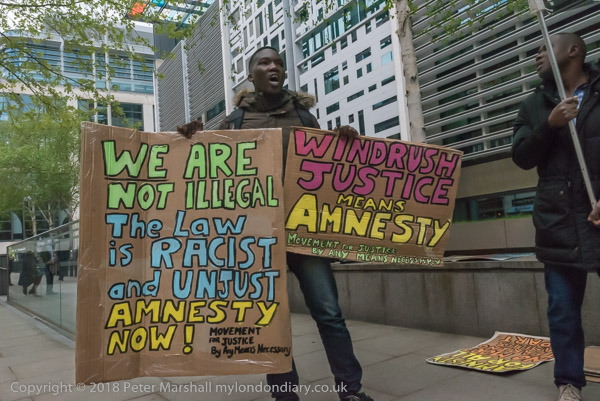
The protest outside the Home Office was taking place not because it was May Day, but as the as the Home Office intended to carry out a mass deportation to Jamaica later in the week. Despite it being in the middle of the Windrush scandal, the flight would include members of the Windrush generation – although the government is very concerned to make the right noises about Windrush, it hasn’t greatly changed the institutional racism of the Home Office and the racist attitudes put into law in Theresa May’s 2014 Immigration Act.
Against Deportation Charter Flights

Fortunately the times of these two events made it possible for me to leave the May Day march as the end of it left Clerkenwell Green and rush down to Farringdon station to catch the Underground to Westminster to cover both, before rushing back to the Strand to meet the May Day marchers on their way to the rally in Trafalgar Square.
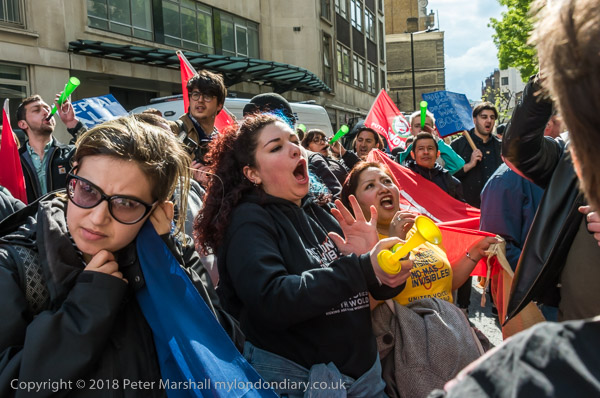
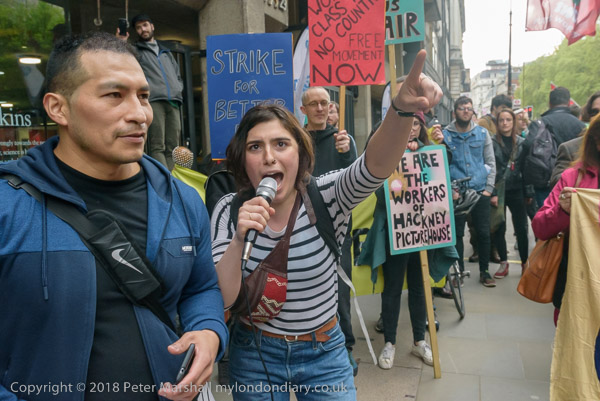
My next event began at the rally, where precarious workers had decided to gather for their own action. A couple of them spoke as a part of the May Day rally before that ended and they moved off. They first went to the Ministry of Justice, where cleaners in the UVW are demanding to be paid a living wage – the London Living wage – and to be directly employed by the Ministry so they get the same conditions of service as comparable workers there. At the moment they are employed by cleaning contractors and get only the statutory minimum conditions – as well as providing bullying managers.
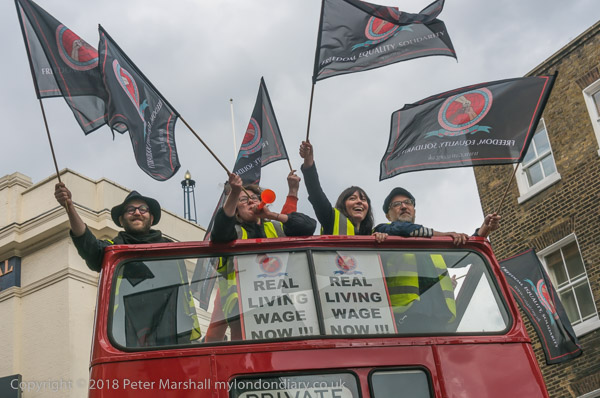
Next they marched to Kings College, where cleaners are also campaigning to be directly employed by the college and held a rally there. At the nearby Royal Opera House in Covent Garden, they met briefly with the open-top bus which had spent May Day touring offices across London where cleaners from CAIWU are demanding the London Living Wage and better working conditions.

I stayed at the Royal Opera House with CAIWU while the other precarious workers went on to protest elsewhere in the West End. The protest there was noisy but fairly short and I was soon on the tube on my way to Brixton for the final event of my day.

The emergency protest outside Lambeth Town Hall, Lambeth Housing Tell Us the Truth, was poorly attended, reflecting the general lack of interest in local politics. Most people only think about the actions of their local councils when it is too late – and they find their council homes are being demolished. It had been called because the ruling Labour Party manifesto for the local elections coming up in a few days was making ridiculous claims about its housing policy, stating ‘By early 2018 we had over 950 homes completed, being built or already approved by Lambeth’s cabinet …’ The actual number completed by May 2018 is thought to be 8 or 9, and the council is engaged in a large-scale programme to demolish council estates together with private developers and replace them with expensive private housing with only a token proportion of social housing.
______________________________________________________

There are no adverts on this site and it receives no sponsorship, and I like to keep it that way. But it does take a considerable amount of my time and thought, and if you enjoy reading it, a small donation – perhaps the cost of a beer – would be appreciated.

My London Diary : London Photos : Hull : River Lea/Lee Valley : London’s Industrial Heritage

All photographs on this and my other sites, unless otherwise stated, are taken by and copyright of Peter Marshall, and are available for reproduction or can be bought as prints.

To order prints or reproduce images

________________________________________________________

May Day

May Day has been a big day for me ever since I left a full-time teaching post, when most years I would be at work – unless it happened to fall at the weekend. One of the many changes I hope the next Labour government will make is to replace the silly Early May Bank Holiday on the first Monday in May – brought in by Jim Callaghan in 1978 and called ‘May Day’, with a real May Day bank holiday on May 1st every year.

May Day was an ancient festival to mark the first day of summer (and such celebrations exist – as in the London May Queen Festival and others I photographed which you can view some pictures of in my book preview – and more in many posts on My London Diary.

Since around 1891, May 1st has also been celebrated as a socialist festival, usually called May Day, but often also referred to as International Workers’ Day, Labour Day or Workers’ Day, the date chosen in memory of the Haymarket massacre in Chicago in 1886, where a bomb was thrown at police as they attempted to disperse what had been a peaceful rally of trade unionists. Eight anarchists – none of whom had actually thrown the bomb – were convicted of conspiracy, and seven were sentenced to death, though the sentences on two were commuted to life imprisonment. The trial was widely criticised as a miscarriage of justice and the three men still alive were pardoned and freed in 1893. The massacre was on May 4th, and the date of May 1st was almost certainly chosen because it was by tradition May Day.

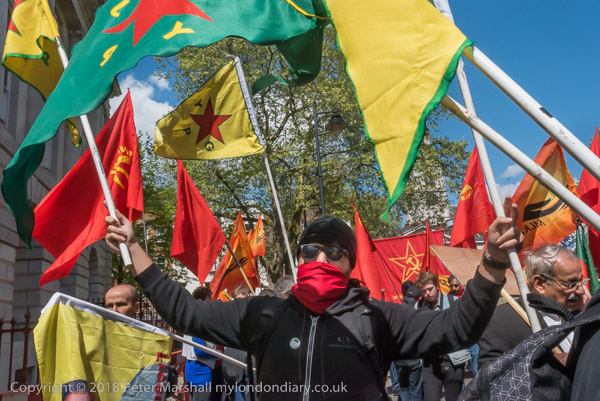
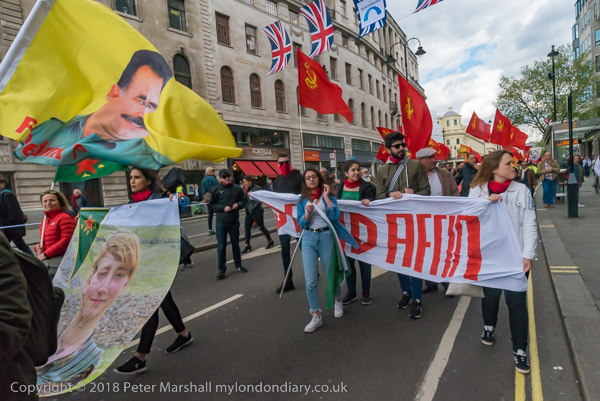
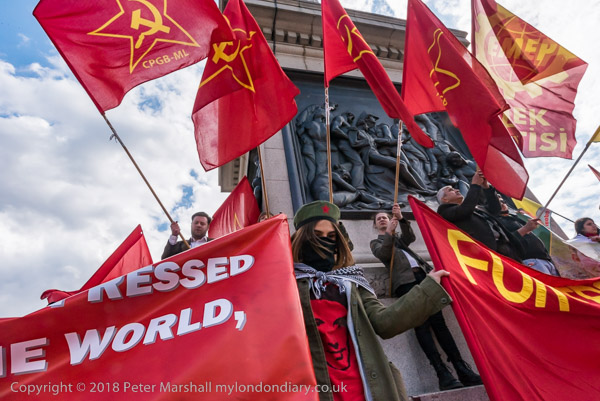
Every year the London May Day Organising Committee’s May Day March gathers at Clerkenwell Green and marches to a rally in Trafalgar Square. Ever since I’ve been attending the event it has been dominated by some of London’s migrant communities, from countries where May Day is a much more significant event, although there are also quite a few trade union branches taking part with their banners.

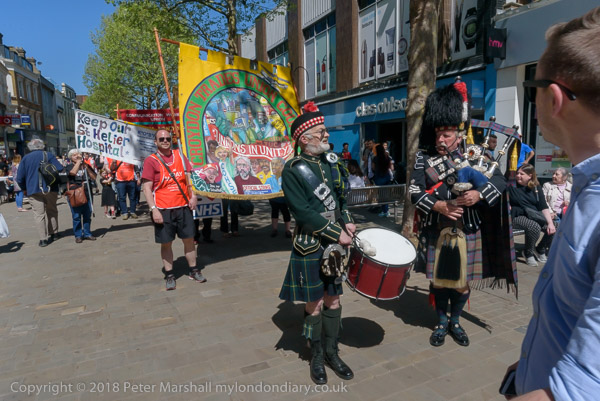
This year, as in previous years there have also been other groups taking the opportunity to protest, some more closely related to International Workers’ Day than others – and I’ll write about some of those in a separate post. But because May Day is not a Bank Holiday, there are also May Day marches that take place on other days, and in Croydon trade unionists and others met to march through the town centre to a rally at Ruskin House in celebration of May Day on the following Saturday rather than on International Workers Day.

London May Day March meets
May Day March on the Strand
May Day Rally
Croydon march for May Day

______________________________________________________

There are no adverts on this site and it receives no sponsorship, and I like to keep it that way. But it does take a considerable amount of my time and thought, and if you enjoy reading it, a small donation – perhaps the cost of a beer – would be appreciated.

My London Diary : London Photos : Hull : River Lea/Lee Valley : London’s Industrial Heritage

All photographs on this and my other sites, unless otherwise stated, are taken by and copyright of Peter Marshall, and are available for reproduction or can be bought as prints.

To order prints or reproduce images

________________________________________________________

Muybridge’s Horse

I don’t recall coming across the blog Muybridge’s Horse before, which is a site featuring artists whose work relates to the way we interact and experience animals and nature run by Emma Kisiel who lives in Portland Oregon.

It was drawn to my attention by a post featuring work by Carl Corey from his series Americaville, which you can see in more depth on his own web site and in particular in his Americaville blog, which appears to have been running since November 2016, though the photographs on it are undated. A feature on Slate suggests that Corey began the project in 2014, and you can hear him talk about the project on Wisconsin Public Radio in 2016.

You can find out more about Corey and see more of his archive and current projects on his impressive web site (a few may still need telling that the symbol with three horizontal lines close to top left indicates the menu.)

Corey’s work attracted my attention so much that I completely forgot about Muybridge, who I’ve previously written about elsewhere at some length. He came from Kingston, on the edge of London, close to where I was born and not far from where I live, and a few years ago in 2007 I took part in an exhibition with two other photographers, Paul Baldesare and Mike Seaborne, in the museum there which houses a display on Kingston’s most famous son, though the work which made him famous was made in California. Kingston Museum has put together a web site about him with the local university which is perhaps the best introduction to his work.

So much is written about Muybridge and is available on line that adding more would be superfluous, but perhaps I might link to the web site on our show at the Kingston Museum, still on line some years later, Another London, and a picture from Kingston in 2006, a very different place to that which Muybridge knew.

More on Windrush

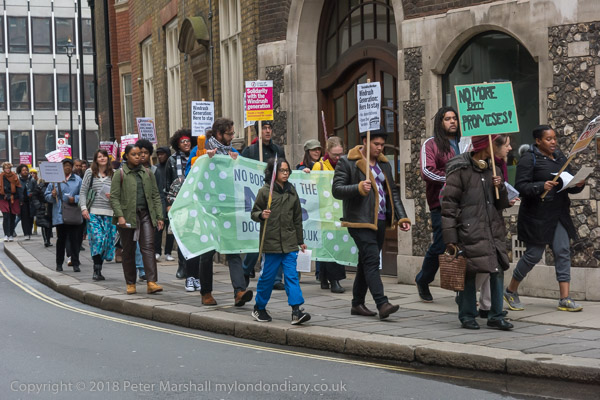
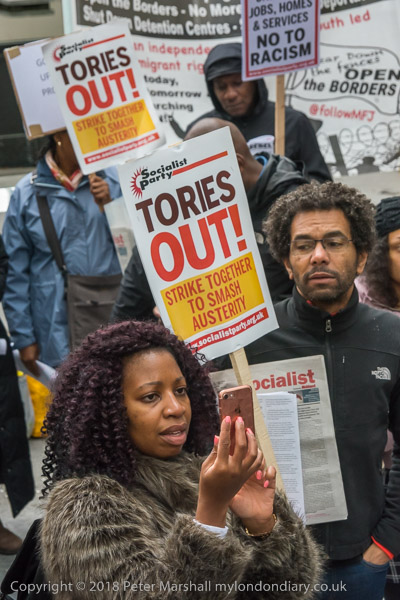
The march from Parliament Square to the Home Office was unusual in that it was called and organised not by a group, but by one incensed individual, Sara Burke who wrote that “the government’s abhorrent treatment of those from the Windrush generation is a national embarrassment”. Other groups including Docs Not Cops, Stand Up to Racism, Movement for Justice and the Socialist Party joined in to support her initiative, but it did give the event a slightly different feel.

The event began with people gathering in Parliament Square, where there was some organised chanting mainly led by people from Stand Up to Racism and the Socialist Party, but Sara Burke declined to speak there and led a rather quiet march through Parliament Square and on to the Home Office, insisting that the marchers kept to the pavement.

Sara Burke did give a carefully prepared speech outside the Home Office, and there were other speakers including from all of the supporting groups.

A few of the same people were back on Monday afternoon for a protest during the parliamentary debate on a petition with 170,000 signatures calling for an amnesty for all the ‘Windrush reneration’ who arrived here up to 1971, calling for a change in the burden of proof  – instead of individuals being assumed illegal unless than can prove their right to remain, it should be up to the authorities to prove that they arrived after 1971 or are otherwise not entitled to stay, and calling on the Home Office to provide compensation for any loss and hurt they have caused.

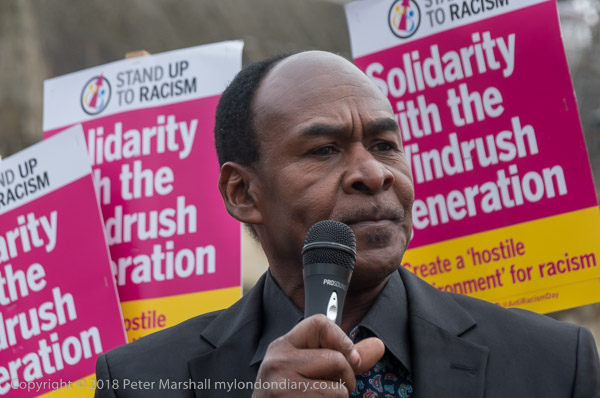
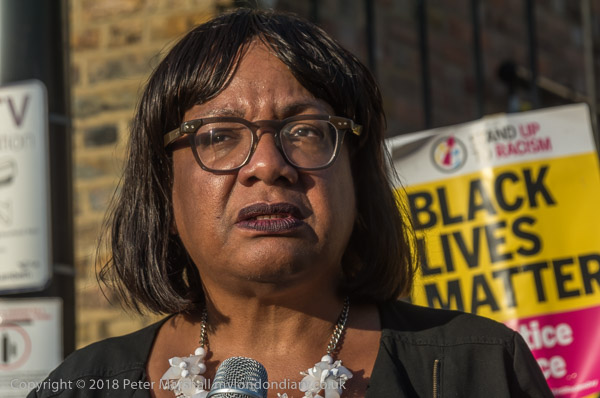
Among those who spoke was Harold, above, who came to this country legally in the 1950s and and has worked here since, but  who the Home Office has been refusing a passport and was threatening with deportation, others whose parents and grandparents are from ‘Windrush’ families, and anti-racism campaigners including NEU General Secretary Kevin Courtney and Shadow Home Secretary Diane Abbott.

Windrush march to Home Office
Protest supports Windrush amnesty debate

______________________________________________________

There are no adverts on this site and it receives no sponsorship, and I like to keep it that way. But it does take a considerable amount of my time and thought, and if you enjoy reading it, a small donation – perhaps the cost of a beer – would be appreciated.

My London Diary : London Photos : Hull : River Lea/Lee Valley : London’s Industrial Heritage

All photographs on this and my other sites, unless otherwise stated, are taken by and copyright of Peter Marshall, and are available for reproduction or can be bought as prints.

To order prints or reproduce images

________________________________________________________

Workers’ Memorial Day

International Workers’ Memorial Day is observed on April 28th. It is also called International Commemoration Day (ICD) for Dead and Injured or sometimes just Worker’s Memorial Day, though the acronym for this, WMD, has other connotations.

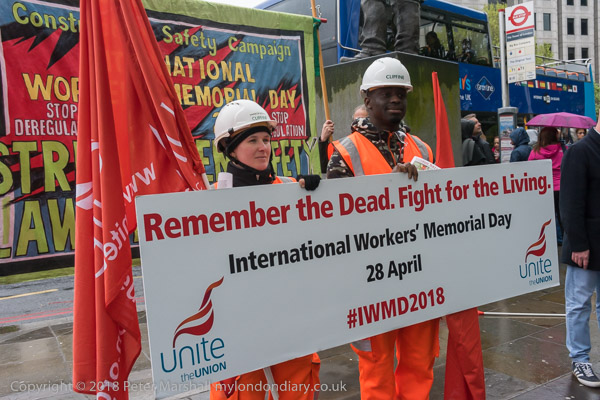
IWMD is an international day of remembrance and action for workers killed, disabled, injured or made unwell by their work, and highlights the fact that most workplace incidents are not ‘accidents’ but the largely predictable result of failures by organisation to have proper safety procedures and training. It promotes campaigns and organisation to fight for improvements in workplace safety under the general slogan for the day ‘Remember the dead – Fight for the living.’

The day was inaugurated by the US AFL-CIO in 1970, and was later taken up elsewhere. In Canada parliament made  April 28 an official Workers’ Mourning Day in 1991. Since 1989 it has been celebrated in North America, Asia, Europe and Africa and it came to the UK in 1992, being adopted by the Scottish TUC in 1993, the TUC in 1999 and the Health and Safety Commission and Health and Safety Executive in 2000. The ILO, part of the United Nations, recognised Workers’ Memorial Day and declared it World Day for Safety and Health at Work in 2001.

Since 2010, Health and Safety standards in the UK have dropped and the system of safety inspections greatly weakened as a part of a government drive against what they call ‘red tape’. This means workers’ lives are now at greater risk than for many years.

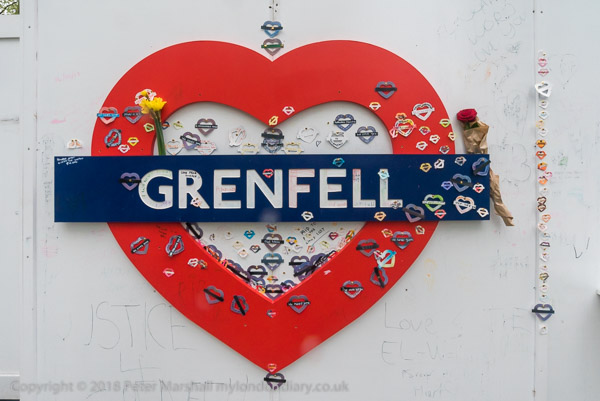
This slackening of regulations appears to have been an important factor in allowing the Grenfell Tower disaster to take place. Rather than face tough fire inspections and have to make improvements they paid a contractor to make less strict inspections that would allow highly dangerous situations pass without comment.

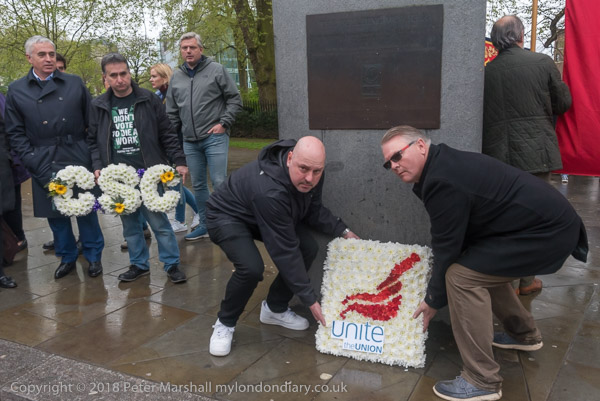
Among the speakers at the main London remembrance at the statue of a building worker on Tower Hill was Moyra Samuels of the Justice4 Grenfell campaign, and after wreaths were laid and the event ended, some of us travelled to Notting Hill for another brief ceremony close to Grenfell Tower.

Most of those who take part in this event are building workers, as the building industry is one of the most dangerous in the country. Because of the way that statistics on work-related deaths are compiled, most are not recorded as such. In particular many thousands of work-related deaths occur annually from cancer following exposure to materials such as asbestos and other carcinogens. There is typically a 20 year or so period between exposure and death, and it is usually hard to show a definite causal link in an individual case, though overall figures may be clear.

International Workers’ Memorial Day
Workers’ Memorial Day Grenfell vigil
______________________________________________________

There are no adverts on this site and it receives no sponsorship, and I like to keep it that way. But it does take a considerable amount of my time and thought, and if you enjoy reading it, a small donation – perhaps the cost of a beer – would be appreciated.

My London Diary : London Photos : Hull : River Lea/Lee Valley : London’s Industrial Heritage

All photographs on this and my other sites, unless otherwise stated, are taken by and copyright of Peter Marshall, and are available for reproduction or can be bought as prints.

To order prints or reproduce images

________________________________________________________

London University – End Outsourcing

Outsourcing – getting an outside companies to bid to employ people who work at your location – is never a good idea. It adds extra management and takes out profit; if there are cost savings its because you are getting the job done less well  – and the people you rely on to do it are getting treated badly.

Like many of London’s cleaners and others in low paid work, the security, porters, cleaners, catering staff who do the essential jobs to keep the University of London running, at its central administration and halls of residence etc, include many migrant workers.

Often they are working in low paid jobs despite having higher level qualifications and experience which is not recognised here. Migrants have proved their resilience by coming here, and expect to be treated with dignity and respect, but outsourcing  is rife with incompetent and bullying managers.

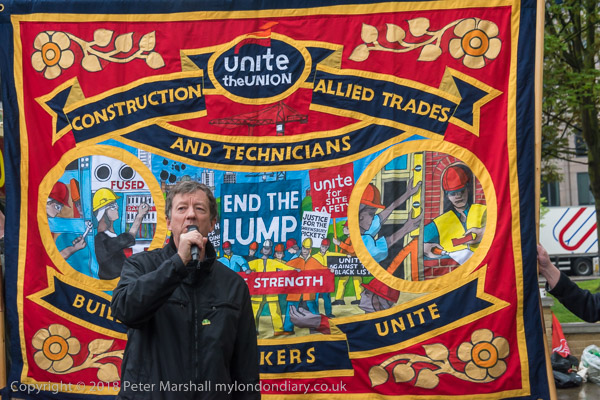
The larger unions – apart from some branches – have often failed these workers. At times they are more concerned with maintaining differentials than in getting a good deal for the lowest paid. Often too, union organisers lack the language skills to communicate with Spanish speaking workers, and haven’t really made much effort to do so.

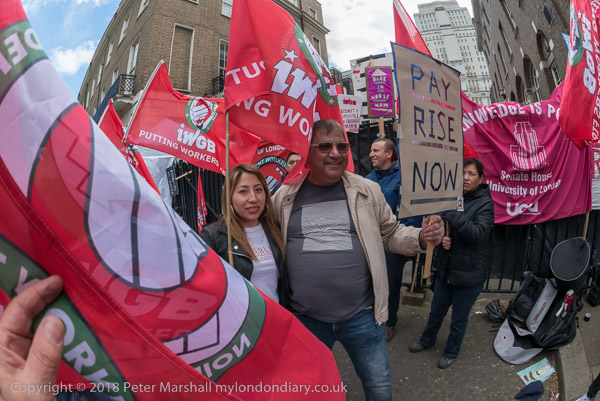
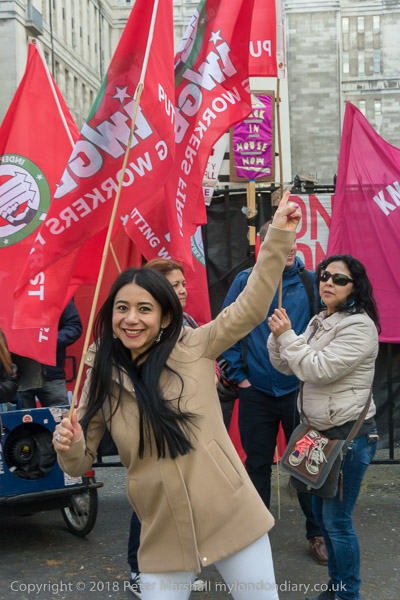
This has led to the rise of grass-roots unions, small organisations run by the workers directly such as the United Voices of the World and the IWGB, representing international workers, particularly in the cleaning sector. These unions have employed simple tactics of direct action, loud protests outside workplaces to shame employers, and have been remarkably successful in campaigns to get the London Living Wage and better conditions of service.

The IWGB at the University of London has campaigned for years getting improvements for the outsourced workers there, working with other union branches and with other small unions. At today’s protest they were supported by people from the UVW, and from SOAS Unison branch as well as students and lecturers.

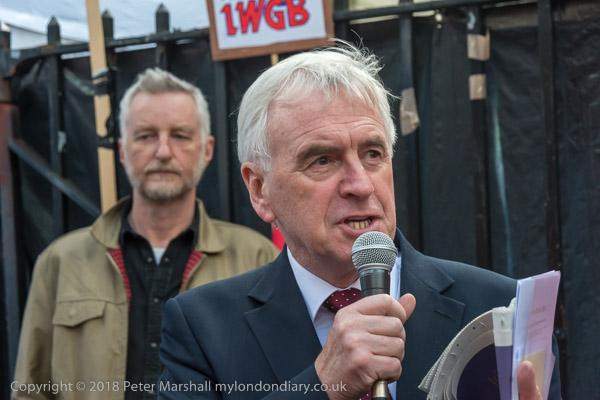
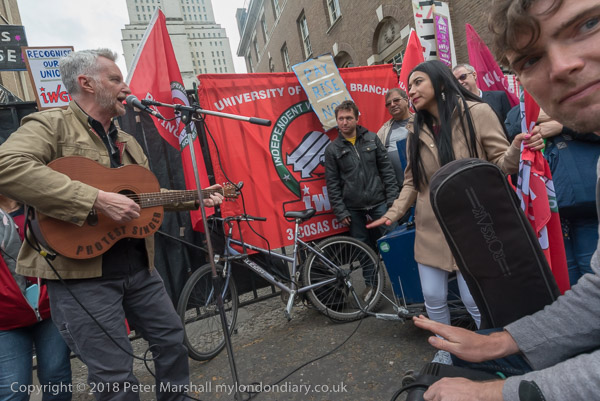
Shadow Chancellor John McDonnell MP has long supported workers such as these and came along to speak, supporting their campaign and promising that a Labour government would make important changes to unfair trade union laws.   Waiting to perform after he spoke was Billy Bragg, who sand a new song and then led the singing of several well-known worker’s songs.

There were other speeches and performances, including from Poetry on the Picket Line and then the protest ended with a march around Russell Square, blocking traffic for some time on Southampton Row.

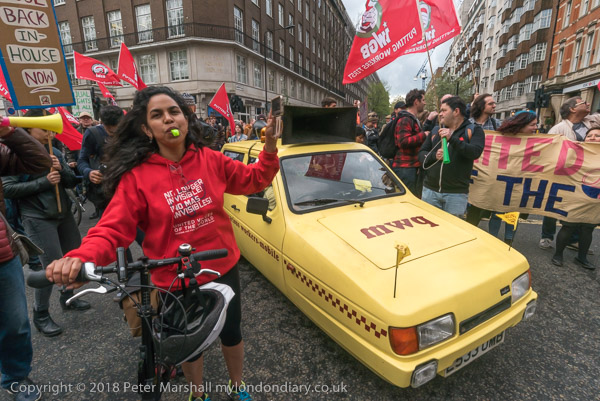
The marchers were led by the bright yellow Precarious Workers Mobile, a three-wheeler Robin Reliant with a powerful amplification system which has come out in support of other workers’ struggles, including the Brixton Ritzy strikers.

Unfortunately the PWM turned out just a little too precarious, and had to leave the road at the end of the march, leaking petrol. I hope it was soon fixed.

More on My London Diary: End outsourcing at University of London

______________________________________________________

There are no adverts on this site and it receives no sponsorship, and I like to keep it that way. But it does take a considerable amount of my time and thought, and if you enjoy reading it, a small donation – perhaps the cost of a beer – would be appreciated.

My London Diary : London Photos : Hull : River Lea/Lee Valley : London’s Industrial Heritage

All photographs on this and my other sites, unless otherwise stated, are taken by and copyright of Peter Marshall, and are available for reproduction or can be bought as prints.

To order prints or reproduce images

________________________________________________________

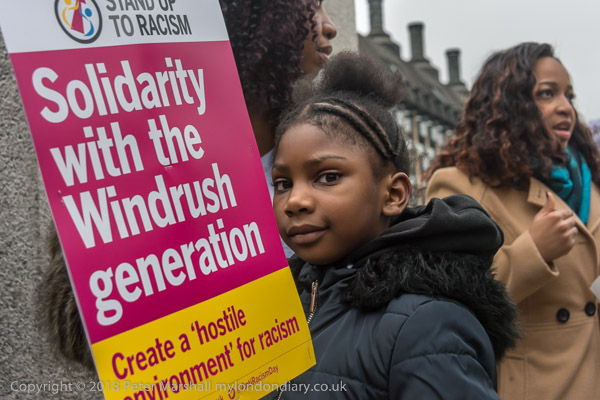
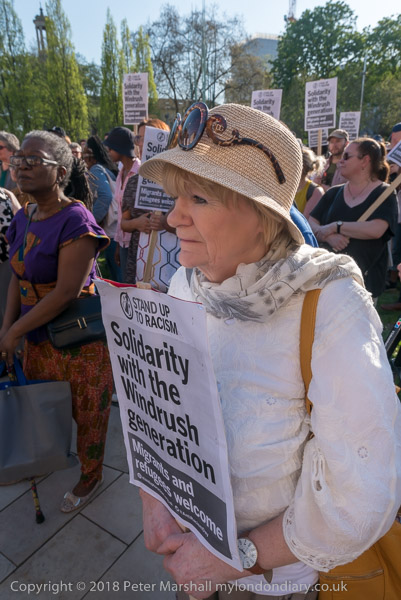
Windrush Brixton

It was only in 1948 that we became British citizens, or more accurately, Citizens of the United Kingdom and Colonies (CUKC), before which all those in the UK or its colonies had been British subjects. But new countries which were former colonies wanted to have their own nationalities, and so change was needed. But those who had been born in the UK or the former colonies retained the right to come here unfettered until the Commonwealth Immigrants Act 1962, introduced by a Conservative Government largely at the behest of right-wing Conservative extremists in the ‘Monday Club’.

It was, as then Labour Leader Hugh Gaitskell said, “cruel and brutal anti-colour legislation“, and later Acts made things even worse. But that 1962 law had an important exemption as Wikipedia states:

Commonwealth citizens who were residing in the UK or who had resided in the UK at any point from 1960 to 1962 were exempted, as well as CUKCs and Commonwealth citizens holding a passport issued by the British government or who were born in the UK. The exemption also applied to wives and children under 16 of these people, or any person included on these people’s passports.

That exemption was necessary  because of the huge contribution by 1962 being made to the running of our hospitals, buses and other services by immigrants particularly from the Carribean, where Minister of Health  from 1960-63 ran a very active recruiting programme for nurses.

It is these people who came to the UK up to 1962 – including wives and children under 16 and others on their passports who make up what we think of as the Windrush generation, part of a process that began with the Empire Windrush docking at Tilbury in June 1948, but involves many, many more than the  492 passengers on board. Others too who arrived between the 1962 Act and the 1971 Immigration Act which gave CUKCs the ‘right of abode’, a somewhat curious concept that results in the UK being in breach of international law.  The 1981 British Nationality Act made them (and those born here) British Citizens.

More directly the problems for these people arise from then Home Secretary Theresa May’s 2014 Immigration Act which introduced draconian and discriminatory provisions and changed the legal immigration landscape. Among the speakers at the event was Labour Shadow Home Secretary Diane Abbot, one of only 8 Labour  MPs to vote against that act, pointing out then the problems it would cause.

The Home Office, with its policy of a ‘hostile environment’ for migrants has been deporting many who have British Citizen status (or refusing to allow them to return to the UK after they take a holiday or trip to visit relatives. It is doing so as a part of a racist ‘numbers game’ which has involved both major political parties in trying to appease racist pressures to cut immigration.

People who came here legally – often by invitation from the government or major employers at the time – are being asked to produce documentary proof of their residence and employment many years ago, to prove that their status was covered by the various twists of UK immigration policy over the years.

It’s a quite unnecessary and virtually impossible process, clearly designed simply as harassment. If anyone has the records that they seem to require it should be the relevant government departments as these people have paid taxes and national insurance over the years. And to learn that the Home Office has recently destroyed vital historic documents related to the Windrush generation rather than sending them to the National Record Office or the Black Cultural Archives in front of which this protest was held adds injury to the already significant insult.

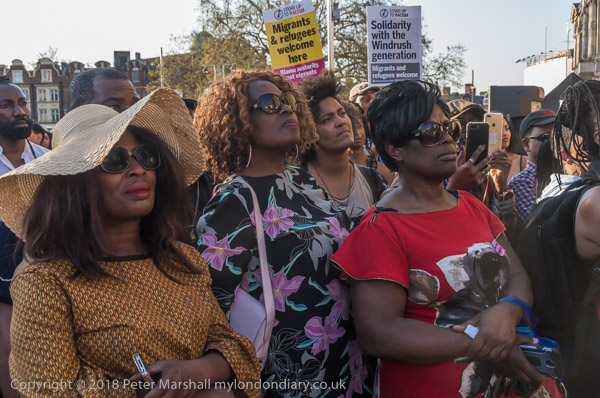
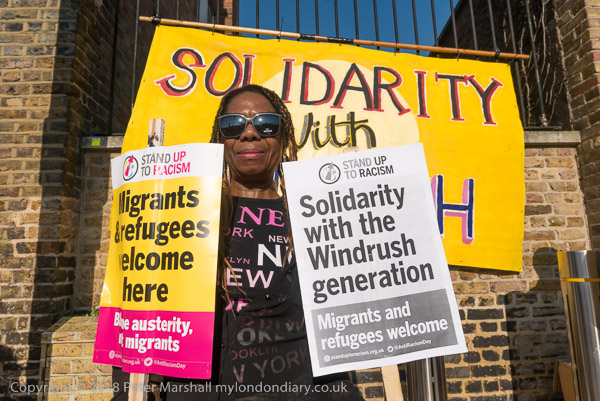
More on the protest in Windrush Square Brixton on My London Diary:  Solidarity with the Windrush families
______________________________________________________

There are no adverts on this site and it receives no sponsorship, and I like to keep it that way. But it does take a considerable amount of my time and thought, and if you enjoy reading it, a small donation – perhaps the cost of a beer – would be appreciated.

My London Diary : London Photos : Hull : River Lea/Lee Valley : London’s Industrial Heritage

All photographs on this and my other sites, unless otherwise stated, are taken by and copyright of Peter Marshall, and are available for reproduction or can be bought as prints.

To order prints or reproduce images

________________________________________________________

High Ideals

The planners of post-war London were people with a vision, but it wasn’t always one that it was possible to put into practice. They were not starting with a clean sheet, but with a city that despite its devastation was still largely intact.

We can still see much of their vision in the Barbican, where a large area had been more or less flattened. It integrates the high rise blocks with lower buildings as well as a large school and an Arts Centre, as well as a medieval church remaining at its centre. Most of the movement around the area is by pedestrians on its high-level walkways, well above any road traffic. It is a system that is popular with those who live there, though casual visitors find it confusing – and it had to be given yellow lines to follow to guide those going to the Art Centre.

Bits of that ‘ped-way’ or ‘high walk’ system extended out, with bridges across London Wall and Aldersgate St, and there were small sections of similar high walks to the north of the Guildhall and around Lower Thames St, as well as across Bishopsgate and around the Nat West Tower developmetn, with developers being required for some years to provide these to get planning permission, but the whole never developed into anything like a joined up system, which would have required far too much demolition of existing buildings.

People in general like to take the easiest route, not that which looks best on the architects or planners drawing boards, and the steps required to access these upper level streets were a considerable disincentive. Although the bridge across Wormwood St was a good vantage point for photographers before its closure (in part by the IRA) most pedestrians preferred the short wait at the traffic lights.


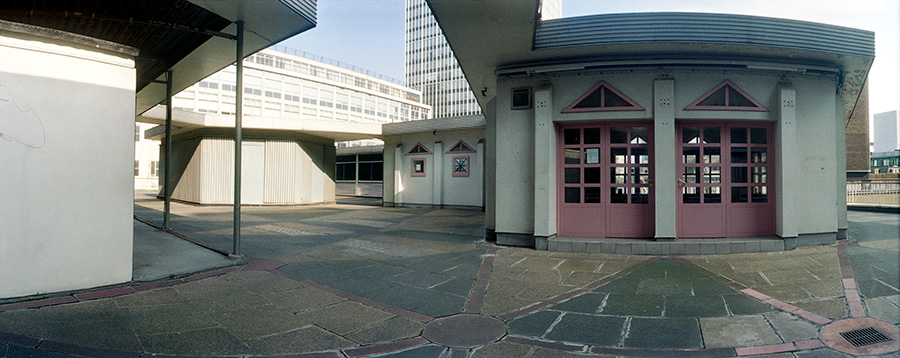
St Alphage Highwalk, 1992

Some years ago St Alphege Highwalk was closed and the bridge across London Wall to it from the Bassishaw Highwalk was demolished. It was one of a number of areas of London I had photographed for a show by London Documentary Photographers in 1992, using my newly acquired Japanese panoramic camera.

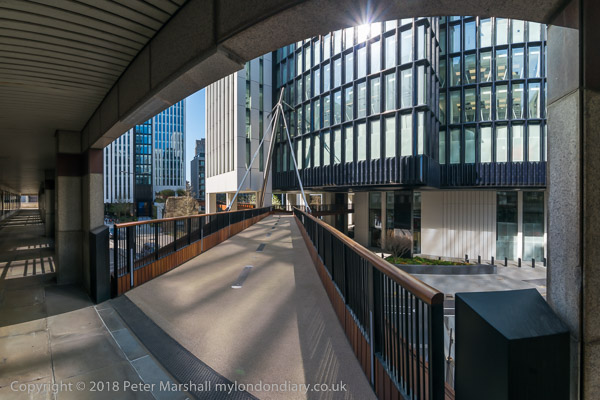
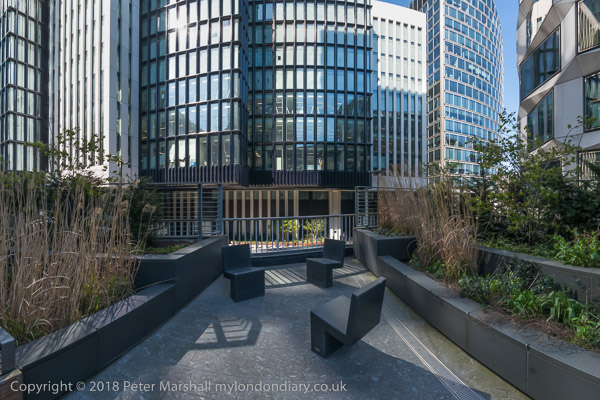
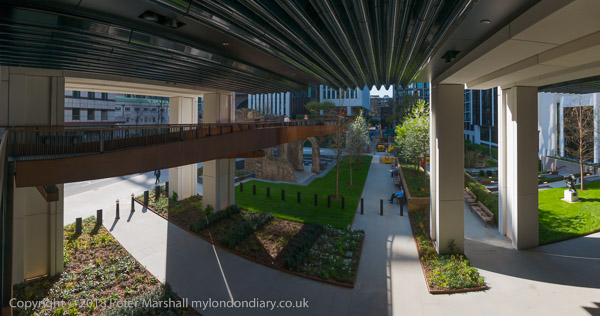
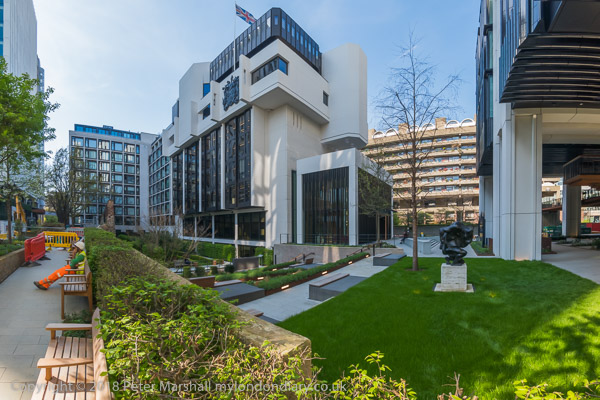
The whole site is now redeveloped, with a new bridge a few yards to the west of the former, and I again took a number of mainly panoramic images around the area, now using a digital camera.

Where the old bridge was is now a dead end – and the walkways that are left have many such dead ends. The small triangular pavilions of my 1992 picture are now large tall office blocks, rather lacking in character, though doubtless considerably more energy efficient.

These blocks apart – and they are no doubt what made it all possible – the area is a more pleasant one now, with plenty of space to stroll around at ground level, as well as on new walkways, room for the workers to eat their lunchtime sandwiches (if they can leave the screens to which they are now chained.)

It opens up also the view of Salter’s Hall, one of the better modern buildings in London, where I was once briefly involved in an innovative chemistry teaching scheme, and also the ruins of St Alphege.

The digital panoramas are considerably easier to produce than when I used film. Not only is it much easier to work hand-held (and I’ve grown to hate tripods) but the give roughly twice the vertical angle of view, producing images within the standard 1.5:1 format of 35mm film, though I often find it useful to crop them at top, bottom or both to something more recognisably panoramic.

The horizontal angle of view is a little greater than the three swing-lens panoramic film cameras I’ve used, and around 50% more than is sensibly possible with a rectilinear view. Although the verticals in the images are straight, to get such a large angle horizontal lines away from the image centre have to curve. The images from the High Walk include some rectilinear views, mainly taken with a zoom at its widest, 18mm.

Many more pictures from around the area at City Highwalk.

______________________________________________________

There are no adverts on this site and it receives no sponsorship, and I like to keep it that way. But it does take a considerable amount of my time and thought, and if you enjoy reading it, a small donation – perhaps the cost of a beer – would be appreciated.

My London Diary : London Photos : Hull : River Lea/Lee Valley : London’s Industrial Heritage

All photographs on this and my other sites, unless otherwise stated, are taken by and copyright of Peter Marshall, and are available for reproduction or can be bought as prints.

To order prints or reproduce images

________________________________________________________

Forests Aren’t Fuel

It is hard to understand why cutting down forests which have taken hundreds or thousands of years to establish to burn them as fuel could ever have been considered as a viable renewable energy source.

That we have to pay a surcharge on our electricity bills which enables ancient forests in the south of the USA to be cleared of threes, converted into woodchips and shipped to be burnt at Drax is irresponsible madness. Apart from the environmental damage in felling, wood is a dirtier fuel even than the coal it is replacing at Drax.

And there is the ‘double whammy’. As well as putting more carbon dioxide into the atmosphere, the destruction of the forests means the destruction of the only large scale method of carbon dioxide removal from the atmosphere. Without the photosynthesis that converts CO2 and water into carbohydrates, releasing oxygen in the process there would be no life on earth.

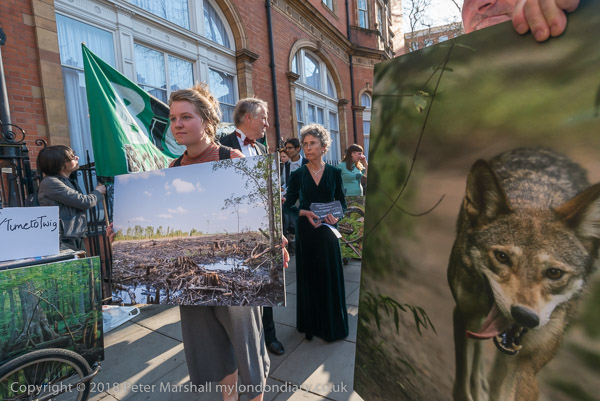
The science is clear – even to primary school children – but there are still companies promoting biomass, trying to expand their businesses and profit from contributing to global catastrophe. And some of them were holding the largest international biomass conference in the Landmark Hotel opposite Marlebone Station in London.

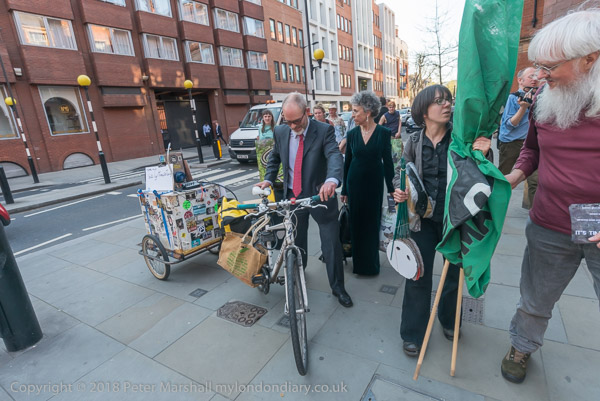
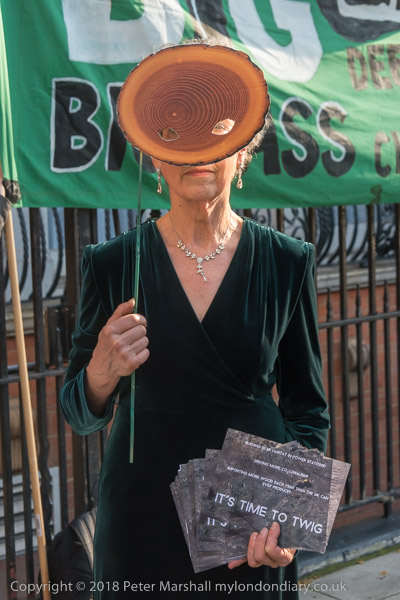
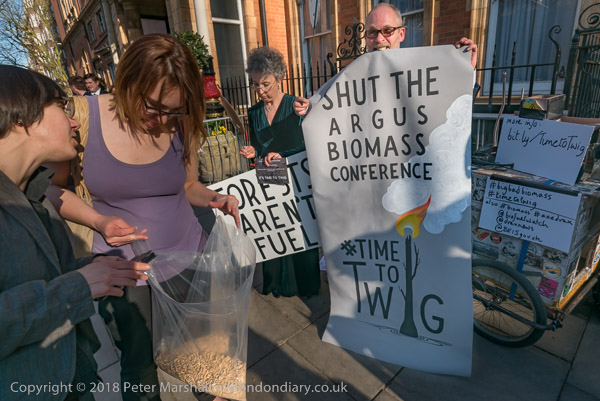
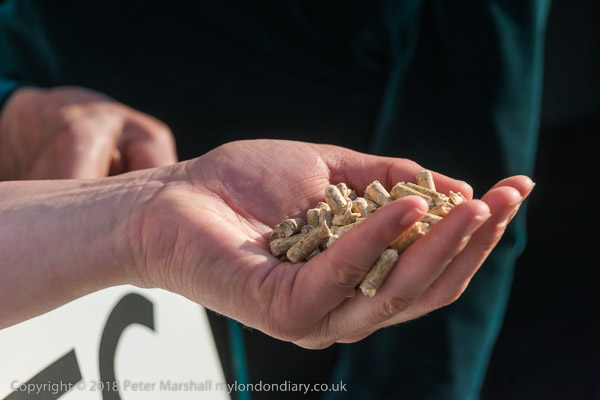
Environmental group Biofuelwatch came to the hotel in what they called a ‘Time to Twig’ Masked Ball Forest Flashmob, bringing posters showing some of the environmental degredation caused by forest felling for biofuel, banners, a bike-hauled sound system and some rather strange masks showing a cut section of a tree trunk. They had also brought a small bag of wood chips similar to those used at Drax.

There were also speeches giving more information about the destructive nature of biofuels and their impact on global warming, including from one activist who had attended the conference and talked with some of those taking part.

More pictures: ‘Time to Twig’ Masked Ball
______________________________________________________

There are no adverts on this site and it receives no sponsorship, and I like to keep it that way. But it does take a considerable amount of my time and thought, and if you enjoy reading it, a small donation – perhaps the cost of a beer – would be appreciated.

My London Diary : London Photos : Hull : River Lea/Lee Valley : London’s Industrial Heritage

All photographs on this and my other sites, unless otherwise stated, are taken by and copyright of Peter Marshall, and are available for reproduction or can be bought as prints.

To order prints or reproduce images

________________________________________________________