Berlin 2: Karl-Marx-Allee

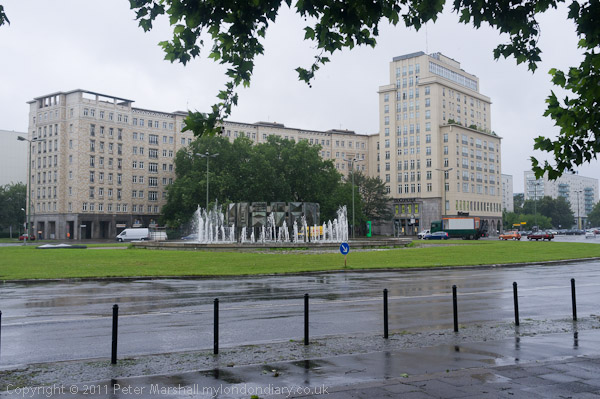
The next day it rained. All day, though sometimes the rain was lighter and sometimes it was heavier.  It was perhaps appropriated weather to make our way down Karl-Marx-Allee, though at times the rain was a little too heavy to make photography easy, and a number of pictures were spoilt by raindrops on the filter in front of the 23mm lens of the Fuji 100x, despite wiping it before every exposure.
The street was rebuilt as a flagship monumental showcase for the East German regime in the 1950s, originally as Stalinallee, but renamed in 1961 after he fell from grace some years after his death. Moves to rename it after the wall fell have so far failed.
It is a truly massive street, roughly a hundred yards wide, and parts of it had some equally massive roadworks that we sometimes struggled around. Back in the old days it was no doubt always clear for the May Day military parade.
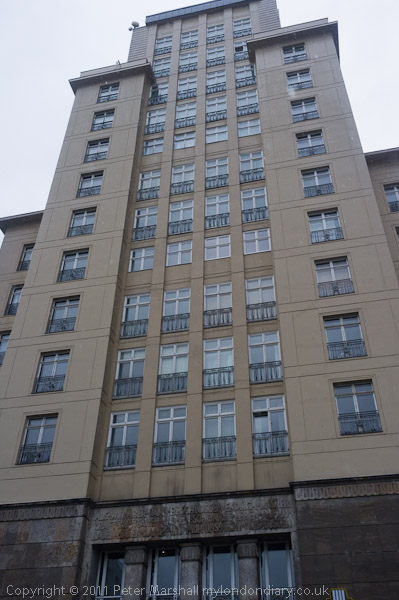
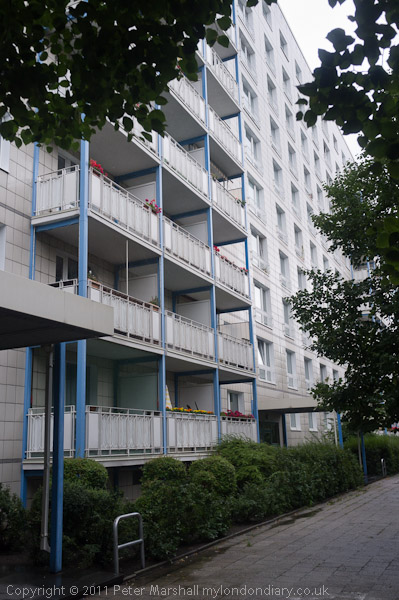
Both sides of the street are lined by buildings on an appropriate scale and built for a wide range of functions, including  spacious and luxurious apartments for workers, shops, restaurants, cafés, a tourist hotel, and a vast cinema, all in the rather ponderous Russian  modern classical style, not particularly to my taste.
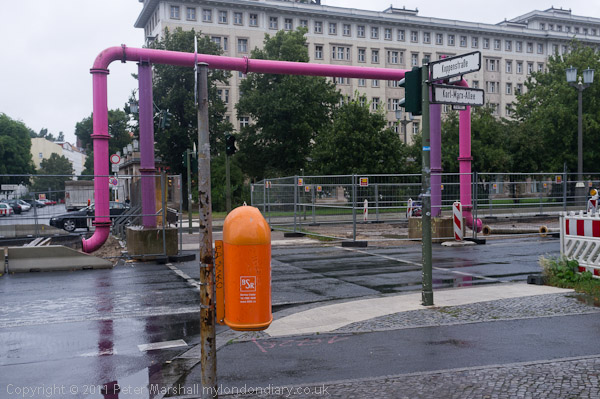
A curious note was added by some colorful above-ground pipework.
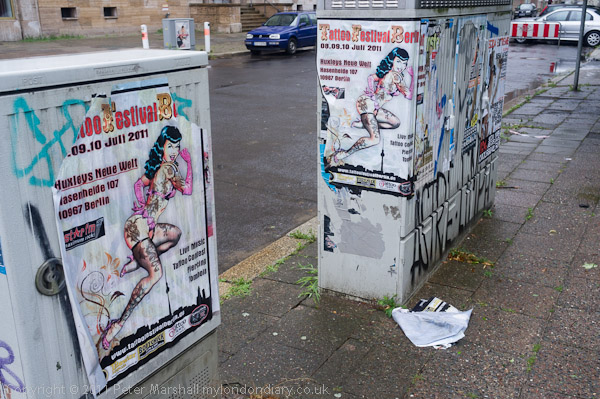
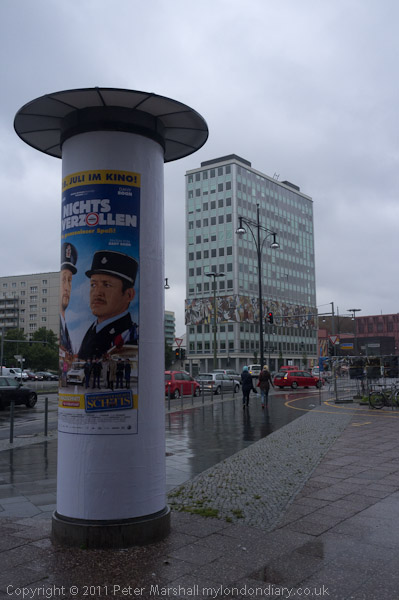
A couple of blocks near the start of our walk on the edge of the Alexanderplatz had some interesting decoation, with a huge Mexican style mural on the Haus des Lehrers (Teacher’s House – in the second picture from the top – but I made a better picture later in the week) and on the north corner of the street a huge metallic tribute to the Russian cosmonauts.
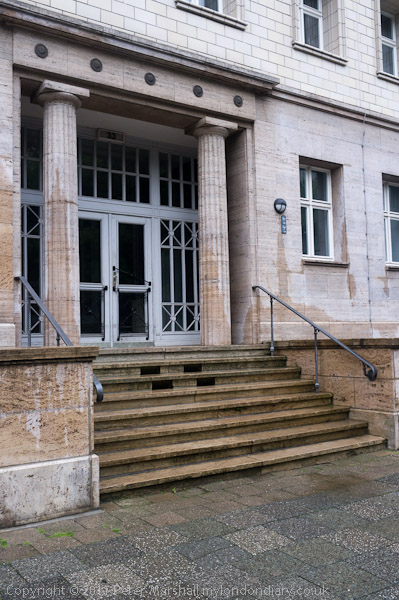
Had the weather been better I might have lingered more, and perhaps taken the Leica out of my bag to use a wider lens, but we hurried on, keen to reach our first café of the day for morning coffee and cake, though I preferred a beer. I did take rather more pictures than appear here, a little over 50 in total , but most are either family pictures or more pictures of the various buildings.

More about the  café  in Berlin 3.

Previous Berlin Post.

______________________________________________________

There are no adverts on this site and it receives no sponsorship, and I like to keep it that way. But it does take a considerable amount of my time and thought, and if you enjoy reading it, a small donation – perhaps the cost of a beer – would be appreciated.

My London Diary : London Photos : Hull : River Lea/Lee Valley : London’s Industrial Heritage

All photographs on this and my other sites, unless otherwise stated, are taken by and copyright of Peter Marshall, and are available for reproduction or can be bought as prints.

To order prints or reproduce images

________________________________________________________
Berlin 1: Rosa Luxemburg Strasse

I found Berlin a rather confusing city when I visited there for a few days in July 2011. Fortunately I was there with my wife, who speaks German, and my son who had booked the flat we were staying in and he was able to use his phone to find our way there. He also had his young daughter in a push chair. We’d flown into the city, and my first impression was how well organised the airport there was compared to Heathrow, always something of a nightmare.

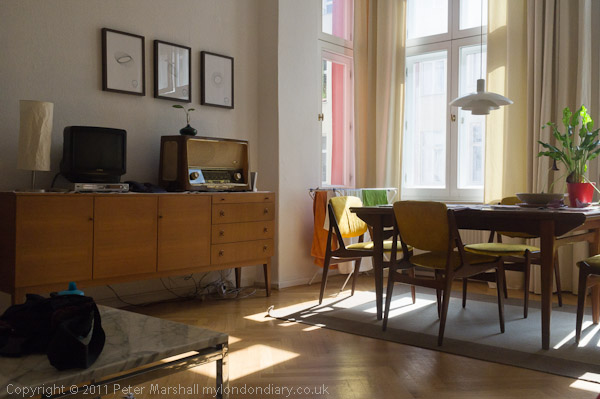
The flat was large and relatively luxurious, with the kind of mod cons that we don’t have at home, though without the several thousand books and other clutter that make our place home.

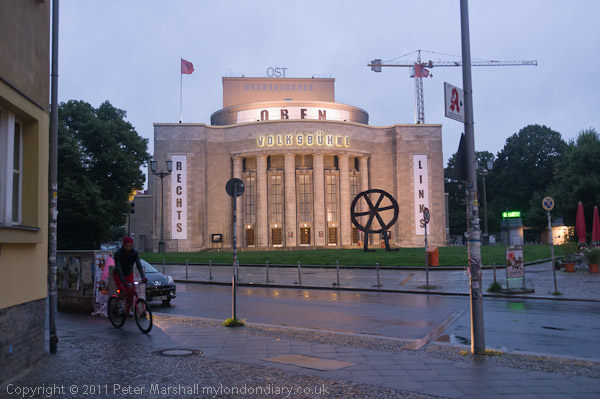
It was getting dark as we made our way out from the flat and on to Rosa Luxemburg Str to look for somewhere to eat (and drink) and to do some shopping. Just a few yards up the street in Rosa-Luxemburg-Platz was the Volksbühne (People’s Theatre), described as Berlin’s most iconic theatre, coming out of and 1890s movement to provide realistic theatre for working class Berliners, with the motto ‘Die Kunst dem Volke), Art for the People.  The building from 1913-4 was heavily bombed duirng the second world war and rebuilt in 1953-4 with a very similar frontage.

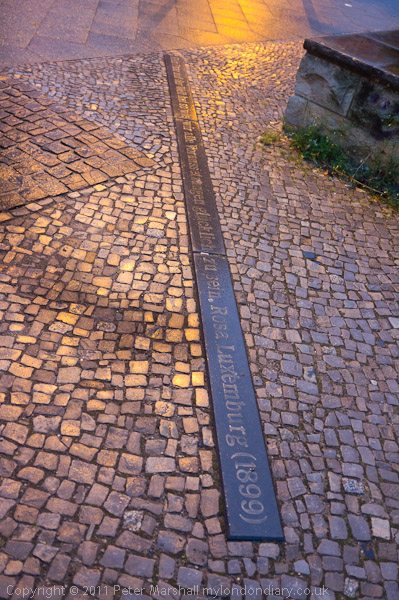
On the street close to the theatre were a number of quotations from Rosa Luxemburg, who together with Karl Liebknecht was captured by the Freikorps right-wing paramilitary militias during the revolutionary struggles in Berlin in January 1919. They were questioned under torture and then ordered to be executed; she was hit on the head by a rifile butt, then shot in the head and her body thrown in a nearby canal.

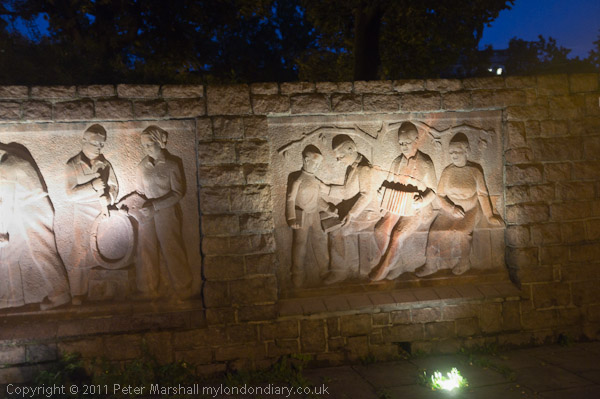
We took a walk in the dark and I took a few pictures, though most were rather blurred.

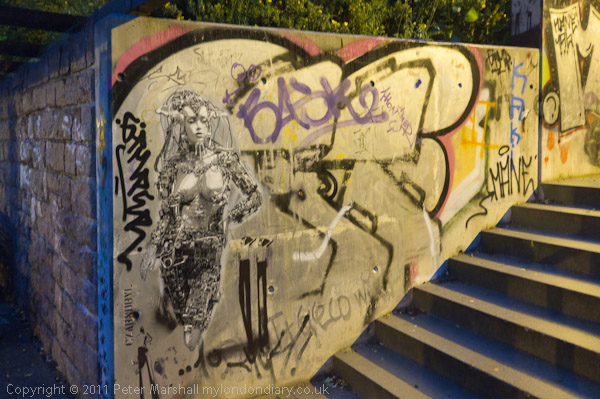
The steps led into a park with a large round pond, but my pictures of that are too blurred to post.

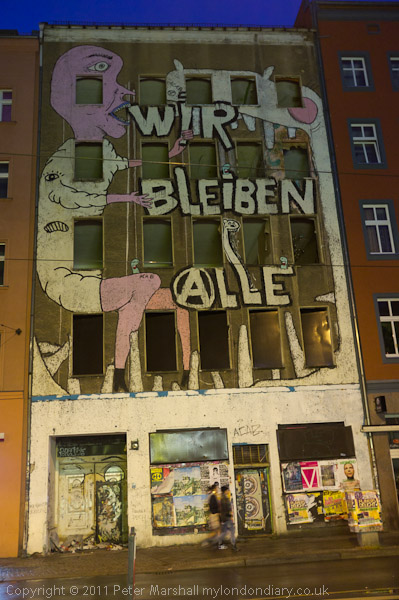
Wir bleiben alle!  We are all staying put, a housefront against gentrification of the area.

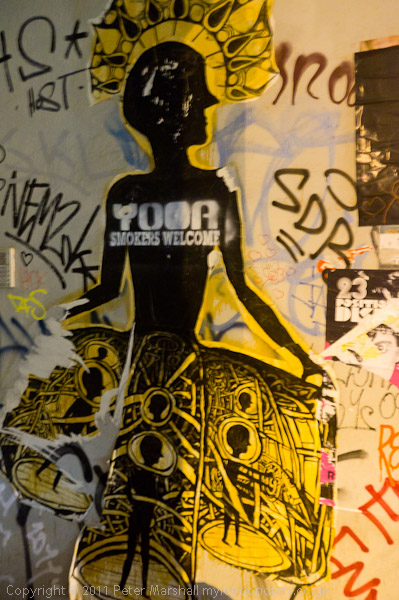
Smokers Welcome. Though to quite what I’m not sure.

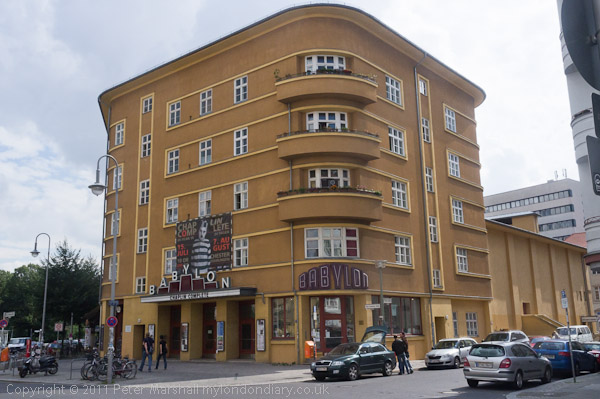
Babylon, a cinema opposite the Volksbühne. A typical ‘Neue Sachlichkeit‘ (New Objectivity) building from 1928/29, architect Hans Poelzig and is regarded as typical of its construction period, opposite to the Volksbühne. The building was erected 1928/29 according to plans of architect Hans Poelzig and is regarded as typical of its construction period, Neue Sachlichkeitand is still a cinema.

More pictures from Berlin in later posts.

I had two cameras with me, A Fuji X100, with its fixed 35mm equivalent lens and a Leica M8. As I was working in colour I had a very limited choice of lenses available for the Leica as for colour they needed to be fitted with an IR cut filter and I only had these for two lenses. The unusual 1.33x crop factor turned the 35mm f1.4 into a 47mm standard lens and the 90mm f2.8 to a perhaps more useful 120mm equivalent. Unfortunately the Leica optical viewfinder has never really been too useful for the 90mm, giving you a rather tiny but pretty accurate frame. It’s a fine lens but really needs a camera with live view rather than the optical viewfinder.
______________________________________________________

There are no adverts on this site and it receives no sponsorship, and I like to keep it that way. But it does take a considerable amount of my time and thought, and if you enjoy reading it, a small donation – perhaps the cost of a beer – would be appreciated.

My London Diary : London Photos : Hull : River Lea/Lee Valley : London’s Industrial Heritage

All photographs on this and my other sites, unless otherwise stated, are taken by and copyright of Peter Marshall, and are available for reproduction or can be bought as prints.

To order prints or reproduce images

________________________________________________________
Berlin Syndikat

I’ve only been to Berlin once, back in 2011, when I spent a few days their with my wife, son and rather small grandaughter, in a rather grand Airbnb flat on Rosa Luxemburg Str.  Of course, being then a relatively new grandfather, many of the pictures were simply family pictures which I don’t make public, but there were quite a few others.

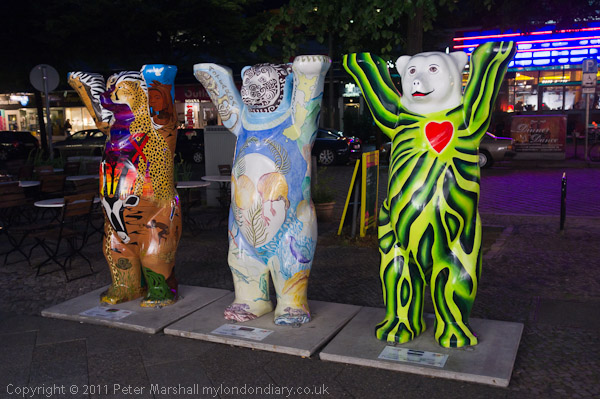
But back then I had this idea that ‘My London Diary’ was just for pictures of London, something I now have a rather more relaxed idea about and so I don’t think I’ve ever put any of the pictures I took during our stay on-line. Except for some of the bears, which appeared in  a post Do Bears? in this Re>PHOTO blog inb 2011.

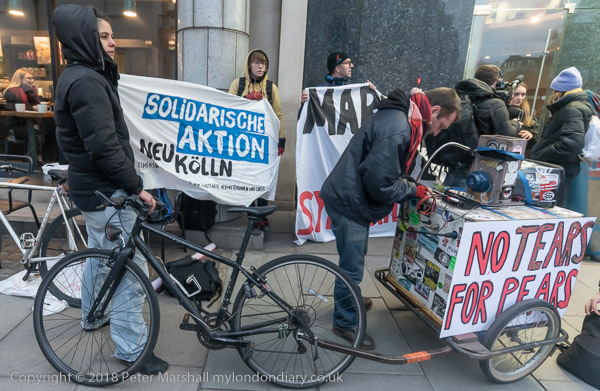
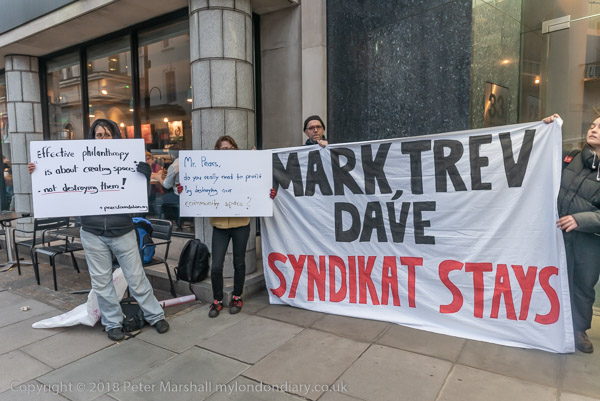
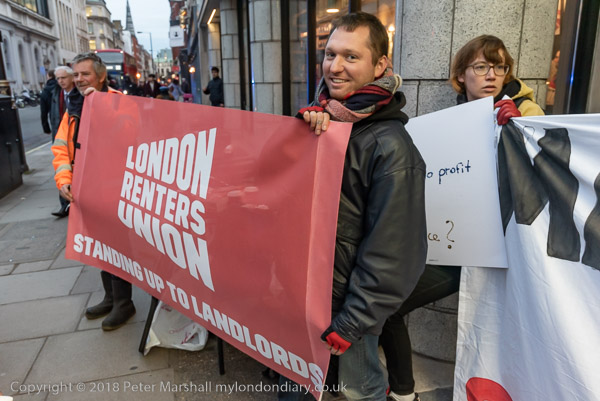
I was reminded of this visit in December, when people from the Berlin community centre and pub Syndikat protested with London Renters Union outside the London offices of their landlord, Global Real Estate Investors Limited, near Cavendish Square.

It’s probably a company you’ve never heard of – and certainly I hadn’t. Owned by the ultra-secretive Pears brothers, Mark, Trevor and David, who through a whole lot of front companies apparently own 6,200 properties in Berlin as well as around £6 bn worth of property in London and south-east England, including 3-4,000 properties in London, many in Notting Hill and thousands elsewhere.  The three brothers are thought to be worth around £2.1bn, not bad for a company begun by their grandfather in 1952 when he ran 3 greengrocers in North London.

They also run the Pears Foundation “an independent, British family foundation, rooted in Jewish values, that takes £15-20 million of private money every year and invests it in good causes.”

Syndikat have been running their anarcho-pub in Neukölln in Berlin for 33 years, but were recently given notice to quit for no real reason. Their lease ran out on 31st December 2018, but they were still open at the end of January 2019, and waiting for a court date for the eviction order. There have been a number of protests in Berlin, including at their landlord’s office there and the British Embassy (also thought to be owned by Pears) with another planned for the start of March.

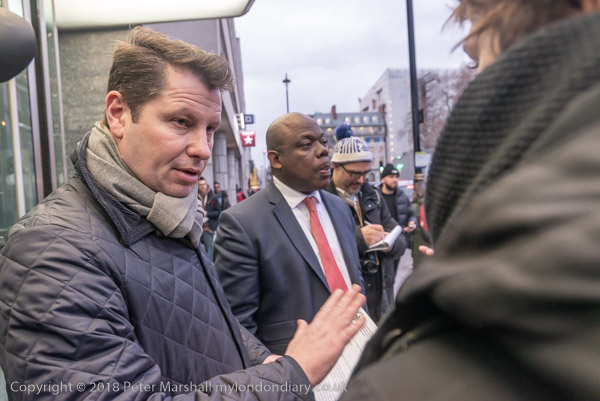
This was a peaceful protest, standing in front of the offices and handing out flyers, as well as talking with those entering and leaving the offices, including one of the executive officers who promised to look into their case, though nothing appears to have come from this.

More pictures at Berlin Syndikat protest at London landlords.

______________________________________________________

There are no adverts on this site and it receives no sponsorship, and I like to keep it that way. But it does take a considerable amount of my time and thought, and if you enjoy reading it, a small donation – perhaps the cost of a beer – would be appreciated.

My London Diary : London Photos : Hull : River Lea/Lee Valley : London’s Industrial Heritage

All photographs on this and my other sites, unless otherwise stated, are taken by and copyright of Peter Marshall, and are available for reproduction or can be bought as prints.

To order prints or reproduce images

________________________________________________________
January 2019 complete

It has been a struggle for me to get all of the events I covered last month on line on My London Diary, though I’m not entirely sure why that is. Perhaps it’s the time of the year or the weather or, more likely it’s Brexit, thinking of which is just so depressing.

And although I’m still trying to cut down on the number of things I do and have turned down several commissions I still seem to be rather busy, with a long list of things I intend to do but haven’t got around to, particularly web projects and books.

I’ve also got to think about the future of My London Diary and the other web sites I run, as the file count on my web space is fast approaching the limit. It would be good to find some other solution other than simply having to pay for another contract for web space, and any suggestions are welcome.

Jan 2019

Pro- and Anti-Brexit protests
No imperialist coup in Venezuela
End TfL Discrimination against private hire
Pro- and Anti-Brexit protests
No imperialist coup in Venezuela
End TfL Discrimination against private hire
Sudanese protest against al-Bashir


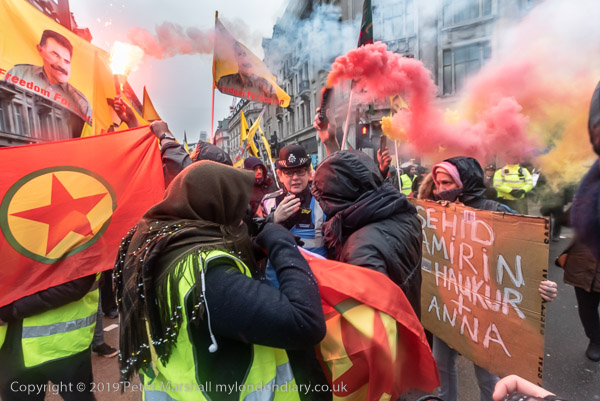
Defend Rojava from Turkish invasion
Yellow Jackets in Westminster
Balochs protest abductions by Pakistan


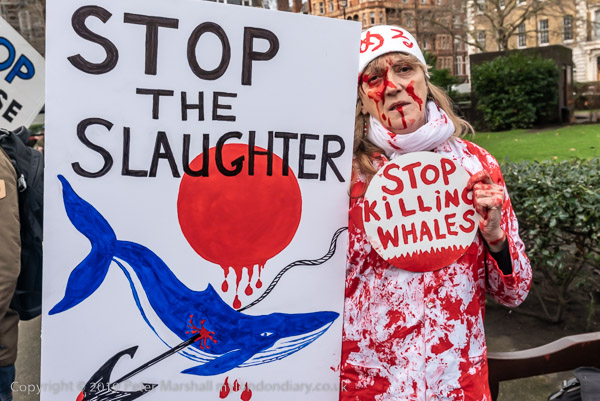
‘No Whaling’ rally and march
Lambeth protest Children’s Centre cuts
Marzieh Hashemi arrest protest


Stop Arming Saudi while Yemen starves
Solidarity with Russian anti-fascists
Bolivians protest against Morales


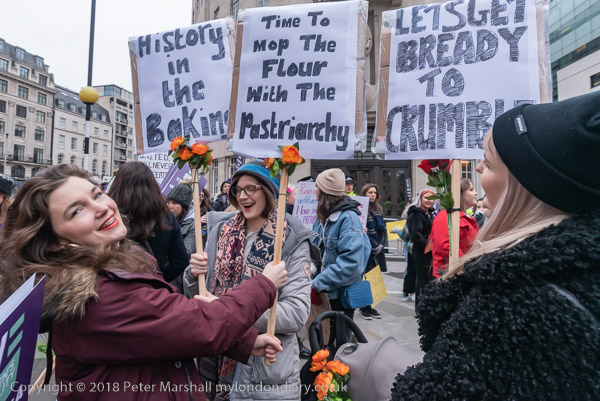
Women’s Bread & Roses protest
Bus Day of Action for disabled
Earth Strike Kickoff Protest
Brexit protest against May’s Deal
Vedanta Zambian pollution appeal
Eton Wick


Vigil marks 17 years of Guantanamo torture
Brexit Protests continue
Pro- and Anti-Brexit protests at Parliament
Solidarity with Pipeline Protesters
Stand Up for the Elephant
Tower Bridge & Shad Thames

London Images

______________________________________________________

There are no adverts on this site and it receives no sponsorship, and I like to keep it that way. But it does take a considerable amount of my time and thought, and if you enjoy reading it, a small donation – perhaps the cost of a beer – would be appreciated.

My London Diary : London Photos : Hull : River Lea/Lee Valley : London’s Industrial Heritage

All photographs on this and my other sites, unless otherwise stated, are taken by and copyright of Peter Marshall, and are available for reproduction or can be bought as prints.

To order prints or reproduce images

________________________________________________________
Stansted 15 scandal

Sometimes the law is an ass. And sometimes the law realises it is being an ass and decides to try and mitigate its asinity, though in this case rather inadequately.  The Stansted 15, peaceful protesters who prevented an illegal deportation flight taking place by going on to the runway and chaining themselves to the plane, should never have been charged with an offence under terrorist legislation because they clearly had no terrorist intent. Eleven of the 60 who were put on the flight have not yet been deported and should not have been on the plane; the Home Office should be in court for putting them there.

Equally clearly the government and the Home Office in particular put on a lot of pressure to get them tried under this entirely inappropriate legislation. It paints both police and Crown Prosecution Service in an extremely poor light that they bowed to this pressure, and it is perhaps surprising that the court went along with them.

Using a terrorism charge meant that the accused could have been sentenced to 15 years in jail.  They should not have been found guilty, but they were, though its hard to see why. Had the court really thought they were terrorists they would not have been on bail awaiting sentence, as they were at the time of this protest, spending a couple of months over Christmas worrying about what might happen, and whether they would spend years in jail.

Even though none was given an immediated custodial sentence, three who had previous convictions for aggravated trespass in an earlier direct action were given a suspended sentence of 9 months along with long hours of unpaid work, with the other 12 receiving community orders, again with long hours of unpaid work. All the sentences seemed disproportionate, and the judge in sentencing repeated the lie that their action had endangered anyone at the airport – except themselves. In fact they had saved a number of the passengers – including four victims of trafficking – from the danger that their deportation would have put them in.

I don’t know if there will be an appeal against the convictions or the sentences, though there are probably grounds for both. But it’s shocking that such as serious charge should be misused in this way, clearly in an attempt to deter further acts of legitimate protest.

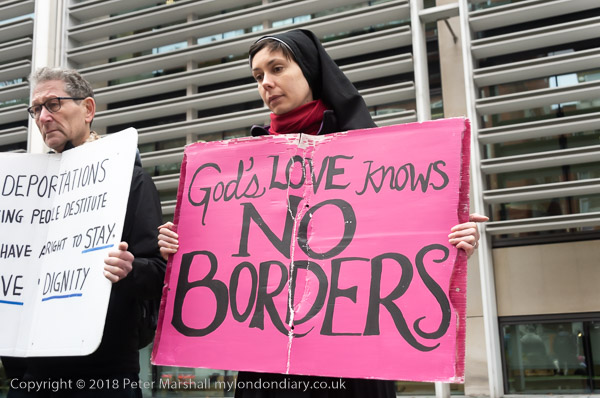
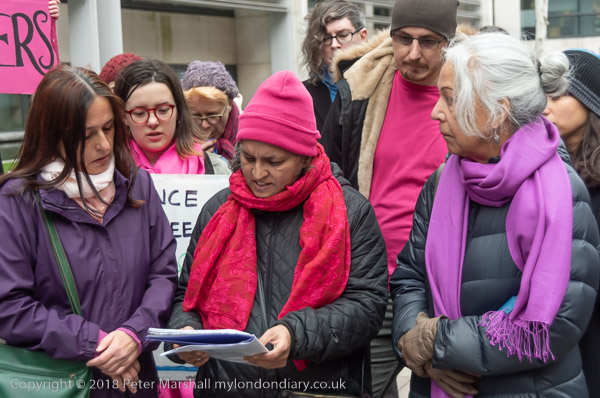
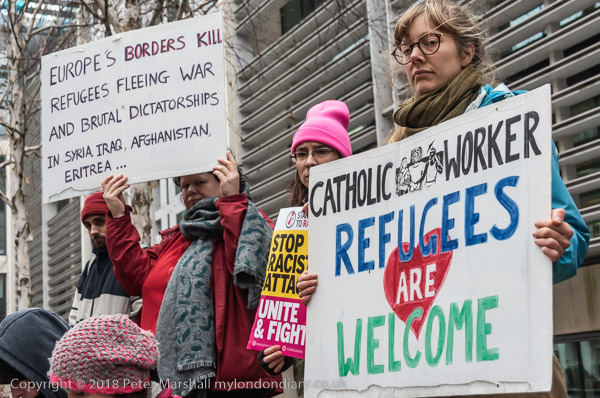
Usually I try to remain as an observer when photographing protests, but this was a liturgy rather than a protest and one I felt I had to take part in.  So I stood with the others when not taking pictures, and when as a part of it a list was passed round with the names of some of the many refugees who have died, some drowned on their way to Europe, others trying to cross the channel , some in our deportation prisons, while being deported or deported to die in another country, I didn’t just pass it on, but read out some of those names.

More about the protest, and a few more pictures at London Stands With The Stansted15.

______________________________________________________

There are no adverts on this site and it receives no sponsorship, and I like to keep it that way. But it does take a considerable amount of my time and thought, and if you enjoy reading it, a small donation – perhaps the cost of a beer – would be appreciated.

My London Diary : London Photos : Hull : River Lea/Lee Valley : London’s Industrial Heritage

All photographs on this and my other sites, unless otherwise stated, are taken by and copyright of Peter Marshall, and are available for reproduction or can be bought as prints.

To order prints or reproduce images

________________________________________________________
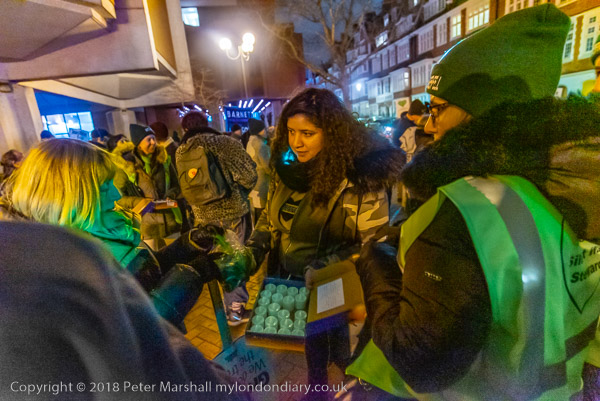
Grenfell – 18 months

Eighteen months after the terrible fire so little seems to have been done. No real changes to the systems that made it possible. No prosecutions of those responsible for making the tower into a fire-trap and for ignoring or taking steps to silence residents who pointed out the problems. A council that still seems to be failing its duty of care towards the local community, particularly those still in temporary accomodation. None of the government promises kept. No one held to account.

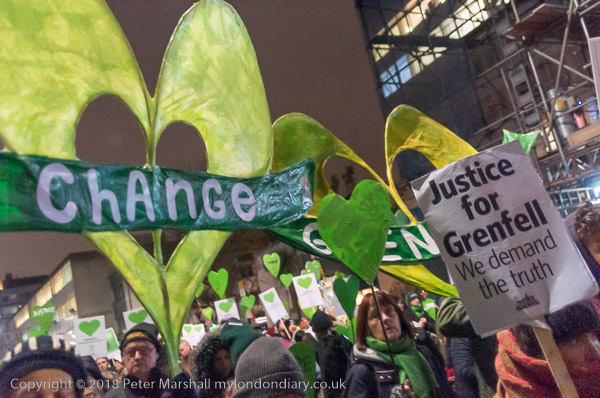
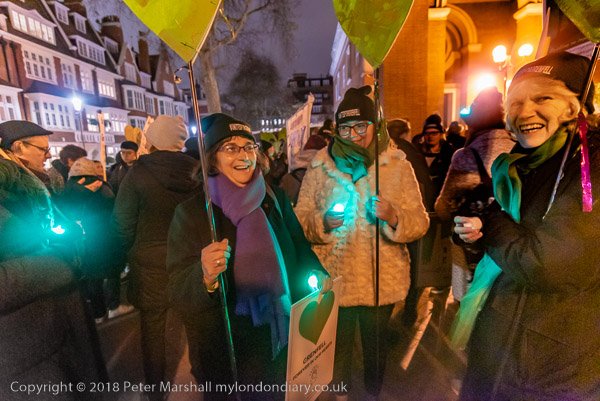
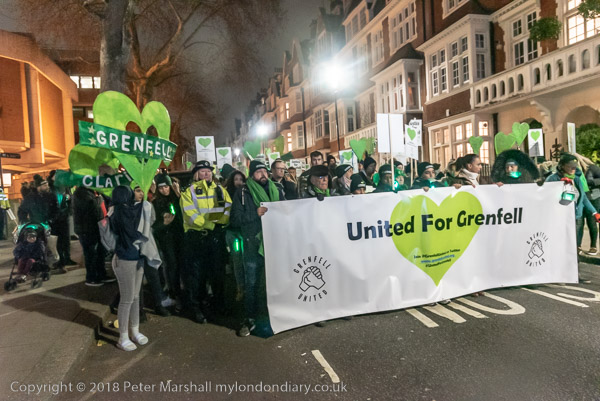
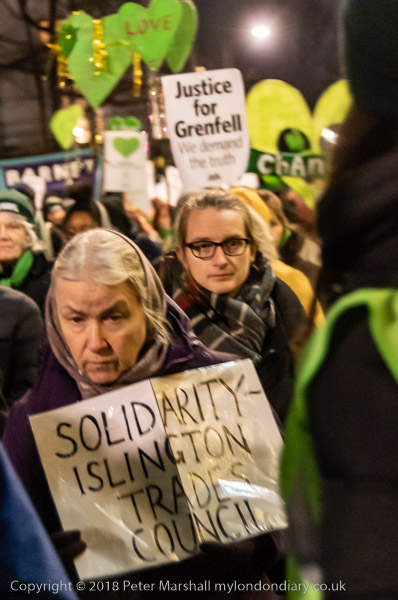
The inquiry has revealed some horrific details, but also seems to have been used to try to push blame onto the firefighters, who made heroic efforts at the scene of the crime, and is widely seen as trying to push any real action longer and longer into the future, hoping that people will forget. Which is why these monthly marches really matter, with thousands marching through the streets carrying green candles, green Grenfell hearts and wearing green scarves to keep the memory alight

But while of course many still suffer the trauma and will continue to do so for the rest of their lives, perhaps the response is now too passive and it’s time to make a lot more noise than this monthly silent walk.  Some feel their real purpose is to divert people from more active resistance.

It isn’t an easy event to photograph. This walk started at Kensington Town Hall, where the yard is at best gloomy. A few people have a very negative attitude to the media and one man followed me for some time telling me I shouldn’t be taking pictures. It remains a rather emotional event, and I try hard not to aggravate anyone’s distress, but it’s hard not to be affected. None of my friends died in Grenfell, but I meet a number of people I know who were friends of some of the victims, and sometimes find my eyes full of tears as I try to frame an image.

It gets a little easier once the walk starts, not least because there is more light on the streets. Most of these pictures were taken with the lenses wide open at around f4, with shutter speeds varying from around 1/8 to 1/50th at ISO 6400. Some in the council yard are still several stops underexposed and require considerable help from Lightroom.

On the walk I still try to be as unobtrusive as possible. There is the added complication of movement, but progess is deliberately slow with many halts. The lighting changes as people go along the street, from lamp post to lamp post, coming into the light then moving back into shadow. The major routes are of course considerably brighter than the side streets, and I made more pictures on them, particularly at Notting Hill Gate, where the walk took a long rest and more walkers joined. In places there was enough light to make using longer focal lengths possible, with shutter speeds up to around 1/100th.

As the march turned off to go towards Grenfell, I made my way to the Underground for the journey home. I’d been on my feet long enough and was cold – and the streets get darker as you go north.

Grenfell silent walk – 18 months on

There are no adverts on this site and it receives no sponsorship, and I like to keep it that way. But it does take a considerable amount of my time and thought, and if you enjoy reading it, a small donation – perhaps the cost of a beer – would be appreciated.

My London Diary : London Photos : Hull : River Lea/Lee Valley : London’s Industrial Heritage

All photographs on this and my other sites, unless otherwise stated, are taken by and copyright of Peter Marshall, and are available for reproduction or can be bought as prints.

To order prints or reproduce images

________________________________________________________
Hand Back Venezuela’s Money

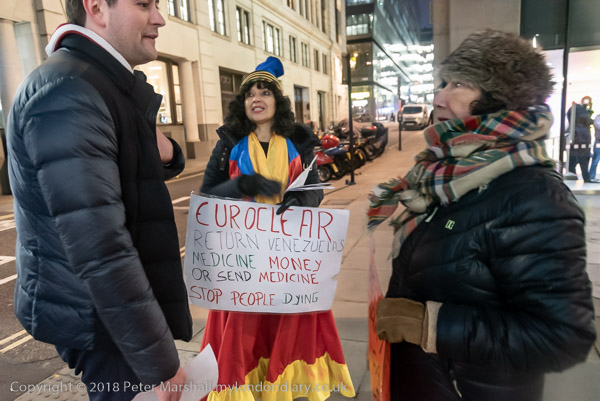
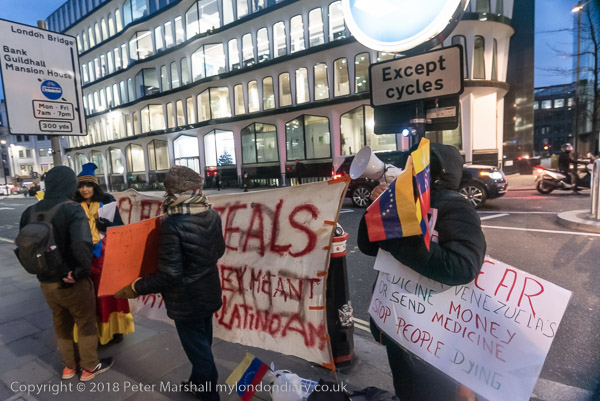
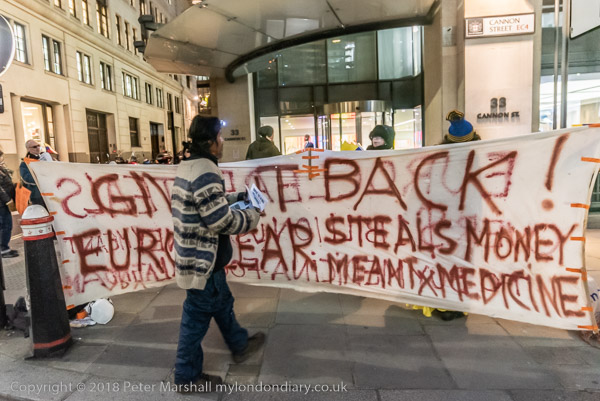
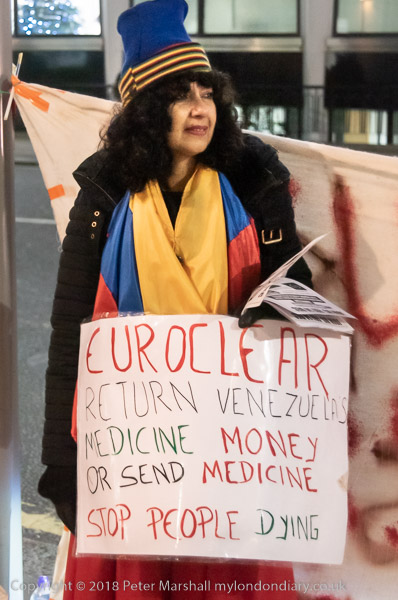
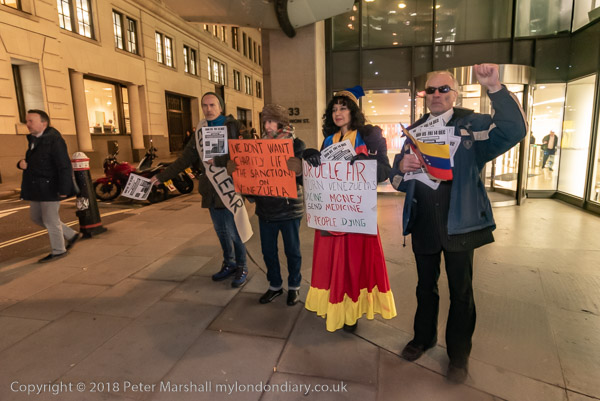
On a cold wet evening I asked myself why I was standing on a dimly lit street corner in the CIty of London taking photographs of a small group of protesters. And I had an answer, that I wanted to try to draw attention to the real causes of the current situation in Venezuela, a country running out of money.

Venezuela is rich in natural resources, the largest known oil reserves in the world along with gold and other minerals. It was, and should be a wealthy country, but the problems have come because under Hugo Chavez, President from 1999 to 2013, it made a determined effort to share that wealth widely, eneacting wide-ranging social reforms and nationalising industries, creating neighbourhood councils and greatly improving access to food, housing, healthcare and education for the poor.

These policies brought the country into conflict with western dominated world economic agencies and countries, particularly the United States, leading to various sanctions, which, together with a steep drop in the price of oil have led to the current economic problems there, helped by a certain amount of corruption as well as political manouevering by the opposition largely right-wing middle classes whose dominance is threatened by the socialist programme.

Opposition voices dominate in the media coming out of the country and are widely reported in the UK media, with great prominence being given to anti-Maduro protests and little or no reporting of the large demonstrations in support of the government. The sanctions, particularly those imposed by the US seldom get a mention. As the US Congressional Research Service notes “For more than a decade, the United States has employed sanctions as a policy tool in response to activities of the Venezuelan government or Venezuelan individuals.” Sanctions were imposed under President Obama and have been stepped up under Trump, particularly over finanacial transactions and the oil industry.

The protest I was photographing was against one result of these sanctions, outside Euroclear, a J P Morgan Subsidiary in the City of London calling for the company to return over $1billion belonging to the Venezuelan government, sent to buy medicines and food for Venezuela. Euroclear accepted the money despite US sanctions which were in place, but has failed to release it, meaning that many Venezuelans, particularly children, will die because of lack of medicines.

So I was there taking pictures, though there wsn’t really a great deal to photograph, as you can see. And I sent them into the agency, knowing exactly how little interest there would be from the media in the story and little chance of them being used by the UK media as they don’t support the story the UK press want to tell. But perhaps one day they may help to tell a story which I think should be told about Venezuela’s stolen money.

Hand Back Venezuela’s stolen money

There are no adverts on this site and it receives no sponsorship, and I like to keep it that way. But it does take a considerable amount of my time and thought, and if you enjoy reading it, a small donation – perhaps the cost of a beer – would be appreciated.

My London Diary : London Photos : Hull : River Lea/Lee Valley : London’s Industrial Heritage

All photographs on this and my other sites, unless otherwise stated, are taken by and copyright of Peter Marshall, and are available for reproduction or can be bought as prints.

To order prints or reproduce images

________________________________________________________
SODEM Night

December 12th wasn’t really a day for taking photograph for me, more a day off to go out for a few drinks and a meal with some photographer friends. But as I sually do on such occasions I took a camera with me, just in case I wanted to take some pictures. Not one of the Nikons I usually use for work, but a Fuji X-E3, with the 18-135 lens fitted, and as something of an afterthought I also put the smallish 18mm f2 in my bag too.

The day out started a little late, as when we agreed to meet at the Tate. For some unknown reason (senility?) I had in mind Tate Modern but everyone else got it right and went to Tate Britain, where at my request we were aiming to start at a show by photographer Markéta Luskačová of her Spitalfields pictures. A couple of phone calls later I was on the Jubilee line to Westminster and then hurrying down past the Houses of Parliament, where I saw a bus coming and rushed to just miss it.

Finally arriving at Tate Britain I had to find the show, which wasn’t easy – the gallery does really need to look at its signage. Finally I asked one of the gallery staff who didn’t really know but gave me a map and pointed in roughly the right direction. The show does continue until May 12th 2019, so if you start now there is some chance of finding it by then.

Finally we were all met, and after I’d run around the show (worth seeing though I was familiar with all the work already) we left for the pub, a journey where I at least part redeemed myself by actually knowint the way as it was the same one I’d gone to meet Class War before their visit to the Rees-Moggs a few months earlier. We’d hoped by around 2pm it would be getting a little less busy, but approaching Christmas it was rather full, with several parties about to take place, and after a drink or two we left for the next venue, a theatre bar I’d often walked past but never visited,  which was quieter and cosier.

An hour or so later we’d had enough of expensive beer and got on a bus towards a Wetherspoons where we were also to eat. Not a gourmet location, but almost always edible and good value, with fast service. Spoons do differ despite all being a part of the same empire, and this was the preferred choice of our late colleague-in-arms Townly Cooke, who at one time was a part of their quality control, being paid to eat and drink unannouced at their pubs across London.

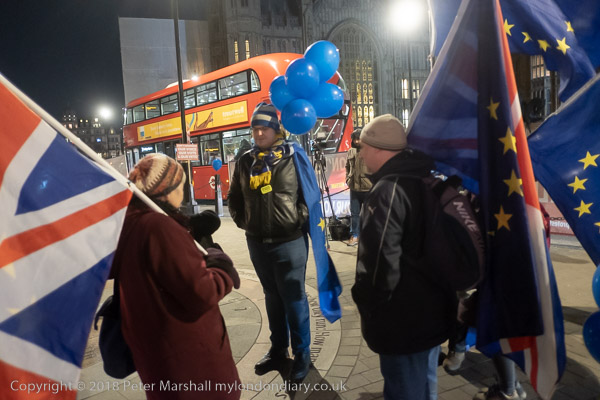
We finished early as one of our number had to get back to Oxfordshire for an early start to work the following day and I found myself going across Waterloo Bridge at around 6.30pm and realising I couldn’t use my Super Off-Peak rail ticket until half an hour later.  I remembered there had been quite a lot of Brexit-related activity outside Parliament when I’d run past earlier in the day and decided to return to see if anything was still happening.

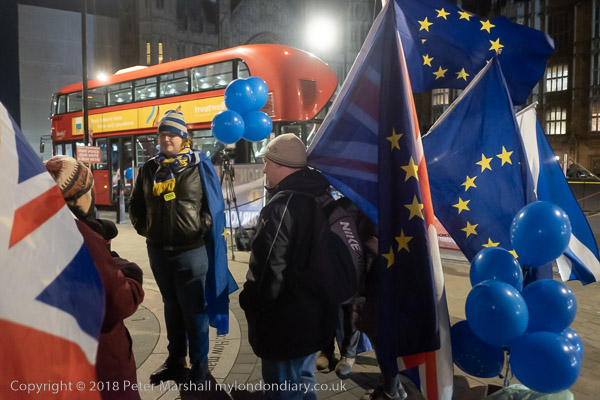
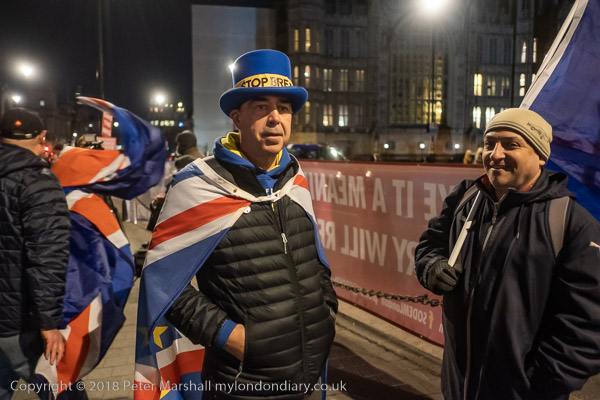
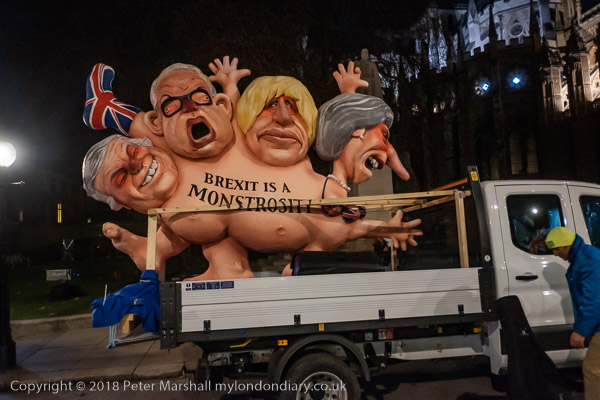
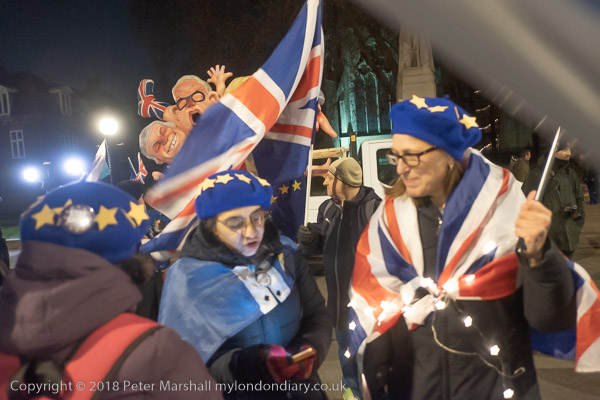
I changed the f3.5 maximum aperture zoom for the 18mm f2 fixed lens and set to work photograph SODEM who were still keeping up their vigil, along with a rather impressive Brexit monstrosity on the back of a lorry. The extreme-right who had been noisy and disruptive were long gone, and things were pretty quiet.

I was interested to see how the Fuji would cope under the failry dim conditions, working at f2 and ISO 3200.  Shutter speeds varied, but were generally usable, around 1/50s and the camera usually focussed fairly easily on something, though not always exactly where I had intended, though I suspect this was my fault. As always under such conditions, depth of filed is always a problem, but the smaller sensor compared to full frame does improve this. Working in low light like this not everything works, and I always have to overshoot, but there weren’t that many absoluted failures. I’ve put most of the frames that didn’t have obvious problems on the web site rather than edit more tightly to perhaps half a dozen frames as I might usually have done.

Although I’ve decided the Fuji cameras I’ve tried can’t really replace the Nikons for my work, I’ve been wondering for some time about trying a micro four thirds system. I think my first step will be to evaluated using one with a telephoto zoom alongside the Fuji X-E3  with the wide-angle zoom.

As I walked back into Parliament Square I saw a bus to Waterloo just entering the square and ran towards to stop to catch it. This time I got there in time.

You can see the pictures I took at SODEM vigil against Brexit

There are no adverts on this site and it receives no sponsorship, and I like to keep it that way. But it does take a considerable amount of my time and thought, and if you enjoy reading it, a small donation – perhaps the cost of a beer – would be appreciated.

My London Diary : London Photos : Hull : River Lea/Lee Valley : London’s Industrial Heritage

All photographs on this and my other sites, unless otherwise stated, are taken by and copyright of Peter Marshall, and are available for reproduction or can be bought as prints.

To order prints or reproduce images

________________________________________________________
Human Rights – 70 years

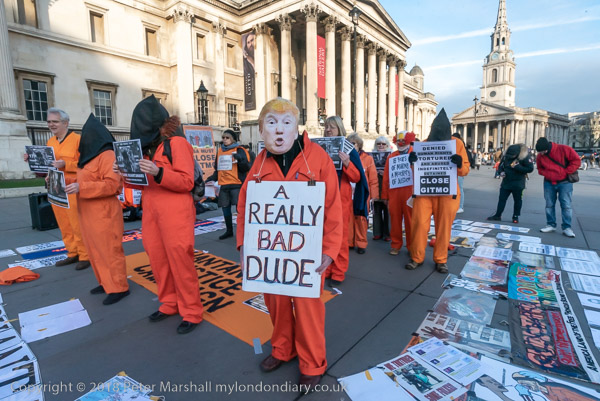
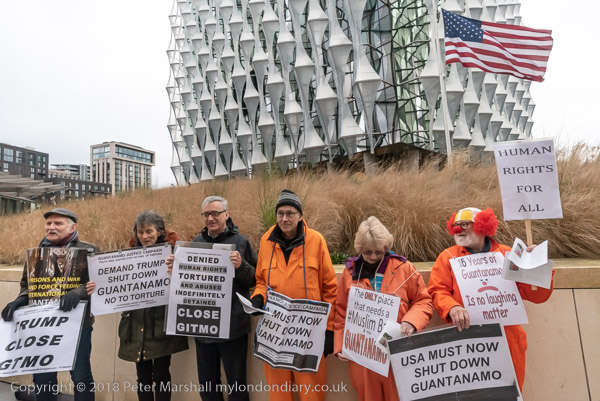
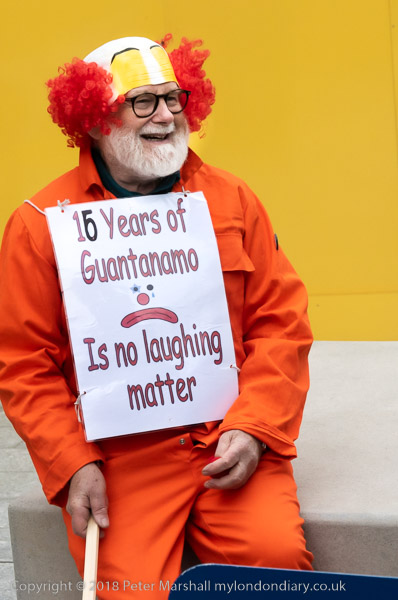
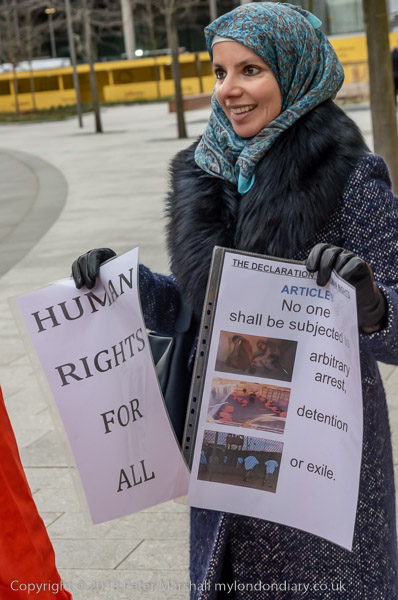
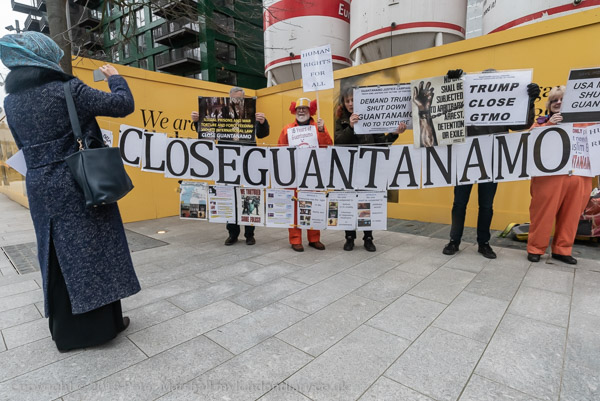
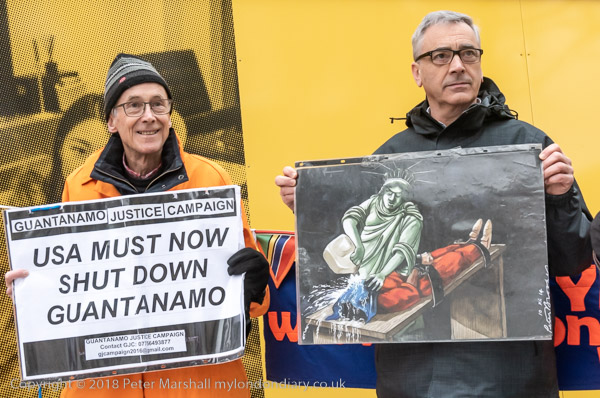
Modern Human Rights law came out of the aftermath of the Second World War as a response to the barbarism of that war, with the UN in 1947 setting up a Human Rights Commission, chaired by Eleanor Roosevelt, which after consderable discussion came up in 1948 with the non-binding  Universal Declaration of Human Rights which was adopted by the United Nations General Assembly at at Palais de Chaillot, Paris on the 10 December 1948, 70 years to the day before this ‘Shut Guantanamo!’ protest at the US Embassy by the London Guantanamo Campaign.

December 10 is celebrated in countries around the world as Human Rights Day or International Human Rights Day, though it is an anniversary that passes almost unnoticed in the UK.


Almost 17 years – since January 11th 2002

When the Council of Europe (not to be confused with the EU) was set up in 1949, it immediately began work, led by Sir David Maxwell-Fyfe, a British MP who had been a prosecutor at the Nuremberg trials, on a European Convention on Human Rights, completed in 1950 and ratifed three years later, with the European Court of Human Rights  established in Strasbourg to oversee it.

The Council of Europe now has 47 member states, including almost all those with any territory in Europe such as Turkey and Russia, along with Iceland, and is thus a much wider body than the EU

In 1998, the UK Human Rights Act was passed, incorporating the European Convention on Human Rights  into domestic British law; it sets out the fundamental rights and freedoms that everyone in the UK is entitled to and means they can be argued in British courts rather than having to go to Strasbourg. It came into force in the UK in October 2000.

The protest was held outside the US embassy in Nine Elms, London because the US has been clearly contrravening the Universal Declaration of Human Rights in its treatment of prisoners held at Guantanamo (as well as in other secret military prisons in countries around the world.)

The US activities are a violation of many of the articles of the Universal Declaration of Human Rights, but particularly:

Article 5
No one shall be subjected to torture or to cruel, inhuman or degrading treatment or punishment.

and

Article 9
No one shall be subjected to arbitrary arrest, detention or exile.

But the UDHR was a non-binding declaration and its provisions have never been incorporated into US law, although there are some similar provisions in the US Bill of Rights (which were based on those in the 1689 UK Bill of Rights.)

70 years of Human Rights
______________________________________________________

There are no adverts on this site and it receives no sponsorship, and I like to keep it that way. But it does take a considerable amount of my time and thought, and if you enjoy reading it, a small donation – perhaps the cost of a beer – would be appreciated.

My London Diary : London Photos : Hull : River Lea/Lee Valley : London’s Industrial Heritage

All photographs on this and my other sites, unless otherwise stated, are taken by and copyright of Peter Marshall, and are available for reproduction or can be bought as prints.

To order prints or reproduce images

________________________________________________________
Against the ‘Brexit Betrayal’ march

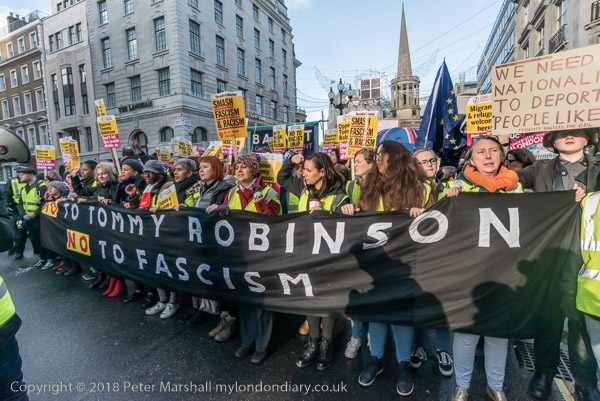
Two groups had planned events in opposition to a march by supporters of Tommy Robinson, advertised as the ‘Great Brexit Betrayal Protest‘ march in London on Dec 9th. One was Unite Against Fascism & Stand Up to Racism, both largely dominated by Socialist Workers Party members and the second was a broad coalition of anti-fascist groups, including Momentum, Plan C, Feminist Anti-Fascist Assembly, Global Justice Now, Women’s Strike Assembly, Brazilian Women Against Fascism, Women’s March London, Feminist Fightback, Fourth Wave: London Feminist Activists, Sister not Cister UK and many others who had managed to bring a previous fascist march through London to a halt, delaying it for several hours until police managed to re-route it, while UAF/SUTR held a separate small and innefectual static protest in Parliament St.

This group has a much broader representation of women’s and ethnic minorities than  UAF/SUTR, and a wider political base including many from Labour, left wing and anarchist groups, but is largely London-based. Outside of London there are fewer groups opposing racism and fascism and I think UAF and SUTR are groups with broader support than in London, often virtually the only game in town.

UAF and SUTR made a big appeal for unity, to stand up to the fascists together, and the anti-fascists agreed, only to find out that on the day of the march it was more or less a takeover by the other group, who with the aid of the police rather hi-jacked the event. The march to Whitehall took place, and it was a fairly large one, with perhaps roughly three times as many as on the Brexit Betrayal march, but they were stopped from presenting any real opposition to the fascists, and the rally at the end of the march close to Downing St was entirely a UAF/SUTR event, with no speakers from the anti-fascists.

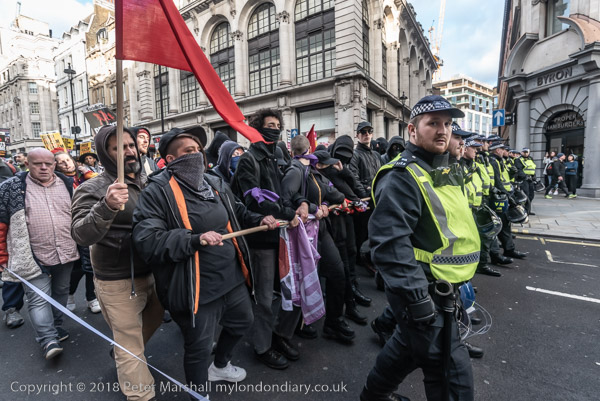
For most of the march, the main banner, held by UAF/SUTR supporters with the message ‘No to Tommy Robinson – No to Facism’ was at the front of the march, carried at the head of a group of supporters carrying Stand Up To Racism and Socialist Worker placards. But when police halted the march briefly on Haymarket as there were a small number of fascist who had come to oppose the march in the area, the a hundred or two anti-fascists came to the front to defend the march,

Somehow with the aid of the police the No to Tommy Robinson – No to Facism’ banner was again at the front of the march as it reached Trafalgar Square, but it was the anti-fascist who left the march to tackle the counter-protesters who had gathered there, while the rest of the march moved on towards its end in Whitehall.

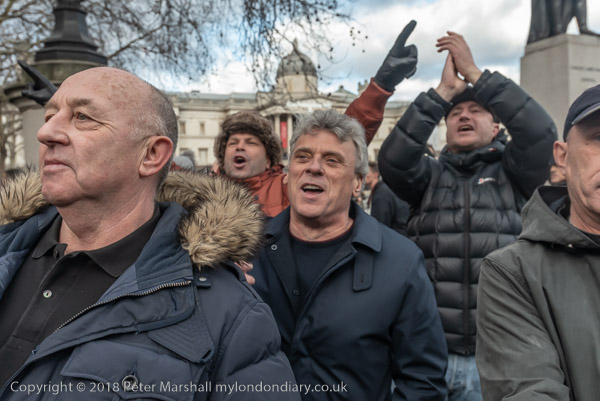
I paused briefly to photograph this small group of extreme-right couter-protesters in Trafalgar Square and was threatened with violence by them if I took their picture, as well as being pushed around a little by police who rather seemed to be on their side. But having taken a few pictures I soon moved off, keen not to miss the start of the rally in Whitehall.

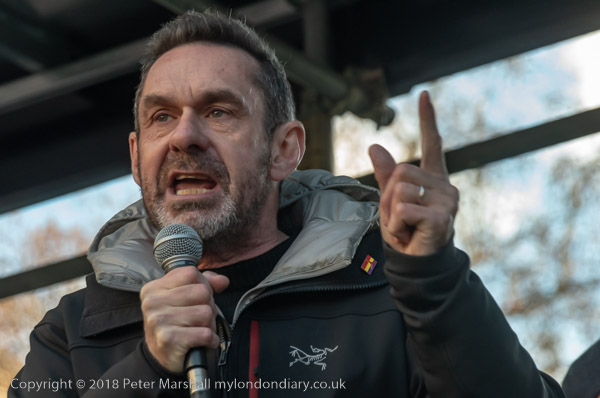
As the rally went on and one I became more and more disappointed. Although there were some good speakers –  including Paul Mason – it became obvious that there was to be no representation at all of any of the many groups in the anti-fascist coalition that probably represented considerably over half of the march, and when a musical interlude was introduced I turned to leave.

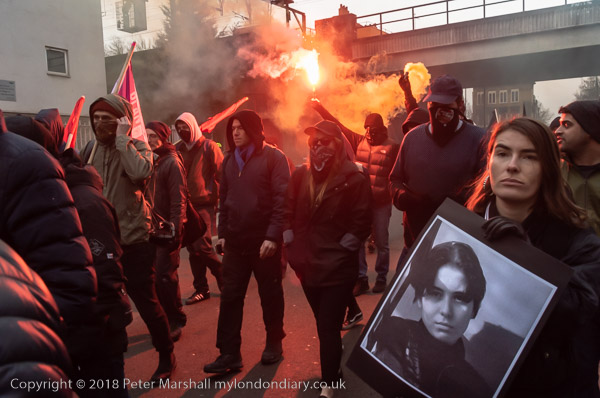
Most of the marchers seemed to have come to a similar conclusion, and there were relatively few people in left Whitehall. It was a cold day and probably many had decided not to stand around listening to speeches – or had soon drifted away, perhaps to one of the many pubs and coffee shops around. But there was still a largish ‘black bloc’ group towards the Trafalgar Square end of Whitehall who had decided to leave together for security and make their way to Charing Cross station to disperse. I walked through a line of police without being stopped, but more police moved in to stop them leaving.  Evventually the officer in charge decided they could go and arranged for police to escort them to Charing Cross, though they were more than capable of making their own way their in safety.

More about the protest and many more pictures at Marchers oppose Tommy Robinson

______________________________________________________
There are no adverts on this site and it receives no sponsorship, and I like to keep it that way. But it does take a considerable amount of my time and thought, and if you enjoy reading it, a small donation – perhaps the cost of a beer – would be appreciated.

My London Diary : London Photos : Hull : River Lea/Lee Valley : London’s Industrial Heritage

All photographs on this and my other sites, unless otherwise stated, are taken by and copyright of Peter Marshall, and are available for reproduction or can be bought as prints.

To order prints or reproduce images

________________________________________________________