October 2013 on My London Diary


Letting Agencies Illegal Colour Bar

I rushed to finish the posts on My London Diary for October before I left for nine days in Germany earlier this month, but then forgot to post this for almost a week after I returned.

October was a rather busy month for me, as you can see, despite having to be away from London for a very long weekend (at five days, closer to a week) earlier in the month. Most of the pictures I took while away in Derbyshire were of friends and family and I won’t post them on My London Diary. There are still a few events in the later half that I’ll probably write about at more length here on >Re:PHOTO.

October 2013


Russia, Free Greenpeace Arctic 30

Protest Against Colombian ‘Vulture of Death
Cleaners Invade John Lewis Oxford Street


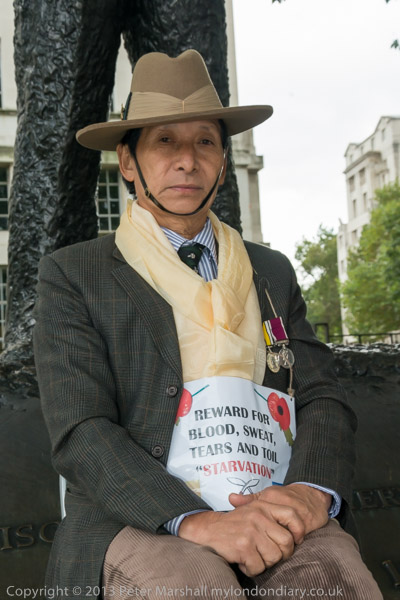
Gurkhas Hunger Strike for Justice
United Families & Friends Remember Killed
3 Cosas Defy London Uni Protest Ban
Southall Black Sisters Protest Racist UKBA
Climate Deniers told ‘Frack Off’
Justice for Cleaners Protest
Fossil-Free London Lobby Tour


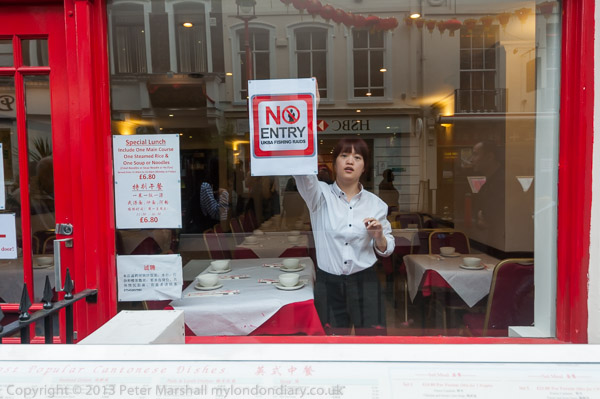
Chinatown Says ‘No Entry UKBA’
Movement Against Xenophobia


Vigil at Work Assessments Appeal
Make Caste Discrimination Illegal Now


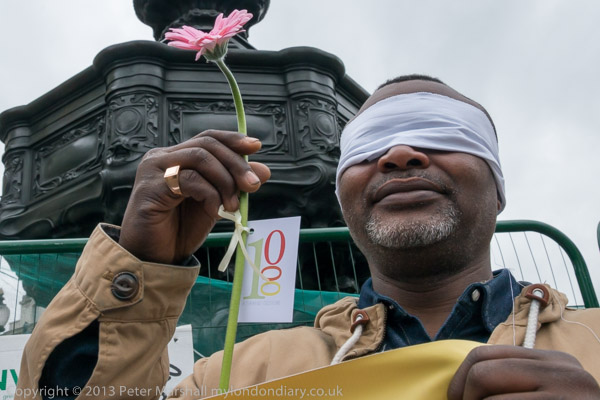
Don’t Be Blind to DR Congo Murders
Global Frackdown: Lord Browne resign!


Stop Shipping Tear Gas to Bahrain
Anti-Slavery Day Sinai Torture Protest
Teachers March against Government Plans
Letting Agencies Illegal Colour Bar
Vigil for Shaker Aamer
Cannabis Hypocrisy Protest


Gurkha Veterans Demand Justice
Police & Developers Evict Soho Working Girls
Scrap Royal London NHS PFI Debt
Don’t Gag Free Speech


PMOI call for release of 7 Hostages in Iraq
EgyptFor & Against Muslim Brotherhood
Freedom for Ocalan & Kurdistan
Daily Mail You Told All the Lies


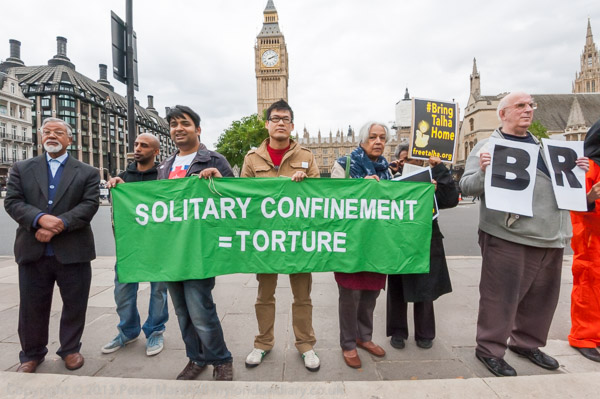
Bring Talha Ahsan Home
UK Uncut Road Block for Legal Aid


Support South African Shack-Dwellers
Cops off Campus- Royal Holloway

As usual in these summaries, the pictures are mainly from protests I’ve not otherwise mentioned here on >Re:PHOTO.

Continue reading October 2013 on My London Diary

Against Xenophobia


Lee Jasper of the Movement Against Xenophobia

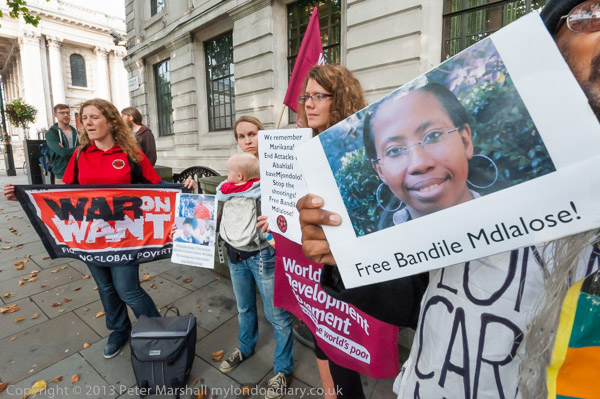
Many of us here in the UK are worried by what seems an increasing tide of prejudice against foreigners. Newspapers making up hate stories about foreigners, biased reporting even by some of the more respectable media, and increasing statements and actions by the government against asylum seekers and immigrants generally. Raids by the UKBA on places where foreigners are thought to be working, picking out people who look foreign for bullying questions about their status, vans in the street encouraging those without the necessary documentation to be here to go home, e-mails suggesting the same sent to many regardless of their immigration status and more.

And now a new Immigration Bill aimed to remove most of the grounds on which people can appeal against deportation, and to get banks, landlords and others to check on immigration status, checks on driving licence applicants and more, including levies on temporary migrants who want to access the NHS.

All this despite report after report that immigrants have a positive effect on the economy, and the obvious (except to racists) invigoration they have brought to so many aspects of our society. London could not run without migrant labour carrying out low paid jobs, many of them without proper immigration status. And no, I refuse that racist term “illegal immigrant” that the government has labelled them with – and the BBC and other media use. People may be here without the documents that allow them to stay here, they may even have committed an immigration offence though that generally remains to be proven, but people are not illegal. They are here perhaps because they could not safely remain in their own countries, but largely because we need them. Need the work they do, and need the taxes and national insurance that they pay.

Labour had a poor record in office, bringing in new restrictions if never managing to deal with what some see as the problem, kowtowing to the racists and the right wing press. The Condem coalition is worse, not least because it has begun to be more efficient in its anti-immigrant measures.

The newly formed Movement Against Xenophobia brings together various groups concerned about this increasing racism and victimisation, and intends to challenge the current anti-immigrant discourse and the attacks on human rights.

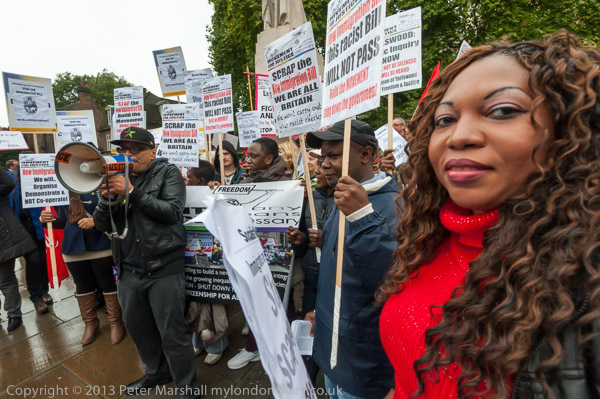
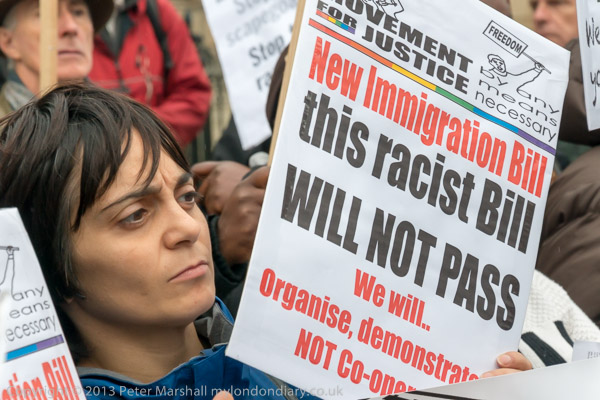
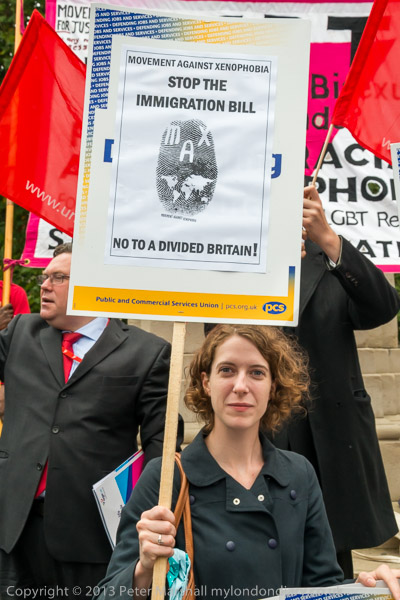
Photographing the event I was keen to bring out what the protest was about in the pictures – and focussing on some of the placards was one way to do this. The protest involved a number of fairly well-known people – trade unionists, MPs and others who I wanted to make sure to include. And then there were those whose features I found particularly interesting – such as a woman with such splendid hair and a bright red jumper (people had been invited to wear red for the event.)

I got close to put her on the edge of the frame, with as many people as possible with placards and a banner in the background. Lee Jasper, the main organiser of the event and a well-known Black campaigner is speaking in what was perhaps the best overall view I made of the event.


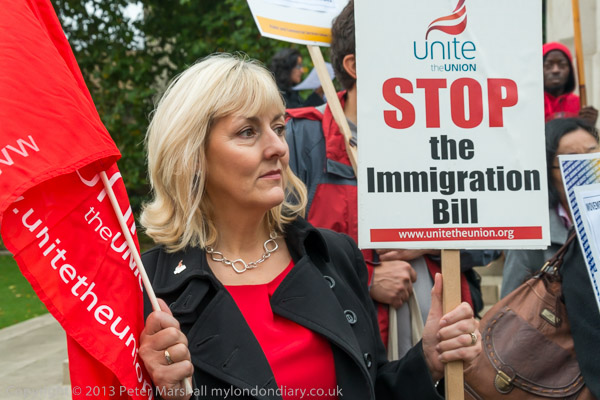
Unite political director Jenny Formby

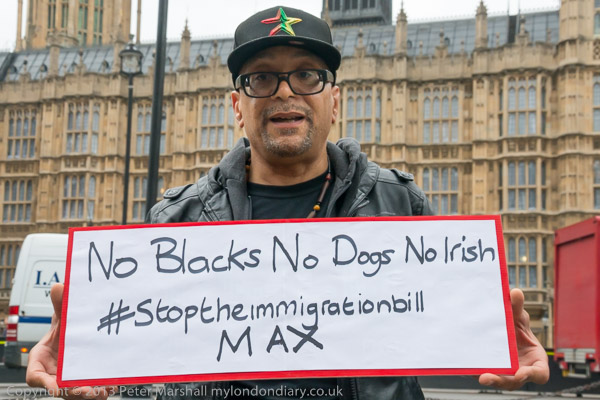
I took some better pictures of Lee himself, including several with the poster ‘No Blacks No Dogs No Irish’ he had brought to the event, and it also comes in some other pictures. Among the others I made sure to get decent pictures of were Unite political director Jenny Formby, Habib Rahman, Chief Executive of the Joint Council for the Welfare of Immigrants and Jeremy Corbyn, MP.

As well as the main banner from the ‘Movement for Justice’ I also took pictures showing the other banners present clearly – including those of Southall Black Sisters and the LGBT banner for the Movement for Justice. I also tried to cover the whole range of placards, including those from Unite, PCS, Socialist worker and Movement for Justice (who had prepared a number of variations.) I try to make sure that at least in some images the whole message on the placard is legible, though often cropping tightly to avoid a whole series of simple ‘person holding placard’ pictures.


A person holding a placard, but the lively background adds interest

More pictures and text at Movement Against Xenophobia.
Continue reading Against Xenophobia

Ed van der Elsken

Perhaps one of the best introductions to Ed van der Elsken’s work was by Sean O’Hagan in The Guardian when his classic Love on the Left Bank, first published in 1956, was published in a facsimile edition by Dewi Lewis in 2011.   As O’Hagan makes clear, despite the raw documentary look and feel (‘grainy, monochrome cinéma vérité’), the book is a fictional work, a ‘photo-novel’. In another well-turned phrase, O’Hagan calls it ‘one of the first visual narratives that walks the line between fly-on-the-wall reportage and created narrative.’

The Dewi Lewis edition seems still to be available according to the publisher’s web site, though you can buy it more cheaply secondhand (or, should you be so inclined, pay several times the cover price – as always it pays to search around a little.) Van der Elsken, (1925-90), sometimes called the ‘enfant terrible’ of Dutch photography, was a prolific maker of books, as the list on his web site reveals. It’s in part a strange web site, with an off-putting selection of small images under the link to pictures, which finally leads the persistent to an index page for more of his work. The images this leads to are of more interest, although poor scans – it looks like a site from the early days a few years after his death when getting any image on the web was a  novelty.

You can see his work from ‘Love on the Left Bank’ better on Lensculture, and there is a more varied selection about him on AmericanSuburbX. I’ve not seen all of his books, but Jazz (1988) has been republished several times and is available reasonably second-hand and there is an Errata Editions ‘Book on Book’ of his Sweet Life (1966) also at a reasonable price, though the original book costs around ten times as much. I wasn’t quite taken enough with his Hong Kong when Dewi Lewis published it in 1997 to buy it, and it now also seems expensive.


Space Hijackers £100,000 Police Payout

I was pleased to see in the Mirror newspaper that the Space Hijackers, who I described in 2009 on one of the many times I’ve photographed them as “a group who call themselves ‘Anarchitects’ whose various projects over the last ten years given a new creative face to protest” have got a payout from the Met Police over their arrest at the G20 protests in April 2009.

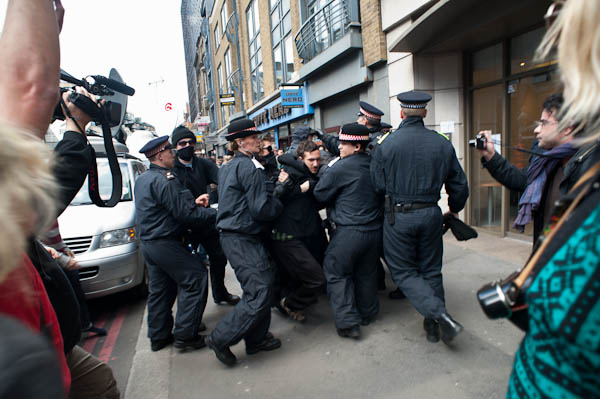
It’s perhaps a little unfair on the Met, as it was the City of London Police who actually arrested them on clearly spurious grounds for ‘impersonating police officers‘, but the Met were in charge, and presumably pressed the Crown Prosecution Service  to proceed with the ridiculous case against them. It was almost certainly simply as an attempt to deflect criticism away from the police handling of the event, which they had spent days in the media talking up into a riot, and where they then engaged in riot against the protesters. Unfortunately for their plans, one of those who got caught up in the police riot, a newspaper seller on his way home, was killed by a police officer. Even more unfortunately for them, the unprovoked attack was caught on video, and a few days later the story of Ian Tomlinson hit the news headlines.

I didn’t do a great job at the G20 protests, though I started reasonably photographing the street theatre and carnival in Meltdown – Financial Fools Day, and managed (with some difficulty) to be on the spot for the start of the Climate Camp in the City, I left the area early to cover a protest march in the West End, managing to evade the police containment by walking out as they moved in force to deal with the protesters.

Other photographers who were trapped inside the huge police cordon around the area (it was one of those days when police just laughed at press cards) got some rather better pictures – and some colleagues had arms broken or lost teeth when police attacked them.  Finally the press did manage to get out through the police lines – and when most had gone, the police stormed the peaceful Climate Camp in Bishopsgate, batoning down protesters who stood facing them simply raising their hands and chanting “This is not a riot!”. The protesters were wrong, it was a riot, but a riot by the police. Later it got worse still.

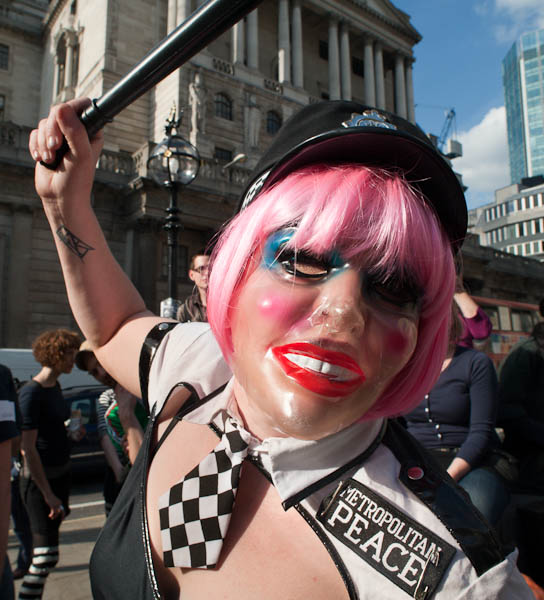
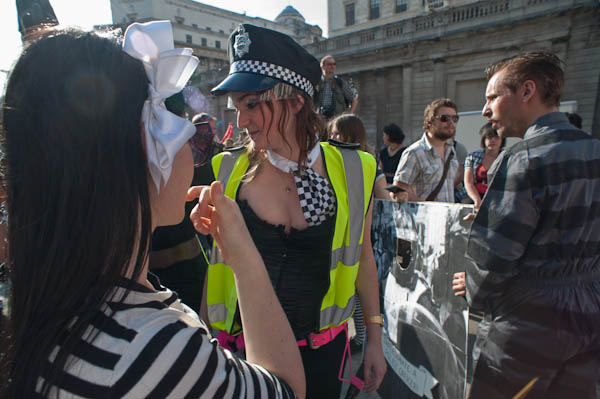
Police had arrested the Space Hijackers on their way to join the Climate Camp protest, so I didn’t manage to photograph them in their ‘police uniforms’ there, though I got that opportunity a few weeks later in May 2009, when they organised ‘Guilty‘, a party at Bank, the centre of the G20 protests, inviting people to come dressed either as guilty criminals or as police, and for the guilty to give themselves in.

The Space Hijackers have also been very generous in giving support to the police during the two protest marches by police in London, on each occasion setting up a stall on the route providing free advice on how to protest and suggesting suitable slogans and placards. So it’s good to see them getting a little payment from the Met.

As well as being motivated by police politics, the CPS decision to prosecute was also clearly a political one on wider grounds. It is impossible to avoid the conclusion that they were prosecuted because they were anti-capitalist protesters. Others get away with similar or much more serious breaches of impersonation all the time.

If the Space Hijackers were guilty of impersonating police officers, then every tourist who comes to London and buys a plastic police helmet should be charged too.


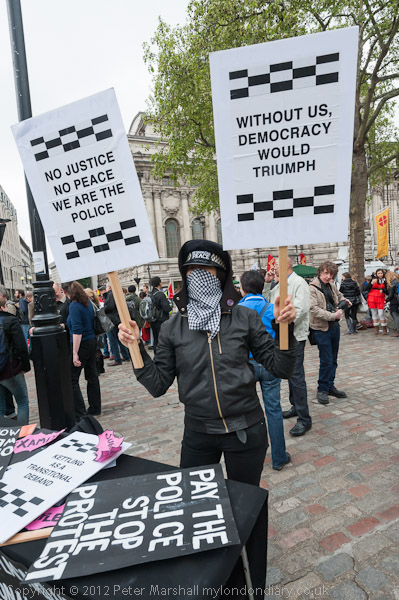
No, those aren’t police on the left, though they look awfully like them, and are meant to deceive you.

Of course there are others on the streets of London every day who do impersonate police officers, but if you are a large commercial organisation (and probably giving big handouts to the Tory Party or jobs to former cabinet ministers etc, along with the odd brown envelope here and there) they don’t bother you.

Some council employees too, for example in Newham, wear uniforms that seem more like police than many of the police – and giving them titles such as ‘Law Enforcement officers’ surely are designed to confuse the public into thinking they are police. Its perhaps time the Met took a serious look at some of those who are clearly ‘impersonating police officers’ and threatened them with action under section 90 of the Police Act 1996.

Continue reading Space Hijackers £100,000 Police Payout

Vedanta Foiled

August 1st seems a very long time ago now, but aspects of it came back to me as I struggled to correct the images in Lightroom today. Since then I’ve had two very busy holidays with groups of friends, the first in Edinburgh for the festival, and the second in Yorkshire, just for the heck of it. Away from London I missed a lot of what was going on, though I did arrive back just in time to cover Saturday’s large protest against US intervention in Syria, and I’ve been quite busy since then.
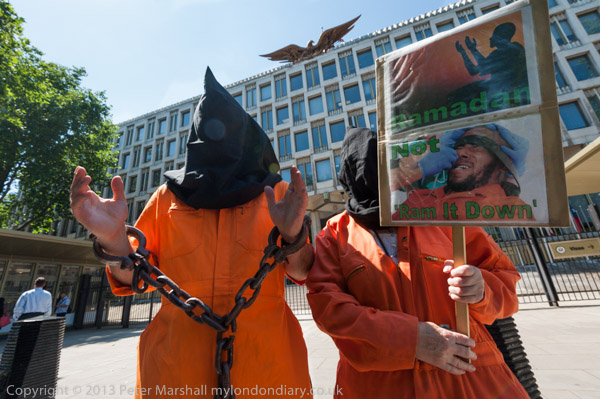
But back a month, and on the first day of August I had a couple of events to photograph. The first was the regular monthly Shut Down Guantanamo protest at the US Embassy, calling for the closure of the prison camp nd the return to the UK of the remaining Londoner still being held and still being tortured there, despite having been cleared for release in 2007 as there was no case against him. Shaker Aamer, like many of the others there, has now been on hunger strike for 6 months, kept in solitary confinement and being force-fed, suffering beatings from the guards whenever he makes any request. It truly is unbelievable that a country which professes to be on the side of freedom can set up anything like Guantanamo and keep it running when the truth about it is known around the world, something every American should be up in arms about, protesting against their government’s shameful actions.

I’ve photographed so many protests at the US Embassy and elsewhere calling for its closure that photographically it is hard to say anything new, and I didn’t feel I managed it on this occasion. But it is important to try, for the protesters to keep up their protest and for it to be recorded and publicised. They aren’t great pictures, but one of them made at least one major paper.
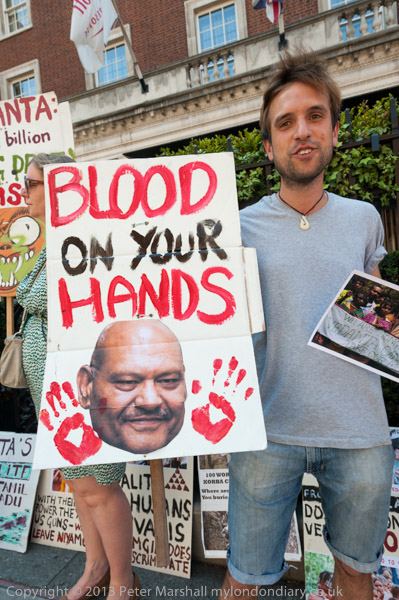
From that protest I moved on to the corner of Grosvenor Square and the London Marriot Hotel, where the mining company Vendanta was holding its AGM. I’d earlier been reading on-line a major Indian newspaper article about a protest in India the previous day in support of the forthcoming London protest. Vedanta’s crimes (or attempted crimes) against the environment hardly make the news here, but are front-page in India and important in the other countries where Vedanta operates.
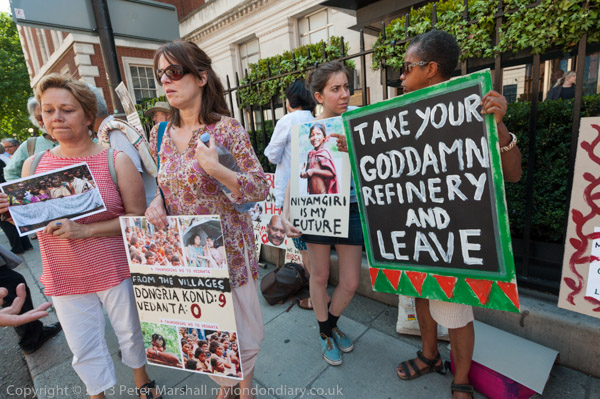

‘Take your goddamn refinery and leave’ was a quote from Arundhati Roy which made the front pages in India

This year the annual protest at the AGM by Foil Vedanta was both a protest and a celebration, as Vedanta’s plans to destroy the Nyamgiri mountain sacred to the Dongria Kondh tribal people in Orissa do appear to have been foiled. The Indian Supreme Court had decided that Vedanta’s proposal had to be supported by the local village councils, and the news on the day of the protest was that the ninth of twelve councils had rejected it. The court is expected to confirm their decision later this year.
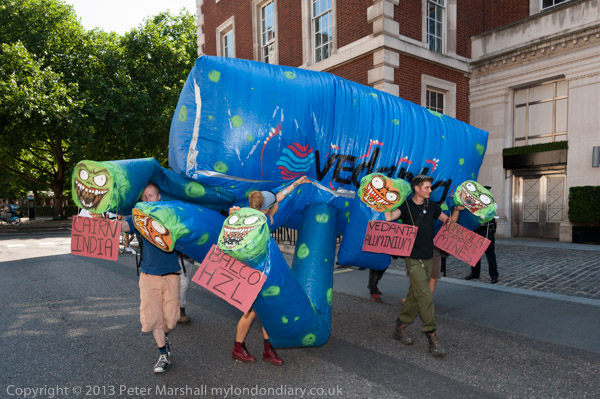

The Vedanta monster arrives to join in the protest

As well as protesting, a number of those opposed to Vedanta’s ecological and human rights crimes have also become shareholders, entitling them to attend the AGM and to raise questions about the companies activities. The revelations about its activities have also led some major shareholders to disinvest.
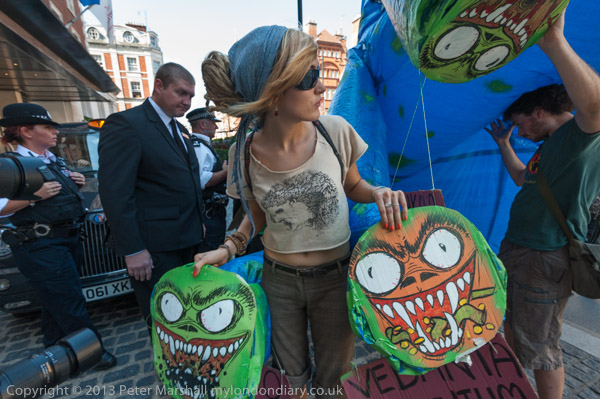

Police and hotel security object as the Vedanta monster invades the hotel forecourt

Photographically there were a couple of problems – bright sun and police. The lighting contrast was extremely high, with a virtually clear blue sky, and often parts of a picture were in full shade and others in bright sun. Of course fiash can help to equalise things when – as in many of these pictures – the shaded areas are closer to the camera. It also helps with the large difference in colour temperature, with the blue sky providing the light in shaded areas and the much warmer sunlight. But working with two cameras, the D700 and D800E, I have a small problem as I only carry one SB800 flash gun. I can move it from one camera to the other, but often there just isn’t time to do so.

The instruction manual for the flash tells you that you should turn off flash and camera before putting on or removing the flash, but I don’t seem to have had any problems when I forget this precaution, but even so it takes a little time. In a hurry its also rather easy not to quite push the flash fully into place on the shoe – when it usually doesn’t work properly, but can sometimes still fire – and to forget to lock it in place. Though it is still held fairly firmly, when you are moving around and being fairly active the flash can then fall off, often with rather expensive consequences.  Experience tells me that they don’t bounce well on concrete.

Auto white balance also has problems in mixed lighting, which is hardly surprising. Shooting on raw this isn’t a great problem, but does mean a little more fiddling in Lightroom. Sometimes to get the best results I also have to make use of the colour temperature correction possible with the adjustment brush in Lightroom, as will as using it to lighten the dark areas (and often increasing their contrast as well) and darkening the light parts.

Police have a balancing act in situations like this, wanting to allow people to go about there normal business as well as allowing legal protest. It’s often difficult and sometimes I think they get it a little wrong, as at times they did here. They also sometimes have some odd ideas about there own operational needs, and don’t always understand the needs of photographers.

There was a rather narrow pavement with a line of protesters along it, and the police keeping the pavement clear, but also objecting when I stood in the gutter of the road to take pictures. It wasn’t a busy road, and it would have made sense to cone half of it off to allow the protest and photography to take place rather than being obsessed over traffic flow.

________________________________________________________

My London Diary : Buildings of London : River Lea/Lee Valley : London’s Industrial Heritage

All photographs on this and my other sites, unless otherwise stated are by Peter Marshall and are available for reproduction or can be bought as prints.

To order prints or reproduce images

________________________________________________________
CMYK Struggles

I’ve spent the day battling with CMYK. It’s happened before and I’ve seldom managed to get things to work properly, despite reading all the documents, following the setting up of color preferences and all the rest.

I’m finishing off my latest Blurb publication, ‘The Deserted Royals’, which definitely has no connection at all with the Windsor family and their offspring, but about the Royal Docks, which when I photographed them in 1984 were more or less a ghost town. More details – including how to order – shortly.

Before I’ve always printed using sRGB image files – which are still the only option if you use Blurb’s free Booksmart software. But now I work with Adobe’s InDesign, and Blurb say you can get better results, particularly in the shadows, with CMYK files. Although I’ve been happy with the quality of my previous books, the black and white images were at times just a little too far from neutral for my taste, usually with a slighly green or cyan tone, with variations on different print runs. I’d like them to be neutral (or perhaps even a very slightly warm neutral) and more consistent, and I’m told CMYK is the answer to that problem also. Though it might make sense to send the files as slightly warm in the first place in case they drift a little. As we found long ago with inkjet printing, black and white is much more sensitive to these things than colour. There were of course even worse problems with printing black and white chromogenic films like Ilford XP1 and XP2 on colour paper, which few processors really managed to solve consistently, though in the darkroom the solution was simple – print them on black and white paper.

Blurb have some clear instructions on how to set up a Blurb color-managed workflow and print good black and white books (and different instructions online if you use Booksmart), with a video showing even the slowest in town how to set things up in InDesign. There are instructions too on how to prepare your files in Photoshop, converting from a neutral or toned RGB file to a suitable CYMK file, and there is a great Blurb book by Franz Huempfnerwith 33 proofs of pure or toned black and white images with the Blurb ICC Profile and some other CMYK Profiles” available to view in full as a preview on Blurb. It gives full instructions on how to do it and links to some useful presets and actions for Lightroom and Photoshop.

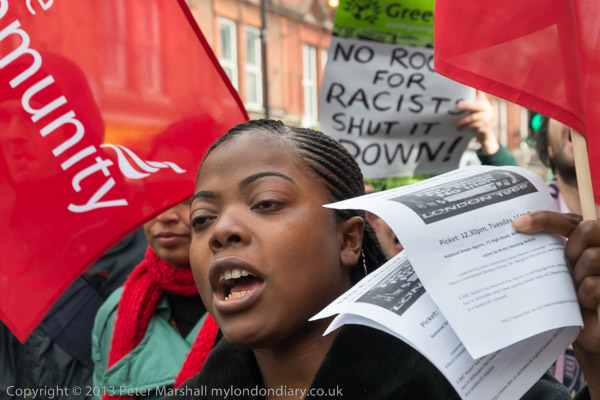
So I try it out. I start with an sRGB file, absolutely neutral having been converted in Lightroom from the original grayscale TIFF scan. Wandering across it in Photshop with the eye-dropper confirms R=G=B at ever point.  Converting it to CMYK using the Blurb ICC profile but saving and updating the image in InDesign gave a flatter image with a slight cyan cast. I got even worse results using a custom ICC profile suggested by Huempfner and others, or some of the presets he gave a link to. I played around with it a bit, checking and double-checking I’d done everything correctly, including updating the files in InDesign.

Eventually I gave up, and started writing about my problems. I decided I needed an illustration, so tried again exactly what I’d been doing earlier. No changes, following exactly the same directions. And it seems to have worked.  Of course I’ll only know if it does give a more neutral result when I get the printed book back from Blurb in a couple of weeks.

It’s in a way possibly not that important. I’ve decided to go over to publishing in digital format in any case, assigning the ISBN for this ‘book’ to the PDF file. Two reasons, cost and quality. I can sell the PDF through Blurb at a sensible price and there are no expensive delivery costs – and I could also produce my own PDFs. Secondly, the quality of the images on a good screen is better than any printer can produce. Of course books do still have some advantages, and I’ll certainly want my own printed copy for the bookshelf. And as Huempfner points out, Wilhelm Reseach gives the HP Indigo inks used by Blurb’s printers have a dark storage life over 200 years without noticeable  fading or colour balance.

I’m still not happy about CMYK conversions, and haven’t found any of the various methods suggested by Huempfner or the presets and actions he links to give results I like the look of. Using the Blurb ICC profile without any toning is the only way I’ve managed to get results I like. Although some of the tonings look great in his book, when I tried them on my own images they seemed not to give quite the same results, mainly altering the image tone too radically for my taste.

Syrians on the March

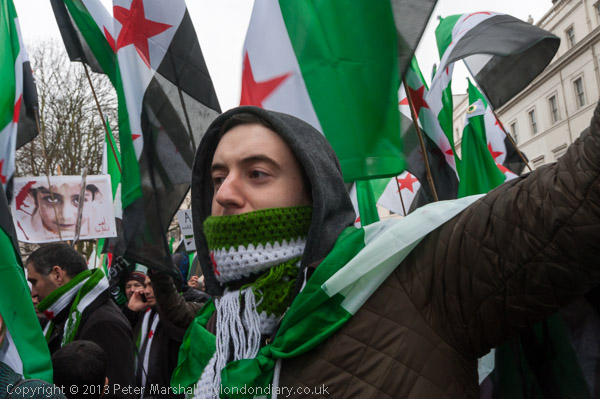
Syrians gathered in Belgrave Square for a noisy protest across the road from the Syrian Embassy for a march to Downing St on the second anniversary of the start of the uprising there, a fight against the Assad regime that gets bloodier and bloodier. In my report Syria – Two Years Fight for Freedom on My London Diary I quote some figures about the numbers killed by the brutal regime which “has so far killed over 70,000 people, injured 320,000, imprisoned 160,000, and caused several million to become refugees inside and outside of Syria.”  Syrians feel let down by the international community, which has largely stood back and watched this happen without managing to take any effective action – as I mention, one of the posters “included the question ‘Hey World, How Many Kids Should Be Killed Before You Do Something?'”

The Syrians were protesting in a fairly dense crowd inside a large pen, but unlike some events it was easy to move through and to get to the centre where things were happening. The people want publicity for their cause and a keen for the press to get good pictures, and with a few quiet words and gestures made way for me to move past. Almost everyone – men, women and children – was happy to be photographed, and very friendly. This, unlike some, was a crowd where I felt welcome.

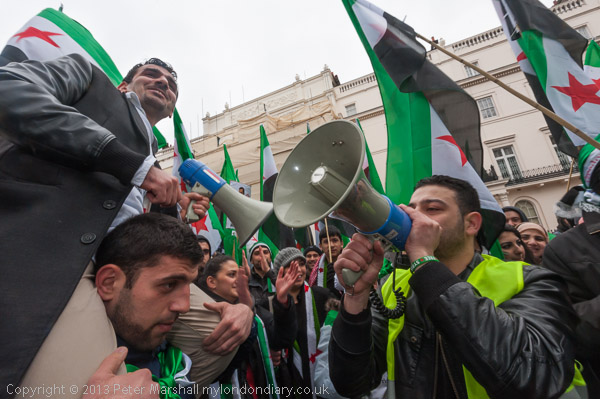
Visually, the many Free Syrian flags often provided some drama – and it is a better flag to photograph than some with its black white and green bands and red stars, whether waved, worn or painted on faces.

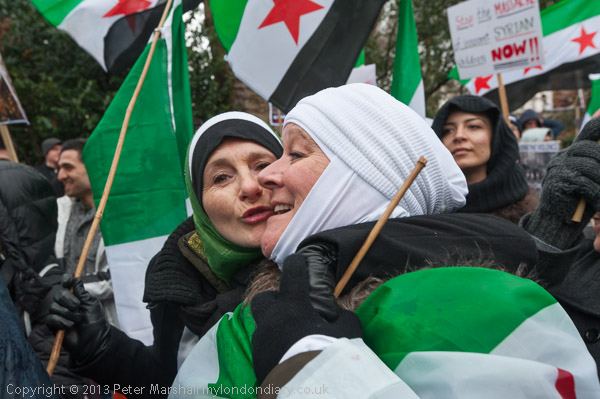
The woman on the left in this image saw me taking photographs of hef friend and ruashed forwards to kiss her – this was the second or third frame as she turned round and smiled at me. I showed them the picture and they laughed. Most of the time I was working with the 16-35mm, and there was little room not to be very much in people’s faces, and that big lens (considerably larger than the 18-105mm DX) with its 77mm filter and large lens hood can be rather intimidating, but not I think with this crowd.

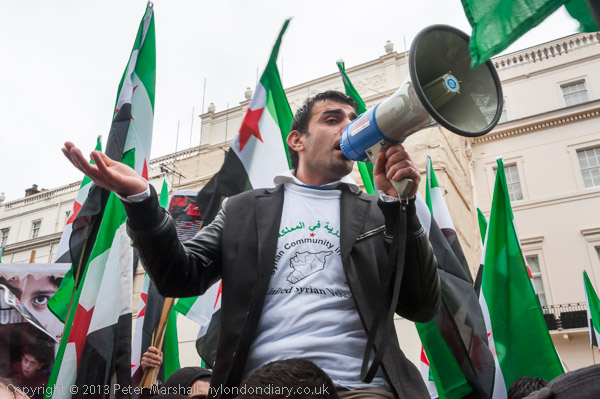
Most of the time I was too close to some of the people for flash to be an option, but although the light was fairly even overall – a dull overcast day with still the occasional spot of rain – I needed it for some of the pictures, for example where the face of this man was in shadow against a bright background.

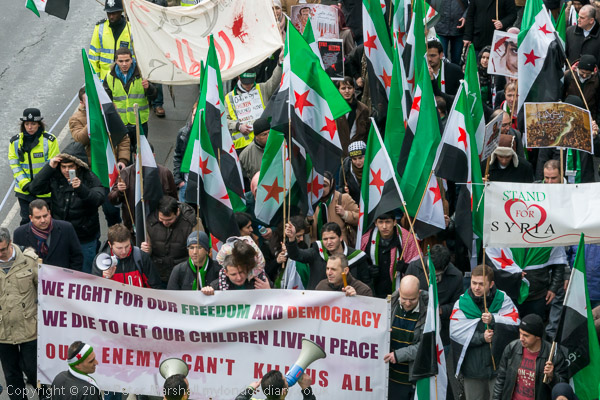
I continued to take pictures for the first quarter mile of so of the march, and left it as the tail end disappeared below my feet into the Hyde Park underpass. Standing above as the march approached I wished I had put the 70-300mm into my camera bag that morning, although I’m not sure I would have made many good pictures.

Views from a height are seldom as interesting as I hope they will be, although probably the main reason I take few now is that climbing up on street furniture and walls is rather a strain for me now, and unless – as in this case – I’m on really solid ground I tend to lose balance and start shaking.

But a longer lens would have got a more compressed view when the march was approaching that would have been full of those flags. Here I used the lens at 66mm (99mm equiv) to take in more or less the whole width of the march, framing to get the banner at the bottom, at right and at top left to the edgies of the image. I rather like that the large banner is part obscured by the three men – two with megaphones – in front. It’s message is still clear and it’s sometimes good to leave a little for the viewer to do. One thing that didn’t quite work for me was that the young girl on her father’s shoulders at the centre of the banner has her held held firmly down – I would have liked her to be looking up at the camera.

  Continue reading Syrians on the March

Million Women

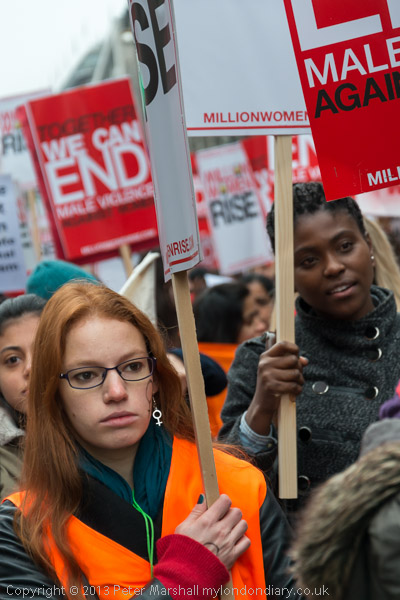
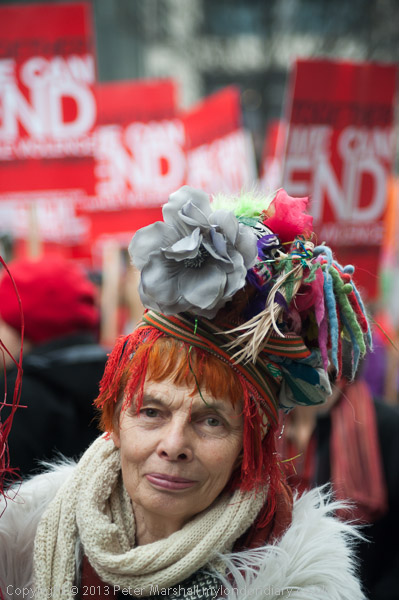
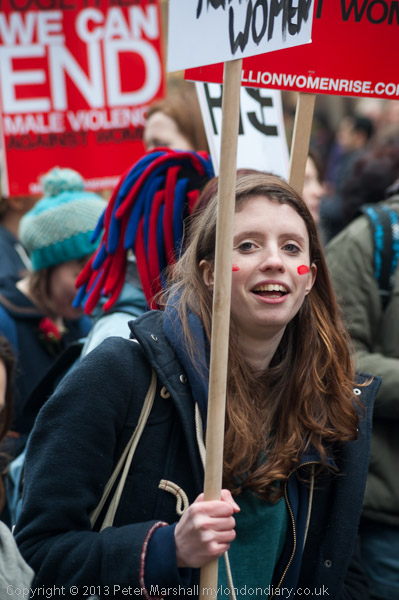
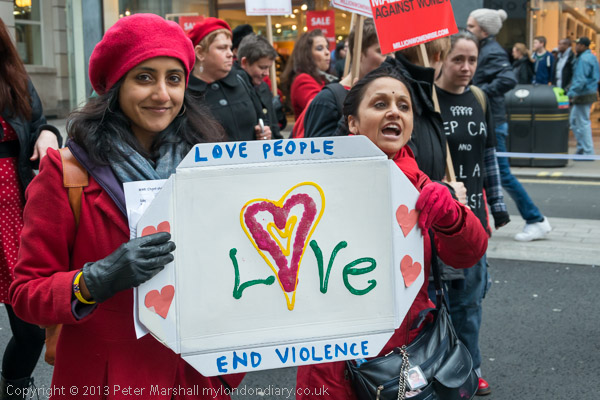
Violence against women is something most men as well as women are against, but it keeps on happening, most but not all of it by men, whether domestic violence or war or otherwise. The annual Million Women Rise event around the world helps to raise the profile of the fight against it, and I’m happy to photograph it, although being an all-woman protest it does raise some problems.

Most of the women taking part are pleased to be photographed, knowning that pictures such as mine help to gain the event and the cause some publicity, but in past years I’ve occasionally been verbally abused by a small minority of those taking part, and march stewards have occasionally objected to me even standing on the edge of the pavement to take pictures of the march. This year I had no such problems.

But many on the march see it not just as a women-only march, but the march as a women-only space, and I work in a way that respects this view, although it very much limits how I can cover the event – and the quality of that coverage. So while at most marches I work almost entirely with wide-angle lenses, getting close to the marchers, here I feel bound to behave differently, and for much of the march was working with the 70-300mm in place of my 16-35mm.

The AF Nikkor 70-300mm 1:4-5.6D Nikon ED lens (Nikon really know how to give things snappy names) is one of their cheaper offerings, though I bought mine secondhand from a friend, so it was cheaper still. Nikon now offer a similarly specified 70-300mm f/4.5-5.6G VR lens that costs rather more and weighs almost half as much again, supposedly focuses faster – and of course has vibration reduction.

Supposedly the lens I have isn’t quite optically up to the standard of the newer lens – or Nikon’s larger and heavier pro offerings, but I think you would be hard put to see the difference once it is stopped down one or two stops. It seems excellent up to 200mm or a little above and not bad above that, and when used as a DX lens on the D800, hard to fault.

Being a relatively light, fairly small lens (at least in full-frame digital terms) makes it good for carrying in the bag and for handheld use. With the kind of things I photograph, the lack of VR is seldom an issue – you need a fast shutter speed because the subject is moving. And although I’ve heard people complain about focus speed and hunting, on the D700 or D800 body it seems to work rapidly enough.

You can see more pictures, some taken with the 70-300mm and others with the 28-105, and even a few with the 16-35 in Million Women Rise on My London Diary. Among them are a few that I had some issues with the language involved and didn’t put on the wire because the images contain the ‘c’ word. I don’t have any problems with women who want to reclaim the word, but it might offend some.

________________________________________________________

My London Diary : Buildings of London : River Lea/Lee Valley : London’s Industrial Heritage

All photographs on this and my other sites, unless otherwise stated are by Peter Marshall and are available for reproduction or can be bought as prints.

To order prints or reproduce images

________________________________________________________
Feb 2013 Summary

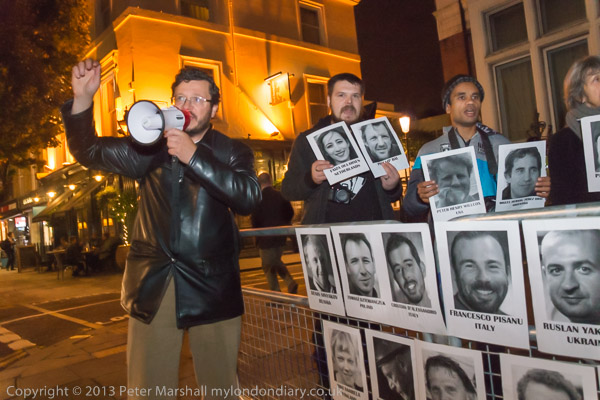
As usual, here’s a summary of my posts on My London Diary for last month, with some pictures from some events I’ve not written about here:

Hillingdon Marches Against Cuts
Vulture Funds – Claws off Argentina!
Reclaim Love Valentines Party
Fuel Poverty Rally & DAN Roadblock
Defend the Union Flag
Alevi Protest Discrimination in Turkey & UK

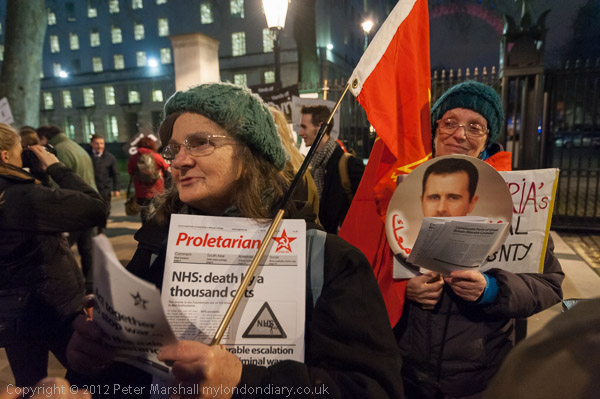
Supporters of President Asad from the CPGB(ML)

Stop Western Intervention in Syria & Mali
Thames Path Greenwich Partly Open
Fight to Save Lewisham Hospital Continues
Ash Wednesday – Ministry of Defence

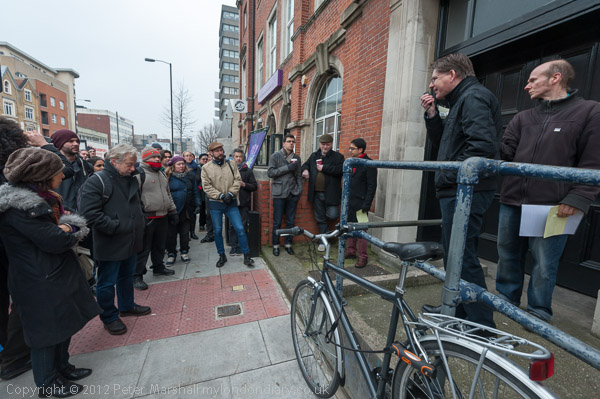
Meeting outside London Met protests at discrimination against staff

Victimisation at London Met
and the good news is that the staff have now been re-instated.

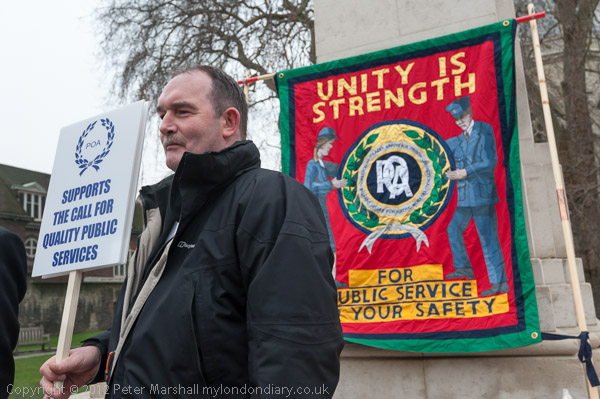
Prison officer with placard and Union banner at Old Palace Yard

Prison Officers Protest Against Cuts
Shaker Aamer – 11 Years in Guantanamo
Great Spitalfields Pancake Race
Poulters Pancake Race
Friern Barnet Library Victory Celebration

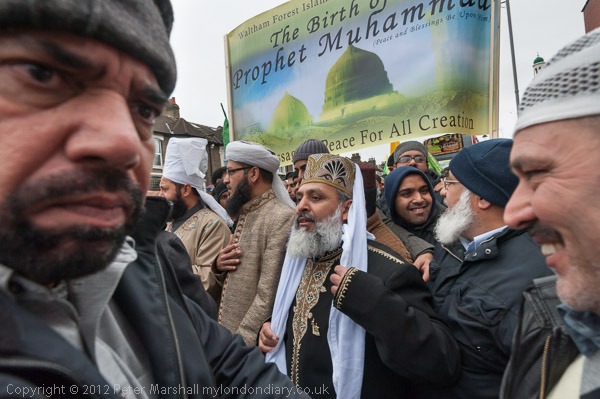
The start of the procession in Leyton

Waltham Forest Milad-Un-Nabi Procession
Cleaners Protest at Barbican
Save Chase Farm Hospital

Continue reading Feb 2013 Summary

Lensculture March 2013

I’m always pleased to get news from Jim Casper of a new edition of Lensculture, though I’ve not yet had time to look through all the material on it.  Of what I’ve seen so far, the highlight is a set of work from Michell Sank,  In My Skin, work from her project about “young people under 25 in the UK who are challenging their body image “, though I find it hard to understand why some of those she has photographed have any problems with what seem to me perfectly adequate  forms.  I’ve managed to live with all my own imperfections for a very long time without getting too worried.

I’ve also enjoyed looking at Gloriann Liu’s essay on Long Term Refugee Camps in Lebanon and several other pieces on the site, though as always Lens Culture covers a wide range of photographic practice, including a few things that do nothing for me. But there is plenty that does.