Syria Again

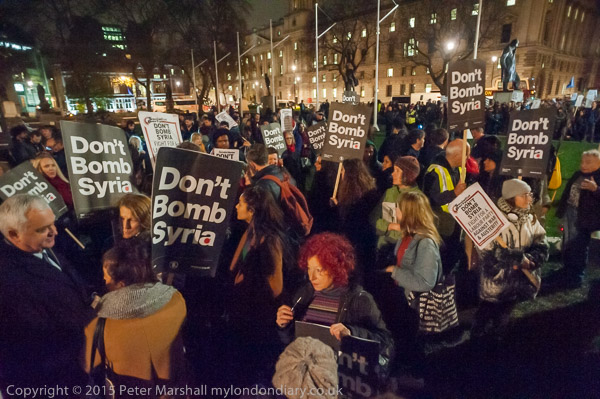
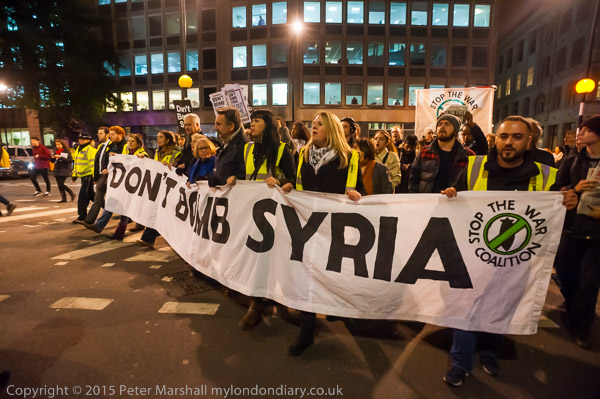
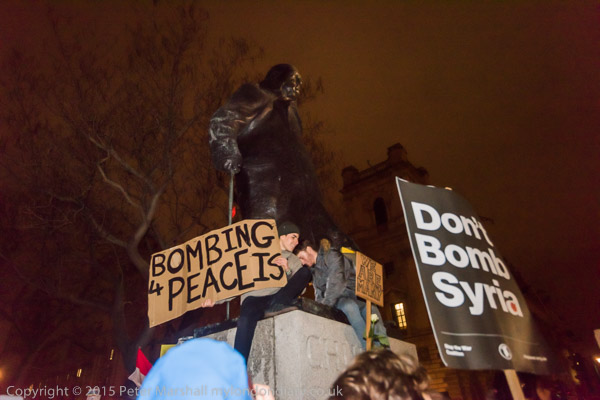
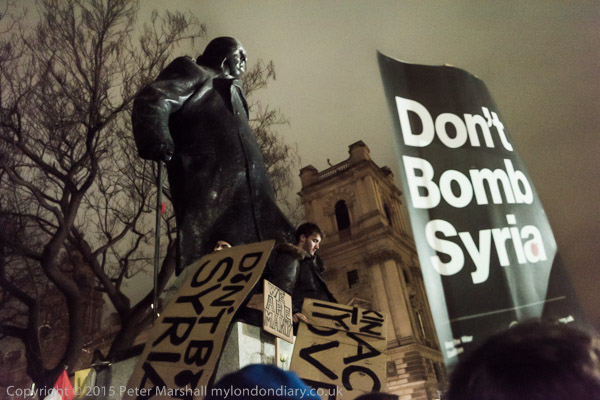
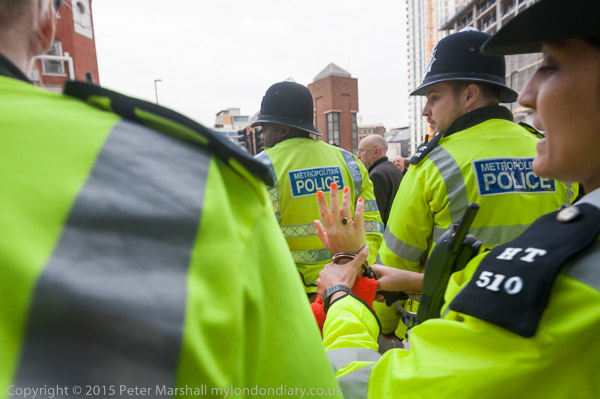
Stop the War organised another protest against David Cameron’s motion to allow bombing of Syria on a weekday evening, with a rally opposite Parliament and a short march around Westminster via the Conservative and Labour Party HQs.  Like their previous protest, what struck me was the absence of views from Syrians, although there were some supporters of both the Assad regime and the Free Syrians at the rally.It was also noticeable that there was no condemnation of the Russian bombing of the Syrian opposition as well as Daesh.

Of course I wasn’t the only person to notice this and to comment on it, and Stop the War were forced into issuing  ‘For the avoidance of doubt‘ by John Rees, which makes seven points, the first of which begins “The STWC has never supported the Assad regime.” As I commented:

Well, it’s good to make that clear, because there have been many protests by Stop the War which Assad supporters have attended and appeared to be welcome, and by refusing to let Syrians opposed to the regime speak at this and other protests STW have certainly given that impression.

Photographically it was a night where I had a lot of problems. For a central London location, Parliament Square is remarkably dark, and working without flash was perhaps a little beyond the capabilities of the D700 and D810, though I did manage a few images. Things were a little better on the march, which at times went through some fairly well let junctions.

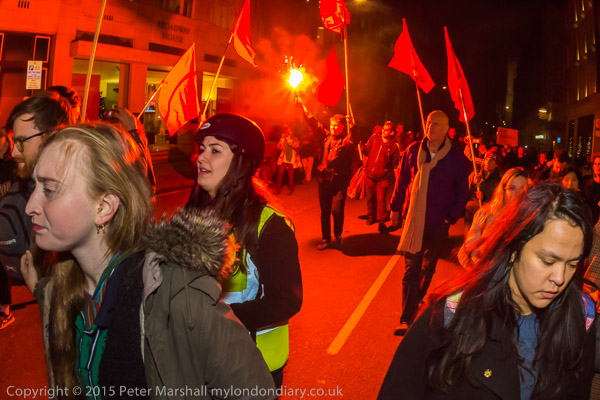
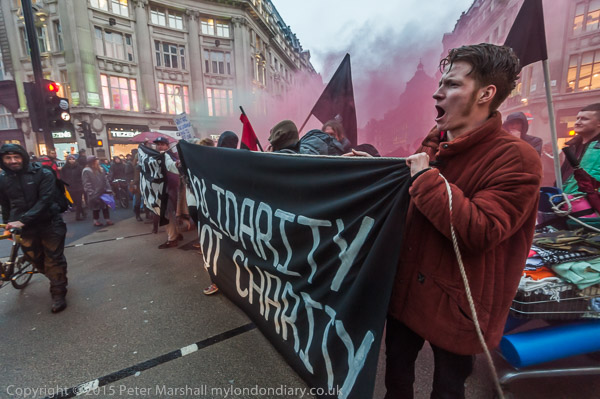
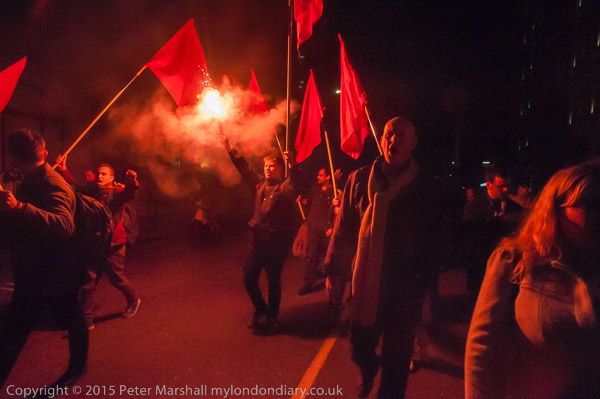
But perhaps the most challenging situation was when a large group of red-flag carrying protesters let off red flares. The image at the top of this post was taken without flash and an exposure which held the highlights, but they were really too extreme, and I needed to let these burn out.

Increasing the exposure showed up at least some of the background, and using a little flash let me bring people in the foreground up from the shadows. But I still don’t really have a solution for situations like this.

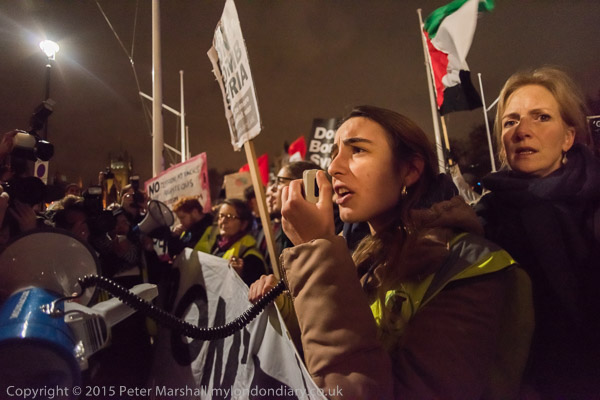
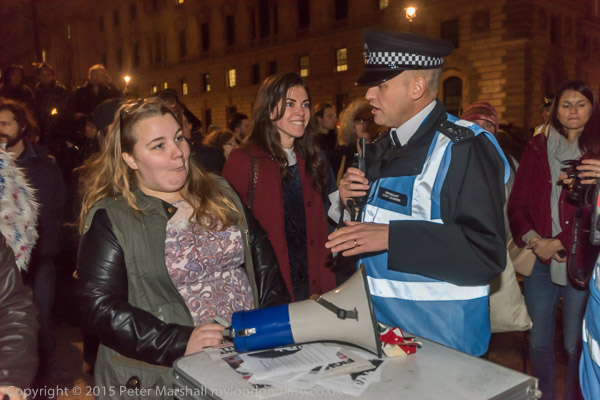
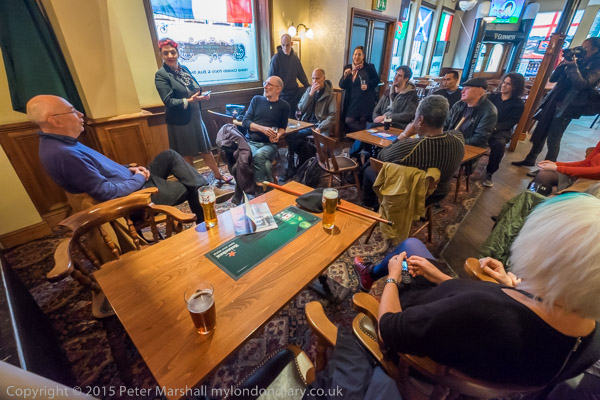
After the march there was another short rally, with rather a crush of photographers. I took a number of pictures working very close in to those speaking with the 16mm fisheye – including that above. With the wide view of that lens, flash isn’t generally an option – unless you are aiming for powerful vignetting – and I was working by available light, in this case augmented by someone’s video light. As usual changed to cylindrical perspective.

After the end of the official protest there were still hundreds of people milling around in Parliament Square and wondering how to continue their protest. But I was having a very bad case of wandering finger, somehow managing to shift the shutter speed on the D810 to ridiculous levels – it had reached ISO2500 before I finally noticed it. It’s quite remarkable that the flash continues to synchronise at these speeds, but most of the results were not usable. I knew things were going wrong, but in the dark and heat of the moment couldn’t immediately sort things out. So I went back to working without flash and changed to 1/50th second, but it was a little late, as police were approaching and people climbing down from the plinth.

ISOs really become pretty irrelevant under these conditions. This image was taken with the camera set at ISO2000 but with -4 stops of exposure compensation.  Which I suppose you could call ISO 32000.

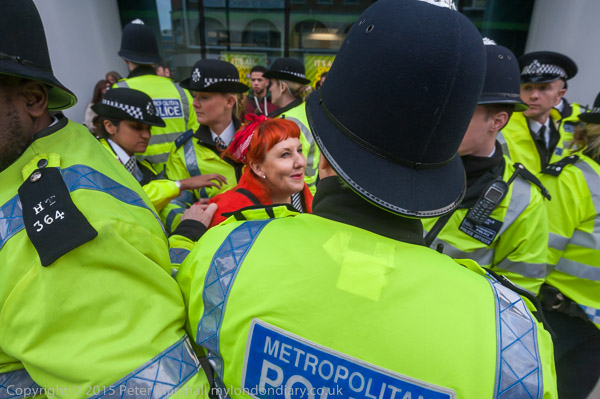
Within seconds I had the flash and camera working together again, and was able to photograph the police questioning one man who had been on the plinth and then telling Focus E15 that they were not allowed to use a megaphone in Parliament Square. They were deciding what to do, but I’d had enough and decided it was unlikely much more would happen and went home.

More at Don’t Bomb Syria.
Continue reading Syria Again

Epson Scans

Today I’d doing some serous scanning despite it being a lovely day to go out and perhaps take some pictures. But I’ve a busy few days over the weekend and don’t want to get tired before this. I’m trying hard to finish a whole month of black and white work – July 1986. The pictures here are just a small sample from those I took that month, all in London.
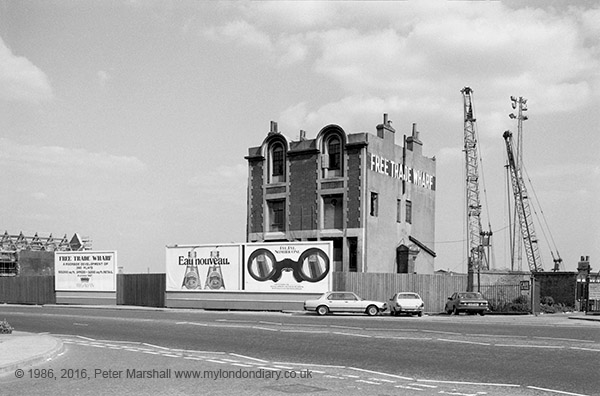

Free Trade Wharf, Limehouse, London. July 1986

But before I started did something I should have done several years ago but always put off – something I’m definitely Grade A* at.

I’m scanning today with the Epson V750 flatbed; it’s much faster than the Minolta Dimage Multiscan Pro, and with care the results are virtually as good. I’ve been having problems with the Minolta – the Firewire interface has become unreliable, working for a few scans then giving up halfway, and it had become very difficult to use. It’s the way most of these scanners eventually fail.

The scanner also has a SCSI interface, but getting the SCSI card I have to work in my current computer might be difficult – though I mean one day to try. But SCSI is really now a thing of the past.

For some time I’ve been photographing negatives instead of scanning them, and I had everything set up using the D800E – and then that decided to internally destruct. Again another thing I mean to try is to get it working sufficiently to use for this, but that’s another job I’m putting off. And although the images were sharp and detailed I also had problems with getting even illumination across the frame.

So I decided to use the Epson V750 flatbed that I have on my desk and have mainly used for making scanned ‘contact sheets’ and as a photocopier, or a quick method of getting web-size images from slides or negatives. It is a capable scanner, and the only real reason for not using it before is that I had other ways of scanning negs that were just marginally superior. I’ve used the V750 both at home and elsewhere to produce scans for books by a couple of other photographers, and they have been very happy with the results.

A new Neg carrier

One of the problems that I think Epson themselves acknowledge is that the 35mm filmstrip negative holder just isn’t quite up to the job. They’ve never I think said so, but when they came out with the V800 it had a new holder. Unlike that provided with the V700 and V750 it was not glassless but incorporated anti-Newton’s rings glass as well as more flexible height adjustment to ensure correct focus.
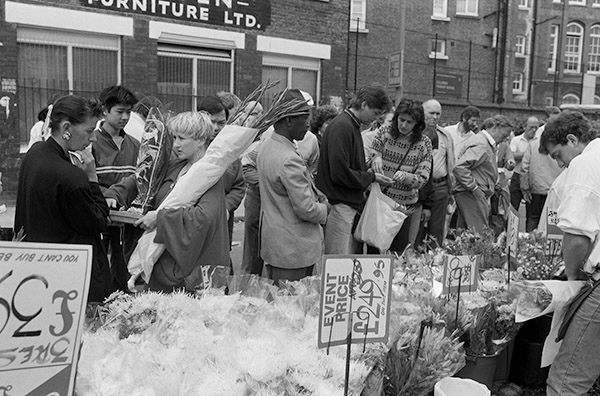

Columbia Market, London. July 1986

Looking at the pictures in the reviews, some of which commented on the improved design, it looked as if it would fit the D750, and I checked this was so before ordering one – rather expensively – from eBay. As well as the A-N glass, it also has better height adjustment than the D700/750 holder. Overall it does seem possible to get flatter negatives and better overall sharpness – though before things were already fairly good

Having the glass does of course make dust more of a problem. But with care and a powerful blower brush, along with the Pro Co Statbrush 2000* conductive brush I used in the darkroom and a lint-free cloth or two it isn’t too bad – and Photoshop sees off much of it very quickly. I seem to get slightly less dust spots than with the Minolta, and so far none of the problems with Newton’s Rings that sometimes plague my Minolta scans. It was an effect I hardly saw in the first year I used the scanner, then told another photographer I hadn’t seen them, after which they became a real problem.

Cleaning under the scanner glass

For several years I’ve been looking at the V750 and seeing smears and dust on the underside of the platen glass; I could clean the top easily, but these remained. The manual didn’t help, and on several occasions I’ve done a quick search on the web and read dire warnings from various people and decided perhaps it didn’t really matter.
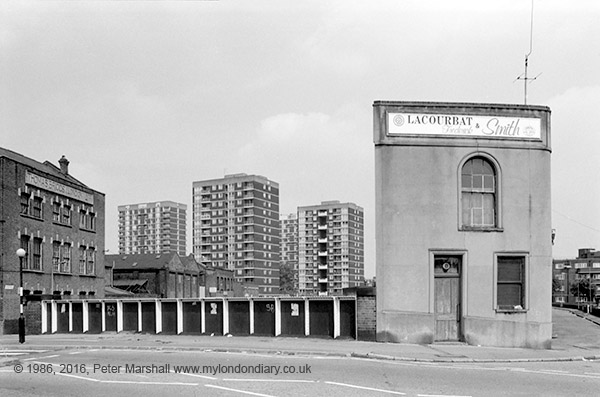

Bridge over Regent’s Canal, Bridport Place, Islington, London. July 1986

This time I was a little more assiduous in my search, and found a few people who said it was a quick and easy job. A link to Epson’s exploded drawings of the scanner on the ‘Better Scanning’ site which has a page about dismantling various Epson models confirmed it was a matter of lifting the lighting module off from the scanner bed and then revealing and removing 4 screws and the top would lift off. And so it did.

The hardest part was removing the four plastic plugs which hide the screws, which I did by kind of digging at their edges with a craft knife and easing them up. They have a V on their top and are easy to spot, one fairly near each corner of the glass bed. Once the screws are removed the top can be pulled off – mine caught a bit at the front a needed a little persuasion. Fortunately fitting it back on again after cleaning turned out to be as simple.

Using Epson Scan

The Epson scanner software isn’t bad when used in ‘Professonal’ mode, though some features – like the ‘Thumbnails‘ which always seem to crop your images are best avoided. I do a Preview scan, click the Normal tab if thumbnails have appeared, then drag a marquee roughly around the first neg I want to scan, and click to ‘zoom’ in. It’s best then to adjust the marquee to be entirely inside the image area to avoid any black and white areas outside the frame which might affect exposure before clicking on the auto-exposure icon.

Auto-exposure will always give a less than optimal result, but does get in you the ballpark. It’s best to keep the Histogram panel open all the time you are scanning and click on the ‘show output’ button to check if there is any black or white clipping. Adjust the input values to get rid of all or almost all of this, then move the midpoint slider to get the image looking roughly how you want it.

I can’t see any real point in not having the output as the default visible in this panel as it is what you really need to see, although sometimes you might want to be able to view the input. It’s one of several minor annoyances about the software, but otherwise it works well. I could instead use Vuescan, which I’ve used with the other scanners, but somehow never bothered with the Epson. Perhaps I’ll download the latest version and give it a try, certainly when I start to scan some colour negs.

It’s best to scan in 16 bit grey for black and white (48 bit RGB for colour) as then you can make final adjustments to brightness and contrast in Photoshop (or other image editor.) You are going to have to open the images in Photoshop anyway to retouch the dust etc. So concentrate on getting all you can from the neg by avoiding clipping.

Re-adjust the marquee boundaries to the edge of the image, and then you are ready to scan. Of course you will have already set the directory for the image to save in and for it to be saved as 16 bit tiff, as well as a suitable stem for the name – to which Epson Scan with add 001, 002…
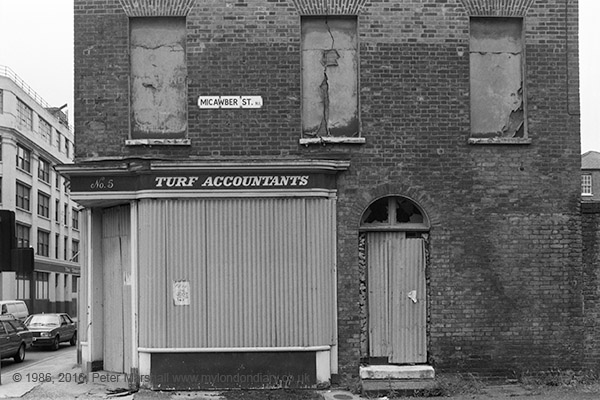

Closed Turf Accountants, Micawber St, Islington, London. July 1986

When the scan has saved, click on ‘Full’ in the preview pane, shift the marquee to the next image on the page you want to scan, and then ‘Zoom’ to view it and adjust exposure. Only use the auto-expose icon if it comes up way out, otherwise it is generally quicker to adjust from the previous values. And ‘unsharp mask’ has a habit of sneaking itself on. You don’t need it – if you want sharpening, Photoshop can do it better.

One further hint. Always go through the negs and decide exactly which are worth scanning – I mark the contact sheets, but if you don’t have these, you can write down the negative numbers. Otherwise if you are like me you will end up scanning twice as many.


* Not quite as effective as those Polonium 210 based StaticMaster brushes we used to use, but which now appear unobtainable in the UK. Quite safe so long as you remembered not to stir your tea with them!

Continue reading Epson Scans
Cyclists Die in London

It was on my sixth birthday that I got my first two-wheeler. Before that I’d had a pedal car and then a basic trike, both of which I rode along the pavements of our street, and just occasionally on the road. There wasn’t a lot of traffic then. It wasn’t a main road, a side road in what is now one of London’s outer boroughs, then a part of Middlesex. On the stretch of a few hundred yards on which we played, there were a handful of shops and perhaps 50 houses. Usually only one car was ever parked there, owned by the parents of one of my boyhood friends, often playing around our house or on the street. He and his parents lived in his gran’s small house; they could afford a car because both his parents went out to work – something my mother definitely didn’t approve of. A few years later they moved out to a council flat a couple of miles away. Times have very much changed.

Of course it wasn’t a new bike. Like the trikes and the pedal car it had been handed down. It wouldn’t have been new when my elder brothers had ridden it, but probably my father had cleaned it up and given it a new coat of paint, keeping it hidden in a corner of his workshop so it came as a surprise.

For a few hours I was on it, riding up and down the pavement with an older brother’s hand on the saddle running with me, until eventually I realised I was on my own and had travelled a few yards before putting my feet down. Then I had it, and could ride, and after a little more practice could both start off and stop without falling off. It was freedom.

It wasn’t long before I was riding to visit friends from my class who lived half a mile away, and when they too got bikes we would ride around the local heath, and to parks and woods to play. And to get chased by park keepers, as cycling there certainly was not allowed.


Event organiser Donnachadh McCarthy (left) taking part in the die-in

A couple of years later I graduated to a larger model – again ten or twelth-hand – but with hub gears, and there was no holding us back. Soon we were cycling out to Box Hill or Virginia Water and other places around the south-west edges of London, often making our way along major roads such as the A3, A4, A30. A few sections built in the 1930s had cycle paths, but most didn’t, and we made our way in often heavy traffic.

Even so, it was safer than today. Traffic speeds on the open road were generally slower and lorries were smaller. Now my parents would probably have their children taken away by social services if they allowed them the freedom we enjoyed. But then they made sure we knew the rules of the road, taught us to keep our bikes in good order and left us to it.

Many reasons have combined to make our roads now less safe for cyclists – and some of the changes have been deliberate. Traffic engineering for many years only considered how to allow cars and lorries go faster, realigning junctions, roundabouts and one way systems, designing them with this in mind. It’s still happening with many local authority transport departments, increasing the danger to cyclists and pedestrians at many junctions.

In recent years, things have begun to change. Cycling in London got a boost from the 2005 bombings, which made some people reluctant to use the tube, and numbers of cyclists continue to increase. Folding bikes like the Brompton I sometimes now use have increased many people’s choices, making bikes easy to store in small flats or at the office and allowing commuters to combine cycling with tube or rail. And those misnamed ‘Boris Bikes’ that Ken set in motion have encouraged many more to get on a bike.

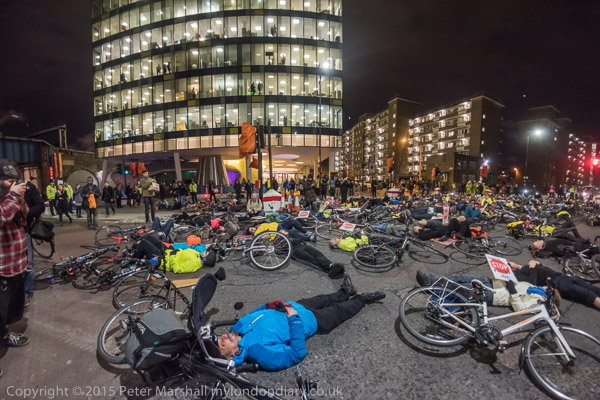
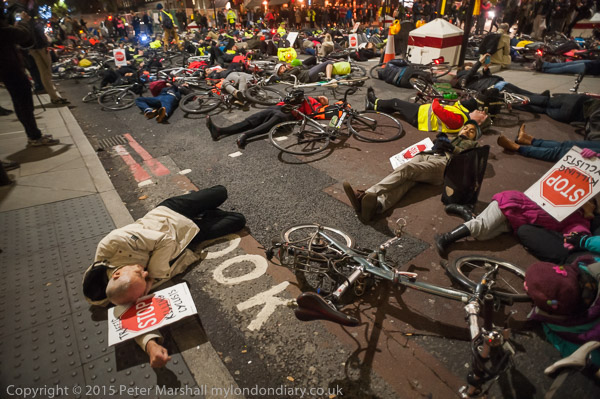
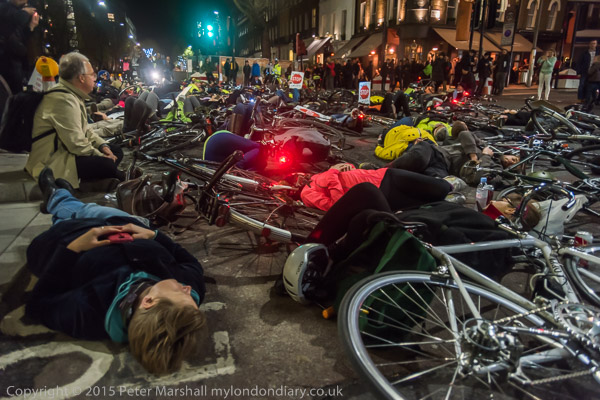
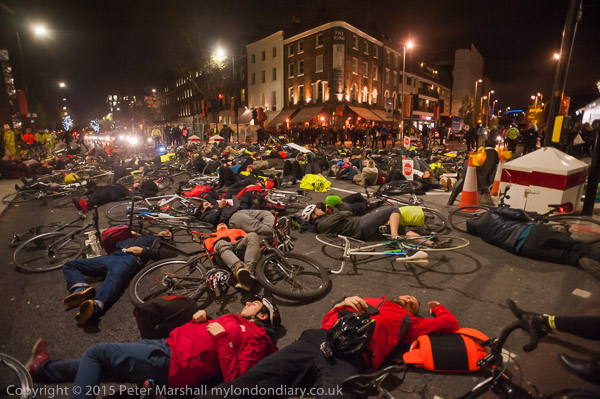
Safety is a major reason many people give for not cycling in London, and there is good reason behind this. At last November’s protest there was a row of 21 mock coffins, one for each of the cyclists killed on London’s roads in the previous 2 years. The great majority of them killed by heavy goods vehicles, particularly skip lorries, designed with very limited vision to the rear and along their sides.

The protest was organised by ‘Stop Killing Cyclists’, a pressure group calling for a much greater emphasis on cycle safety. In Stop Killing Cyclists Die-in you can see and outline of the list of demands for safer cycling they presented to London’s then prospective Mayoral candidates. The response from Sadiq Khan, now elected to the post was not too encouraging (though a little more positive than than of his main rival, the allegedly green Conservative Zac Goldsmith, both probably deciding that there were few votes for cyclists and promising more might upset motorists) but we can expect to see some progress under his reign. And outgoing mayor Boris’s last official engagement was to open the latest part of a cycle superhighway, a segregated bike path across Blackfriars Bridge.


Green Party Mayoral candidate Sian Berry (centre left) at the protest

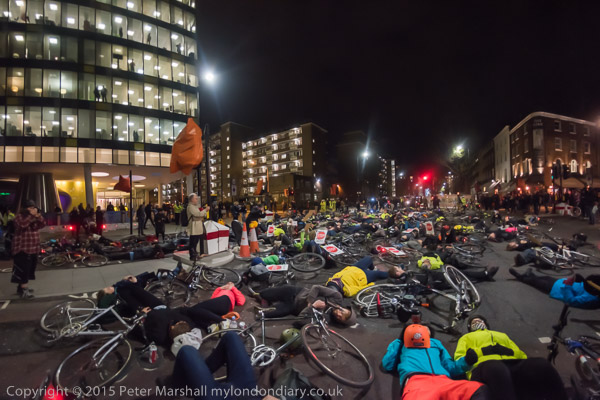
Photographing the cyclists’ die-in just a quarter of a mile down the Blackfriars Rd from that bridge Bridge in front of the Transport for London offices presented some problems. Of course there wasn’t a great deal of light almost two hour after sunset, but it was more a matter of both giving an idea of the sheer number of bikes involved and of also of getting some strong foreground interest – and of avoiding other photographers, a few of whom were something of a nuisance wandering into the centre of the die-in.

I made use of the 16mm fisheye, as well as the 20mm f2.8 and the 28.0-200 mm  to try and make effective images, and felt I’d done a reasonable job. There are examples from each of these lenses above (the fisheye images converted using FisheyeHemi as usual.)  Of course I photographed other things than the die-in and Sian Berry, though you will find more pictures of both as well as more about the event at Stop Killing Cyclists Die-in.
Continue reading Cyclists Die in London

April 2016

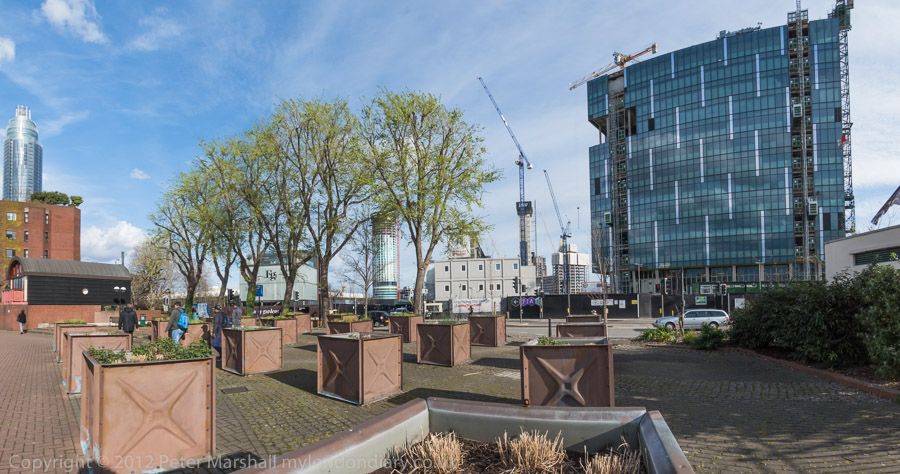
My work from last month is now on-line. It seemed a busy month and I think there are 42 stories, including a family wedding and a walk. There are some of the pictures I took while travelling around London at the bottom of the list. as well as an entry showing a little of the incredible development going on at Vauxhall and Nine Elms, which I’m afraid will probably offer little to Londoners.


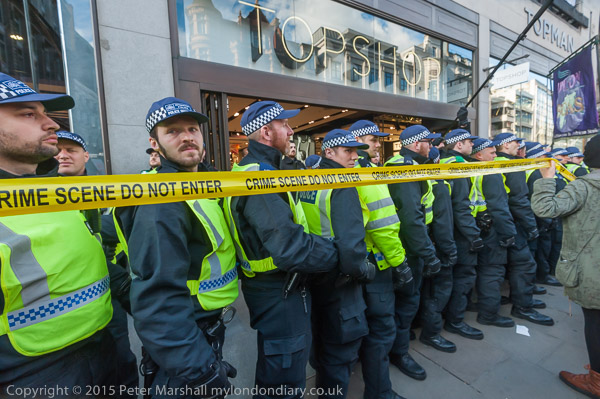
Jane Nicholl of Class War stretches out ‘Crime Scene Do Not Enter’ incident tape in front of the police in a protest against victimisation of cleaners

Apr 2016

Save Aleppo, Stop Airstrikes
Save Upper Norwood and all Lambeth Libraries
Stop Air Pollution Killing Cyclists
Downing St rally for Junior Doctors


Doctors & Teachers march together
Windsor Great Park Walk
St George in Southwark Procession
Peace Garden at War Museum


St Georges Day in London
Sierra Leone Blood Diamonds at Tiffany
Sierra Leone Blood Diamonds at Selfridges
Stop Refugees Drowning


Drax AGM Biomass opposition
Cleaners in-house now, not later
Family Wedding
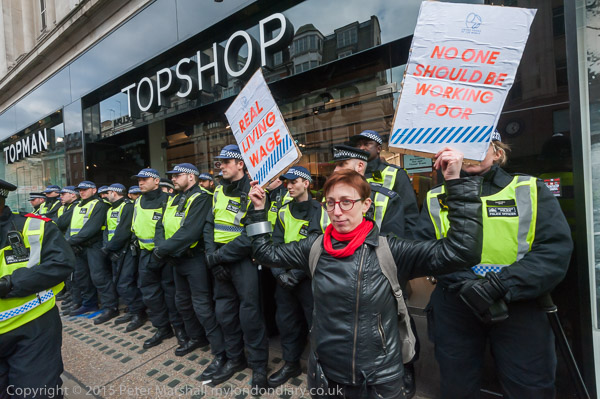
UVW Topshop & John Lewis Protest


UVW Topshop 2 protest – Strand
Palestine Prisoners Parade
Dancing for Homes, Health, Jobs, Education
Homes, Health, Jobs, Education Rally
Ahwazi protest against Iranian repression
March for Homes, Health, Jobs, Education


Streets Kitchen March with Homeless


Vauxhall and Nine Elms
Make Tips Fair
End Killings in Colombia
Party against Cameron
Don’t Criminalise Abortion in Poland
Stop Grand National horse slaughter
Cameron must go!


March to Save Lambeth’s Libraries
Carnegie Library Occupation Ends
Bursary or Bust Die-In & Rally
Bursary or Bust march to Dept of Health
Support for Junior Doctor’s Picket
Immigration Bill – racist attack on human rights
International Pillow Fight Day
Butterfields Won’t Budge
Ban Canned Hunting of Lions
Christians protest Lahore bombing


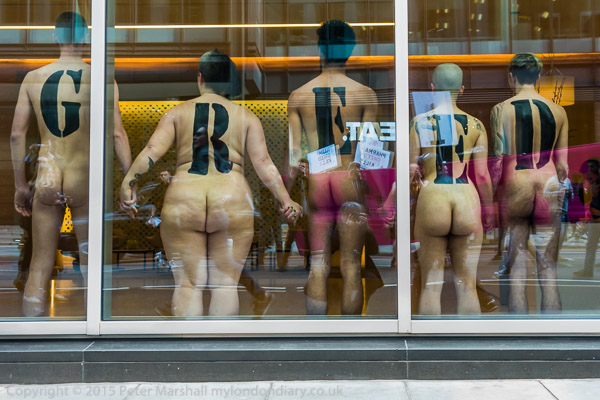
Act Up protests Gilead’s naked greed

London Images

Continue reading April 2016

Harbutt Tribute

I was pleased to see L’Oeil de la Photographie‘s Tribute to Charles Harbutt who died last June, published today. I’ve written many times, both before his death and in on this site in an article last year written to mark his passing about his contribution to photography, concentrating on its effect on photography in the UK and on me personally.

L’Oeil’s (it now prefers to be called ‘The Eye of Photography’ in ‘Anglo-Saxon’ countries, probably because many Americans have a problem with anything Frenchified other than fries) piece is short, but brings together a number of links, appears to have been prompted by the news that the Peter Fetermann gallery in Santa Monica has acquired a portion of his estate. You will find some of his pictures on their site as well as a page on his last book, Departures and Arrivals, still available new in the UK for around £20 (though you can pay up to up to £80 from some overseas booksellers.)  It is better printed than his first and most influential volume, Travelog, which contains most of the better images from the later volume but now costs ten times as much.
While you are on the L’Oiel site, the ‘About‘ page, which features an interview with its founder Jean-Jacques Naudet makes interesting reading. There is also now a Chinese version of L’Oeil, (is it called 作者?) though it appears to be almost entirely in English, with the exception of some titles and the occasional spot of French.

You can learn more about Harbutt on some of the links cited in L’Oeil, and in those on my post last year.  I’d particularly recommend the Visura portfolio, still on line though sadly the magazine is not currently being published.

Pre-Raphaelite Staines?

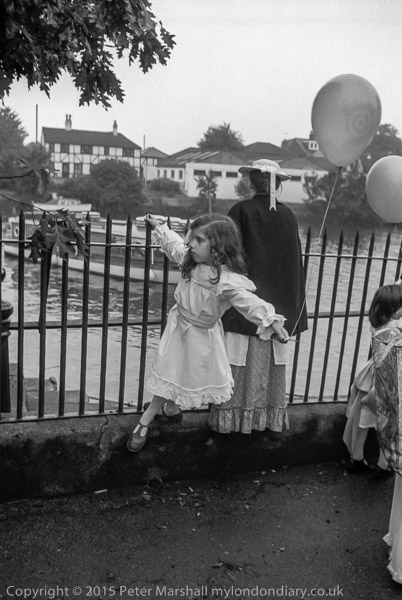
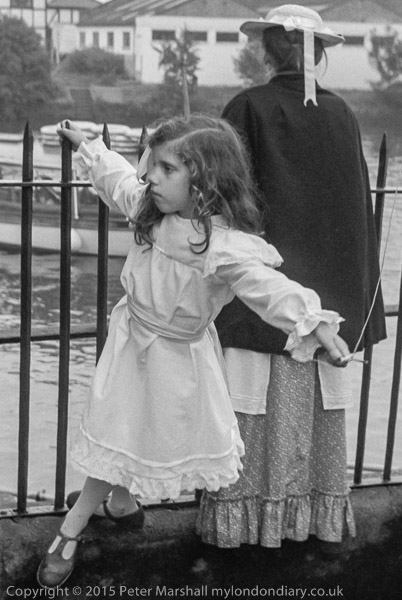
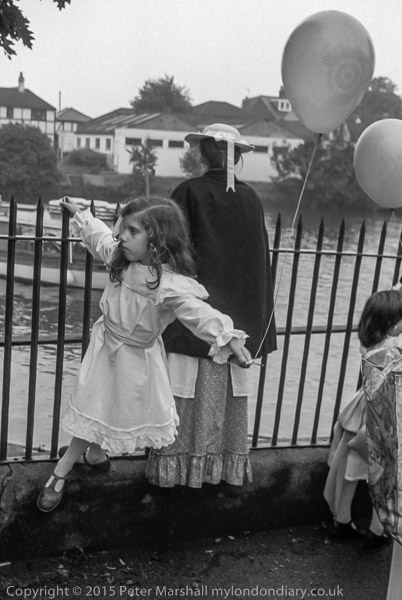
It was a brief moment and I managed to take a picture which was tolerably sharp and focussed as a young girl, balloon in one hand swung around from the fence overlooking the Thames in July 1980. I can’t recall what the event was, but it had a band playing in the bandstand (long demolished) behind the old Town Hall and lots of people in old-fashioned fancy dress, with free balloons being given away by the local newspaper.

The area where I took these pictures has now been redeveloped by the council and made into a larger but less interesting space. The bandstand has gone- though it wasn’t much used and the whole area made more open. And there has of course been a feeble effort to rename Staines.

My contact sheet – one complete film on the event, except of a first picture of my wife holding a shopping bag and one out-of-focus close-up of my fingers in front of the lens – gives no help, though it does tell me I was using Kodak Plus X and developed it in Kodak HC110, and that I was using my Minox 35EL.

The Minox 35EL was claimed to be the smallest full-frame 35mm camera, just tall enough to enclose a 35mm cassette and just wide enough for the casette and a similar space to hold film on the other side of the 1×1.5″ film gate. Made mainly of plastic with its 35mm lens on a lensboard that folded down for the lens to spring into place it was about as small and light as a 35mm camera could get, fitting easily in to a shirt or trouser pocket when folded back. The electro-mechanical shutter made a very discreet click and it was a great instrument for working without intruding. So good that many spies used it – and the USSR even made an almost perfect copy in Ukraine which doubtless supplied the KGB.

The 35mm f/2.8 Color-Minotar was supposed to be very sharp, though the first one I bought was decidedly not – after several months of argument and a visit to the Luton office of Leitz, who distributed it in the UK, they swapped my camera for one that worked properly – along with a slightly snooty reminder that there were no performance criteria for the lens – but they had actually tested this one! I still have my third or fourth Minox 35 camera – one jumped out my my pocket while cycling (and was replaced on insurance), another needed servicing and I was offered the GT at around half price when Leitz couldn’t get the parts.

It wasn’t an ideal camera. The viewfinder isn’t exactly precise, the simple auto-exposure was easily fooled (though all 36 on this film are reasonably exposed) and the two-stroke film lever had little leverage and could rip your thumb. Scale focus would be a problem for some people, though in good light the 35mm usually gave enough depth of field to cover my guesses. But it was a camera the size of a pack of twenty fags and as I’d long since given up smoking there was always room for it in my pocket.

But it had a 35mm lens. For years I worked almost entirely with that focal length, both on Leica and Olympus SLR, and it is a fine focal length. But sometimes it just isn’t wide enough and at others – like this – it is too wide. Fortunately on this occasion I was quick to seize the chance and take a picture without trying to move in, as I would then have missed it – as the next frame shows the back of her head. Though on the 35EL, the next frame would have been several seconds later at best.

Hers was a costume that suited her, and the unruly hair (a typical July day in Staines there was some wind and rain) made me think of those subjects pressed into submission by Julia Margaret Cameron.

I don’t like to crop pictures, and this is perhaps why I don’t think I’ve ever shown this one. Or perhaps I couldn’t decide on the crop. Here’s how I finally decided to make it.

Continue reading Pre-Raphaelite Staines?

Marathon Day

Saturday August 15th last year was something of a marathon day for me, with nine of the roughly 20 stories from the month. I’d left home that morning with a fairly ambitious schedule, five events spread out across the day from 10am until around 8pm, and came across a few more things to add as I travelled around.

My day started outside the National Gallery where there was a rally by the PCS strikers at the end of the morning picket on the 61st day of their strike against privatisation and calling for the reinstatement of victimised union rep Candy Udwin.

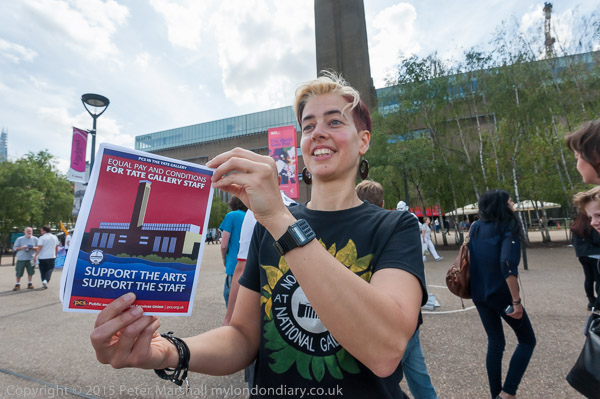
Joining in the protest there had been people from the Tate Gallery, where some privatisation has already taken place, with privatised gallery assistants getting paid £3 an hour less than their directly employed colleagues doing the same job, as well as minimal conditions of employment and zero hours contracts that fail to give them predictable hours or income.

I went on to photograph their protest outside of Tate Modern, where Equalitate were handing out leaflets to the busy crowds walking past there, before leaving and taking the bus back to Aldwych and the Indian embassy.

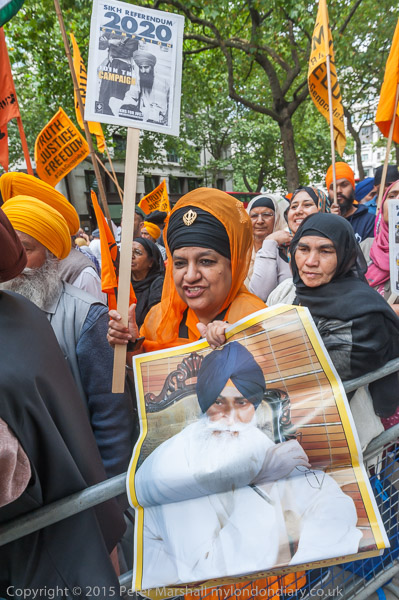
I’d come here for a protest by Sikhs on Indian Independence Day supporting the call by hunger striker Bapu Surat Singh for the release of Sikh political prisoners, but found that there was also a protest by Kashmiris.

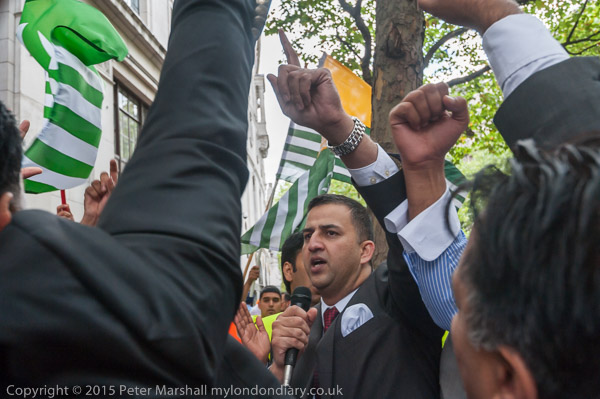
Kashmir is a disputed territory with areas occupied by India, Pakistan and China., and Independence Day is observed as ‘black day’ in Indian military occupied Kashmir. The Kashmiris want freedom for their country and the protest became quite heated at times.

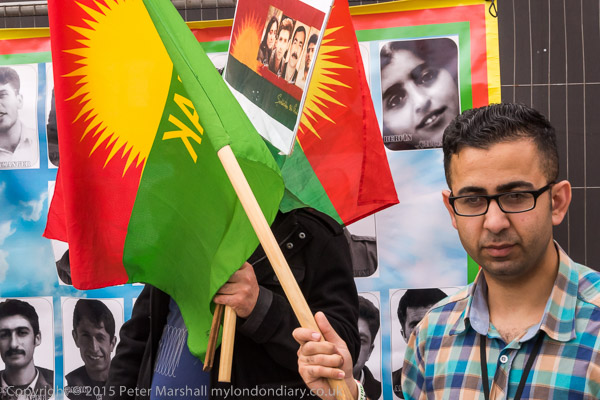
Back in Trafalgar Square there were also two events taking place. The  Party of Free Life of Kurdistan (PJAK),  an Iranian Kurdish group formed to fight against the Iranian regime for self-determination for Kurds in Iran and based close to the Iranian border in Iraq were celebrating their martyrs with flags, banners and posters showing their faces.

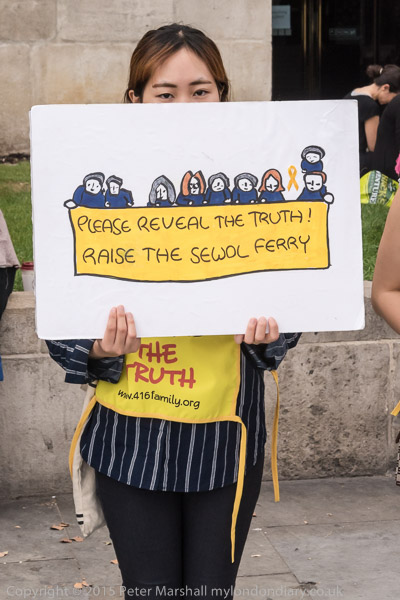
A short distance away was the regular monthly protest mainly by Koreans over the Sewol Ferry disaster, calling for changes in the Korean law and a full inquiry into the disaster which killed so many schoolchildren who were told to ‘stay put’ on the lower decks as the ship went down.
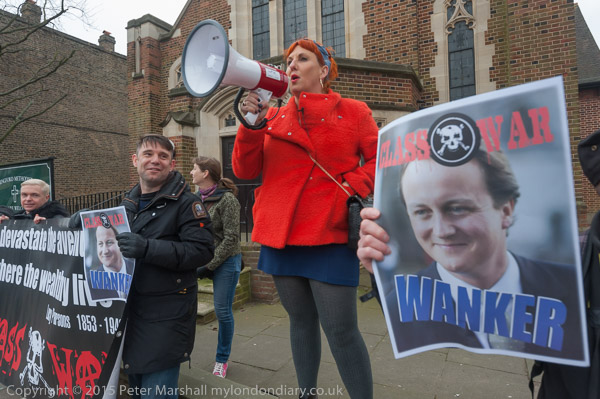
Next was another in the series of protests by United Voices of the World at Sothebys in New Bond St, where two workers remained sacked following an earlier protest calling for better conditions of service – sick pay, holidays and pensions – for the outsourced workers who clean Sothebys.  As usual there was a certain amount of friction between the protesters and police who tried to limit their protest.
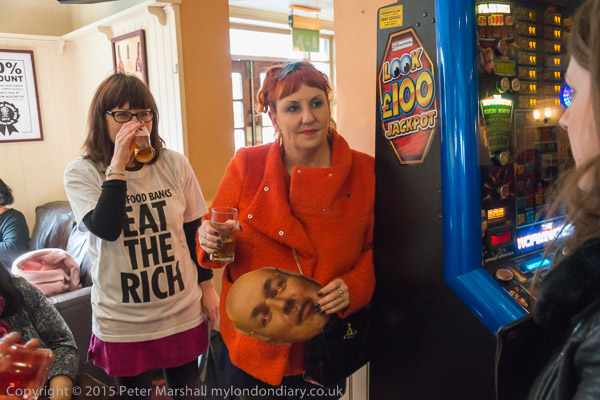
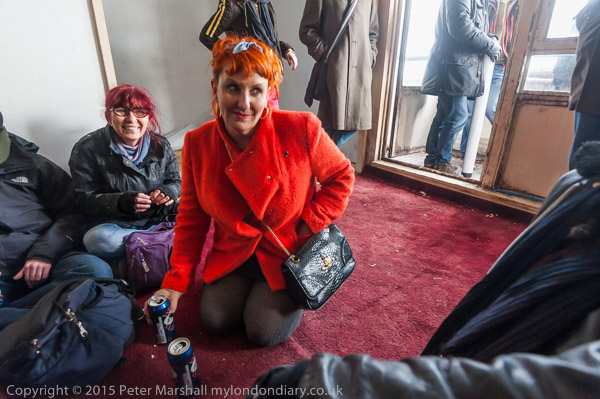
But on this occasion there were fewer police than previously, and they were less forceful in their intervention, largely trying to persuade rather than using force. By the time this protest ended I was tired and ready for home, but there was one last event I wanted to cover.

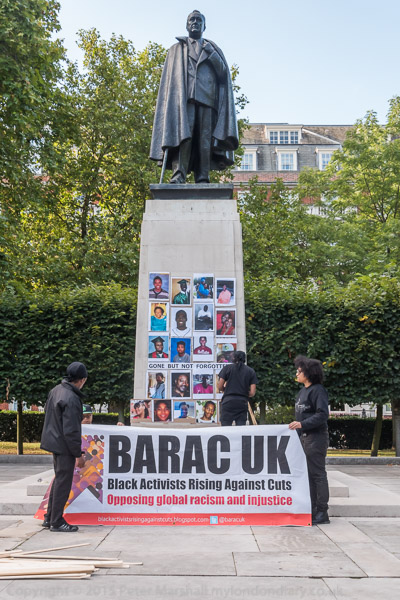
BlackoutLDN solidarity with Black US victims took place not as I had expected outside the US Embassy, but a short distance away inside the garden in Grosvenor Square, where there is a statue commemoration President Franklin D Roosevelt. It was an unusual event with contributions from a number of individuals and groups including BARAC and the Nation of Islam, and as well as speeches there were songs and poems. But I was getting tired and had to leave before the final lighting of the candles as it began to get dark.

I had been on my feet too long, and my legs were suffering. I had to rest for a few days after this to get fit for the week’s holiday that was coming up.  During the day I’d also taken a few pictures as I travelled around London, which are in London Views. Altogether I’d taken a ridiculous number of pictures – after deleting those which were obviously unusable I was still left with around 1,600 – around 25Gb of RAW files. Far too many!

It’s good to be able to report that all three of the industrial disputes that I photographed on that day have since then been successfully resolved.
Continue reading Marathon Day

Lisa McKenzie in the THE

I’ve been rather busy in the past few days, with emergency protests around bombing Syria adding to what was already a fairly busy period, and computer problems at one of the agencies I submit work to causing ridiculous delays, with stories that should have taken 10 minutes to file (after I’d worked for an hour or two on captions and image adjustments) taking repeated attempts over several hours – and with one set I gave up, went to bed and then took three hours the following morning.)

So I’ve not found time to write my thoughts for >Re:PHOTO, indeed not found time to have much thoughts not directed to the work I’ve been engaged on. Normal service will I hope be resumed shortly, although I’m at another emergency protest tonight.

I began this intending to write about something quite different, but was interrupted by the doorbell and the postman bringing two items for me. Not the usual bills, requests for donation and catalogues of things I have little interest in (I get shoe catalogues for Imelda Marcos though I only buy a pair once or twice a year) but two things I’m rather excited about. One was a replacement 35mm negative holder for my Epson V750 scanner which I’m hoping for great things from, and the other a complimentary copy of Times Higher Education.

I’ve not the time today to try out the new negative holder – its the Epson redesign for their more recent V800/850 with anti-Newton ring glass. better height adjustment and negative holding – but I have read the relevant pages of the THE, where two of my pictures accompany an article Lisa Mckenzie on the day she was arrested.

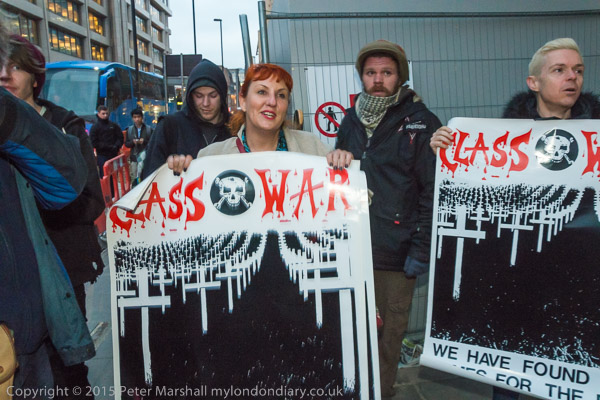
The first double-page in the magazine is simply the picture at the top of the on-line article with just a few lines of introductory text apparently coming from the bell of the megaphone. Its one of a number of pictures I took when Lisa was launching her election campaign against former Tory leader and welfare terrorist Iain Duncan Smith in Chingford – and you can see it and more at Class War Chingford Election Launch. It isn’t the frame I chose as my lead image for the story, where I wanted the poster in the foreground and other members of Class War with her:

but an image with a plain background which isolates Lisa from a closer and lower viewpoint against what was actually an empty grey sky. The file I sent THE was a little better colour-corrected than that I put on the web site.

We went on to celebrate in the pub, an essential element of the Class War constitution, before making a rather hilarious journey across London to the occupation taking place on the Aylesbury Estate, where Lisa came to my defence after I was jumped on by activists for taking her photograph with the Aylesbury activist, Aysen. Carefully framed not to include other faces.

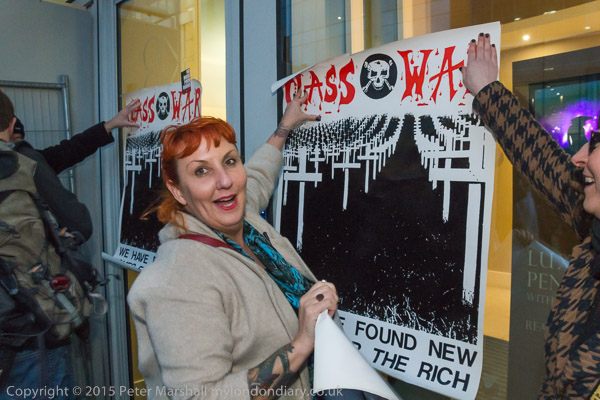
It was the next Thursday at http://mylondondiary.co.uk/2015/03/mar.htm#classwar Poor Doors where I took the second image that the THE used (rather smaller but still at a decent size of Lisa holding a poster:

though I think there are other better pictures that would have served, such as this:

and several weeks later I was there again with Lisa when the police surrounded her and arrested her for something they later admitted she had not done.

There is a set of around 11 pictures of her arrest on http://mylondondiary.co.uk/2015/04/apr.htm#lisaarrested My London Diary, and I rather like the two that actually show the least of her. Less is often more!

Later I was pleased to be present – waiting outside the court in case I was called as a defence witness – to be present when two of the charges against her were thrown out and she was found not guilty after the briefest possible hearing on the third – with the judge telling her barrister that there was no need to argue the case after the prosecution evidence had been given. And of course we went to the pub to celebrate.

Of course it’s Lisa McKenzie’s article that is worth reading, but the THE have done her proud, and its an article that I’m very pleased to have been able to contribute to. Photographers seldom get any say in how there images are used, and sometimes – particularly with images of Lisa – I’ve been disgusted at how the papers have used them. It’s good to have something I can be proud of.

Harlem Argument

Don’t miss the New York Times Lens feature Gordon Parks’s Harlem Argument written by Maurice Berger, which looks at a show organized by Russell Lord for the New Orleans Museum of Art  in collaboration with The Gordon Parks Foundation and shown at NOMA in 2013-4. You have to register to get access to the museum’s pages about the show, but you can read their press release and articles by John D’Addario and offsite in a blog by John Edwin Mason.

It’s probably best to start by viewing the essay as it was published in LIFE over around nine pages (four double page spreads and two half pages) on the TIME site, – it starts on page 21 of the gallery, and viewed at full screen the text is legible too. The gallery also has separate views of some of the images they used and a few they didn’t, and again has text by Mason.

The New York Times feature comes as the show is open at Vassar’s Frances Lehman Loeb Art Center in Poughkeepsie, NY until Dec 13th 2015.  The essay ‘Harlem Gang Leader‘, published in LIFE Magazine, November 1, 1948 was Gordon Park’s first for LIFE, and although it is a powerful essay, I think it is probably true to say that the photographer lost the argument.  Red, the gang leader Leonard Jackson, as Berger writes:

“was dismayed by the photo essay’s portrayal of him as a slick gangster, living a fundamentally unhappy and lawless life. “Damn, Mr. Parks, you made a criminal out of me,” the photographer recalled him saying after the essay was published. “I look like Bogart and Cagney all mixed up together.””

Gordon Parks devotes a chapter of his autobiography, ‘Voices In the Mirror‘ to the story. At the time he was about twice the age of the teenage gang members he was photographing and impressed them with a flash car he was driving, a Buick Roadmaster which helped him gain their confidence. He also mentions that some of the pictures were taken with the help of an infra-red flash rigged up for him by LIFE and goes on to comment about the editing – but makes no suggestion that Red was dissatisfied with the article. On p110 he writes:

“There had been some contention between the editors and myself during the layout of the story.They had wanted to show Red on the cover with a smoking gun in his hand. I fought against it, even destroyed the negative to be sure it wasn’t used for such a purpose.”

Parks wanted to show a more rounded view of Harlem and the life of the gang members, but he still beleived that the essay had a positive effect, bringing gang violence to the attention of the public and also helping to cut the murder rate in Harlem, as least temporarily. He also recounts how almost 40 years latger, Red got back in touch to tell him he was getting an education and trying to stop Harlem youths taking the road he had.

Robin Hood


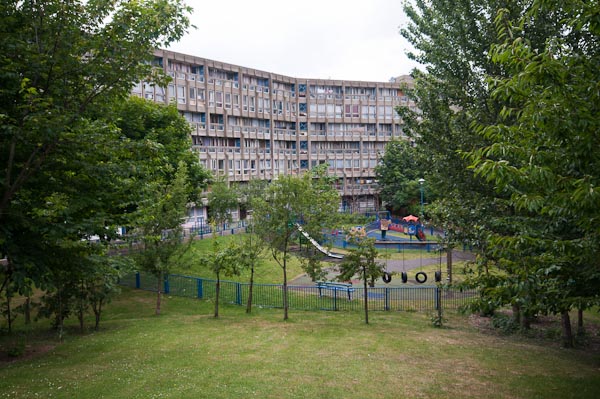
Robin Hood gardens 2009

Robin Hood gardens 2015

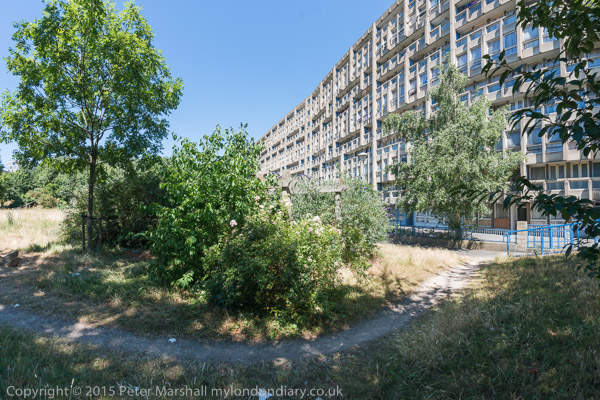
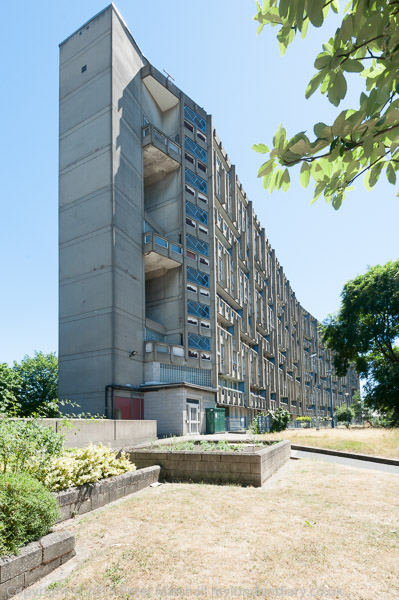
I’m sad that Robin Hood Gardens is doomed. Sorry for the loss of what I think is a fine architectural solution to a difficult site next to the Blackwall Tunnel approach, and also for yet another loss of social housing in London, at a time when there is a desperate shortage of low cost housing in London, resulting in most of those who work at the essential low-paid jobs that keep our city running being unable to afford to live in it.

I think the decision not to give the estate listed building status was wrong – as too was the failure to list the Heygate Estate at the Elephant, built as around 1200 council flats and maisonettes while its replacement will have virtually no truly affordable properties. Robin Hood, like Heygate, attracted a great deal of praise when it was built, designed by architects Alison and Peter Smithson and completed in 1972. It was a shame that it’s ‘streets in the sky’ ended up a little less wide than they should have been, but it is still a remarkable property.

The plan – like many at the time, was for a fairly low density development, with the east and west slabs enclosing a large green space, a surprisingly quiet oasis in inner London, just a few yards from the busy Blackwall Tunnel Approach. The flats, like those in other developments of the time, were large and airy, and had it been a private development the two-storey maisonettes would now be worth approaching a million pounds.

But several things conspired against it. Some people found its Brutalist design unattractive and the lack of necessary upkeep by Tower Hamlets council led to problems, exacerbated by the council moving in problem residents, using it as a sink estate. The real killer – of this and other council estates – came with Thatcher and the right to buy, both losing social housing and complicating management. And it is the commitment both to relatively low density and generous property sizes that make it and other council estates such an attractive proposition to investment-fuelled property development in London.

It doesn’t after all matter if a property is meanly proportioned and in a poorly designed environment if you are not going to actually live in it, but simply buy it for the high increase in property values year by year in London, or are going to let it to others who are prepared to pay high rents to stay in London.

The proposed redevelopment covers a rather wider area than Robin Hood Gardens, and according to the proposal with provide over six times as many housing units, with around 40% of these being social housing or shared ownership. Of course many such proposals have ended up with delivering far smaller number of social housing units than originally promised, with a get out clause allowing developers to evade their obligations on the grounds they say it would be uneconomic – that is, that they would not get enough profit.


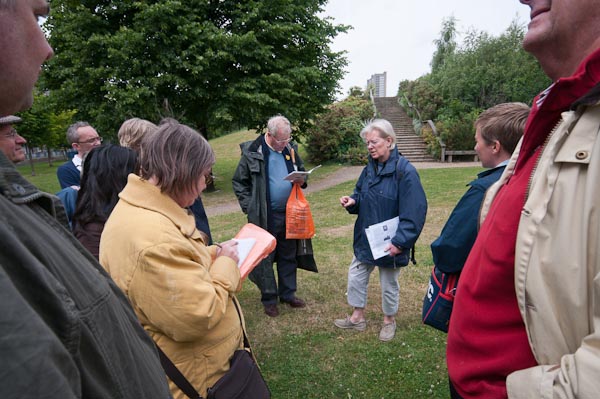
Despite the Blackwall Tunnel approach next door it is very quiet inside Robin Hood Gardens and it was easy to hear Bridget Cherry talking. June 2009

I first photographed Robin Hood Gardens back in the 1980s, but only took a few pictures. I returned in http://re-photo.co.uk/?p=674 2009 on a walk around by Bridget Cherry, who together with Charles O’Brien and Nikolaus Pevsner wrote the definitive volume on the architecture of East London in the ‘Buildings of England’ series.

Back in 2008, the local council claimed that in a consultation over 75% of the residents wanted the estate to be demolished, but a survey the following year by residents gave a very different picture with over 80% of residents wanting it to be refurbished. Rather curiously exactly the same results were also claimed by Soutwark Council and residents over the Heygate Estate – and a rather similar result also for the Aylesbury Estate. Some councils certainly employ PR firms to provide them with the results that they want, rather than seriously to carry out consultations.

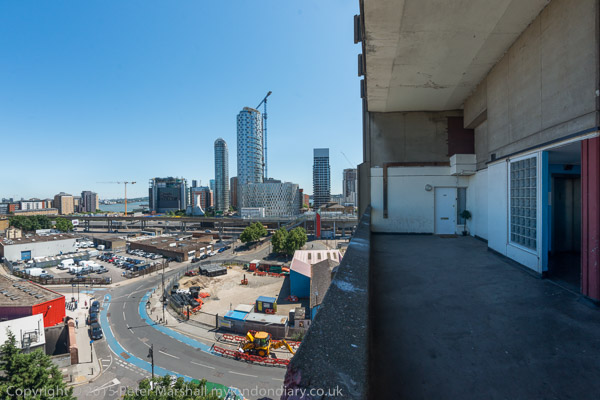
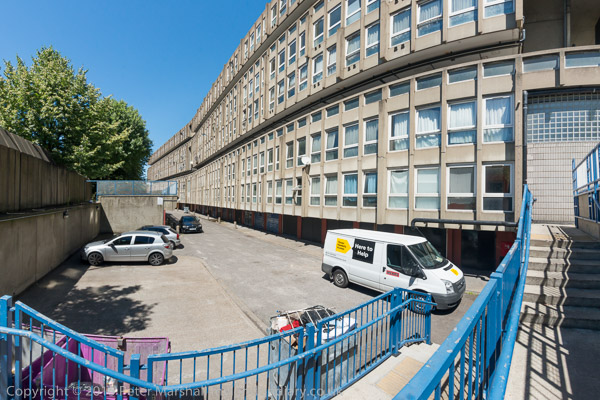
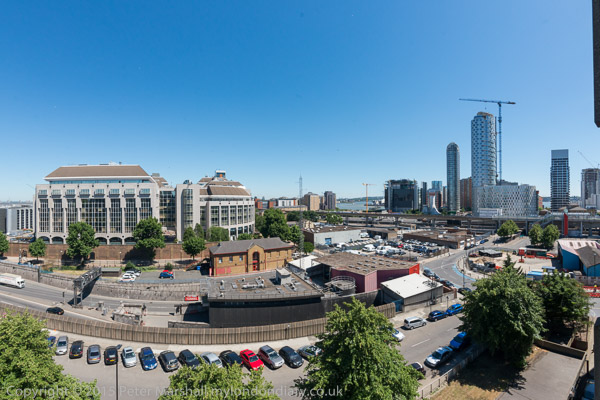
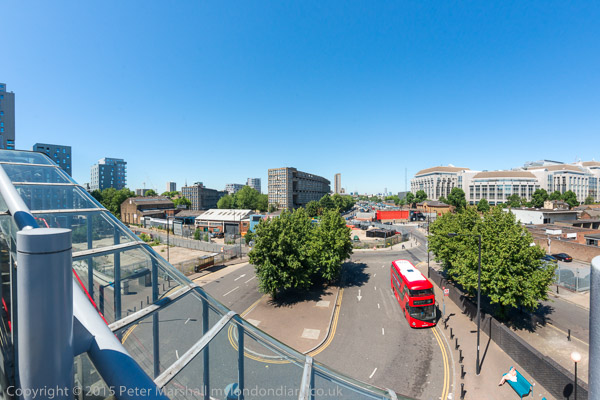
Work was taking place on the western block of the estate when I visited and I was unable to obtain access. I didn’t try too hard as the light was coming from the wrong direction to work from the ‘streets’ there. Some flats might still have been occupied, but it was not possible to be sure. The gardens which had been well-cared for on my 2009 visit were overgrown, but there were some signs suggesting they had been worked on earlier this year. But the whole of the eastern block seemed still to be occupied, and I was able to make my way up to the topmost ‘street’ and walk along it and make photograph from it. The lifts were still working but I went up by the stairs to see if their were any opportunities for photographs on the way up, but views out of the building were very limited. However from the top street there were good views over the Blackwall Tunnel Approach and across towards the River Thames and beyond.

Both from the top deck and at ground level, most of the photographs I took were made using the the Nikon 16mm fisheye lens, which gives a horizontal angle of view of around 146 degrees. With this on the D800E at ISO200 produces extremely detailed files, typically around 7,200 x4,800 pixels after minor corrections, giving a potential print size at 300 dpi of around 24 inches wide.

The D800E does allow you to work at lower ISO, but there is really no point in doing so. I think the sensor basically works at the same base ISO – ISO200 – but then simply amplifies or diminishes the signal to give the required ISO.

Usually I make these images with the intention of conversion from fisheye to cylindrical proportion, and cropping the 1.5:1 aspect ratio to around 1.9:1 format. In the viewfinder it is easy to visualise the horizontal scope of the image, as the conversion retains the centre of each side, but allowing for the vertical cropping is rather more a matter of guesswork.

This approach also give a post-processing equivalent of camera movements, equivalent to a fairly small amount of rising/falling front. Most of the images that I put on the web however show the full 1.5:1 image uncropped.

Also from my elevated position I took some view with a narrower angle using the 18-105mm DX lens, as well as some images with the rectilinear 16-35mm on the D700. I’m unlikely to have the chance to photograph from here again.


From DLR Blackwall platform. Robin Hood Gardens at left and the East India Docks estate at right

Bridget Cherry – Poplar Trail 2009

Robin Hood Gardens 2015

Continue reading Robin Hood