Robert Rauschenberg: Photographs

Suffering today from the annual and unwelcome reminder of ageing (though the presents are nice) I got to thinking about Robert Rauschenberg, who died two days ago on May 12, aged 82.

As the New York Times obit by Michael Kimmelman says

“A painter, photographer, printmaker, choreographer, onstage performer, set designer and, in later years, even a composer, Mr. Rauschenberg defied the traditional idea that an artist stick to one medium or style. He pushed, prodded and sometimes reconceived all the mediums in which he worked.”

Although I have a book of his photographs (Robert Rauschenberg Photographs, Thames & Hudson, 1981, ISBN 0 500 54075 6) it seems to me that photography is the one medium about which this isn’t true, although of course he made considerable use of photographs in various mixed media works, both using his own pictures and solvent transfer prints from magazine images.

In the book Rauschenberg comments that he first took up photography as a young man, it was a “social shield“, covering up the perosnal conflict he felt “between curiousity and shyness“. In the interview published in the book with Alain Sayag, Rauschenberg says that while studying with Josef Albers (who he elsewhere said “was my best teacher, and I was his worst student“) at Black Mountain College in 1949 he became aware that he had to make a choice “I was serious enough or dedicated enough to know that I could not have at that point two primary professions“. Since at that point his photographic project “was to photograph the entire U.S.A., inch by inch” it’s perhaps good that he chose painting (later, in 1980-1, in his project ‘In + Out City Limits’, he did try to photograph at least parts of the country.)

Had Rauschenberg been as excited by other teachers at Black Mountain – perhaps Aaron Siskind or Harry Callahan, the history of art and photography would have been different.

Rauschenberg’s early photography was good enough for Edward Steichen to buy two of his prints – one a portrait of his friend Cy Twombly – for MoMA‘s photography collection – his first sale to a public collection.

The first group of pictures in the book are from the period when he had given up photography, and are perhaps the strongest, uncropped square format images with a strongly emotional content, although the often square-on approach to the subject and sensitivity to lighting carry suggestions of Walker Evans. His later work when he returned to photography (I think, from the evidence of the images with a 35mm SLR) in 1979-80 are more related to formal concerns and less personal, although many are still very interesting, concentrating largely on urban details. Many of them were from the project In + Out City Limits (1980-81) mentioned above, which was followed by other photographic projects, including Photems (1981/1991), and Chinese Summerhall (1982-83.)

Rauschenberg comments that for him photography is “a kind of achaeology in time only, forcing one to see whatever the light of the darkness touches and care” and goes on to state: “Photography is the most direct communication in non-violent contacts.”

Sayag asks him why he never crops, and gets this response:

Photography is like diamond cutting. If you miss you miss… You wait until life is in the frame, then you have the permission to click. I like the adventure of waiting until the whole frame is full.”

Rauschenberg was certainly a great artist, and had he devoted himself to the medium could also have become a great photographer.

Unfortunately very little of his photographic work seems to be available to view on the web.

Here is an example Untitled, ca 1952 though it is not in my opinion one of his more interesting images. There are also one or two fairly poor reproductions from In + Out City Limits: Baltimore, Los Angeles and a rather better exhibition poster for Los Angeles.

Paris Photo

Paris Photo was one of the highlights of the year for me, although there is much about the actual event and its venue I dislike. For those who’ve not been, PP is mainly a trading show for dealers, with over 80 from around the world having stands and selling product. Its an expensive business, so many are looking for big money, largely selling corporate artworks to decorate extravagantly large office walls in major cities across the world. What matters most is scale and colour and the result is big prints that often achieve the difficult task of being both boring and garish.

If you went to PhotoLondon you will know exactly what I mean. Half of Paris Photo was like this, but there was also a truly incredible amount of really excellent photography on display, including on the stands of some of the better-known US dealers. My vote for the favourite of these has to go to Bruce Silverstein, where several photographers were treated to well-displayed mini-exhibitions of their work – with a pink-curtained area with images by Joel-Peter Witkin, and another black-painted wall with images by Aaron Siskind, as well as a nice range of works from Paris by one of my favourite photographers Andre Kertesz, along with one of the first images I wrote (and lectured) about, his Martinique, made when he was in his seventies in 1972. You can read someone else’s thoughts about it here.

Other galleries with plenty to see included Laurence Miller, Robert Klein and Howard Greenburg. Vu La Galerie had a fine range of images, mainly documentary and photojournalistic, but also including a couple of John Davies landscapes from the show currently at their Paris gallery.

Far too many stands to mention were – at least in part – showing interesting work, and from all periods of photography. Many years ago I picked up a number of copies of ‘Photograms of the Year‘ from the 1920s and 30s, and some of the more interesting images were nudes by the Czech photographer Frantisek Drtikol, and I came across work by him on half a dozen different stands including Kicken from Berlin and Michael Hoppen. Kicken also had some of the Austrian Heinrich Kuhn‘s large gum prints from around 1900, impressive for their size. Most of his work I had only previously seen as small reproductions.

There was also some fine work from the nineteenth century, with some of the finest images being on the stalls of English dealers, including for the first time Lindsey Stuart from Bernard Quaritch Ltd, who was showing on Baudoin Lebon stand, and Robert Hershkowitz.

One thing that was noticeable was that some galleries were showing exactly the same highly priced images as last year, perhaps an indication that these pictures were actually overpriced?

The market in photography has many pitfalls for the ignorant or inexperienced, and it always dismays me to find work that must make the photographers turn in their graves for sale. One stand had a couple of cyanotypes that I would have told my rawest student to put in the bin and have another try, and there were many ‘vintage prints’ that must surely have been taken out of the bins of the photographers concerned. It made me feel I should rush home and start looking through all those old boxes of my own ‘vintage’ prints in the loft and burn any which I don’t think reflect my best standards – probably most of the prints from my first 20 years in photography. In most cases they only got into those boxes because they weren’t quite good enough to show.

Of course the whole thing about ‘vintage’ prints is largely a nonsense. There were several opportunities in PP to compare prints of the same image on different stands made at different times. In virtually every case, the prints made later are better. And of course cheaper.

Two Prime Ministers

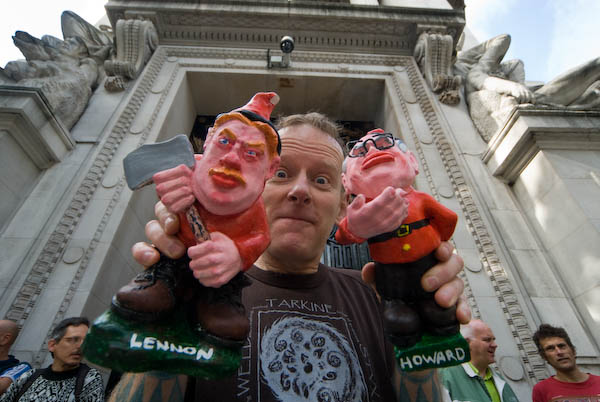
Its not often that I get the chance to photograph two prime ministers at once. And I turned down the only invitation I’ve had to actually photograph Blair inside No 10 Downing Street because it would have meant getting up earlier than usual and paying a peak hour rail fare!

But on Saturday, outside Australia House in the Strand, were Australian Prime Minister John Howard and Tasmanian Premier Paul Lennon, looking rather brighter than usual.

It was a small demonstration against the destruction of ancient forests in Tasmania, where legislation to preserve the wild rainforest has been ineffectual and further clearance will be accelerated if the building of a new pulp mill is allowed.

Perhaps the forthcoming elections there will change things. Ironically, one of the economic incentives to the clearing of forests is carbon offsetting, as new plantations in the cleared space can be marketed to assuage the consciences of polluters. “Burning forests for tree farms”, as the protesters banner read, truly is a “carbon trading ripoff” and demonstrates the madness of the whole offsetting approach.

The only sensible way to attack increasing carbon dioxide levels is to cut carbon emissions, by using less carbon fuels, farming less cows, and repairing and re-using manufactured goods wherever possible (and, as a last resort, recycling.)

Personally, I’m feeling a little guilty as I’m planning to get on a plane in a few days. But it will be the first time for over 2 years, and only the third time in over 60. I think I’ve offset it by the many thousands of miles I’ve travelled by bicycle.

A few more pictures, as usualĀ 

Peter Marshall