Chinese Torture Torch Relay Shames Olympic Ideals

Four years ago I photographed the Olympic torch relay as it made its way through Brixton.
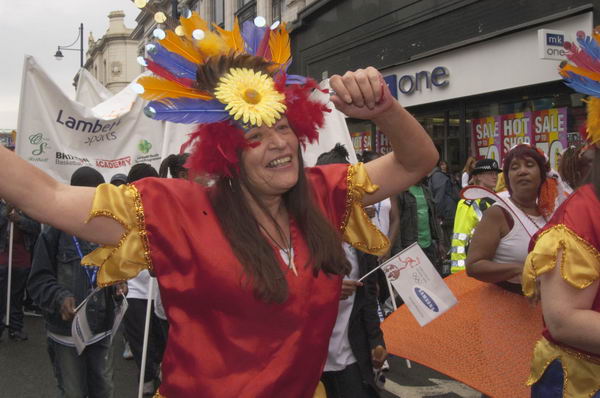
Brixton torch

At the time I described it as a rather sad non-event, which seemed to lack the kind of real community involvement that might have made it worthwhile. Unfortunately the whole Olympic movement has become so tied up with the commercial exploitation of sport that it is now impossible to see much evidence of the original ideals that led to its foundation.

It was an organised but low-key event, with little apparent security and I was able to stand only a couple of feet from Frank Bruno and as Davina McCall as they carried the torch, which had arrived by taxi and was accompanied by dancers as it made its way along the high street.
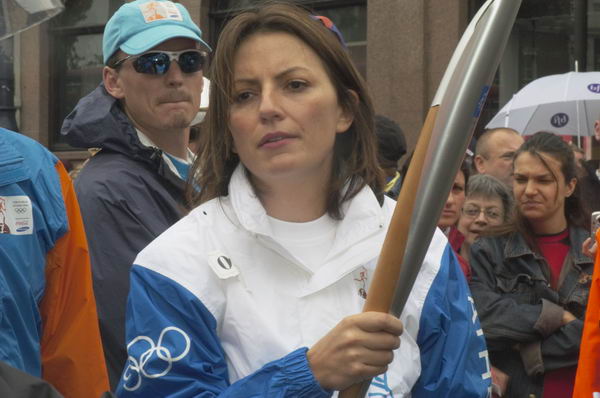
Davina
This is Davina and not Frank

Sunday was in contrast a giant security operation, with crowds of police, and a rather sinister phalanx of Chinese security men. I’d chosen the Bloomsbury leg as the torch was to have been carried there by the Chinese ambassador, but these ‘secret’ plans were altered at the last minute (she carried it instead in Chinatown) apparently as police decided it would be too dangerous. Instead the torch was smuggled through hidden inside a vehicle, with no sign of it visible to the waiting crowds. About all we got to see – apart from a huge security operation were some very silly looking dancing girls.

There were probably around a thousand demonstrators for human rights in Tibet on and around Great Russell Street, mainly penned behind barriers in Bedford Place, roughly ten yards back from the road. Probably about the same number of Chinese with pro-Olympic banners and flags were allowed to remain behind banners along the route. This seemed to me to be a very debatable taking of a particular side by the police.
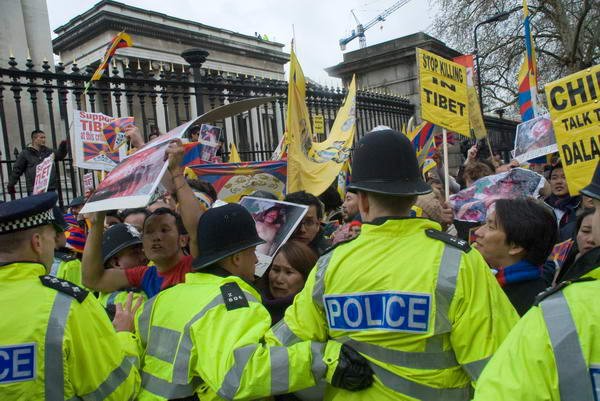
British Museum
Police hold Free Tibet protesters outside the British Museum

Similarly when the motorcade had passed, the police attempted to detain the Tibet supporters, while allowing others to disperse freely. The crowd pushed through a double line of police close to the Montague Street junction but were held for some minutes further down the road before eventually being allowed to disperse down Coptic Street. Presumably this was a delaying tactic to stop them catching up with the Chinese ambassador in Chinatown.

By this time I’d decided it was probably too late – given the traffic disruption caused by the event and the likely crowds – to get to a worthwhile position in Whitehall (a BBC reporter who had been in Bloomsbury and hurried there had to rely on a man standing on a wall to tell her what was happening – less practical but not entirely unknown for a photographer, and at least one of Henri Cartier-Bresson’s well-known pictures from India was taken by a man up a pole he handed his Leica. But I did walk down to see the crowds in Trafalgar Square, arriving just minutes after the relay had left. The square was still full of people, with crowds of Chinese arguing heatedly (if seldom very cogently) with mainly British human rights demonstrators, and the police in general seemed to be doing a decent job of preventing actual conflict, warning those who became overheated or abusive.
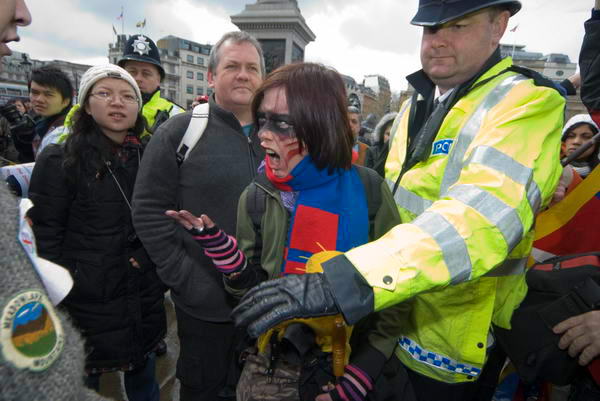
Police step in
Police try and cool down the argument

After a short while they decided to clear the square, and I got on a bus to go the Tibetan Freedom Torch Relay in Argyle Square. More pictures from the London Olympic Torch Relay on My London Diary as usual.
April 1

Photo Safety Identity Checking Observation (PSICO) in EPUK’s April 1 post is great stuff – worth a look if you’ve not already seen it.

Met Police to relax London photography restrictions in pilot scheme is the headline, and the feature gives some pretty full details of the pilot scheme for tagging photographers – including the cost of licences and a map of the area covered. And of course, “There will nevertheless be full consultation with the NUJ and other interested parties once the scheme is up and running.”

Of course you can read several true stories related to police and photography on the web, including my own piece on Jeremy Dear’s one-person protest at New Scotland Yard last week.

Kingsnorth - Parliament Sq
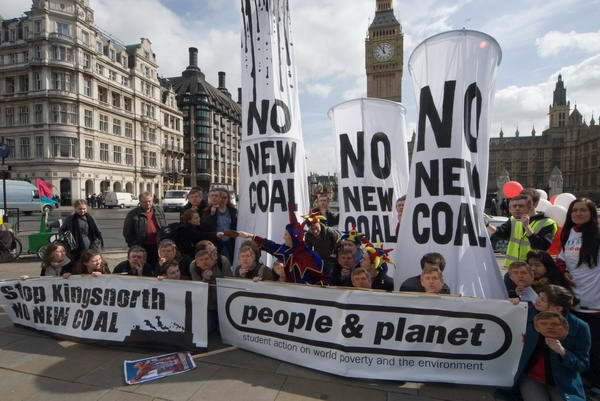
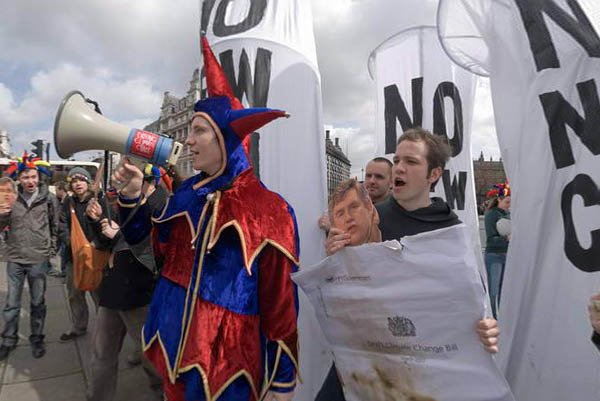
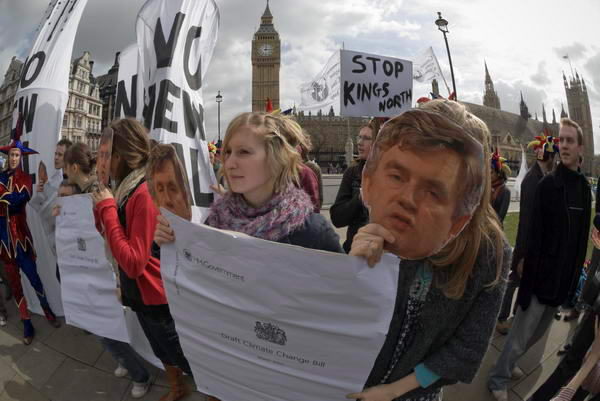
‘No New Coal’ read the cooling towers in Parliament Square

I was too busy to read the April Fool post on 1 April, being out taking pictures of protests in London on ‘Fossil Fools Day’ against the Kingsnorth coal-fired power station and opencast mining in Merthyr Tydfil.

Vaisakhi

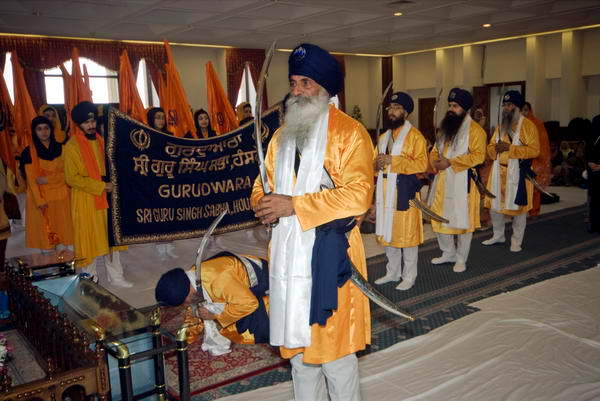
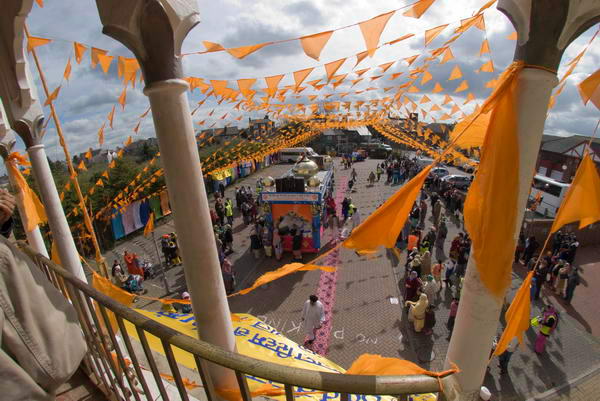
One of the really great things about being a photographer is that it gets you places you wouldn’t otherwise go. So on Sunday I walked into the Gurdwara in the town I grew up up, and was welcomed as a guest and helped to photograph virtually everything that went on.

Hounslow Gurdwara
Rather different from when I used to walk along here to the pub at lunchtimes.

Sikhs are of course very generous people, and non-Sikhs are I think always welcomed. But the reception I got contrasted rather with the Catholic cathedral I’d entered earlier in the week to be greeted by notices stating ‘no photography‘ (and I’ve been escorted out of an Anglican cathedral for attempting to take pictures of an event there.)

Of course you have to behave with a certain sensitivity and follow the normal practice of removing your shoes and covering your head, and not to get in the way of the activities, but as with the Sikh wedding I photographed last year, you could otherwise photograph as you liked.

I was fortunate to meet when I arrived another photographer I knew who had also arrived to take pictures and already knew some of the people at the Gurdwara.

Vaisakhi Hounslow

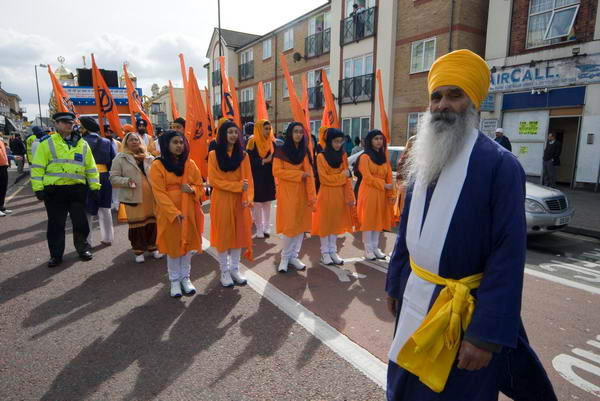
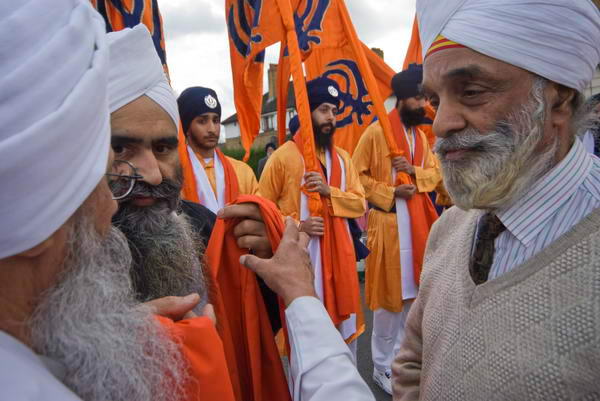
I’ve previously photographed Vaisakhi processions on half a dozen or so occassions in other places, including a few times in Southall, in Slough and at East Ham, so I had a good idea what to expect, although each of these places observes things with some differences. But this was the first time I’d photographed the events inside the Gurdwara before the procession around the town.

Bell Road

I stayed with the procession for several hours as it made its way around the town, which I’ve visited only infrequently since my father moved away in the early 1970s. It was a fascinating day, and like the other similar processions I’ve photographed, extremely interesting. One real bonus is the free food available at various points along the route, though it hurts to have to turn down all the delicious sweets on offer.

Ouside the other Gurdwar in Martindale Road

You can also see pictures from some of the Vaisakhi processions I’ve photographed in previous years on My London Diary. There are processions in various towns over the next few weekends.

Arranged Images and Bossy Photographers

I don’t believe in the elaborate setting up of images of events. As a photojournalist I want to record and comment on what is happening, not to produce staged images.

Of course I’m not naive enough to think that me being there and taking pictures has no effect on the situation. Even were I to act like Cartier-Bresson, hiding his Leica and pouncing on his prey without warning – though in practice he didn’t always work like this either. Flies on the wall don’t take pictures, and even they get swatted at times. Like it or not, we are part of the action.

Actually I do rather like it most of the time. Like getting up close and rather personal, often deliberately using flash fill more to draw the subject’s attention than to alter the lighting, though it usually does that as well. And I do like to shoot several pictures, working through slight variations of my idea before I’m satisfied that if it works I’ve got it working. Of course many ideas still fail, but it’s seldom from want of trying.

So yes, I interact with people and they respond to me, but still in general they choose their responses, not me. Very occasionally I may ask someone to look at me, but usually I’m happy with their choice whether to look at me or away. Yesterday I did ask a couple of people to move placards so I could see things they were masking, occasionally I’ve tidied a branch or some grass out of a foreground, or removed some litter, but generally I don’t interfere with the subject.

At yesterdays Fossil Fuel’s Day demonstration in Parliament Square I watched with some annoyance as one photographer spent around 15 minutes rearranging the cooling towers, demonstrators and banner to produce a rather dull composition in front of Big Ben. Like the other photographers present I was annoyed because it stopped us getting on with taking pictures, and turned what was just getting interesting into a boringly formal situation.

KIngsnorth Demo in Parliament Sq

It’s something that often happens with photographers at events, who want to organise things for their own particular view of what a picture of the event should look like. Local press photographers are usually the worst offenders.

Then there are some press photographers who always want other photographers to stand further away so they can take shots with a longer lens. I use a 200mm quite often, but seldom to take things I could take with a 28mm. You can get too close to things – and sometimes circumstances force us to. At times I’ve been pushed into actual physical contact with the people I’m photographing, which makes it hard even with an extreme wide lens. But in general, Capa’s dictum “If your pictures aren’t good enough, you’re not close enough” is a good one.

KIngsnorth Demo in Parliament Sq
Later we were able to get back to taking pictures

Back to yesterday, none of us like being bossed around, whether when being posed and having pictures or if you are taking pictures. It was behaviour that showed a lack of respect for the subject and for the other photographers present, and also that undermines photography as a medium of record. It makes it PR photography rather than reporting.

Kingsnorth Demo in Parliament Sq

This is one area where journalistic practice in the UK is poor compared to that in the USA. Photographers working for the press here do things as a matter of course that would be firing matters there, failing to observe the clear boundary that they insist on between news and features.

It did mean that I – and others, including the person who had spent ten minutes arranging things and getting in anyone else’s way – didn’t get as good pictures as we might otherwise have done of the centrepiece of the protest – which was a shame.

More about the event and more pictures of course on My London Diary.

Photographers by the Yard

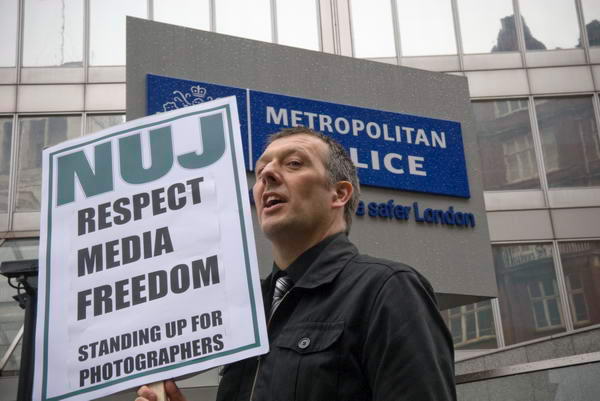
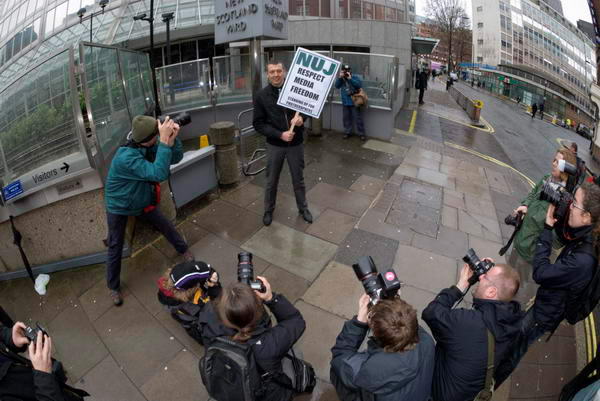
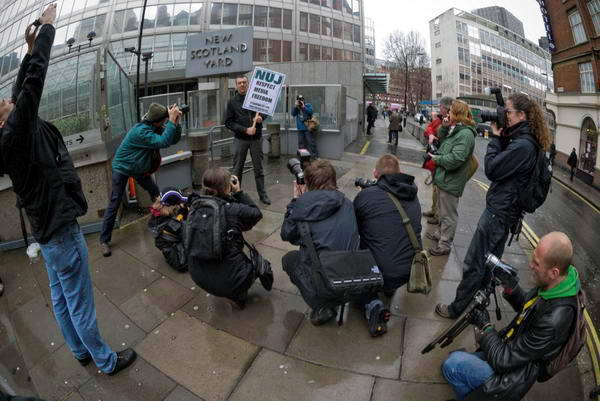
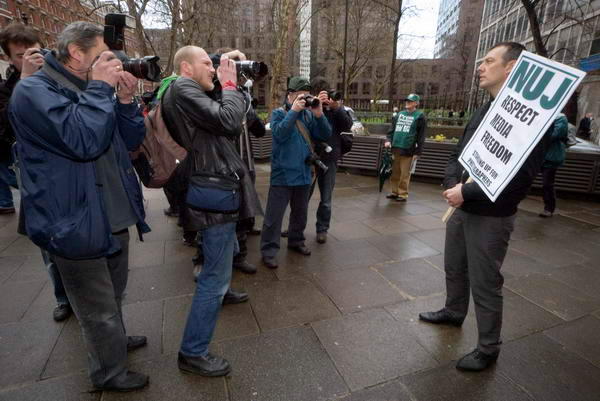
Along with 20 other photographers (dozens according to the NUJ site, but I made it exactly 1.67 dozens) I went along to New Scotland Yard this afternoon to photograph the one person protest by Jeremy Dear, NUJ General Secretary, to highlight the failure of law enforcement officers to protect media freedom.

If you are a regular reader of My London Diary and this blog you will know I often have reason to complain about the way some police officers impede the work of photographers covering protests on the streets. Sometimes its a matter of individual officers deciding that we shouldn’t be photographing particular events – as in the case of the officer who stood in my way while a young man was being stopped and searched in Whitehall, and when I attempted to move into a position that gave me a clear view while in no way interfering with the work of the police ordered me back. At other times its a failure by the officer in charge to realise that we need reasonably close access to events to photograph them adequately. Sometimes we are even denied access on spurious grounds of road safety – when police officers are standing further out in the road than photographers would.

There are agreed guidelines, but too often police simply ignore them. At times officers have even denied that my NUJ Press Card is a valid press card, and have treated me as a protester rather than a reporter, refusing for example to allow me to leave a protest when I have finished taking pictures.

In particular the SOCPA legislation which has made many demonstrations around Parliament illegal has soured relations between police and press – as well as those between police and protesters. So its good news to hear that the relevant aspects of this law are to be reviewed, although we may fear that a SOCPA Mark 2 will be no less inimical to the rights of citizens to protest.

SOCPA provided a limited right for one person demonstrations, which although they had to give notice, the police are not entitled to ban, although they can impose restrictions. So Jeremy had duly applied, filled in the forms and answered various questions about his demonstration (the police were apparently very exercised about the actual wording of his placard) and been granted permission, and photographer Marc Vallée had talked, texted, e-mailed and contacted through Facebook and other on-line sites with photographers to persuade them to come and photograph the event at New Scotland Yard, bribing us with the offer of a free drink to celebrate the out of court settlement his lawyers recently agreed with the Met for his injury during the ‘Sack Parliament’ demo in October 2006.

It was a fairly daunting group of photographers to be working with, including a few well-known names and as always we all wanted to take a better picture than the pack. There wasn’t really a lot to work with – just Jeremy with a placard, New Scotland Yard as a background, and of course the other photographers, so it was something of a challenge.

NUJ photo protest

I started with a straightforward picture of Jeremy with the placard and the New Scotland Yard (or Met Police) sign behind him. Not a bad snap, but nothing special.

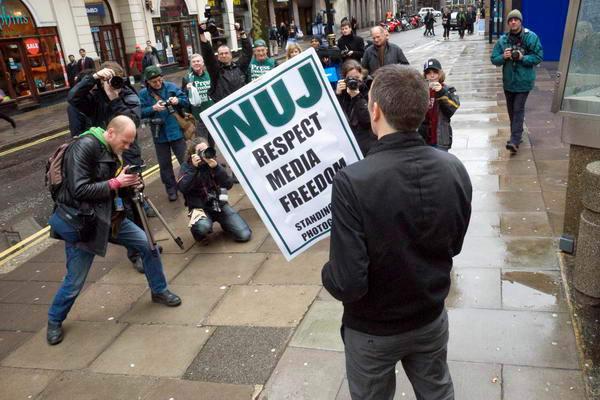
But obviously it would be more interesting to have both him and the photographers. I tried a ‘Hail Mary‘ from behind with the 18(27)mm wide-angle end of the 18-200; perhaps a bit too prosaic, and of course you can’t see his face, nor the whole of the placard.
NUJ PHotographers protest

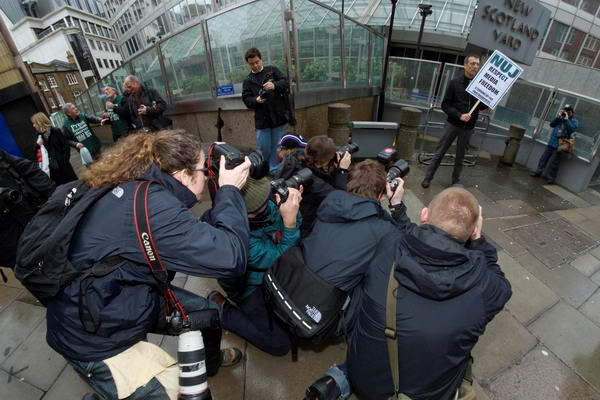
Unfortunately for once the police were simply ignoring us and standing some distance away. I tried a few shots including them, but the placard was just too small, so I came back to photograph the pack from close in using an extreme wide-angle.

NUJ Photographers protest

Several rather similar shots to choose of which I thing this is the best.

Taking a higher viewpoint gives a different view, but shows a line of photographers rather than a pack
NUJ Photographers protest
and coming down lower perhaps provides a more interesting shot.

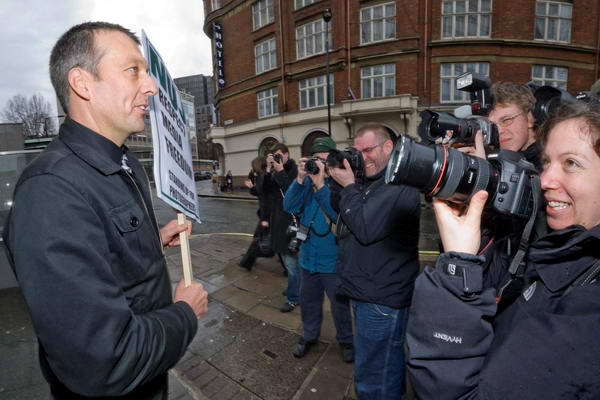
Moving in close to Jeremy, still working with a very wide lens I could show him, the poster (though a rather oblique view) and the line of cameras pointing at him.
NUJ Photographers protest

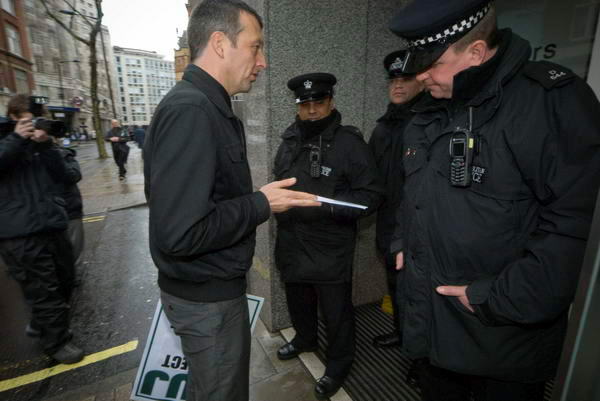
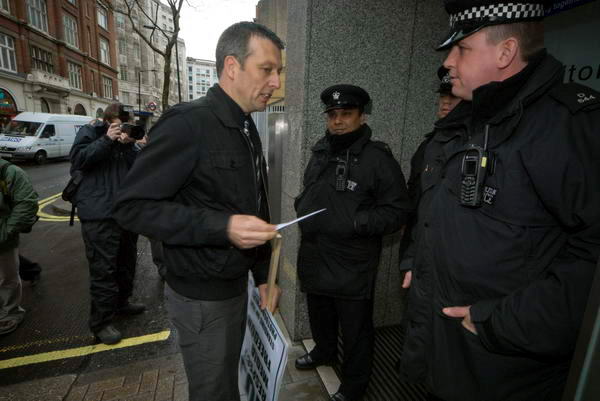
Jeremy then moved to hand in a letter to New Scotland Yard, but they refused to take it. I moved fast to be in the right place and shot from close with the 12-24mm, getting a couple of shots that aren’t bad.

NUJ Photographers protest

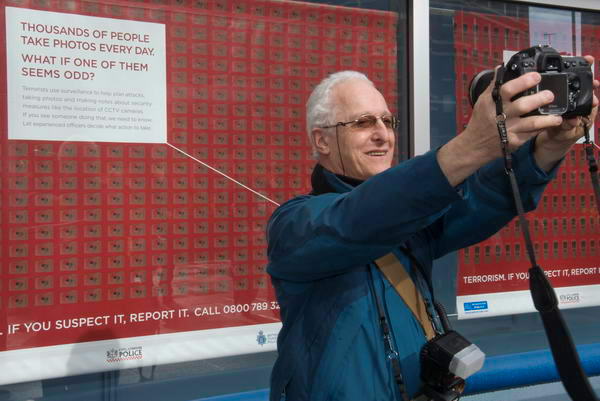
Finally we moved to the corner of the building where the windows were showing the infamous posters, including the anti-photographer poster:

THOUSANDS OF PEOPLE TAKE PHOTOS EVERY DAY. WHAT IF ONE OF THEM SEEMS ODD?

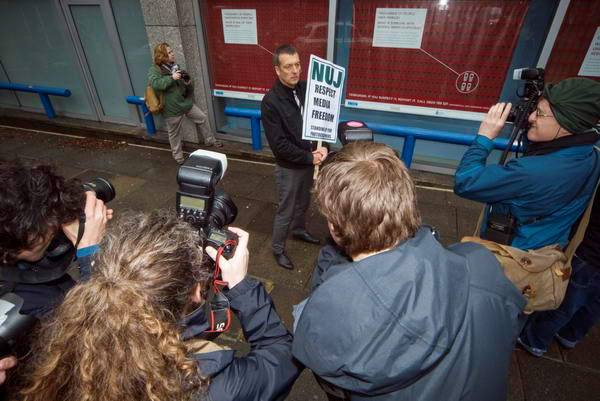
Again my starting point was a simple image of Jeremy with placard in front of this.
NUJ Photographers protest

Then I shot the pack facing him, but couldn’t include the poster in this.
NUJ Photographers protest
Shooting over their heads provides an image including the poster, but not I think a very strong one.
NUJ Photographers protest

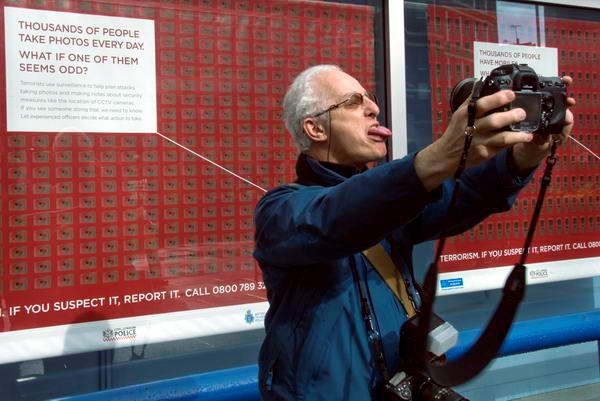
David Hoffman has produced one of many parodies of this poster available on the web – and you can buy his as T-shirts, mugs etc. He decided to photograph himself in front of it, and I caught him doing so, with tongue out

and looking rather more normal
David Hoffman

Finally came a few pictures of photographers standing in front of the poster and looking odd. If I post these here they might never speak to me again, so I’ll tuck them away in case I ever need them for blackmail.

Peter Marshall

David Spero – Urban Churches

Taking one of my regular looks at the ‘Conscientious‘ blog I was interested to see a familiar building from Finsbury Park, London, the former cinema which became the ‘United Church of the Kingdom of God.’

This is one of a series of 15 churches in various odd buildings mainly around London photographed by David Spero, a photographer born in 1963 who studied at the Royal College of Art. Most of the locations in the series were familiar to me, although in one or two cases I’d photographed the same buildings before they were in use as churches.

Spero goes for the clear overall view, and does it well, and like
Jörg Colberg I find this the most impressive of his projects. Part of the reason for this is I think in the very variety of the buildings concerned as in some of his other projects (both when I’ve seen them on gallery walls and on his web site) I find the images too similar. Of course to Spero this was perhaps the point, but I find it a little tedious and long for a little more surprise in the next image in some of his work.

Some of projects in the ‘archive’ section of the site are represented by a very small number of images. ‘Interiors‘, ‘Boardrooms‘, ‘Control Towers‘ look like promising areas, but what he shows us is enough to tantalise but not to satisfy. It seems hardly worth putting only 4 or 5 images from each on the site – it isn’t as if the web was an expensive medium to use.

The churches project is a good example of how concentrating on a small subject and presenting it can work well. Although I’ve shown images of such urban buildings pressed into new use, and particularly images of black-led churches, I’ve never approached it as a discrete subject in this way.

Finsbury Park

One of my best-hidden web sites does however take a look at Finsbury Park and the surrounding area (although I’ve also photographed it on quite a few other occasions.) The pictures I put on those pages were made when I had just started to work seriously with a Hasselblad Xpan, and don’t actually include the church/cinema though I’ve photographed it on several occasions and probably while making these images.

Finsbury Park
Finsbury Park, London, 2002

A rather prettier picture of the New River in Finsbury Park from the series actually won a photo competition concerned with the regeneration of the area.

At the time I posted the images and wrote on-line that I had walked around the area carrying the Hasselblad I got several messages from people telling me I must be mad to go on the streets there with an expensive camera. One at least came from someone who had lived in a flat there for some years. But if you are sensible – and at least slightly street-wise, London remains a very safe city.

Golden Full Moon in Soho

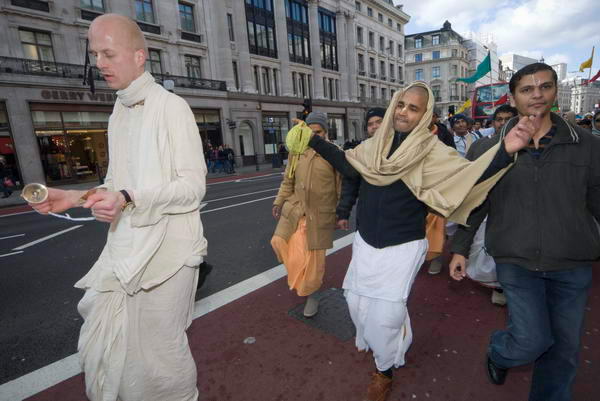
From Golders Green I travelled on to Soho and started to look and listen for the Hare Krishna procession to mark the Gaura Purnima festival. Around 500 years ago in West Bengal, Krishna put in an appearance as the Lord Caitanya, and encouraged everyone to chant and sing the name of Krishna. The practice came to London and other western cities in the 1960s with the International Society for Krishna Consciousness (ISKCON) and became a part of hippie culture (if not usually lifestyle.)

I finally heard the sounds as I walked up Regent Street close to Oxford Circus, and turned the corner to see the procession with dancers, musicians and a large chariot pulled by people on ropes coming along Oxford Street.

Regent St

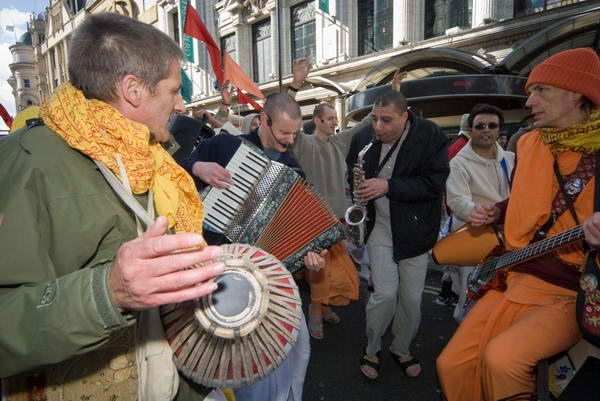
Although you can’t normally photograph sounds, the noisiest parts of processions – and demonstrations – are often visually the more interesting too. People simply walking are less interesting than people dancing or playing musical instruments.

Musicians

I photographed the procession as it went down Regent Street and past Piccadilly Circus, where a clash of culture appeared between religion and the Mammon of the billboards , and on to Leicester Square.

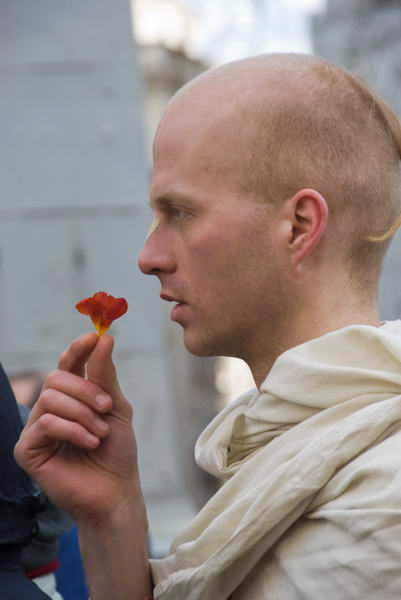
The procession stopped here for a little ceremony and a short sermon. I watched as incense was burned, and flowers passed reverently around and their fragrance savoured.

I left them still chanting in the square and went to the pub, despite an invitation to join them in the meal at which they would break their fast. I’d had my sandwiches on the underground on the way to the event, and didn’t feel too attracted to a lifestyle that means giving up on alcohol, caffeine, meat, fish, eggs, onions and garlic, mushrooms and sex (apparently allowed only for the purpose of procreation within marriage.)

More pictures 

Purim

As well as being Good Friday, last Friday was also the Jewish festival of Purim, which celebrates the saving of the Jewish people while in exile in Persia by Esther. Orphaned as a child she was brought up by her older cousin Mordecai. When King Ahasuerus fell out with his Queen and organised a beauty contest to find a replacement, Mordecai encouraged Esther to enter, advising her to hide the fact that she was Jewish. She won and became Queen Esther, and Mordecai gained a minor position in court, where he did well.

Golders Green

Haman, the villain of the story, became chief minister, and fell out with Mordecai who refused to bow down before him as he expected. Haman decided to kill all the Jews, persuading the king that they were a people who obeyed different laws and should not be tolerated in his kingdom, and he made plans for them all to be killed.

Mordecai persuaded Esther she must see the king and plead for mercy – as she too would have been killed. It was tricky as anyone who went to see the king without his invitation – even a queen – was likely to be executed on the spot. She fasted three days before risking a visit, but fortunately he was pleased to see her. Later she told him about Haman’s plans and that she would be one of those killed; he was appalled and granted mercy. But he had already allowed Haman to make the orders in his name, and they could not be annulled. Instead he made a new decree, allowing the Jews to defend themselves against the killers – which they did with great effect, killing 70,00 and hanging Haman on the gallows that he had built for Mordechai.

Golders Green 2

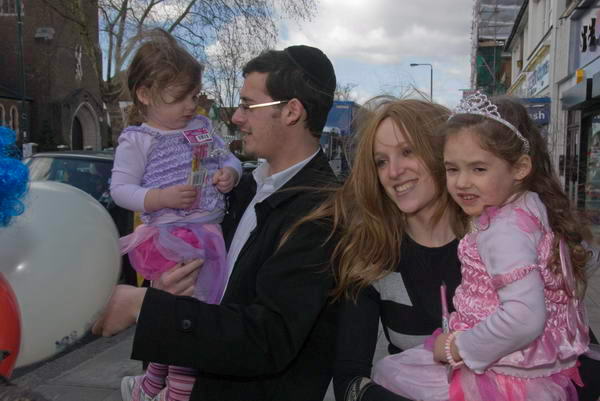
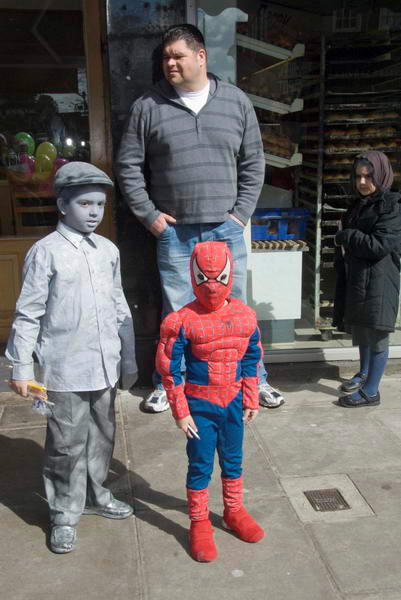
The Purim celebrations include wearing fancy dress, and I photographed the people at at Camp Simcha Purim fun bus in Golders Green for half and hour or so, and you can see more of the pictures on My London Diary.

Good Friday

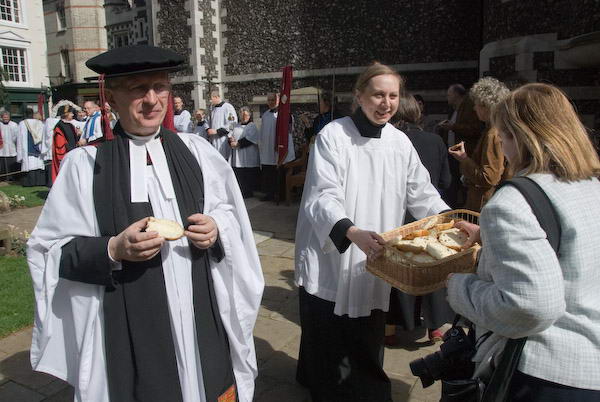
Last year I photographed four rather different events of Christian witness on Good Friday in different parts of London – including council estates, a main railway terminus, a shopping centre and a traditional ceremony at one of the oldest Anglican churches in London.

Butterworth Charity
Good Friday: Distribution of the Butterworth Charity, St Bartholemew the Great, Smithfield, London. April 6, 2007

This year I managed only one, the other half of the North Lambeth and District Good Friday Walk of Witness, which made its way around the area by Waterloo Road and The Cut to meet up with those coming from the Imperial War Museum to the service in Waterloo station.

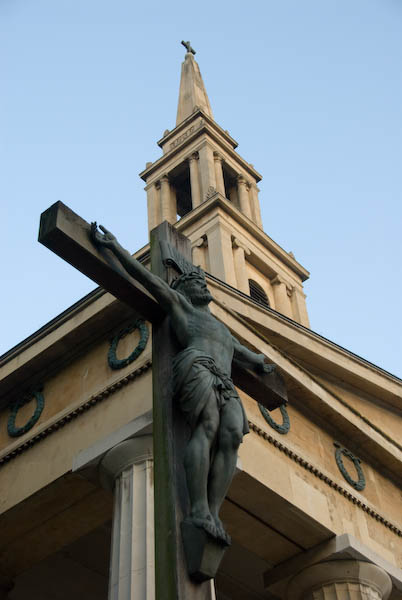
St John's Waterloo
St John’s, Waterloo
We started at St John’s Church on the Waterloo Road, a fine Greek Revival building, leaving by the gate at the back of the churchyard and walking to the modern St Andrew’s in Short Street and on to the square opposite the Old Vic theatre. After a short service there the procession led on to Waterloo Station and a longer service with the other group in the middle of the forecourt.

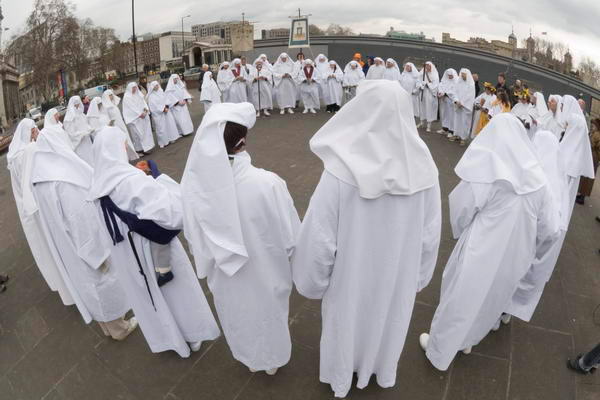
Druid Spring

Tower Hill

Easter weekend has been long and busy for me and I’m only now beginning to catch up. Thursday was the start of Spring, marked this year with biting northerly winds, threats of snow and some bouts of cold driving rain.

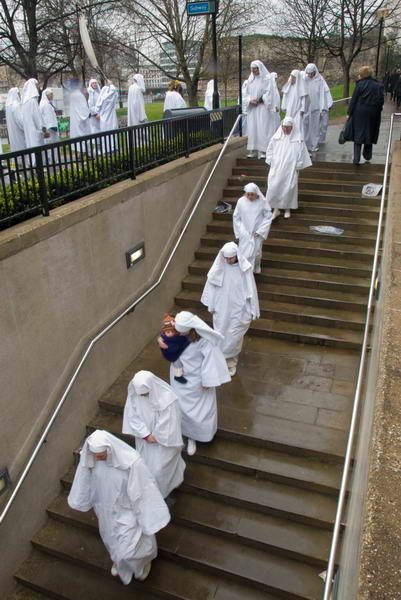
The Order of Druids were lucky that the rain held off until the end of their Spring Equinox celebration at Tower Hill, but their long file back to their starting place was through the rain.

Through the subway

As always when photographing in rain, it was hard to avoid the odd drop on the front of the lens, giving some diffusion – as you can see in a couple of areas of this picture. With a wide-angle lens, you can’t use a lens hood that will effectively protect against rain, and when the wind is sweeping the rain fairly close to horizontal umbrellas are tricky to hold and rather ineffectual. Working without an assistant they get rather in the way in any case.

Like most photojournalists in similar conditions I work with a microfibre cloth or chamois leather, wiping the front of the lens at frequent intervals and keeping the cloth balled in front of the lens with my hand in front of it when not taking pictures. But there is still the second or so when you actually frame the image for the rain to descend.

At such times I always think of the Martin Parr book, Bad Weather, in which he sought out the effects of water drops on the lens, flash bounce from rain and snow and more, often working with an underwater camera for the purpose. Interesting though the pictures are, I think few editors would have the vision to see it in his way. But perhaps the main thing that makes the pictures I took of the Spring Equinox this year differ from those I made last year is the weather. There is after all something timeless about the Druids, whose origins stretch back into the deepest ancient history even if the particular order I was photographing was only inaugurated for the Autumn Equinox at Primrose Hill in 1717!