April Biofool

Last week’s ‘April Biofools demonstration opposite Downing St looked a promising event to photograph, but I ended up finding it rather disappointing. At least one photographer wisely decided not to hang around and went home after taking just a few pictures.

The issue is of course a serious one. Using biofuels looked green enough to attract the support of the EU – and so we got the Renewable Transport Fuel Obligation (RTFO) – and it’s ratification was the reason for this demonstration. Biofuels were seen as a technical fix for carbon emissions, but unfortunately turn out in practice to be the kind of fix that creates more problems (and more carbon dioxide) than it solves.

Buring down the forest

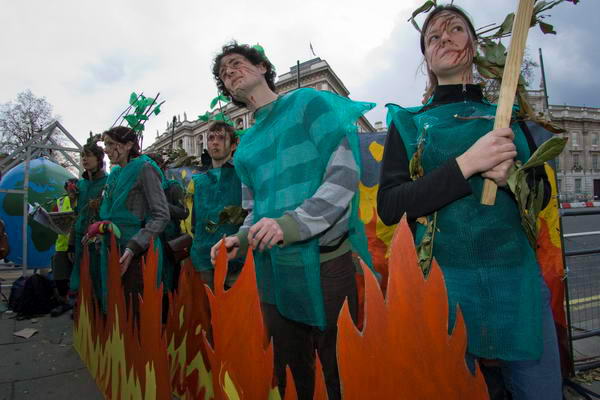
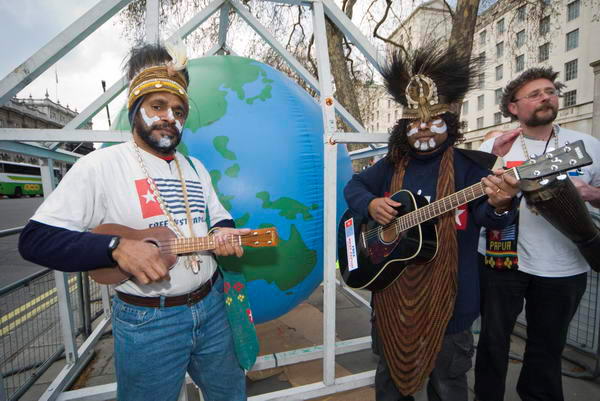
Commercial biofuel production means taking land out of food production, burning down forests and more. The organisers had gone to some trouble to show some of this in visual terms, with protesters from West Papua, one of the largest areas of rain forest under threat from biofuels, and others dressed up as trees being destroyed by some brightly painted flames.

What the event really lacked was numbers, and perhaps this was because they had set up another session for the press at lunchtime. It did however allow me for the first time ever to make some real use of the Campaign Against Climate Change‘s greenhouse containing the Earth, which photographers have cursed at since it first appeared. One of many great ideas that just doesn’t really work visually (like those huge banners that you need a helicopter to photograph.)

West Papuan independence protesters

I wasn’t sure where West Papua was, and I was able to get those campaigning for its independence from Indonesia – who invaded it three months after it became independent from Dutch rule – to show me exactly where it was. For once I really made the earth move, turning the globe around to photograph them in front of their country on it.

Still not much of a picture though!

Wide Angle on Global Day Of Action For Darfur

I do like working with wide angle lenses, as anyone who has ever looked at My London Diary will have noticed.  Most times when I go out to take pictures I start off with a wide-range zoom on the camera, either a Sigma 18-25mm or the Nikon 18-200mm. The Nikon adds that extra length, has VR (I keep it switched on all the time, but don’t feel it does a great deal) but is quite a bit heavier and bulkier and mists up badly in dampish conditions. Image quality is very similar – both need software correction for chromatic aberration and distortion for critical use.  The Sigma feels better made, has a much better lens hood – the Nikon hood often falls off at inconvenient moments. Annoyingly the Sigma zooms in the wrong direction, but that’s the only real problem I have with it.

These lenses are both very flexible, allow you to work from a little distance or get in reasonably close. But when things are going well, there is usually a time when I feel I need to take off my jacket and get stuck in with a real wide angle, such as the Sigma 12-24.  And sometimes when I want to get really close and personal, the 10.5mm Nikon semi-fisheye. The curvy perspective can be a problem with the fisheye, but often when I use it I’m already thinking how I can sort things out a little in software afterwards.

The Darfur Day of Action marked five years of conflict there, and I needed the wide-angles for the two Darfur events I photographed in April and September 2007 as well.

Sudanese Embassy
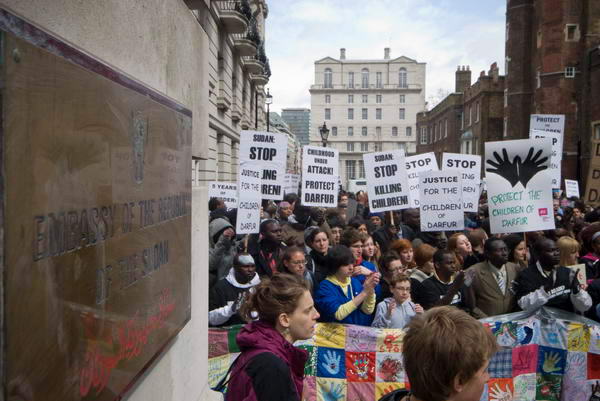
This shot, with the 12-24mm, manages to show that the demonstration is taking place at the Sudanese Embassy. A little work with Photoshop would help to bring this out – but this is a simple development of the RAW file. Probably I could have improved it a little while I was taking the image, but I had to stand on top of a wall with a rather long drop down to cellar level in front of me, the kind of situation that always leads me into a bad case of the shakes. I’ve just no head at all for heights – I blame it on my father taking me up with him on roofs where he was working when he had to look after me when I was a very small child.

But the wide angle has let me put together the brass plate and the demonstrators, and the perspective on it brings in the eye to the demonstration. I’d have preferred it to be wider to show more of the demonstration which stretched roughly twice as far across the street.  Although this was only at 24mm, it is tolerably sharp from the Y of Embassy to infinity, depth of field being a great advantage (usually) in wide angle shots – this one at f13.

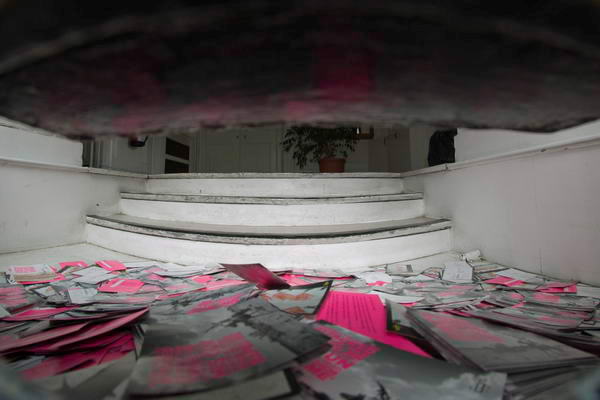
Shortly before I’d poked the 10.5mm into the Embassy letter box, with this effect:

fisheye-ITfilter

Earlier I’d photographed people putting postcards through the door, and here they are in a pile on the floor inside., almost covering the area in front of the steps. Here I’ve used the Image Trends  Fisheye-Hemi 2 filter, followed by a slight crop. I couldn’t quite get the lens as far into the letterbox as I would have liked, but I think it still gives a decent effect.  The closest cards are really very close to the lens, and even the vast depth of field of the fisheye doesn’t quite cover.

The filter makes vertical lines straight, but leaves horizontals such as the steps with the curve that you see.  It is easy to remap to rectilinear perspective, but that seldom works unless quite severely cropped. The horizontal angle of view of roughly 140 degrees just results to too distorted a stretched effect towards the edges, and much of the image is lost when the remapped image is cropped to rectangular. You also get a drastic loss of quality at the edges and corners where there are simply not enough pixels to give a good result.

You can also try remapping fisheye images with the Panorama Tools plugin (particularly using the PSphere projection) or RectFish although this latter is perhaps better for circular fisheye images. Another alternative – and a great way to deal with distortion in all normal lenses, is PTLens.

The Darfur Protest pictures include a number taken with an ultra wide or semi-fisheye lens – as well as those taken with longer focal lengths. These things are useful tools, but can’t do everything you might need to do.

Protest and Publicity

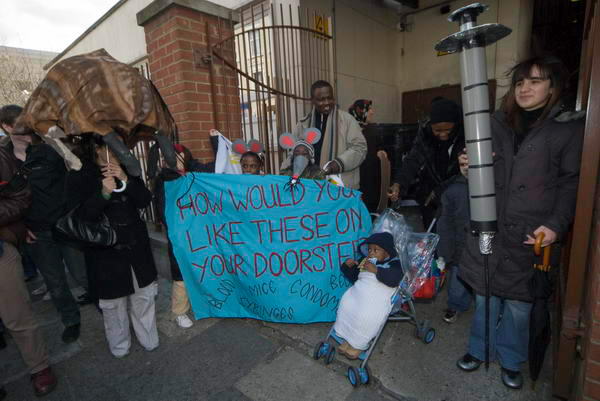
On Saturday morning, April 12, I arrived at a hostel in Stoke Newington from where residents, together with supporters of the London Coalition Against Poverty, were intending to march to Hackney council offices to highlight the appalling conditions they lived under and shame the council into taking action rather than simply making promises.

As I arrived, another photographer, photographing for a local paper advised me I needed to talk to the organiser of the event. She told me that it might be a problem if pictures of some of the women involved were to appear in the press, as some had been rehoused after suffering violence from their partners and that photographs might reveal their location and expose them to further attacks. Since one of the issues the protest was about was the lack of security at the hostel, with no locks on the outside gate and easily broken doors to the flats themselves, this seemed a real problem.

Of course, publicity was important to the case the residents was making. So they wanted publicity – and pictures. There was a dilemma here, and one which I don’t really think sensible that I should have been faced with. This was a protest in public, walking through busy streets in a major shopping area full of people with cameras – and I later saw many holding up their phones as the march past.

If there are ever real concerns about people being recognised in public protests, the solution is obvious; they should cover their faces (and any other recognisable features.) Many people in demonstrations of course do, for various reasons and in various ways. In this particular event, masks depicting mice, rats and bed bugs would all have been appropriate, and added to the impact of the march, although simple scarves or balaclavas would have done the job.

PHoto call
Photo call outside the hostel gate before the march. The umbrella is a bed bug.

There were some ‘mice’ present, and they were difficult to keep out of the camera. I tried hard to make sure everyone in my pictures was happy to be photographed, because the last thing I want to do is to cause any problems to people who are already in difficult circumstances. Nobody I asked had any problems with having their picture taken, so perhaps all those whose position was sensitive stayed at home.

Story and more pictures on My London Diary

Vaisahki Woolwich

Vaisahki celebrations continue around London – one of the last this year will be in Vaisakhi in the Square at Trafalgar Square on Sunday 4 May, around three weeks after the actual day, where some 25,000 people are expected, mainly to watch the dancing, music and drama in the afternoon. I probably won’t be there, as I find such events too organised to be of great interest and usually too crowded to work effectively. But if you do go, go early and enjoy the religious events in the morning – and get in the queues for the free food before they stretch all the way round the square.

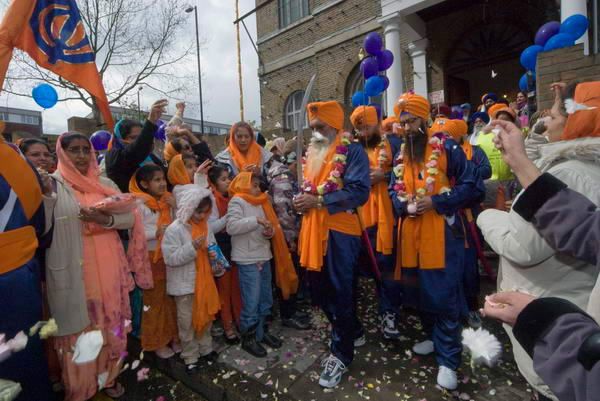
Coming out of the Gurdwara
Calderwood Gurdwara, Woolwich, April 2008

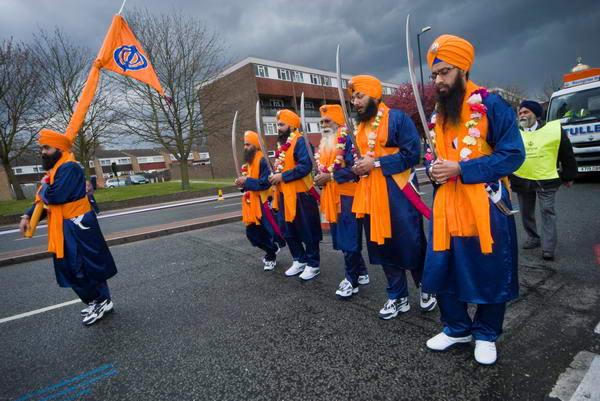
The Vaisahki celebrations in various places around London are of much greater interest, and I greatly enjoyed photographing those in Hounslow at the end of March. Others I’ve photographed in previous years are in Slough, East Ham, and the largest of them all, in Southall, which I’ve attended several times. This year it took place on the same day as the Olympic Torch debacle and so I missed it. One I’d not been to before was at Woolwich.

Woolwich Vaisakhi
Vaisahki procession at Woolwich

As you can see from the picture above, the weather was April at it’s most intense, lead-grey clouds and dramatic colour. Sunshine was soon replaced by a rainstorm that, apart from the temperature, could have been tropical.

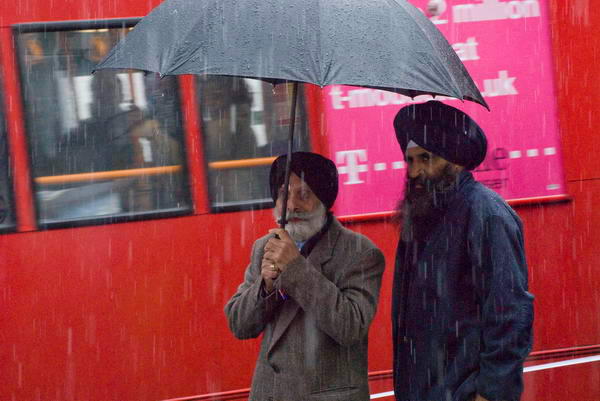
Rain

I took shelter, taking pictures of the people continuing in the procession through the torrential rain, many without umbrellas. Fortunately it wasn’t too long before the sun was out again and people beginning to dry out as they walked up the hill. I was sorry to have to leave them here, as the celebrations were to continue when they reached the second Gurdwara – another year I’ll make sure to have more time.

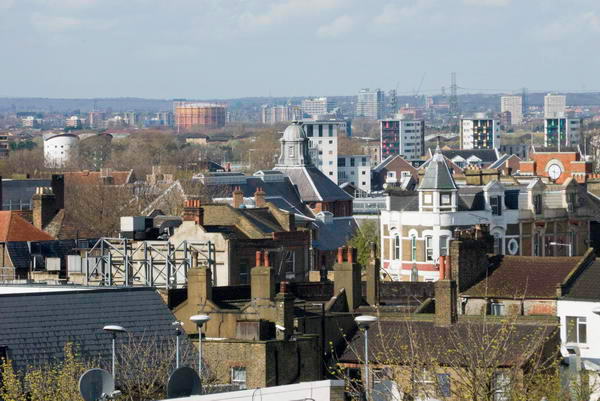
Woolwich view

The rain had cleaned the air, and the view from the hill into the distance had an unusual clarity as I walked back down to the station. Across the rooftops of Woolwich the distinctive student accommodation of the University of East London 2.5km distant seemed only a stone’s throw away.

More pictures of Vaisakhi in Woolwich.

Free at Last! But…

The pictures of Bilal Hussein that we’ve been waiting for- in an Associated Press feature on Google News.

So all of those who campaigned on his behalf will be celebrating his release after two years of imprisonment without cause by the US in Iraq. But like his mother, who is quoted there as saying “I thank God for Bilal’s release and I hope that all Iraqi detainees will be released” we know that he is only one of many who have been detained without proper cause.

In the same feature, Joel Simon, of the Committee to Protect Journalists deplores the way that the U S Military is increasingly removing journalists from conflict zones and locking them up for prolonged periods before releasing them without bringing charges.

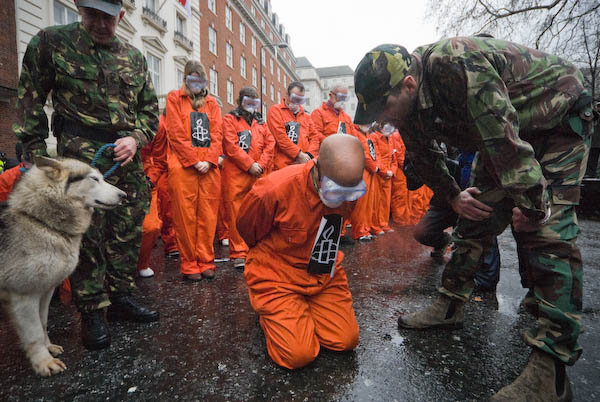
Of course, as the prisons in Iraq and most obviously Guantanamo Bay attest, it isn’t only journalists who get such treatment. The demonstrations in January marked six years of the illegal detention of prisoners at Guantanamo, with some now having been held over three times as long as Bilal. Binyam Mohamed was arrested in Pakistan on April 10, 2002 and the CIA took him to be tortured in Morocco for 18 months, then imprisoned him in Afghanistan before he ended up in Guantanamo, where he remains despite a request from the British Government for his release made last August.

Guantanamo demo, London
London demo marks 6 Years of Human Rights abuse at Guatanamo

Of course the USA isn’t the only country abusing human rights, but what makes it stand out is the gap between the rhetoric of defending freedom and the practices of torture, maltreatment and illegal imprisonment used in the so-called ‘war on terror.’ It’s perhaps a continuation of the same hypocrisy and failure of understanding that led to disastrous US foreign policies that took them into Vietnam, supported dictators and corrupt regimes around the world (including for many years Saddam in Iraq and in too many South American countries to list.)

Of course there are many countries with a considerably worse record in terms of human rights in their own territory – China springs immediately to mind – and of course for its activities in Tibet as well as for its abysmal record in China itself. And of course Britain isn’t entirely blameless. In My London Diary I’ve recorded protests about human rights abuse in countries around the world. I sincerely wish there was less need for them.

Silverprint

It’s a while since I last visited Silverprint in Valentine Place, off Webber St, a few minutes walk from Waterloo Station in south London. With the shift to digital in most aspects of photography, my requirements for photographic materials in general have dropped greatly. I seldom make actual prints, viewing images on screen, supplying work as digital images.

Even for exhibitions I’ve supplied work digitally. The 24 pictures I sent to Brasilia travelled by e-mail (all 96Mb) and I’ve previously written about my excitement when the prints, made by the best lab in Brazil, in Sao Paulo, were unwrapped for hanging. I’ve not actually seen the extremely large print made from my file I sent to Hungary for the touring ‘Europe Of Culture – The Culture Of Urbanity‘ show, and even for the two shows across London in Hackney which I had pictures in last year the images were sent as files.


This picture was in ‘Out and About in Hackney ‘at the Hackney Museum

The pictures for the Roof Unit show at Space went digitally because we had decided to print using Lightjet, and I have to admit they were very nice prints, although probably I could have done as well on the considerably cheaper Epson R2400 I normally use.

But most of my older work on photographic paper was made on materials imported by Silverprint – and it’s precursor in Muswell Hill, Goldfinger, where I benefited from the advice that was available both personally from Peter Goldfield and Martin Reed and in print in the old Goldfinger craftbook. Later came an encyclopaedic Silverprint Ag+ manual and Silverprint magazine that became Ag+ magazine.

You can read the latest news from Silverprint on their web site and one of the more interesting additions to their range is InkAID, which enables you to coat almost any surface – including traditional fine art papers, metal, plastic and wood veneers, so they can used to make decent ink jet prints – assuming of course that you can feed them through your printer.

Also available as a large download(10Mb) from the site is an article by a photographer I mentioned recently, Angus McBean, written and photographed by him for ‘Homes & Gardens‘ magazine in March 1977. This describes the restoration by him of his Elizabethan house, and as might be expected he certainly makes it into something theatrical if not a place I would find comfortable to live in. The photography is of course extremely professional, but frankly rather ordinary, and unless you have a particular interest in period homes your time would be better spent at the rather eccentrically designed Angus McBean web site.

A Day with Panasonic

I’ve often seen the RIB (Rigid Inflatable Boats) speeding along on the river and wondered what a trip in one would be like. Today, thanks to Panasonic, I got to find out. It actually felt surprising smooth and safe, although they did tilt at quite a steep angle when turning sharply at high speed, and I often felt a need to hold on with one hand while taking pictures. But it was enjoyable and rather more exciting than the conventional river trips, although these would be considerably easier to take photographs from.
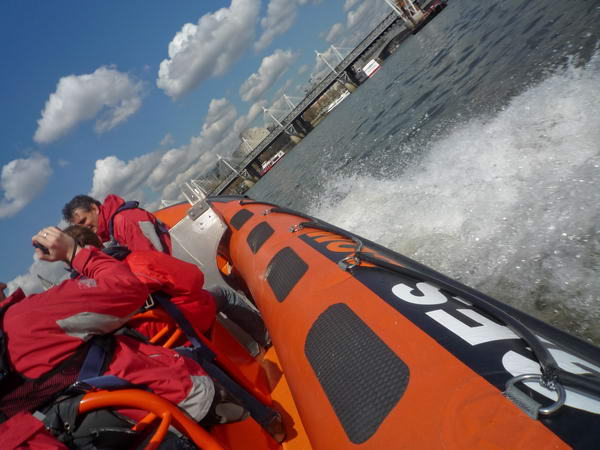
RIB Thames

If you are planning a trip to photograph London from the river, its also worth taking a look at the tide tables. When the tide is fairly low you do get the advantage of some uncovered sand and mud which might add pictorial interest, but at high tide the added height gives you a better viewpoint, as do the raised decks of some of the larger river boats.

Panasonic had invited a number of bloggers to come and look at their latest products, both in their Lumix range of still digital cameras and also their camcorders.
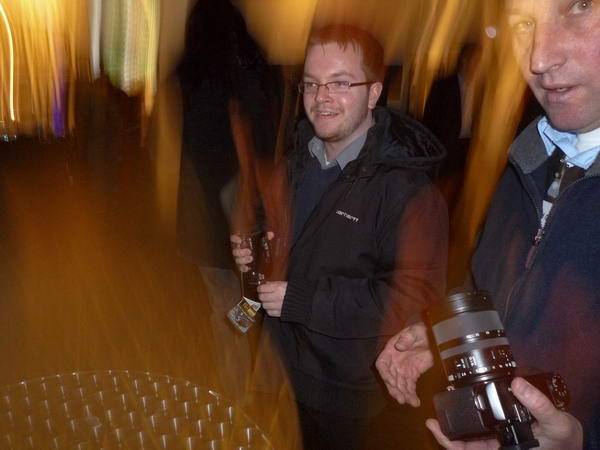
We met in Dali Universe, handily close to Waterloo station, and the morning started with an opportunity to handle the cameras and then a presentation about them. Panasonic came to still cameras late, but have from the start realised the need to offer new ideas, becoming one of the more innovative companies. Some of the ways they are doing this sound very interesting, such as intelligent exposure which can, among other things – and if I understood correctly, make use of different ISO speeds in different areas of the same image to produce more evenly lit effects when using flash.

Panasonic cameras also have benefitted greatly through cooperation with one of the most repsected firms in the business, Leica in lens design. It is perhaps the link-up with Leica that has enabled them to offer wider angles of view on their compact digitals, with 28mm or even 25mm equivalent as the widest angle of view on many of their cameras. Leica make some of the best wide-angles available for use on their M-series cameras, and I only wish I could afford a couple of their recent designs to use on my Leica M8, which gives the sharpest results of any digital camera.

After the talk we were allowed to choose a camera to get some hands-on experience with during a RIB river trip, which took us up close to Canary Wharf then back past the Houses of Parliament and then to the pier at the London Eye. It was an exhilarating journey.
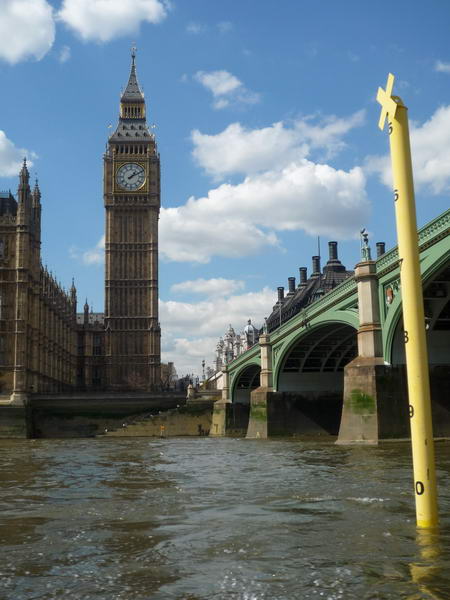
HP

Panasonic DMCFX-500

Given my preference for wide-angle lenses, I chose one of the new compact cameras with a 25mm lens to use on the trip, the Panasonic DMCFX-500. It’s a beautifully compact design and gives sharp 3648×2736 images, as I found under rather trying conditions of shooting from a RIB going rather fast along the Thames. If I needed a new compact for general use, this would be camera around the top of my list. It’s not fair to judge it from my limited trial under rather trying conditions, but it generally performed pretty well, and I imagine if I’d had the time to read the manual and fine tune things it would have done even better.

The colour was pretty good, the images were showed low noise. I left the camera on auto, and it was a sunny day, so almost all were at ISO 100). They had good detail with just a hint of over-sharpening (less than with the default settings of many compacts.)

But it isn’t my ideal camera. Despite the nice large clear viewing screen I still want an optical viewfinder, but that is fast becoming a lost cause. But what I had most problem with was shutter lag. Perhaps 20% of the pictures I took were not as intended, either because of the speed of the boat which meant the camera was pointing at something different by the time the picture was actually made or because I’d not held the camera still for long enough after pressing the shutter.

I blame Henri for this, Cartier-Bresson that is. Long ago I read his advice on taking pictures, about getting to know your camera so well that you could make all the settings needed without looking at your camera, then take pictures in a single rapid movement of the camera to your eye for the 1/125 of a second or so needed to frame and expose before bringing it down again. With a compact camera you need to remember to keep holding it steady for a second or so after you press the release, and the delay with the FX-500 seemed just a little longer than my current compact – so more pictures of the back of the seat in front of me than I really needed.

The camera also features image stabilisation, but either I didn’t have it turned on or the vibration on the RIB was just too much for it to cope with, and many of the images at longer focal lengths were unsharp due to camera shake. I didn’t see any problems with those taken on dry land, but mostly those were wide-angle pictures.

The screen image was large and very clear, possibly the best I’ve worked with in bright light. On auto, the camera also made some fairly intelligent decisions about when fill-flash was needed, although it wasn’t clever enough to spot the reflective clothing in one picture that always creates problems with its use.

Overall it seemed a nice camera to use, although I would need to get used to the shutter lag and for this reason wouldn’t choose it for action photography. But as a camera to put in your pocket for when you don’t have your Nikon or Canon DSLR it would be a reasonably versatile choice.

Examining the images back at home on my computer I was pleasantly surprised by the image quality. It seemed pretty even across the frame and there was little or no vignetting, perhaps thanks to the Venus4 engine. It looked as if this was also doing a fine job of removing chromatic aberration, as although there was some weak red cyan fringing, this could not hardly be improved using my usual software lens corrections. There was also a small amount of blue fringing visible, but not objectionable in any of the images I took.

The exposures were pretty consistent, and mainly more or less spot on, though in some cases a little highlight detail was clipped. I didn’t find out if it was possible to display a histogram or otherwise examine this. But there were quite a few images where it occurred to me that a RAW file would have been a great advantage. I don’t like to shoot jpeg, but most of these were very acceptable straight out of the camera, though almost all were improved slightly with a little tweaking in Lightroom.

Overall, although the Panasonic DMCFX-500 seemed to be a very good compact camera with the 25mm lens and image quality (at ISO 100 – not tried at faster speeds) a big point in its favour, but the shutter lag did seem worse than my current model, and the shot to shot time also seemed a little slower, although I didn’t measure it.

If you don’t already have a decent digital compact, the DMCFX-500 is certainly worth a look. It would be a good camera to take on a holiday where you wanted to travel light. Some people might prefer the longer 10x zoom range of the slightly less compact TZ5, but this would be my first choice

Video?

What really impressed me more than the still cameras was the amazing quality of the video made on the same boat trip using the Panasonic HDC-SD9 was amazing. We we were able to see it immediately on our return to Dali Universe, played back a a very large widescreen TV, and the colour, exposure and general image quality were superb.

Also impressive was the SDR-SW20, although the image quality is only DVD standard. This camera can shoot under water – even in the sea – up to 5 foot below the surface and is robust enough to juggle with (though you do need at least three for this.)

I was so impressed that I decided it was time to try video again and came away from the afternoon with the diminutive Panasonic SDR-S7, only 180g and fitting a pretty small pocket. Although I don’t think its likely I’ll stop using the Nikon D200 or Leica M8, perhaps soon you’ll see the occasional video added to this blog!

More pictures (but no video) from the day on My London Diary. All pictures in this post and the My London Dairy post were taken with a Panasonic DMCFX-500.
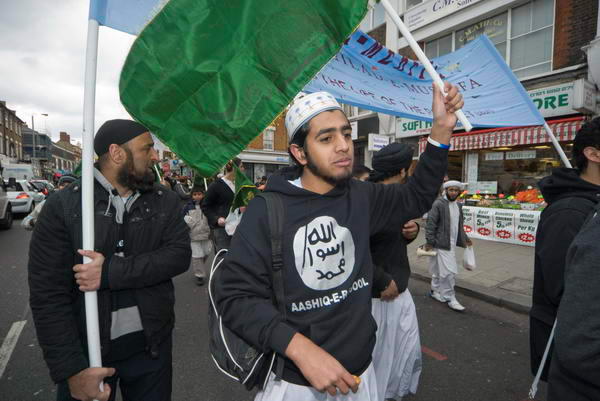
Eid Milad-Un-Nabi

Thanks to a signal failure due to a cable fire in the Waterloo area, my train up to London came to a halt in Feltham, then crept forward slowly to Twickenham before expiring completely. Ten minutes later another service took me the few hundred yards further to St Margarets, where I abandoned rail and jumped onto a passing bus to Richmond.

I’m not quite sure why our railways still essentially rely on nineteenth century technology, particularly when the manpower to keep it working as it used to in the old days has long since become prohibitive, and various rationalisation programmes have cut the flexibility and redundancy needed to give it reliability. It seems to have been almost six hours before the system returned to more or less normal working, and things were still in a mess when I came home several hours after that.

We have reliable fault-tolerant communications systems (you are reading this thanks to one) and navigational systems that could locate every train on a network to within a few centimetres and give its accurate speed and direction. Modern systems could be devised that would enable much higher traffic densities without sacrificing safety, and make problems such as this a thing of the past.

However, should you ever want a slow and frustrating ride through some of the more obscure southwest London suburbs I recommend the 493 route, which even includes a ride past Wimbledon Park and the world’s most famous tennis club before taking you past the dog track and on to Tooting.

Not expecting such travel problems, I hadn’t allowed the extra hour or two, not bothered to take a map, both of which would have been useful. So perhaps might have been a phone that could have used the Transport for London journey planner, although as so often this fails to find the fastest route (the 493 at 80 minutes is the best it suggested when I tried it out after I got home. In the unlikely event you ever need to do this journey try a 337 to Clapham Junction and then a 219, which should save you 20 minutes or so – and changing at Wandsworth for the 270 to Tooting Broadway could be even quicker…)

Thanks to a half-mile run after I abandoned the bus I almost reached the starting point for the Tooting Sunni Muslim Association’s procession for Eid Milad-Un-Nabi as they started ‘promptly’ only around 20 minutes late.

2008

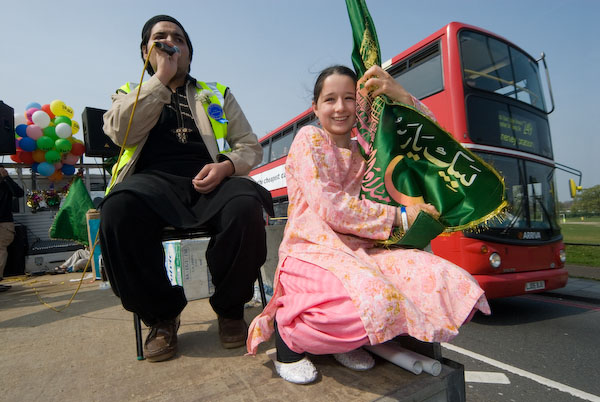
The Juloos to honour the birthday of the Prophet, and was part of an all-day community event which I attended last year, going into the clebrations inside the Tooting Leisure Centre and being very impressed by the ‘whirling dervishes’.

This year the weather was not quite as good, and there seemed to be rather fewer people taking part, although as last year this did include local community representatives including the Deputy Mayor of Wandsworth, Councillor Mrs. Claire Clay.

2007
Last year we had better weather – and better pictures?

This year I left the procession as it turned into Garratt Lane as I wanted to go into the centre of London and view some exhibitions.

End the Siege of Gaza – Another Demo

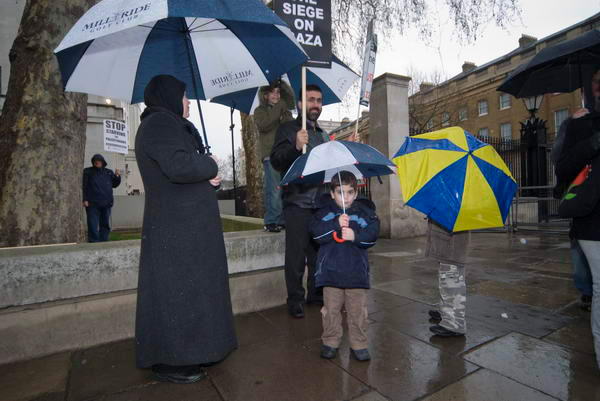
Around 50 people turned up to protest opposite Downing Street on a wet and wintry Saturday afternoon (5 April 2008) calling for and end to the Israeli siege of Gaza. The measures imposed in September 2007 are an illegal collective punishment against the population and have already resulted in many dying.

At Downing st

The demonstration was one in a series organised by the Palestine Solidarity Campaign , which calls on the British government to end the arms trade with Israel, and to press Israel to abide by international law, end its illegal occupation and allow the return of refugees.

Man with Palestinian flag

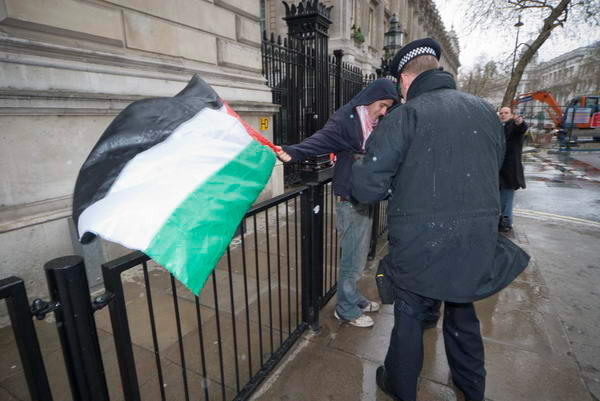
While the demonstration was taking place on the opposite side of the road with friendly cooperation from the police, one young man with a Palestinian flag went and stood on the pavement outside the gates to Downing Street. He was pulled to one side and questioned, and his flag taken from him and dropped on the ground, the officers explaining to him that because of the SOCPA law he was not allowed to demonstrate there. He picked up the flag again, and one of the officers swore at him, grabbed the flag out of his hands and dropped it on the pavement.

While I was there the man with the flag was informed that he was being stopped and searched under (I think) section 44 of the Terrorism Act, 2000. I could see no evidence of any specific terrorist threat in his behaviour that would justify this – waving a flag is not terrorism.

Another officer moved in front of me to prevent me from photographing this and on learning that I was press insisted I move further away as he alleged I was interfering with the actions of the police – although I was clearly at a reasonable distance by this time. After making my opinion clear I moved back as ordered.

At this point a woman officer came up and held her hand in front of my lens. I told her that this was illegal and that one of the senior officers in the Met had told a colleague that he would consider it “a sacking offence” and she hurriedly moved off across the road and away from the area. Unfortunately I failed to get her number, or that of the other officer who impeded me – I was still busy trying to take pictures.

I left and returned across the road where the protest was continuing. The man was still being held by the police when I left the area. You can see more pictures from the demonstration on My London Diary.

Light the Passion, Share the Dream, Free Tibet?

Argyle Square Gardens is a relatively small park just south of Kings Cross, and I arrived just as the Tibetan Freedom Torch Relay was starting, to find it absolutely jam-packed, and it was a rather difficult job to make my way to the stage at the centre where there was a space for the press to work.

This too was pretty packed, and it wasn’t always possible to find a position from which one could photograph those appearing on stage adequately. Working in confined spaces is made considerably harder by the increasing trend of photographers to use backpacks rather than shoulder bags. There were also too many inexperienced photographers moving in front of others taking pictures without thinking about it. It’s something we all do occasionally by accident, but when working with others most try to avoid as much as possible. The worst offenders are people with camera phones or similar who think nothing about holding them out at arms length in front of other’s lenses.

Face in crowd

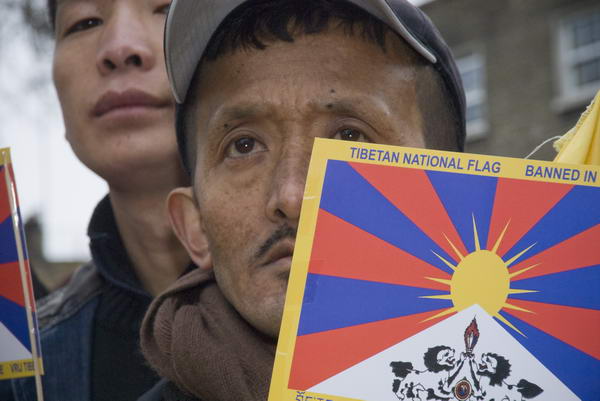
There were stirring speeches and some fine performances on stage, but mostly the interest there was for the ear rather than the eye, and it was the members of the audience that attracted the photographers’ attention. The exception came at the end of the event with a short drama depicting the treatment of Tibetans by the Chinese and the Tibetan response, followed by the introduction to the Tibetan Freedom Torch and Team Tibet.

Athletes of Tibetan origin living around the world want to compete for Tibet in the Olympic Games and formed a national Olympic committee and mad an application to the International Olympic Committee to compete in Beijing. They received no response to this and last month withdrew their application, demanding the IOC remove all Olympic Torch relay stops in Tibet, including those in the Tibetan areas now a part of Chinese provinces.

I’d stood on the pavement where the press were cleared to by police in Bloomsbury thinking that the Olympic slogan – Light the Passion, Share the Dream – really needed a third statement to seem complete, and ‘Free Tibet’ made the obvious one. That supplied by the Tibetan Freedom Torch organisation, ‘Freedom and Justice for Tibet’ is just too long to chant.

Team Tibet also appealed to athletes around the world to show solidarity with them by visible actions to protest about human rights abuses by China, and have started their own alternative Olympic torch relay. This began in Olympia, Greece on March 10th, the 49th anniversary of the Tibetan Uprising and has travelled across Europe, with ceremonies in Budapest, Rome, Munich and Edinburgh and London.

Tibetan Torch Relay

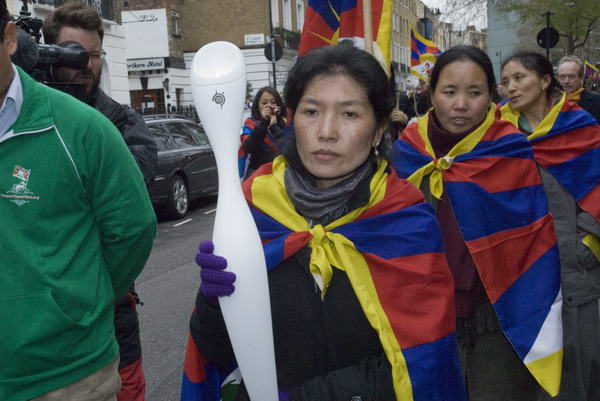
I photographed the torch as it was carried by one of the Drapchi nuns, imprisoned and tortured by the Chinese, on its route to St Pancras Station for the train to Paris – – like the other Olympic torch was going on to Paris. From there it will travel through North and South America and Asia, with its arrival in Tibet planned for the first day of the Beijing Olympics.

Text and more pictures on My London Diary