Who needs Oscars?

I have to admit to a certain feeling of ennui about the increasing number of awards for photography, especially so those that attempt to introduce something of the ridiculous commercial razzmatazz of the Oscars.

So I didn’t have very high hopes when I heard about the Sony World Photography Awards, especially when I learn they were to be held in Cannes. And although the Honorary Board members did include photographers Bruce Davidson, Elliot Erwitt, Martine Franck, Susan Mieselas and Martin Parr of Magnum, along with Nan Goldin, Mary-Ellen Mark, Rankin and Tom Stoddart. There are also some very well-known names in the other Academy members, along with a number of others whose photographic credentials are perhaps less credible. It was also a team lacking in international terms; far too many are from the UK and US, with only two from Asia, one from Africa and none from South America.

This week’s British Journal of Photography (some stories need a subscription to read online) has two interesting features on photographic competitions. One is about the SWPA (not to be confused with the WPA, which for all of us with an interest in photography is the Works Progress Administration), written by Su Steward (BJP editor Simon Bainbridge was one of the Academy, so perhaps she had to be even more careful than usual in what she wrote.) She gives an interesting view of the event and some of the problems, as well as commenting on the judging and winners, although the article has its own teething problem with a wrongly captioned image.

I did find it surprising, that after quoting the comment made over a Cannes Film Festival lunch that apparently kick-started the SWPA, claiming that there wasn’t “an Oscars for Photography” she failed to mention the “Lucies,” set up for that very purpose in 2003, when Henri Cartier-Bresson received the first Lifetime Acheivement Award. On the Lucie Award web site the front page quotes for Douglas Kirkland “The Movie Industry has its Oscars and the Photography Community has its Lucies.”

The 2007 Lucie Awards were:
Elliot Erwitt – Lifetime Achievement,
Kenro Izu – Humanitarian Award,
Ralph Gibson – Achievement in Fine Art,
Eugene Richards – Achievement in Documentary,
Philip Jones Griffiths – Achievement in Photojournalism,
Lord Snowdon – Achievement in Portraiture,
Deborah Turbeville – Achievement in Fashion,
Howard Zieff – Achievement in Advertising,
Heinz Kluetmeier – Achievement in Sports,
and the 2008 Awards will go to Richard Misrach, Josef Koudelka, Sara Terry: The Aftermath Project, John Iacono, Susan Meiselas, Visa Pour L’Image Festival, Herman Leonard and Erwin Olaf – with more details on the web site May 15.
I never attended the Lucie awards ceremony – despite being invited – partly because it didn’t seem my kind of event, but it surely deserves a mention in this context.


(C) 2007, Peter Marshall. Giacomo meets Max Kandhola

You can find more about the WPA event on its website – or buy the BJP. I’d just like to mention one of the winners, Giacomo Brunelli, who showed me his superb work at Rhubarb Rhubarb in Birmingham last year and I wrote about it for this blog, with a couple of examples, as well as introducing him to Luminous Lint.

Also in the BJP is an article first published on-line at Foto8 by two of the judges at the World Press Photo contest, ‘Unconcerned but not indifferent‘ by Adam Broomberg and Oliver Chapman. They lift the lid off the proceedings there and also question the role of photojournalism, particularly as “photographs rarely break the news these days” or at least those that do are largely the products of ‘citizen journalism’, the blurred impressions from the mobile phones of those caught up in the affair. (When I wrote a guide to the photographs of 9/11 – first on-line on 9/12 it received hundreds of thousands of hits – I commented on the immediacy of such coverage, highlighting some of the more powerful examples.)

The BJP adds a little to the debate by publishing a reply by this year’s World Press Photo of the Year winner, Tim Hetherington, who argues that photojournalism remains as relevant today as it ever was.

I’ve been meaning to write for some time about the re-launched “all-new” biannual Foto8 magazine. 180 pages of essential reading for anyone with the slightest interest in photojournalism. If you are reading this are aren’t already a subscriber you almost certainly should be.
Photography as Intimidation

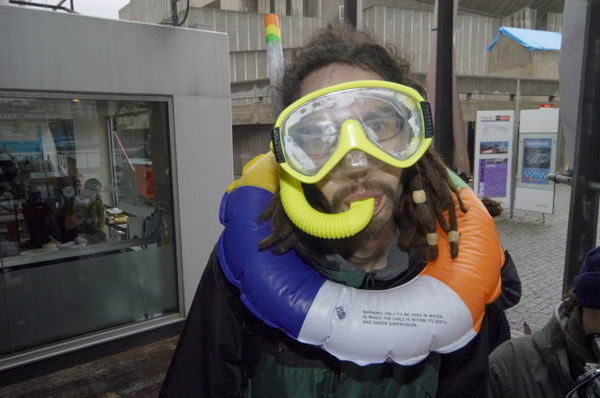
In October 2004 I wrote the following on My London Diary while covering the European Creative Social Forum‘s London Underwater 2050 Tour of the G8 Climate Criminals:

worrying was the deliberate police use of photography as intimidation, with the police photographer going out of his way to confront demonstrators, aided by two other officers.

i worry because i think it is an attempt to attack civil liberties, but also because such behaviour makes all photographers suspect. i can only work effectively if i gain the trust and cooperation of those whose pictures i take. perhaps it helps that photography is one of the activities that also arouses suspicion and intimidation by the police.

as i walked away at the end of the demonstration, this team ran 50 yards down the road and caught up with me, one calling “excuse me, sir” and tapping on my shoulder. i turned to face him, and found myself looking into the lens of the police photographer, who took my picture as his colleague started to question me about who i was taking pictures for. it seemed clear and deliberate harassment, intended to intimidate a photographer acting entirely lawfully, photographing on the public highway.

This was the first time that I’d come across the police use of photography in this way, and I was worried by it. Now it’s commonplace and few demonstrations take place without police harassing demonstrators in this way, without Fitwatch confronting the police FIT teams, and without police harassing photographers.


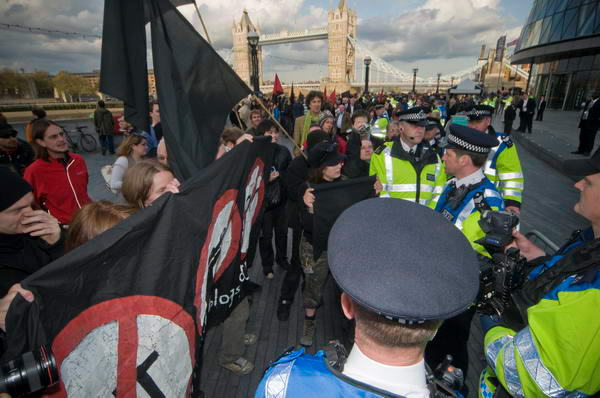
Fitwatch confronts the police FIT team at City Hall, May 2008

Like Marc Vallée, I was also photographed by police at the City Hall demonstration last Friday, while I was engaged in the subversive act of sitting on a wall and reading a book. I ignored them, but he had a long stand-off, camera in front of his face before the event, and also found the police camera pointed at him from close range later in the event. You can see his pictures on his blog.

An e-mail today pointed out to me a Guardian article: Police should harass young thugs – Smith by political editor Patrick Wintour, in which he reports home secretary, Jacqui Smith as urging police forces across the country to mount “frame and shame” operations stopping and photographing “identified persistent offenders on problem estates.

The police have already used such tactics to photograph 14 young poeple “known to the force” on estates in Basildon. Wintour quotes a police spokesman:

“The aim is to target a small group of persistent offenders by openly filming them, knocking on their doors, following them on the estate and repeatedly searching them, as well as warning them in no uncertain terms that local people have identified them as lawbreakers.”

Smith is quoted as saying she wants “to create an environment where there is nowhere to hide.” I immediately think of Orwell’s ‘1984‘, although current-day surveillance techniques have perhaps outstripped anything he envisaged. As the article says, there may be “human rights issues about such tough tactics, especially if those harassed by the police have not been found guilty of any criminal offence.”


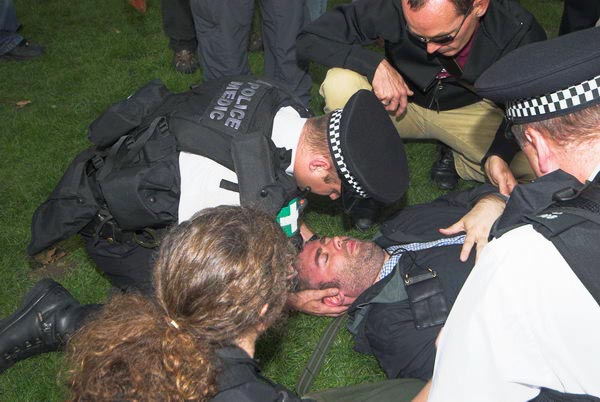
Marc Vallée receives medical attention after being injured by police in Parliament Square, October 2006.

Photography is not yet a criminal offence, indeed I have a letter from an officer of the Metropolitan Police confirming my right to photograph in public, written after a rather unpleasant encounter when two police threatened to fit me up around ten years ago. So far as I’m aware, Marc’s only offence has been to allow himself to be assaulted and injured by police, for which he received an out of court settlement earlier in the year.

The Toff Wins

Class War and other London anarchists were going to protest whoever won the London Mayoral Election. One banner said:

NO TO
THE CROOK
THE TOFF
THE FASCIST
OR COP

and since only 45% of the electorate bothered to vote for any of the ten candidates they may feel that London followed their advice, althought the 55% majority was surely more for apathy than anarchy.

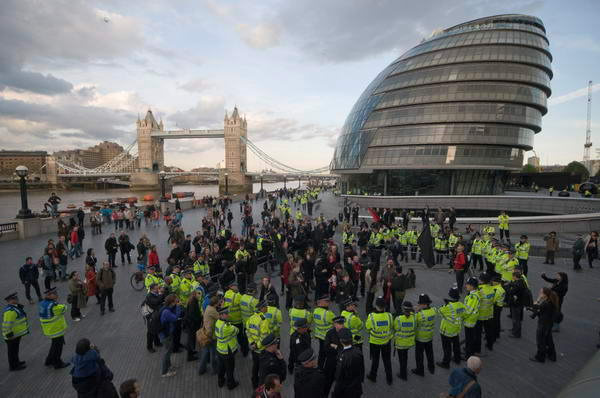
Police watched the demonstration (if with some obvious frustration) for around 35 minutes, taking no action. Then Fitwatch sprang into action, holding their banner in front of the police photographers who had been having a field day photographing demonstrators, photographers, anyone with a beard or reading a book etc. One FIT team were surrounded on the barriers set up around City Hall, hemmed in by both Fitwatch and the many photographers present, and began to look extremely worried, if only about beiong made to look rather silly.

So along came their mates from the TSG to the rescue, pushing everyone out of the area and coralling a few of the demonstrators in waiting pens. Most made their escape thanks to a rather slow response by the police, stopping briefly to display their banner on a balcony overlooking the scene before making for the pub.

Surprisingly the anarchists were the only organised group of protesters on the day. There had been rumours that the BNP would be along to celebrate, but if so they will still hiding under the stones when I left for home.

No to the Crook, the Toff, The Fascist or Cop

Just Shares

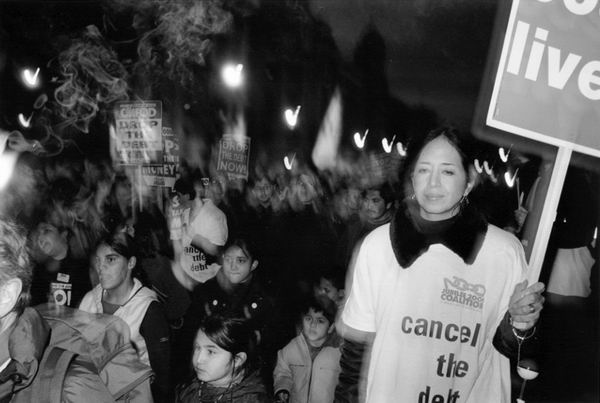
It doesn’t really seem very long ago that I was photographing the closing event of Jubillee 2000, with Ann Pettifor on the stage at Trafalgar Square, but the fact that I took most of the pictures in black and white is a reminder of how much things have changes since then.


The candlelit march up Whitehall in Dec 2000

Jubilee 2000 did get things moving on debt relief, although there is still a long way to go, and since then we’ve had other campaigns – such as ‘Make Poverty History‘ which have added to the impetus.


Applause for Nelson Mandela in a packed Trafalgar Square, Feb 2005

Ann Pettifor is now working for Advocacy International, which works with “low-income country governments, and with organisations working to promote positive development, investment and environmental sustainability in those countries” and Operation Noah, a Christian-based climate-change campaign.

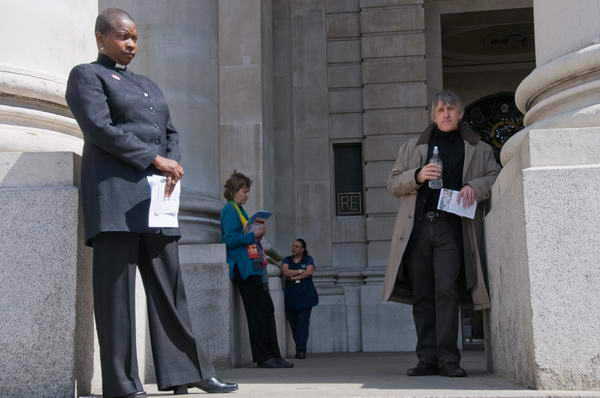
I went to hear her speak at a rally and seminar organised by ‘Just Share‘, “a coalition of churches and development agencies seeking to engage with the City of London on issues of global economic injustice.” Just Share is based at a city church (St Mary-le-Bow of bells fame) and the rally was held bang in the middle of the city, at Bank, in front of the Royal Exchange, with the Bank of England to one side and the Mansion House across the road. Speaking along with her was Larry Elliott, economics editor of The Guardian for the last 11 or so years.


Listening to Ann Pettifor speaking at Royal Exchange.
Larry Elliott waits to speak at right.

I’m not an economist, but as I understand it, Pettifor argued that our present ‘Credit Crisis’ is a symptom of a deeper structural problem in our economy, the creation of money by the banks in a way that is no longer linked to reserves and production, but entirely dependent on trust. Once people lose faith in the banks, we have a problem.

I wasn’t entirely sure about the link that she made with this and the traditional Christian teaching against usury, which seems to me something rather different. But I have to admit that I haven’t read her book on the subject that might make things more clear.

What I think she also argued was that the current model has allowed the exponential growth of money – and as we know, exponential growth of anything can only ever be a short-term process in a finite world.

More pictures from the event – and also information about Ann Pettifor’s book in Just Shares Take on The Bank in My London Diary

May Day, May Fayre

Perhaps the silliest of our Bank Holidays is the early May one, introduced in 1978 by the the Callaghan Labour government as a sop to the unions who had wanted a holiday on May Day, celebrated in many countries around the world as International Workers’ Day. But they bowed to pressure from business who didn’t like the idea of a holiday that might be on any day of the week, and instead of May 1, made it the first Monday of the year. So Britain’s workers either have to take a day off work or miss May Day celebrations except in those years where it happens to fall on a Monday.

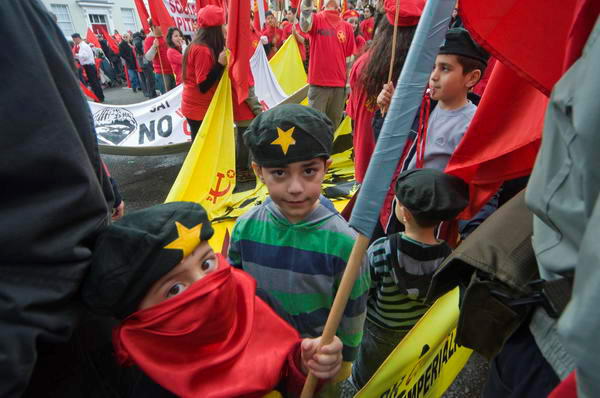
This year it was a Thursday, and most of the unions – whose participation has always been half-hearted – wanted to forget the whole thing in favour of the local elections on the same day, including those of the London Mayor. But in the end it went ahead – probably because the Turks, the Kurds and a few others would have marched whatever – but with very little support from the unions.

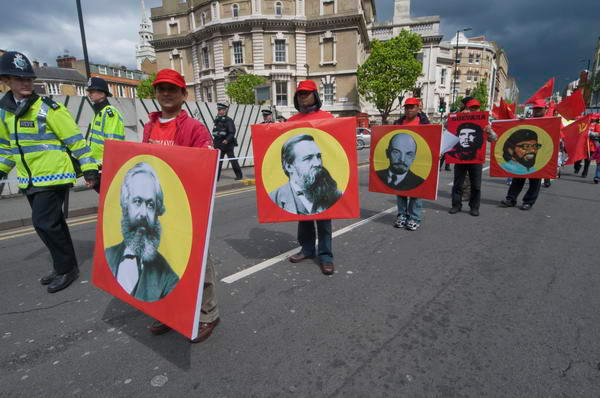
As usual Clerkenwell Green was awash with red uniforms, and there were banners with images of Karl Marx and other communist notables – including a large painting of Joseph Stalin. One of my earliest memories is the newspaper and radio coverage of the death of ‘Uncle Jo’, but now we know rather more about him.

As the march left Clerkenwell Green I committed a grave sin and actually set up a picture:

Without a little arrangement it was impossible to see all of the five pictures which were being carried in line. But everything else on My London Diary is as it was.

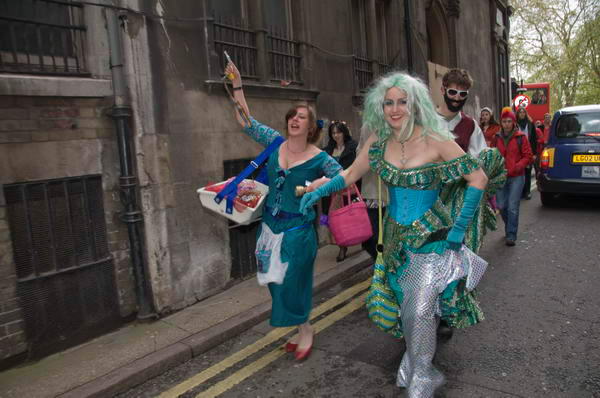
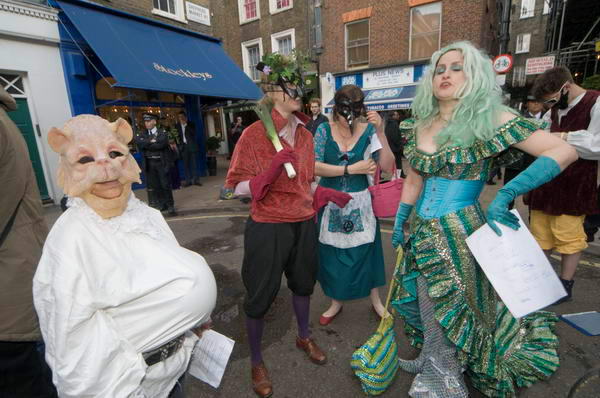
From Clerkenwell Green I walked down to Farringdon with some other photographers and took the tube to Green Park, where the Space Hijackers were gathering to hold a May Fayre in Mayfair – from where it had been banned in 1708 when the area started going up in the world. However unlike the original it was only going to last a few hours rather than 15 days.


On the way to Shepherd Market

When the Olympic Torch was in London (largely surrounded by Chinese thugs when not hidden on the coach) police made a distinction in the way they policed those who wanted to celebrate China’s human rights record compared to those who wanted to demonstrate in favour of the Beijing Olympics. Human rights protesters were penned behind barriers and kept at a distance, while pro-Chinese demonstrators were allowed to line the route.

Police justified this by saying that they didn’t stop people celebrating – but that demonstrations were covered by the Public Order Act. So the May Fayre wasn’t a demonstration but a celebration, and whatever the police thought about this they stood back and let it happen, if keeping the event under a very watchful eye.

Although police stood across the roads leading into Shepherd Market, at least while I was there they didn’t stop anyone entering or leaving on foot, although most cars were turned away. And while those in charge didn’t seem amused, many of the officers watching obviously enjoyed watching the partying, even though they were not allowed to take part – except in the ritual encounter between FIT and Fitwatch.


A May Day entertainment

More pictures on My London Diary.

Street a State of Mind?

I think I’ve more or less got over being a street photographer, though I work most of the time on the street, if anything I do think of myself as a ‘post-street’ photographer. Been there, done that, eventually got bored.


Hatton Garden

Of course I’m not being entirely serious. What I’m really bored with is people who think of themselves as somehow radical because they are ‘street photographers’ and are wandering around producing very third rate images. As Mitch Alland puts it in his
An Approach to Street Photography on the Online Photographer site:

without a purpose, street photography can be meaningless, particularly if the pictures don’t have any graphic distinction: how many times have you seen on the internet humdrum photos of street people, of old men sitting on benches, that say nothing either socially or graphically?

Amen. Recently in Britain we’ve seen far too many people claiming to have invented the wheel and making it far too square for my taste.

As Alland goes on to say, “even photographers that have no experience in street photography can do it when they have a purpose and a reason for doing it” and also talks a little about the kinds of techniques he find useful. I was particularly interested in his description of how he works when using the small-sensor Ricoh GR Digital II, using the LCD to roughly establish the edges of the frame but looking at the subject when pressing the shutter.

The discussion that followed the posting also brings out some interesting points, but rather than pursue that here, I thought I’d just post a fairly random selection of pictures. Some might be street.


Notting Hill Market


Weston-super-Mare 1


Weston-super-Mare 2


Oxford Street


Manor Park


Soho


Brixton


Edgware Road


Peckham

I don’t know if everyone would think of all of these as street photography, and I don’t greatly care. They were all scenes that interested me in some way at the time I made the picture.  None were set up, all taken in an intuitive manner, “on the run“, with a brief glimpse at the viewfinder – or, in a couple of cases just relying on my experience of what a 28mm lens would show.

Black Friday?


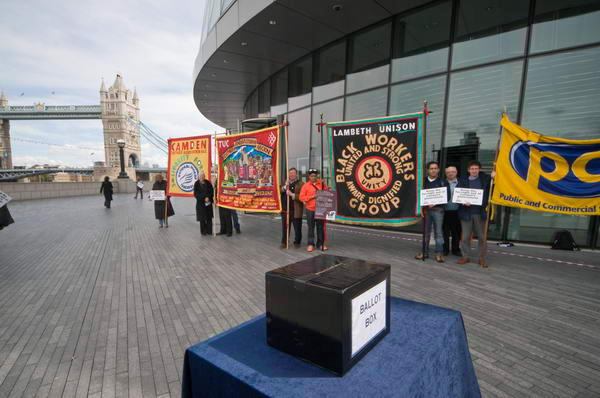
Keep the Far-Right out of London Government – see My London Diary

London waits the count of yesterday’s election, expected this evening, but woke up this morning to the news of terrible results for Labour around the country and predictions of all the pundits that Ken Livingstone would lose his bid to be re-elected as mayor.

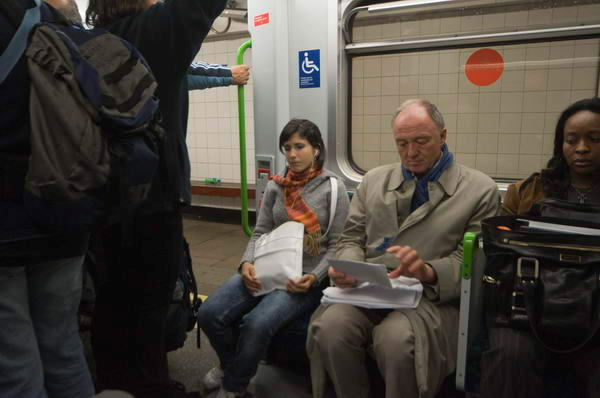
On Saturday I went to hear Ken speak in Whitechapel, and after the meeting we travelled away on the same underground train, and I talked to him briefly before taking a few pictures.

A defeat for Ken will be a very black day for the future of London – a set-back similar to that inflicted by Thatcher when she abolished to GLC, a decision from which London was at last recovering. Cities can’t be run effectively without a proper city authority, nor by one led by a buffoon like Boris.

There are Conservatives who I could imagine making a decent throw of it, but he isn’t one – and none of those who could do the job would have attracted the media publicity that has led to Boris’s poll ratings.

I’m still hoping that the pundits got it wrong. Although I’ve not agreed with everything Ken has said and done he has got most of the real basics right, making London a much better place to live and become a cosmopolitan capital. It will be a very sad day for Londoners if he loses.

And, as I wrote for My London Diary on Sunday:

My photographs of London owe a great deal to Ken Livingstone and his transport policies at the GLC in the 1980s that made a quantum change in transport across the capital. It’s hard now to imagine the difficulties and of getting around the city before the Travelcard – assuming you aren’t in the class that always travels by taxi.

Sweet and Sour Protest

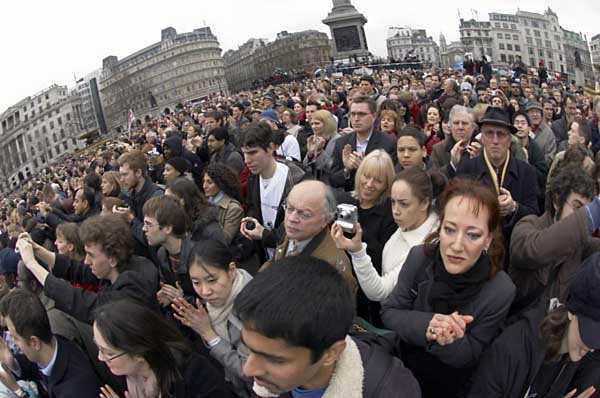
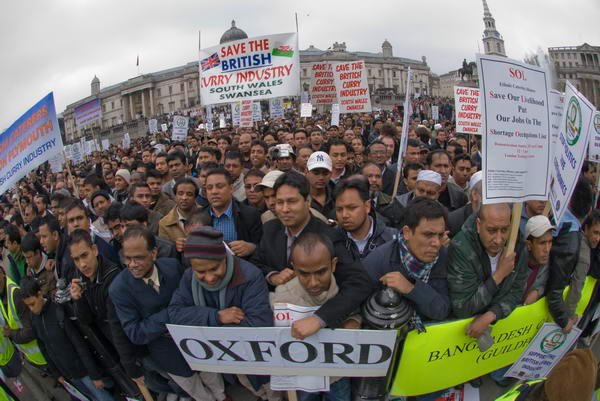
The scene in Trafalgar Square on April 20 was a pretty amazing one as it was packed out for a demonstration by the Ethnic Catering Alliance, representing the many Chinese, Bangladeshi, Indian, Pakistani and Turkish restaurants and food outlets that have revolutionised eating out in Britain.


Showing the crowd – a ‘Hail Mary’ with the 10.5mm fisheye

Gordon Brown‘s proposal that British workers should be trained to fill staff shortages that are hitting ethnic restaurants no longer able to recruit staff from the home countries seems more a gift for comedy writers than a serious proposal. And our Polish friends who came over to fix our plumbing problems (and increasingly to run so many service industries) are hardly likely to bring a great knowledge of curry-making – or be prepared to accept the below minimum wages and poor working conditions that some ethnic restaurants offer. Nor do I foresee a great marketing opportunity for dumplings.

One of the speakers brought up the very pertinent observation that very few of the sons and daughters of migrants who grow up in this country want to go into the catering industry – and indeed their parents want them to do better, to become lawyers, doctors etc. The reason was pretty clear in the square, with the contrast between the smartly cut expensive suits of some of the restaurateurs around the platform and the mass-market clothing in the bulk of the square. Although owning a restaurant can be extremely profitable, working in one tends to be a low paid and unpleasant dead end. A real symptom of the actual problem of the restaurant industry was the lack of union participation in the event.

Of course there are very real problems, and a considerable amount of victimisation of migrant workers, both those here legally and those without permission to work here (who are never illegal workers but may be people working illegally.)

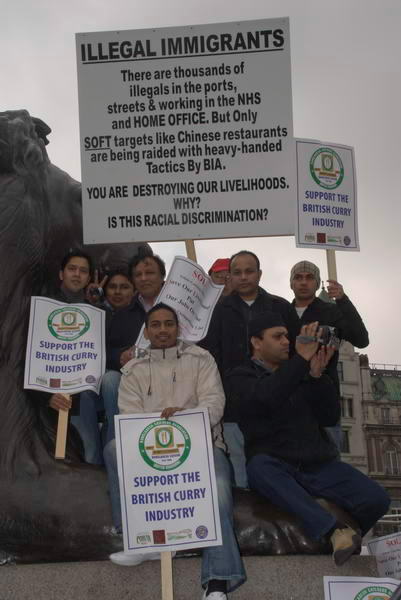
One of the longest placards at the demonstration – see above – read:

ILLEGAL IMMIGRANTS

There are thousands of
illegals in the ports,
streets & working in the NHS
and HOME OFFICE. But Only
SOFT targets like Chinese restaurants
are being raided with heavy-handed
Tactics By BIA

YOU ARE DESTROYING OUR LIVELIHOODS.
WHY?
IS THIS RACIAL DISCRIMINATION?

Those who regard the BIA, (the Border and Immigration Agency, now a part of the UK Border Agency) as an institutionally racist organisation set up to implement an inherently racist immigration policy, largely driven by knee-jerk political responses to the distortion of a racist popular press would perhaps find this naive. Rather too much like being surprised that the SS persecuted Jews. But still of course something that people – and not just ethnic caterers – should be demonstrating about.

Ethnic Catering Alliance – Save the British Curry Industry on My London Diary

May Comes in April

Climate Change seems to be noticeably with us, with the hawthorn around the local footpath in blossom for a couple of weeks – and the generally early flowering of the May actually made the news headlines last week.

Gathering the may is an ancient British custom, when young men and women went off together into the woods in the early hours of the morning, ostensibly to cut branches of blossom, bringing these back to decorate the houses in the village to mark the coming of Spring. Doubtless there was much drinking of ale proffered in return for the gift of the boughs, and not a few maidens and masters nipping back to the woods, but Henry Peach Robinson made it a rather less raucous event in his carefully constructed rural idyll, ‘Bringing Home the May’, made in 1862.

Robinson was one of the first masters of the constructed image, although it was Oscar Rejlander who had led the way with his ‘Two Ways of Life‘ in 1857. This was a dramatic combination print made from 30 negatives, whereas Robinson’s ‘May’ made do with only nine (you can see them on-line in this pdf, and a thumbnail of the final print here.) While such feats are now made ridiculously simple with Photoshop, he had to do things the hard way, printing each negative in turn onto the same sheet of paper, although the fact that he would have exposed each negative for long enough to produce a visible image rather than developing the paper made registering the images rather simpler. Few photographers in those days developed paper, almost all images were made by printing out – and many photographers continued to work in this way well into the 20th century.

Robinson and other photographers worked by combination printing largely for technical reasons. The most common use of the technique was to add an interesting sky to a print. Until close to the end of the 19th century photographic emulsions were sensitive only to blue light, and areas of blue sky were far denser on the negative than they should be, resulting in very pale or ‘paper white’ skies. ‘Sky negatives’ were made by giving several stops less exposure than was needed for the rest of the image – and many photographers had their favourites with fine cloud formations and used them on a number of pictures.

Robinson often – it not always – sketched out in detail how he wanted his pictures to be before he made his exposures, and it was doubtless easier to set up smaller parts rather than an overall scene. The people in his pictures were actors, models or friends and it might well be possible to use one of them in different roles in the same image – as Rejlander had done in his picture. The actual country people didn’t suit the idyllic view he wanted to give of rural life, they were doubtless too coarse, dirty and often disfigured, although he did aim for a certain authenticity, noting that country girls could easily be persuaded to sell their clothes for a few shillings.

Another important reason for working from multiple negatives was quite simply size. Almost all nineteenth century photographs are contact prints. To make a print the size of his ‘Bringing Home the May‘, approximately 40 x15 inches, would have needed a camera that took a plate that size. It was easier to work with something rather smaller and build up the final result.

If you really want to know all there is to know about H P Robinson, you may like to download David Lawrence Coleman’s 2005 dissertation, ‘Pleasant Fictions: Henry Peach Robinson’s Composition Photography‘ from the University of Texas, which includes some well-chosen illustrations at the end of its very informative text.

Looking at his pictures – which he regarded essentially as art – I find it hard not to think of advertising photography. But then I get the same feeling about most of the constructed photography that has appeared in galleries over the last 30 or more years, although the advertising sometimes seems less false.


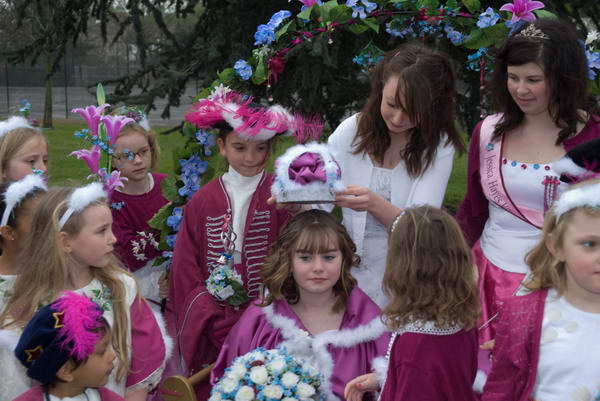
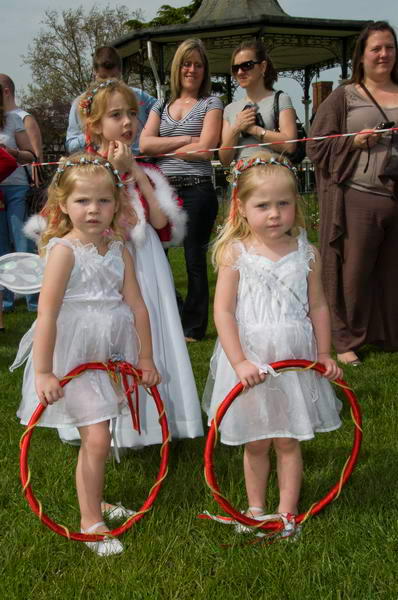
Crowning the Hayes Village May Queen, April 2008

Along with this image, Robinson exhibited another, entitled ‘May Queen’, which unfortunately I can’t locate on line. But other Victorian artists and writers took an interest in these traditional May festivities, and John Ruskin in 1881 established the May Queen ceremony at Whitelands College in Chelsea, the oldest recorded continuing May Queen event (Hayfield makes a claim to this, but despite an ancient tradition, it’s procession had to be revived in 1928, rather later than the start of processions at Brentham in 1906.) The Whitelands celebration survived the move of the college to East Putney and its incorporation into Roehampton University, although they now crown a ‘May Monarch’, alternating between sexes.


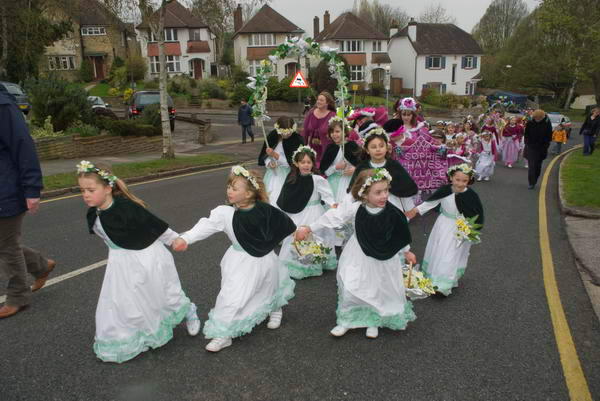
May Queen procession in Hayes, Kent, 2008

More pictures from last week’s Crowning of the Hayes Realms.