No Third Runway

Today I photographed a demonstration against the continuing expansion of London Heathrow, certainly one of the worst located airports in the developed world.

I grew up under its flightpath. In my back garden in Hounslow I would imagine myself reaching up and touching the planes as they passed overhead. It wouldn’t have needed very long arms. I dreamed (or nightmared) of them passing over in flames (though sometime it was true) and jumping across the sky as flaming fragments.

Heathrow was established by deception – as a miltary airstrip for which there was no military purpose. It has grown by lies. The third terminal was all the airport would ever want, but as soon as planning permission was obtained, in went the application for a fourth. Of course that would be enough. But somehow we have a fifth, and the sixth will soon be with us unless we stop the madness.

The quiet Middlesex villages I cycled through as a child – and by the time I was ten I was roaming through them all on my bicycle and further afield – are either already gone or under threat. Longford, Sipson, Harlington, Harmondsworth and more.
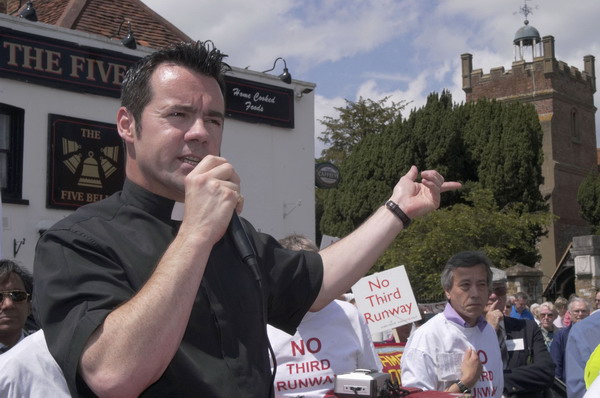
Harmondsworth, 2003
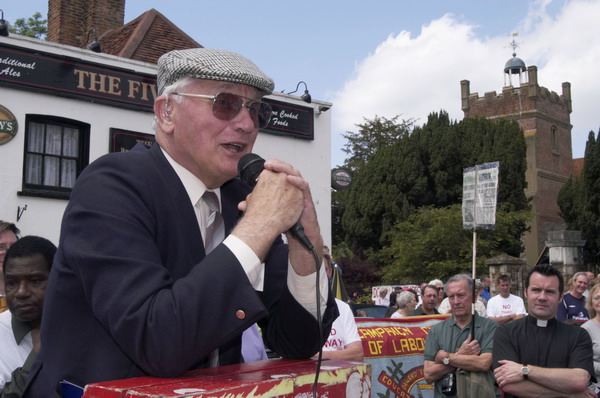
Harmondsworth, 2003

Harmondsworth, 2003

Look at the placard at the right of the picture. Here is a detail from another frame that states clearly what the BAA, responsible for Heathrow, promised about the possibility of a third runway there:

Detail of BAA's view of a third runway at Heathrow
Rule out third runway say BAA

I hope today’s demonstration – in which over 3000 people gave a resounding ‘No’ to the idea of a third runway will cause even our un-green government to think again. It has been clear to anyone who took a careful and balanced view that Heathrow was in the wrong place since the 1950s – if not before. Government after government has refused to grasp the nettle and start to develop another London airport on a more suitable site. We now have a different situation, with increasing oil prices as we go past ‘peak oil’ as well as an much greater appreciation of the catastrophe approaching through climate change. From every point of view – even a strict economic one that ignores environmental issues – Heathrow needs to shrink rather than expand.

I’ll post some of my own pictures of today’s demonstration shortly. For the moment you can see a few my pictures from the march from Sipson to Harmondsworth in June 2003, and you can also see the BBC’s video coverage of the event, in which I appear rather too prominently, immediately after the huge ‘NO’, taken from a cherry picker, as a photographer in a blue check shirt, first walking towards the camera and then walking back into the frame to take another picture.
Pagan Pride

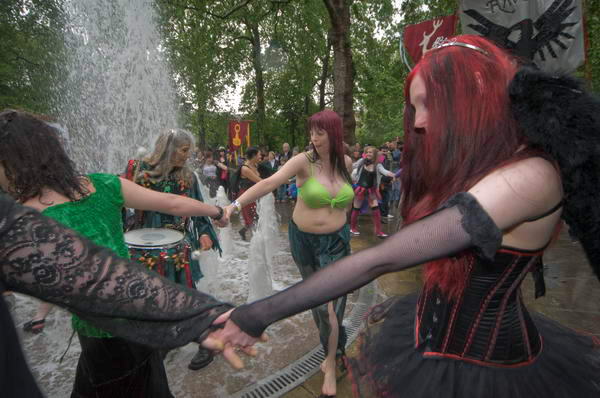
Pagan Pride, a procession of pagans (or neo-pagans) around London’s Bloomsbury has a certain colour and charm. It’s a celebration of spring, the public part of an annual ‘Beltane Bash‘ event, with elements that come from our Celtic past.

Pagan Pride (C) 2008, Peter Marshall
Dancing around the fountain in Russell Square

Efforts have been made to restore the garden in Russell Square to its original plan. It was laid out by Humphry Repton in 1805-6, although his original planting of lime trees were fortunately replaced by J C Loudon with London planes in the 1860s – so they are now fine, mature specimens. Camden council added a central feature of three ‘modern’ fountains in 1960, which were certainly not to everyone’s (or possibly anyone except the Borough architect’s) taste. Fortunately funding from the Urban Parks Programme in 1996 enabled these to be removed (and the original garden layout to be restored) and the park reopened in 2002 with a modern computer controlled fountain designed by Land Use Consultants (LUC).

This fountain could hardly have been designed more appropriately for the Pagan Pride parade – which I think began shortly afterwards, with phallic water jets emerging, rising and falling from a number holes in the York stone paving creating a truly organic (or orgasmic?) effect. When I first photographed the event, the jets were following the normal erratic (if not random) pattern, but this year the gardeners appear to have been persuaded to turn them on more or less full for the duration of the event.

You can see the effect on My London Diary. And yes, I did get wet, both from the fountains and the rain.

Justice for Darfur

(C) 2008, Peter Marshall

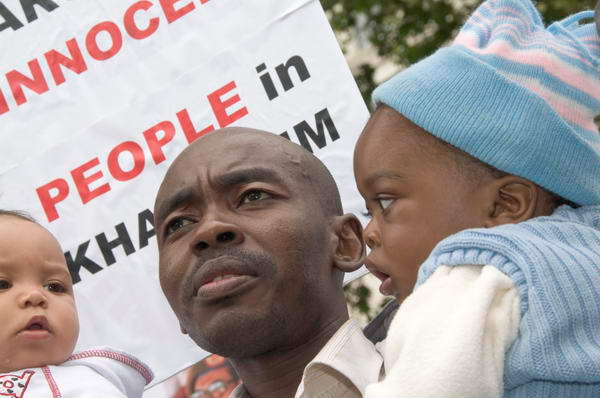
The genocide in Darfur has being going on for so long that it seldom makes the news, which is perhaps why none of the newspapers could be bothered to send anyone to cover the demonstration in London calling for ‘Justice for Darfur’ and for those accused of war crimes there to be sent for trial at the International Criminal Court.

Although over 50 people haven been listed for investigation, so far as I am aware only two arrest warrants have been issued. Ahmad Haroun is a minister in the Sudanese government, and rather than send him for trial, the government response has been to promote him. Janjaweed leader Ali Kushayb was actually being held by the police in Sudan on other charges when the warrant was issued, but they have since released him without charge.

As I said to one of those on the demonstration and march, it is hard to see why an event like this isn’t news when celebrities only need to sneeze to make the front page. As so often to find out what is really going on you have to look on the Internet rather than rely on what the commercial press thinks we want to know – or wants to tell us. I’m a great supporter of press freedom, but at the moment most of the press is hardly worth fighting for, and we often have to rely on non-commercial news media such as Indymedia for news.

More about the event and more pictures on My London Diary

Journey to Justice

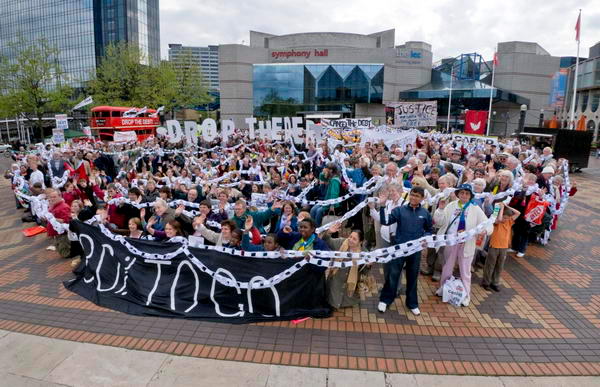
Sunday I was a demonstrator with a camera rather than a reporter, going with a coachload of others from a church a few miles away to Birmingham. Ten years ago I’d made a similar journey to form a human chain around the conference centre where heads of government from around the world were meeting; I think the 70,000 of us were the first major demonstration at a G8 meeting, and we put Debt Relief very firmly on the political agenda.


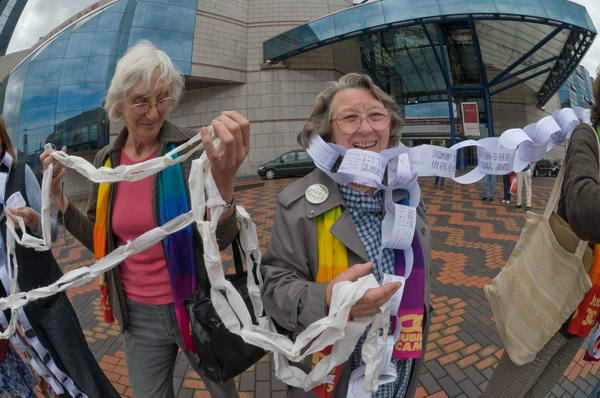
Methodists from Worcester caught in the chains of debt, Birmingham, 2008

Digital showed its strength again, when we went into the rally in the same conference centre that the G8 had used. The lighting in the hall wasn’t bright, but I was still able to take some nice sharp images with the 20mm from my seat, although it was a pity that the 18-200mm VR lens had jammed the previous day. The picture below, taken without VR, was at 1/125th on a Sigma 55-200mm lens at 200mm (300mm equiv) full aperture, ISO 1600, and is sharp and relatively noise-free.


Ann Pettifor (Advocacy International and Operation Noah, previously of Jubilee 2000)

It was a long day – but interesting, although the final demonstration proved a bit of a challenge – a human pie chart to illustrate that 20% of debt has been dropped but 80% still remains. Here’s my best effort.

Pratt’s Bottom

It’s hard to resist a name like Pratt’s Bottom and I have to confess I didn’t try hard, and as soon as I heard the details it was etched in my diary. Pratt’s Bottom (or rather Pratts Bottom, as I notice they like to omit the apostrophe these days) is a village on the south-east outskirts of London, and notable particularly for its annual village fete held each year in May.

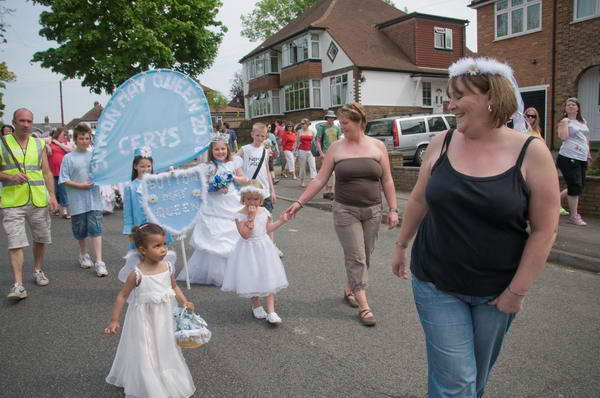
Pratts Bottom May Queen
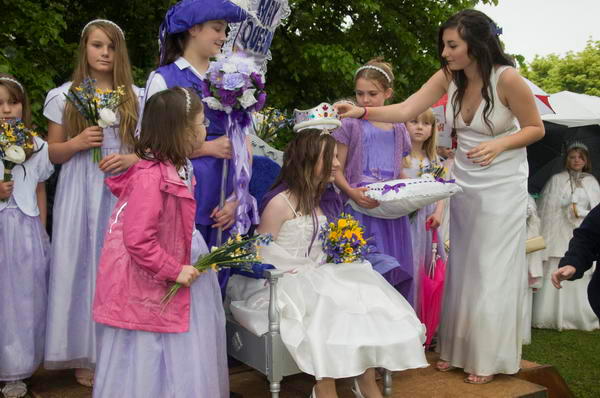
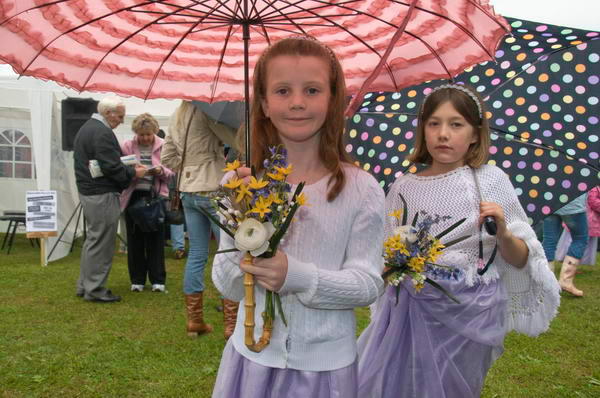
Last year’s May Queen crowns the Pratt’s Bottom May Queen for 2008
Part of the reason for its continuing vitality as a village is the Village Hall, where you can act, sing opera, play short mat bowls, train your dog, play badminton or with model trains as well as be a Brownie or join the WI, though if you get your nights mixed up the results could be surreal. It also has a very nice pub, the Bull’s Head, its very own village school with 47 pupils (a pre-school group also meets in the Village Hall) and – the real reason for my visit (although the pint of Theakstons was very welcome) its own May Queen.

There are some drawbacks. Pratt’s Bottom is a longish journey from where I live and the nearest station only gets one train in each direction per hour. Due to a misunderstanding about the times I arrived rather late to find the procession had already left and found myself running over half a mile up a hill to catch up with it, getting to the village green where the fete was taking place more or less as it arrived.

It was also raining. Not particularly heavily, but steadily. Enough to sneak the odd drop onto the filter I’d just wiped and spoil the picture, though I’d tried hard to keep a cloth over it when not in use.

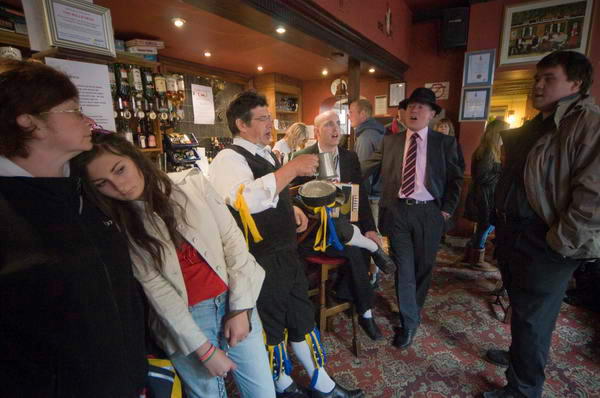
So when I’d taken the pictures of the May Queen crowning, had a walk round all the stalls, had a couple of goes on Pratt’s Bottom’s Human Fruit machine and taken a look inside the Village Hall at the drive-it-yourself model railway (I resisted) there really wasn’t a lot to do other than join the Morris Men having a bit of a sing-song in the pub.

Bull Head

It is, after all, traditional.

Taken to the Cleaners

London Cleaners at AON

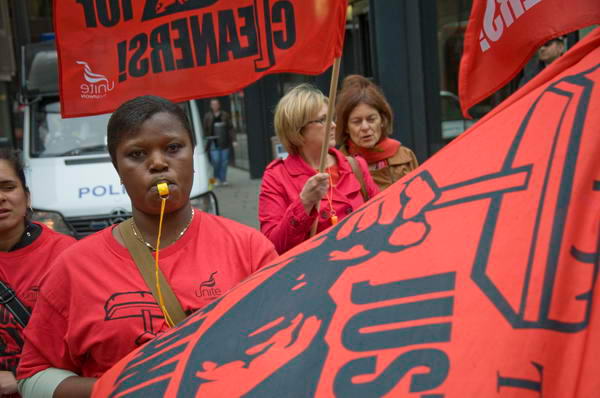
It’s hard not to sympathise with the cleaners when you compare the rates they get paid for cleaning the London offices of some of the richest companies in the world with the ridiculous amounts paid to some of those who work there. They certainly deserve enough to live on – and the current minimum wage isn’t enough to survive on in London. Their demand is for a living wage – currently set at £7.20 an hour – as well as some basic rights as workers.

Their campaign aims to shame the companies by making a fuss, with demonstrations that are highly visible and audible. It was one event where I was glad I had a set of ear plugs in my pocket as they blew their whistles pretty mightily. The red t-shirts and flags make them stand out, particularly in the financial area where dull suits abound.

I’d like my pictures to be as powerful as possible, but it was hard to produce anything really dramatic – and even harder to get anyone interested in publishing them. More pictures and more about the campaign on My London Diary.

Changing Spaces at Photofusion

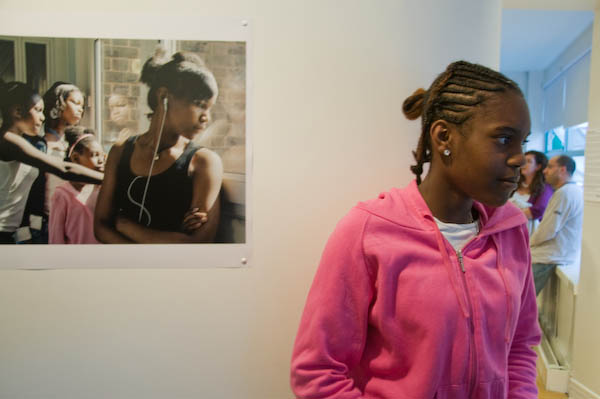
I usually like going to exhibition openings at Photofusion, though more often it’s the people I meet there that make it interesting than the pictures on the wall. Photofusion is very much a photographers gallery and most of the people at openings have a real interest in the medium. Its also a much more friendly place that most galleries, one where you can talk to strangers and meet new people, as well as bumping into old friends and acquaintances.

If anyone doesn’t know, Photofusion is London’s largest independent photography resource centre with a full range of facilities and services for pros, amateurs and students. Members can work in a well-equipped digital suite (or for the retro, darkrooms) hire a studio attend courses and events at reasonable rates, and Photofusion’s picture agency represents the work of many photographers whose work deals with social and environmental issues – including some of my own.

It’s also very handily placed in Brixton, 2 minutes walk from both the Victoria line tube and Overground station. When I did a project on people on buses Brixton was one of my favourite places to work, because there were just so many buses and people. I dropped in to Photofusion last night on my way back from photographing in the centre of London, a fifteen minute journey by tube.

The current exhibition, Changing Spaces, (until 21 June, 2008) has work by five photographers, Laura Braun, Mandy Lee Jandrell, Isidro Ramirez, Simon Rowe, Gregor Stephan and is a part of the Urban Encounters programme, a collaboration between Photofusion and the Centre for Urban and Community Research at Goldsmiths (part of the University of London, based at New Cross.) Curated by Paul Halliday and Catherine Williams, this also includes a conference, talks and workshops.

The show aimed to present different approaches by photographers to urban spaces, and is one of the more interesting currently on view in London, although I find some of the writing about it more than opaque. Here’s a short chunk:

Laura Braun’s move towards sub-urbanisation in the mid 1900s, show social and public spaces devoid of the photographs of Downtown Los Angeles, the once glamourous heart of the city, side-lined and in decline since the pressure of people however with the traces of their passing intact.

This certainly isn’t English as we know it, and must surely be the output of some deranged computer programme that strings together random phrases in an attempt to demonstrate artificial intelligence. But doubtless it will be clear to speakers of Acadamese.

Two projects of the five appealed particularly strongly. One was by Isidro Ramirez who gained a BA on the Editorial Photography course at the University of Brighton in 1998 and an MA in Photography and Urban Cultures at Goldsmiths in 2006. His pictures in the project What We Don’t See are of spaces in which blind and visually impaired people live and work, and show a fine sense of both space and light. I think they reveal considerably more about how the photographer sees than about how those who inhabit the spaces perceive them. Keeping spaces relatively open and uncluttered is of course essential when vision is limited, as we found when my late father-in-law used to stay in our untidy home.

Simon Rowe worked with Francesca Sanlorenzo and Ben Gidley of Goldsmiths on the 2004 Pepys Portrait Project. His work on show is “part of a larger project about the Pepys estate, present a portrait of a South East London housing estate as it moves into a new era. The project reflects a sense of the multiplicity of human and social relationships against a background of social change and regeneration.” Both this text and his pictures are models of clarity and show a real feeling for the people and place.


Some of the people in Simon Rowe’s pictures were at Photofusion for the opening

The Pepys estate in Deptford was built by the GLC, (Chief Architect Ted Hollamby,) in the 1960s on a prime 45 acre site next to the Thames to provide over 1,300 homes. Opened by Lord Mountbatten of Burma in July 1966, it was lauded at the time as a landmark in social housing, and gained a Civic Trust award.

Pepys Estate (C) Peter Marshall
Pepys Estate, 1982 (C) Peter Marshall.

By the 1980s, when the estate was handed over to Lewisham Council, the buildings had deteriorated through poor upkeep and the estate had become known for crime, vandalism and drugs. Problems were confounded by those of language, with many asylum seekers being housed there.

Regeneration started in the early 1990s, mainly refurbishing existing buildings, but came to a halt in 1998, with six blocks on the prime riverside sites not completed. Lewisham engaged in complex and highly doubtful moves, against considerable opposition from Pepys tenants, finally resulting in Aragon tower being refurbished as a private block by Berkley Homes (handy yuppy flats for over-paid workers at Canary Wharf) and the five low rise blocks being replaced by 250 new homes by Hyde Housing Association.

Anyone for Morris?

I’m never quite sure that I want to photograph Morris Dancing. Partly I think because it seems to be such a popular subject with amateur photographers – the kind of event that gets listed under ‘photo opportunities‘ in the amateur magazines. Fortunately I don’t think these have got onto May Queens yet. But it does seem to be a general rule that whenever something is listed whether on a press release or elsewhere as a ‘photo-op’ it is almost certain to be boring. You, along with 27 other photographers are presented with someone else’s idea (almost always a word person’s idea) of what would make a good photograph, typically some posed group, and its always hard work – if not impossible – to make a different and more interesting picture.

Of course Morris isn’t like that, but it does come with lots of wacky coloured clothes, stripy waistcoats, flowery hats and knee-bells that make it ‘photogenic‘ – another of my least favourite words, committed as I am to the proposition that it’s photographers who make photographs. Photogenic just means more clichés to struggle against, and all too often my doggy paddle can’t breast the stream.

Not that I’m against Morris at all. It’s a great tradition and guys like Cecil Sharp and the others who recorded and resuscitated its dying embers at the turn of the nineteenth century did a great job. If I didn’t have a life and two left feet I’d happily join up and spend more time with them studying real ale. I’m even on record as saying that the stupidest, most arrogant and wrong-headed decision the English Arts Council ever made was not to fund Morris Dancers; “Over my dead body” on of its more illustrious leaders was reported to have said in a rare pause from shovelling money into the bottomless pit of London’s Royal Opera House.

sword and wheel
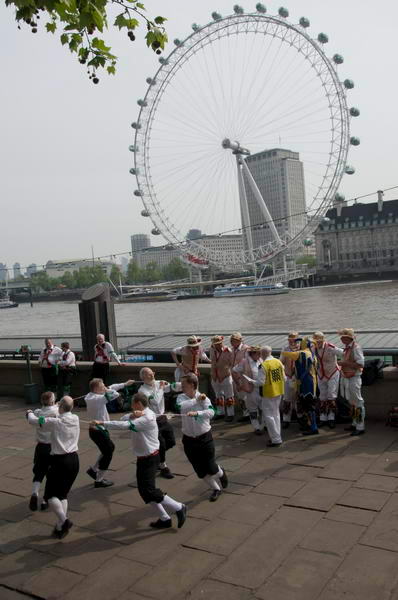
Sword dancers at Embankment Steps, Westminster, London

The Westminster Day of Dance is rather a splendid event, organised by the “world famous Westminster Morris Men” who dress in tabards with a portcullis motif which makes me think of council employees (perhaps why I seem to have edited them completely out of the pictures I’ve put on line) though they do have a rather fine unicorn.

There were four locations where groups of dancers were putting in an early morning session before coming together in Trafalgar Square, and I decided that the River Thames would make for a more interesting London background, so started off at Embankment steps, with the view across the river, including the London Eye – see above. Shortly before the session ended I rushed down to Victoria Gardens, where I hoped that the Houses of Parliament and Rodin’s Burghers of Calais might form suitable backgrounds, though I didn’t really get either to work.

After a brief and pointless journey on the tube to photograph another event (on arrival I found it wasn’t starting until three hours after the time I’d found on the web) I went to see the Morris Men (and I think they were all men, although there are women Morris Dancers, following in the footsteps of the suffragette Esperance Working Girls Club of 1906) in Trafalgar Square, where they were competing rather successfully for the attention of tourists with Falun Dafa, celebrating its 16th anniversary and protesters against the slaughter of seals. The dancing continued at various sites around Westminster after lunch, but by then I was with the May Queens in rural suburbia.

There is a tendency for us to look back and see the interest in and revival of folk traditions – including both Morris and the May Queens around the end of the Victorian era as a conservative movement in political terms. There were actually strong links with the radical movements of the day both in the arts – the Arts and Craft movement – and in politics, including both socialism and the emancipation of women.

London May Queen

I’ve had an exhausting few days, partly from working in what for us in England has been some unusually hot weather but also because I’ve been out photographing rather a lot. People who aren’t photographers (even some who take a lot of photographs) think that photography is an easy number but – at least the way I do it – it can actually be physically and mentally draining.

My camera bag isn’t particularly heavy, typically around 15 or 16 lbs on my left shoulder, and I can stand around for hours without getting tired (though if I forget and pick it up on my right I start to feel pain in minutes.) But covering a procession or demonstration involves a lot of running around, much of it going backwards, as well as stretching, crouching and leaning to get the camera into the right place, often rather tricky as the subject is often moving too.

Mentally I think it’s rather like taking an exam when new questions keep getting fired at you and you have to respond instantly with answers. As well as the purely visual problems you are also working with people and situations. I’m not complaining – I do it because I find it exhilarating, but can also be very tiring.

Of course the subjects I choose to cover are relatively soft ones, unlike those of some other photographers. Despite some of the lurid stories of gun crime that appear in newspapers there is essentially little or no risk of “kinetic activity” when photographing in London, and the worst physical dangers I usually face are those of road traffic. And being able to get on a train and go home at the end of the day does make life so much easier.

Coney Hall
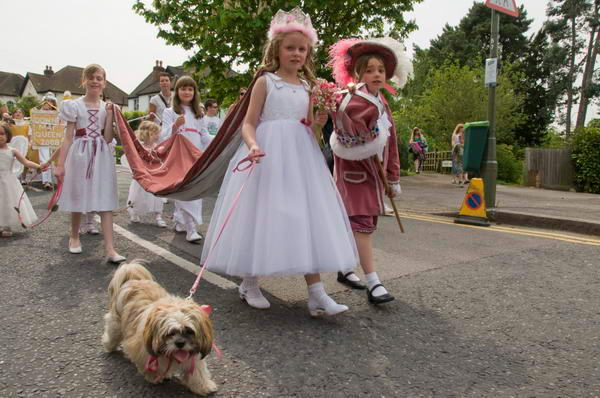
The Coney Hall May Queen and her dog in the procession

But despite the fact that the Merrie England and London May Queen Festival is a delightful and interesting event, I was still pretty tired by the end of it, and it was great to be able to relax and have a couple of beers before going home and downloading the images on to my computer. It’s also good not to have to work to tight deadlines, although I had to get everything transferred and backed up so that I could go out and take more pictures the following day.

Sutton May Queen
Sutton May Queen

The festival was held as always at Hayes Common, on the leafy suburban south-east fringe of London (and the pollen count was undoubtedly high as my itching eyes and sneezing testified.) I’d been invited to take pictures by the mother of the 96th London May Queen, though I would quite likely have been there in any case as I’ve been working on a project on the subject of May queens, hopefully for a museum show and book, since 2005. Given the problems that there can be now in photographing children, getting to know and be trusted by people has been vital.

You can read much more about the actual event, and see more pictures than you need on My London Diary, where there are also pictures from various previous May Queen events.

Slough Arm

Come friendly bombs” wrote John Betjeman, and although Slough has definitely changed since his day, I’m not sure a walk through the town centre would convince anyone it was for the better. Like the rest of the country, industry there has to some extent declined, although there are still things being made in parts of the industrial estate.


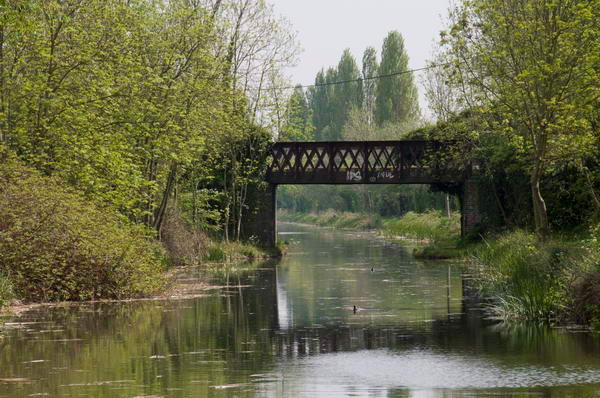
A rural aspect on the Slough Arm of the Grand Union Canal

I went there on a Bank Holiday (the silly May one that isn’t May Day) along with Linda and Sam to walk along the Slough Arm of the Grand Union Canal, for a long more or less disused. Despite Betjeman’s ” There isn’t grass to graze a cow” it was surprisingly rural, where you weren’t walking past factories, many of which were disused.

The first couple of miles of canal were pretty empty, although there were a few people enjoying the fine weather (and some fishermen, although I thought this was the close season.) Most of the people we met were talking Polish.

The Slough branch of the canal is a five mile long dead end, but we didn’t walk all the way to the junction with the main line at Cowley Peachey, instead diverting past the sewage works to Iver to take a look at the church (covered in scaffolding) and buy chocolate and ice cream. Iver also has several pubs. We then came back over the canal and took the ‘Beeches Way’ to West Drayton where Linda and I caught a bus home and Sam a train on the first part of his journey to Milton Keynes – another 40 or so miles up the canal.

The last half of the walk was through the Colne Valley, a curiously remote area on the edge of London, traversed by many rivers – there are two aqueducts carrying the canal over the Colne and the Colne Brook. Also passing through it is the M25, and, just a little south of where we were, the M4. Much of the area is covered by the lakes left from mineral workings, along with other derelict industrial sites.

The Slough Arm