Tent City

Tent City“, the occupation of the Wembley Sports Ground in opposition to the building of a city academy on the site was finally brought to an end early last Friday morning, when specialist bailiffs acting for Brent Council turned up and removed Hank Roberts, the local secretary of the two major teaching unions, the NUT and the ATL who had locked himself to the flagpole on the top of the changing room block.

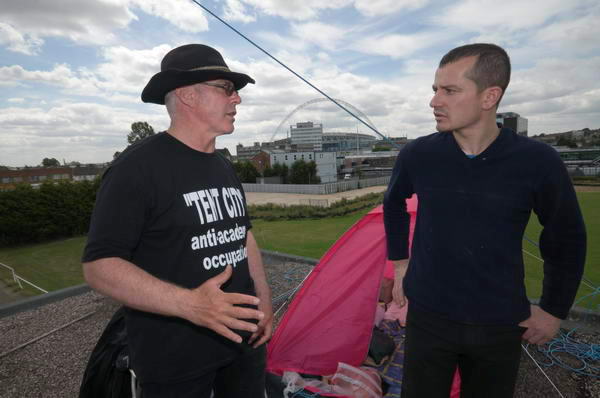
Hank Roberts (left)
Hank Roberts (left) talks to another protester on the roof – with Wembley Stadium in the background

Although I wasn’t there for the eviction, I had climbed the ladders up to the roof to talk to Hank and some of the other protesters on Wednesday, when he was continuing the protest despite a court injunction against him personally and the protest in general. The fight to stop the academy will continue, but the plans to house 200 children in portable classrooms on the site for next September now seem likely to go ahead, despite the poor educational experience this seems almost certain to provide.

I also wrote a complaint to the BBC about their biased reporting of the occupation, which highlighted the comments of a Brent Council representative and failed to mention the educational reasons for the action or that Roberts was a teacher and union secretary. As yet I have not received a reply.

I was very glad I could climb down after half and hour or so, as I have no head for heights, perhaps because my father used to take me up on roofs that he was repairing. Our ideas about ‘Health & Safety’ were very different then and there were times when he had to look after a small child and earn a living.

You can read more about the ‘Tent City’ protest and see more pictures on My London Diary

Up with the Swans

I’d lived close to the Thames for 25 years before I first saw the swan uppers as they made their annual pilgrimage up the river counting and marking the cygnets. Our local papers typically only notice the event with a short note the week later, although it is a spectacle that would interest many of their readers to see in person.

But perhaps newspapers – like more obviously television – are a way of avoiding contact with the world rather than encouraging participation, other than through patronising the advertisers. (Much of their content is of course advertorial, and even some of the news stories sometimes have me doubting. This week one front-page splashes a shock-horror-shame exposé of a local brothel for which the paper carries a regular advert in its adult section which makes me muse about the quid pro quo for this week’s extensive free advertising!*)

The uppers however, have been on the job since the twelfth century or so, though their modern practices are now considerably less bestial than in the past. The Queen, Dyers and Vintners no longer eat the birds and they don’t even cut their notches in their beaks any longer. It is all about conservation, ecology and the environment, and about a great deal of care and concern for the welfare of these splendid birds. And they are splendid, even though I once was driven to threaten to spit-roast any of my photography students who added yet another image to the pictorial waste-heap of pictures of them.

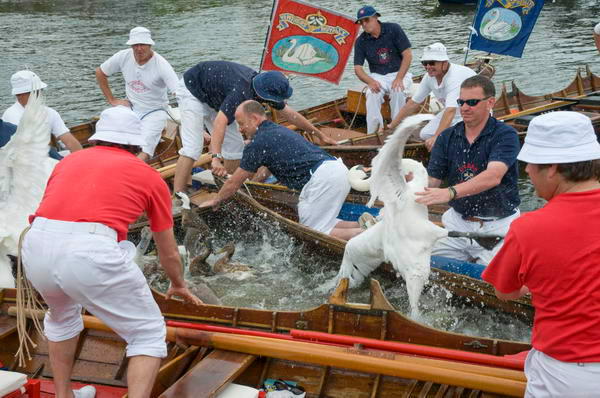
Swan upping

But it is in some ways an exciting event, and the skilled teamwork involved a delight to watch and admire, and it’s good to meet them again. Travelling back from Hull in the morning I caught up with them as they left the Swan for the afternoon’s voyage to Windsor, along a relatively swan-free section of river. There seemed to be considerably less press interest than last year, when rumours it could be the final year for the upping drew snappers from the nationals and major agencies, and I was able to work without having to use my elbows.

Swan inspection
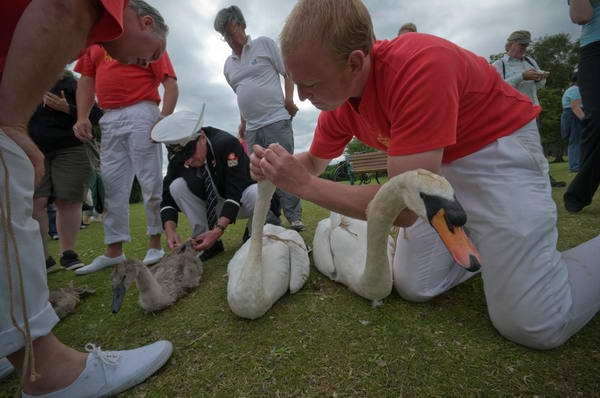
The swans get a quick medical on the bank and their details are recorded

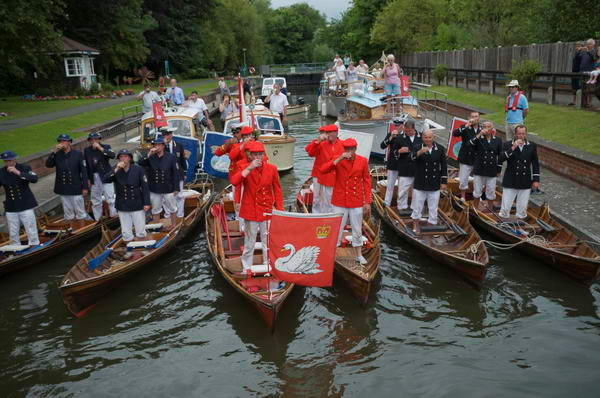
It was only the second time that I’ve overcome my republican sentiments sufficiently to continue to photograph the royal toast in the lock at Windsor. This year the whisky seemed to be watered down even more than last.

Royal toast

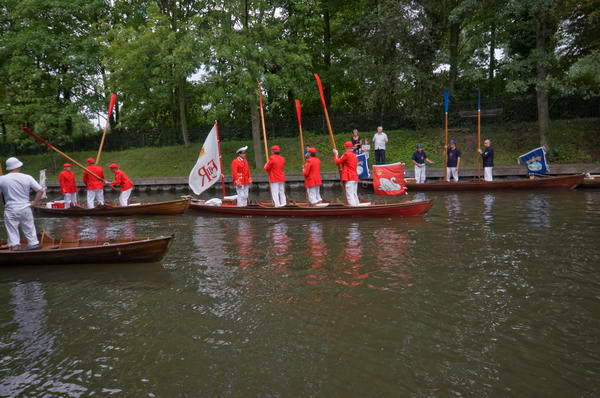
It doesn’t really make for an exciting picture, although probably more saleable as stock than most I take. The final event of the day, when the Dyers and Vintners stand with oars raised to salute the Royal uppers as they pass standing similarly is one that I’ve yet to work out how to photograph adequately. This year I did slightly better than last, but still not to my own satisfaction. The boats are too spread out to photograph – even with the 10mm which in any case makes them look too small – and longer lenses just can’t show enough. So perhaps I’ll go back yet another year and try to find a different approach.


The boat at left had drifted back behind some bushes, and another had gone too far to my right. 

*Note to their legal department. This is not meant seriously, although it does illustrate a certain hypocrisy endemic in the British press rather than any particular newspaper.

A Yorkshire weekend

My London Diary went on holiday last Friday to Yorkshire, where I spent a weekend staying with a friend in one of Hull’s stateliest homes, a grand ‘Arts and Crafts‘ mansion near the university, which he is busy restoring to something like its original state, but with modern comforts such as central heating and en suite bathrooms. However I haven’t posted pictures of this rather grand project this time, but from a couple of trips we made during the weekend.

Hornsea, on the North Sea coast, used to be a short rail journey from Hull, although thanks to Dr Beeching, the trackbed became available and is now a recreational trail, but we went there on the bus. It’s the kind of seaside place that is seldom crowded, but since it rained most of the time we were there, even less so. Our route back was interesting, going through Beverley and then passing Bethnal Green, both of which I photographed.

Fish St, Hull
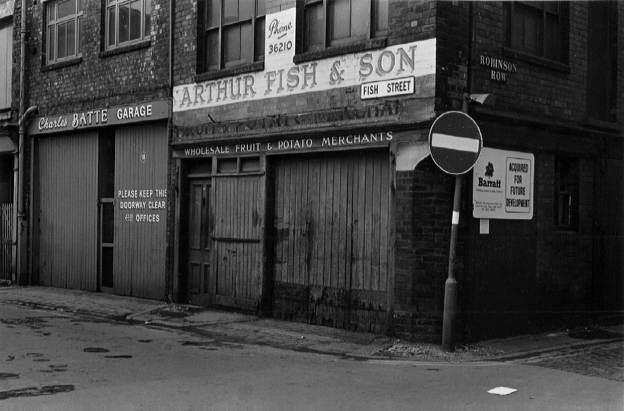
Arthur Fish & Sons, Fish St, Hull, 1970s

Hull was where I made my first major photographic project – and had my largest one person show to date, with almost 150 black and white and colour prints on display in the fine Ferens Art Gallery there in 1983. Traces of the Hull I photographed are still visible, but much has changed, sometimes for the better. The pictures I’ve put on My London Diary from last weekend in Hull were taken within a short walk of where Fish St.

It’s a free country (at least in New York)

New rules from the New York Mayor’s Office of Film, Theatre and Broadcasting (MOFTB) about photographing on the streets of that city will I think be welcomed by photographers who work there. They make it clear that you don’t need a permit unless you want to use extensive equipment or vehicles or want to block a significant part of a street for your work.

If you only use a hand-held camera (still or video) – even if it is on a tripod, you don’t need a permit, as it makes clear: “Standing on a street, walkway of a bridge, sidewalk, or other pedestrian passageway while using a hand-held device and not otherwise asserting exclusive use of City property is not an activity that requires a permit.” Tripods can still land you in trouble if you block road lanes or use them on narrow pavements, but do not in themselves need a permit – they too are generally regarded as “hand-held equipment.”

Similarly it states ” the filming of a parade, rally, protest or demonstration does not require a permit” and you don’t need a permit if you are a press photographer with a NYPD pass.

To photograph in city parks and inside public buildings will still require authorisation from those in charge of them and permits will continue to be required for the certain activities “including but not limited to animals, firearms (actual or simulated), special effects, pyrotechnics, police uniforms, police vehicles” etc.

The new rules came only after several rounds of public consultation and seem a useful clarification of the right to photograph on public streets (and the activities that, largely reasonably, require a permit.)

Although we have a similar freedom to photograph in public places in the UK without need of permits, it might perhaps be nice to have a similar statement clarifying this in our country and in our major cities in particular, where increasing photographers are finding their right to photograph while on the public street without permission challenged, particularly by the growing armies of heritage wardens, community support officers, security employees and others who police our streets.

One site worth looking at for UK photographers is UK Photographers Rights
by Linda Macpherson LL.B, Dip.L.P., LL.M, a lecturer in law at Heriot Watt University, and I’m glad to read from one of the comments that she is working on a revised version of her “short UK guide to the main legal restrictions on the right to take photographs and the right to publish photographs that have been taken” which you can download there.
The comments on the page, and in particular Linda’s replies to them make some interesting reading, although they are occasionally debatable (as are so many things in law.)

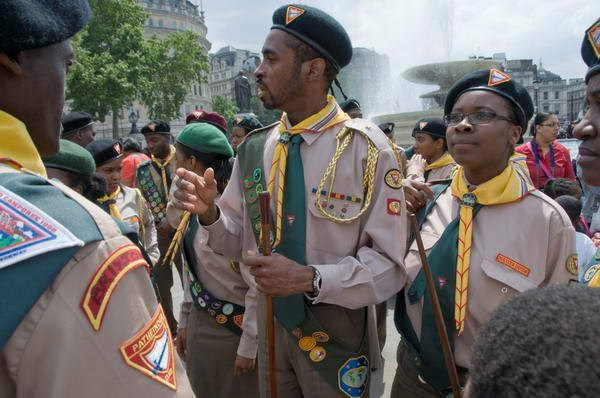
Trafalgar Square - without a licence
Trafalgar Square – without written permission to photograph
(Seventh Day Adventist Youth march against gun & knife crime)

One particular instance concerns the by-laws which apply to Trafalgar Square which thousands of photographers – myself included – regularly break which require written permission for “photographs or any other recordings of visual images for the purpose of or in connection with a business, trade, profession or employment or any activity carried on by a person or body of persons, whether corporate or unincorporate“.

This is exactly the kind of nonsense that the New York MOFTB rules clarify and largely dispense with – making clear exactly what kind of photographic activity needs a licence, and provides a very good example of why would benefit from a similar document in London.

Panoramas and Balazs Gardi

I’ve long been a fan of panoramic images, though since moving to digital for most of my work I’ve taken far fewer (and there are still a few rolls of film containing them waiting for me to develop them.) Having tried a few panoramas on film by combining several exposures (so much easier with digital!) I saved long and hard for a rather expensive Japanese Widelux swing lens model in around 1990 and worked fairly hard with it and a cheap Ukranian Horizon 202 I acquired a few years later.


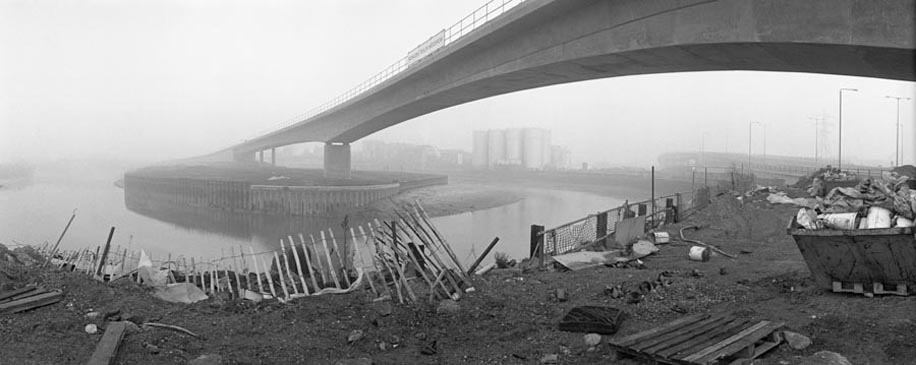
(See it larger on my Lea Valley web site)

With digital you can fairly easily stitch images to make panoramas – especially with static subjects, but it is hard to work with people, and cameras such as the Horizon or the no longer made Hasselblad XPan – a superb rectilinear panoramic camera, especially when fitted with the wide-angle 30mm lens, which became another favourite of mine, still have a role.

What brought panoramic photography to my mind was a fine set of black and white images, The Valley, taken in Afghanistan in late 2007 by Hungarian freelance Balazs Gardi of VII Network which includes some panoramics. Gardi first came to my attention when he won a Getty Grant in 2005 for his work on Roma. I’ve also mentioned ‘The Valley’ before but it was brought back to mind by a recent mention on PDN Pulse, where I also read news of another panorama currently arriving from Mars, which will take several Martian days to complete!

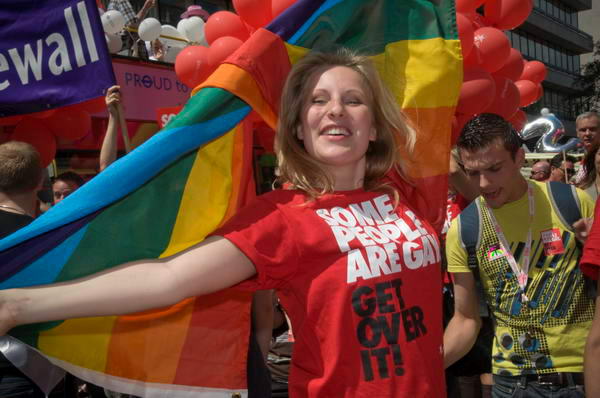
London Pride


Stonewall’s slogan – ‘Some people are gay – Get over it!’

From My London Diary – where you can see more pictures:

It’s nearly 20 years since I first photographed Pride (you can really go back in time and view the actual web site I wrote in 1997 for my pictures that year – but I would no longer recommend Netscape Navigator 4!) and some earlier work is still on Fixing Shadows. You can also see the 40 or so pictures (as rather better scans) from my ‘Ten Years of Pride‘, part of the ‘Queer is Here‘ exhibition at the Museum of London in 2006.)

Now I wonder each year if I will bother to photograph it next year. It’s still I think an important event, but really now an entertainment rather than the kind of statement it used to be.

This year there seemed to be rather less of the parade than in previous years, though much of it seemed just the same as last year, and the whole thing seems to have rather got in a rut. Still, at least this year it was dry.

Paper Planes for Ruth Kelly

Flash mobs can be rather tricky things to photograph, particularly for those of us who find it difficult to be at the right place at the right time. According to the FAQ on the UK Flash Mob web site, a flash mob is “a sudden gathering of people into a crowd that do something unusual for a few minutes in unison and then disperse.” I photographed one of their events – the London start of a Flash Mob Global Pillow Fight in Leicester Square – earlier this year.

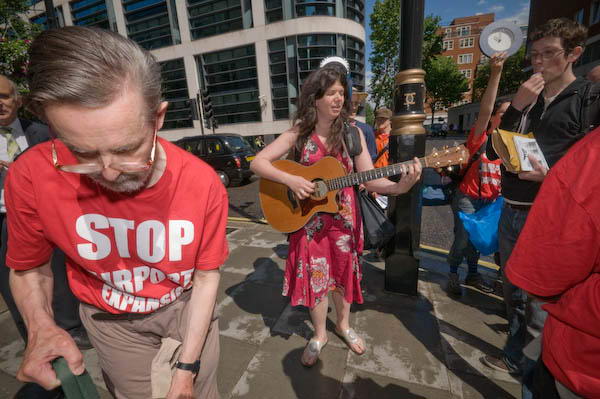
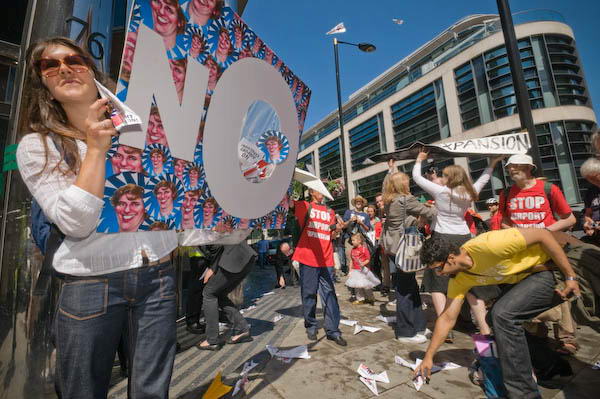
Stop Airport Expansion‘ was both the name of the group who had organised the event (and an earlier one to celebrate the opening of Hedatrow T5 that I missed) and the message they wanted to send to the elusive Transport Secretary Ruth Kelly, who has refused to visit local authorities or meet with local people who will be affected by airport expansion, particularly by a third runway at Heathrow. The ‘Stop Heathrow Airport Expansion Flashmob‘ took place outside the offices of the Department for Transport in Marsham St, though where she was at the time nobody seemed to know.

I’ve been opposed to the expansion of Heathrow as a local resident since I used to watch the aircraft low over the garden from my pram. The airport began with deception before my birth, pushed through in wartime (and diverting resources from the war effort) and has continued to grow and grow, repeatedly breaking promises that each new development will be the last. I photographed marches against the building of the third runway at Heathrow in 2003 as well as earlier this year.

People did appear fairly dramatically just before 11 am, although there were perhaps not quite enough of them to make a real mob.

The whistle came early
And when someone (at right above) blew a whistle just before 11.02 (their clock was wrong) everyone took it as a signal to throw their planes, though they did pick them up and throw them again at around the correct moment. They had to pick up the planes in any case, as police had warned them they might otherwise be charged with littering.

Planes in flight

Catching good pictures of paper planes in flight turned out to be surprisingly tricky. I’d fortunately realised there might be a problem in advance, and turned the D300 on to the high speed mode. Usually I leave the camera on the low speed continuous setting, which I’ve set using the custom setting d4 to be 3 frames per second. I find this is the fastest speed I can leave it on and reliably take a single exposure by a short shutter press that doesn’t jab and cause camera shake, while allowing me to take a sequence of images by holding my finger down.

Up till now I’ve also been using the 14 bit RAW setting, which restricts the maximum frame rate to slightly slower than this, at 2.5 fps. I’ve seen reports that there is very little advantage in using this compared to the 12 bit setting, but hadn’t found the time to test it out for myself. (I’ve continued to use RAW compression which I tested on the D200 and found made no discernible difference in my kind of pictures.) But waiting for the mob to flash, I’d remembered to set the bit depth down to 12 bit so I could shoot 12 bit RAW bursts at 8 frames per second.

You can see more of my efforts at photographing the Stop Heathrow Airport Expansion Flashmob on My London Diary as usual.

I didn’t notice any drop in quality in these files compared to the 14 bit ones, but the extra number of pictures on a card was significant (the manual suggests around 1.3 times as many.) I found I got almost exactly 100 files per gigabyte compared to around 79 using 14 bit, a very slightly smaller difference. I’ll perhaps get round to making some more careful comparisons of image quality for myslef shortly – and when I do will write more.

Even in 1/8th of a second, a paper plane moves a considerable distance, and catching them flying low with the added milliseconds of reaction time and shutter lag was a lottery in which I had no outstanding success. Of course I could have set something up, but I’m not that sort of photographer.

Time Running Out

Time seems to be passing very quickly for me at the moment, and I could hardly believe it when I had to start a new month on My London Diary. So it was perhaps fitting that several of the events I’ve photographed recently have been about time running out for our planet.

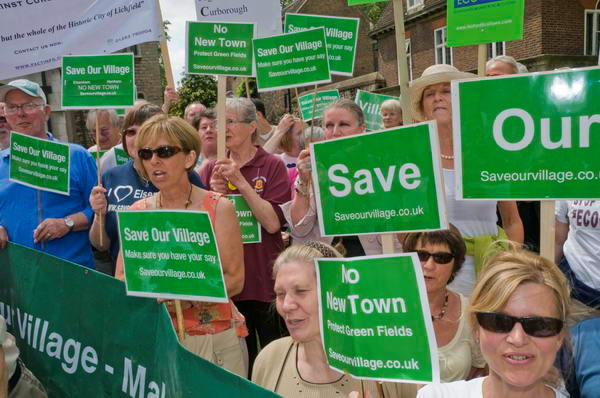
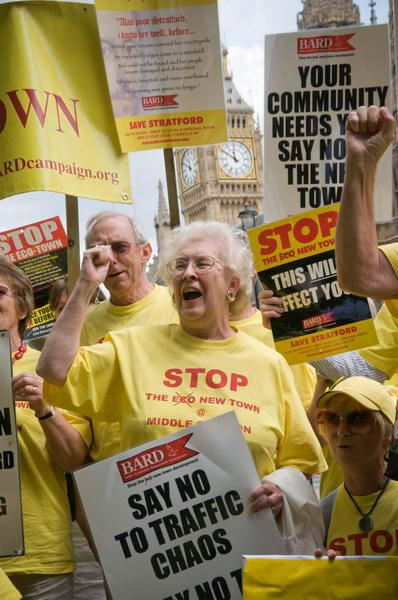
June 30 was the last day of a government consultation about what started off as a potentially good idea – eco-towns – but has ended up as an unpopular mistake. Eco-towns were promised to be zero-carbon new developments using brown-field sites and acting as exemplars of ecological development in various ways. But the thinking behind them was never properly explored, and murky compromises with the building industry muddied the original concept, and we ended up with proposals that really looked very little different from other new town developments, largely to be sited on prime agricultural land. Brown-field sites are harder to find and generally give developers more problems.

It was hardly surprising that local protest groups emerged to oppose most of the proposals, nor that most of their opposition was on environmental grounds although probably very few of us welcome development in our own backyards. (I certainly hated it when the council built rather plain flats on the unregistered common land at the end of my garden.)

BARD against Middle Quinton

Certainly I think the strength of the opposition which was demonstrated outside the Houses of Parliament on June 30 will at least worry the government – as should the comments of prominent architects and environmentalists.

More on the story – and of course many more pictures –
in Eco-Towns Scam – Parliament Lobby on My London Diary.

Drop the Debt in London

Thursday I spent a day out in London, but my idea of a day out is perhaps different to most people. It started badly, when I forgot where I was supposed to be going and went to Trafalgar Square rather than Parliament Square!

I’ve changed from using my ancient and rather inconvenient diary software that produced nice neat printouts of my schedule to a rather more up-to-date piece of software, but haven’t so far managed to get it to give me such nice lists. Thursday I was in a rush and just glanced at the screen, scribbled a few notes and ran for the train. And got it wrong.

So I was late, and missed the start of the event I’d gone to photograph. Really organisation is vital, and I wasn’t the only one who had messed up, as the organisers hadn’t realised they needed permission from Westminster City Council for what they wanted to do.

The two mistakes didn’t quite cancel each other out, but it did mean I’d missed rather less than I would otherwise have done. I was able to catch up and photograph the rest of the event.
Birmingham May 2008
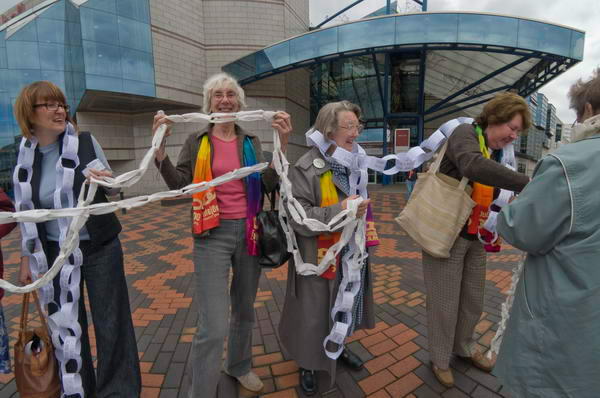
Paper chains in Birmingham

Which had started several weeks ago in Birmingham, where at the ‘Journey for Justice’ we had celebrated the 10th anniversary of the human chain which had been perhaps the most effective demonstration ever at a G8 Heads of Government meeting. Without any violence by demonstrators or police it put the cancellation of the overseas debts of the world’s poorest countries firmly on the political agenda.

There is still a very long way to go for the ‘Drop the Debt’ campaign – with only 20% of such debt yet dealt with. But that 20%, as the director of Christian Aid noted, has meant as much as the contributions collected in a thousand years of the annual fund-raising in Christian Aid week, one of this country’s major charity collections.

The paper links in the chains made this year in Birmingham were to take the ‘Drop the Debt’ message to the G8 meeting in Japan in July, and last week a small group of London activists carried them to the the Department for International Development in Palace St where they were met by Development Minister Gareth Thomas.
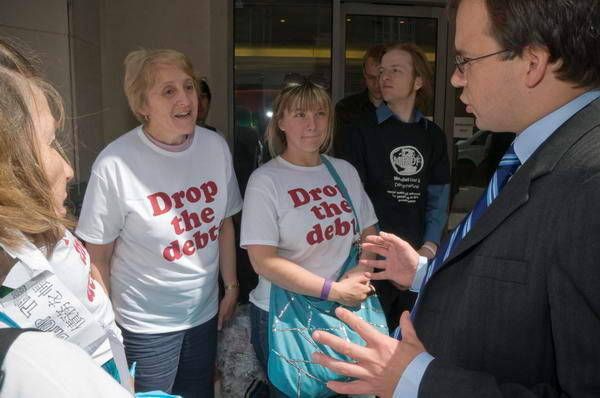
Drop the Debt, London

Photographically things were a little tricky. As you can see, the meeting took place outside on the pavement, at the entrance of the building. There was a fairly huge difference in light levels in the bright sun on the pavement and the deep shade of the entrance.

Photographers sometimes tell me that digital doesn’t have the dynamic range of film, but generally that simply means they haven’t learnt to use digital. It can really deal with much the same range as colour neg, though to do so in this kind of situation does require that you shoot RAW rather than jpeg, and also make use of some flash fill where you can.

The big plus is that with digital you can see immediately whether you have things right, not mainly from the picture display, but from the histogram, and if necessary adjust exposure and flash intensity. Here I was also moving the flash (with the plastic diffuser head that came with it) to point in the direction that needed flash and as far as possible away from the parts of the subject in bright sun.

Apart from a few pictures with my new ultra wide-angle – which I discovered was stuck wide-open and had to give up with, most of the pictures came out fine, at least so far as exposure was concerned.

On the tube to my next location I played with the stop-down lever on the back of the ultra-wide, and fortunately was able to sort out the problem. Obviously I’d changed lenses in a hurry and banged the small lever against the mount, bending it enough to prevent it moving smoothly. After straightening it out carefully the lens worked perfectly.

Having spent around thirty years working with what seem to be the best camera mounts ever designed – from Leica and Olympus – the Nikon mount does seem a little crude.
A Looking Glass Eye – Exit Gallery

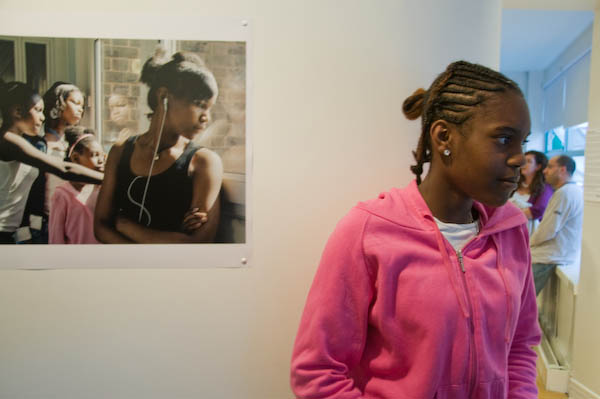
A LOOKING GLASS EYE’, 21st Century London‘ (which continues until 12 Sept, 2008) is the first show I’ve been to at the ‘Exit Gallery‘, the stairs up out of London’s best photographic bookshop, Claire de Rouen Books, on the first floor at 121-5 Charing Cross Road, just north of Foyles.

Exit opening
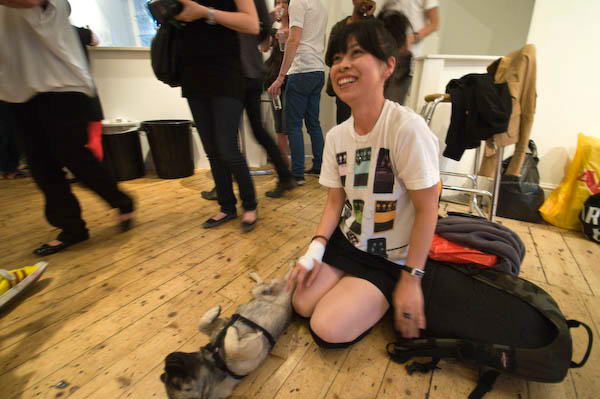
At the opening at Exit

There, around 140 unframed works of various sizes from enprint to poster (including one multiprint work) were each pinned by four bright shiny nails to around a dozen different areas on the stairs and landing in irregular grids, bereft of names or captions. At the opening party it was difficult to see the work for the press of bodies. As Brian David Stevens says on his ‘Drifting Camera‘ blog, “it was a fun party” and he has a few pictures from it there. You can see a couple which show the actual installation with some of the guests on Edmond Terakopian‘s blog – and that’s my shoulder visible in a check shirt at the bottom left of the top image, with I think Daniele Tagmani and Thabo Jaiyesimi in the centre.

There were a few copies of plans of the wall layout available, with squares and numbers on them, but even with the help of these it was confusing to march pictures to photographers, although there were a few that were instantly recognisable. It would have been rather easier to have the individual plans and lists pasted on each section of wall – our better still some rather easier and more informative system there, but things will of course be rather easier without the crush of bodies on the opening night. I’m not sure quite how many photographers have work in the show – perhaps 50 – and most of them seemed to be there and with a few friends.

Unlike the curate’s egg, this really is a show that is good in parts, and if the intention was to provide a full cross-section of work from the last 8 years on London ranging from the superb to the rather ordinary, it was successful. Print quality also seemed to cover a similar range, with work representing the best work from some of London’s leading labs on the wall together with looked like inkjet prints on cheap paper from the kind of printers that cost less than a set of inks. Some photographers seem to have decided that it wasn’t worth taking a great deal of trouble for work that was going to be nailed onto a wall – and the fact that the gallery showed several pictures partly obscured by electrical conduit or similar wall-clutter suggests a certain contempt on their side.

Of course there are different approaches to the medium. Not every black and white needs the Ansel Adams treatment, and I’ve been to shows I’ve loved where the prints were made on a photocopier. But there needs to be some kind of match between the intentions of the work and the syntax of the printing process. Otherwise even good prints can be bad prints and bad prints are best reserved for the rubbish bin, not the gallery wall.

But there is plenty of work here to interest most viewers (although the photographer I arrived with left very quickly) and not just from the biggest names, although several of the half-dozen pictures by Simon Wheatley were among those that appealed to me most (though work by some other photographers I admire was disappointing.) Among the highlights for me were Brian David Stevens, who I mentioned before, and wrote about for his work that stood out in Press Photography 2008 with several fine black and white prints, and David Boulogne had some of the more interesting details from suburbia (some of which at least are from his Henorama project) which I perhaps like because they remind me very much of some of my own work with similar subject matter in the 1970s and 80s.

Simon Rowe picture & model at Photofusion opening
At Simon Rowe’s Photofusion opening – the picture at left was in the Exit show

Another photographer I’ve mentioned before is Simon Rowe, and the work here included some of that shown at Photofusion earlier this year.

But this is a show with a wide range of work, and others will doubtless find other work that attracts their interest. If you are in London it’s worth a visit, but give yourself plenty of time, as you will want to spend quite a while browsing and buying from the incredible stock of Claire de Rouen Books.

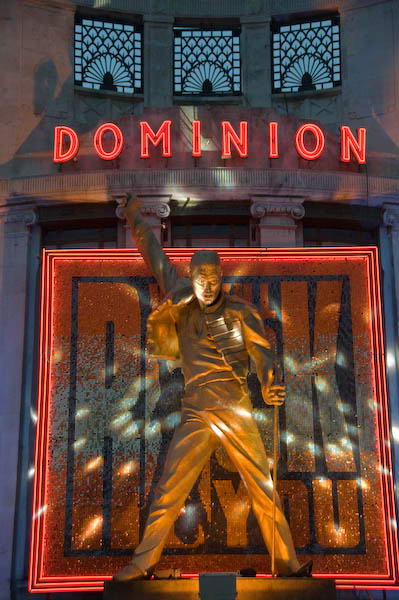
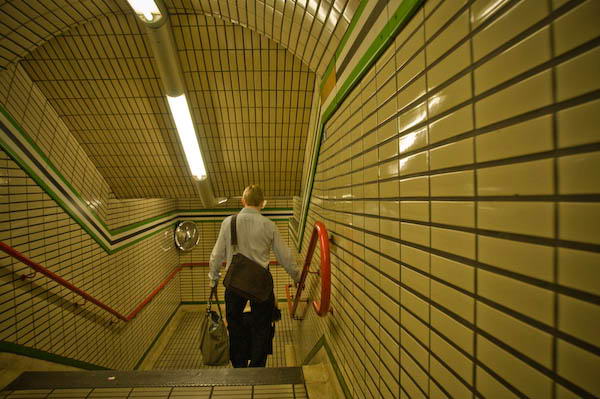
The gallery is close to Tottenham Court Road Station, and I took a couple of surprisingly upright pictures there on my way home.

Dominion TCR
Dominion, Tottenham Court Road

Tottenham Court Road