Kelvingrove


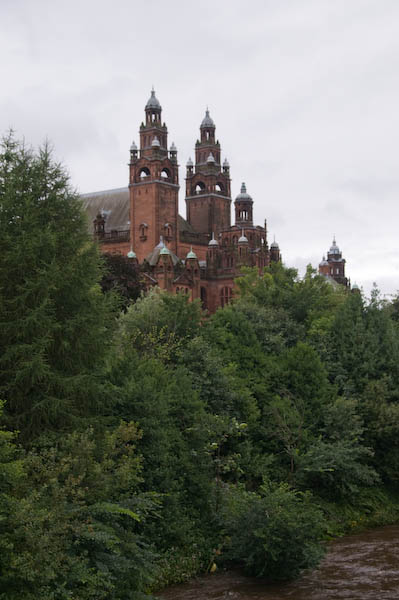
River Kelvin and Kelvingrove Art Gallery

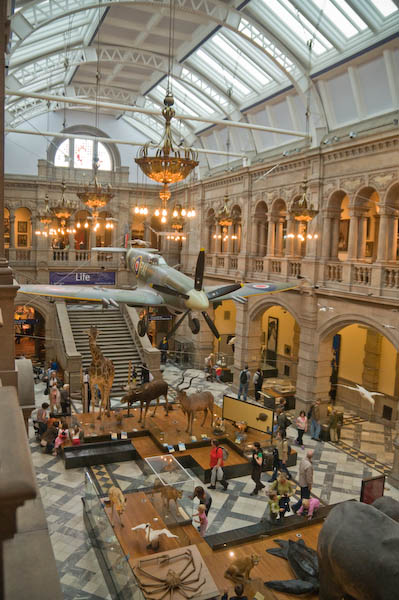
Glasgow’s Kelvingrove Art Gallery. is a gallery I can whole-hardheartedly recommend with a fine collection of paintings and other objects.

My companions and I differed in our opinions of the ‘Glasgow Boys‘, whose contribution to art in the 1880s and 90s deserves to be better known, but the gallery has a superb collection of French painting, although unfortunately too many works were absent on loan, some in Edinburgh for a joint show, ‘Impressionism & Scotland‘ which comes to Glasgow later in the year. I don’t like these big collected shows – much better I think to see the works a few at a time, but having paid your £8 you feel obliged to slog round all hundred and something of them.

The gallery (entry is free)  also has a fine display of work by C R Mackintosh and friends  – rather more authentic than in most tea-rooms and certainly than the ‘Rennie Mackintosh’ hotel I was staying in. (Like W H F Talbot, Mackintosh seems almost always saddled in the popular mind with his middle name.)  It also made clear how much his work relied on that of sisters  Frances and Margaret Macdonald, which I found more interesting than his. Good though buildings such as the ‘School of Art’ are, I find a little Mackintosh goes a very long way.

It’s also a great place for kids, and there were a lot enjoying it while we were there on a wet August morning. What other museum can boast both a Spitfire and a giraffe?

(Also showing at the Kelvingrove Art Gallery were photographs by  one of its most illustrious photographer sons, Harry Benson – which I write about separately.)

More Pictures on My London Diary

Holidays have rather disrupted my postings to this site and also My London Diary over the last couple of weeks – one spent in Glasgow and the second in Iona.  It is possible to connect to the Internet in both places, but the hotel I stayed in on Renfrew St was in the 1980s and the Abbey on Iona medieval in terms of communication. Anyway I wanted a rest away from it all, though that didn’t stop me using a digital camera.

Given the low cost of CF cards at the moment, it’s hardly necessary to take a computer away on holiday, and the market for portable hard disk devices must have plummeted.  I did in fact take my notebook, as I wanted to be able to show my presentation and work from Brasilia to some of the people I was to meet in Iona, but in future I’ll perhaps travel light with a few 8Gb cards.

Of course it is good to be able to see what you are doing on a larger scale than the camera display while your away – and to share them, and at around 3.5 lbs my notebook isn’t a huge weight to carry – and there are smaller, lighter models now.

I’ve still not had a good look at the holiday snaps, and many will be more of interest to family and friends than a wider audience, but I expect I’ll put at least a few on line. But my priority on getting home was to get the pictures from before I went away  onto My London Diary (and deal with those 1500 or so waiting e-mails.)

No New Coal
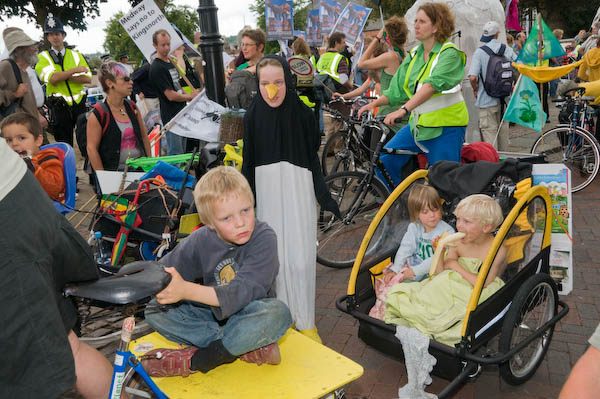
The march forms up to go to Kingsnorth for the Climate Camp

The No New Coal Rally and March pictures are now available as well as those from the Hayling Island Carnival

Hayling Island (C) Peter Marshall

Prison Justice – Paula Campbell

Prison Justice Day, August 10, started in Canada in the 1970s.  On August 10, 1974, Eddie Nalon bled to death in solitary confinement, and on that day a year later prisoner in the jail held a one-day hunger strike and a memorial service – and were themselves put in solitary for doing so. By August 10, 1976, there were two deaths being remembered by the prisoners, and thousands of prisoners in jails across Canada took part in a hunger strike, with Prison Justice Day Committees in Quebec, Ontario and British Columbia organising events in the outside community.

In 1983, prisoners in France joined in, calling for the day to be an international event and by the mid 1990s those in Germany, England and the US were also involved. You can read the details of the history on the Prison Justice web site.

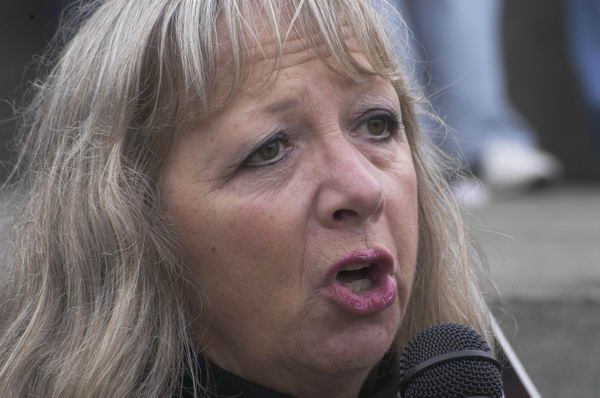
In this country, one of the best known campaigners for justice in our prisons was Pauline Campbell. After the death of her daughter in Styal Prison in 2003, she put all her considerable energy and organisational skills into a constant campaign against deaths in prison. I first met her later that year in Trafalgar Square at the annual United Friends and Family Campaign Remembrance demonstration, where her story moved me to tears.


Pauline Campbell speaking  in 2003

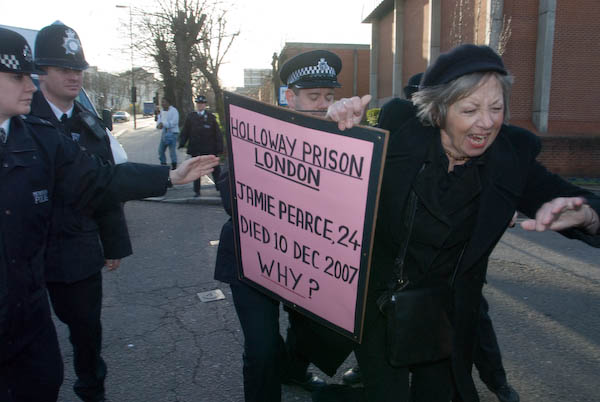
I photographed her on several occasions after that and got to know her rather better this January at a protest outside Holloway jail in London, in memory of Jaime Pearce, a 24 year old who died there the previous month, aged 24, the eighth woman to die in jail in 2007. From then on – like many journalists – I received regular emails from her about her protests, as well as frequent personal messages about my own work.

Pauline assaulted
Pauline Campbell assaulted by a police officer outside Holloway, Jan 2008

Like others who knew her I was deeply shocked (but not surprised) at the news of her suicide at her daughter’s graveside in May this year. So I was sorry to miss the demonstration for Prisoner Justice Day organised by the group No More Prison outside HMP Styal on August 10 to show solidarity with women in prison and pay tribute to Pauline Campbell, who we remember as a fearless campaigner and a remarkable person.

Hayling Island Carnival

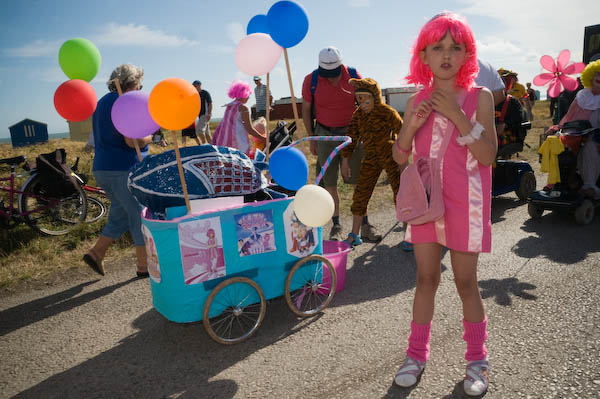
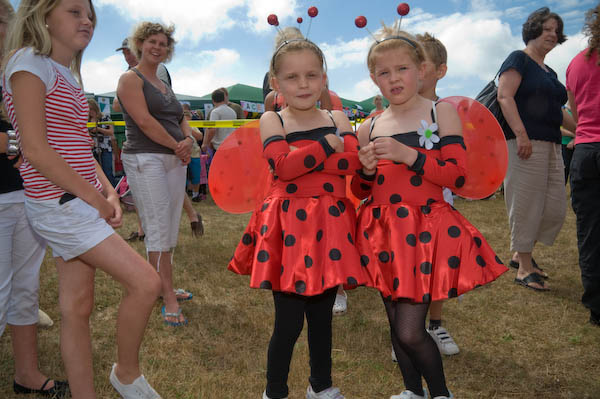
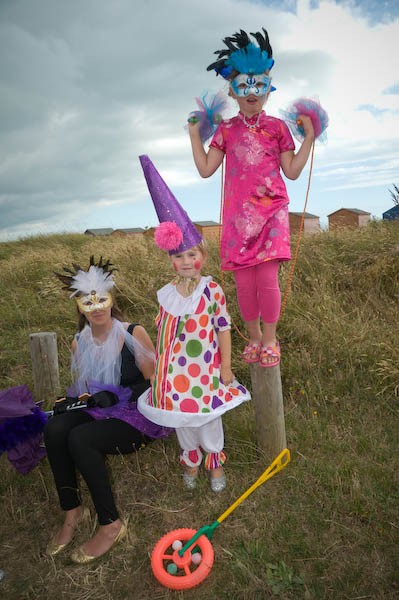
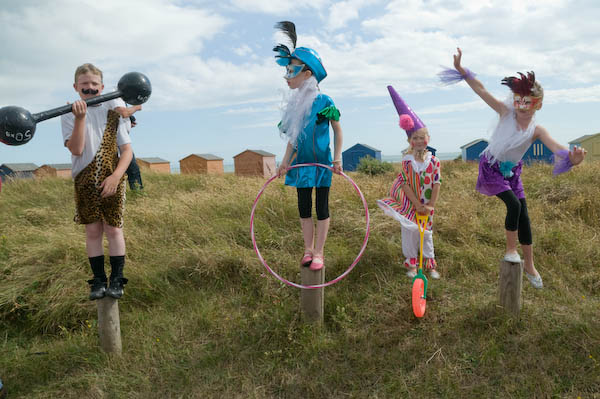
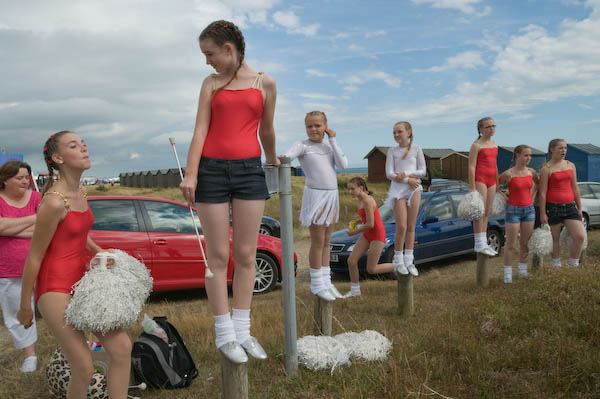
Just a few pictures from the Hayling Island Carnival on Saturday:


Children’s Fancy Dress Competition

Waiting for the start of the carnival parade

These were all taken by me, but I went to the carnival with three other photographers, Paul Baldesare, David Trainer and Bob Watkins, and the four of us have an exhibition in a couple of months, part of the east London ‘Photomonth‘, at the The Juggler, 5 Hoxton Market, N1 6HG in Hoxton, London from  29 Sept- 31 Oct, 2008 .

These pictures won’t be in it, as I will be showing black and white work from Notting Hill. You can get a preview of the show on the English Carnival web site.

I’ll be travelling around quite a bit in the next couple of weeks, so it may be some time before my next post to this blog, or before I have time to put more pictures from the carnival on My London Diary.

An Increasing List

I don’t know if it’s some kind of medical condition, perhaps a harbinger of oncoming senility, but I’m developing an increasing list.

Not an ever longer chronicle of those who, come the revolution will be lined up against the wall though my weekend stroll though the deepest home counties might well have prompted that.  Nor even a more and more lopsided walk due to the weight of my camera bag on my left shoulder – always my left shoulder as I collapse in pain after a just a few minutes with it on my right. It’s perhaps strange that with the coming of digital its weight has grown considerably from the more carefree past of film, when the heaviest item in the bag was a bottle of water or in winter a flask of coffee. Who would have thought all those electrons could be so heavy?

Somehow in the old days I seldom needed a flash unit or all those large spare batteries and (though I don’t often carry it) a notebook computer. Spare batteries back then were a couple about the size of a 20p piece that I changed every year on my birthday whether they needed it or no.

No, my problem is that none of my pictures are upright any more. Verticals ain’t vertical and rivers and oceans pour out from right or left frame. While a ‘dynamic composition’ may often be appropriate (as we very clearly learnt from Garry Winogrand) for demonstrations and street photography , it doesn’t always look too fine in landscapes and architecture.

One of the few possibly useful features found in the Nikon D3 lacked by the D300 is an ‘virtual horizon‘ or camera level that can be displayed at the right edge of the image in the viewfinder. Possibly it might solve my problem, but only at the expense of the camera’s weight crippling me over a long day’s work.  Of course the recently announced and lighter D700 has it too…

Incidentally, for a rather different set of pictures taken with the D700, take a look at Jim Reed’s gallery – Nikon lent him a pre-production camera early in April and he used it for a hundred days of chasing storms – there is rather scary image of him running towards a tornado holding it on the page where he writes about the camera giving it an excellent rating for durability and weather-resistance. Storm-chasing isn’t an area of photography I’ve ever felt drawn to, but I did find some impressive examples as well as a wealth of excellent advice on both techniques – such as how to photograph lightning – and also some very important safety information when I wrote a feature a few years ago.

What the D300 does have is the ability  (Custom setting d2) to project a rectangular grid on the viewfinder display. This is something I’ve avoided using, finding it too obtrusive as it flashes up in bright red when you autofocus. But now I’ve turned it on – and added it to ‘My Menu‘ so I can quickly turn it off when it gets really up my nose. It really is useful to be able to list just those things you want to access while shooting on that My Menu page so that they are there at the press of the menu button.

For years I walked around with a shift lens on the camera, getting things straight and even largely managing to avoid convergence when I wanted or needed to tilt the camera, though it’s main purpose was to allow me to stand in the right place and get the perspective I wanted. I don’t have one for the digital body, and my work has changed so I seldom miss it. With this lens, my favourite viewfinder screen in all my Olympus bodies (two OM4, OM2 and OM1) was a ruled one, finer and with a better thought-out layout than the Nikon version.  It also worked so well with other lenses that I very seldom bothered to change it. Funnily enough the Olympus one didn’t flash red and you could focus manually and precisely on the screen. Sometimes progress seems to go backwards.

Of course it’s easy enough to correct a list. In the darkroom we came to do it almost without thinking when needed, rotating the easel slightly to make the print straight. For digital it’s just as quick in Lightroom, pressing R to change to the crop/rotate screen, dragging the image as required, then D (or R) to return to develop mode.

If you use Photoshop (at least in version 7) it is a little slower still, but perhaps easier to get absolutely right. Change to the measure tool (it’s an alternative to the eye-dropper) and click to mark two ends of a line that should be either horizontal or vertical; then go to the image menu, choose Rotate Canvas, Arbitrary…, and click on OK. Then crop away all the extra background colour the rotate has added. You can just drag a marquee over the area you want to retain using the crop tool and double click, but I usually prefer to drag guides from the rulers (Ctrl R if they aren’t visible) to mark the 4 edges, then, when I’m happy these are in the correct place, use either the crop tool or the rectangular marquee (with ‘Snap to Guides‘ set in the View menu), finally using View, Clear guides. It is a bit fussier, but that way you know exactly what you are doing, and I find it  is rather easy not to get it quite right with the crop tool.

All this – even in Lightroom – does slow things down, and if like me you usually crop tightly in the viewfinder, presents a problem as the rotation results in a need for further cropping of the image.  So it’s better to get the tilt exactly how you want it in camera. Better still if you don’t need a gadget like the virtual horizon to do so.

A Bitter Birthday

Yesterday was my elder son’s 32nd birthday, but he wasn’t at home – I expect to see him later today when he comes back home. But yesterday I went to another birthday party, for a young man exactly two years younger than my son. His family, a few miles away in London,  haven’t seen him since 2002 and may never see him again.

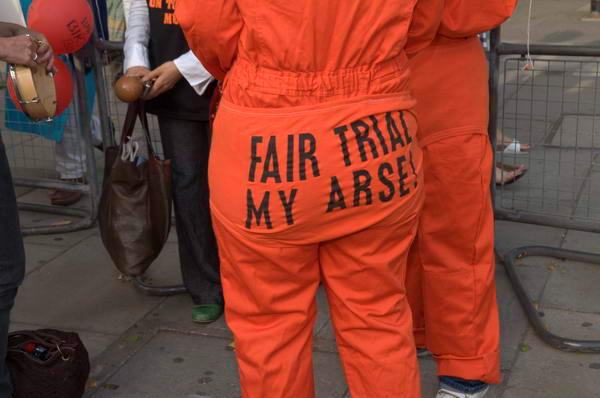
Fair Tiral?

Binyam Mohamed, born in Ethiopia but lived in London and was given refugee status in 1994 was in Afghanistan in 2002 and fled across the border to Pakistan when the fighting started . There he was kidnapped and handed over to the CIA becoming one of the many subject to “illegal rendition”. First they flew him to Morocco, where he was tortured for 18 months. At times he was shackled in excruciatingly painful positions, sometimes hanging, for hours or days in darkness, unable to move to relieve the pain, often with headphones blasting music at ear-splitting volume into his head. Other abuses included regular razor cuts to his genitals. The torture continued at Kabul’s ‘Dark Prison’ where he was rendered next, before going on to Guantanamo. You can read more about his treatment on the Reprieve website, at the National Guantanamo Coalition or on You Tube (and related videos there.)

The US now intend to put Binyam in front of a military tribunal, calling for the death penalty. The “evidence” was produced during his torture and none would be admissible in any proper court.

The London Guantánamo Campaign had organised a six day vigil at the US embassy calling for Binyam’s release and return home, which culminated in a protest party on Whitehall, urging our Government to do more to get the US to release him. I hope that Gordon will talk to Obama about it too when they meet tonight.  Earlier this year I photographed a day of demonstrations in London on the 6th anniversary of the setting up of the illegal prison camp at Guantánamo, with events organised  by Amnesty,  the London Guantánamo Campaign, London Catholic Workers and ending with a rally in Parliament Square by Cageprisoners / Guantánamo Campaign, at which Binyam’s case was raised.

As I walked away I felt for Binyam and for his family. When I see my son tonight I’ll remember them again.

Prize Pictet

Yet another prize I didn’t enter for is the Prize Pictet, for which the short list of photographers has recently been announced: Benoit Aquin, Edward Burtynksky, Jesus Abad Colorado, Thomas Joshua Cooper, Sebastian Copeland, Christian Cravo, Lynn Davis, Reza Deghati, Susan Derges, Malcolm Hutcheson, Chris Jordan, Carl De Keyzer, David Maisel, Mary Mattingly, Robert Polidori, Roman Signer, Jules Spinatsch and Munem Wasif.

In fact none of them entered as you cannot do so, but they were all nominated by a “global nominations panel of 49 leading experts in the visual arts, from six continents” which “made over 200 nominations from 43 countries” from which the seven judges selected the 18 names above.

In fact exactly the kind of process that fills me with intense gloom about the future of our medium, although there are people among the two carefully selected groups I admire and even a few whose judgement I might respect (and even a few I know.)

This is apparently the ‘Premier Photographic Award in Sustainability‘ although I’m not entirely sure what they mean by this, and even less so by their claim “Pictet is a leading wealth and asset management group worldwide, which aims to be grounded on sustainable business principles for the environment, society and corporate governance.”

Of course there have been other photographic attempts to look at issues related to sustainability. At the end of last year I exhibited work as a part of Foto Arte 2007 in Brasilia, and the theme of that very extensive festival was “Nature, the Environment and Sustainability.”  You can see more about the work I took there, and also read about some of the themes of the lecture I gave there in the posts ‘Under the Car‘, Garden Suburbs and Garden Cities and Architecture and Urban Landscape photography.

Elsewhere on the blog you can also find some of my posts about my experiences in Brasilia, as well as some of the shows from FotoArte 2007 that I was able to see, and on My London Diary the full set of images I showed in Brazil, as well as some of my pictures from Brasilia.

Of course I had no expectation of being nominated for the Prize Pictet, but it is perhaps a little surprising that (unless my memory is wrong) not a single photographer from the very long list of those who took part in that major international festival on the topic is included in the short list.

Pigeons Post


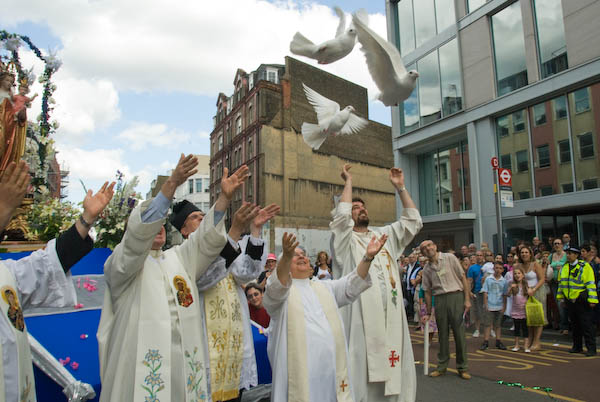
Detail from ‘Release of the Doves’ – see full image below

Pigeons were behind much of the dramatic increase in interest in photography in Britain as an expressive medium in the 1970s. It was the Coo Press, owned by Colin Osman, both a keen photographer and a photo historian, which provided the finance for ‘Creative Camera‘ magazine in the 1970s and the premises for the Creative Camera bookshop in Doughty St, where many of us made regular pilgrimage. (Osman had bought the magazine, then called Camera Owner and about to fold, for £1 in 1966) and the magazine, particularly with Peter Turner as editor and a great deal of advice – at least in the first place unsolicited and typically forthright – from Tony Ray Jones and some other photographers that edged at least a small section of British photography out of its comfortable and self-satisfied rut.

Behind me as I write is an almost complete set of that magazine, and on the shelves downstairs the annuals – including one with a set of three of my pictures, the first of my work published outside of the more strictly amateur magazines.


Town Meadow, Brentford, 1970s published in ‘Creative Camera Collection 5’.

(One of many paradoxes was that while those amateur magazines paid for photographs – at much the same rates as today – in Creative Camera you did it for love and prestige, as is still the case in some of the best photographic magazines, including Aperture.)

Camera Owner changed gradually into Creative Camera and continued to lose money, and it was the pigeon-fanciers who had probably never heard of it and certainly never read it who kept it afloat. Later, when Osman could no longer afford to subsidise his labour of love, the Arts Council took over the reins and drove the magazine into a cul-de-sac from which it only rarely ventured onto fertile ground. You can read the story in more detail (and doubtless more accuracy) on Roy Hammans’s Weeping Ash web site.

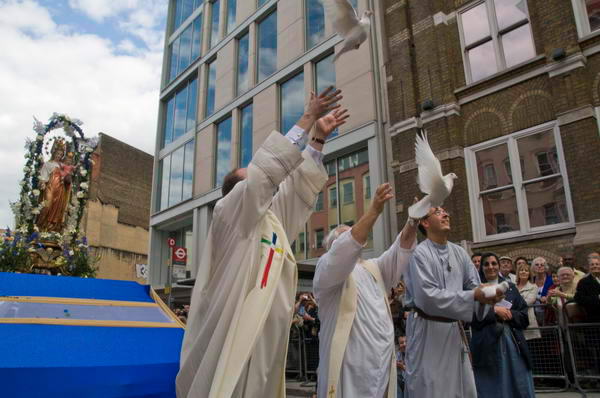
Once a year I photograph pigeons. Not for ‘Pigeon Breeders Gazette‘ or some other magazine, but as a part of the festival of Our Lady of Mount Carmel, the annual Italian festival in Clerkenwell, London (once known as ‘Little Italy’) where doves are released as a part of the event.

Last year I struck lucky as you can see from the detail – at roughly 50% full size at the top of this piece. Three pigeons took up a difficult to improve triangular formation as I pressed the shutter; it was superb choreography. I’d quickly moved into a good position for the picture as the clergy got ready to release the birds, but then it really was a matter of luck, as the pigeons generally head up into the air at great speed when released.

The full image below includes on the left hand edge ‘Our Lady’ looking down on the clergy and to their right some of the watching crowd (and I think the bus stop adds something, showing clearly it is London.


Release of the Doves, Procession in Honour of Our Lady of Mount Carmel, Clerkenwell, London, 2007. 

This year, however well I did I was never going to have the same luck, the doves were going to be something of an anticlimax, and so it proved. Either the pigeons were pesky or the priests who released them needed more training, for they failed to synchronise, and the birds only came together in the air a couple of hundred meters away.


The best of 3 frames taken in around 0.5 seconds before the birds disappeared

The release of the doves is a part of the procession which has evolved considerably over the years I’ve photographed the event, but still I think lacks something. As a considerably lapsed Congregationalist it’s perhaps surprising to have to point out that the missing element is liturgy, an appropriate and religious combination of words and actions, where the priests are in charge.

A countdown by an over-intrusive photographer (not me!) just doesn’t fit the occasion, which would be better served by a blessing with the release of the doves on the closing ‘Amen.’ It might just unite priests, doves, photographers and the crowds.

More pictures from the event on My London Diary – including more frames with the doves.

As always, pictures here, unless otherwise stated are (C) Peter Marshall and are available for use as high-res files

A Host of Pictures

There certainly were a host of pictures at the FOTO8 Summer Show 2008 in the Host Gallery in London’s Honduras St,  EC1Y 0TH (23 July- 31 August 2008), with 164 images on the walls of the gallery and the adjoining stairs. Although it is perhaps admirable to be so inclusive, (and I was told there was a much larger than expected entry from around the world), I think it would have been a much better show, and certainly rather easier to view with perhaps half that number of prints.


Honduras St gets quite full

A simple listing  with photographers names, sizes, media and prices was available at the gallery, but to fully appreciate the show you need a copy of the catalogue which contains the captions for the prints and can be downloaded as an illustrated pdf (4Mb) from the site. A rather smaller number of prints would have had the bonus of allowing captions to be included on the price list.

Most of the work was by photographers whose names were unfamiliar to me, although the three prints I personally singled out as possible choices for best of show were by photographers I know, including one I see regularly and another I’ve written about in the past. I won’t attempt to influence your efforts to find your own choice by naming them. Go along, look at the work and vote for your choice of best of show. Though I do think they have missed out in not calling it the Golden Daffodil Award.


The open bar was kept busy

Meeting another photographer from my generation (most of those present at the opening were considerably younger), I asked if she had anything in the show, and she told me that she didn’t have a great interest in  competitions and hadn’t entered. I feel much the same, although in my case a general lack of organisation had also contributed to my not sending anything in. I have after all been a subscriber to FOTO8 magazine since it began, and did feel that perhaps I should support this initiative. But then I had other things to do.  (If any of you reading this don’t get the magazine, do take a look at a recent issue – now better than ever.)

Competitions, particularly those based around single images (though a few photographers had two or three) do encourage and reward a particular type of photography, and much of what we were presented could be seen as a celebration of the exotic – unusual places, people and events – in a kind of colour supplement view of life.  When my students used (rather often) to complain about having “nothing to photograph” and if only they could go to China or New York or Bosnia or wherever the last set of pictures they had seen in a magazine had been taken I used to remind them of something I think said by Alfred Steiglitz, to the effect that he had found his best photographs within 50 yards of his front gate. Though of course his family back yard at Lake George was also extremely extensive.

Or perhaps I might show them the work of Helen Levitt or Ruth Orkin (New York yes, but working on their not very unusual doorsteps) or many other photographers whose subject has been everyday life, not treated as the exotica so often on display in this show, but working with the warp and weft of everyday life and creating something with a little magic, some small epiphany. Of course you also see it in the best photojournalism, often working with much more dramatic events (and it is important that these should be photographed too.)


Pizza appeared and quickly disappeared

It’s work like this that, for me at least, is at the heart of photography, and perhaps the only game worth playing is trying to bring out the significance of the ordinary. There is work in this show that moved me in this way, perhaps even 20 or 30 pictures that I might want to live with and hang on my wall, but much of the rest, after I had stood looking at the image for perhaps thirty seconds on the gallery wall I didn’t really feel I wanted to look at it much longer or need to see it again. Plenty of novelty perhaps, but it isn’t easy to produce photographs you can live with. But 20 good prints is a good show, and one well worth a detour. Buses 55 and 243 stop handily and Old Street tube is a short walk away.

The show also prompted me to think about photographic printing, print sizes and pricing.

Pricing
Also on the show page at the Foto8 web site is a useful guide intended for the selected photographers about the pricing of their pictures, which others might also like to download for some sensible general advice on the subject. However I think there were perhaps rather too many who might have been given further advice on the subject.

Setting prices is always a problem. But I think many of these works are unlikely to find buyers at the kind of prices involved, unless the photographers have particularly rich and generous friends and relatives to support them as sometimes happens (mine are all poor and expect prints for nothing.) It would be nice to be proved wrong and to find that there are people willing to pay perhaps £500 or £750 or more for a work by a relatively unknown photographer.

Print sizes
As a very minor quibble, while I’m not in favour of uniformity in general, I think the gallery might have converted all sizes to centimetres rather than have some in metric and others imperial.

What I do find interesting is looking at the small images in the downloaded catalogue and comparing them with the works on show, which range from original small Polaroid prints to five-footers. One of the conclusions I drew from looking at the show was that printing large can be and usually is a mistake!

That all the pictures I found of most interest were a moderate size (mainly 16×20″ or 20×24″) in part reflects my interests stated above, but I did actually feel some of these were a little too large and might have been better at say 10×15″ or even smaller. But then I think photography is at its best as an intimate medium, perhaps in a book (although having spent more on my Eizo screen than the computer that serves it, I’m coming very much to appreciate the advantages of a high resolution rock-steady display screen for viewing my own work and other pictures available at suitable resolution – and certainly looking forward to a new generation of very much higher resolution screens in the future.)

Some works do need scale, but I’m not sure these were the ones actually printed big for this show – and there were a few small images that might have looked rather better at floor to ceiling size. What we are I think seeing in photography at the moment is size largely as a marketing device rather than an artistic one, relating more to the display space than the image. It’s an approach that has a great deal of sense. While large prints may – and I think did – look rather out of place on the crowded wall at HOST, the more normal photographic sizes would be lost on the vast white spaces of the corporate atrium.

Print Quality
Some of the best prints on the wall were inkjet prints, both black and white and colour. With prints for which no information on the print process (or an ambiguous term) it was seldom possible to decide whether they were inkjet or chemically processed.

Inkjet as a medium has certainly come of age (it did so a few years ago for colour, but black and white has now more or less caught up too), although this show also demonstrates that some of its users have still some way to go. Looking through the small digital thumbs in the catalogue there are clearly a dozen or two images on the wall where the print fails to do the work justice.

It isn’t too hard to set up a properly calibrated digital workflow that will produce excellent print quality on desktop printers such as the Epson R2400 – and, using appropriate paper and inks the results are likely to be more long-lasting than C-types or other chemical colour processes. But if you don’t have proper colour management or use unsuitable materials – such as Epson’s misleadingly named ‘Archival Matte’ then problems will arise.

Of course, back in the days when more of us went into the dark to print our own colour there were often some sorry examples of C-types on some exhibition walls – and of course many expensive lab prints from the 1970s and 80s boom in ‘New Color’ are now distinctly past their best.

Giclée

One thing I did find amusing is the number of different ways photographers choose to tell us (or, more often to disguise the fact) that their work is an inkjet print. Among the variations in this show (apparently produced on a device lacking an e acute)  are:  Giclee, archival Giclee, HP Professional, archival pigment, Giclee printed on Art photo paper, Giclee print on archival matt paper, Giclee art paper print, digital Giclee print (I wonder briefly about analogue Giclees, and how they might be made, but given its slang usage it’s best not pursue this train of thought far) while others give us the make of the printer,  the paper, the day of the week and the name of their cat who sat next to their printer (well, almost.) I was pleased to see a few that simply said ‘inkjet print’ or ‘archival inkjet print.’ Giclee (or even giclée) is a term than should have long since been dead and buried.


Someone still working in an office round the corner as I went home
Local Government workers ask for a fair pay deal

Unison and Unite were the main unions involved in a two-day strike in protest at the pay deal the Government is imposing on most workers in local government, which will mean most of them get increases that are less than the current rate of inflation – pay that is worth less.

Various pickets and marches were organised across the country, and I photographed a march by a couple of thousand trade unionists in central London on Wednesday.

Local Govt march

I’m in favour of fairness over pay, and the public sector has always taken a knock when the government finds the financial going tough – and never makes things up when the economy booms. However I couldn’t help reflecting as I was taking pictures that many of the photographers there are scraping by on a fraction of what most local government workers earn, with fees for freelance work generally being much the same as they were 10 or even 20 years ago. The minimum wage doesn’t apply to freelances, and many would be financially better off in any full-time employment.

Many if not most people who try to make a living through photography fail. Often they spend a few years trying, then either give up completely or discover some other source of income to support them while they continue. I’ve known photographers whose living comes from renting property, from selling stuff on e-bay, from delivering milk, from gardening jobs, part-time teaching, waitressing and more. Many rely on partners who have regular paying jobs – some even in local government.