Merchants of Death

Last Saturday I went on a ‘Merchants of Death‘ walking tour led by members of the London branch of the Campaign Against the Arms Trade (CAAT) which visited the offices of companies involved in selling arms and providing mercenaries.  It isn’t surprising, given the nature of their businesses and the close relationship that they have with the government and various ministries that many arms companies choose to have the corporate offices within easy reach of parliament and the government offices clustered around Westminster.   Although as you can see from the map   which includes the sites that we visited, there are more scattered around the London area.

Its perhaps also not surprising that the vast majority of those who walk past these buildings would have no inkling of what goes on inside them – in many cases there was no indication at all of what went on there. Others did have their name small to label one of the several bells, but nowhere was there anything that would reveal their secrets to the casual passer-by. It was as if they were ashamed of what they are doing (but not ashamed enough to stop them making massive profits from wars and unrest.)

Our first call was at the UK Corporate HQ of Lockheed Martin in Manning House, 22 Carlisle Place.  They are the largest arms manufacturer in the world and apparently the senior partner in the Atomic Weapons Establishment, Aldermaston, who will make huge profits from the replacement for Trident.
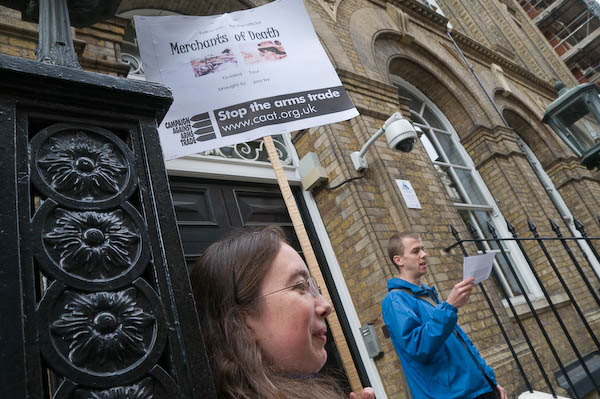
Manning House, Carlyle Place

There was no indication about the organisations that work here on the building, which for around 25 years at the end of the nineteenth century was the house of Cardinal Manning, Archbishop of Westminster.  It’s rather a nice building and gets a few lines in Pevsner‘s Westminster volume.
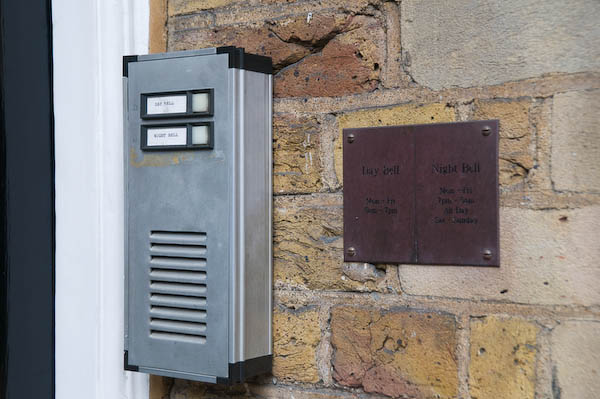
Manning House, Carlyle Place 2
The bells just say ‘Night’ and ‘Day’. No mention of arms, devastation and hell.

Our next stop, the offices of Aegis Defence Services, was inside the SOCPA zone. The walk organisers had been contacted by police, asking if they would like to apply for permission for a demonstration, but they had declined to do so on the grounds that a walking tour was not a demonstration. As we stood outside the offices of this private military and security company (shared with various others at 39 Victoria St) opposite New Scotland Yard, two police officers rode up on bicycles. They seemed very relieved to be told we were a not a demonstration and jumped back on their bikes and rode away almost before they arrived!
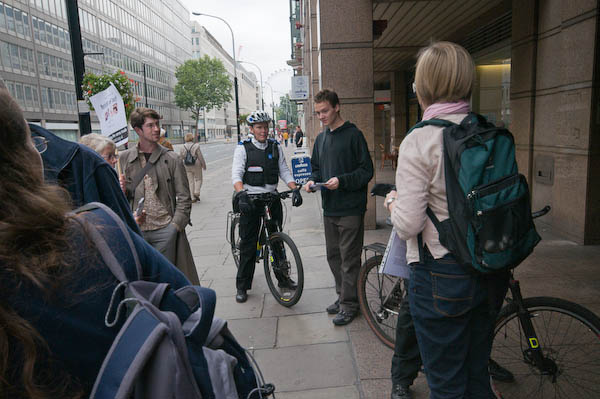
Police on the run

The walk then led up Buckingham Gate, with stops at Rolls Royce (65), QinetiQ (85), Aromor Group (25-28) and General Dynamics (11-12)
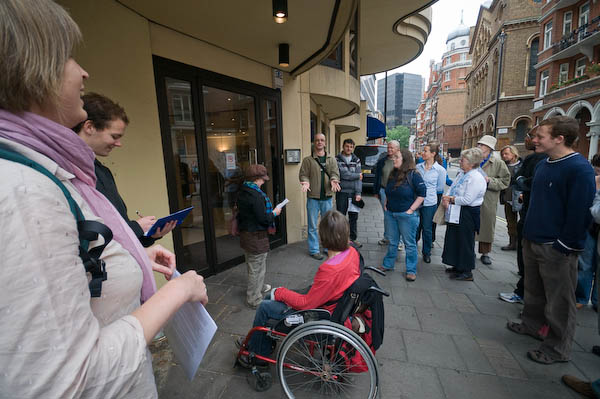

QinetiQ produced scandalously huge returns for the Carlyle Group – including George Bush Sr  and James Baker
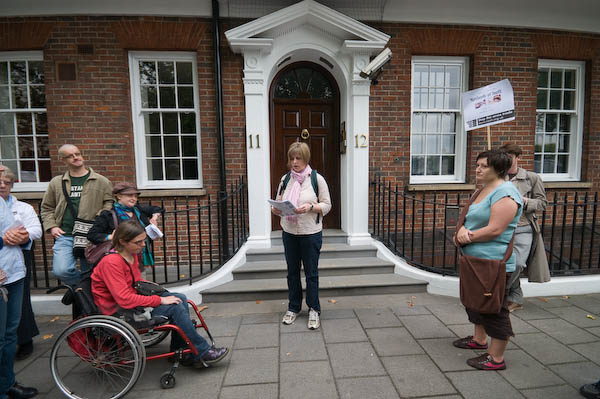
General Dynamics, the 6th largest defence company in the world started as The Holland Torpedo Boat Company, building the US Navy’s first submarine.

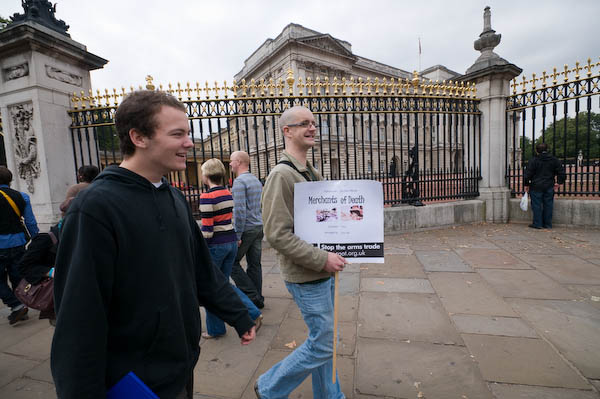
Crossing to go in front of Buckingham Palace, we were stopped by police who objected to the poster being carried at the front of the march. After a short discussion we were allowed to go on so long as this poster was not held up while we were in the park.
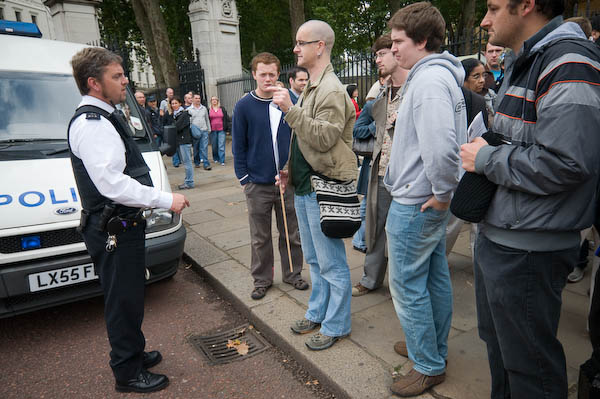
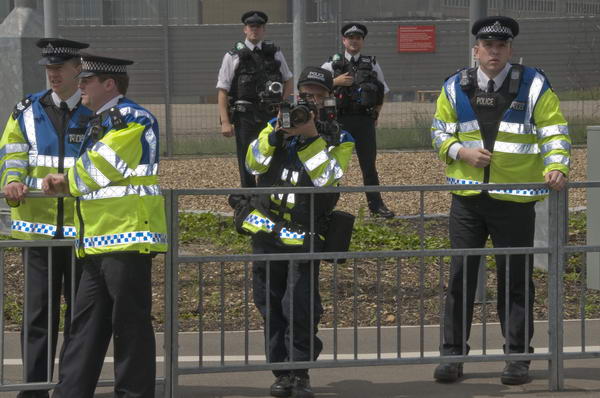
Police don't like the placard
You can’t carry placards in the park
unless you keep them down
unless you hold them down

In St James we apparently visited Boeing UK, though their offices at 16 St James St seemed nameless,
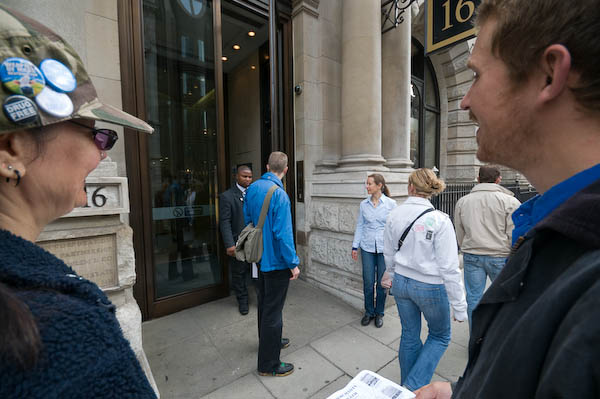
The security man just wanted to make sure we kept off the premises

and an equally anonymous Northorp Grumman at 16 Charles II St, before going back to visit BAe Systems at 6 Carlton Gardens
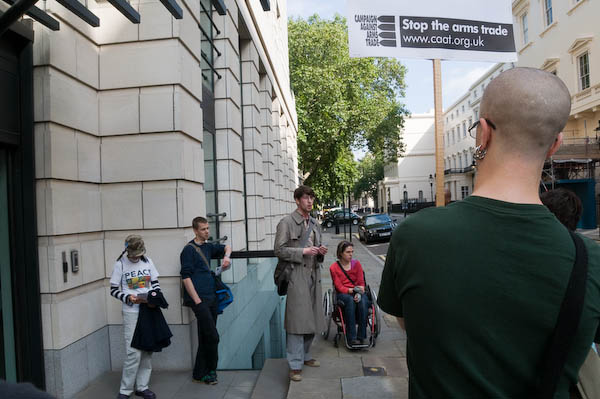
and then finishing at Matra BAe at 11 Strand.
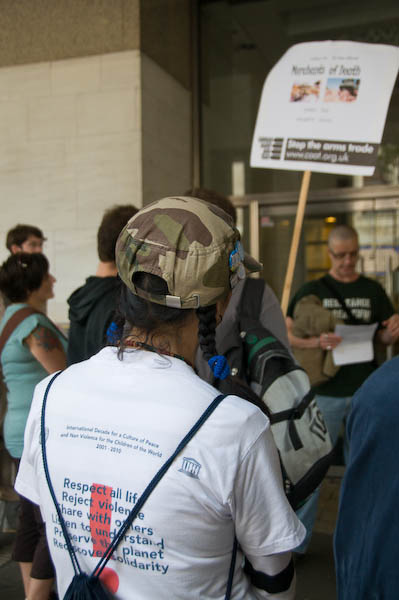
You can find more about the activities of most of these companies at the CAAT web site and also from War on Want, who have a Corporations & Conflict page and you can also download their report on Corporate Mercenaries along with much other relevant material.

More pictures from the event on My London Diary.
Money Running

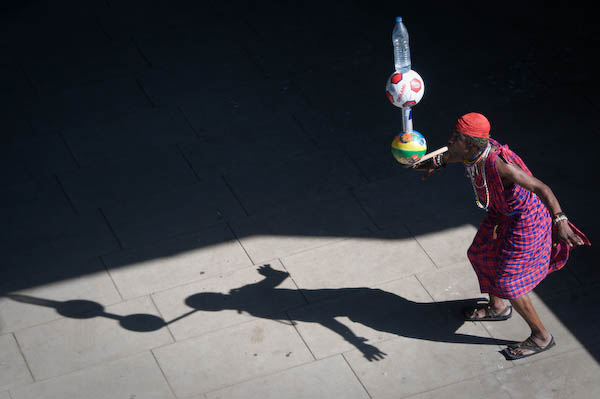
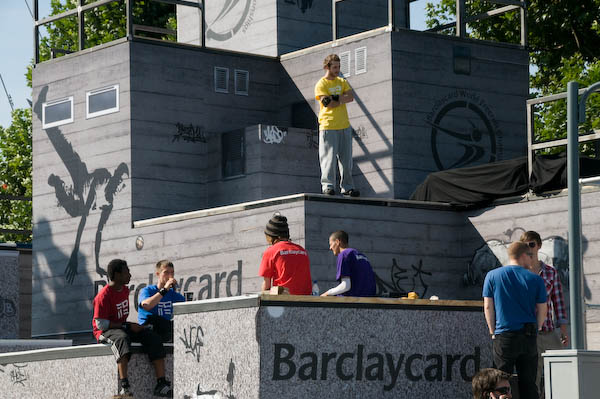
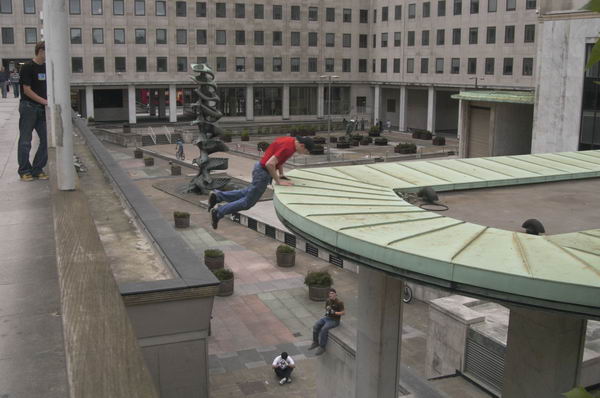
Perhaps the saddest thing for me in the whole of the Mayor’s Thames Festival (and there were also a few delights)  last weekend was this structure in Jubilee Gardens, used for a performance by Urban Freeflow, a professional group of ‘freerunners‘.

I first came across this urban sport a few yards away, with groups of young men developing their skills on the buildings of the Shell Centre and the South Bank complex.  It’s a sport that was started in France, in the Paris suburb of Lisses by David Belle and given the name ‘parkour‘, and most of those involved in it seem very much against the kind of competitive aspect that is being brought into it with sponsorship by Barclaycard.

May 2004
Parkours on the Shell Centre, May 2004

There are some spectacular parkour videos on YouTube, many of which feature short sequences from the South Bank, but one I can’t resist sharing with you, although perhaps not the most spectacular is Parkour Generations‘s  City Gents, which gives a rather different perspective on the journey to work!

On his blog, ‘traceur’ Ben Nuttall, a student from Sheffield writes: “I’m totally against competition in parkour, it’s completely wrong in the philosophy of the discipline which is about self-improvement, continual progression at a naturally-defined pace, and the achievement of being better than we were yesterday rather than being better than Fred is today. Competition only causes people to find the need to show off, perform stylish flashy moves, and attempt things they are not physically or mentally prepared for and trained for. Competition is about winning and being better than someone else, which is not why we do parkour, and if it is, then what we are doing is certainly not parkour.”

It isn’t an activity I’ve taken a great personal interest in, having absolutely no head for heights – I often find myself shaking too much to take pictures when standing on even very low fences and walls to get a better viewpoint – but the event in Jubilee Gardens seemed to sum up  something about the way that commercial interests increasingly appropriate aspects of our lives in pursuit of profit.

I’d like to make it clear this isn’t a specifically anti-Boris rant. I’ve enough against him for throwing away public money by cancelling the cheap oil contract with Chavez and back-pedalling on congestion charges while pushing up fares – policies which put public transport in the capital at risk.  Thames Day after all was one of Ken’s ideas and I felt much the same about similar events – including many of those in Trafalgar Square – organised during Ken’s time in office, as well as some of those organised by London Boroughs of various political hue.

south bank

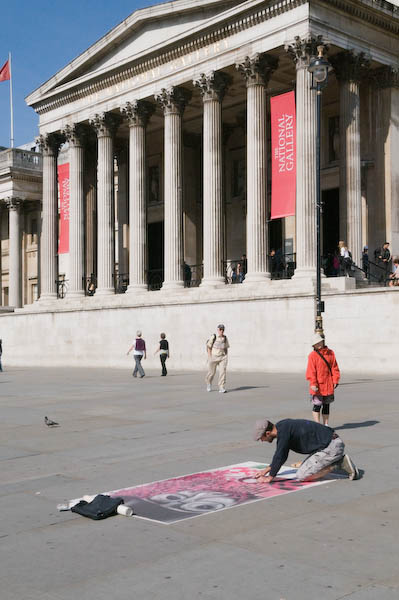
I didn’t stay to watch the performance, though I’m sure it delighted the crowds. I’ve seen plenty of circus acts and there was one around the corner, as I walked across the Jubilee bridge. On the other side I came across another symbol of our declining nation, newly installed turnstiles at the public toilets on the Embankment. For the moment at least, those in Trafalgar Square remain free – as too is our fine National Gallery there. It’s a great collection and I should visit it more often.

Stop Forced Deportations to Iraq

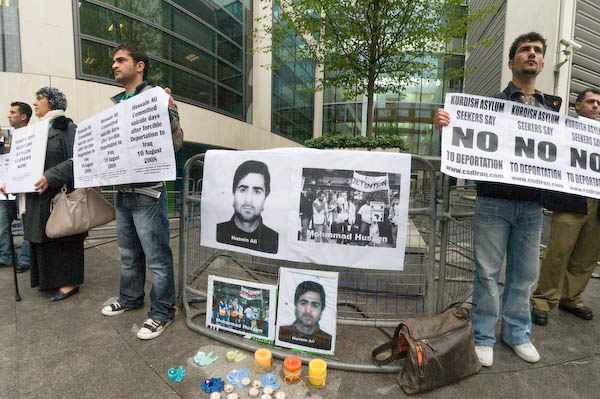
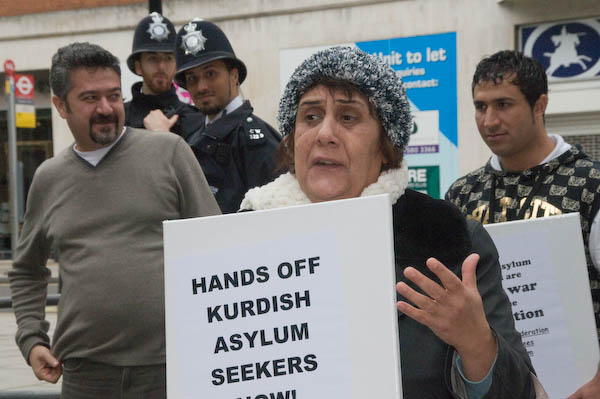
Around thirty demonstrators held a lunchtime vigil outside the London Home Office on Thursday 11 Sept, 2008 to oppose the unfair detention and forced removal of Kurdish Iraqi asylum seekers from the UK, which has resulted in an unknown number of deaths.

Kurd's vigil

Some Kurds have accepted voluntary return to Iraq, often forced on them because they are prevented from working in this country and have to rely on charity of friends and a few small groups supporting them.

One of those who eventually signed to go back was Kalir Salih Abdullah, a former fighter of the Patriotic Union of Kurdistan (PUK) who claimed asylum in Britain in 2000, having fled leaving his family of six in Kurdistan.  He spent five years pursuing his claim for asylum without success, before desperate circumstances here led him to sign voluntary return papers, and he was returned at the end of March 2005.

In Feb 2006 he was kidnapped outside his home, apparently by the PUK, and his family have since been unable to find out what has happened to him. His teenage daughter, traumatised by his disappearance, committed suicide.

The protest at the Home Office included members of the families of two men who died this August. The UK tried to send the dying Mohammad Hussain back to Iraq after 8 years here this May,  but his lawyer made a successful challenge to the order, and he died here on 3 August.

Hussein Ali  was forcibly returned to Kurdistan on 7 August this year. Three days later he committed suicide.

Since 2005, this country has forcibly returned around 500 Iraqi asylum seekers to Kurdistan, claiming despite considerable evidence to the contrary that this was a safe area to which people could be returned without risk. Little information is available about what has happened to most of them – and once they have left Britain there is little evidence that our government gives a damn. Even worse, in July this year they started deporting Iraqi asylum seekers to Baghdad. Of course there are people inside the government and the Home Office who want to treat asylum seekers in a humane fashion, but they are fighting – and largely losing – against policies designed to appease the tabloid press. Two people from the Home Office did come out to accept a letter to Jackie Smith and a folder of evidence.

As I went to take photographs, one of the two police officers came to ask who I was saying “We have to know who is coming to these things.” Well, “NO” I thought, “you have no need to know and no right to know as this is a perfectly legal activity” but handed him my press card and watched as he examined it and wrote down the details in his notebook.  It’s easier not to make a fuss – and I know were I to do so I could be asked to give my name and address – and it would be and offence not to comply – and possibly subjected to a “stop and search.”

I think there is also a perhaps more important point. By paying so much attention to trivial things like people photographing protests such as this, the system gets jammed up with irrelevant data, making it much less likely that important things will be spotted.

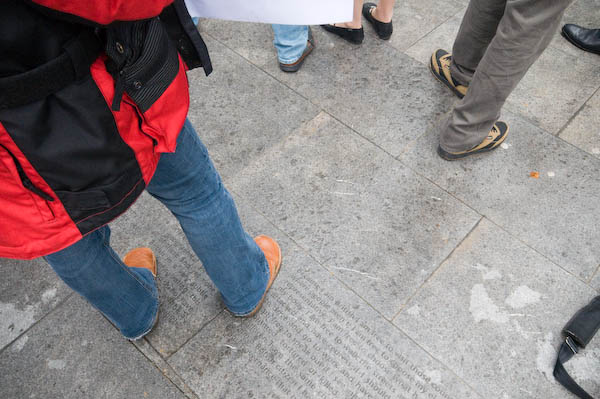
 pavement piece

Next to us on the pavement, under the feet of the demonstrators is a piece of public art in which people are invited (it is continuing for 25 years from its start in 2006) to write a short statement about what being British means to them. Most of the statements seemed to be about the freedoms that we enjoy – to travel, to work etc.  I’m tempted to send in as my contributionto this work: “Because I am British I keep having to show my ID to the police and am likely to be stopped and searched without good reason while doing my job.” But that might just be seen as critical of the Home Office – one of the things that is explicitly disallowed for this art work.

More information on the Coalition Against Deportations to Iraq web site at  and more of my pictures from the event on My London Diary.
Press Freedom Under Attack

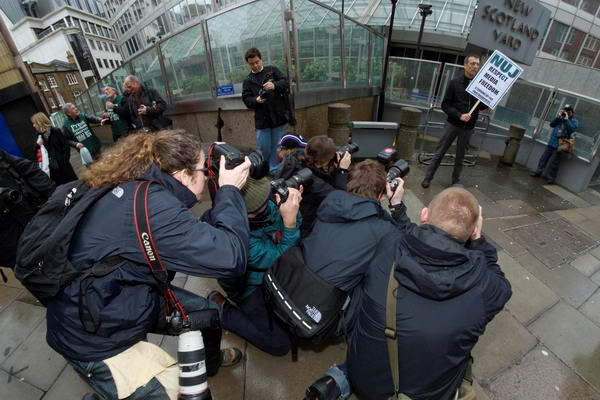
I’ve written a number of times about the increasing harassment that I and other photographers who document protest have been getting from the police over recent years. It’s  got so bad that NUJ General Secretary Jeremy Dear held a one-man protest outside New Scotland Yard this March, photographed by around 20 of us.

Jeremy Dear at New Scotland Yard

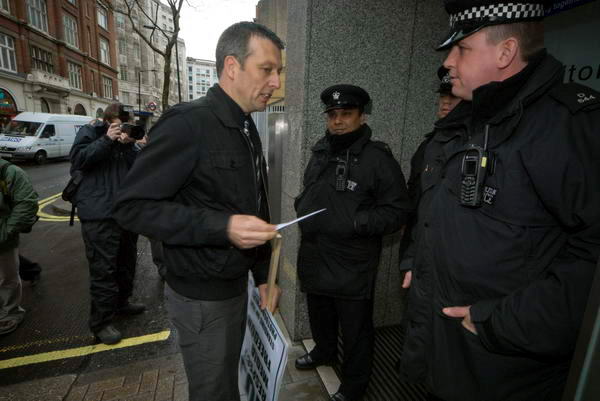
At least on that occasion the police didn’t bother us, although they did refuse to accept a letter from Jeremy Dear at New Scotland Yard, refusing him access to deliver it – he was told to put a stamp on it and post it.

This is a police station - you can't come in!
This is a police station – you can’t come in!

Other recent posts have looked at the repeated searching of photographers covering the Climate Camp (Police States – Hoo and Beijing) and the Smash Edo demonstration in Brighton.  A more general piece looked at the deliberate use of ‘Photography as Intimidation‘  by the police both against the press but also against demonstrators and also – praised by Home Secretary Jackie Smith – against those who police have identified as “persistent offenders” on some problem estates.

Those of us who believe in law in order and order in law feel that persistent offenders should be brought before the courts with proper evidence rather than suffer summary victimisation by  police officers.

At the Trade Union Congress in Brighton, Jeremy Dear moved a motion which called for a rethink of government policies that put journalists at risk of imprisonment just for doing their job which was adopted unanimously. His speech was brief but cited various examples of harassment of journalists, and in it he mentioned a video giving more details. You can read some of his speech and see that video on the NUJ site.


More pictures of me – as at every demo –  this time from a distance

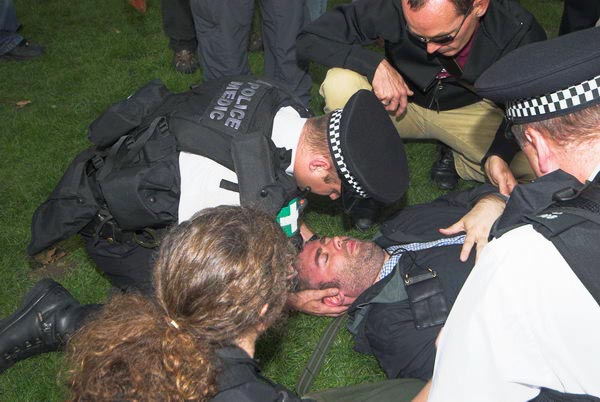
The video, Press Freedom: Collateral Damage, is filmed , written and directed by Jason Parkinson, who I first met when he was held inside a police cordon at  the Colnbrook Detention Centre with police refusing to accept his NUJ card as genuine (it happened to me too at the tank auction at Excel last year- see Bad Press?) The producer of the film was Marc Vallée, who I wrote about when he accepted an out of court settlement earlier this year for a police assault that put him in hospital at the ‘Smash Parliament‘ demo in Parliament Square in 2006. Others involved in making the 9 minute video were Jeremy Dear as Executive Producer, Roy Mincoff for Legal and additional footage by Rikki Blue.

Police Medics treat Marc Vallee

I was taking pictures at most of the events covered by the film (and you will find them on My London Diary as well as often on Indymedia and in picture libraries), and there are fleeting glimpses of me at several points in the film but fortunately no more.

All of us suffer the kind of harassment you see and hear about, although it’s fair to add that there are other officers who apologise to us for the way we are treated by others and  for the orders they have to carry out. And at times some are helpful. One once told me he had been given an official warning for being too friendly to me. So perhaps I shouldn’t mention it.

Although relations between individuals can sometimes be good, we do seem to be increasingly faced with an official policy of restriction and harassment, of trying to prevent us from reporting what is happening.  Jeremy was absolutely right when he called it “a co-ordinated and systematic abuse of media freedom“, and equally right to set it in a wider context of the use by an intolerant government of “blunt instruments” of the Terrorism Act, SOCPA and other restrictions on the personal liberty of all citizens. As he said towards the close of his speech,  “The price is too high. Less liberty does not imply greater security. It never has.

Major A.Villiers Gardening Club

I first photographed what we now call the ‘Olympic area‘ in the early 1980s. Then it seemed rather like the back of beyond, a long-neglected backwater of London, which appealed greatly to my imagination.

The pictures I remember well are largely those on one of my least-finished web sites,  ‘The Lea Valley‘ which looks at London’s Second River – The River Lea (or Lee.)  It’s probably 20 years since I went back and looked at the contact sheets for the pictures I made there rather than just the relatively few that made it to a portfolio.

In the past couple of days I’ve been doing just that, and it’s interesting to see how looking at the pictures takes me back and reminds me of things that were previously submerged in the hidden depths of memory as well as some lost completely. I don’t think I’ve found any great work I missed but there are certainly things that stir my interest.

One that I’d forgotten taking was of these gates on Waterden Road:

Gardening Club gates
Waterden Rd, Hackney Wick, 1983 (from a quick scan on my flatbed)

which isn’t a startling composition, but the text on the notice caught my eye. It may be a little small to see clearly, so here it is larger:

Gardening Club gates

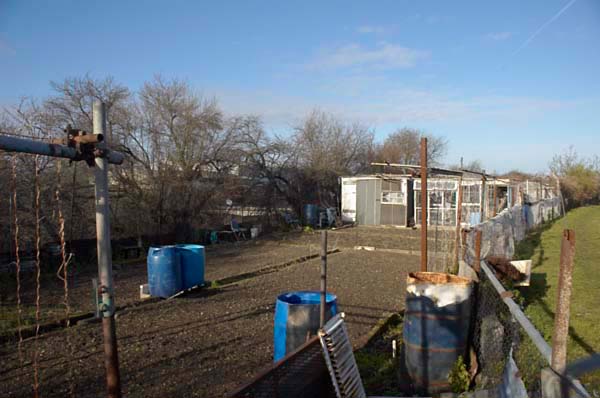
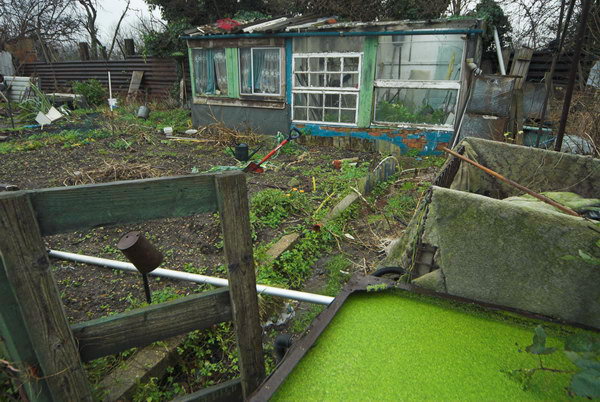
Twenty years later not far away, close to Bully Point nature reserve, I took another picture of allotments started by Major Villiers:

and a couple of years further on I played a very small part in the big campaign to keep the Manor Gardens Allotments  as a green centre-piece for the Olympics. As we all know was unsuccessful (their great campaign running up against a total failure of imagination by our Olympic organisers) and they are now in Leyton, struggling to grow crops on damaged land.

My River Lea web site does have quite a lot of work from the area,  including a few of those black and white images from the 1980s, but the vast majority of work on it is taken since 2002 – for example pictures of the Stratford area – such as this:

The site however covers much more than the Olympic area, with pictures that start at the source in Leagrave, near Luton, and go to both Bow Creek where the river enters the Thames and also to the Limehouse Dock entrance, which offered an alternative route to the Thames.

Perhaps one day I will find the time to put more work on that site. Of course it is so much easier to put digital images on line, although there are many on My London Diary that I’ve not yet got around to also putting on the site – most can be found from the site index, though I’ve not quite kept that up to date either.  But it’s even more time-consuming to work with those old pictures from the 80s and 90s on film. In 2005 when I started the River Lea site I wrote “1990s (to follow)” and they are still to follow three years later.

Notting Hill – I went home early on purpose

There are two kinds of photographers when it comes to covering violent or potentially violent events, those like to keep safe and those who seem to hunt out trouble. I found out which I was pretty definitively on May Day in 2000, when I was in the middle of a surging crowd in Whitehall and a few yards away people started smashing the windows of that well-known fast food shop.

May 1, 2000
A woman shouts at demonstrators from behind a police line

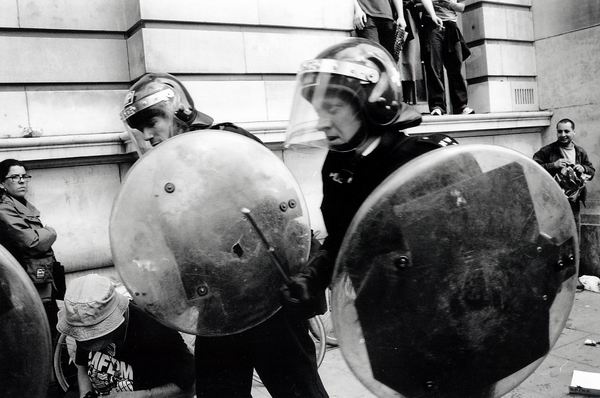
My immediate thought wasn’t to rush and push my way through the packed bodies to get pictures, but to think whether I wanted to take pictures that might incriminate those involved. And I pointed  my lens away and photographed instead some of the reactions to the event, including those of the police who after giving the demonstrators time to trash the place decided to move in, incidentally with a an entirely gratuitous violent assault by one officer on a photographer standing close to me – unfortunately my picture of the event too blurred to provide any evidence.

May1, 2000
Police charge – but I missed a picture of a photographer close to me being hit by a baton

Looking back, it was the wrong decision, and certainly when the police charged I should have followed them rather than deciding it was time to go home rather than risk being detained by the police for several hours. Now I think I would react differently – and certainly now being an union member with a press card and an emergency support number helps a little. But I’m still a cautious (or sometimes rather timid) kind of guy.

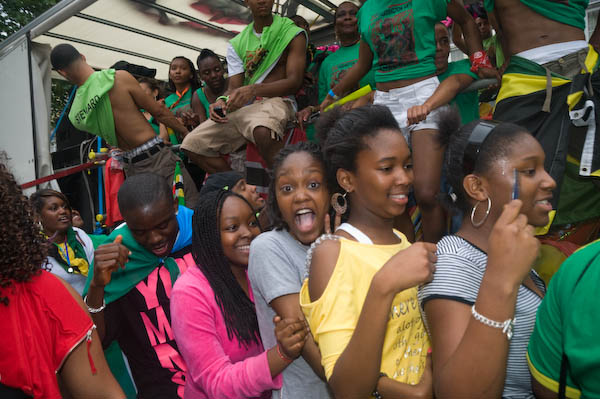
So although I’ve been to Notting Hill Carnival for around 20 years I’ve never photographed any violence there. For me it’s a great event with hundreds of thousands of people enjoying themselves, while the press coverage this year gave almost as much attention to the 40 youths who had a minor rampage and threw bottles at the police on Ladbroke Grove as to the three-quarters of a million who danced along there earlier. (In the coverage from Sky on at the Times it is hard to see any rioters at all, though the streets are full of police.)

By 5pm I’d been photographing carnival for five hours and felt it was enough. All my pictures are about carnival and not about a violent few, and deliberately so, and I certainly left with a feeling that things might get at least rather lively later. I missed the violence because as always I went home long before it started as darkness fell.

Ladbroke Grove
On Ladbroke Grove where the incidents occurred several hours  later

One of my friends was still there later taking pictures (probably including some of those that made the papers), but I prefer the film coverage, at least for the actual scenes it shows from the street, where the viewer can get a better idea of the extent of the problem and make their own judgements.  Still photography can sometimes catch a moment that has a particular intensity or that somehow represents a situation or an event, but if anyone did that here I’ve yet to see it.  And even with cameras like the Nikon D3, video still seems to have an advantage in very low light, perhaps because sharpness is far less important in moving images.

One thing I find surprising is the apparent slowness of the police to respond to the youths, who they say were making trouble for two hours. There were after all reported to be 40 youths and 11,000 police, including a number with riot shields and the full gear – including, according to my photographer friend, tazers which were used on some of the youths, although this gets no mention in the press coverage I’ve seen.

There was a sickening predictability to the coverage of the event by some of our newspapers. Ridiculous comparisons made to the Notting Hill riots of 1958 when white racist thugs threw petrol bombs into the homes of black families, or the 1976 battle when the 3000 police on duty decided to close down carnival and were repulsed by those taking part.  (Thanks to the web you can now access material published in 1976 by the Times  (see Times Archive box at left, some way down the page, the BBC and others.)

Others used the small disturbances as a pretext to call for an end (or at least an emasculation) of carnival, something the police and some administrators have long wanted – with calls in 1976 by the then Commissioner of the Met, Sir Robert Mark,called for the event to be held in a stadium. Although carnival over the years I’ve been going has become in some ways more restrained and ordered, it is still a long way from that kind of sanitised display, with crowds behind barriers rather than taking part.

You can see my pictures of the carnival from Notting Hill on My London Diary.
Free Hackney Carry On Protest Torch

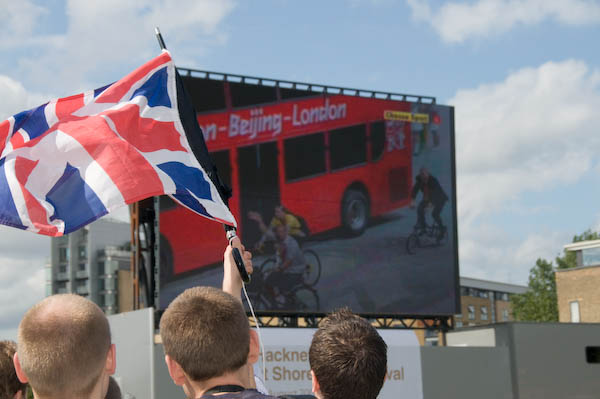
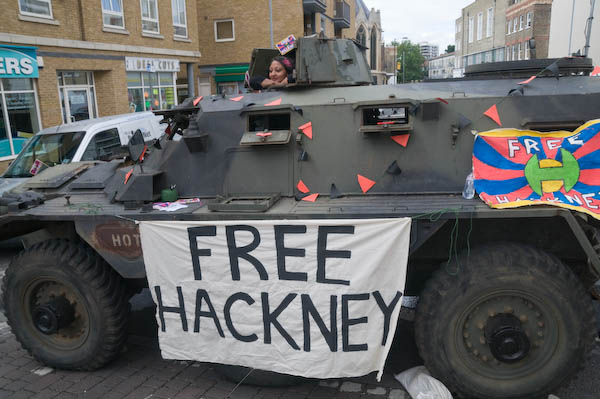
As billions around the world were being fed images of the Olympic Flag passing from the Mayor of Beijing to our local glove muppet (it’s just so embarrassing to be emborised) in another important ceremony more or less totally unobserved by the commercial media, the Olympic baton of protest was passed from the Free Tibet movement to the Free Hackney campaign.

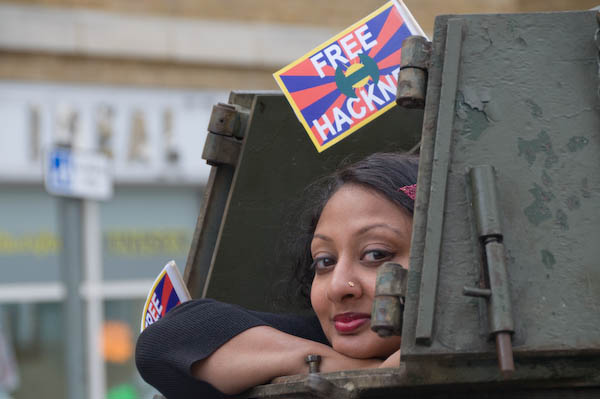
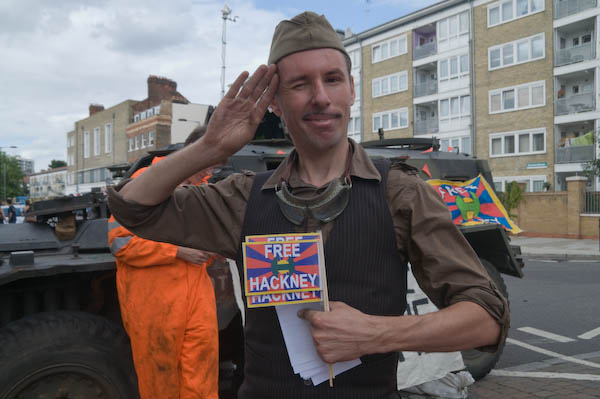
To mark the transfer, rather than eight minutes of puke-inducing performance that made me sad to be English, the Free Hackney campaign brought their ‘tank’ to the ‘street party’ in Hoxton St that celebrated our considerably more sensible approach to the 1948 event.  Perhaps because of the lack of money it was probably the last Olympics to have any real connection with the spirit of the modern Olympic movement, celebrated in the words of its founder, Baron Pierre de Coubertin: “L’important n’est pas de gagner, mais de participer.” Tell anyone remotely connected with Team Britain or the rest of our sports industry that what is important isn’t winning but taking part and they will look on you as a lunatic.

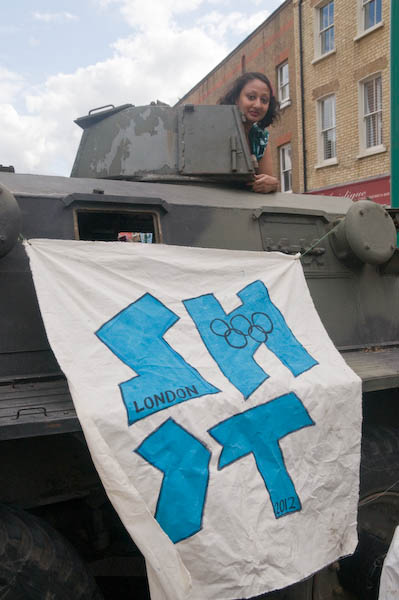
The ‘tank’ – some kind of small and lightly armoured personnel carrier – was manned and womanned by some familiar faces from earlier ‘Space Hijackers‘ events, including a tank commander I last saw in charge of a rather larger ‘tank’ being auctioned at (or rather just outside) thanks to over-keen co-operation between police and the arms traffickers, at the  the East London Arms Fair at Canning Town’s EXCEL centre.

The vehicle carried several ‘Free Hackney‘ flags which have a familiar yellow, blue and red sun motif, as well as a considerably more meaningful adaptation of the Olympic logo.

As ‘Free Hackney’ point out, London 2012 presents  a great opportunity for property developers to rip us off and make obscene profits building luxury flats in the area, while at the same time restricting public access, closing down the existing free facilities and demolishing social housing and local businesses.

Next to the tank the ‘austerity Olympics’ were taking place on a small section of Hoxton St, with events such as a slow walking race creating considerable hilarity. Unfortunately the event in 2012 promises to be rather more painful.

(Based on a story posted by me to Indymedia on 24 Aug.)

Olympic Gold for Brompton

The one bright spot in the otherwise intensely puerile 8 minutes of the London presentation for the Olympic closing ceremony was the appearance of a Brompton.

Hackney Handover - Brompton
Hackney Handover- Brompton at extreme right.

I suppose it’s too much to hope that this quirky and clever British invention – and probably now the only vehicle of any kind designed and manufactured in England – should be made the official vehicle of London 2012. Because that might suggest that these would at have some pretension to being a green Olympics, an impression the organisers have so far gone to some lengths to avoid by removing the Manor Gardens ‘Olympic’ allotments from the site.

The Brompton became quickly one of my favourite photographic accessories when I bought one at the end of 2002. You can take it on trains, on the underground, get off, unfold it in 15 seconds and ride it away. The front bag is a good place to carry cameras, and you can stop anywhere to take pictures, unlike a car where by the time you have found a place to park you may face a long walk to the location – or have missed the chance of a picture.

It’s also handy when parked against a fence or wall, adding up to a couple of feet to your height to see over obstacles – one foot on the saddle and one on the handlebars for maximum lift, enabling you to climb up easily on walls and look over fences. It’s almost like having a short step-ladder with you.

If necessary you can walk with it, and it carries your kit like a trolley. You can climb up footbridges with it on your shoulder, set it down and ride away and it can also take you reasonable distances at a decent speed. It’s not a good off-road choice, but on a decent surface can travel at a good pace, and I’ve often covered 20 or 30 miles, occasionally more.

But its real forte is rush-hour traffic, when I’ve made journeys across London in minutes that would have taken at least twice as long in car or taxi or by underground. With a Brompton, London seems much smaller – even if, like me, you usually stop at red traffic lights and keep to the correct direction on one-way streets – and its short wheelbase makes weaving in and out of cars held up in traffic easy.

It’s only real down-side is that it’s a powerful magnet for thieves, with a high second-hand value getting quick sales at on-line auction sites and on dodgy market stalls.  Forget D-locks, heavy chains, it’s never safe to leave it locked- you just have to take it everywhere with you, which can occasionally be a problem even though it folds pretty small.

Terry King at 70

Terry King
Terry King reads his poetry at his 70th birthday party

I was surprised to find that Terry King was approaching 70 when I got an invitation to his birthday party on Saturday.

I got to know Terry in the 1970s when we both went to meetings of ‘Group Six‘, a rather controversial group of the Richmond and Twickenham Photographic Society whose interests in photography were largely outside the world of amateur photography with its print battles and sunsets. At the time it was led by another photographer now well-known on the web, Vincent Oliver (then just Vince) whose photo-i web site is the only place to go for reviews of scanners and printers.

Later Terry took over the group, and together we organised a series of shows that got considerably more attention than the main society events, upsetting the committee and we had to set up as ‘Framework‘, an independent photography group outside of the amateur movement. Framework continued to organise shows for a number of years and among many UK photographers to exhibit with Framework were Terry King, Carol Hudson, John RT Davies, Derek Ridgers and Jo Spence. We also had a few foreign contributions.

But Terry is best known for his interest in alternative print processes and his personal work using them, particularly gum bichromate and the ‘Rex’ variations he developed for gold printing and cyanotype.

Around 30 years ago, I sat in a row on the left-hand side of a dimmed hall in Richmond listening to a lecture by a retired advertising photographer called Steinbock. On my right was Terry King and on my left, Randall Webb (much later to become the co-author with Martin Reed of ‘Spirits of Salts:  A Working Guide to Old Photographic Processes‘  London:  Argentum, 1999.) The small and rather tonally lacking gum prints which the lecturer put on display were not the first I had seen, but this was the first time I had seen a gum printer and been told with some detail how to make such prints.

The three of us went away, each determined to try the process. At the time I was a teacher of chemistry and photography, and liberated a couple of surplus jars of the potassium dichromate needed from our chemical store and gave one to Terry.

Later I helped Terry who had set up a course ‘From Wedgewood to Bromoil‘ so he could get paid while he tried out early photographic processes at the local adult education institute.  I got my college to pay my fees for the course and we spent a year of Saturday mornings with a few other keen students learning how to do pretty much the whole range of alt processes, with William Crawford’s ‘The Keepers of Light‘ as our main guide.

I found gum a pain to work with, especially when I tried tri-colour printing, and soon concentrated on other processes such as salt-printing, kallitype and platinum and palladium, teaching a few classes and workshops, but eventually my other photographic interests left no time alt printing.  In any case, once most alt printers had started to work from digital negatives I felt they may as well go the whole way and make inkjet prints.

Terry went on to develop his own individual approach to gum printing, producing many fine images (one of which normally hangs on my wall, and you can find some examples on his web site)  with this and other processes, as well as to run workshops that trained a whole new generation of alt photo printers in the UK, to organise the international APIS (Alternative Processes International Symposium) and various other events, as well as becoming Chairman of the Historical Group of the Royal Photographic Society.

Terry is also a poet, and in particular has produced many inspiring limericks. Long ago when he was a civil servant he used to compose at least one every morning on his train journey from Twickenham to Waterloo. The photograph shows him reading some short poems shortly before blowing out the candles on his cake.

Busman’s Holiday?

What do you do about taking pictures when you take a holiday? Many, particularly amateurs, see their holidays as one of the main opportunities for taking pictures (and when long ago I used to belong to camera clubs I would groan, usually inwardly, to see yet another picture of Windermere or Switzerland flash up on the screen or appear on the wall.)


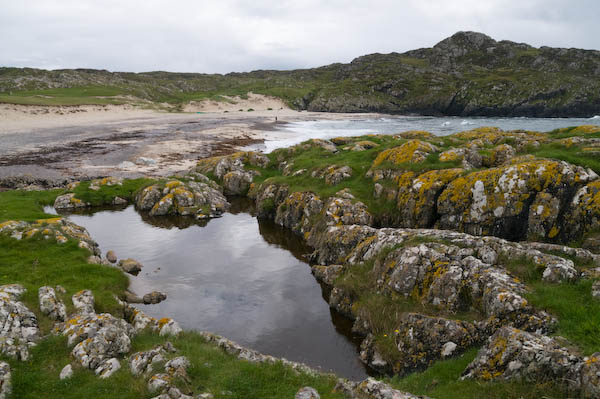
Iona: Another holiday snap!

But as someone whose life revolves around photography, if I take a holiday I want to at least distance myself slightly from the normal round and relate at least a little more normally with the people I’m on holiday with. Much as I enjoy and am involved with it, making decent and meaningful pictures is hard work, demanding a high level of concentration, and I am often pretty mentally exhausted at the end of a busy day. Once in a while I feel I need a rest.

So there are times – days, possibly even weeks (though I can’t remember one) where I don’t take any pictures at all. But on holiday I often come across things I’d like to at least record in some way by taking a few snaps – and sometimes rather more. My companions almost certainly still think I’m obsessed with photography (and they are probably right) but it is a matter of degree. Time after time in the last couple of weeks when I was away on holiday I didn’t go down the street, didn’t cross the road, didn’t go and talk to the person I would have approached had I been photographing seriously.


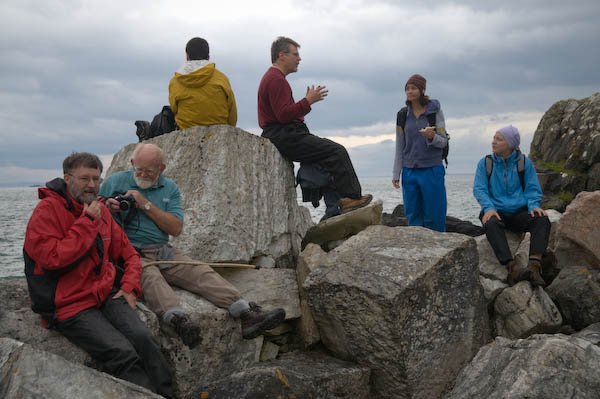
Some companions on a pilgrimage on Iona relax at the marble quarry.

Often when I’ve travelled for reasons other than to work as a photographer I’ve travelled light, often taking only a simple compact camera. Generally I’ve come across situations where I’ve regretted not having a better camera for various reasons, and digital has added to that dilemma. With film, the quality of the results from a 35mm compact with a good lens was identical to that from an large and expensive SLR (or sometimes with wide angles, even better) while the same just isn’t the case with digital.

I’d hoped that the Leica M8 would present me with an reasonably compact solution – if at considerable expense. With a fast f1.4 lens it was certainly fun to use, particularly at night in Paris, but in general it’s been a disappointment, though if I could afford them, some new lenses might help. But over the past few years I’ve become so used to using zooms that it’s a hardship to be without one.

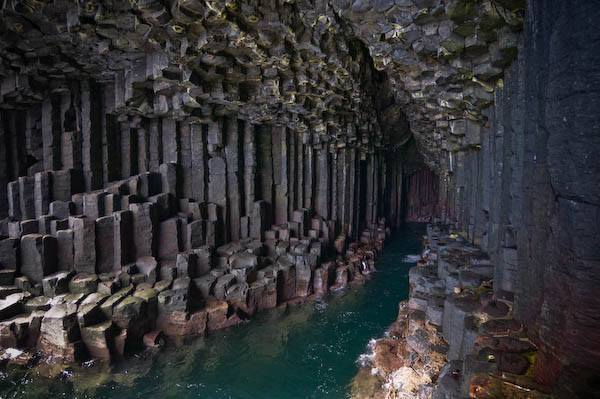
Staffa - Fingals Cave
Fingal’s cave, Staffa – one place where a real wide-angle helped

So this summer I travelled with the Nikon D300, but with a considerably cut-down kit. Even so, 2 lenses (the moderately large 18-200mm VR and the miniscule 10.5mm semi-fisheye) and an SB800 flash although a very flexible outfit isn’t exactly light and compact, and at times the gear did get a little in the way. Next time I’d certainly opt for a smaller lens, perhaps an 18-50mm, which would also enable me to rely on the camera’s own flash.

Of course what I’d really like would be a compact digital with no shutter lag, a large sensor and a a zoom lens with something like 24-85 equivalent.  It doesn’t seem an impossible specification, but nothing yet approaches it. In fact it might even replace my Nikon for work.

I’ll doubtless put more of my holiday pictures on line shortly, both from Glasgow and Iona.  A few of them show that I was occasionally able to think as well as press the shutter.