Wine-tasting for London Bloggers

Around 50 London Bloggers from the almost 400 members of The London Bloggers Meetup Group enjoyed a great time in the basement at Ember in Farringdon last night, tasting wines provided by wine bloggers from Germany, Italy, Spain and Portugal, invited by Robert McIntosh of the Wine Conversation blog and Thirst for Rioja,to contribute some bottles of wine and a short video for the occasion.


Robert pours a wine sample

This is a photo blog and not a wine blog, so let me start by saying something technical about the pictures before getting down to the wine. I was working with the Nikon D300, starting with a 20mm f2.8 and then moving to a Sigma 18-125mm lens. As usual I worked in P mode, but with the SB-800 flash set to work at -2/3 stop to avoid any over-exposure. The flash was in TTL/FP mode, with a minimum shtter speed of 1/60, and I set the4 ISO to 1250 so that the dim light in the bar would add a little to those areas not lit by flash. Quality at 1250 is still pretty good on the D300, but with a D700 or D3 I would probably have prefrred to work at 2500 or 3200.


Glasses waiting for the tasting as Robert talks about the wines

I had the translucent dome diffuser on the flash to give an even spread of light over the frame – almost all the pictures I took were at 18-20mm. Apertures – set by the camera – were around f8, which with this wideangle gives plenty of depth of field. I worked with the camera on autofocus, selecting a focus area on the closest face in the picture.

The flash head was generally angled so that most of the light rteaching the subject was bounced from the slightly off-white ceiling. It coloured the flash a little, but I think the white point aedjusts for this as it is the main light, and leaving the camera on auto white balance gave good results. On shots where a part of the subject was close to the camera I generally swivelled the flash head away from that direction.


Enthusiastic bloggers towards the end of the evening

Despite the use of bounce flash in most of the pictures there was still considerable light fall-off evident in the images, which is where Lightroom 2.1 came in. In most of these images I’ve done some burning in of faces, arms and hands close to the camera and a little dodging of important but more distance areas.  Using ceiling bounce, areas such as the tops of balding heads need considerable attention to bring them to a normal density. Somehow ears too can often seem too bright however you light things, and so need a little burning down too.

Of course there would be some advantages in using the flash away from the hot shoe, but this makes things far less convenient. And as I think these results show you can do surprisingly well with a flash on your hot-shoe.

Now for the wine – and it was a fine selection.

Thirst for Rioja
Robert’s own blog on the Rioja area for Spain and in particular the Bodegas Dinastia Vivanco, Bodegas Criadores de Rioja and Bodegas Carlos Serres which he represents. His  video – his first – is perhaps a little too static and information filled. The wines he brought were a white Vivanco Viura Malvasia, Rioja, 2007 which I didn’t taste and Dinastia Vivanco Rioja Crianza, 2004, a really fine oak-aged red I’d be very happy to drink again.

Winzerblog
Winzer is German for Winegrower and Thomas Lippert writes about his daily work growing grapes and making and selling wine. His video tour of the estate has some nice touches but is far too jumpy. Thomas provided Riesling Kabinett Trocken 2007, Weingut Clauer which I didn’t taste.

Bodegas Tintoralba
Javier Navarro‘s site about this cooperative winery in Higueruela, a small town near Alicante, where almost all of the 1300 inhabitants belongs to the co-op. The video has a few pictures of it near the end. But what impressed me rather more was the smooth deeply coloured Higueruela wine – probably my favourite red of the evening.

Poggio Argentiera
Gianpaolo Paglia
blogs for Poggio Argentiera, a young winery with two estates in Tuscany. As well as a video in which he talks about the area and its wines in English, you can watch another in Italian which shows you the area and the grapes, and very much makes me want to pay a visit there. The red wine, Bellamarsilia – Morellino di Scansano, was, as the web site says “perfect for every day, informal drinking, fantastic for parties, middle-of-the-week suppers at home or in a nice little eatery, or by the glass over lunch.”

Casa de las Vides
Emilio Saez Van Eerd from Casa de las Vides in Valencia, Spain sent us a video with some nice still pictures of the vineyard and winery (though I find the music over-obtrusive.) The  CVP 2007 was another fine oak-aged wine, though not my personal favourite of those tested.

Cortes de Cima
Jose Eduardo J Silva writes a very readable blog (in English) about this family owned vineyard and winery in the south of Portugal. The vineyards look a little bleak in the video, which also shows the winery. The dark red fruity Syrah 2004 did, as it said on the video, make me want to have another glass, and I did. Another good drinking wine.

Justin Roberts of the  Vinos de Jerez etc… blog persuaded Jan Pettersen at Rey Fernando de Castilla to supply their Antique Oloroso, and made a video interview with the man who made it. I’m sorry I didn’t get to taste it, but there is only so much I can drink, and I’ve never been a great fan of sherry, although one of the few perks of being a union rep some 25 years ago was that the boss used to always give me a glass if I went to see him late morning.

And I don’t often drink port, but at the end of the evening I just couldn’t resist some of Quevodo Port’s  Special Reserve Tawny. Again there is a video, by Oscar Quevedo, the youngest member of the family who have been making Port for over 100 years in Portugal above the River Douro, and one of five bloggers on their site. An 8 year old fruity wine with 19% alcohol, it did really make excellent drinking, though I was very pleased I wasn’t driving the bus or train home.

Thanks, Robert!
Zombies in Ramillies Street

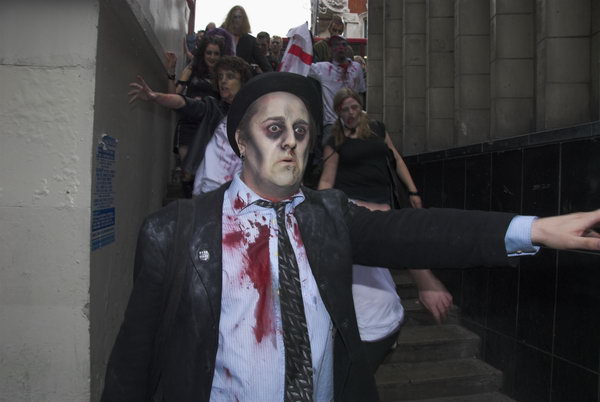
Ghouls, zombies and the undead staggered and lunged along Ramillies Street on my previous visit, sprawling on the roadway of this small street down a short flight of steps from Oxford Street, often referred to – as Photographers’ Gallery director Brett Rogers informed us – as “Piss Alley.”


Coming down the steps into Ramillies St

But that was Halloween a couple for years ago, and tonight things in the pristine white space of the temporary home of England’s “flagship photography gallery” were a little quieter, although I was perhaps more apprehensive.


Brett Rogers welcomes us to the gallery

Rogers welcomed us to the new space –  opposite the former home of Keith Johnson Photographic, and like its predecessor on the edges of Soho, but this time at its north rather than east – and waxed enthusiastic about the possibilities it presented for a new building to replace the current temporary conversion. Dublin based architects  O’Donnell +  Tuomey then told us about their early years in London and their plans for a new building, constrained by the small footprint of the site, rising vertically around a lift and stairway, organically (or at least metaphorically) like the branches from the trunk of a mighty oak. (You can read more here – and see a computer graphic view of the new building by clicking on the thumbnail.)


John Tuomey talks about the building as Sheila O’Donnell looks on.

Their presentation was excellent, but I found the futures suggested for the gallery outlined by Rogers rather more chilling, and my doubts were heightened by the work that had been selected for the inaugural showings in this new space.

Like many of those I talked to, I felt that this was a real occasion that should have celebrated English (or British) photography, but it was one that was sadly missed.

I’m old enough to remember Picture Post and its place in lifting the spirits in an age of austerity and rationing, even though in my childhood my family were too poor to buy it. We saw copies at neighbours and friends, read it waiting for a haircut at the barbers, and sometimes people passed on issues when they had read them. Later of course I saw many of its best pictures republished in books, and got to know the work of many of its better photographers, writing features about several of them, including Thurston Hopkins, Grace Robertson, Bert Hardy and Bill Brandt.

It takes great curatorial expertise to mine this rich resource and produce such as turgid, mind-numbing show as was presented on the ground floor of the gallery. All photographers of course have their off-days but on this evidence Picture Post photographers spent most of them – or at least their off-nights – in Soho. But from the evidence we see here it would be difficult to regard Hopkins or Slim Hewitt as anything more than reasonably competent hacks.  And Tim Gidal and Kurt Hutton fare little if any better, and we can see that Ken Russell was well-advised to turn to making films.

As the major show for this major British event I would have hoped for a major show by a well-known British (or British-based) photographer – perhaps one of that long list neglected by the gallery over the years (and there were at least half a dozen of them present at the opening) or one of the great historical figures in photography in this country – such as Bill Brandt or Raymond Moore.

Instead we got Katy Grannan, a USAmerican photographer bron in 1969 who studied with Gregory Crewdson, Philip-Lorca diCorcia and Tod Papageorge at Yale (one of the more disappointing highlights mentioned by Rogers was the Deutsche Börse Photography Prize 2009, where Papageorge is a contender with his rather bland images of Central Park, shown at Michael Hoppen  in Chelsea earlier this year – but I couldn’t bring myself to review it, as the most interesing thing was that one image was shown upside down – though Taryn Simon is also on the short list for her Photographers’ Gallery Show – one of their best in recent years, but it is hardly a heavyweight list) graduating with an MFA in 1999.

Grannan had her first gallery shows in 1998, and in 2004 she showed work at Arles, exhibited in the Whitney Biennial and won the 2004 Baum Fellowship Award for Emerging American Photographers. In 2005 she got an Aperture award for emerging photographers, and theypublished her ‘Model Americans.

Grannan is a photographer whose work I’ve previously written about appreciatively in the past, but I think this show, “The Westerns” does little to enhance her reputation. Large images, empty in every sense, at times vapid, with a few little digs in various directions including an unbelievably bad Edward Weston pastiche. You can read an interesting interview on her earlier work at The Guardian by Melissa Denes.

In that earlier work, published in Model Americans in 2005, she photographed people in their homes and other locations,  she worked mainly with strangers (starting to advertise for models in local papers in 1998), coming together for the short time needed for her to arrange them (and sometimes the surroundings) as a stage set on which to photograhp them with her 4×5 camera.   The Westerns is the result of a more lengthy collaboration with three people, including two middle-aged transsexuals, and I don’t feel she has managed to sustain the same level of interest and creativity.  It might even have been a more interesting work had the three people concerned been more conventional in their life-styles; their somewhat exotic nature makes for too easy a cliche.

Grannan is a photographer for whom size matters, and most of these prints seem to me to be oversize. Her work often appeals far more strongly to me on the web or magazine page than as these large wall prints.

Of course there were a good things on show – including Vanessa Winship’s charming portraits (one of the few stars of this year’s Arles, her pictures are also on show in the Royal Festival Hall as a part of the 2008 World Press Photo.) And on the top floor in the Print Sales area, Picture Post came to the rescue with Bert Hardy‘s delightful evocation of a British summer in his Box Brownie view of two young women perched on the promenade rail at Blackpool. It was an image that stood out glowing from what largely seemed to be an ocean of fashionable mediocrity.

I’d gone to the event in an optimistic mood; I’d thought that perhaps the move to a new building represented the possibility for a new start, a new emphasis on photography. Unfortunately the auguries seem bad, and despite the new premises, the gallery seems destined to remain mired in the same old rut.


At the opening – not much depth of field on the 35mm at  f1.4!

As someone who has been a member for around 30 years I find it deeply disappointing that if you want to see photography and a vibrant photographic culture you need to look elsewhere, whether to smaller London galleries such as HOST or by taking a trip to Paris.  (see Paris and London: MEP & PG)

London National Climate Change March

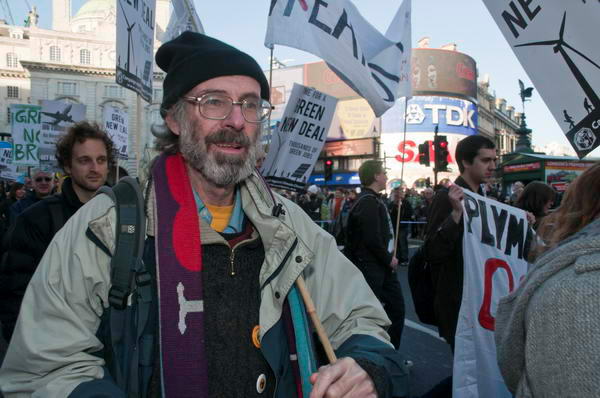
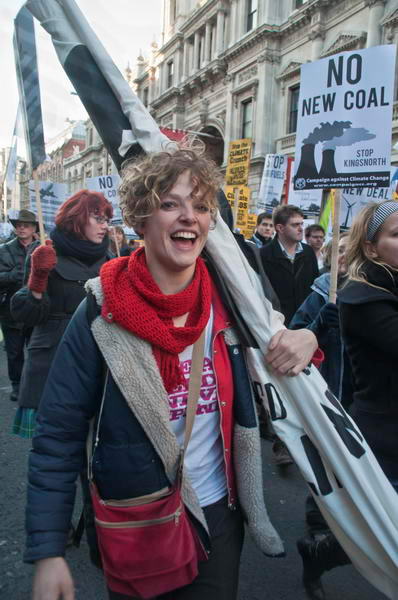
Almost 4000 marchers, along with several hundred cyclists, demonstrated in London on Saturday 6 December, marching from Grosvenor Square along Piccadilly, past Trafalgar Square and up Whitehall to a rally at Parliament Square. It was a colourful event, with many in costumes and most carried placards or banners to send a clear message to the UK government that urgent action is needed to secure a future for the planet.

Marchers in Piccadilly

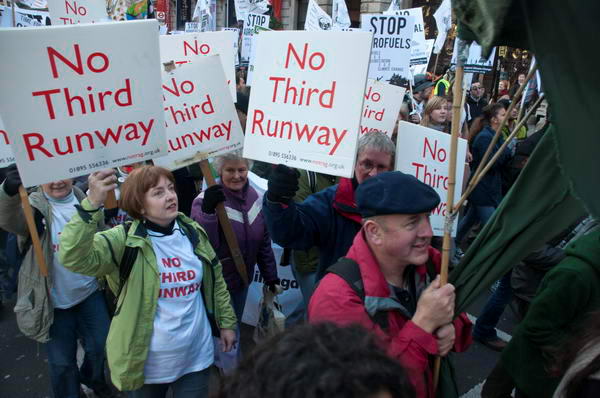
Posters reflected the four major themes – no to coal-fired power stations, no to airport expansion, no to agro-fuels and a big yes to a renewable energy revolution and green jobs – as well as numerous related issues.  Campaigners from many groups around the country  – such as those opposed to the building of a third runway through homes to the north of Heathrow – made their views felt.

Phil Thornhill, National Coordinator of the Campaign Against Climate Change

The march, organised by the Campaign Against Climate Change, was timed to coincide with the UN Climate Talks in Poznan, Poland, and was part of a Global Day of Action with events in 70 countries around the world. There was a large police presence, with more Forward Intelligence Teams than I’ve seen at a single event before, but despite  a few provocative actions – including what seemed some arbitrary “stop and searches” and photographing a working photographer in defiance of the guidelines – the event remained peaceful and good-natured.

Tasmin Osmond
Tasmin Osmond brought the Suffragette Banner from the ‘Climate Rush’ in October.

Environmental direct action continued on Monday morning, when around 50 activists from Plane Stupid cut through the fence at London Stanstead Airport and staged a lock-on. It was around 5 hours before police were able to remove them and the airport could be re-opened. Very many more such actions – but on a larger scale – are expected should the government reject environmental advice and press ahead with plans to build a new third runway at London Heathrow.

More pictures and more about the Climate Change March on My London Diary.

Swap Don’t Shop

There are times when it’s hard to decide how to cover a story.  Although when I got an e-mail about the latest event organised by the Space Hijackers it looked as if it might be interesting, I could see there might be practical difficulties in covering it.

They had decided to hold what they called  “the restyling fashion mash-up event of the year” inside one of the larger shops on London’s busiest shopping street, Oxford St. And of course to do so without permission. Although I wasn’t sure about how the store would react to this event, I was pretty clear about one thing – they would not be happy with photographers taking pictures.

So I went along hoping that something interesting would happen outside the shop. I did recognise a few people going in from having taken pictures at earlier events, and there were a couple of police standing around watching the front of the shop, but otherwise nothing was happening. So eventually I decided to go inside and take a look.

There a found a group of people taking off various items of clothing and exchanging them with others on the shop floor, watched by rather a lot of security men and a few police. And as expected, almost as soon as I started photographing I too was surrounded by large guys dressed in black telling me I couldn’t take pictures.  Since thespace in front of my lens was by then filled at short range by large black clad shapes, there wasn’t a lot of point in trying!

All of them were polite to me (as I of course was to them) but our conversation wasn’t going to get me anywhere,  and so I walked out of the store (with one of the security men following me until I left the premises.)  I was rather surprised that I hadn’t even been asked to leave, just told to stop taking pictures.

Two other photographers who had come to cover the event were treated a little less politely, getting pushed around and one woman photographer was actually physically thrown out of the store – though I was just too far away to get a picture as this happened. They’ve also been banned from Topshop, though I don’t think either will be too worried by this.


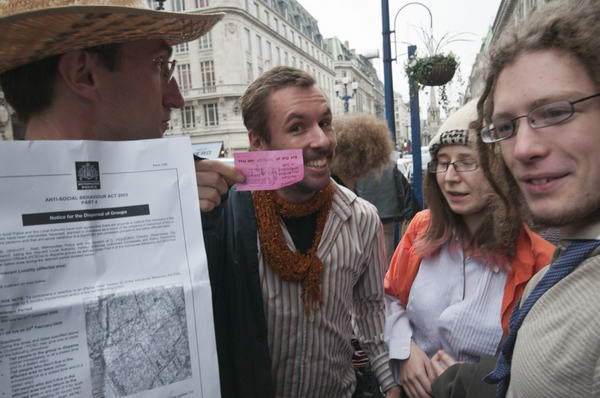
ASBO notice and Space Highjackers pink “Get out of Topshop Jail Free” card

The demonstration, which continued on the pavement outside the shop after those taking part were escorted out of the side door, was of course a protest against consumerism and the relentless pressure on people to buy things that they don’t really need that is central to our society. One of them was served with a Notice for the Dispersal of Groups under the Anti-social Behaviour Act.  This didn’t seem appropriate for the protest in the store as it seems only to apply in public places and outside there seemed to be no evidence of “members of the public being intimidated, harassed, alarmed or distressed.”  Those few who noticed what was happening  seemed either slightly puzzled or mildly amused, though one or two stopped to join in or take photographs.

More about the protest and more pictures on My London Diary.

Steam at Staines


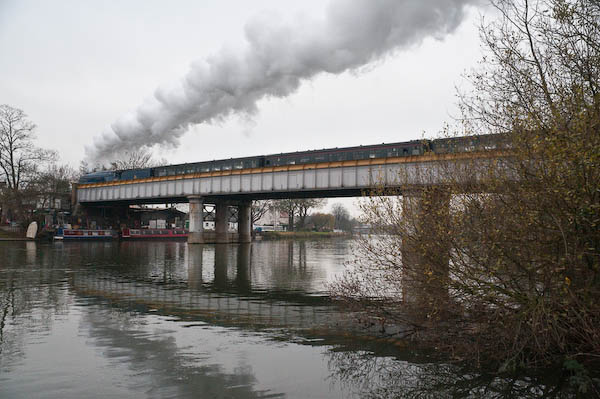
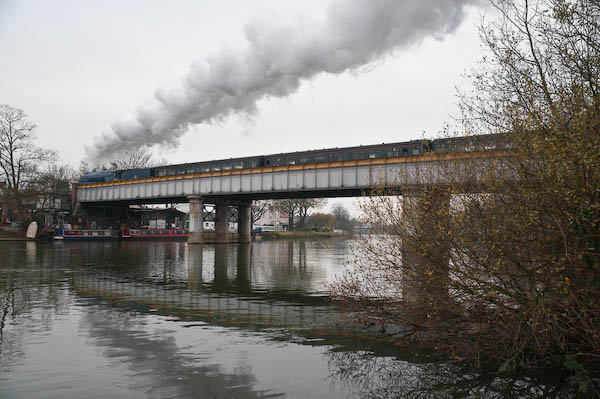
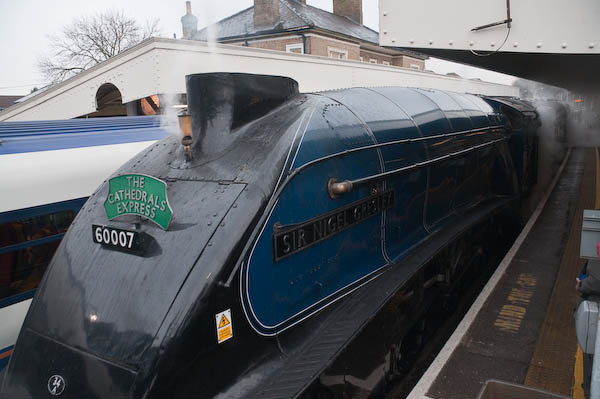
Sir Nigel Gresley hauls the steam special over the River Thames at Staines

I’m not a railway photographer, and my main interest in trains is in using them to get places. So I had considerable sympathy with the woman I had a short conversation with on the riverbank after I had photographed the steam special going across the bridge over the River Thames. She felt it was old-fashioned and far too noisy and would have preferred to see a modern train on our lines.

We have seen considerable modernisation on the railway since I’ve moved to Staines, with several generations of new trains, complete replacement of track with long sections of welded rails and more. So far this has resulted in a considerably slower and less frequent service to London – and of course in costs that have increased considerably above inflation.

Actual travel times have increased – the so-called “fast” services now taking around 20% longer than they used to – though it is useful that they now stop at Clapham Junction rather than racing through it.

Actual travel times are longer still. In the old days you could arrive at the station for a train that was timetabled at 10.23 at that time or even a few seconds later,  jumping on it even as it started to pull out and buy your ticket from the guard – or at your destination. Now you need to allow at least 5 minutes to buy a ticket – longer at busy times (and if there is an international on at Twickenham it can take 30 minutes). You may then have a short queue to get through the newly installed ticket gates, and the train doors are likely to be locked half a minute before the scheduled departure time. All in all, you need to allow almost half as long again for the journey to Waterloo.

But also for me, the sound of a steam engine is still exciting. It takes me back to my occasional bike rides up to Southall and that long footbridge (closed last time I was there) over the tracks along which Kings and Castles thundered at speed. The sound and the steam and smoke all add up to a great feeling of power.  And the two places where I photographed are only a couple of minutes on a bike from my home!

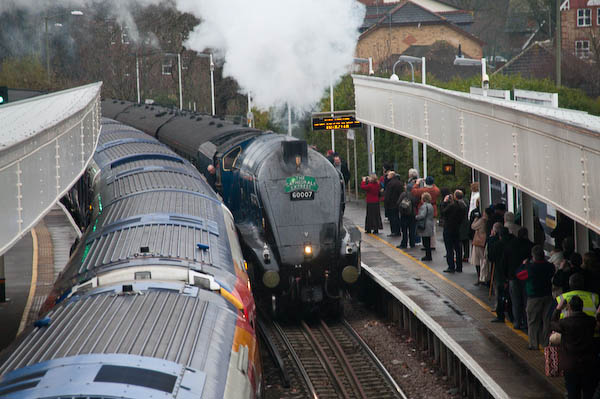
The engine hauling ‘The Cathedrals Express’ was  ‘Sir Nigel Gresley‘, the 100th Gresley Pacific, built in 1937  by the London and North Eastern Railway who honoured the designer of the class by giving the locomotive his name, and now owned and maintained by a devoted charity.

I photographed it coming into Staines, along with around 50 rail enthusiasts who had also come to watch. It stopped in Staines for a few minutes to pick up passengers for an expensive day out. I got on my bike and cycled down to the River Thames to take some pictures as the train swept across the bridge. Here I was the only photographer.

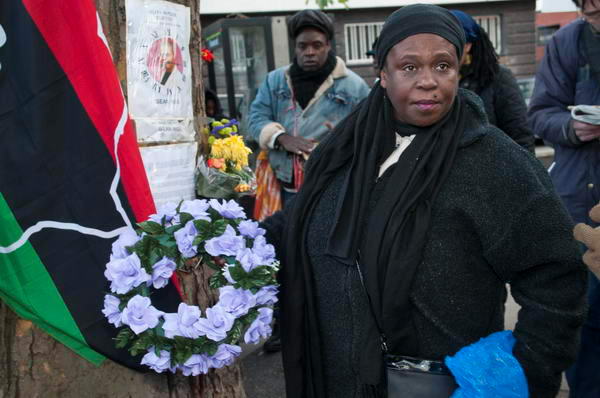
Ricky Bishop Remembered in Call for Justice

Ricky Bishop was a passenger in a friend’s car, driving  through the back streets of Brixton, London on a Thursday afternoon, 22 November, 2001. For reasons that have never become clear, police decided he was suspicious (being a young black male seems often to be a good enough reason, and the fact he was in a car with a white man may have added to their concerns) and decided to stop the car and take the two along to Brixton Police Station for questioning.

Four hours later, a healthy young 25 year old black man was dead. Bishop’s family and friends allege he was assaulted by police, and that they held him down and failed to giv e medical assistance when he had a heart attack.  The inquest seems largely to have served to lay bare inconsistencies in the police account, and the jury were denied the opportunity of bringing in a verdict that would have blamed the police for his death  – as is also happening in the current case of Jean Charles de Menezes.

His family and many members of the community want to see justice done, not just in this case but in many others. At the anniversary march in Brixton this year, two other men were also remembered, Derek Bennett, shot in the back by police as he held a novelty gun-shaped cigarette lighter in Brixton in 2001, and Sean Rigg, who died after being taken ill in police custody in Brixton Police Station on Thursday 21 August 2008.

You can see more about the march and rally outside Brixton Police Station on My London Diary.  Elsewhere on Current TV there is also a short video by Jason Parkinson which includes much of Ruth Kimathi’s statement about the Bishop case.

English Carnivals Deja Vu

All over again at the Barbican Library in London, UK, starting from Wednesday 2 Dec and continuing until 29 Dec, with a day or two off for Santa’s Shopathon in between. I think it will be more or less identical to the previous showing in October in the East London Photomonth at the Shoreditch Gallery (the Juggler.)

If you are around Wednesday evening, you are welcome to the private view, 6-15-8.30pm and if you haven’t got the slightest what I’m talking about, here’s most of the stuff from the press release:

Barbican Library
Level2
Barbican Centre
Silk Street
London EC2Y 8DS

3 Dec – 29 Dec, 2008

Monday, Wednesday: 9.30am – 5.30pm
Tuesday, Thursday: 9.30am – 7.30pm
Friday: 9.30am – 2.00pm
Saturday: 9.30am – 4.00pm

Contact:   Peter Marshall: petermarshall@cix.co.uk
Website:  http://englishcarnival.org.uk/

English Carnival shows the work of four documentary photographers who have each been inspired by the carnival tradition and carried out long-term projects on Carnival in this country. Although they have at often worked together, each has a distinctly different approach to the subject in their photography. All four photographers have shown work extensively and their pictures have been published widely in books and magazines.

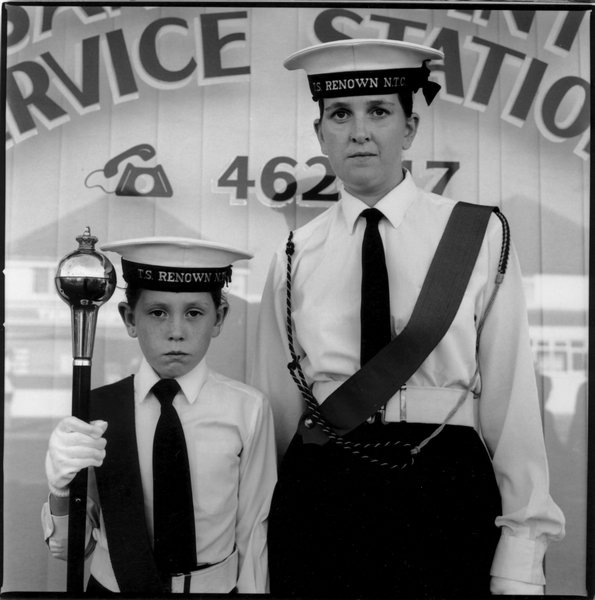
Paul Baldesare and Bob Watkins have photographed traditional English carnivals since the early 1990s, and they received an Arts Council National Lottery Grant in 1997-8 to continue their project. A show of their work organised by Kent Arts toured a number of venues in the South East.  Baldesare in colour and Watkins in black and white both show the highly idiosyncratic and sometimes esoteric side of the traditional carnivals that result in their peculiar fascination.

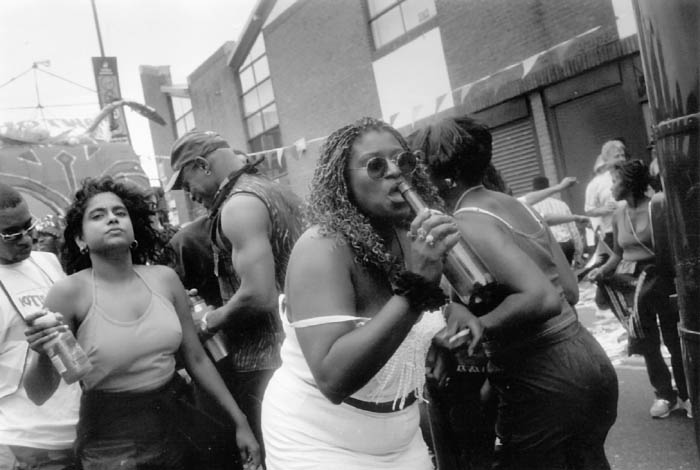
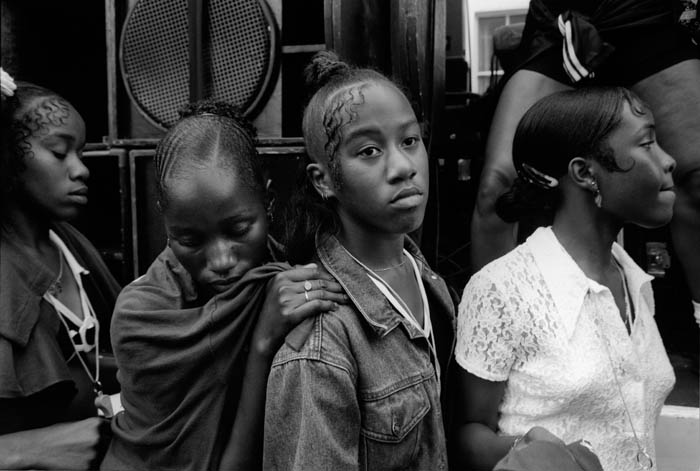
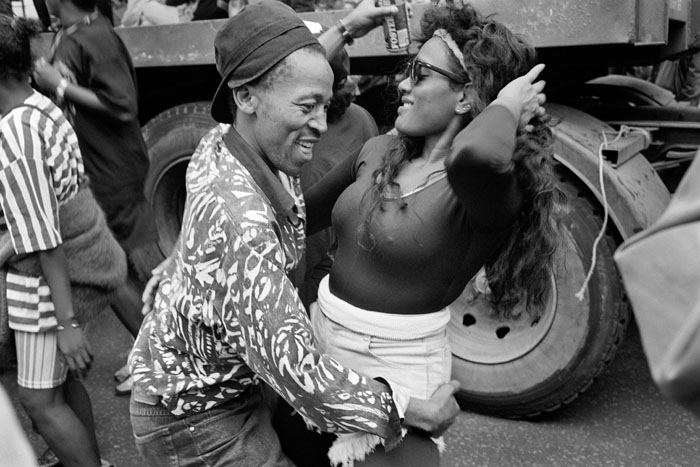
Peter Marshall’s black and white prints from the 1990s are from ‘Notting Hill in Carnival’ , published in ‘Visual Anthropology Review’ in 1999 with an essay and comments on the pictures by George Mentore who took part in Notting Hill in the 1970s.

David Trainer’s striking black and white portraits come from traditional English carnivals and fairs. His work has been included in shows in leading galleries, including the Tate Gallery’s ‘How We Are: Photographing Britain.’

Paul Baldesare  Many years ago I came across a book called A Day Off by photographer Tony Ray Jones. One section, ‘Summer Carnivals’, shot in the 1960s, was a particular favourite.” “For me, these events were full of cultural imagination and ritual contradictions.”

Peter Marshall “Notting Hill has brought new traditions of carnival to this country, enlivening our tradition. I deliberately chose to photograph it in black and white to concentrate on the people and the spirit of the event. I wanted myself and my camera to be a part of the dance.”

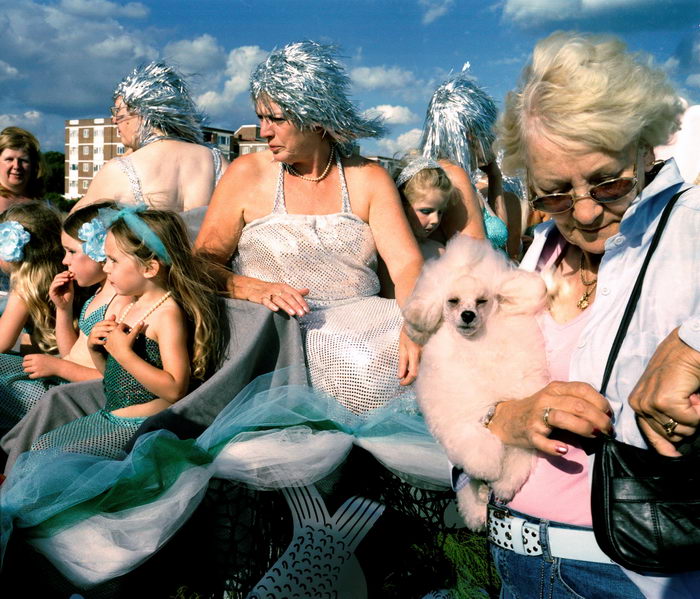
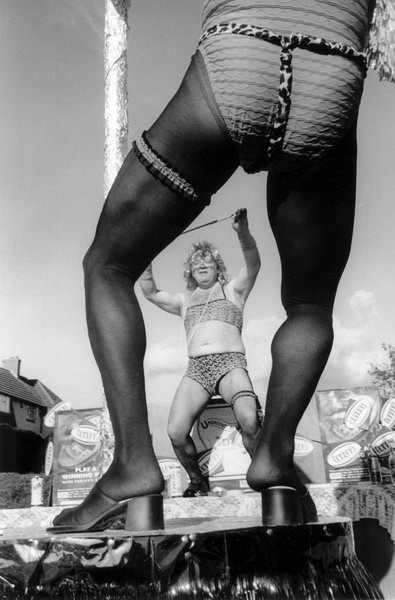
Dave TrainerJust for a day you can be someone else, live out those hidden fantasies, look and act like your heroes. Dress up like a lady with balloons for boobs and walk around half naked without being arrested… it’s all about dressing up, showing off and having fun. Well, it’s only once a year.”

Bob Watkins “carnivals are unique in the way they mirror variety and depth of our social history through popular cultural images… these pictures are social documents of particular times and places, [but] some have a meaning beyond the thing itself and it is this possibility of the photo as metaphor that keeps me enthusiastic about image making.

And of course if you can’t make it, there are more pictures on the English Carnival web site  – rather more than the 40 that are in the Barbican show.

Cafe Ideal, Cool Blondes and Paradise revisited

I worked on the project that became Cafe Ideal, Cool Blondes and Paradise for around ten years, and the final on-line version I mentioned in a previous post is only one of several ways that I showed the work – there were also several different physical shows. But all of these only really scratched the surface of the project, for which – at a guess –  I took around 20,000 images.

Recently a group of 25 of them have been selected for a museum collection and I’ve been getting down to scanning the negatives – mainly from around 1990 – for the first time.

Technically it wa a project that was made possible by my switch to colour negative in the mid 1980s. Until then colour neg had largely be seen as an amateur medium, while pros shot mainly on transparency, which was always demanded for repro work.

Many of the images I too for this series would simply have been impossible on transparency material, as the lighting contrast was simply too high, and shadows would have blocked to an impossible extent on the higher contrast material. The presence of lighting of differing colour temperature would also have been a challenge  on some images, but was easier to handle on neg  – though sometimes it meant waving CC filters under the lens over parts of the printing the darkroom.

Like many other things in photography, this would have been so much easier with digital – and the prints from scans are very much easier to correct.

Almost all these pictures were also taken with a shift lens, which again was essential to the project, enabling me work from the viewpoints that were possible and also to exercise some control over perspective. The framing in these images would not have been possible without the vertical and horizontal displacements that this lens allowed.  I still often find myself trying to push the lens to one side when working with other lenses on a digital SLR.

Many of the images chosen are ones I’ve not used before, and previously I’ve mainly scanned enprints rather than negatives, so it’s been interesting for me to see this work again in a new light. I think I will end up scanning many more images from the project and re-evaluating it.

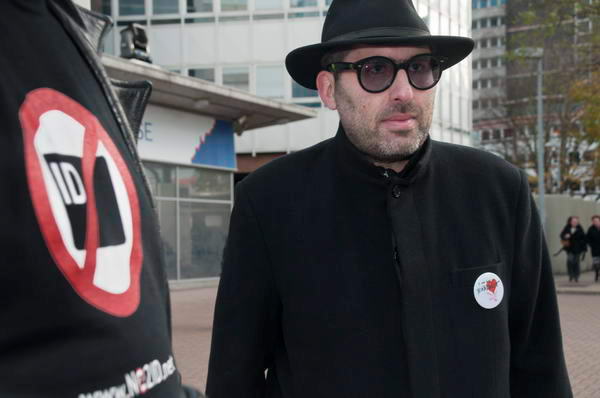
No 2 ID Cards

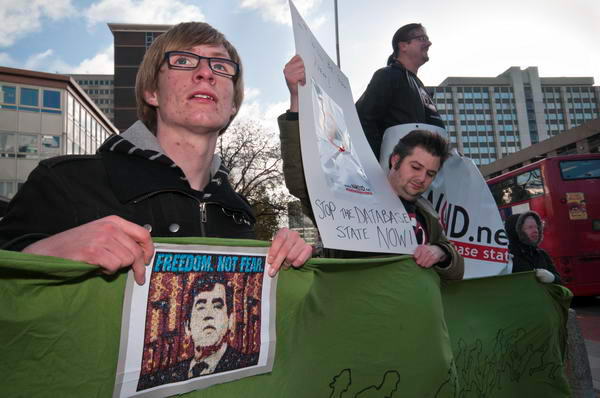
There is a particular satisfaction in photographing an event where there is really very little visually to work with, and coming up with some even half-decent pictures, and the demonstration against ID cards outside the Border and Immigration Agency provided me with that.

Nov 25, 2008 saw the start of the programme to track the every movement of all of us in the UK by our government with the start of the issue of biometric identity cards. You can read some of my thoughts about this and see the other pictures I took on My London Diary.

Wellesley Road in Croydon sprouted tall buildings in the late 1960s, in an attempt to imitate Manhattan in Surrey. Most now look rather grim and dated and they have been joined by newer buildings. The ensemble forms an efficient wind-tunnel providing a blisteringly cold gale to chill the protesters.

Among the few who came to brave the Arctic conditions was one man who has managed to get his fingerprints and DNA profile removed from the police national databases – and you can read more about him there too.