Seasonal Greetings: Bells not Bombs

Apologies to those readers who have already received a Christmas Card from me, either physically or by e-mails, but finding one picture that was recent, appropriate and visually literate was the best I could do, so you will already have seen this.
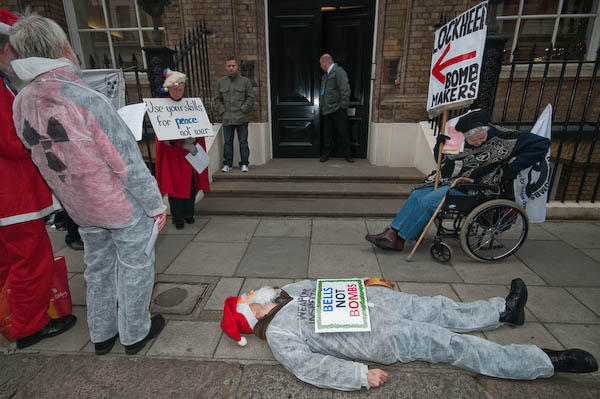

Festive demonstration outside London offices of one of the three companies that make the UK’s nuclear warheads at Aldermaston, Dec 2008

 Glory to God in the highest,  and


on earth peace,  good will toward men


Someone did ask me whether I had arranged this group for the photograph, (or rather they accused me of doing so)  but as usual I was able to reply that all I had done was to be in the right position at the right time and keep thinking and shooting as things developed.  It’s a picture in which body language was very important, and the only one in a short sequence where the guy in the ‘radiation suit’ at left has a strange lean away from centre. I also shot a similar image without flash:
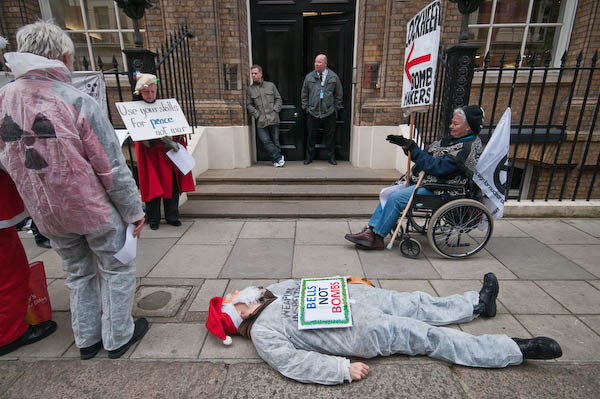

Two frames and 10 seconds earlier without flash

but I think this doesn’t for me work quite as well, partly because my eye goes to the two very bored looking security men on the door.  I also like the picture with flash partly for the way it picks out the foreground slightly, and especially the figure lying on the ground (a deliberate reference by the demonstrators to the outlines of bodies etched on pavements by the atomic bombs dropped on Japan) but also to the ‘fault’ of the reflection on the shiny black door of the bomb-makers offices – which the remaining security guy seems to be regarding with concern.  It appears to me like there is an explosion taking place inside and this flash is escaping through the door.

People often ask photographers if they ‘saw’ certain things in their pictures when they were making them.  Well, I certainly don’t stop and write things down – and the pictures are the best record of how I was thinking. In some ways it helps not to have too set ideas of what I’m trying to do which would stop me trying to push things further and make things less open to chance.

Minor White had a lot to say about photography.

every photograph a celebration

every moment of understanding a birthday


So enjoy and celebrate.

Background Information

Picture shows the North-London based group of Trident Ploughshares, the ‘Muriel Lesters’, in festive protest on 12 Dec 2008 outside the London offices of the leading company behind nuclear bomb production at the Atomic Weapons Establishment at Aldermaston.

US company Lockheed Martin leads the group making warheads for the Trident replacement and is the makers of ‘bunker buster’ and ‘cluster’ bombs, the worlds largest exporter of weapons.

The UK’s Trident replacement program is an illegal breach of the UK’s obligations under Article VI of the Nuclear Non-Proliferation Treaty.

Around a week after I took this picture it was announced that the one-third stake in the UK bomb-making programme previously owned by British Nuclear Group (BNG) has been sold off to another US firm Jacobs Eng, outside whose offices the Muriel Lesters also demonstrated.

The group of protesters takes its name from Muriel Lester, (1883–1968), born in Leytonstone, was a leading Christian peace campaigner and writer. Among many other things she founded Kingsley Hall in Bow, was a friend of Ghandi, Travelling Secretary of the International Fellowship of Reconciliation and was detained for ten weeks in Trinidad and then several days in Holloway Prison for her activities during the Second World War.
Paris Supplement

Finished at last, November’s Paris Supplement to My London Diary.

Paris (C) 2008, Peter Marshall

The trouble with being a one-man band is that when its all hands on deck there are still only two of them, but at least you can get away with murderously mixed metaphors without the restraining good sense of an editor. Though too many of those have the good sense of the average donkey coupled with a total lack of vision and an over-pernickety attitude to spelling and punctuation (and in the unlikely event she’s ever reads this, there is one lady who will immediately know I’m thinking of her – and for the record, you have absolutely no idea about punctuation despite your “corrections” to my pieces.)

Paris Photo, the world’s largest annual dealer photography fair, Le Mois de la Photo, a two-yearly festival of around a hundred shows and events, and it’s fringe, the Photo-Off with another hundred or so (and probably another hundred shows unlisted on the fringe of that fringe.)

Paris, the city and perhaps 50 km of walking around its streets searching for those shows and taking pictures. It’s all too much for one guy, even with the help of his wife (whose punctuation is always reliable and French impeccable.)

I admire those who are able to pull out their laptops or notebooks and blog or twitter away at events – at least until I read what they have written. Twitter is really such an apt name. Dawdlr is perhaps more my style, though I’ve yet to feel moved to contribute.

Anyway, my Paris Supplement 2008 is now on-line, with a dozen articles

PARIS SUPPLEMENT

Tourist Montmartre at Night
Le Paris Nord
Ceremonies du 11 novembre
Cimetiere du Pere-Lachaise
Night in the City Centre
More Shows, more walking
The Canal, Les Halles and more
Friday – More Shows
Saturday- Art & Tourism
Sunday: Marais, MEP, Seine
Buttes Chaumont / Belleville Traversée
Paris Photo Party

and over 300 photographs. In the features there are many links to the roughly 30 articles and reviews from Paris I’ve posted here on >Re:PHOTO and of course both sites have many links to external sites where you can see some of the pictures and find out more.

If you went to Paris you might find I saw some things differently, and almost certainly you will have missed some of those things I saw. Comments as always are welcome on this site, though you need to join (it’s fast, free and simple) to post.

For those who missed Paris this November (and if you are interested in photography and weren’t there, you did miss a lot) reading my thoughts and seeing my pictures (or at least the 10% or so I’ve put on line) is probably the next best thing. So if you can tear yourself away from the mince pies and steal away to your screen it might provide a little Christmas cheer.

(C) 2008, Peter Marshall

You’ll need to provide  your own champagne for that party though.

Naked Rambler Jailed

One of the sadder pieces of news in the past couple of days has been the jailing of the ‘naked rambler’ Stephen Gough, given a 12 month sentence by a Glasgow Court for breach of the peace.

I don’t have any particular wish to walk our streets naked myself, our weather seldom tempts me to bare anything, but I find it hard not to agree with Gough’s comment reported by the BBC, that if members of the public were offended by his nakedness then the problem was with them and not with him.

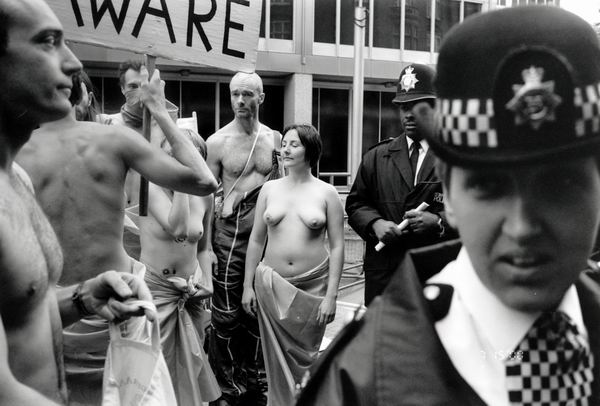
Naked protest (C) 2000, Peter Marshall

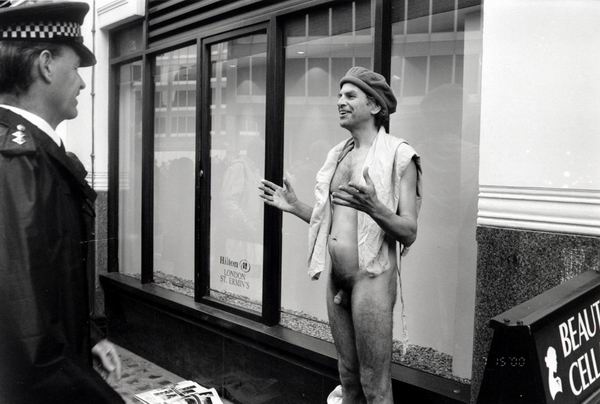
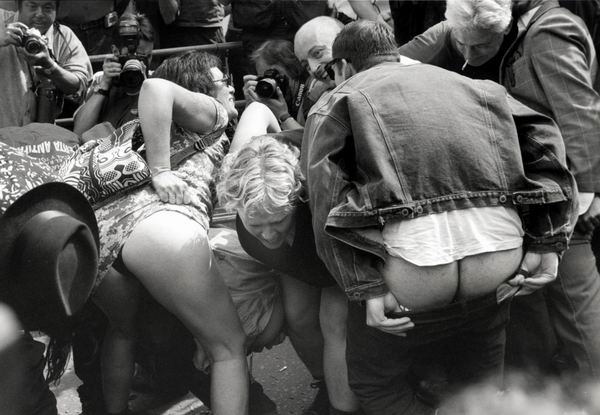
In 2000 I photographed a protest for the right to be naked in public outside the Met police HQ at New Scotland Yard.  I don’t think any of the public showed any signs of concern, and most of the police seemed pretty amused by it, although doing what they considered their duty by telling people to cover up – the man below was threatened he would be arrested until he held his hat strategtically over  his penis.

Naked protest (C) 2000, Peter Marshall

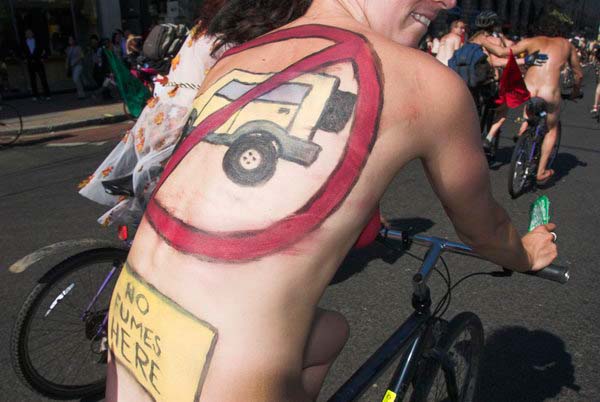
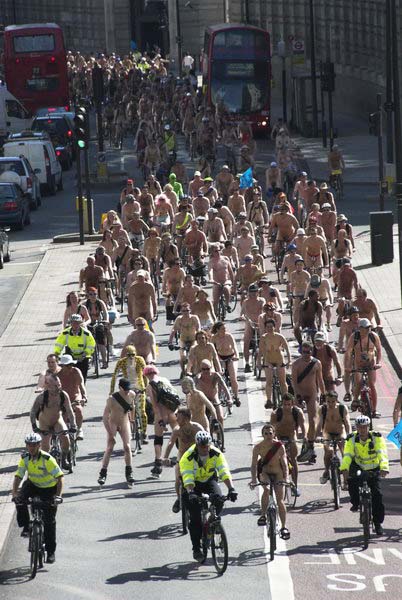
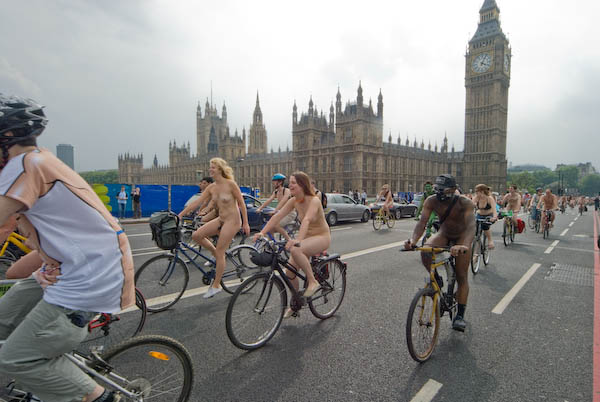
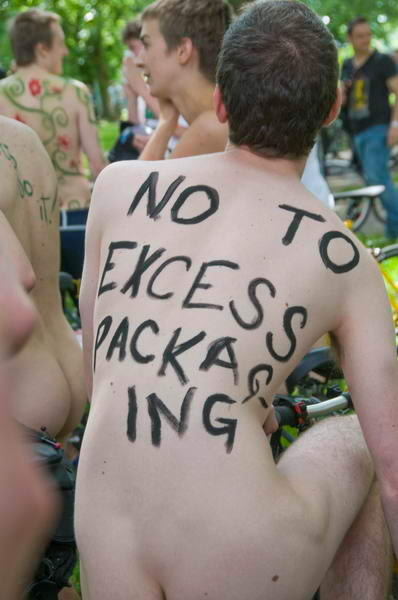
More recently I photographed several of the annual naked bike rides through the centre of London – last years had almost a thousand riders, mostly wearing nothing more than a little decorative body paint. It was again an event that caused considerable amusement among spectators. Here are a couple from the 2006 event:

No fumes here (C) 2006 Peter Marshall

WNBR London (C) 2006, Peter Marshall

and one from 2007:

WNBR Lonfon (C) 2007, Peter Marshall

and again from this year:

WNBR (C) 2008, Peter Marshall

We all have bodies, and most of us have nothing very special about ours. Mine I think generally looks better the more it’s covered and I certainly feel more comfortable wearing clothes. But I can’t really think it should be an offence not to do so.

Mooning

Even where the attempt was to give offence – as in this group of anti-monarchists ‘mooning’ outside Buckingham Palace in 2000.  Here the police did wade in and make an arrest – of a Swedish journalist watching the event who had kept his clothes on, but just happened to wear rather similar ‘Lennon’ style glasses to one of those taking part in the protest.

This event came into my mind last week when the police were insisting that anarchist demonstrators should remove items of clothing – face scarves –  in the demonstration I photographed at Dalston last week,  but here and at Scotland Yard they were attempting to arrest them for not keeping bits on.

Philip Jones Griffiths & Patrick Tourneboeuf

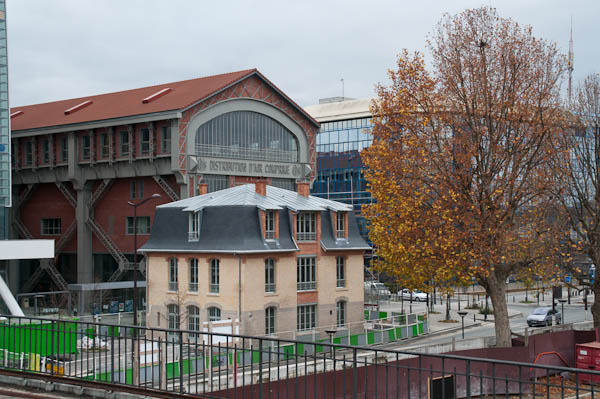
There were two exhibitions at the École nat. sup. d’architecture Paris Val-de-Seine, housed in the fine late nineteenth century factory (now listed and protected as a historic monument, and recently restored) built for the Société Urbaine d’Air Comprimé (SUDAC) and with the message in large text on its frontage: ‘Distribution d’air Comprime‘.


View from the Pont National, Peter Marshall

‘Recollections’ was a show of pictures by Philip Jones Griffiths taken in Britain from the 1950s – 1970s, with plenty of reminders of what a fine photographer he was. It appears to be showing also at the National Conservation Centre in Liverpool from 17 October 2008 to 15 March 2009, and their site has half a dozen images and some text. You can also read more and see some other pictures on the Trolley Books page about the accompanying book. The Paris show did not have the slide-show of his Vietnam images which is apparently at Liverpool, and there is also a slide-show linked at the top of the Trolley page.

This show – like the John Bulmer show I’d seen the previous day, was also a reminder of a vanished past – some gone for good, but in other ways very much for the worse. The Jones Griffiths show covers a much wider range of political and cultural events, and there is always an insistence on stating the photographer’s point of view in his work.

One image that particularly appealed to me (you can see it small and dark on the Trolley site) was taken in Downing St, outside the home of the Prime Minister. It showed four nannies with a couple of prams and a push chair who had stopped – as they did every day while taking their young charges for some air – to chat to the two policemen on duty outside the door of No 10. Now the west end of the street is walled off, and there are security gates on Whitehall, and they would need to apply several days in advance to go down the street – after passing through an airport-style security gate.

You can see many of Jones Griffith’s finest images on his Magnum pages, including in the slide show there a number that were in the show. Surprisingly, the book Recollections does not yet feature on the site.

Patrick Tourneboeuf’s giant colour pictures of spaces behind the scenes or being redeveloped in his ‘Monumental, etat des lieux’, (shown in Los Angeles as ‘The Museum Project‘) were also impressive. For once the scale of the images had a purpose, confronting us with these spaces almost on the same large scale as they actually existed, giving the feeling one could walk into these empty halls and spaces under repair. I was particularly impressed by an image of the Théâtre du Châtelet, its balconies and stalls wrapped in plastic and the workmen in hard hats at the bottom left.

It is also a project that reflects the much greater support that photography enjoys in France compared the UK.  The project began with a carte blanche commission from the French Minister of Culture in 1997 to photograph the renovation of the Pompidou Centre; other official commissions followed on from the success of his work there.

Lars Tunbjork: Vinter

Lars Tunbjork: Vinter
Galerie Vu, 2 rue Jules Cousin, 4e
12 Nov 2008 – 25 January 2009

also

Lars Tunbjork: I love Boras
Centre culturel suedois, 11 rue Payenne, 3e
9 Nov 2008 – 25 January 2009

The basement  exhibition space of Galerie Vu was filled with the large colour images of one of my favourite Swedish photographers, Lars Tunbjork. His show Vinter was drawing a good audience there, and deservedly so, although I felt it lacked the kind of unity found in his earlier books such as “Home” and “Office.”

I met Lars in Poland when his work was on show at the first FotoArtFestival at Bielsko-Biala, and was very there were photographers from 25 countries showing in Poland, and I was present as ‘Great Britain’ with  ‘London’s Industrial Heritage‘)

You can see a good selection of his work on the Agence Vu web site and also on the Cohen Amador Gallery site.

Here’s a little of what I wrote about him in 2005, but didn’t publish as I am still waiting for a reply from Lars for permission to use the images concerned!

Lars Tunbjörk

Lars Tunbjörk was born in Boras, a small city in southern Sweden in 1956, in an area that was an exemplar of the Swedish ‘Folkhemmet’ (the ‘people’s home’ or welfare state envisaged by the ruling Social Democratic Party). When he was at school in 1971 at the age of 15 he went on work experience to the ‘Boras Tidning‘ newspaper and was introduced to photography. He went on to become a freelance before getting a staff job with the ‘Stockholms-Tidningen‘, a leading daily in the Swedish capital. His work there from 1981-4, distinguished by its subtlety, established him as a leading Swedish photojournalist. He also worked for Metallarbetaren, the magazine
of the Swedish Metal Workers Union, Manadsjournalen, a Swedish monthly cultural review which ceased publication in 2002, and the Scandinavian Airlines magazine Upp&Ner (Up & Down.)

It was the work published in the book ‘Country Beside Itself’ in 1993 (Swedish title: Landet Utom Sig) with text by Thomas Tidholm and Göran Greider that brought Tunbjörk’s colour photography to the attention of the photographic audience world-wide. His pictures (and you can see a good selection of his work from 1989-99 including some from this book on Zone Zero) show a strong sense of colour and design as well as a taste for the amusing, ridiculous and occasionally surreal.

The images as well as showing his personal vision, also comment on the political and social malaise felt in the country, where much of the aims of the ‘Swedish Model’ welfare state had been acheived, and the consensus that this common aim had generated was being replaced by increasing feelings of alienation, emptiness and lack of purpose, and a movement away from social idealism towards a free-market individualism.

So in Olandi, 1991, a man and a woman recline in their swim suits on almost invisible supports, oddly suspended above a large area of grass, apparently floating as if on some invisible lake or by the yellow umbrellas that seem to emerge from their heads.

Far behind them along the edge of the grass across the centre of the whole frame is a series of buildings, black roofs above offwhite wood or plaster walls, a fairytale like faux-heritage development, stressed by the fake antique black metal lamp post which rises from beside the empty grey tarmac path at left of the picture into the white sky. Even the distant trees are drained of their colour. An image flickers into my mind of bathers floating in the high density of the Dead Sea, but this dead sea is marked as clearly Swedish by the colour – the yellow umbrellas and the complemenatry blue of the woman’s costume are those of the national flag, “a blue cloth with a yellow cross”.

An interior, Oland, 1991 is a simple scene. A room is seen in a wide-angle view square on to a wall, with white ceiling with glowing fluorescent fitting, a rather vivid green floor and pale orange-yellow walls, both facing the camera and to the right. The facing wall has a blue door at right, and in the corner of the room to the right of this a red plastic chair. High towards the left of the wall a TV is fixed, and below it stands a man, dressed only in trunks, socks and sandals, heavily sun-tanned, hands down at his sides. Seen from behind he betrays no thought or gesture through his pose, and appears to be staring at the wall in front of him (again the blue and yellow of Sweden) rather than looking up at the screen. Its a strangely empty room, nothing else except the white skirting board, a white light switch and socket by the door, a picture of loneliness emphasized by the colours. On the screen in cold blue light a couple embrace, the colour contradicting their contact.

In Flemingsberg 1989, a businessman or doctor or politician in an off-white raincoat, grey trousers, black shoes, walks along an empty tarmac road beside a fence past the grounds of some institutional building (presumably a hospital), striding out, head bowed, clutching his bulging briefcase. Perhaps representing the middle-class with all the plans of the ‘Swedish Model’, looking down and not thinking about the future, oblivious to the lamp post that has fallen down apparently towards him, about to pierce his heart with the sign attached. It reads ‘Diagnosv‘(Diagnosis) 13,15,17.

Later in the afternoon we also made it to Lars’s second show in the Mois de la Photo, a much smaller show, I Love Boras, in the Centre culturel suedois in the rue Payenne in the 3e. This too was busy, but for many the main attraction was the copies of his books available for browsing rather than the few prints on the wall.

Both shows continue until 25 Jan 2009, so if you are in Paris before then, they – and the Galerie Vu show in particular are worth a visit.

Gilles Raynaldy: Domiciles

Gilles Raynaldy: Domiciles
Ecole nat. sup. d’architecture de Paris la Villette, Paris
4-28 Nov, 2008

Domiciles by Gilles Raynaldy turned out to be one of the more pleasant and rewarding shows of the Mois. It was a simple enough idea and project, taking photographs of the interiors (mainly) of the homes of different people, mainly in France, but also some in Morocco. (The examples you can see on his web site are arranged in two projects, Parisian apartments and Moroccan interiors.)

Each residence was represented with a short text about the person or people who lived there, giving their occupation (or former occupation for the several who were retired.) There was then a short series of pictures of the interior of the house or flat, nicely taken and well-printed in colour.

The interiors reflected the personalities of the individuals concerned, but not just that, also of course their affluence and other aspects of their background, as well as the locations. These varied from tiny flats in Paris through mansions in the south and some rather more rudimentary housing abroad.

It was very nicely done and rather fascinating in a kind of voyeuristic way. It reminded me of the glimpses inside houses that one gets walking down the street in the early evening, when people have put on their lights but not yet closed their blinds or curtains, often fascinating but it would be rude to stop and stare. In these pictures Raynaldy has gained access and permission to do just that.

I did wonder about the choice of these particular examples, which was not dealt with in the notes on the show but were certainly in no way a random sample or cross-section of the population. There were, for example, several photographers, a rahter small element of society.

There were apparently a hundred 30x40cm colour images on show and I think it would have been at least as effective as a book or a high quality presentation on CD or DVD (my normal screen has an almost identical size.)

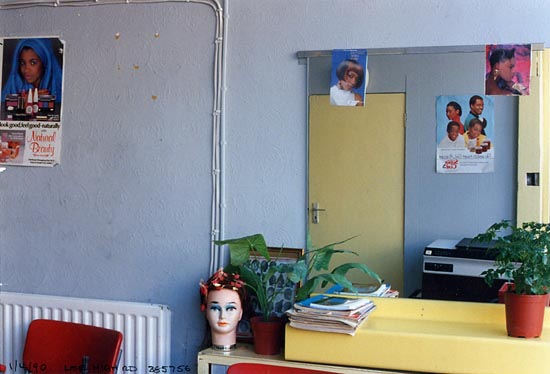
It made me think briefly of another series of domestic interiors, Bert Teunissen’s Domestic Landscapes  but these are very different, with Teunissen photographing the inhabitants in their own homes. Raynaldy’s people, who are perhaps his true subjects, remain invisible (or almost so), and the photographer roams their creation, recording their arrangement of territory and traces of their existence. It’s a project that perhaps has rather more in common with my views of shop interiors that made up a large part of the series ‘Cafe Ideal, Cool Blondes and Paradise.


Lewisham, London, ca. 1990 by Peter Marshall

Also on display in the show was a book of work by Raynaldy ‘Habitat social en Meuse‘ (also on his web site) which looked like a fine urban landscape project.

Showing in a projection area at the centre of the display were a couple of extensive slide shows by various photographers. One, on children seemed to me to have rather too many images that were largely of interest to the families concerned, mixed in with some more interesting work and some visual candyfloss. ‘Contempler et construire’ was made of sterner stuff, although not all the work appealed to me, but I was particularly interested to see the urban landscapes of Normandy as shown by Benoit Grimbert. The subject seemed rather more appropriate to his rectangular format and upright approach than the North Circular Road show I had viewed the previous day.

London & Greece

You can’t really compare the events in London with those in Greece, but if the Met haven’t yet started shooting harmless teenagers for being on the streets, they do seem to be stepping up the pressure against anarchists and other demonstrators, as well as journalists.

Over the last week or so we’ve also seen an inquest verdict on the shooting of an innocent man, in which the jury were clearly prevented from reaching the verdict of unlawful killing they felt deserved,  making clear that they didn’t believe the evidence given by several of the police concerned. (And it’s not clear if the shoot-to-kill policy they were following was legal – it was certainly introduced without proper debate.)  We’ve seen a photographer, Jess Hurd, covering a travellers’ wedding for The Guardian detained by police for forty-five minutes in London’s docklands by police misusing anti-terrorist legislation, (you can see the wedding pictures here), photographers  covering a demonstration outside the Greek Embassy assaulted, (it happened again later in the week) and many other smaller incidents in which the press is harassed and obstructed in covering protests.

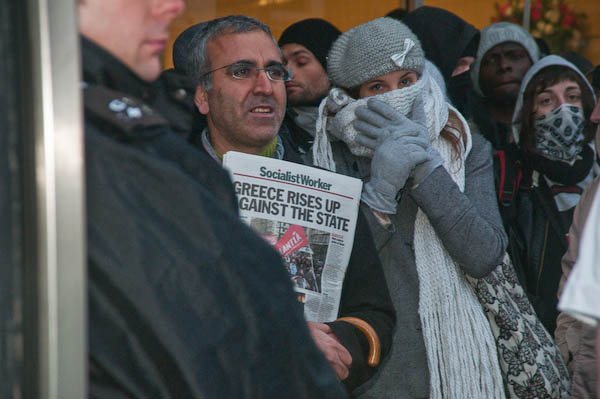
So I expected there might be some problems with the police last Sunday when I went to photograph a march by Anarchists along with Greek students and workers in protest against the events in Greece. Rather than at the embassy, it was being held in North London in an area where there is a sizeable Greek population.


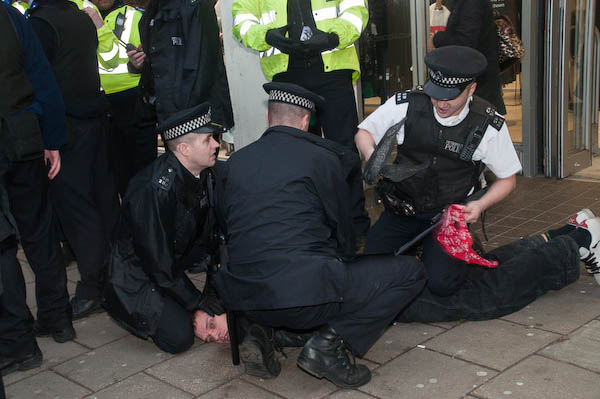
Police arrest and unmask a protester they alleged to have assaulted an officer

What I didn’t expect was that the police would decide to use the powers they have under the 1994 Public Order Act to force people to remove face coverings where the officer concerned is convinced they are worn wholly or mainly to conceal identity – and an Inspector or higher rank has issued an authorisation for such actions in that particular place (and time.)

It is of course arguable whether masks are worn at such events to conceal identities rather than as some kind of ‘uniform’ or even a fashion statement or just to keep warm. Few of those taking part in demonstrations have any real need to conceal their identity, and masks are seldom a truly efficient way of doing so – most of their wearers remain easily identifiable and many remove their masks at times during events.

What is clear than an attempt to get all those taking part to remove masks was doomed to failure and would considerably raise tempers at the event.  Those making the decision clearly did not want the march to go ahead but wanted to create a flash-point that would lead to a confrontation between police and anarchists.


Demonstrators in the kettle.
Police complained I was too close when I took this picture – though a gap between three separated lines of police.

It was a confrontation set up to show who was boss. And although the police were rather slow in bringing up reinforcements after they only managed to “kettle” a small fraction of the anarchists (along with rather more of the Greek students and workers)  they were clearly in command.


I’m starring in the film for the Police Xmas Party again

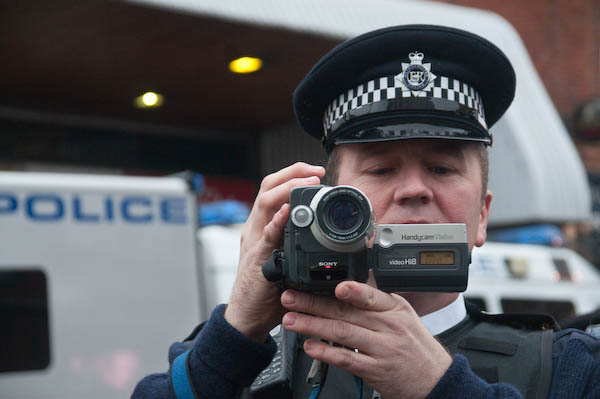
You can read a more detailed account of the events in Dalston on My London Diary, where the story is also told in pictures.  My job was occasionally made difficult by the police, particularly in their insistence on keeping a clear zone around the kettle and I did get pushed around a few times when the crowd spilled over into the street and colleagues took a few amusing pictures of me arguing with police about the rights of a free press, but I saw none of the assaults and attempts to grab cameras that had marred the events outside the Greek Embassy in the previous week.

Cité des trois fushias

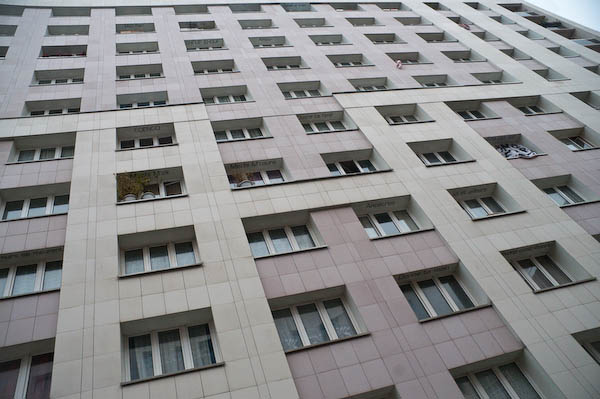
We had to hurry away from the bar Floréal because there were several other things I wanted to see and it was getting late. Our next call was not far away at the Cité des trois fushias, blocks of modern ten-storey flats around a large courtyard.


Cité des trois fushias

The first problem was getting in through the security gate from the street to the courtyard, solved in the normal way of waiting until someone came out! We then wandered around inside, vaguely hoping to see some notice telling us about this Photo-Off event, but these were too small and insignificant for us to see. Finally one of the group concerned, Colectif Tribuydom, who were setting up a film for later, saw us wandering around  and took pity on us. He phoned a friend to get the security code and took us over to the block on the east side of the court and let us in.

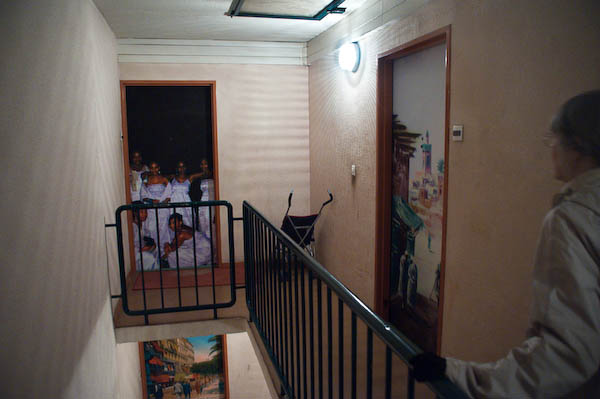
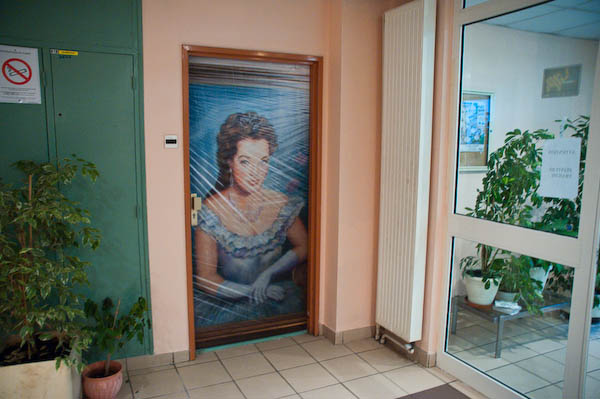
Here we found, in the lobby and on selected doors off the stairway all the way up to the 10th floor were images, largely photographic in some way, meant to relate to the inhabitants, the cite and the quarter.

Slowly we climbed our way up the stairs, stopping to look at the various doors, and to photograph all or most of them in some way. It was a long way to the top of the block, and by the time we got half way we realised it would have been more sensible to take the lift up and walk down!

I’m not sure that it was really worth the effort – and perhaps something that is more for the people who live there than outsiders – but it was certainly one of the more unusual experiences of the Photo-Off, and a reminder of what a broad church photography is. I’ll put a few more pictures from the show in the Paris supplement to My London Diary shortly

Gabriele Basilico, Vertical Moscow

Moscou Verticale
Mois de la Photo, Paris
la Cité de l’architecture et du patrimoine
23 October 2008 – 30 November 2008

One of the really major shows in the Mois de la Photo, Gabriele Basilico’s Moscou Verticale proved more difficult to find than we expected, and had us checking the information in the programme very carefully.

(C) 2008, Peter Marshall
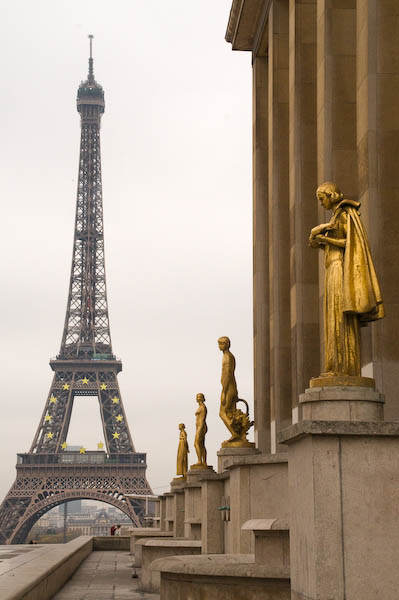
place du Trocadéro, Paris, Peter Marshall, 2008

The place du Trocadéro is really one of the bleaker areas of Paris, with the large empty square dominated by the two wings of the Palais de Chaillot, built on either side of an open terrace with its well-known view of the Eiffel Tower across the River Seine (and now thronged by young men trying to sell small models of the tower.) Built to impress for the 1937 International Exhibition it embodies every worst element of a classicized  debased modernism, and houses a rather bewildering array of museums, badly signposted in what is almost a French art-form. Even though we knew where we were going it still seemed hard to find, and we were almost put off by the notices demanding an entry fee. But although you do have to pay to visit la Cité de l’architecture et du patrimoine, this and some other exhibitions were free.

I’ve long been a fan of Gabriele Basilico (b1944, Milan)  and there were a few good examples of his work in one or two stands at Paris Photo. I own several books of his work, but I think this is the first one-person show of his that I’ve seen. Or at least it was a one-photographer show, because Basilico, wo trained as an architect before becoming a  photographer, worked on the project with architect Umberto Zanetti , photographing and photographing from the seven curiously ridiculous towers around Moscow  from the Stalinist era sometimes known as the ‘Seven Sisters‘.

These were built as showcases for the state, very much to outdo the skyscrapers of New York – and in terms of excess they certainly do. There is a story about Stalin receiving two quite different alternative plans for a building from an architect who had expected him to choose the one he preferred. But perhaps after rather too many bottles of vodka, the plans were returned with both approved by the dictator, and the architect had to build the two together on the same foundations. Looking at some of these pictures I did wonder if it was only two plans.

These are buildings so impressively bad that it becomes fascinating. You can see three of his black and white images of them on the Cohen Amador Gallery site  (you are unlikely to be fooled by the caption which tells you one is in Naples.) Like the black and white images on show, these are inkjet prints, and at least as good as those he has previously printed on silver gelatin.

But while these black and white pictures were very much what we have come to expect from Basilico, the colour work on show actually taken from the ‘Seven Sisters’ took a radically different perspective on both the buildings and the rest of the city, looking down at sometimes seriously vertigo-inducing angles and often concentrating on relatively small building details.

In part the new direction may have come from working with the architect on this project, but it may also have some connection with Basilico having worked with another of my favourite urban landscape photographers John Davies (a couple of whose pictures were also in Paris Photo.) John is one of the photographers included on the Urban Landscapes site I run with Mike Seaborne, and which links to his own extensive site.

Although I can’t find any significant pictures of this colour work by Basilico on-line (we’d be delighted to put some on Urban Landscapes) pictures at Cohen Amador from Naples (probably), Bari, Barcelona and San Francisco show this new viewpoint, as do the 2008 pictures from San Francisco at Studio La Città.

Peter Marshall


(C) 2008, Peter Marshall
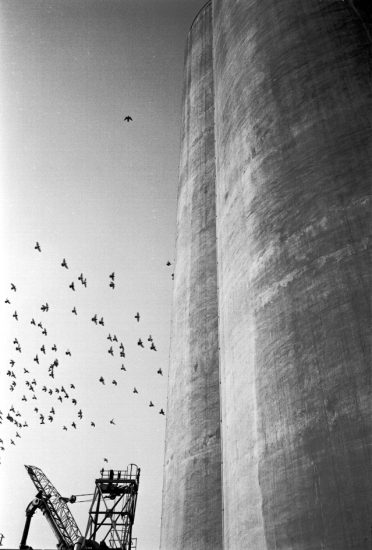
Grain Silos, Riverside Walk, East Greenwich (1982) (C) Peter Marshall I don’t often mention my own photographs of buildings (several hundred are in one of our national collections), but you can see some on the web. Perhaps the best site is London’s Industrial Heritage, but one of the first sites I wrote (and showing its age,) ‘The Buildings of London‘  has a few examples from the hundred thousand or so I took.(C) 2008, Peter Marshall
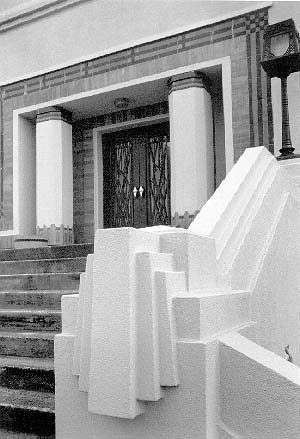
Art Deco Factory, Great West Rd, Brentford, 1980s  © Peter Marshall

Burma: Thought under Military Control


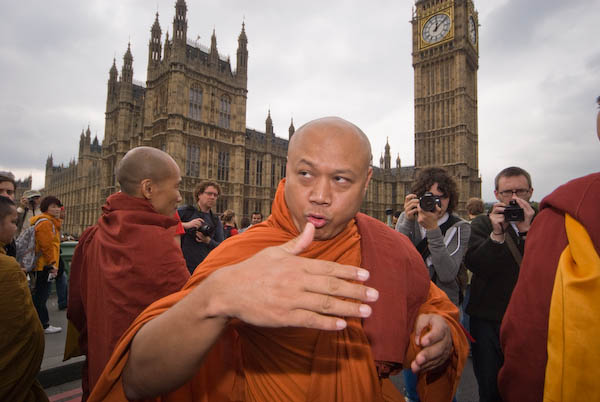
Monks protest in London during Global day of action for Burma – see My London Diary. (C) 2007, Peter Marshall

MOIS DE LA PHOTO-OFF, PARIS
Birmanie, rêves sous surveillance
(Burma, Dreams under Surveillance)
Du 10 au 23 novembre 2008 aux Vôutes

The web site Burma, dreams under surveillance gives an excellent account of this project started in 2003 by the humanitarian organisation ‘Les yeux dans le monde’ to increase our awareness of the social and political situation in Burma.

On 13 November we went to the opening of a show of the photographs taken by Manon Ott and Grégory Cohen at Les Vôutes, vaults under the roadway at les Frigos, a former industrial complex now artists homes, studios and exhibition spaces, a block east of the new building of the National Library (Bibliotheque François Mitterand) in the XIIIe.

The work is also available as a book from Editions Autrement, published in May 2008, when the work was also shown at Les Vôutes with a two-day festival.  The photographs are presented in four chapters: People’s desire, Stories of resistance, Between survival and guerilla war and The border areas, and also includes appendices containing information about the country and its culture.

Although there were some powerful images on the wall, and in the projection on the screen at the end of the cellar, the added structure of the book gives a much tighter experience.

There were a number of images among the work that to me seemed perhaps more touristic than documentary, and at times I wondered about how the work had been affected by the difficulties of working openly in Burma, impossible for me to assess.

But there were also moving stories and powerful suggestions of a pervasive military supervision of all aspects of life (the mention of Orwell’s 1984 seemed only too true.) But there was also humour – and if you don’t know about the Moustache Brothers you can find out here and also see them on YouTube.


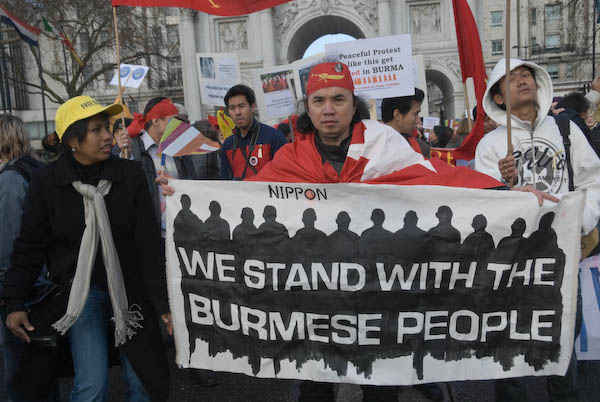
Burma Peace walk in London,  Jan 2008 – Protests like this would be brutally repressed in Burma. (C) 2008, Peter Marshall