Odd moments

It takes me roughly 45 to 90 minutes to get to most places in London from home, with a train journey into Waterloo and then on by bus or tube. Over the years I’ve become pretty good at working out routes using public transport, though it can be tricky when engineering works sometimes close down half the tube at weekends, or events on the street (often those I’m photographing) disrupt bus services. The Transport for London Journey Planner is often helpful as a starting point,but can’t be relied on to suggest best routes or give an accurate estimate of journey times.

But often I want to photograph several events at different places, and these are seldom arranged at particularly convenient times. Even I can’t be in two places at one time! So it means prioritising, and perhaps leaving one event before it finishes and arriving at another late – or not at all. Other days I’ll have finished one thing and be waiting perhaps an hour or two for a second event to photograph, so what do I do in these odd moments.

Well, if there are other photographers I know about, we often go to a pub – or less often to a cafe, which can be very pleasant. But I’ve never liked sitting on my own in such places. Sometimes I’ll fit in some other photography, perhaps visiting an interesting or changing area.

I often used to try some street photography, but my current Nikon digital is rather large and clunky for this, and I’ve yet to find a good digital alternative for the Leica or Minolta CLE (no, the M8 doesn’t hack it.) Of course I could keep on shooting film, but the hundred or so rolls I’ve already go waiting for processing puts me off it. So for the moment I’ve given that up, though in good light there are compact digitals that are worth considering.

So what I often do if I’m on my own is visit galleries. Of course there are some photography shows, but I also like to visit art galleries – such as the Tate, Tate Modern, the National Gallery etc, but also sometimes the commercial galleries. It helps to be a member of The Art Fund  because this gets me free into some places and shows where I’d otherwise have to pay – and if I’ve only got a short time it seems hardly worth it, though fortunately most of London’s major galleries are free.

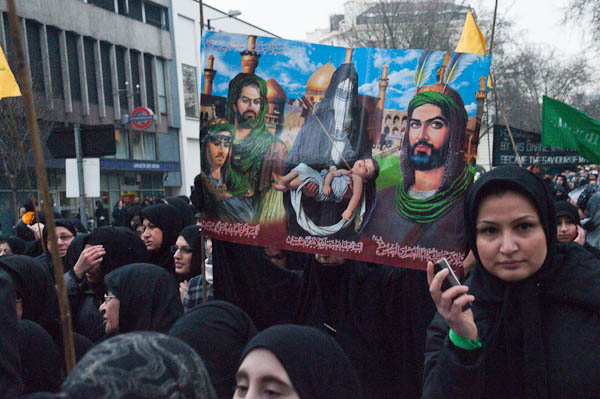
So, having taken enough pictures of the Ashura procession in rather poor light (not helped by getting the exposure wrong by mistake on some of them – my usual trouble with pressing things when I don’t mean to) I turned into Hyde Park and started by taking some pictures of one of my many favourite places in London, the Italian garden.
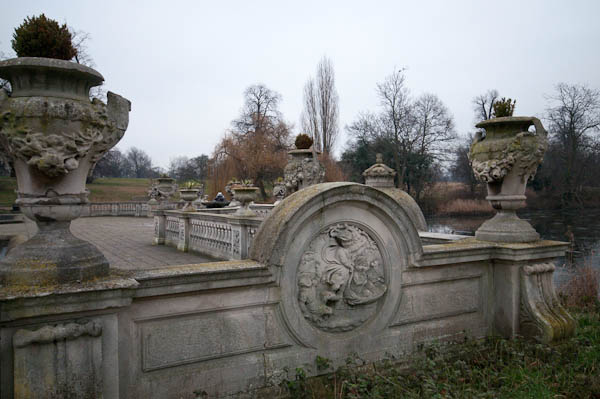
Hyde Park © 2009 Peter Marshall

Then I walked on in the direction of the Serpentine Gallery, walking past sign after sign pinting me towards the Princess Diana Memorial Fountain.
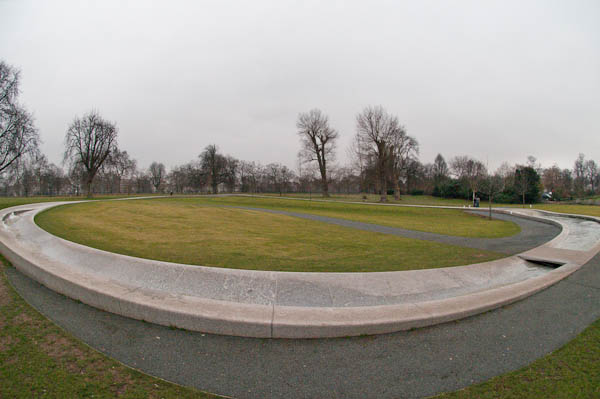
Princess Di Memorial Fountain © 2009 Peter Marshall

Princess Di never appealed to me and I kept away from all the popular outpouring following her death, and although I’d heard and read about the fountain I hadn’t bothered to go and see it, but since I wasn’t short of time I made the detour today.
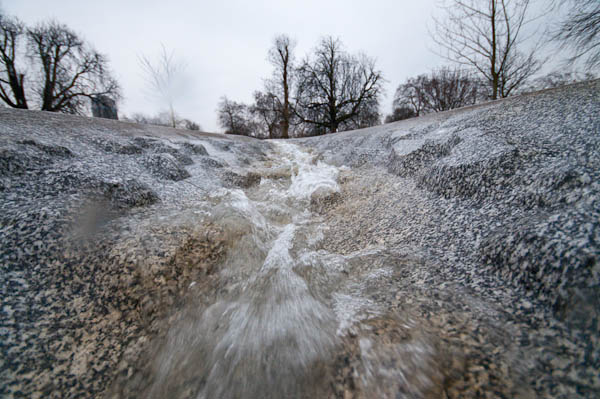
Princess Di Memorial Fountain © 2009 Peter Marshall

Although many people had said some fairly rude things about the memorial when it was opened, I actually rather liked it. Perhaps the failing light on a dull cold day improves it, but I liked the feeling of a mountain stream when seen close too, and the overall view too was a pleasant surprise.

The show currently at the Serpentine Gallery, Indian Highway, (until 22 Feb) was also worth a visit, and for once some of the video, particularly Amar Kanwar’s eight-screen immersive video installation, The Lightning Testimonies, was really worth watching. But most of the work was enjoyable, if some of it perhaps a little too predictable, and I found the couple of photographic pieces of limited interest.

From there a short walk and a bus took me to Jubilee Place and the Michael Hoppen Gallery, which boasted a show, Secret City, by Robert Doisneau and Jason Langer (ending 20 Jan) along with another by Nobuyoshi Araki (ending 10 Jan.) Doisneau is one of my favourite photographers (I have quite a few) but there were only a couple of images by him I would have considered buying were I a rich man, and I’ve seen better prints of both. Langer’s work just seemed rather out of place in the company.

The Araki show I also found disappointing. Few of his ‘erotic’ images rise above the interest of dead meat and pairing them with giantly enlarged flowers does nothing to help. There has long been a market for ‘respectable’ pornography to decorate bourgeois walls but Fragonard did it rather better.

As often happens to me, by now I was running a little late and had to dash for the tube at South Kensington to take me up to my next event, the daily protest opposite the Israeli Embassy since the attack on Gaza began.
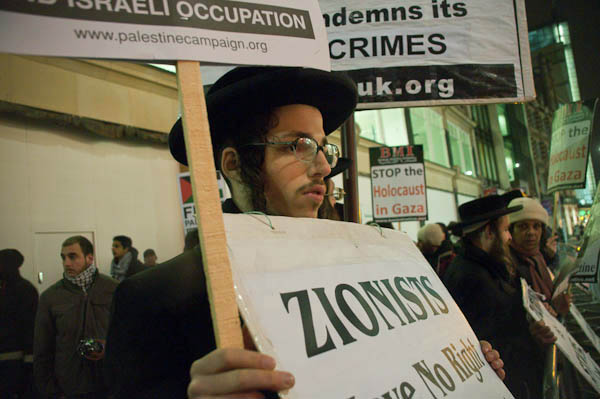
Gaza protest, Israeli Embassy © 2009 Peter Marshall

Gaza Protest at Egyptian Embassy

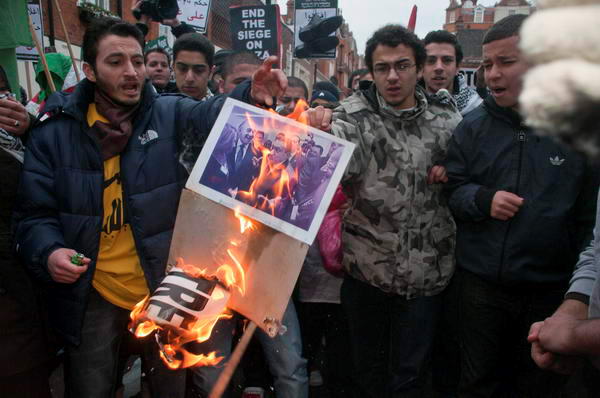
One event this year that I haven’t got round to mentioning was a protest outside the Egyptian Embassy a week ago on Friday 2 January.  It hasn’t had a mention because I didn’t lose any pictures, didn’t get the exposures wrong or otherwise screw things up.

Camp David Treaty in flames © 2009 Peter Marshall
A photograph of the Camp David Meeting is burnt

And although I left early, before the event was finished, I don’t think I missed anything that I would have wanted to photograph, though I was so cold I almost went home before some of the protesters set fire to some home-made Israeli flags and a picture of the leaders at the Camp David Treaty meeting.

I was even reasonably happy with the pictures – and got some positive feedback about them after I put some on line at Indymedia. Just a shame I haven’t yet sold any.

More pictures on line on My London Diary.

Ashura in London, 2009

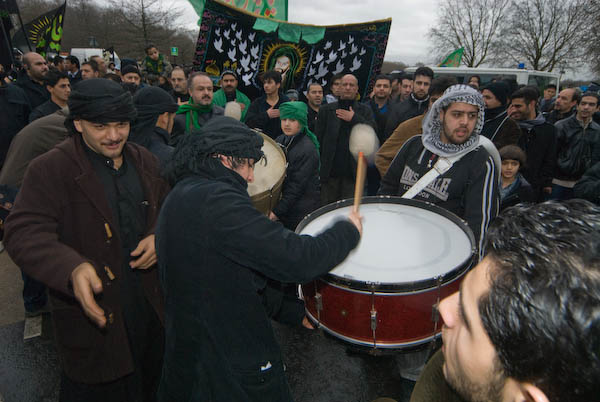
Ashura © 2009 Peter Marshall
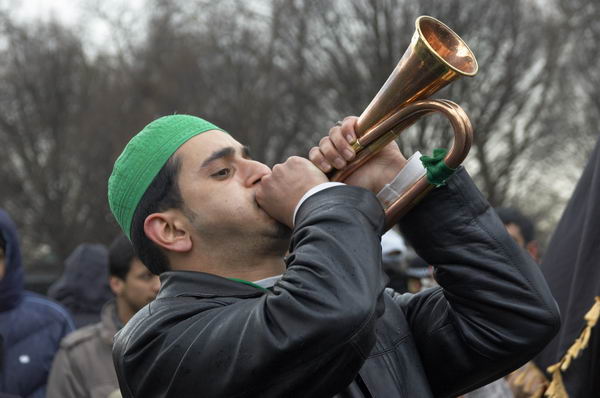
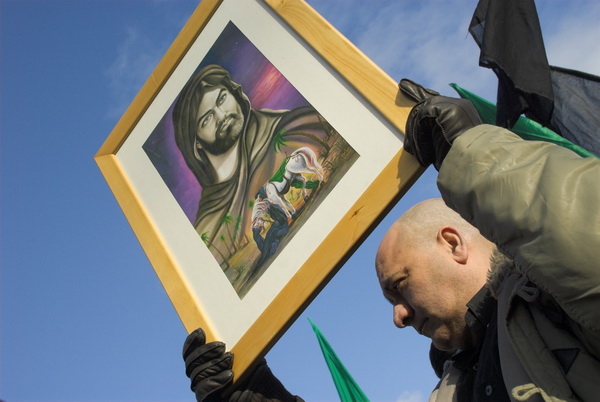
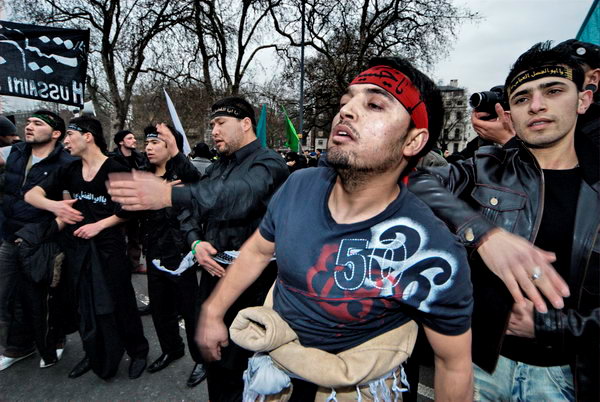
Ashura procession on Bayswater Rd, London Jan 7, 2009

Ashura is a major religious festival for Shia Muslims, who mourn the martyrdom of Imam Hussain, the grandson of the Prophet Muhammed, at the battle of Karbala in 61 AH (680 AD.) The procession in London is a part of the commemoration and mourners, largely dressed in black, walk along accompanied by the beating of drums and the wailing of horns, with a rhythmic ritual beating of their chests and chanting “Ya Hussain“.

The procession, on the 10th day of the Islamic month of Muharram, is just a part of an extended period of mourning for Hussain. Shia see the battle and martyrdom of Hussain as part of a wider struggle of good against evil, with Hussain representing freedom against tyranny and injustice.

You can see pictures from previous Ashura processions on My London Diary:

Ashura © 2005 Peter Marshall
More from 2005,

Ashura © 2006 Peter Marshall
More from 2006,

Ashura © 2007 Peter Marshall
More from 2007,

Ashura 2008 © Peter Marshall
More from 2008.

Today it was cold and rather dark as the procession of several thousands of
men, women and children left Hyde Park on their way to the Islamic Centre
in Kensington, and it was hard to get good pictures. Of course you can see what I managed on My London Diary.

Police Continue Clamp Down on UK Photographers

At least two more stories about police targeting photographers in the London area have hit the papers in the last couple of days.

Artist Reuben Powell (story in the Independent, 6 Jan) was photographing the former HMSO print works in Amelia Street SE17, just south of the Elephant, off the Walworth Road, empty since 2000 and being converted into flats as part of a new Printworks development of over 160 flats. A police car screeched to a halt next to him and an officer jumped out, ran over and asked him what he was doing. When Powell told him he was taking photographs the officer said he was going to search him under Section 44 of the Terrorism Act 2000.

It is hard if not impossible to see how this search complies with the law, which makes it clear that officers may not carry out such a search unless they suspect criminal or terrorist intent. There do have to be reasonable grounds for suspicion, and they seem totally absent in this case.

In the search, police found a knife that Powell uses to sharpen his drawing pencils, and he was handcuffed, had a DNA sample taken and spent five hours in police custody, only finally being released after the local MP intervened on his behalf.

The Mail Online has the story of another MP Andrew Pelling, Tory member for Central Croydon, who was stopped and searched while taking pictures of a neglected cycle path in his constituency. Police give as the excuse for this search that he “was taking pictures in the vicinity of a major transport hub.”

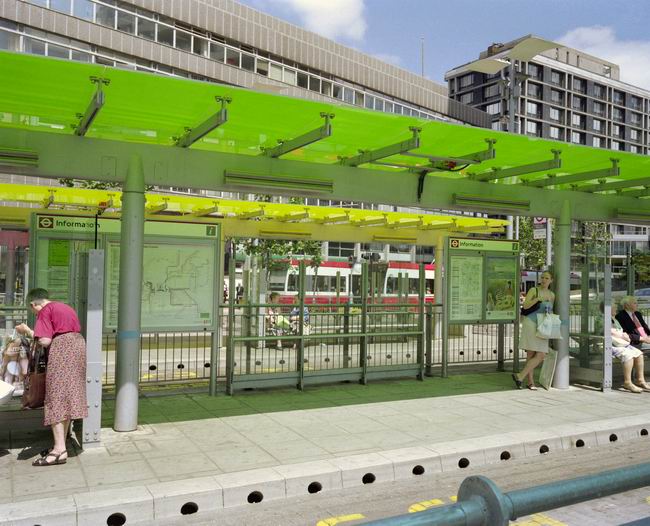
By this they don’t mean the cycle path, but the nearby East Croydon Station, together with its tram stops. In the current climate I expect police to knock on my front door in the middle of the night for naming it (and I note the Mail don’t!)


A major transport hub in East Croydon.
More pictures of the vital strategic Croydon Tramway Line 1 taken by me (without being arrested) in 2001.

I’m all for the police being vigilant against possible terrorist attacks, but this is no excuse for paranoia, and we need to see evidence that senior officers are giving sensible advice (and the occasional warning) to the loonier members of the police force. Unfortunately the opposite appears to be true, with such behaviour being encouraged by the kind of anti-photographer campaigns the police have organised.

What should be required reading for all police is the article written last June by security expert Bruce Schneier, The War on Photography. As he makes clear, the fear of photography isn’t related to real terrorism, but is the stuff of movies, a Movie Plot Threat.

And the real danger is this. If a huge proportion of police time and public money is taken up with dealing with movie-plot threats, although it may make the police feel good (and even keep some of the public happy) the chances are much higher that the real thing will go ahead unnoticed.

Ballen on Lensculture

I was pleased to meet Roger Ballen when I was in Paris in November but didn’t have a lot to say to him, not least because I was busy drinking champagne and taking pictures. But fortunately my host at that party, Jim Caspar of Lensculture, did manage to sit down with him one morning in a Paris cafe and talk to him seriously about his work.

The edited 18-minute audio interview makes interesting listening. Jim sums it up well in his introduction when he calls Ballen’s photographs “both beautiful and profoundly disturbing“, and there is a slide show of 25 recent images you can watch while listening to it.

Ballen somehow seems to inhabit a parallel universe to the rest of us, one that only occasionally intersects with life as we – or at least I – know it. His is an intriguing and unsettling view, with flash deliberately used to create a kind of dislocation. But you can hear him talk about how he sees it and why in this interview.

You can see more of Ballen’s work on his own web site.

New Year Same Old Thing?

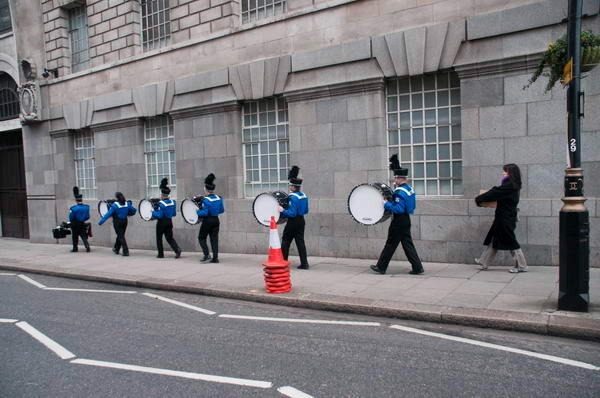
US Marching Band © 2009 Peter Marshall
US High School Bands still play a major part in the Parade

I can’t remember when I first photographed the annual New Year Parade in Westminster, London, though I’m sure it was some time in the 1990s, though apparently it’s been going for 23 years. But for a long time it was an almost entirely USAmerican affair, all high school marching bands and pom-pom waving cheerleaders, and began in Berkeley Square, completely drowning out all nightingales.

Of course it’s changed since then, particularly with 9/11, the fall in value of the dollar and then the London bombings scaring off many from the USA – and the recent recovery of the dollar doesn’t seem to have helped much. Although there are still plenty of high school kids in their uniforms, the balance has shifted, with many London boroughs and other UK organisations now taking part, and although it is still in Westminster it has become a London event.

But for several years I’ve been dragging myself out of bed on 1 Jan and wondering what I’m doing and why. Not that it’s an event without some interest with occasional glimpses of the surreal, even though it has very much been organised into a formula, too stage-managed to really hold the attention.

Going there is in some ways a social thing, getting out and greeting some of my colleagues (also not quite sure why they are there) as well as some of the characters I’ve photographed many times before and wishing them a “Happy New Year.”

It’s also in part a kind of ritual to mark the start of a new photographic year and to put down a marker that I really do intend to keep covering events for another year. Somehow I feel that if I didn’t get up and get out to photograph this, perhaps I might not bother tomorrow to get to the Egyptian Embassy or to the big protest march on Saturday.

But even as I take pictures I find myself wondering that perhaps I should really be looking for something different to celebrate the start of a new year’s work.

LB Merton Winter Wonderland © 2009 Peter marshall
But this was part of the London Borough of Merton’s Winter Wonderland

More pictures now on My London Diary.

Lost Masterpieces?

Almost certainly not. But lost pictures, the ones that got away, are always so much bigger than those you bring to land.

Around 700 pictures lost in a moment not of carelessness but by accident. Yesterday I was covering the protests in London against the Israeli attacks that are killing so many in Gaza. At first things were fairly sedate, with a march to Trafalgar Square and a rally addressed mainly by the usual suspects. Afterwards opposite the Israeli Embassy in Kensington things began to hot up, and noticing I was close to filling an 8Gb CF card I took it out of the camera and put an empty card in, slipping the full card as usual into my ‘secure’ trouser pocket – one with a zip where I also keep wallet and credit cards.

© 2009, Peter Marshall
Riot police face the crowd after some of the barriers have been pushed down

Things did get a bit heated and at one point I heard my trousers rip, and glanced down to see a tear a couple of inches long. What I didn’t realise was that it had also torn some of the stitching of that secure pocket, leaving a gap more than large enough for a CF card to fall through.

It was noisy outside the embassy, with a police helicopter overhead and a near-riot on the street, so I didn’t hear the card fall through and on to the ground, probably when I rushed out to follow the police who were beginning to get seriously to grips with the protesters.

It was only on my way home waiting for a bus three-quarters of a mile away from the disruption that I put my hand into my pocket to look for my travel pass and found a large hole – and no CF card. I suppose it was fortunate that I hadn’t lost credit cards, wallet or ticket home, but I was really despondent to find my pictures had gone.

Even more annoying as I hadn’t really needed to take the card out of the camera when I did, because although I was right to think that things were going to happen, the police – perhaps understandably in the circumstances – stopped me from going to where I could take decent pictures.  Shortly after they cleared and sealed off the area where I probably lost the card, and there seemed no point in going back to look.

I didn’t even have my name and details on the card, which I do on some along with the message ‘Reward for return’ so I think short of some miracle I’m unlikely to see the pictures again.

Until now, I’ve relied on putting full cards in a safe place. Actually in what I thought was the safest place, that zipped pocket where I keep my cash and cards. It’s a system that’s worked without fail for seven years. But yesterday it let me down.

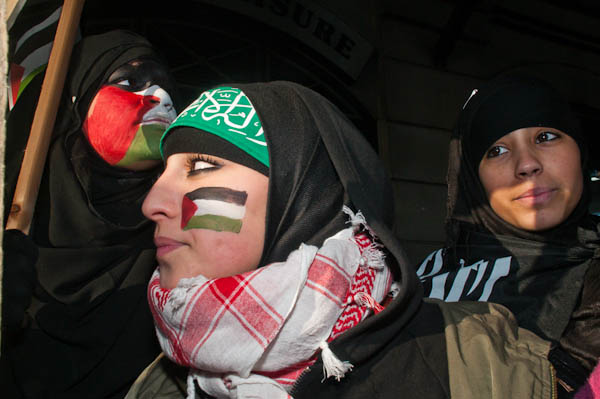
© 2009, Peter Marshall
Young Muslim women with faces painted to show support for the Palestinians in Gaza

I’d put a lot of effort into those pictures. Heavy stewarding made parts of the march hard to photograph, and I think I’d done a good job. At several times I’d been in interesting positions and photographed some great people and until I discovered my loss was feeling pretty good about the event. Losing perhaps four or five hours of my work isn’t really the end of the world but it felt close. And it leaves me with at least one rather tricky e-mail apology to write to one of the people I photographed and can’t send a picture.

© 2009, Peter Marshall
A conversation at the front of the march

To avoid any chance of this again I think I’ll buy a large enough card to hold a full day’s work – perhaps 16 Gb so I never need to change a card when I’m working. It’s something I couldn’t do a few years ago. And I’ll be sure to put my name and address on it so there will be some small chance of getting it back should I somehow lose it.

© 2009, Peter Marshall
Protesters carry a coffin to represent those killed in Gaza.

Actually I was lucky that I’d put two full cards into that pocket with a hole, and surprisingly the 4Gb one had stayed inside, with pictures from the start of the march. So at least I have something to use for the event.

© 2009, Peter Marshall
Young men call for an end to the holocaust in Gaza

And there are just a few more I’ll put on My London Diary shortly. 2009 is starting rather late there.

A New Year

2008 wasn’t a good year for many of us, and certainly not for me. Personally there were several disasters, including the deaths of two family members, an older brother and a younger cousin. Photographically I had some minor disappointments, including the cancellation of a major show of my work which finally fell through after I thought all been agreed, and another invitation to show work at a major photo festival that came to nothing. And don’t let’s even think about money – financially I think most of the world had a bad year.

At the start of 2008 I made a list of things to do in the coming year and posted it, hoping it might encourage others to get themselves sorted out too. There were a total of ten points, and you can read more detail on them in the feature  2008 To Do List. Here are the bare headings:

1. Make better pictures
2. Get out more and take more pictures.
3. Check my camera settings more often when taking pictures
4. Always check for dirt on the lens
5. Edit my work more stringently
6. Sort out a proper back-up system
7. Make proper to-do lists
8. Really sort out my old ’street photography’
9. Publish, at least on the Internet, my Docklands work from the 1980s
10.Get back to scanning my old work which is on deteriorating film negatives.
11. Rewrite as many as possible of my features and put them back on line.
12. make more money by selling photographs

My end of year report on these is a poor one. Even with some very liberal marking I can only claim around 3/10, and I don’t think I’ve quite completed even a single one, although I’ve made some progress on several.

Of course some – like ‘Make better pictures‘ – are things I hope I’ll never be satisfied with, and it would always be nice to make more money selling photographs, if only because it suggests a greater interest in the pictures. But there are a few I’d really like to be able to cross of the list. Still, I suppose there is an advantage in that I don’t need to bother with a new list for 2009.

I’m hoping for a better year than the past one, and send everyone my wishes for a happy and successful 2009.

Amen Sister!

2008 has been a year that has seen a few interesting developments in photography in the UK, although also a year that has left many of us considerably poorer. Many photographers have seen their incomes fall sharply with clients going out of business, staff jobs being axed and an increasing use of images from free or cheap sources. Many publications seem to think that anything that will fill a suitable size rectangle on the page will do and are not willing to pay the rate needed to sustain professional work.

I heard a week or so back of one local newspaper offering a ‘day rate’ of £25 – and still finding people who would take it, while others are now relying on amateurs to send them pictures for nothing but having their name in small print next to them.

Not of course that their is anything necessarily wrong with amateurs – much of the most interesting photography over the whole history of the medium has come from people who supported themselves by other means (or relied on partners, friends or families to support them,) or was the personal work of photographers whose professional work was generally tedious and mundane.

And many photographers who became famous through their actual professional work of course still often produced a great mass of uninspired bread and butter images. One of the problems we now have is that curators have a great delight in bringing this out and presenting it on walls as great previously unknown art. The truth generally remains that there are very good reasons why these images were obscure, but there is no career-enhancing kudos for curators in repeating – for example – to show the pictures that Henri Cartier-Bresson chose to include in his ‘The Decisive Moment.’  (You can now usefully see the entire book online, although of course the quality of reproductions is so much better in the real thing.) And yes, even H C-B had his off-days, and it is hardly surprising that the title “the Pope of Photography” has most often been applied to a curator – John Szarkowski – rather than a photographer.)

There have been some encouraging developments this year. Photographers often like to bitch about the British Journal of Photography (not least when it asks to use their work without payment) and there are sometimes very good reasons for this, particularly in some of their coverage of equipment which at its worst can be little more than a round-up of press releases or a display of personal prejudices, but in my eyes their coverage of photography has certainly improved. This was brought home to me when I cleared out the shelves containing several years of back-issues before Christmas.

One innovation for the BJP this year was its rather curiously named blog, 1854, a reminder that the print magazine is extremely long in the tooth. One of the great things about blogging is that it forces you to read other blogs, and although 1854 hasn’t yet become a useful source of information for me (usually I’ve read it first on the same blogs as them!) it does mean that its writers, “the editors of the British Journal of Photography, the world’s oldest photography magazine” at least keep up to date with “photographic news, from the latest gear to the best exhibitions to the best insights on ongoing and upcoming trends in the industry” which I’m fairly sure accounts for the improvement I’ve noticed in the print issues. Though there are perhaps one or two of their contributors who still need to start blogging!

At least for those of us who live in London, one of the big developments of the year – and one the BJP largely neglected – was the tremendous growth of the East London Photomonth. Of course there are some other photo festivals in the UK, but this is the only one of any moment in the capital and with around a hundred events this year beginning to make an impact.


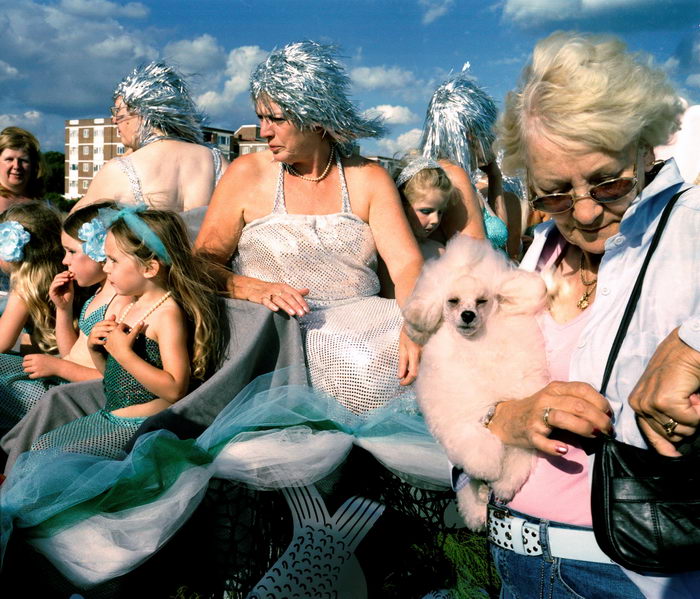
The Mermaids and the Poodle, Hayling Island Carnival, 2005.  Paul Baldesare from the show “English Carnival“, part of the Photomonth I was also in.

Of course it still has a very long way to go to rival Paris – which is why I spent eight days in that capital this November (which you can read about in great detail both in many posts about the shows here on >Re:PHOTO and also in my  Paris Supplement to My London Diary.

One of my first posts on arriving back from Paris was Paris and London: MEP & PG which compared our London Photographers’ Gallery with the Maison Europeene de la Photographie (MEP).

The main thrust of my piece was in the third paragraph:

but the biggest difference so far as photography is concerned is one of attitude. The MEP clearly believes in photography, celebrates it and promotes it, while for many years the PG has seemed rather ashamed of it, with a programme that has seemed to be clearly aimed at attempting to legitimise it as a genuine – if rather minor – aspect of art.

So I was interested to see that when the BJP’s report (BJP 17/12/2008 p6) of the PG’s opening on its new London site (my account,  Zombies in Ramillies Street, on >Re:PHOTO was rather different) commented that gallery director Brett Rogers “hopes that the gallery will reach an equal footing with organisations such as the Maison Europeene de la Photographie in Paris“.

Amen sister! So do I, but I’ve yet to be convinced that we are singing from the same hymn sheet!

A Christmas Message and a small Milestone

Forget Ahmadinejad and the Queen. My Christmas message came in the early hours of Christmas morning. Santa and his elves were busy working overtime with the fairy dust and a small present came floating into my mind as I woke to roll drowsy out of bed to empty my bladder at 3am, and after completing the necessary I sat down with paper and pencil to record it. Unusually for such night-time notes it remained legible and made some sense when I found it again in the morning.

A few months back I got myself involved in one of those long and essentially pointless discussions on internet forums that I usually stay clear of, which I think had started with the question “what is a photograph“, although as such things do soon strayed off into other areas (at least one per participant.) I’d contributed Walker Evans’s quote from the text for a show at MoMA in the early 1950s about valid photography “Under no circumstances is it anything ever anywhere near a beach” (which I had put on >Re:PHOTO a few months earlier

However it’s perhaps more relevant that on Christmas Eve I had been thinking about Minor White, both in writing my Seasonal Greetings and also leafing through the latest Winter 2008 issue of Aperture, which on its final inside page has a feature by Anne Wilkes Tucker on what she truly describes as a “seminal gathering” at the Aspen Institute in 1951, which is accompanied by a group photograph of just over 20 or those taking part. This high-powered crew included Wayne Miller, Ansel Adams, Dorothea Lange, Berenice Abbott, Frederick Sommer, Nancy and Beaumont Newhall, Herbert Bayer, Eliot Porter, Minor White, Ferenc Berko and Laura Gilpin. The event led to both the founding of Aperture, with Minor White as editor and moving spirit and also the genesis of the Society for Photographic Education.

Aperture has now reached issue 193 (as a subscriber for many years I now have well over a hundred issues on my bookshelves) and published many fine books and editions. I wrote a double feature on its history at the time of its 50th anniversary (another piece no longer on line – but perhaps to be rewritten to come out at the same time as issue 200?)

So here (at last) is my little present, a kind of definition of worthwhile photography:

The simultaneous exposure of two sensitive surfaces – one in the camera and the other in the photographer’s mind.

I’m always wary about milestones. It’s a word too close to millstones, which though perhaps notable for grit also hang round necks. But I do note that a few days ago I wrote my 500th post to this blog.

Also, looking at the statistics from my web host (which I seldom do,) I find that with a few days left, >Re:PHOTO is getting very close to 500,000 page views for 2008, though unless there is a sudden surge it won’t quite reach the half a million this year.