Gladstone and Matches

I’m not sure why, at least according to the BBC, celebrations for the ‘Grand Old Man’ of Victorian politics, William Ewart Gladstone (29 Dec 1809 – 19 May 1898) should be launched today, but his was a story linked with Bow, where I went on Sunday for the Three Mills Loop guided walk, which takes place roughly monthly.

The first half of the walk took us from the mills through the centre of the Olympic site on the Northern Outfall Sewer (rebranded in the 1990s as the ‘Greenway’) and then along the Navigation tow-path to Hackney Wick, where we turned down the Hertford Union canal, crossing this to go down Parnell Road. Here, where the walk leader went into the newsagents to buy an ice-cream, we were close to a part of the story linked to Gladstone, although the statue comes later.

© 2009 Peter Marshall.

Further on we passed Bow’s most famous factory, the former Bryant & May match works, set up by two Quaker businessmen in 1861. It’s a fine brick building, now a gated yuppie ‘village’, but was notorious in the 1880s for its low pay, poor working conditions and “phossy jaw” a disfiguring disease that led to early death for many of the young women workers caused by the white phosphorus used to cut the cost of making matches. It earned its place in labour history when Annie Besant went there and organised the Match Girls’ Strike in 1888, winning better working conditions and more pay.

But it was really the Salvation Army that changed the match industry, with William Booth buying up an empty factory close to that ice-cream shop in Lamprell Street and making ‘Lights in Darkest England‘ safety matches which used the more expensive red phosphorus in place of the cheaper but highly dangerous white allotrope.  Booth also paid his workers more and gave them safer and better working conditions  – including tea-making facilities. He promoted these matches through the cooperative movement and also with consumer power, harnessed by the ‘British Match Consumers League’ which he set up, urging members to harass their shopkeepers at least twice a week until they sold the army matches.

It was this campaign that forced the other match manufacturers to switch to the safer red phosphorus and in 1901 Booth was able to close the factory having virtually eliminated the problem, although it took another seven years before the use of white phosphorus in matches was made illegal at the end of 1908. And yes, it’s that same material as Israeli forces have been caught using illegally in densely populated areas of Gaza.

In 1871, Gladstone’s chancellor decided to impose a tax on matches, and there was a public outcry. Although the government went as far as actually producing 1/2d tax stamps with the catchy motto “ex luce lucellum” (from light a little gain) pressure from campaigners (including the Queen herself) led to the proposal being dropped. The match workers from Bow took part (urged by their employer who had threated to pass the tax on to them) in a massive march to Parliament, which although described by some as “entirely peaceful” actually involved some massive and brutal brawls with the police in Trafalgar Square and on the Embankment.

After the proposal was dropped, Bryant and May celebrated with the erection of an ornate drinking fountain in 1872 opposite Bow Road Station (it disappeared when the road was widened in 1953, but a small plaque marks the site) but the workers were less happy when the management docked their wages to pay for it. On the day it was unveiled some of the women slashed their arms in protest, dripping the blood onto the fountain.
© 2009 Peter Marshall.

It was Annie Besant who got this story mixed up with the statue of Gladstone shown here, sculpted by Albert Bruce-Joy and donated by Theodore H Bryant in 1882, and it seems unlikely that workers either had their pay docked or celebrated its erection with their blood. But in 1988, to celebrate the 100th anniversary of the strike, the Gladstone statue was daubed with red paint. After the council cleaned it, someone came back and daubed it again, and you can still see it now on the plinth of the statue and also on the hands in this picture.

There is a good illustrated account covering some of the above and other relevant local history on the Kingsley Hall web site.

More pictures from the walk on My London Diary.
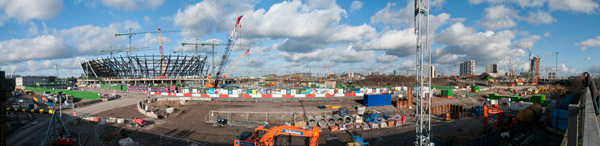
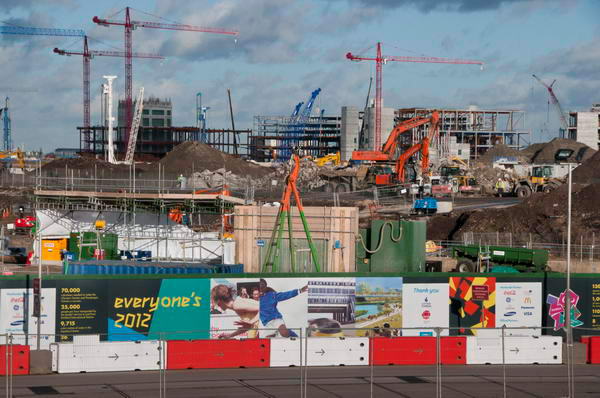
Olympic Panorama

 
Olympic stadium and site, 180 degree view from the Northern Outfall Sewer, Stratford Marsh, Sunday 18 Jan, 2009.

That’s it really. Too small to see here, but larger on My London Diary, though the orginal is about 10,000 pixels wide. A little more about it there as well, and a second panorama of the same scene from a slightly different viewpoint. Stitched with PTGui from four Nikon D300 images taken using my thumb as a special panoramic mount!

Of course I also have panoramas taken from the same places before the work on the site started. And hope to also be taking pictures there when its all over.

Observers and Events

Photographing last Saturday’s demonstration about Gaza in Trafalgar Square on Saturday I was very aware how the presence of photographers and the way that they react to events can actually very much influence what is happening.

© 2009 Peter Marshall.

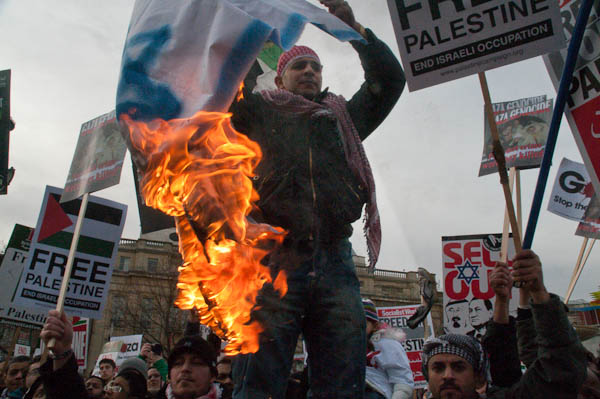
At times speakers had to stop and wait because of the noise, which was prompted by the activities of a smallish group of men at one side of front of the crowd facing the speakers. As well as chanting noisily they also burnt Israeli flags and posters, and of course when they did so a crowd of photographers formed in front of them.

Obviously they felt deeply about what was happening in Gaza and wanted to show it, but this and other similar displays at the demonstrations are very much designed to catch the attention of the press, and very much encouraged by the press reaction.

As photographers we need visual symbols, and the more powerful these are the easier our job becomes. So of course, with all the others I went and photographed what was happening.

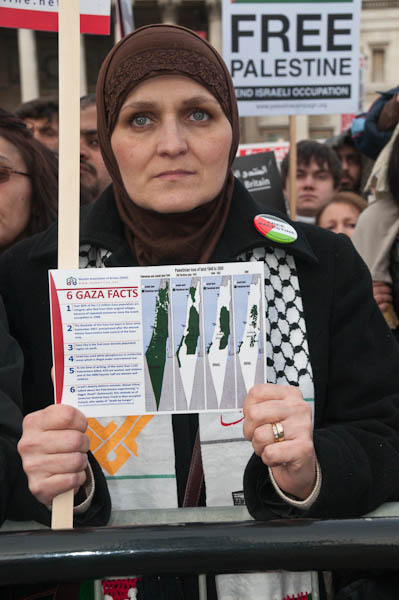
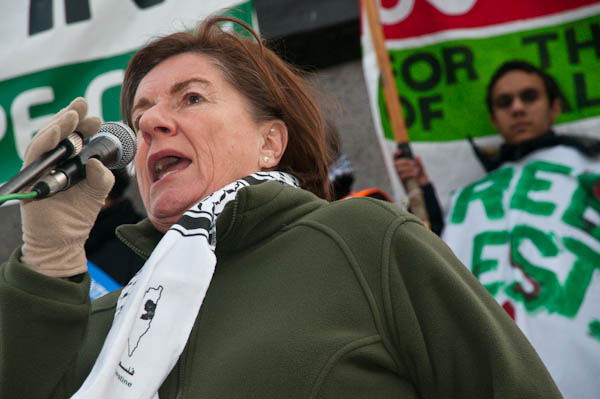
But once I’d got some pictures of a burning flag and images that I thought showed their anger I walked away and photographed other things, leaving them alone. Not that it made any difference as there were plenty of other photographers encouraging them. But I wanted to hear the speeches and photograph the speakers and the audience, and this was an event that was very much about women and children, so I tried to concentrate on them.

© 2009 Peter Marshall.

The police often accuse photographers of provoking demonstrators to violence, but in general I don’t think we do, at least not to any measurable extent. Demonstrators are far more often provoked by the police – and being pushed around or hit by a baton is considerably more effective effective provocation than a camera. Even the way the police use cameras is often considerably more provocative than the way that journalists usually work.

Most of the time we are doing our best to record what is happening rather than to be a part of it, but there are times when our presence as observers can very much change the events we observe, and we need to be aware of it.

You can see my photographs from the rally in Trafalgar Square and the women and children’s march along Whitehall on My London Diary as usual.

T5 Flashmob

© 2009 Peter Marshall. John Mcdonell

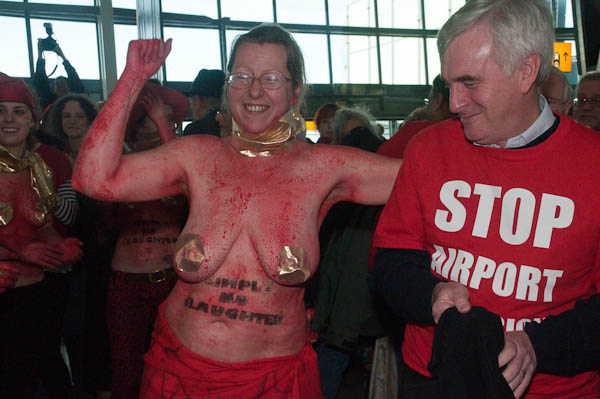
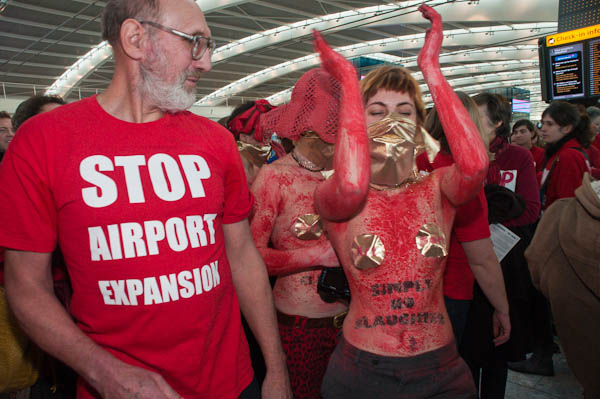
I’m not sure that this is the picture that MP John McDonnell would want to put on his election leaflets, but it did amuse me – and some of his constituents who were there with him at Heathrow’s Terminal 5 to voice their opposition to the expansion of the airport and in particular the building of another runway – the so called ‘third runway’ which will go through their village and mean they are forced out of their homes.

I don’t like airports. I grew up under the flightpath to the main runway (I think in those days it had five runways, but they abandoned some and built a terminal on another) with planes passing over just out of reach, and for a while was a keen aircraft spotter writing down their numbers in my book. They weren’t hard to spot – you needed to look through the wrong end of binoculars to see the whole plane.

Seeing some going over with flames from the engines led to nightmares but fortunately I think it was only in these dreams that I saw and heard them crash.  But back in those days of the Brabazon and Comet, aviation was a brave and exciting new frontier and I was caught up in its glamour, thrilling in visits to the airport where my oldest brother worked and I actually got to go in a plane, and later with him to the Fanrborough air show.

But when I grew up I studied science and became interested in the environment, and even over 40 years ago it was obvious that we had to do something about airports and air travel – and now you have to really stick your head in the sand not to believe it.

Last week’s announcement approving the expansion of Heathrow and the building of a third runway from transport minister Geoff Hoon came as a shock – how can any government be so stupid?   But the protesters who came to Heathrow’s T5 on Saturday are determined to keep up the campaign to stop it, and it seems more than likely it will never be built.

© 2009 Peter Marshall.

For the planet’s sake I hope it isn’t.

More pictures on My London Diary, where you can also see pictures from last year’s flashmob at the Department of Transport and march at Heathrow, the 2003 march against the Third Runway and more.

Inez Baturo – Polish Landscapes

The current exhibition at the Paris-based on-line Dmochowski Gallery features the work of a good friend of mine from Bielsko-Biala, Poland, Inez Baturo.

© 2005 Peter Marshall
Inez Baturo

A week or so ago I wrote something about the ugliness of snow on trees and now have to eat my words seeing the magic which this gives to some of Inez’s pictures. As gallery owner Piotr Dmochowski writes, these are “misty, wistful and pensive visions” and have a powerful poetry, full of “nostalgia, memories and sad reflection.”  I think there is something deeply Polish in them – as Polish as the music of Chopin.

But go and look at them on the web site – and there are some good large versions of the images on show. The pictures date from 1991 – 2008, with 2007 seeming to be a particularly productive year.

Dmochowski was born in Poland and works as a barrister and professor of law in Paris, but has devoted much of his time to promoting the work of Polish artist Zdzisław Beksiński (1929-2005) with a gallery at rue Quincampoix in the centre of Paris from 1989-95. Work from the Dmochowski collection is now on show as the Beksinski Museum in Częstochowa, Poland, and the gallery is now an on-line one, showing mainly paintings.

Earlier shows of photography on the Dmochowski gallery have included the surreal recreations of dreams by Misha Gordin, who I was pleased to spend some time with on my last visit to Bialsko-Biala where we were both guests of the FotoArt Festival organised by Inez Baturo.

© 2007 Peter Marshall
Inez and Misha on stage at the FotoArt Festival in Bielsko-Biala, 2007

Other photographic shows at Dmochowski have included the controversial ‘To die so as to leave the hell’ with work by James Nachtwey, Don McCullin, Sebastião Salgado, Raymond Depardon, Joël-Peter Witkin, Dieter Appelt and Elizabeth Prouvost as well as of Beksiński’s own photographs, which include some powerful closely cropped heads using his family and friends as models.

© 2005 Peter Marshall
Inez and Andrzej Baturo at opening of FotoArtFestival in 2005

Inez and her husband Andrzej Baturo are both photographers and run a gallery in Bielsko-Biala and publish photographic books. They are the co-founders of the Foundation Centre of Photography and the Programme and General Directors of the FotoArtFestival of international photography held in Bielsko-Biala. I met them both when I was invited to show work at the first festival in 2005, and again when I returned to speak at the second in 2007.

© 2007 Peter Marshall
Inez introduces a speaker at the FotoArtFestival, 2007

© 2007 Peter Marshall
Inez listens to one of the talks

Sarah Moon and Inez at FotoArtFestival 2007

So, my congratulations and warm hugs to Inez!

Paranoia or Politics?

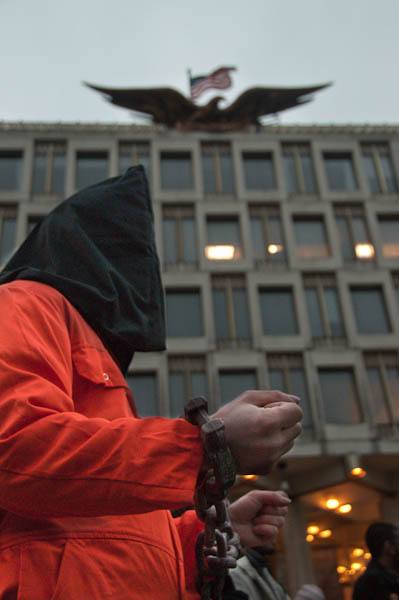
I was outside the US Embassy at dusk on Sunday, photographing a protest on the 7th anniversary of the first prisoners being held at Guantanamo – and remembering those who are still there and still being mistreated, including two Londoners.

To remind us, there were two figures in orange jumpsuits standing manacled while the speeches were being made, so of course I went to photograph them, framing them under the watchful eye of the eagle and the stars and stripes on the embassy roof.

Not of course an original idea, and something I’ve done myself before on numerous occasions, so I was rather suprised when a police officer came up to me and told me not to take pictures that included the US embassy, but to restrict my photographs to point my camera away from the building.

I asked why, and the answer of course was “security“. Which is of course total nonsense, but  rather a common answer these days. Although it is an impressively ugly building, it has been photographed many times and pictures of it are widely available, and it is hard to see how any picture of it could represent a security risk. Rather easier to see why the US government might not wish it to be associated with such.

But I suppose these days I should think myself lucky not to be searched or arrested for taking photographs – like some others. And things could be much worse. While I was being given a polite warning I was listening to a Muslim man from Walthamstow talking about his experience of spending 18 months in prison for having a rather more impressive beard than mine and liking to go paint-balling. The police called it “military training” but fortunately for him the jury were less paranoid.

More pictures

Blessing the Thames

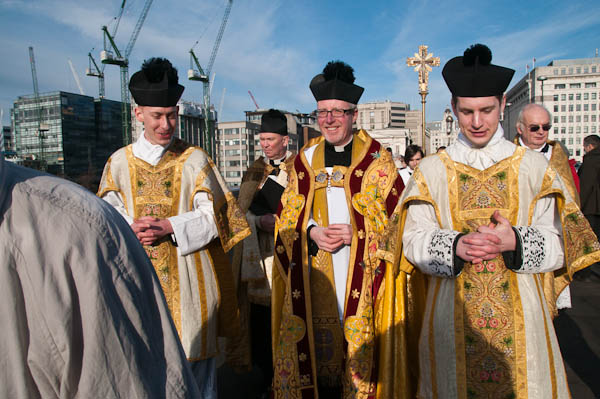
The annual ceremony of blessing the Thames was only started 5 years ago, although it has a very traditional look, thanks to the more ancient forms of dress of those taking part.

I always try to respect religious events when photographing them, trying to interfere as little as possible with the worship of those taking part. But two other photographers from the two churches concerned seemed to have rather less inhibitions than me. I’m not sure if it is simply a matter of insiders having a clearer idea of what is and is not appropriate or just different sensitivities.

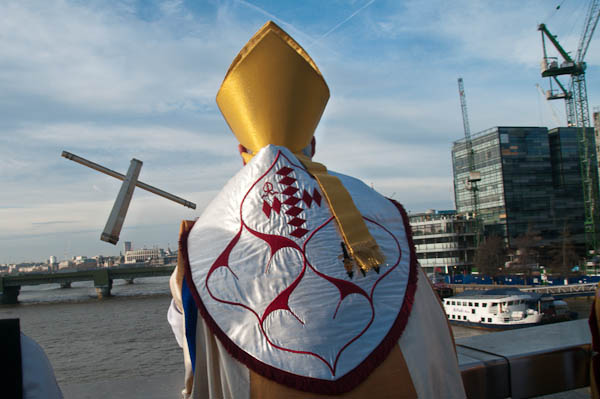
It isn’t easy to work out how to photograph the cross being thrown into the river; perhaps the ideal position for a photographer would be quite impossibly suspended in mid-air over the edge. It was quite a crowded event and it wasn’t possible for me to be exactly the best of possible positions, but I was quite pleased to capture a couple of frames with the cross in mid-air, and, by a happy chance to include a second less obvious cross just to the right of the Bishop’s mitre, made by the con trails in the sky.

More pictures

Hizb ut-Tahrir London March

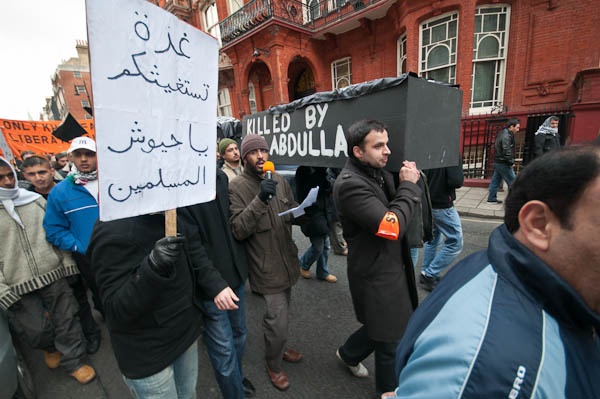
The British branch of the Islamic movement Hizb ut-Tahrir were also demonstrating in London last weekend over Gaza, but their attention was as much on the corrupt Arab regimes as the Israeli aggressors. They call for an end to the various dynasties and dictatorships set up as western puppets in the Middle East and a return to an Islamic caliphate as established in the early years of Islam.

They also call for the Muslim armies to go to the support of the Palestinian people, and visited the embassies of Egypt, Saudi Arabia and Syria to pour shame on them for colluding with the attacks on fellow Muslims.

As expected, this demonstration was highly organised and kept in order by the stewards and there was really very little need for the police other than to direct traffic.

Gaza – National Demo

I’ve had a busy week doing odd jobs and have got a little behind with putting my work on the web and writing blog posts. Last end was a busy one, and I’m only just catching up with things.

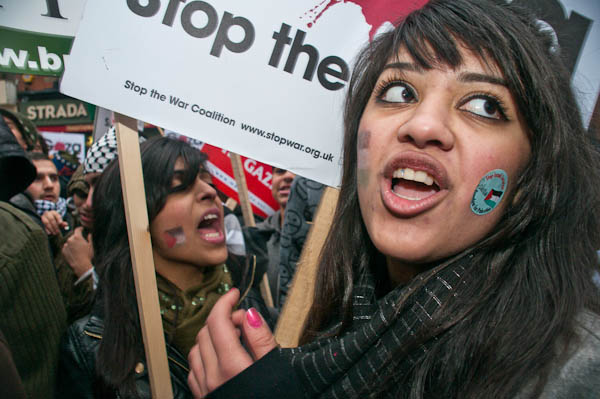
Gaza of course is still very much on all our minds, and on Saturday and Sunday I photographed two very different demonstrations. The first was the huge national demonstration in London on Saturday, when perhaps a hundred thousand marched from Hyde Park to the Israeli Embassy.

Part of the reason why things got rather out of hand around the Israeli embassy has to be the lack of planning by the police for the numbers involved. It’s one thing to issue derisively low estimates of those taking part in marches, but quite another to base the policing on similarly ridiculous figures, and make it physically very difficult for the march to actually get past the likely flashpoint.

When the front of the march reached the southern gates close to the embassy, apparently there were still people leaving the assembly point near Speakers Corner a mile and a half behind, with the mainly wide roads between fairly densely packed with people.

Obviously people would stop – at least for some minutes – close to the embassy, and using barriers to narrow the road there more or less brought the march to a halt. Trouble started both at this point and at the northern entrance to the road containing the embassy, where demonstrators thought the march had been halted by police and started to get angry.

March stewards got angry too, and I was assaulted by several of them while attempting to photograph the front of the march. But I went home early as I had a party to photograph in the evening, and the demonstration continued for several hours after it had been expected to finish. More about the event and of course more pictures on My London Diary.

Tilt-Shift?

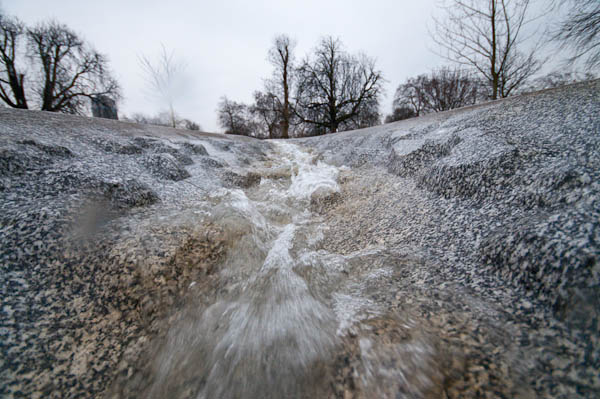
 Princess Diana fountain © 2008 Peter Marshall
Princess Diana Memorial Fountain, Hyde Park, London – more pictures

Tilt-Shift Maker  have got it all wrong. What I never wanted when I used a tilt-shift lens or the movements on a 4×5 was never to reduce the area of sharp focus, but always to get a greater apparent depth of field by tilting the plane of focus to cover the subject.


After extreme processing by Tilt-Shift Maker

So I don’t want this. What I’d like to see is that foreground area made sharp. Software that could do that would really be clever. Almost every time I go out to take pictures in winter or at night when light it low I find pictures where I can’t get the depth of field I want – and often a tilt lens could help. It isn’t often I want less depth of field – and when I do it generally isn’t just in the simple way that this program offers.

But if you are really looking for a new way to really mess up your photos and get some glowing comments on flickr, this is perhaps the way to go.